I was recently reminded of a series of books developed for children which explained various aspects of science. That was a v-e-r-y long time ago, but one in particular stuck with me. It showed the life cycle of the butterfly. The fact that a caterpillar could turn into a beautiful butterfly was utterly fascinating. Still is.
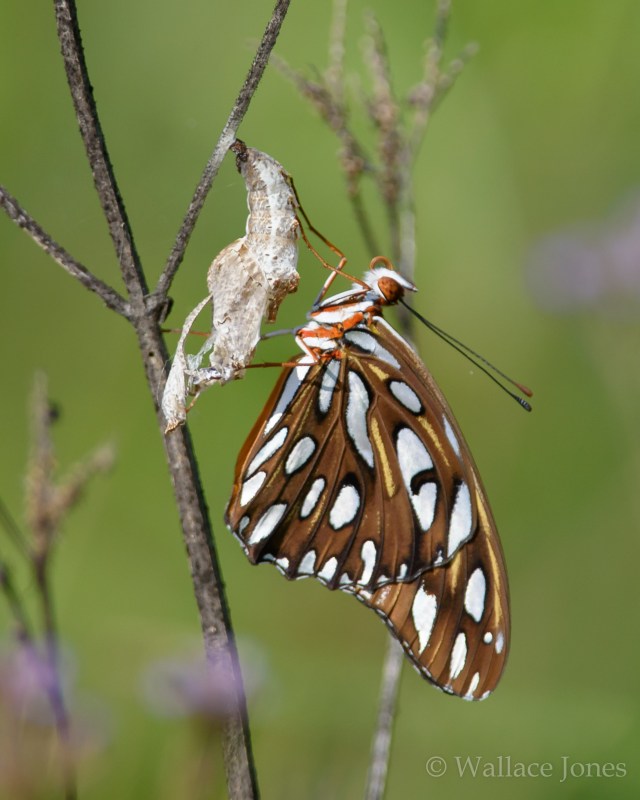
We have been blessed with an abundance of butterflies where we live and a few weeks ago had a chance to observe the life cycle of butterflies up close and in person. Gini spotted a larva of the Gulf Fritillary on its host plant, the Purple Passionflower (Passiflora incarnata). Later that morning, she forced me to photograph a pair of fritillaries mating. Later still, we found a newly emerged butterfly drying its wings beside the chrysalis it had been encased in for the past week.
The miracle of transformation.
Adult Gulf Fritillary (Agraulis vanillae) 2-4 Weeks

Mating

Larval Stage 2-3 Weeks

Chrysalis Stage 5-10 Days
As we all go through changes in our lives, it can be challenging to maintain a positive outlook. Especially these days, negative forces seem almost overwhelming.
Embrace change as an opportunity instead of an obstacle. Live your best life every day!

Enjoy your search for a natural place and come back for a visit!
Once upon a time (stop me if you’ve heard this one), our primary consideration in planning an excursion into the Great Outdoors was limited to researching what birds might be found at a particular location. Was fall or spring migration in progress? Could we hope for wintering birds? Perhaps new bird families would offer an opportunity to observe chicks pestering parents for food or practicing flight lessons.
As time progressed, so did we. It turns out there are more things in nature than just birds! (Do NOT tell birders this. They will not accept your premise.) My Very Best Friend, who is incredibly intelligent, has always been blessed with an open mind and has avoided the curse of tunnel vision with which I am often afflicted. I might be focused on a Scissor-tailed Flycatcher and how best to frame it within the camera’s viewfinder and my VBF will pipe up: “Oooh, what a pretty dragonfly she has caught!”
Evolution. Bird watchers are typically naturalists at heart. Those feathered creations live amongst majestic trees, gorgeous flowers and vast fields all of which also provide homes for hordes of other life forms. It is just not possible to ignore all that nature offers. So, we just try to embrace it.
This poor excuse for a “blog” has been changing somewhat to reflect our interests beyond birds. It is difficult to predict if that trend will continue or if there will be a step back into what has been a “comfort zone”. We’ll see.
Our local state park is 22 minutes from here and provides a pretty good example of how diverse nature can be. Colt Creek State Park contains over 5,000 acres (2,000 Ha) and consists of native long-leaf pine flatwoods, lakes, streams, open vistas, cypress domes and an incredible variety of life which calls it home.
Herewith, a small sampling of what a morning of observation recently produced.
Small clouds of gold hovered above the path along the lake. Wandering Gliders (Pantala flavescens) patrol the area to defend their territory.

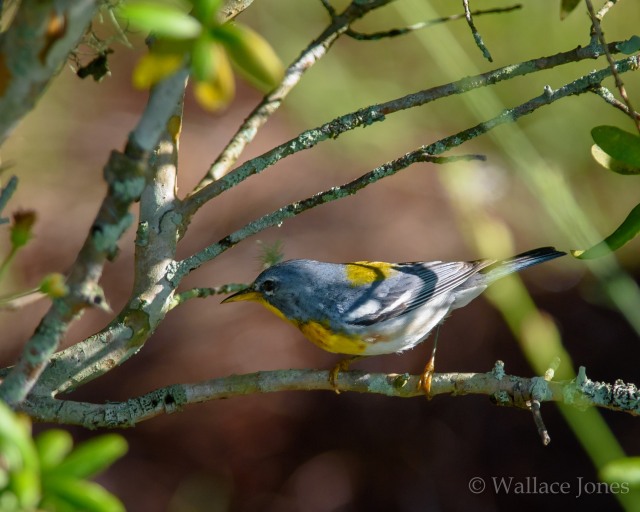
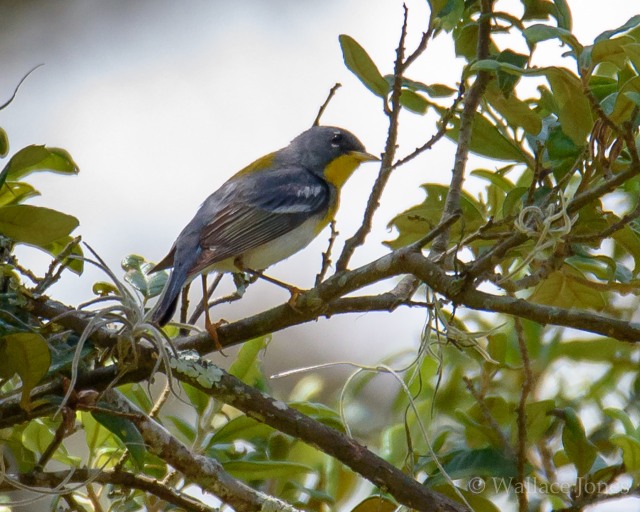
A pair of Northern Parula tirelessly hunted for insects and delivered their bounty to hungry new mouths unseen in the nearby oak trees.
Although their nests are common around human habitation, we don’t often notice the Black and Yellow Mud Dauber (Sceliphron caementarium) in the wild. Capable of delivering a sting, they are seldom aggressive. They pack the cells of their nests with spiders, so that may be a mark in their favor for some.

Guardian of the facilities! This Squirrel Treefrog (Hyla squirella) was perched on a door hinge to the restroom. Small but colorful.

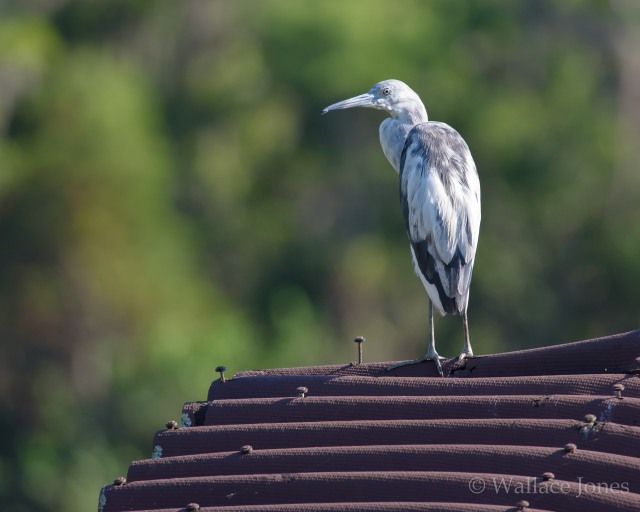
The “calico” plumage of a Little Blue Heron lets us know she’s likely less than two years old. I interrupted her preening and you can see a feather remnant in her beak.
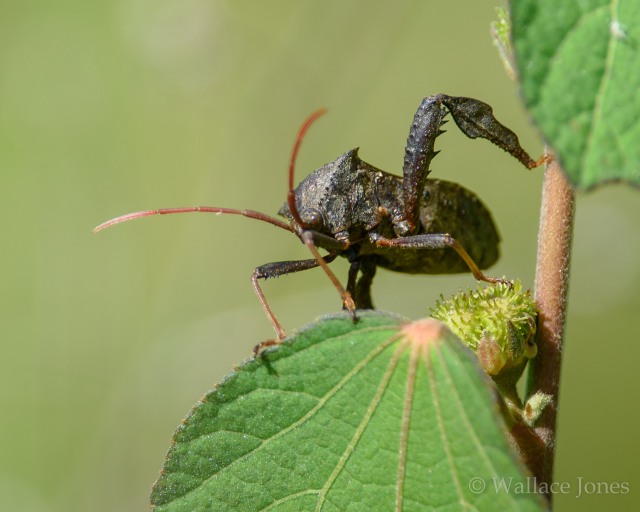
I sometimes think film-makers use nature to inspire their on-screen alien creations. A Leaf-footed Bug (Acanthocephala femorata) would make a good movie star!
A New Species! It’s always exciting to come across something new. Gini saw a large butterfly that turned out to be just that. At first, we thought it was one of our dark-colored swallowtail varieties. But wait – no “tails”! Turns out it is a Red-spotted Purple (Limenitis arthemis astyanax) and this area is probably pretty much the southern limit of its range.


One of the few flycatcher species to breed within Florida, the Great Crested Flycatcher, has beautiful lemon-yellow, rich brown and gray plumage. Their loud, clear whistling call rings out through the forest at this time of year.

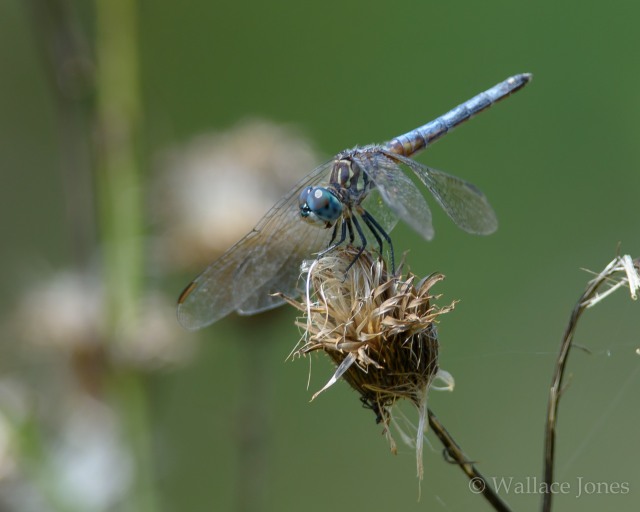
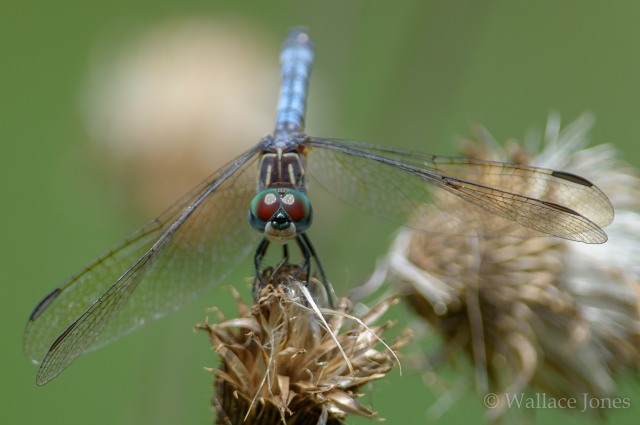
Sports model. The Blue Dasher (Pachydiplax longipennis) with his racing stripe thorax and dusty blue abdomen looks ready to dash off on a moment’s notice.
Blackberries are ripening and Wild Turkeys are quick to take advantage of the harvest!

Here are a few examples of the parks floral selection, which explains why so many pollinators love it here. Us, too!
Common Buttonbush (Cephalanthus occidentalis).

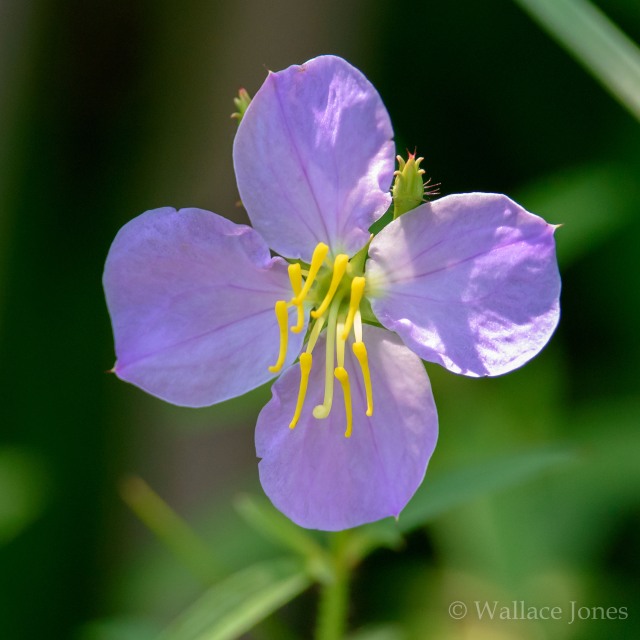
Pale Meadowbeauty (Rhexia mariana).
Leavenworth’s Tickseed (Coreopsis leavenworthii). (Don’t know the insect.)

Spurred Butterfly Pea (Centrosema virginianum).

Purple Passionflower (Passiflora incarnata).

We love birds and birding. We love the fact that birding opened our eyes to so much more to discover. Hopefully, you, too, have a love for Nature’s diversity and places to go to see it all.
Enjoy your search for a natural place and come back for a visit!
Summer is enveloping us. Walking out the front door is like entering a huge sauna. The humidity turns clothing into a heap of sopping wet rags. Camera and binocular lenses fog over and wiping incessantly doesn’t help. Five steps from the car and perspiration runs down your face and stings your eyes.
I. Love. It.
Tenoroc Fish Management Area has become our favorite local patch. With over 7,000 acres of land and diverse habitat consisting of 23 lakes, pine flatwoods, wetlands, hardwood forest and open grassland, the area is extremely attractive to a myriad of flora and fauna species. The number of sportsmen is managed closely in order to prevent over fishing, so it never seems crowded. Opening only Friday through Monday also gives the area a chance to recover from human visitors. Did I mention it takes ten minutes for us to get there?
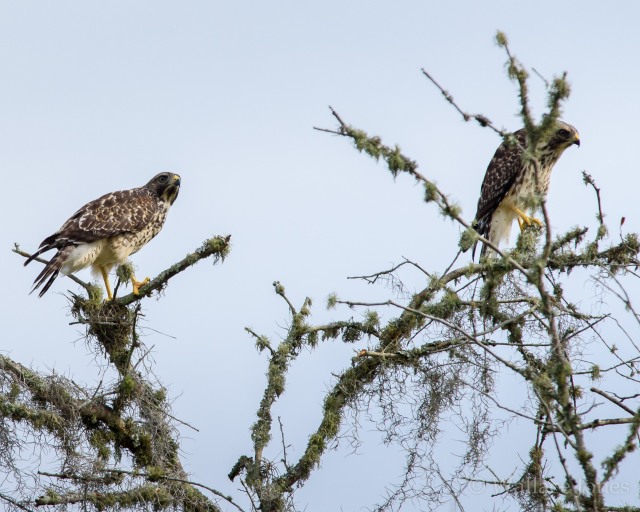
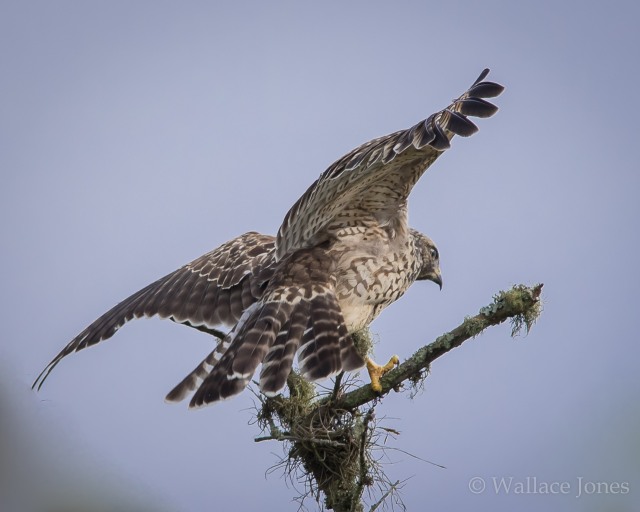
The moisture has been wiped from our lenses for the umpteenth time and it seems that may have done the trick. Just in time. A pair of noisy Red-shouldered Hawks are yelling at us from atop an oak tree. We normally see an adult hawk at this location and these two youngsters may be from breeding earlier this year. Most of our local raptors and many wading birds nest during the winter months. A new dragon! The Little Blue Dragonlet is tiny and it’s hard to believe we’ve never encountered one before.
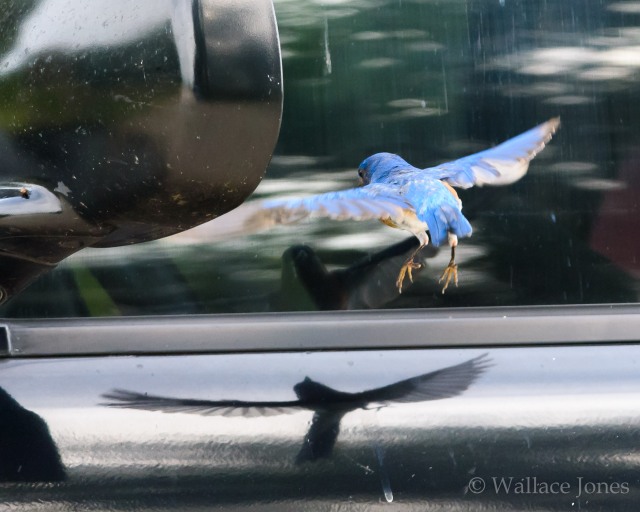
Breakfast AND a show! While we munched a granola bar and a Florida tangerine, a young male Eastern Bluebird spent the entire time entertaining us by trying to figure out where all those bluebirds came from on a truck parked at the boat ramp. There was one in the side-view mirror, one in the window, one on the door, one on the windshield, one on the other side-view mirror – whew! Watching the poor thing flutter at all of the reflections made us tired. He must be exhausted!
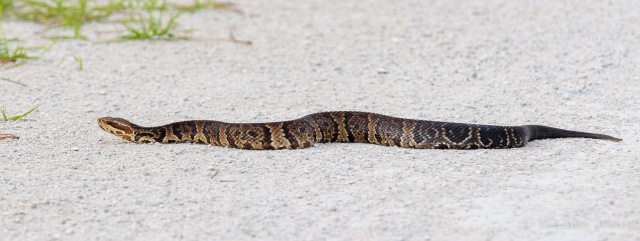
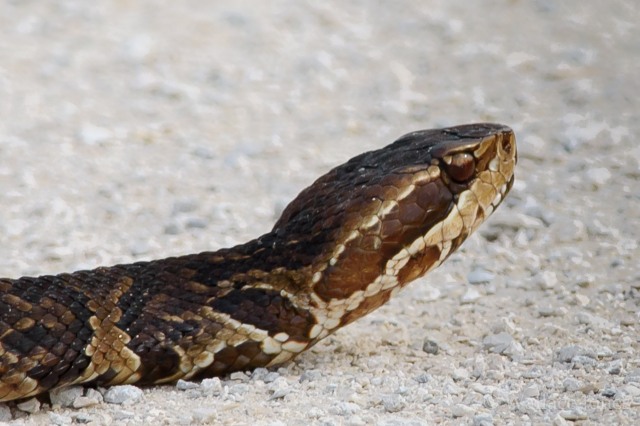
Osprey nests with chicks were everywhere. The strange calls of Limpkins rang out across the wetlands. Dragonflies flew patrols along lake shorelines. Turtles and alligators stared from their watery comfort zones. Snake! Several species of snake call this area home. Spotting one of them usually causes me to jump from the car, lie flat in the road and snap a few quick images before following the critter into the grass in the hope of a closer image. Not this one. The unique design of a wedge-shaped head with eyes on the side, thick body and skinny tail identify a Water Moccasin. Venomous. Can be unpredictable. I am not afraid of snakes, but I do have a healthy respect for them. Despite Gini urging me to get out for a better photo, I was thankful for a l-a-r-g-e lens. She loves me so much.
As is usual, time flew by and it was almost lunch time. We had seen so many very special sights this morning!
Siblings? A pair of Red-shouldered Hawks kept screeching at us until we were well out of sight.

A new dragonfly species for us, the Little Blue Dragonlet (Erythrodiplax minuscula) is really small with a total length of about an inch (25-27 mm). We were extra lucky and found female and male at the same spot.
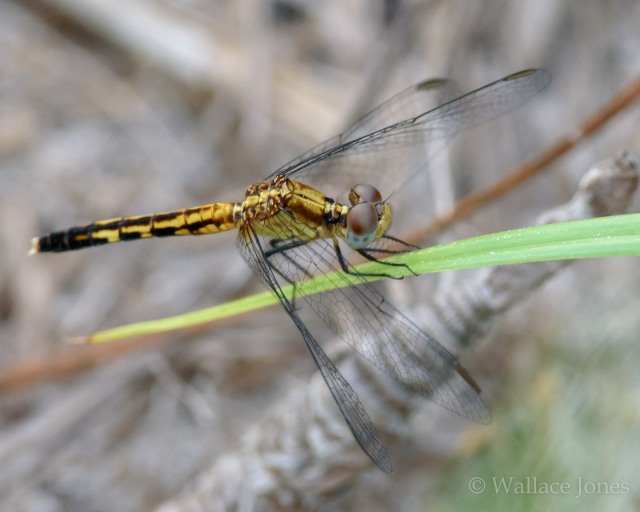
Female

Male
Our breakfast friend, an immature male Eastern Bluebird. He tried his best to make some new friends but, alas, it was not to be.


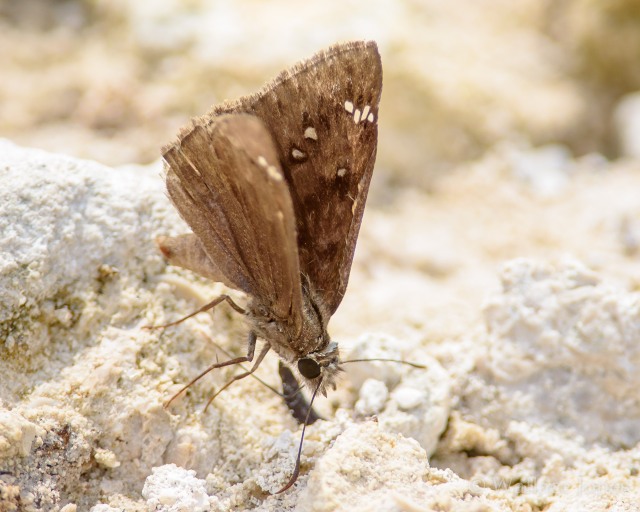
Butterflies obtain needed minerals from mud as well as other materials which they can’t get from plant nectar. That’s why it’s common to see a multitude of them gathering around a mud puddle. Here, a Horace’s Duskywing (Erynnis horatius) tries to extract a bit of salt from the sand at a lake shore.
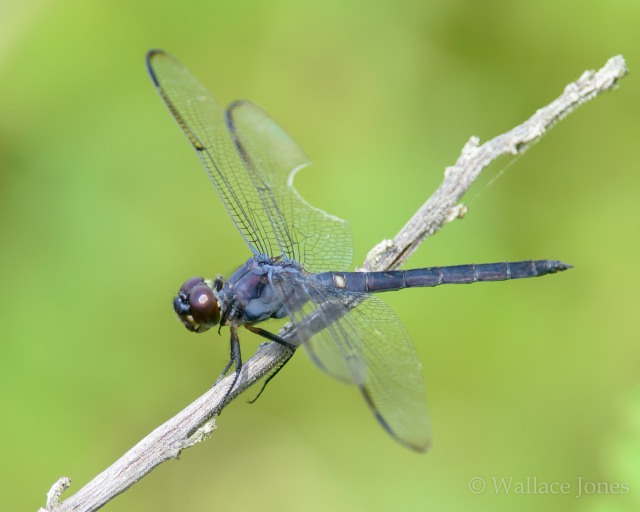
Dressed all in black with a dark face, the Slaty Skimmer (Libellula incesta) is the only large all black skimmer in our area.
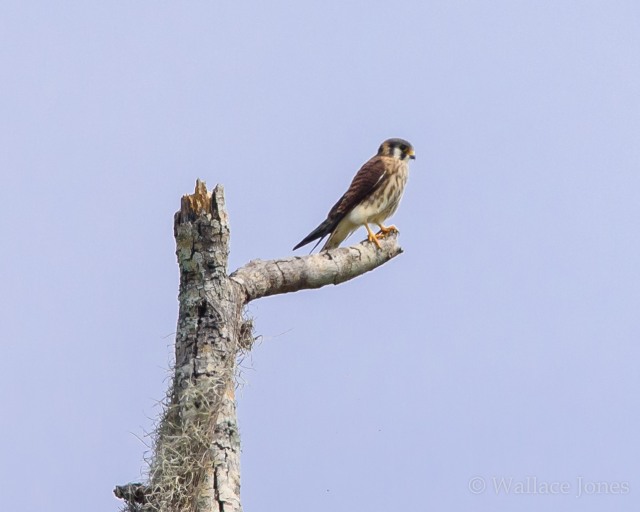
During the months of migration, American Kestrels (Falco sparverius) fly through Florida headed for South America. A few remain all winter. Florida also has a resident population listed as the Southeastern American Kestrel (Falco sparverius paulus) which breeds from mid-March through June. These non-migratory falcons are currently listed as a threatened species due primarily to loss of habitat. It was very encouraging to see this female in summer!
Water Moccasins (Agkistrodon piscivorus) average 2-4 feet (61 to 122 cm) long when mature, have “cat-eye” pupils and a wedge-shaped head with a somewhat thinner neck. Their overall appearance is “blocky” or “thick”, with head and extreme tail appearing small in proportion to the rest of the body. Their nickname is “Cottonmouth” due to the inside of their mouth being bright white. They open their mouths wide when in a defensive posture. Their venom is quite potent and consists of hemotoxins which prevent blood from clotting. FATALITIES ARE EXTREMELY RARE. If you think you’ve been bitten by any poisonous creature, seek medical help immediately. Unfortunately, each year many harmless snakes are killed needlessly because someone didn’t take the time to learn how to identify them. If you’re going outdoors where dangerous creatures live, learn what they look like! Killing a snake (or any other animal) is seldom necessary.
Our morning ended on a very bright note. A Scarlet Skimmer (Crocothemis servilia) put in a brief appearance. We don’t care that he is not a native Floridian, having been introduced from the Caribbean several decades ago, probably through landscape plants. He’s simply beautiful!

It seems no matter where we explore nature, we always find something at which to marvel. From a small dragonfly to a magnificent hawk to – yes – even a poisonous reptile. A day spent in nature’s realm is never ordinary! You should go. Soon.
Enjoy your search for a natural place and come back for a visit!
Additional Information
Anticipation. One dictionary definition describes it as “pleasurable expectation”.
As my memory cells fade into unreliability, a few still meld and conjure up examples of “pleasurable expectation”. Fishing trips. When I was very young, Dad would come home on a Friday afternoon and walk around the boat, check the level in the gas tank, put the tackle in the truck – “Want to go to Panasoffkee in the morning?”
Anticipation. Now I couldn’t sleep. Vivid thoughts of the boat sliding into the cypress tree tea-stained water, fog hugging the lake’s surface, dipping minnows from the bait bucket, the tug-tug-tug on the line, sandwiches up the creek by the spring. No sleep. Let’s go!
One would think now that I am an old man, such childish dreams of upcoming trips would fade. One would be mistaken.
An otherwise ordinary plan to visit a local fish management area to search for young birds, insects, flowers and to just enjoy a day in nature results in tossing and turning during the night. Visions of the island rookery with alligators cruising all around it, new dragonflies to discover, the aroma of pine trees in the air, purple passionflower in bloom. Let’s go!
The rising sun illuminated the small guard building where we would check in and get our permit to visit the lakes of the Mosaic Fish Management Area in south Polk County, Florida, just northeast of the community of Bowling Green. We’ve been here many times and always discover something unique.
Wait. The door is locked and no one around. A notice says “This office will be open Friday through Monday, 6:00 a.m. until Noon.” It was Friday. It was 6:20 a.m. A drive by the access roads to the lakes confirmed all the gates were locked.
So much for anticipation.
Time for: PLAN B.
Without hesitation, Gini The One With Common Sense says: “Hardee Lakes Park is not far from here.” Let’s go!
This is our first visit to the county park this year. It’s one of our favorite spots to spend the day due to the diverse habitat surrounding four lakes. We pull past the entrance and immediately hear Sandhill Cranes trumpeting and the clear songs of Eastern Meadowlarks. Parking under tall pine trees near the shore of the lake, Gini spots a large bird flying low and landing near the lake. As I begin to wander in that direction, “It’s an owl!”. She got a terrific look at the Great Horned Owl perched in a pine tree as it was mobbed by Boat-tailed Grackles and Red-winged Blackbirds. As I maneuvered to get a photograph, the big raptor took off. I managed to get the tip of her tail in focus.
It was an exciting beginning to what would be a glorious day of discovery! And I didn’t even lose any sleep thinking about it the night before.
One of our smallest dragonflies, the Eastern Amberwing (Perithemis tenera) takes on a golden glow in the early morning sunlight. Females usually have dark wing markings while the males are more clear-winged.

Eastern Amberwing (Perithemis tenera) – Male
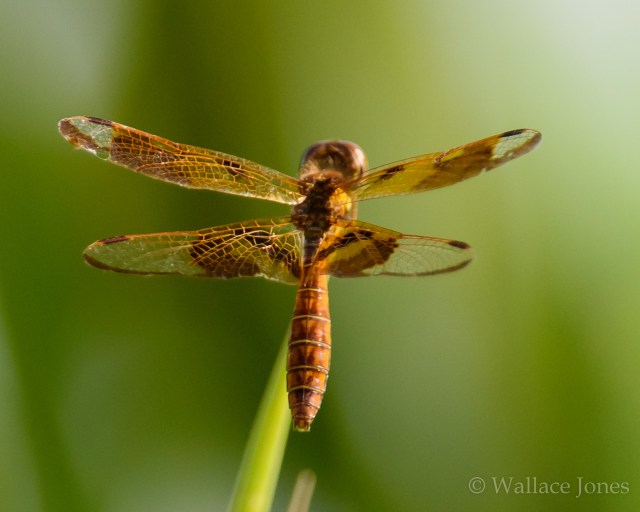
Eastern Amberwing (Perithemis tenera) – Female
With a wingspan of nearly 30 inches (76 cm), the Pileated Woodpecker is an impressive sight. The flash of black and white wings and flame red crest can be quite attention-grabbing!

We probably saw over a hundred Four-spotted Pennants (Brachymesia gravida), one of the area’s most common dragonflies. As with many Odonata species, young males resemble females until they mature.

Four-spotted Pennant (Brachymesia gravida) – Male
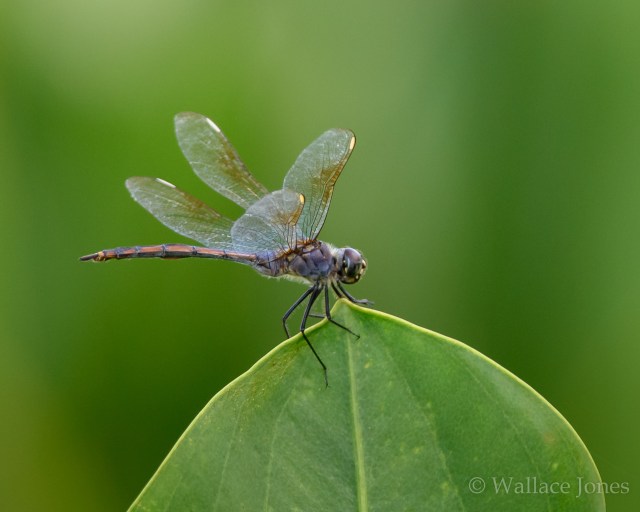
Four-spotted Pennant (Brachymesia gravida) – Female

Four-spotted Pennant (Brachymesia gravida) – Immature Male
Complete with sporty racing stripes and cool blue abdomen, the male Blue Dasher (Pachydiplax longipennis) is ready to “dash” after any likely-looking prey at a moment’s notice.

A fairly large dragonfly, the immature male Roseate Skimmer (Orthemis ferruginea) resembles the female but is beginning to show a slight purple tint to its abdomen which will eventually turn almost neon in the near future.

Roseate Skimmer (Orthemis ferruginea) – Immature Male

Roseate Skimmer (Orthemis ferruginea) – Female
Probing the bark of a pine tree for breakfast, this young male Red-bellied Woodpecker will soon display the brighter reddish-orange cap and nape of a fully mature adult.

We will pretend to be scientific when we refer to this shiny green insect as a Halictid Bee. It just sounds so much better than Sweat Bee. (Halictidae spp.)

A Cuban Brown Anole (Norops sagrei) surveys its kingdom.

I stood in one spot for about 20 minutes observing and photographing near a lake shore. Turning to leave, I discovered a Purple Gallinule about 20 feet away had been observing ME!

Orange body with golden-edged wings describe the male Needham’s Skimmer (Libellula needhami).

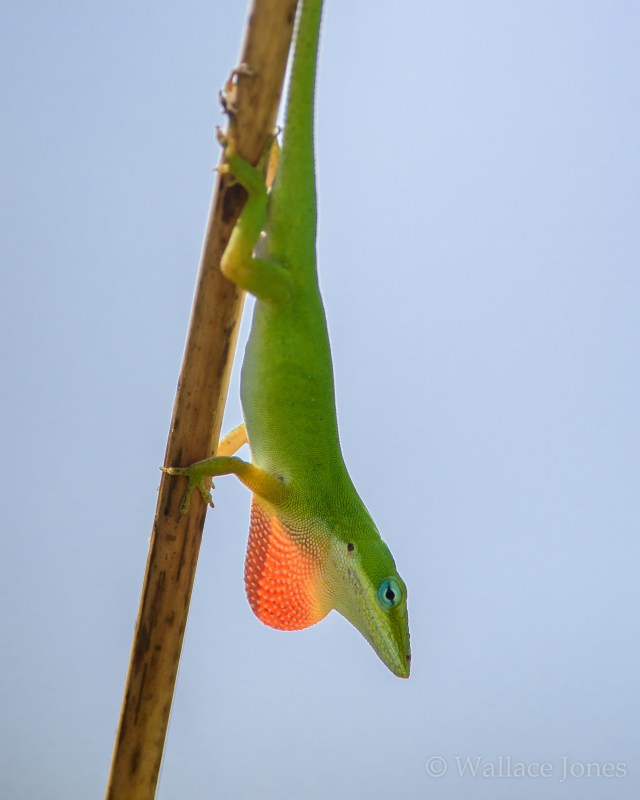
Unlike the invasive Cuban Brown Anole above, the Green Anole (Anolis carolinensis) is a native resident. There was concern the invader would negatively impact the native population but recent studies suggest our Green Anole is doing okay.
Male and female very often look nothing alike in some species and dragonflies are no exception. The male Slaty Skimmer (Libellula incesta) is dark overall while the female is lighter and displays a sporty wing pattern.

Slaty Skimmer (Libellula incesta) – Male
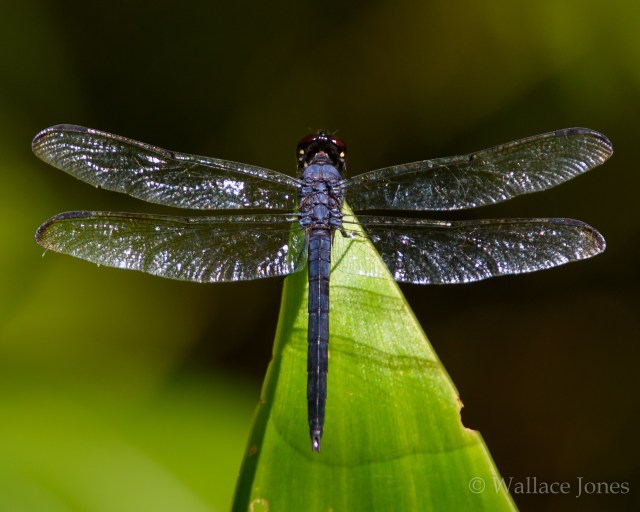
Slaty Skimmer (Libellula incesta) – Male

Slaty Skimmer (Libellula incesta) – Female
A female Eastern Pondhawk (Erythemis simplicicollis) looks like a beautiful green jewel shimmering along the edge of the marsh.

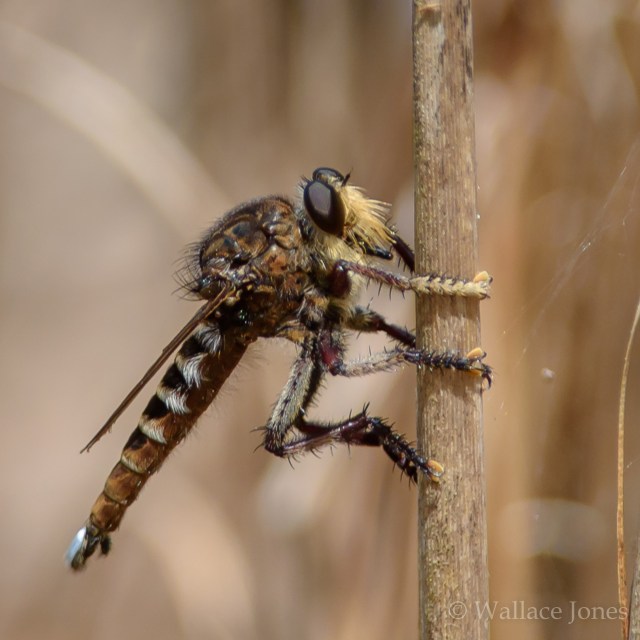
Our day wouldn’t be complete, it seems lately, without finding one of our more efficient predators, a Robber Fly (Asilidae spp.). For those familiar with rock bands, you may recognize a member of “ZZ Top”.

Anticipation of a specific event need not turn to disappointment when that event cannot occur. Our “pleasurable expectation” was fully satisfied. “Plan B” was executed flawlessly, whether by intention or happy accident. We hope your plans, no matter what letter they may involve, include a heavy dose of anticipation and satisfaction.
Enjoy your search for a natural place and come back for a visit!
Additional Information
June in Florida. Very early in the morning, one can imagine the air still has the lingering coolness most people associate with spring. It’s a hallucination. If you take more than two steps through the greenery, your feet and calves are immediately soaked in dew. Humidity manifests itself by making you feel as though you have stepped into a sauna. As there is no breeze, walking briskly helps evaporate the drops forming on your face providing momentary relief from the oppressive warm wet atmosphere closing in around you.
And then, right in front of you, an apparition materializes. A Florida Scrub Jay! The rising sun highlights the bird’s spectacular blue plumage. It has acorns in its beak, glances briefly in your direction and in a moment, it’s gone. Endemic to our state, these large jays inhabit a few areas of scrub oak habitat and remain in loose family groups throughout the year, with young birds from last year’s brood helping to raise new birds.
The temperature and humidity are forgotten. The day has begun for Gini and I as we approach the entrance to the Arbuckle Tract of the Lake Wales Ridge State Forest. A few million years ago, ocean levels rose to cover most of what is now the peninsula of Florida. A ridge running north and south was all that remained. Flora and fauna evolved which was biologically unique. As ancient sea levels receded and tourists discovered white-sand beaches, the Lake Wales Ridge retained some of its special characteristics and today lists 33 plants and 36 animals currently having federal or state status as threatened or endangered.
Eastern Towhees sounded off on all sides: “drink-your-teeeeea“. Gini’s sharp eyes spotted a gorgeous Red Saddlebags dragonfly. A Wild Turkey wandered along a forest path in front of us, seemingly unconcerned by our presence. Diminutive Brown Nuthatches high in the surrounding pine trees sounded like so many rubber duckies being squeezed.
Breakfast by a pond. Red-headed Woodpeckers taking insects to their nearby nest cavity. The brilliant blue flash of Eastern Bluebirds. New Tufted Titmice trying out alarm calls at strangers under their branches. A bright red Summer Tanager singing to his mate, forest flowers, a multitude of dragonflies, more birds and, suddenly, it was after noon.
The heat and humidity had been ignored all morning as we marveled at what diversity Nature presented us. Just us. We encountered no other humans during our morning of exploration. There was no urgency to list a rare bird. No schedule. Glorious!
Florida’s very own Scrub Jay.

Tracks in the road let us know about unseen forest dwellers. Here, a White-tailed Deer and a Coyote passed this way during the night. One following the other, perhaps?

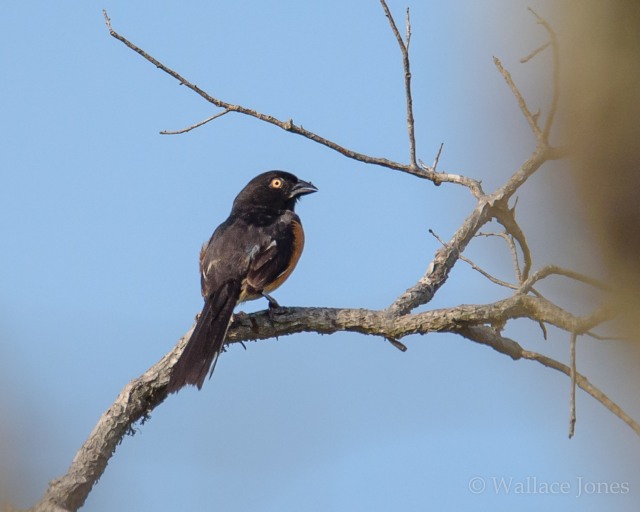
Throughout most of its eastern U.S. range, the Eastern Towhee has reddish eyes. In Florida and parts of Georgia, resident birds have light eyes which field guides describe as “straw colored”.
Gini frequently says: “Why won’t that turkey pull over and let us pass?”. Normally, she is not referring to a bird, such as this Wild Turkey out for a leisurely stroll.

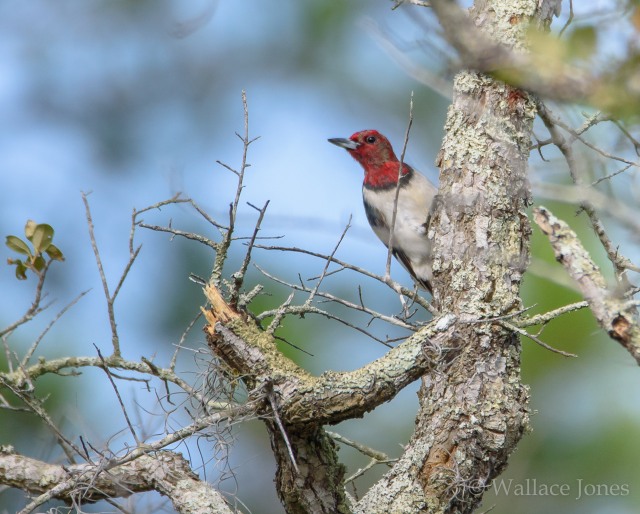
This Red-headed Woodpecker is an immature bird, since his head shows a mix of red and brown.
The Carolina Satyr (Hermeuptychia sosybius) is a fairly common sight along woodland trails.

A medium-sized lizard, the Southeastern Five-lined Skink (Eumeces inexpectatus) is somewhat common in our area. Young males have a striking bright blue tail which fades with maturity.


It’s all about the birds and the bees. Well, in this case, the bee. A Bumble Bee loaded with pollen prepares to visit an American White Waterlily (Nymphaea odorata) to unload her cargo. The lily will repay her with sweet nectar.

Another Florida endemic species, the Yellow Milkwort (Polygala rugelii) is quite showy within the green of the pine forest. The header image gives you an idea of a typical pine flatwoods scene. We felt quite special knowing we were observing a flower that does not grow in any other state.

Once again, the keen brown eyes of my beloved were on the job! Gini spotted a pair of Great Crested Flycatchers, most likely mates. The raised crest and lemon-yellow belly is hard to miss.

Not content with just locating birds and bugs, Gini finds blooms, too. In this instance, a bright orange Butterfly Milkweed (Asclepias tuberosa).

A family of Tufted Titmice (two adults, two young) immediately showed up and raised alarm calls incessantly along a section of path. This one was particularly brave, flying out for a look and returning to his branch to keep up his calling.

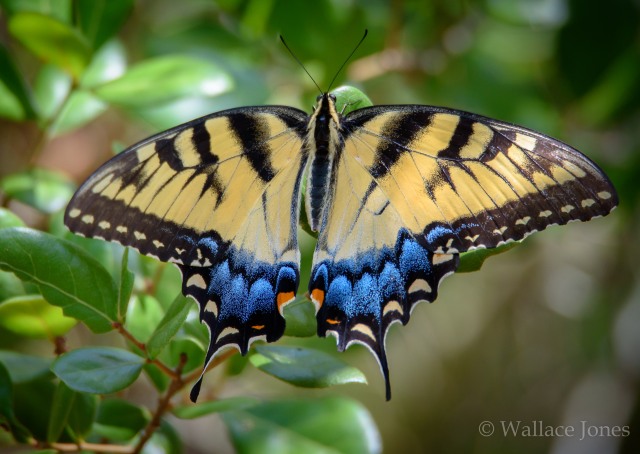
This one took our breath away with her beauty. An Eastern Tiger Swallowtail (Papilio glaucus) posed nicely and we appreciated it!
A few steps from the above butterfly, a male Summer Tanager was singing from the very top of a tall tree. He eventually flew down to confirm we were no threat, returned to his perch and resumed singing.

All through the morning we heard the ascending notes of singing Northern Parulas. This is one of only a few woodland warblers which breed in our area of Florida.
The Green Anole (Anolis carolinensis) continues to face a challenge from the Cuban Brown Anole (Norops sagrei) which was introduced in Florida over 50 years ago. They prefer the same habitat and prey and the brown anole was considered a real threat. Recently, however, it seems the native green anole is holding its own. Fingers crossed.

One of three medium-sized all dark dragonflies in this region, the Bar-winged Skimmer (Libellula axilena) has a distinct face and wing pattern as well as a pale wash at the base of its hindwings.


In our area, we have three species of “broad-saddled” dragonflies (Black, Carolina and Red Saddlebags). This Red Saddlebags (Tramea onusta) displayed its namesake wing feature for us.


Florida in June means heat and humidity. For those of us who love nature, it means new bird babies, a bonanza of buzzing bugs and beautiful blooms in the forest. No matter what your June weather brings, find a place to explore and relax.
Enjoy your search for a natural place and come back for a visit!
Additional Information
 Our Natural Places