Header Image: Clouds In The Marsh
“Should I wear my sweatshirt?”
It’s that time of year here in sub-tropical central Florida. Important fashion decisions are made difficult by seasonal ambiguities. Yesterday, it was humid and at sunrise it was a pleasant 70 F/21 C. Today, it is somewhat chilly at 50 F/10 C. Will it warm up quickly? What will the wind be like? Wear the sweatshirt or just throw it in the car in case it’s needed?
See what I mean? How are we supposed to cope with these incredibly harsh conditions? Sigh. The life of nature explorers is one challenge after another.
The winter doldrums are rapidly yielding to Nature’s annual renewal. Bright green leaves are clothing the bare limbs of hardwood trees, new growth is forming “candles” at the ends of pine tree branches, wildflowers are peeking above the brown detritus under foot, bird migration is in full swing, resident birds are selecting mates, insects are beginning to fill the air – what a wonderful time to be outdoors!
Our morning was filled with discovery! This might be the last views we have of some of our migrants until next fall. The year’s first wildflower blooms are like opening a present each year. A butterfly which will be commonplace in a few weeks, today causes us to chase it through brambles and mud hoping for a photograph. The sky is too blue. It will cause me to “desaturate” it during processing the images else face accusations of “photoshop”!
Wish you had been with us to share the experience.
Here, take a look.
Soon now, this Yellow-bellied Sapsucker will wing its way northward. They breed in the northernmost part of the U.S. and in Canada.

A few weeks prior to hitting the air corridors, Gray Catbirds form groups of up to a couple dozen birds. Safety in numbers, perhaps? This one was with six birds feeding on the fruit of Brazilian Pepper (Schinus terebinthifolia).

Only three sparrow species (four if you count the old world House Sparrow) breed in Florida so this Swamp Sparrow is another visitor we’ll soon be bidding farewell.

American White Pelicans can be found in our area in small numbers year around. During the winter, large groups (over a thousand in some years) will settle in to roost around some of our many lakes.

A couple of years ago, this oak tree was felled by a wind storm. I like the appearance of the branches reaching outward as one approaches.

Rosary Pea (Abrus precatorius) is a vine which has an attractive green fern-like foliage and bright red and black seeds within a brown pod. It’s an invasive plant introduced from Asia. Be careful around this one as it produces a toxin called Abrin. Studies have shown that as little as 0.00015% of toxin per body weight will cause fatality in humans (a single seed). Birds and other wildlife are not affected by the toxin, so they happily disperse the plant wherever they go. (Oh, and fire helps spread the plant, too.)

As the first rains of the year begin to rake across the state, one of the first blooms we encounter is the attractive Rain Lily. In central Florida, the most common species is the Atamasco Lily (Zephyranthes atamasca). There is a lot of discussion about various species, scientific names, common names, etc. but I just like the beauty of the plant! (So, three taxonomists discussed going to a bar/pub/ale house/saloon/taproom – but just went home instead.)


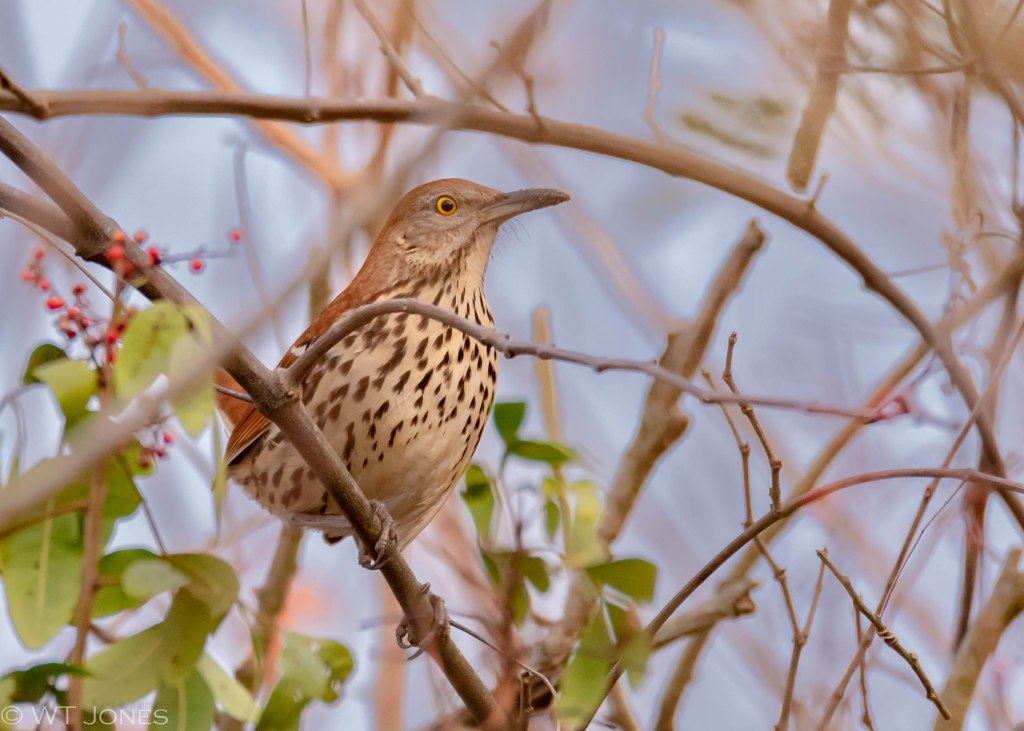
With singing skills which rival any Mockingbird, a Brown Thrasher will soon be building a nest. They are very aggressive in the Spring and that large curved beak can be quite a weapon.
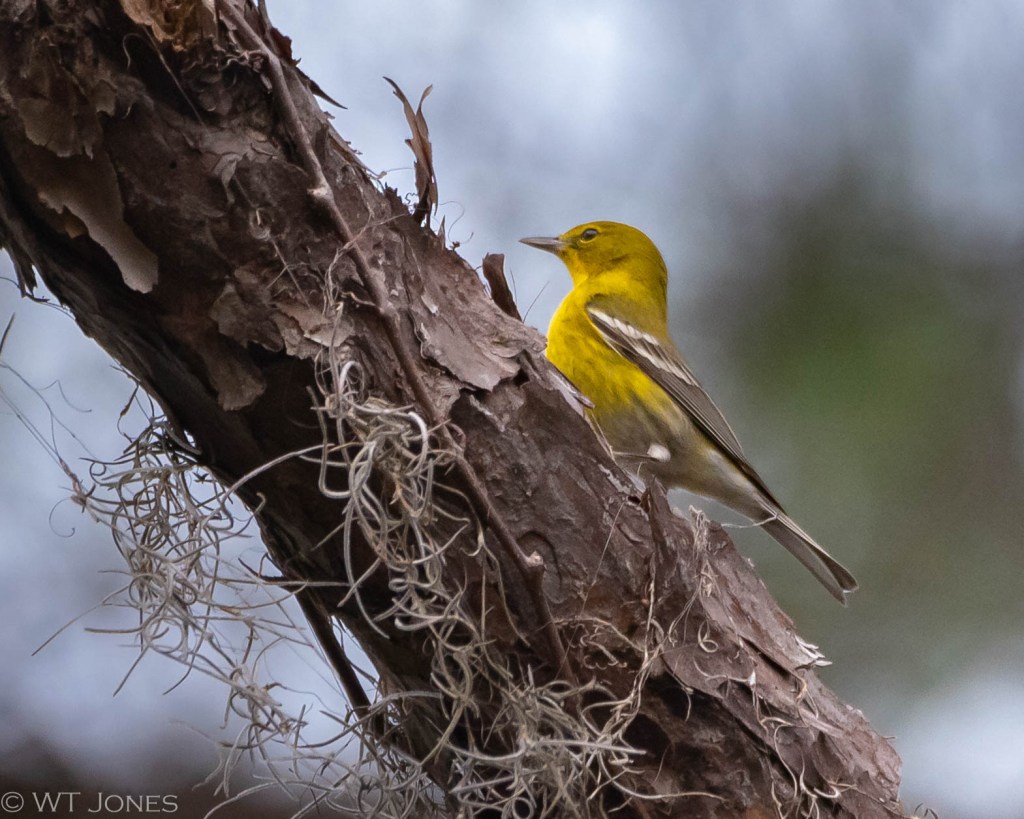
Pine Warblers breed in our area but during the winter we see hundreds of these colorful birds throughout the forests. In a few weeks, only resident birds will remain and they will be scurrying to complete nest building and begin producing more beautiful warblers.
Singing incessantly from low in the bushes, White-eyed Vireos are quick to hop out when we approach. They try to figure out if we’re a threat and then they disappear. They don’t go far, though, as they immediately start their singing again.

Small, sleek Blue-gray Gnatcatchers seem to never stop in their quest for one more bug. Their large eyes scan every millimeter of branches and leaves. These nervous hunters are also residents in this area.

Where there is water and reeds there are Common Yellowthroats. The masked males will soon begin singing “witchety-witchety-witchety” non-stop until a female decides he’s the one.

Bugs! In addition to slapping the first mosquitoes of the year, we are seeing early dragonflies, damselflies and butterflies. This Dorantes Longtail (Urbanus dorantes) posed in the sunshine briefly and we look forward to more insect investigation in the coming weeks.

The Cypress Trees in this bog have yet to begin sprouting new foliage and this scene looks wintry, despite a bright sun breaking through the dimness.

We crossed the edge of Winter into the bright light of a new Spring. Each day is a glorious gift which we hope to use to live our best life. Our hope is for each of you to do the same.
Enjoy your search for a natural place and come back for a visit!
Header Image: Picnic Lake At Sunrise
A liter of water and about 60 grams of coffee beans, for me, is a pleasant way to begin a morning. One of my favorite Central American coffees is lightly roasted at a small local roastery. The flavor is wonderful, but I wished it could be “more“. I tried increasing the amount of beans to the grind but, although stronger, it didn’t increase the flavor. When asked about a longer roasting time, the kind artisans said they tried it at various levels but any darker brought out a bitterness which was unpleasant. Experimentation over several months has produced something I really like. Just 15 grams of a very dark roasted variety from Peru added to 45 grams of the Guatemalan has been extremely satisfying to sip.
That perfect blend.
I know you’re tired of hearing about my genius in selecting the perfect life partner, but Gini taught me early in our marriage the importance of what she considers the most vital ingredient of any relationship, other than unconditional love. Communication. If we can’t talk to each other about everything, issues will sneak in and work to destroy what has been built. Thankfully, she worked tirelessly to instill that trait in our two children. Our adult children today define “proud parents”. We discovered each of us had a unique skill set to offer but only by combining our efforts could we be ultimately successful.
That perfect blend.
Spring is upon us! New green leaves are brightening the landscape. Small colorful flowers are beginning to appear along roadsides and under foot in the pathways. Blooming flowers awaken pollinating insects. Early mornings are just cool enough to make a hike in the forest or around the marsh comfortable.
We are at that special time of year when we marvel at Nature’s renewal. Resident birds are busy with the annual rituals of courtship, mating and nest building. Early birds, such as the Bald Eagle, already have young ones teetering out on a limb flapping their new, large wings. Osprey around our many lakes are putting the finishing touches on large nests and many are already brooding eggs. Songbirds are singing love songs seeking the attention of that someone special.
Meanwhile, flocks of birds are passing through the area returning to northern breeding grounds. Along the coast, groups of ducks and geese gather in the marshes to rest and feed and V-shaped formations are seen in the morning skies. In our inland area, small birds are grouping up as they feed constantly to provide the fuel needed for their long journey.
Resident birds courting and nesting. Migratory birds flocking and feeding.
That perfect blend.
Long post. More images than usual. No apologies.
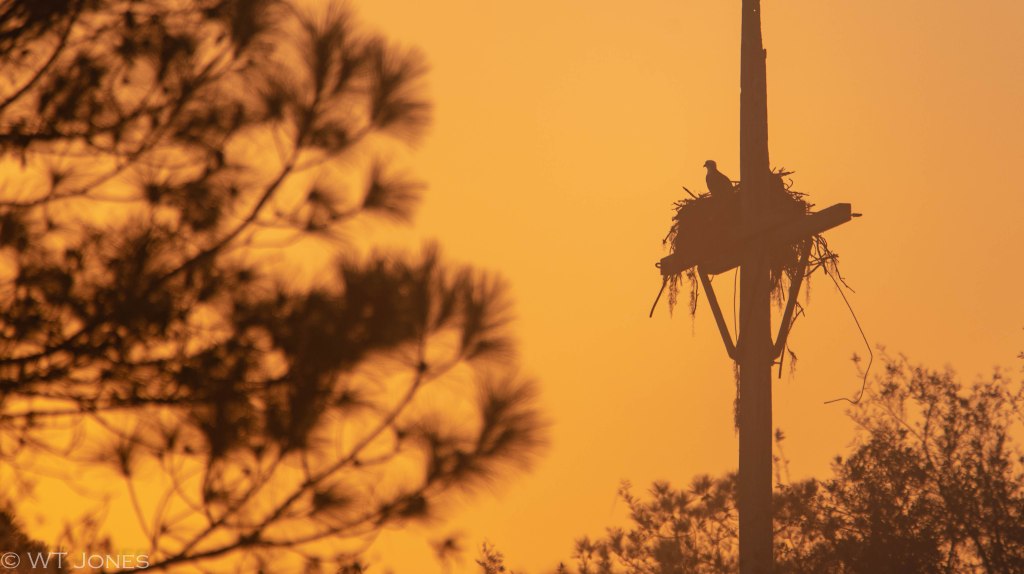
An Osprey greets the dawn. This nesting platform has been used for at least five years by (the same?) Ospreys, except for three years ago when it was appropriated by a pair of Great Horned Owls.
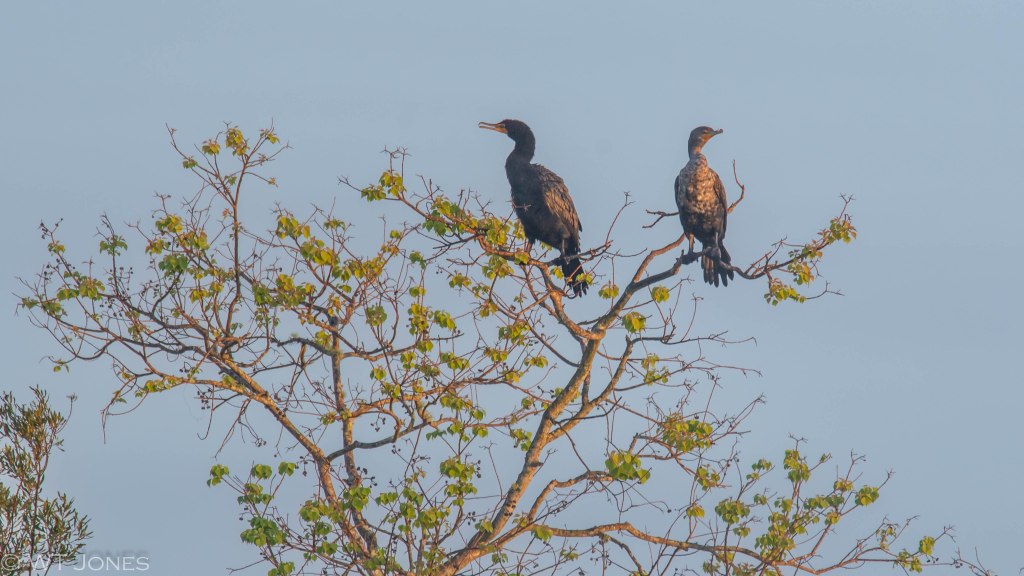
A pair of Double-crested Cormorants warm up as the sun rises on a new day.
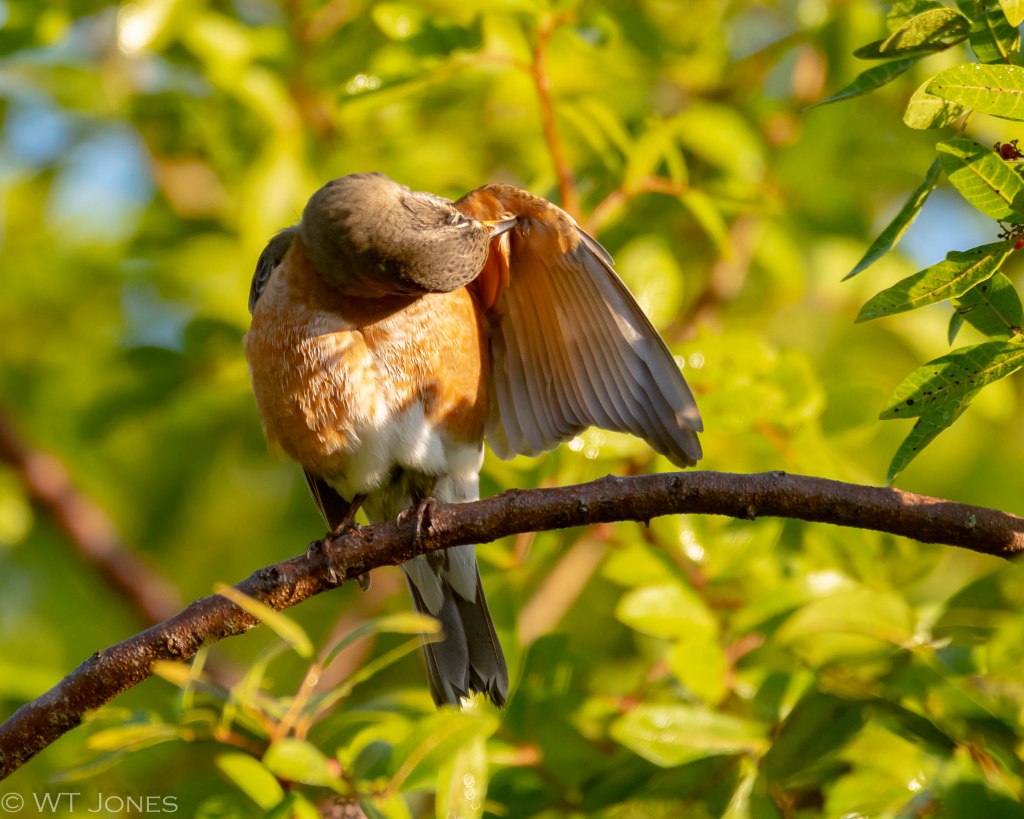
It won’t be too long before this Eastern Phoebe wings her way north. We will miss the one in our yard who reminds us every day that her name is “FEEE – BEEE”!

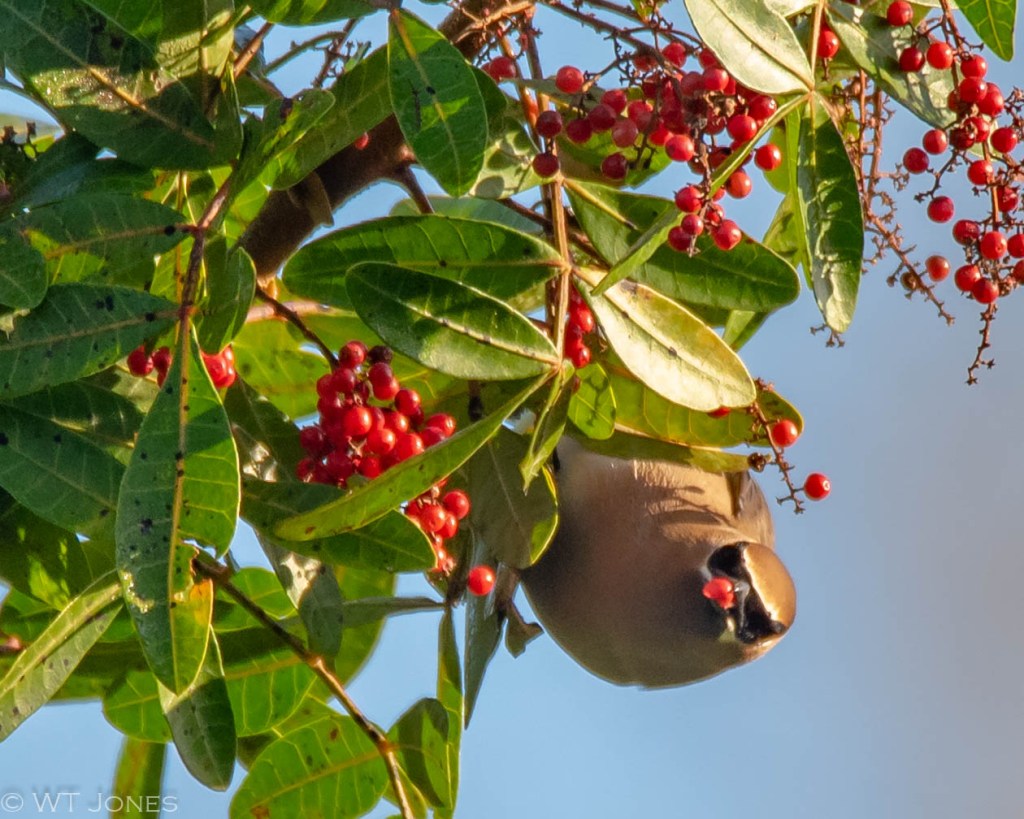
Around a curve in the road we disturbed a group of American Robins and Cedar Waxwings. We often see these species travel and feed together. We sat in the car for a long time and thoroughly enjoyed watching over 50 Waxwings and over 30 Robins gorge on the fruit of the Brazilian pepper (Schinus terebinthifolius).





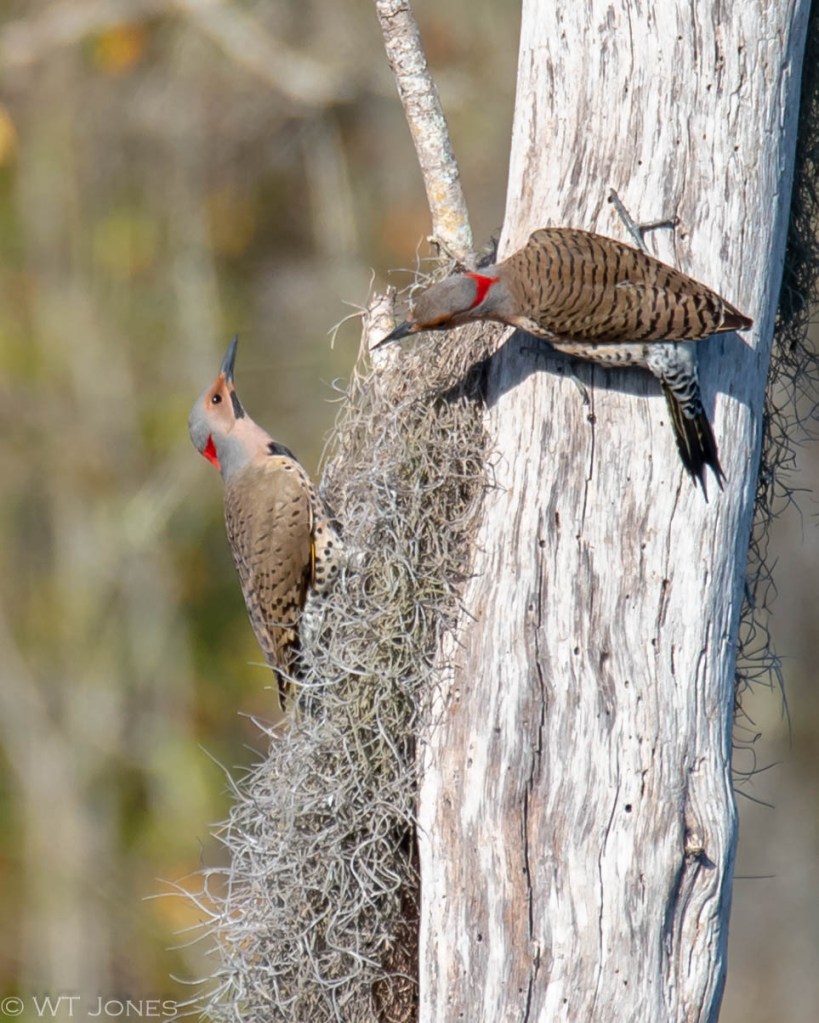
Two male Northern Flickers seemed to be playing a game of tag, but more likely were engaged in discussing territory or a potential mate. As one takes flight, it’s easy to see why these are called the “Yellow-shafted” form. In the western U.S., one finds the “Red-shafted” form.

Dragons have awakened! We saw several Eastern Pondhawks and Common Green Darners. But the highlight was a NEW species for us! A Sepia Baskettail (Epitheca sepia)! A good day made better.


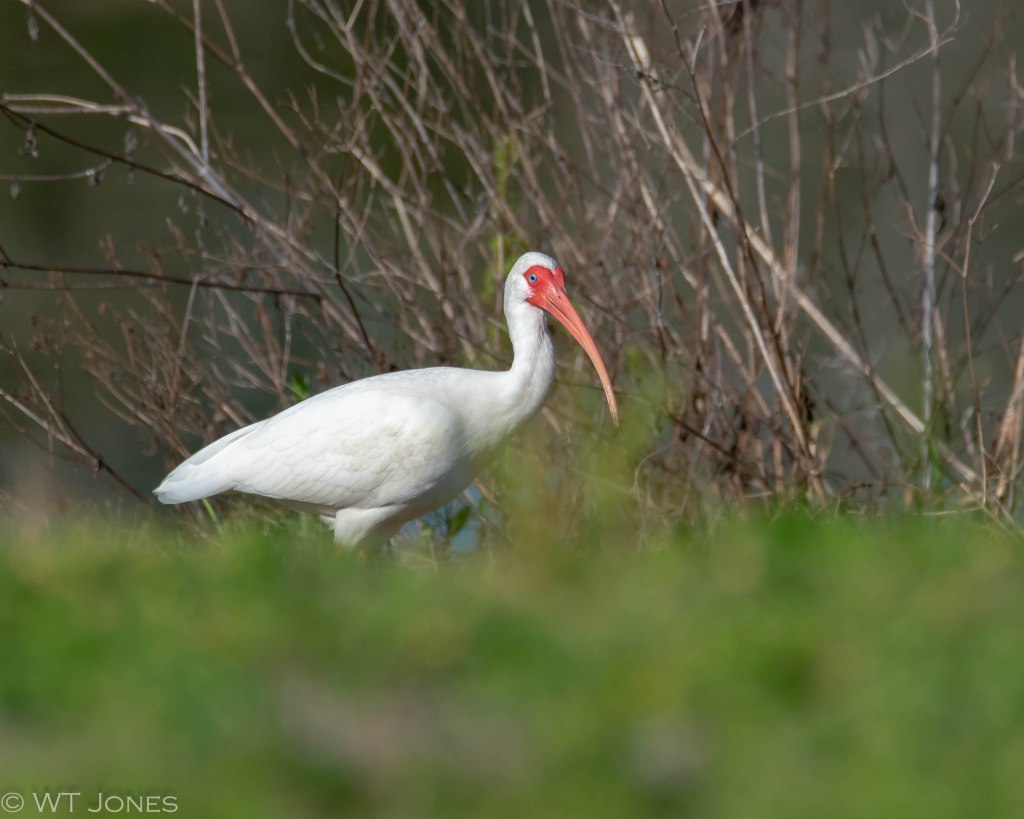
A White Ibis shows signs of breeding changes as its bill and legs become brighter red than normal.
Docks on the numerous lakes are great places for a Tricolored Heron to scan the water for a snack or relax in the morning sun.

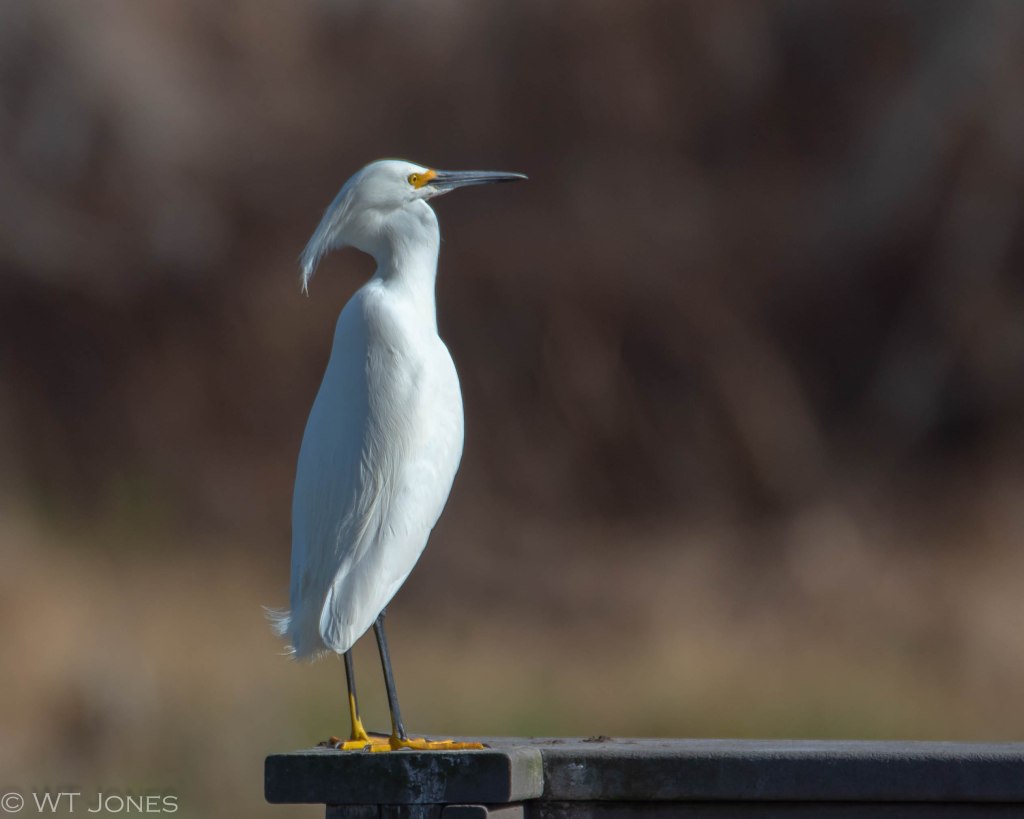
Perched next to the above heron, a Snowy Egret has spotted something interesting in the distance.
I was watching an Osprey pair working on nest remodeling when they seemed to take me as a possible threat. One of them launched out and flew over my head while clucking so I left in order not to disturb them further.


During migration, we see large numbers of Palm Warblers. The Eastern form is bright yellow and brown while the Western form is more subdued in plumage. Constant tail-pumping helps confirm their identification.


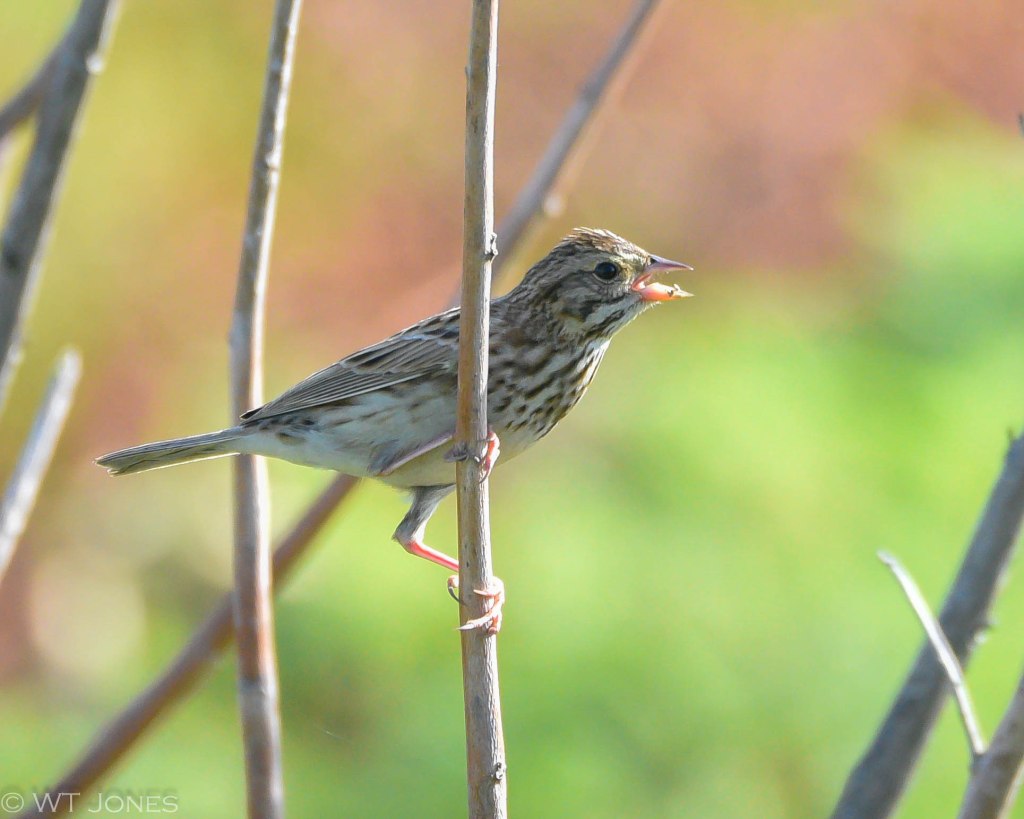
Crisp breast streaks and bit of yellow in front of the eye helps identify the Savannah Sparrow, another winter visitor we will soon be missing.

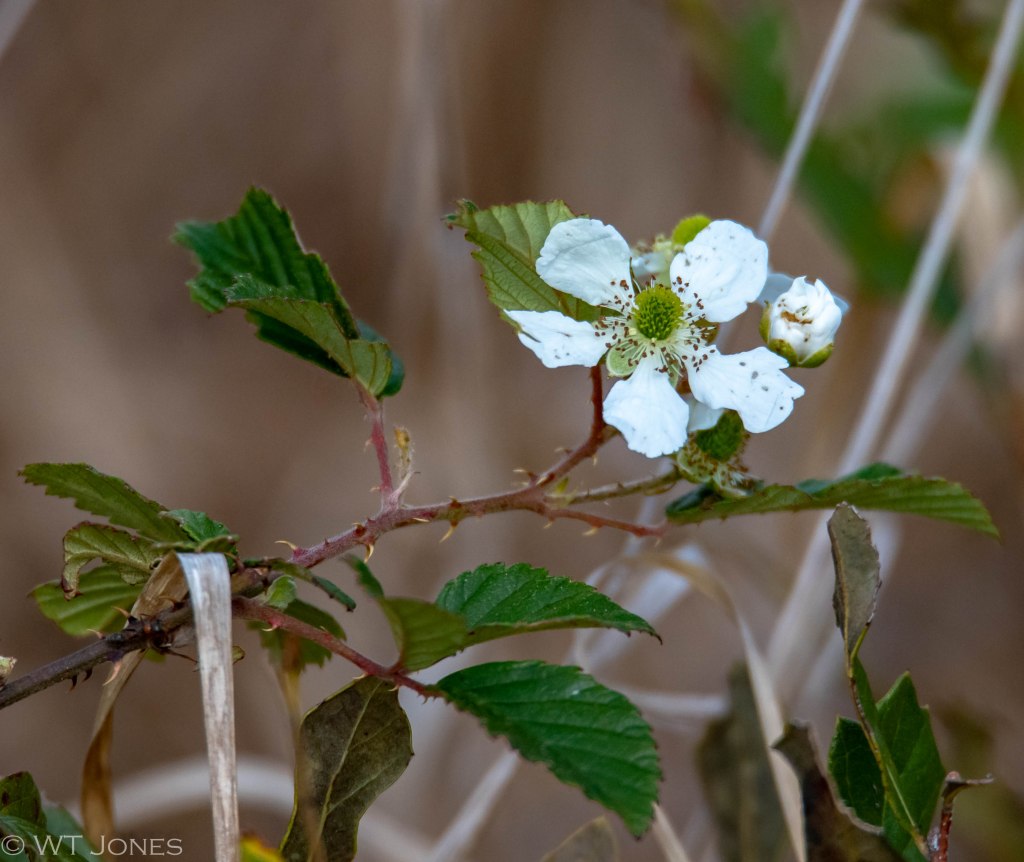
Heading down a path trying to follow a trio of sparrows led to an area filled with blooming Sawtooth Blackberry (Rubus pensilvanicus). These flowers will soon attract a variety of pollinators and in several weeks, the juicy berries will be harvested by several different animals. Including me if I’m quick enough.
Two lone trees in a field and atop one was perched an American Kestrel. Florida has a small number of these falcons which breed within the state and each year we see several dozen migratory Kestrels.

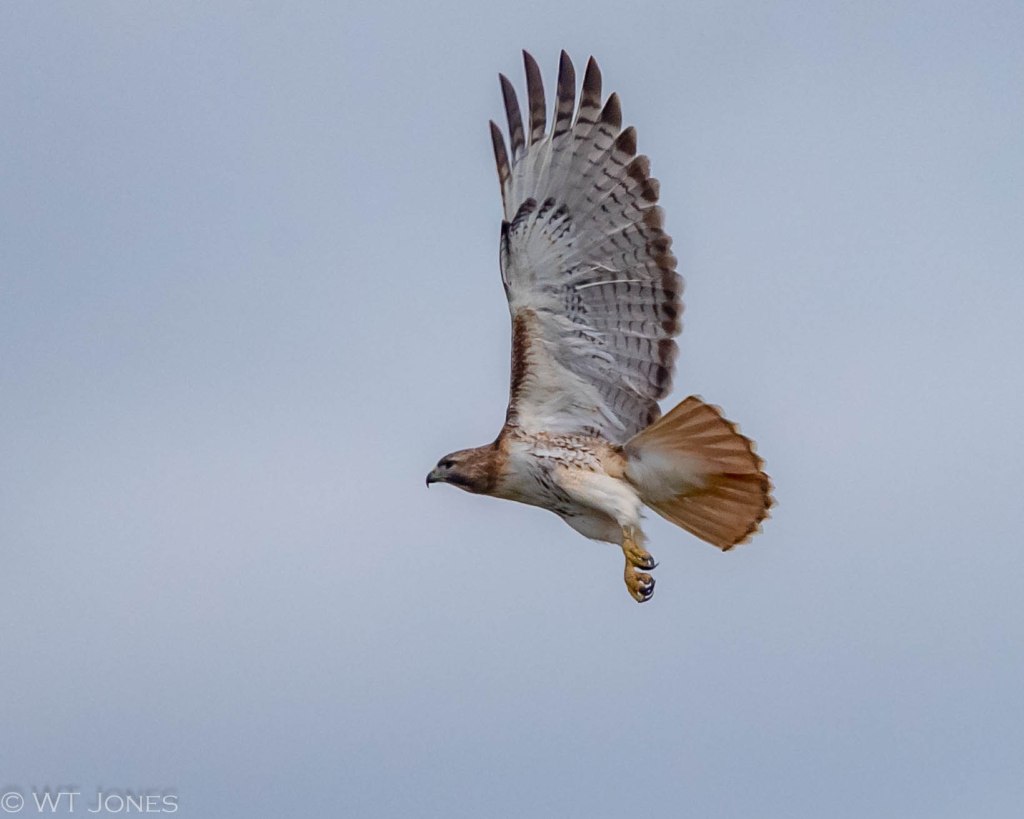
The second of the two trees mentioned above was occupied by our largest Buteo, the Red-tailed Hawk (Buteo jamaicensis) . As I watched, he took off and displayed his namesake red tail. Majestic raptor!


Coffee, birds, a Spring morning – shared with my best friend. Truly – that perfect blend!
Enjoy your search for a natural place and come back for a visit!
Header Image: Park Road
We didn’t have much time to spend exploring today, but at Myakka River State Park, any time at all is well worth the trip.
This is one of Florida’s oldest and largest state parks. The river for which the park is named is not very long, only 72 miles. Typical of Florida rivers it also is not very deep and can be narrow at several points along its length. It flows from near Sarasota generally south and west where it empties into Charlotte Harbor at the Gulf of Mexico.
There is not any agreement on the origination of the name “Myakka”, likely a Seminole Indian name. Early Spanish explorers around the Charlotte Harbor area in the 16th century labeled it “Big Creek” on their charts. In the early 19th century, English maps called it the “Asternal River”. Around 1840, the first reference to the “Miarca” River showed up and is likely the root of its current name.
Myakka River State Park consists of over 37,000 acres and opened to the public in 1942. It was constructed by members of the Civilian Conservation Corps, a group of young men organized under President Franklin Roosevelt in the 1930’s to provide employment for millions adversely affected by the economic depression of 1929. A large chunk of land was gained by a proposal from Sarasota’s first mayor to convert it to public use instead of losing it all to bankruptcy. An additional large parcel was donated by the sons of a Chicago businesswoman, Bertha Palmer, who had moved here to go into cattle and sheep ranching.
Today, visitors can enjoy a wide selection of adventures in the park. Camping, hiking, fishing, biking, boating and some of the best birding in the area. A unique experience is a canopy walk which allows one to wander in and above the treetops and provides outstanding views.
Gini and I enjoyed breakfast overlooking a creek which flows into the river and found early blooming flowers and plenty of birds feeding in the oak and palm hammocks. At Upper Myakka Lake, we could see quite a few shorebirds and waders on the far shore, too far for photographs though. A pair of Swallow-tailed Kites are among the first arrivals we’ve seen this year of this migratory raptor. They will stay here and breed before returning to South America in August. The banks of the river were lined with dozens of alligators who, like us, were happily soaking up the sun’s rays.
We’ll be back soon and try to find a few birds willing to pose. Beginning in May, this park is filled with one of Florida’s native orchids, the Butterfly Orchid (Encyclia tampensis) and dry prairies teeming with wildflowers.
A few images of our morning.
Upper Myakka Lake provides good fishing, fine boating and is a magnet for bird life.

Savannah Sparrows were very active as they’re fueling up for their return to northern breeding areas.

Slow moving streams such as Clay Gully feed the river throughout the park.

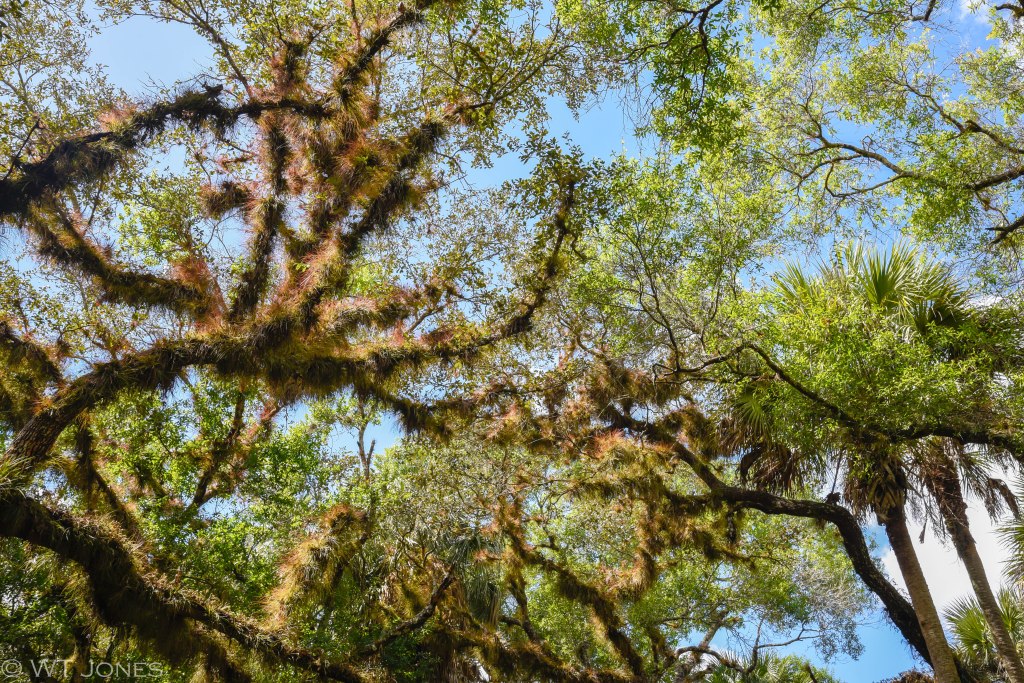
One of the many epiphytes which can be found here is the Southern Needleleaf (Tillandsia setacea).

A look up into the canopy gives you an idea of what the epiphyte population is like.
A dead tree stump provides a roadmap of sorts depicting the life of this particular tree.
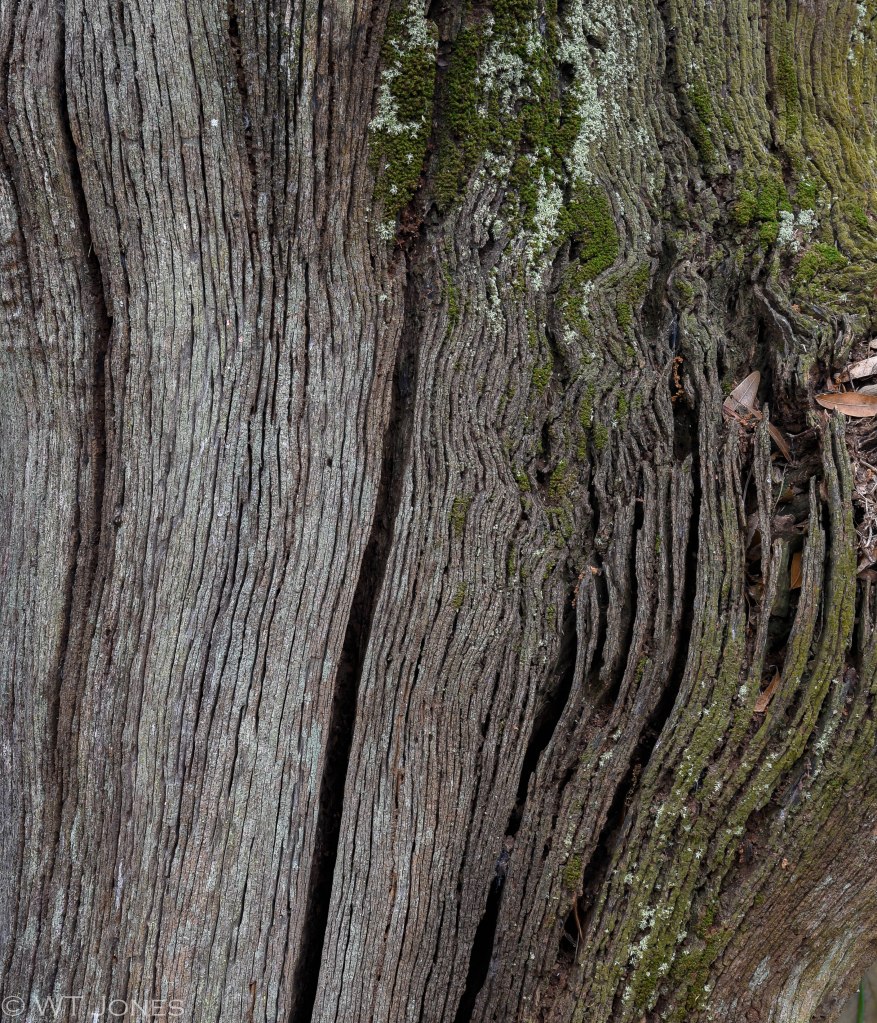
Regular old fungi thrives here as well. The trunk of an oak tree is decorated with a nice selection of growth.


One of the first wildflowers to poke up from the brown of winter is the Canadian Toadflax (Linaria canadensis). Soon, this little species will cover roadsides and fields in a lovely lavender blanket.

The Myakka River moves very slowly, has plenty of fish and its banks are typically muddy and weedy. Perfect habitat for the American Alligator.


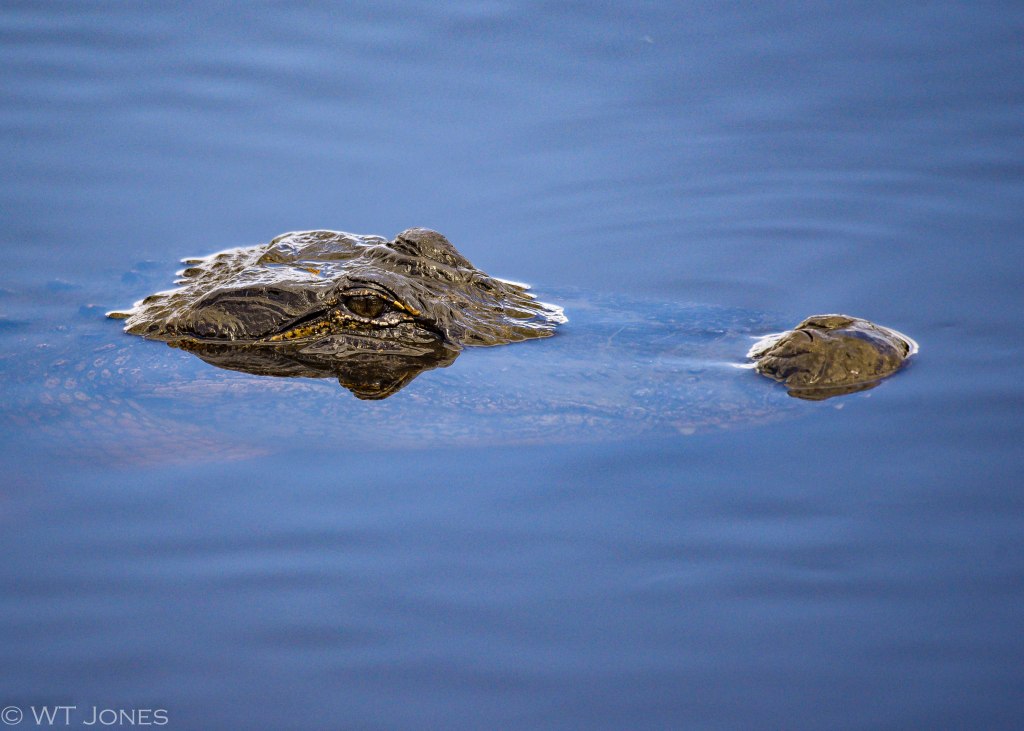
But wait! What’s that?

Photobombed! I didn’t see this hitch-hiking damselfly until post-processing. The image is not clear but the colors and patterns are unique enough to narrow down the species to two possibilities: Florida Bluet (Enallagma pollutum) or Orange Bluet (Enallagma signatum).
On the way home, we stopped at a roadside stand to find a few red jewels for the kitchen treasure chest. It’s getting late in Florida’s strawberry season but we have been enjoying these wonderfully sweet morsels since late December.

A short adventure certainly beats no adventure! We hope you have a park or special place where you can visit and go birding, exploring or simply be still and enjoy the peace and quiet. We’ll leave you with a bit of verse written about the Myakka River at the turn of the 20th century.
The Spell of the Myakka
There are fish and they are jumping and flaunting
and luring me on as they wish;
But it isn’t the fish that I’m wanting
So much as just catching the fish.
It’s the great, broad Myakka out yonder
With its palms where silence has lease;
It’s the beauty that thrills me with wonder
It’s the stillness that fill me with peace.
Neal Wyatt Chapline, 1914
Enjoy your search for a natural place and come back for a visit!
Additional Information
https://www.floridastateparks.org/parks-and-trails/myakka-river-state-park
Header Image: Lake Godwin Moonset
“Every day should start this way.”
Gini’s simple statement was not only profound but a goal worth striving toward.
About an hour earlier, we were on the shore of Lake Godwin, a small freshwater impoundment within the Arbuckle Tract of Lake Wales Ridge State Forest. The moon was descending beyond a line of pine trees. As the sun rose behind us, our surroundings took on a golden glow. The surface of the lake was completely undisturbed and we were enveloped in silence. No car noise, no sirens rushing to aid someone in trouble, no radio or television insisting we must have something we don’t need – a blessed audio void.
One of Nature’s snooze alarm’s jarred us from our reverie. A pair of Sandhill Cranes trumpeted their way across the forest heading from their nightly roost to some field where they will spend the day foraging. That did it. A distant woodpecker hammered on a limb. Screaming somewhere in the distance, a Red-shouldered Hawk announced this was HER forest! The Common Gallinules woke up and began clucking among the lily pads. The moon faded. The sun blazed. The day began.
“Every day should start this way.” She is so smart.
A short distance from the lake, we encountered a tree-top gang marauding the local insect community. The ring-leaders, as usual, were the Tufted Titmice. Palm Warblers, tails bobbing, covered the ground territory while Pine Warblers scoured the middle portions of the tree canopy. Red-bellied Woodpeckers checked all the pine cones while their cousins visiting from the north, Yellow-bellied Sapsuckers, scampered up and down pine tree trunks prying under slabs of bark. From high in the treetops came the unmistakable high-pitched squeaks of the Brown-headed Nuthatch clan. They descended toward us like tiny brown and gray missiles emitting the sound a child’s rubber ducky makes when squeezed incessantly.
Then, they were all gone. The forest was quiet once again.
Lake Wales Ridge State Forest is so-named due to an ancient ridge of dunes that remained above waters which inundated the peninsula over a million years ago. Three separate tracts make up this state forest and we were exploring our favorite, the Arbuckle Tract, named for nearby Lake Arbuckle. The tract consists of over 13,000 acres of pine and oak scrub, flatwoods, sandhill and bottomland hardwoods. Within the state forest are 33 plants and 36 animals which are on state or federal endangered or threatened lists.
Our morning continued with bright blue skies and birds galore. As spring advances, this is one spot we visit often for the wildflowers and insects, especially dragonflies. One main road splits the area and several side roads and trails offer plenty of opportunities for adventure. Check out the link below for more descriptions and maps.
The main road through the Arbuckle Tract is usually in good condition but can be challenging after heavy rains. Be careful. It’s always fun to see the variety of tracks on the road. Deer, raccoon, opossum, coyote, bobcat, mice, quail, snakes – a great place to take youngsters (and even some oldsters!) for a wildlife quiz.

Lake Godwin has a dock and a nice view of the surrounding pine forest. A source of water such as this always attracts wildlife and exploring the shore can be exciting.

From the understory came a loud “Tow-eee”! The Eastern Towhee also reminded us it was time for breakfast with its distinct call: “Drink-your-teeeeaaa.”

The Red-bellied Woodpecker will not only crack open and eat the seeds of a pine cone but knows the cones are great places for bugs to hide.

Brown-headed Nuthatches are among our very favorite birds. Pugnacious and gregarious. They are one of the earliest breeding songbirds in Florida, typically on the nest by the second week in February.


Forest management has helped reconstitute many species of trees decimated during the late 19th and early 20th century by logging. This section of mature planted pines is supported by native understory such as large swaths of Saw Palmetto (Serenoa repens).

Migration brings Yellow-bellied Sapsuckers to our many woodland areas and more than a few remain throughout the winter.

Pine Warblers are residents of Florida but their population swells considerably as migrants join the party during migration.

Open spaces with plenty of pine trees in this area usually means a healthy population of Eastern Bluebirds. Right on cue.

This female Downy Woodpecker has spotted something moving atop a snag. Branch brunch.

Wet flatwoods surrounds an open area of Cutthroat Grass (Panicum abscissum). This species of grass is endemic to Florida and only found in areas with sufficient groundwater seepage to support its growth. The Lake Wales Ridge is one of only a few remaining such areas in the state.

Our foray into the forest was enjoyable, exciting, relaxing, memorable – you know, just another ordinary day for your intrepid birders! We hope you have a forest or similar locale nearby where you can go to explore and contemplate the good things in life.
Enjoy your search for a natural place and come back for a visit!
Additional Information
https://www.fdacs.gov/Forest-Wildfire/Our-Forests/State-Forests/Lake-Wales-Ridge-State-Forest
Header Image: Sandhill Crane On Nest
(Whoa! Lower your expectations. This will not be a post about my favorite person. And, please, don’t tell her the title of today’s entry. She fully agrees with the latter description but takes great umbrage with the first. My physical safety is at stake here, so, thank you in advance.)
I was born in a small village in southeastern Florida long ago before the age of flying cars. Oh, wait, that hasn’t quite happened yet, despite the promises of “The Jetsons”. It was so long ago (how long ago was it?), that our main entertainment on television was the “Honeymooner’s” with Jackie Gleason, the Ed Sullivan Show and Sunday afternoon baseball. After church on Sundays during the baseball off-season, a late-afternoon treat would be the “Sunday Drive“.
We got pretty excited at that prospect (we being the children in the group), because we knew the ride usually ended in a stop at Drexel’s Dairy. For city kids (or, more precisely, suburban kids), petting a baby calf or feeding horses a carrot was a special experience. Not to mention the lasting effects (some of it on our shoes) of enjoying the fresh aroma of a working dairy. The highlight, however, was the marketing geniuses at Drexel’s knew a free cone filled with fresh ice cream would ultimately result in dairy items being ordered for delivery the following week.
That small village where I was raised grew a bit over the years. It has been several decades since I have returned to Miami and still can’t think of a reason why I would.
Solidifying the theory that Gini and I have always been soulmates is the discovery that she, too, had a similar “Sunday Drive” experience as a mere child. (Through some time-warp trick of the universe, she was a child only a couple of years ago.) Dairies and ice cream also rest within her memory of those days.
Lately, when we bring up the subject of “going for a ride”, regardless of the day of the week, it automatically triggers the loading of optical equipment, survival snacks and tumblers of water into our trusty vehicle. While none of those items may actually be used, one can never be certain when they may be needed. Cows and ice cream may not (necessarily) be our end reward, but any day spent with Gini has its own very unique and indescribable bonus, just for me. (I’m selfish that way.)
On this day’s drive, we visited a commercial sod farm. Many former citrus growers have been affected by past downturns in their industry due to economic times, natural attacks on groves and pressure from foreign competition. The demand for lush green grass from homeowners, businesses and civic developers convinced many to convert the beautiful bright green and gold landscape of citrus groves into flat squares of turf as far the eye can see.
Benefactors of this evolution, besides tireless marketing consultants telling us we must have green lawns or face excommunication, include several different species of birds, especially shorebirds, which love the constantly dampened soil (AKA: mud) which makes it easy to probe and locate all manner of protein-rich insects. The prospect of finding a sizable number of shorebirds so far from the shore makes these farms a magnet for scope-toting birders all across the land. Especially during migration.
Even better news. Getting to and from the aforementioned lawn-spawning nirvana requires a drive through some very nice birding territory!
Our actual “Sunday Drive” was fairly short as birding outings go, but it had a few sweet rewards to make for a lovely day.
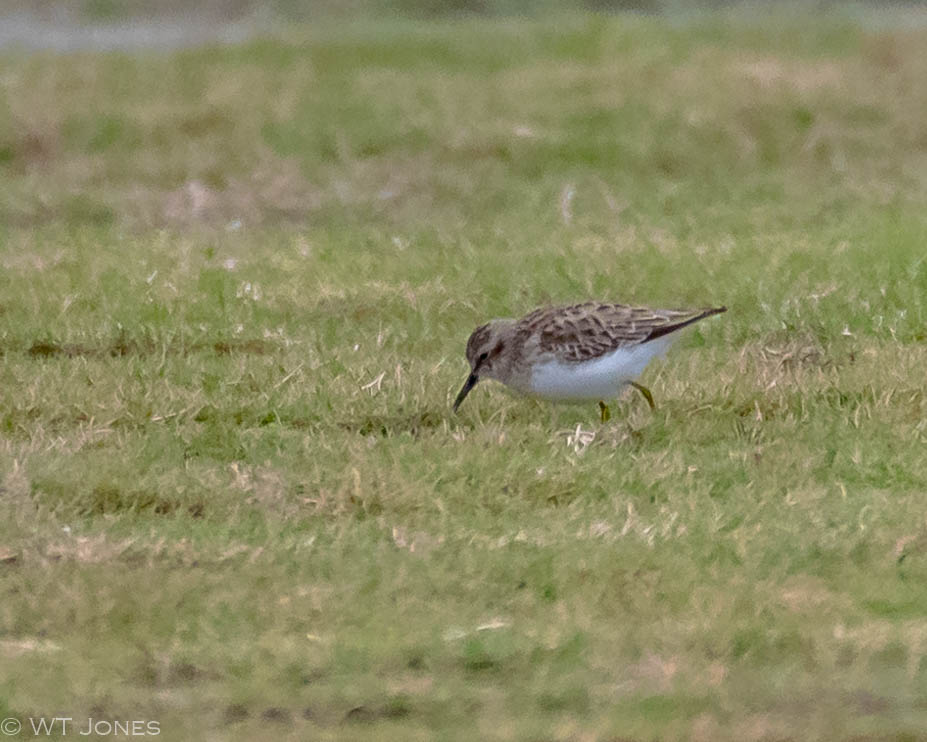
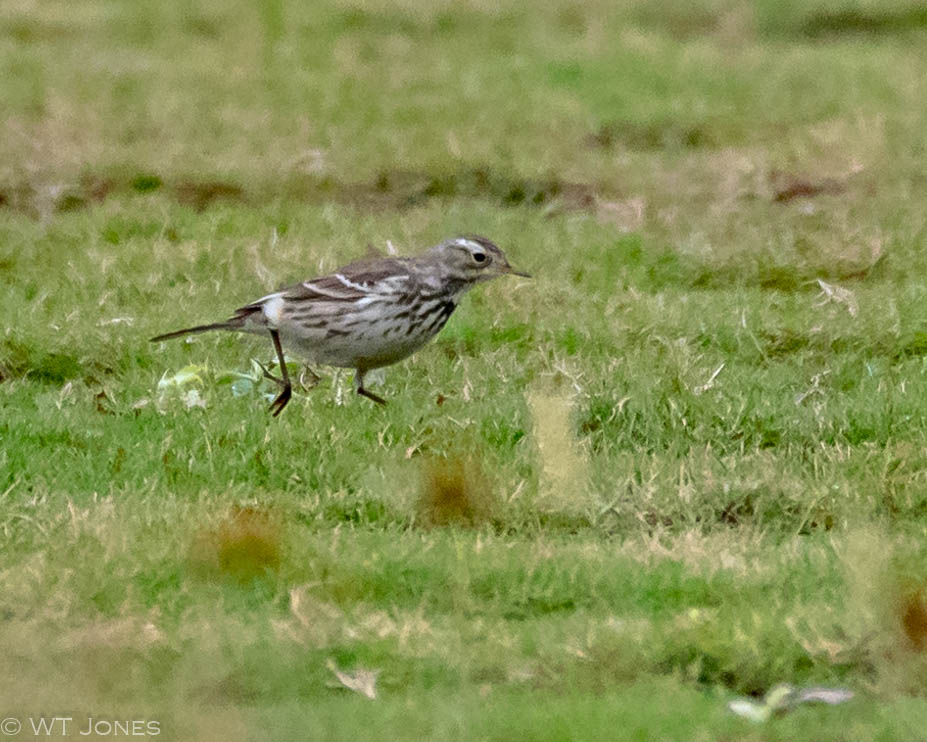
About half a mile in the distance, the spotting scope revealed several hundred shorebirds feeding in the freshly watered turf. Identification was reduced to educated speculation (based on historical data) that the majority of the birds were Least Sandpipers. A small cloud of feathery visitors descended about 200 yards from us and we could identify a couple of dozen Least Sandpipers, a few Semipalmated Plovers and our first look this season of a dozen American Pipit. (Apologies for the blurry images.)
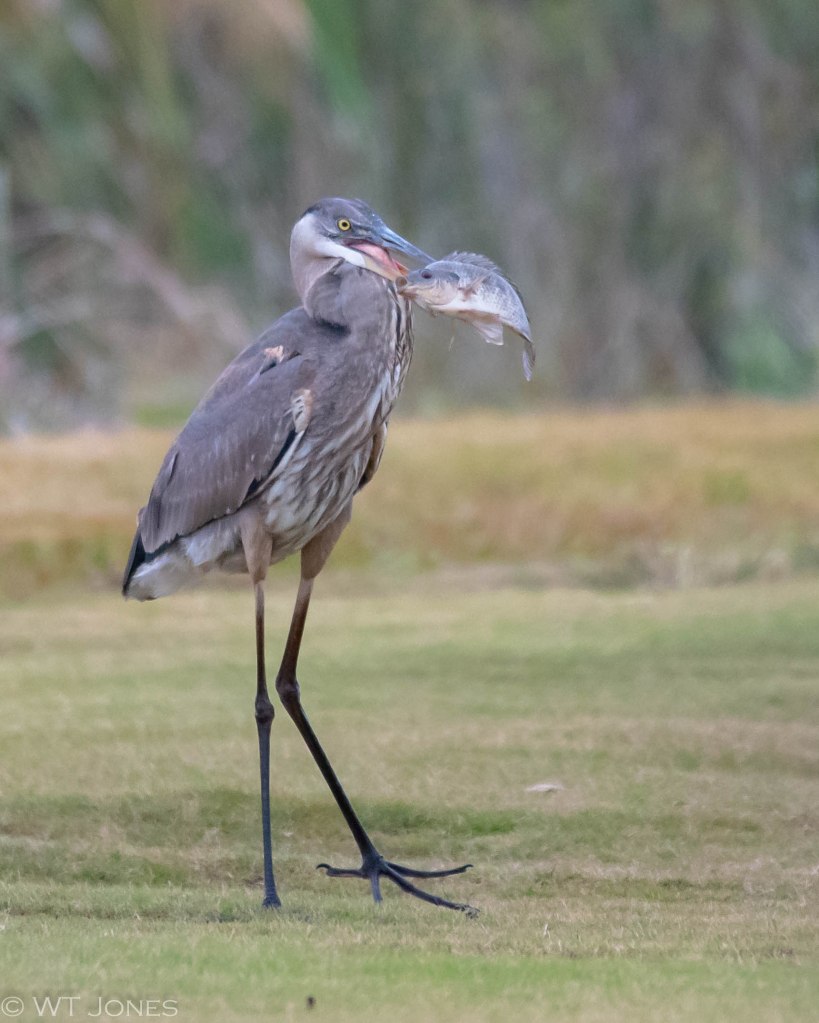
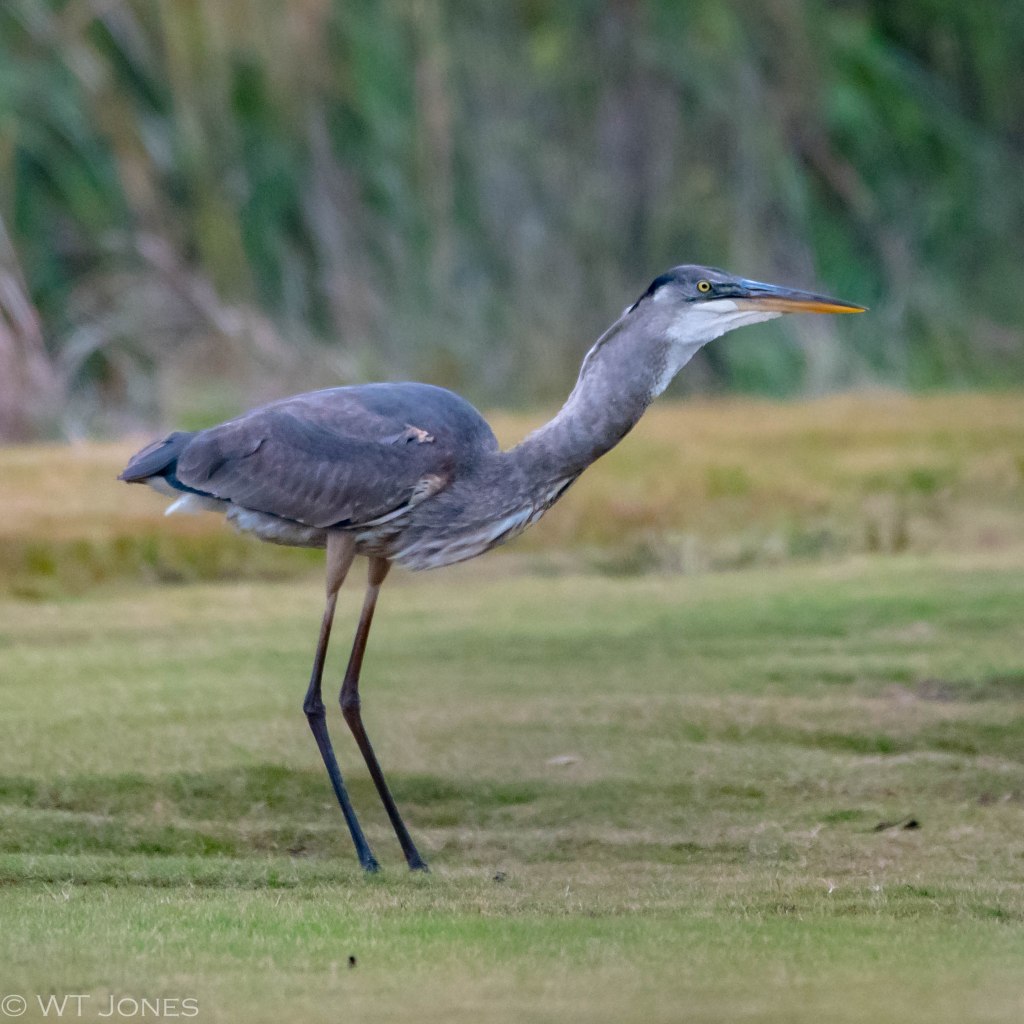
The sod field is bordered by a canal which helps with irrigation. Wading birds line the banks in search of frogs, snakes and fish. A Great Blue Heron proudly displays a catch larger than would be expected from such a small canal.

Not far from the green fields we found a small pond in a large pasture where four Mottled Ducks plied the weed-filled water for their daily salad.

In this same pond, a pair of Sandhill Cranes set up house-keeping on a small island of mud and weeds. Although we are still seeing large groups of migratory Greater Sandhill Cranes (Grus canadensis tabida), Florida has a resident population (Grus canadensis pratensis) which breeds here. Eggs will be incubated for about four weeks.

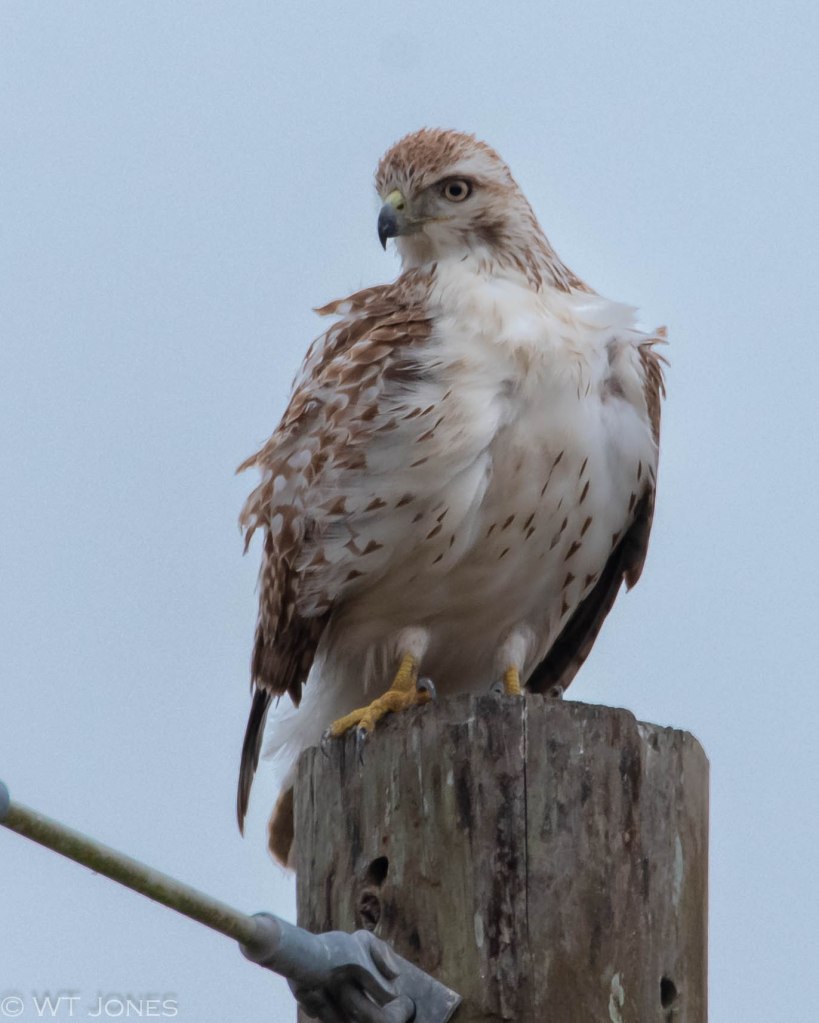
A rather uncommon sighting was a very pale version of the Red-tailed Hawk, sometimes designated “Krider’s” Red-tailed Hawk (Buteo jamaicensis kriderii). Speak to a dozen taxonomists and you will find a difference of opinion on whether this is actually a sub-species. This appears to be an immature bird based on breast markings and tail pattern. Beautiful and unique, no matter what you call it!

Shorebirds away from the shore, a crane on a nest, an abnormally pale hawk – almost as good as any ice cream reward! Another very satisfying “Sunday Drive“. Our outing may have been short but it was most assuredly very sweet. (Just like you-know-who! Shhhh.)
Enjoy your search for a natural place and come back for a visit!
 Our Natural Places