Header Image: Pine Flatwoods
It can be exhilarating to be prone in the damp grass early in the morning just after sunrise observing the waking moments of what is likely the smallest damselfly in the country. Rolling to the left provides a view of the nearby tree line just as a Red-shouldered Hawk lands atop an oak tree. Rolling on my back reveals a superbly clear morning of an impossibly blue sky. A roll to the right and I discover the observer is being observed. “Periscoping” is a term used to describe a snake raising its head above the grass line to see what’s in its territory.
A split-second hiccup in my little brain whispers: “Are we sure that was a Black Racer?”. Rolling away from the reptile, actually, about three rolls, began the process known (at my age) as “getting up from the ground“. The process continues by attempting to get one knee under me, then trying to get a foot on the ground and sort of rolling, stumbling upward – never mind. You’ll become familiar with the technique sooner than you would like.
Today, Gini and I are exploring a very small portion of central Florida’s Green Swamp. This precious ecological resource consists of almost 900 square miles and is the source for four of our state’s major rivers. The particular area we are in is within part of the Withlacoochee River State Forest. Over 155,000 acres make up this forest which is adjacent to its namesake river. “Withlacoochee” has been translated from the Creek Indian language as “Crooked River”. Very apt. Bubbling up from springs within the Green Swamp, the Withlacoochee is only one of two Florida rivers to flow northward. In this case, from the swamp it twists and turns about 160 miles to Yankeetown, where it empties into the Gulf of Mexico.
The spot we are roaming around today is typical of the southernmost part of the Green Swamp. Habitats include: upland hardwoods, wet prairies, marshes, pine flatwoods, cypress swamps and floodplain swamps. An incredible diversity of flora and fauna calls this area home. We appreciate them allowing us in the door.
Once I was upright again, I strolled through a small wetland area. As I crossed a boardwalk, I gazed down upon dragonflies beginning the day’s hunt, purple Pickerelweed offering a buffet to bees and others and – uh, oh – a Water Moccasin. That hiccup moment returned with my tiny brain shouting: “Told you so!”. I still believe I saw a curious Black Racer.
Most of the morning was consumed by enjoying the incredible abundance of spring flowers. There were plenty of birds here, but most are busy with parenting duties and none were interested in posing for today’s blog. Blooms and bugs abound, however.
The rich green of the swamp and forest was punctuated with purple today. The Savanna Iris (Iris savannarum) rose above almost any bit of standing water.

At less than one inch (2.5 cm) in length, a Citrine Forktail (Ischnura hastata) can disappear if you take your eyes off him. Likely the smallest damselfly in the U.S., my old eyes are lucky to see them anymore.

Pretty in pink, the Swamp Rose (Rosa palustris) decorated the place quite nicely. Even the bees think so.

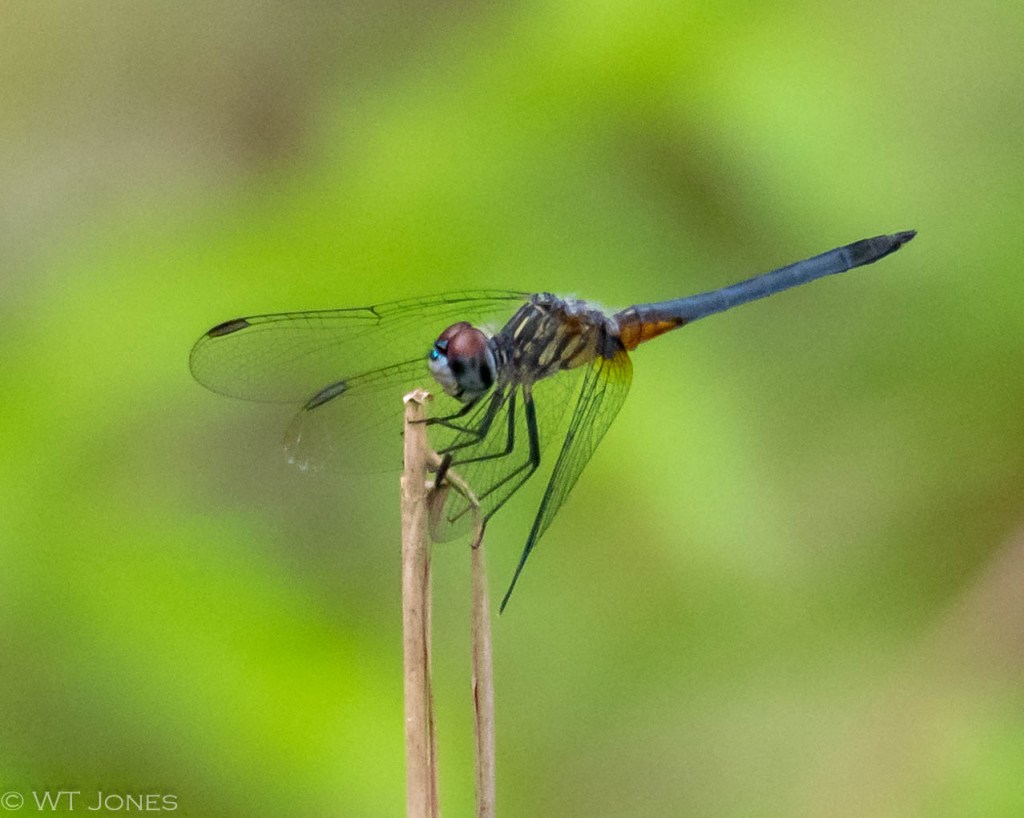
Small and quick, the Blue Dasher (Pachydiplax longipennis) perches with wings forward ready to chase down any passing morsel.
Florida lists 30 species of Ludwigia and even the invasive ones are quite attractive. Peruvian Primrosewillow (Ludwigia peruviana) has large yellow blooms that make it hard to stay mad at its unwanted presence.

Turtle crossing! Well, in the swamp, pretty much anywhere is a likely turtle crossing. This little Striped Mud Turtle (Kinosternon baurii) seldom exceeds eight inches (20 cm) in length and will be much more comfortable once she crosses this bright white road and slips back into the inky ooze a few feet away.

Call it Bluejacket or Ohio Spiderwort (Tradescantia ohiensis) or anything else you like. This is one beautiful bloom!


Who would think a swamp would be so colorful? Bright red sprinkled the landscape throughout our morning meander. Coralbean, Cherokee Bean, Redcardinal (Erythrina herbacea) reminds us we are, indeed, in a semi-tropical environment. Careful with the seeds. They are toxic.


The grass-skipper family of butterflies is aptly named as these tiny insects do seem to skip along the tops of the grass. One Least Skipper (Ancyloxypha numitor) took pity on me and landed for about two milliseconds.

The Green Swamp. So many hues other than green. So much area to explore. So much enjoyment added to our lives.

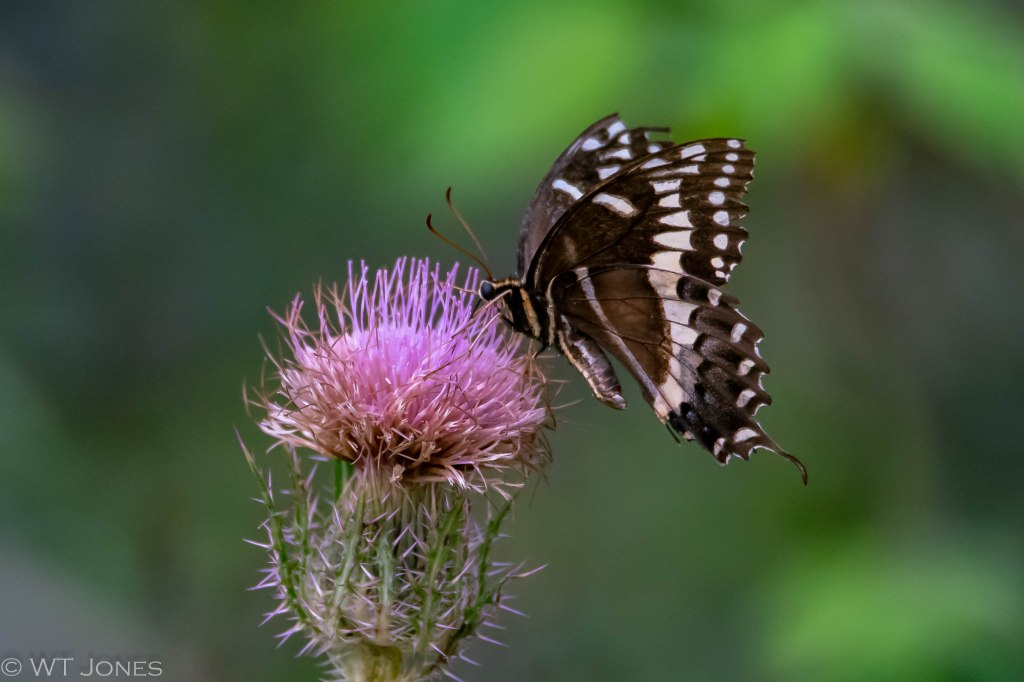
One of our larger butterflies, a Palamedes Swallowtail (Papilio palamedes) braves the prickly leaves to obtain the sweet nectar of a Purple Thistle (Cirsium horridulum).
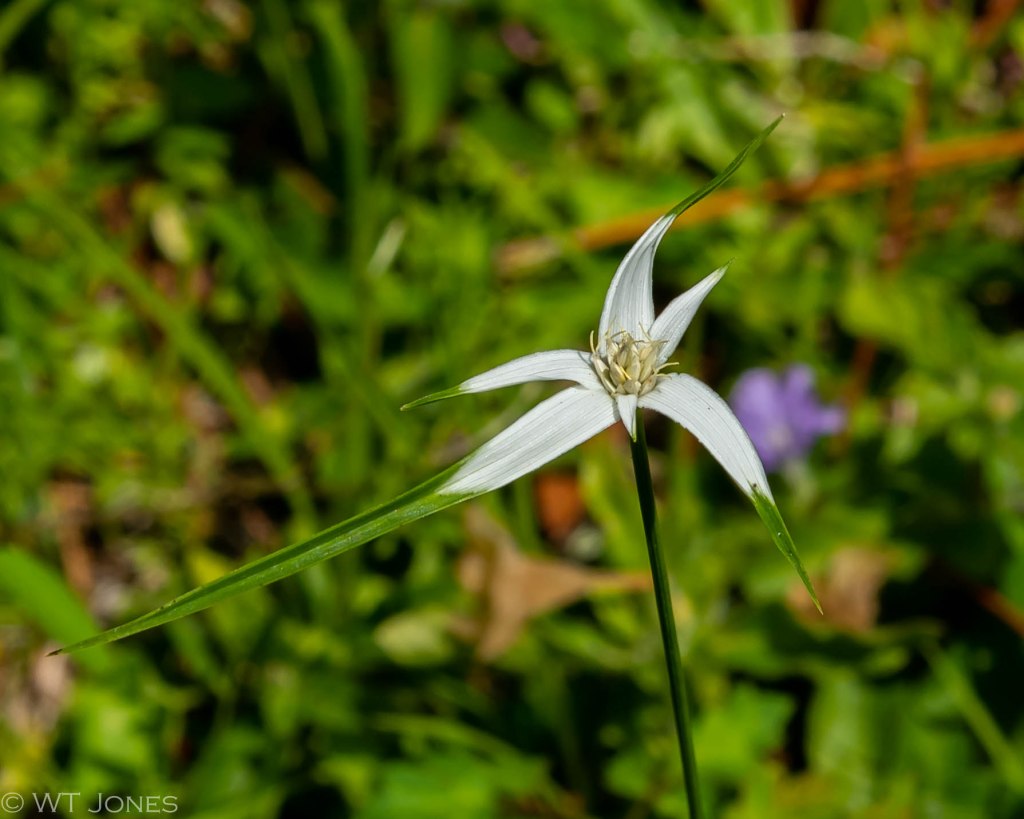
One may be forgiven at thinking the Starrush Whitetop (Rhynchospora colorata) is an attractive flower. It’s actually a sedge that has a very flower-like top. It’s not just you. Even the insects help pollinate this grass when most less-attractive grasses have to rely on the wind.
Butterflies have a tough life. They start out as an egg about the size of a pinhead, turn into a larva whose job is to eat non-stop until it’s full, change into a pupa for several weeks when the adult finally emerges. The adult butterfly, after all that, only lives a couple of weeks during which it is chased by every creature on the planet looking for a snack. This Cloudless Sulphur (Phoebis sennae) has had some nips taken from its wings but is sipping as much nectar as possible until it can find a suitable mate to begin the cycle all over again. Metamorphosis! Nature’s miracle.

A section of Carolina Wild Petunia (Ruellia caroliniensis) with its pale blue beauty caught our eye just off the road. The closer we looked, the more beautiful these flowers seemed!


Fighting off the invaders from nearby tropical islands, Florida’s native Green Anole (Anolis carolinensis) appears to be holding its own. It’s always great to come across this bright lizard in our travels.

I’m sure it’s just a coincidence that after taking the previous photograph we found an extensive area of Lizard’s Tail (Saururus cernuus).

Small and nervous, trying to keep up with a Pearl Crescent (Phyciodes tharos) causes perspiration, frustration and dizziness. The rewards are worth it all!


The headwaters of the Withlacoochee River, or Crooked River, is a breathtakingly beautiful space to spend a morning. Flora, fauna and us. We think it’s a great combination!
Enjoy your search for a natural place and come back for a visit!
Header Image: Least Bittern
Clear skies and the wind had subsided. Two hours before sunset. I had a sudden notion to wander along the western shore of the lake where the sinking sun would provide strong but warm light as I peered into the reeds and trees lining this side of the lake. I knew there were breeding egrets and herons here, but would their nests be visible?
When attempting to learn about photography (a work STILL in progress), we’re told how important light is in making a pleasing image. Indeed, the very word “photography” is formed from two Greek words for “light” and “drawing”. We are further instructed that, in nature photography, the very best light is available a couple of hours around sunrise and sunset. The “Golden Hours“. Some very intent students take that a bit to the extreme and almost refuse to carry a camera outside those parameters. Fortunately, I’ve never been a very good student.
On this day, however, I actually saw the words “Golden Hours” illuminated within my brain and that motivated me to go forth and shoot birds. I even took a tripod. And used it. On purpose. No, really.
A two-mile meander (I don’t think bird photographers actually “walk” and we most certainly don’t “hike”) along the edge of the lake was not only pleasant, it turned out to be what, in another lifetime, I recall Air Force combat jet pilots referring to as a “target-rich environment“. Birds were busily preparing for a night of roosting by very actively hunting for a last-minute meal.
A pair of Black-bellied Whistling-Ducks prepare for a quiet evening by preening and taking care of an itch.

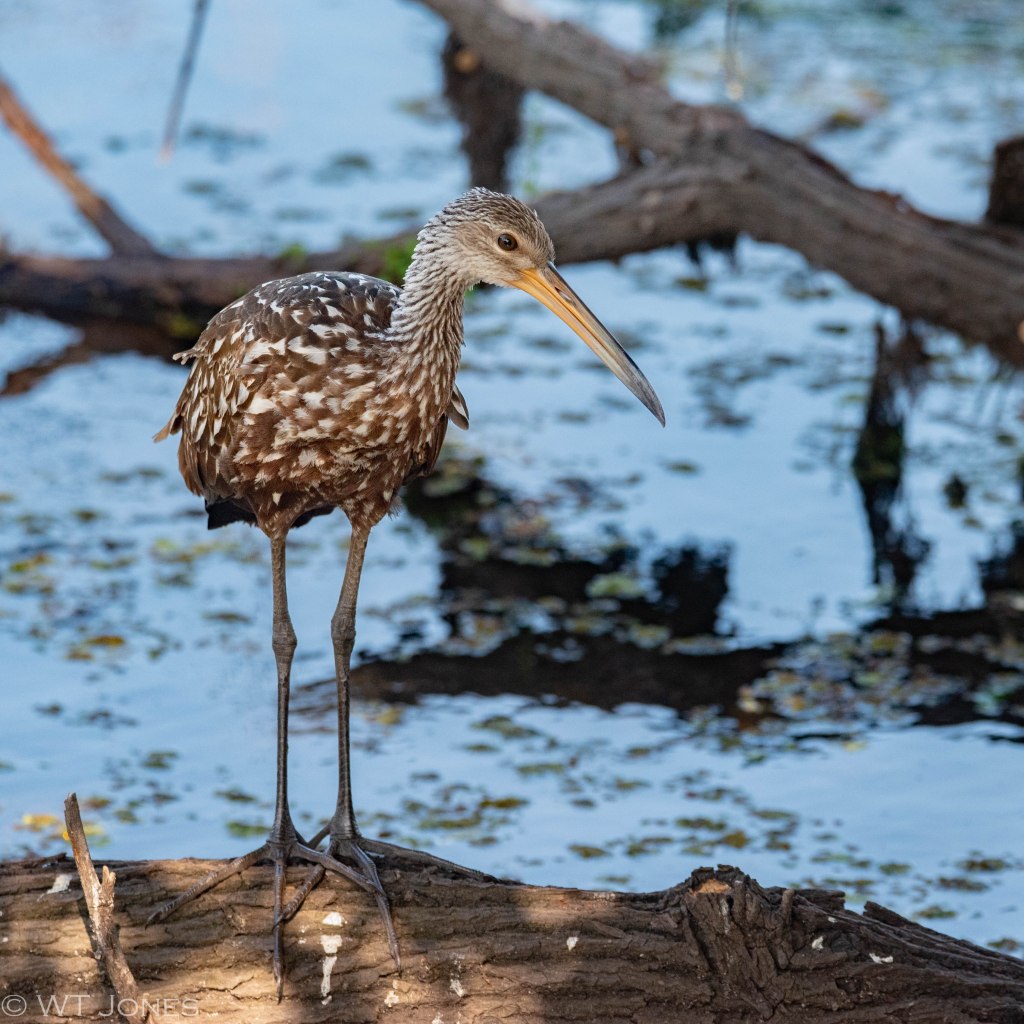
The best roosting logs are occupied early or else a young Limpkin might have to sleep in the reeds or in a tree.
This particularly tall cypress tree is serving as an Anhinga nursery. These water birds tend to nest in colonies and I counted eight nests in this one tree. Immature birds, seen here, retain an overall whitish plumage for about the first three weeks after hatching, at which time the feathers turn light brown as they prepare to fledge.

Let’s just check out this dock which offers a good view into the reeds. Hmmm. It seems other nature lovers are already here. We wouldn’t want to disturb them so let’s just see what’s on down the shore line. (Those are empty apple snail shells on the dock left by Limpkins and/or Snail Kites.)

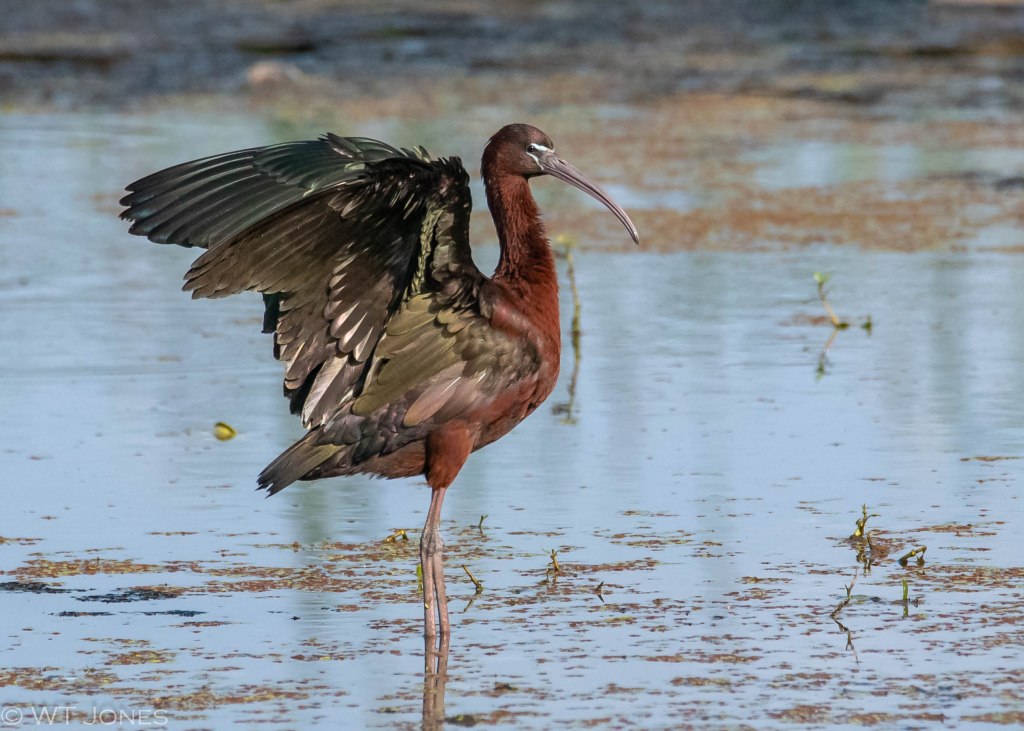
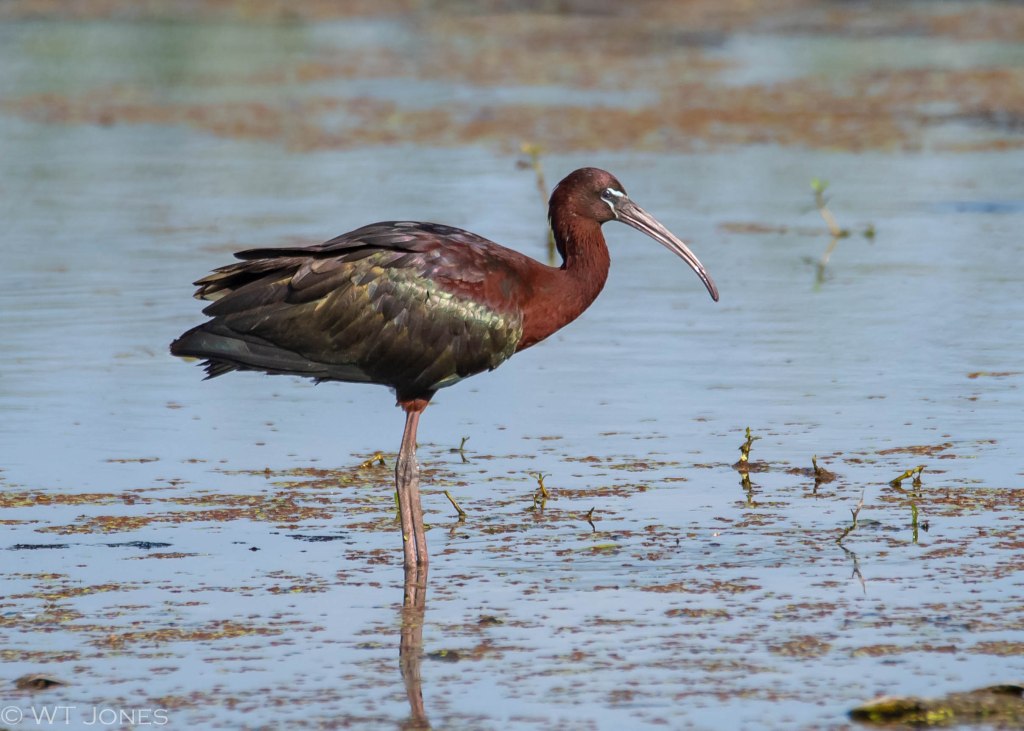
The chamber of commerce has hired a few event actors to pose for eco-tourists such as yours truly. A Glossy Ibis shows off an impressive wingspan and then folds the wings neatly to exhibit the “mother-of-pearl” iridescence which is its namesake.
Once upon a time, we had friends over for barbecue. One of the visitors stated he didn’t care for BBQ, not because of the taste, but because he couldn’t eat it without getting messy. Gini, always the helpful hostess, advised: “If you don’t get it all over yourself, you’re not eating it properly.” (She then pointed the picky diner to the cabinet holding the peanut butter.) This adult White Ibis would have felt right at home at our BBQ table, based on the amount of mud on its bill. Breeding season has turned the bird’s bill and legs a brighter shade of red than normal.

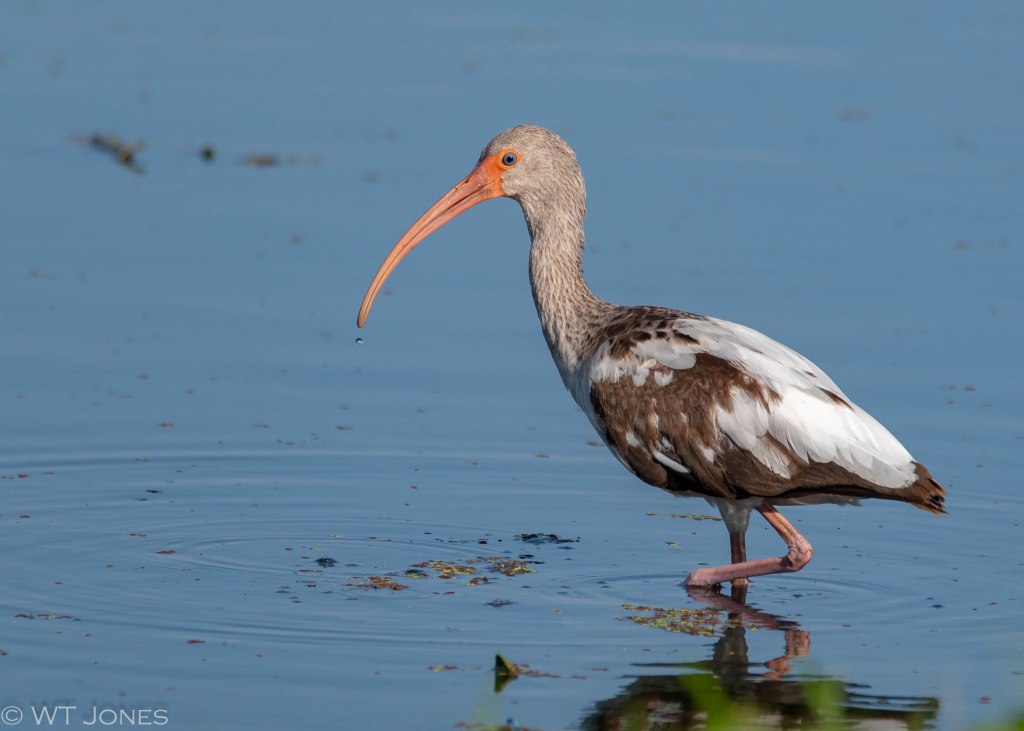
Immature White Ibises are brown, white feathers begin to appear during their first summer, they show more white during the winter and by their second summer they will achieve full adult plumage. The bird in this image is likely about a year old and will be all white by summer’s end.
Stealth is the means by which many birds survive. Watching this Tricolored Heron move in on its prey was like watching the hands of a clock. I knew he was moving, but couldn’t see it happening. Note the white head plume, only present during breeding season.

At the end of the day, a Great Blue Heron hopes for just one more frog. Don’t we all?

Somewhat surprising was finding a very busy Spotted Sandpiper. They breed in our area but I haven’t seen many around this lake. Nice to see one with all its spots, as opposed to the plain winter plumage.

Several years ago, the city erected a Purple Martin house by the lake. It has enjoyed full occupancy every year since. Indulge me for a little while as it is supper time.
Adult male Purple Martin. We typically see them flying at high speed and they appear black. Good light reveals how they got the name.

Mom brings a Four-spotted Pennant (Brachymesia gravida) to a hungry chick.
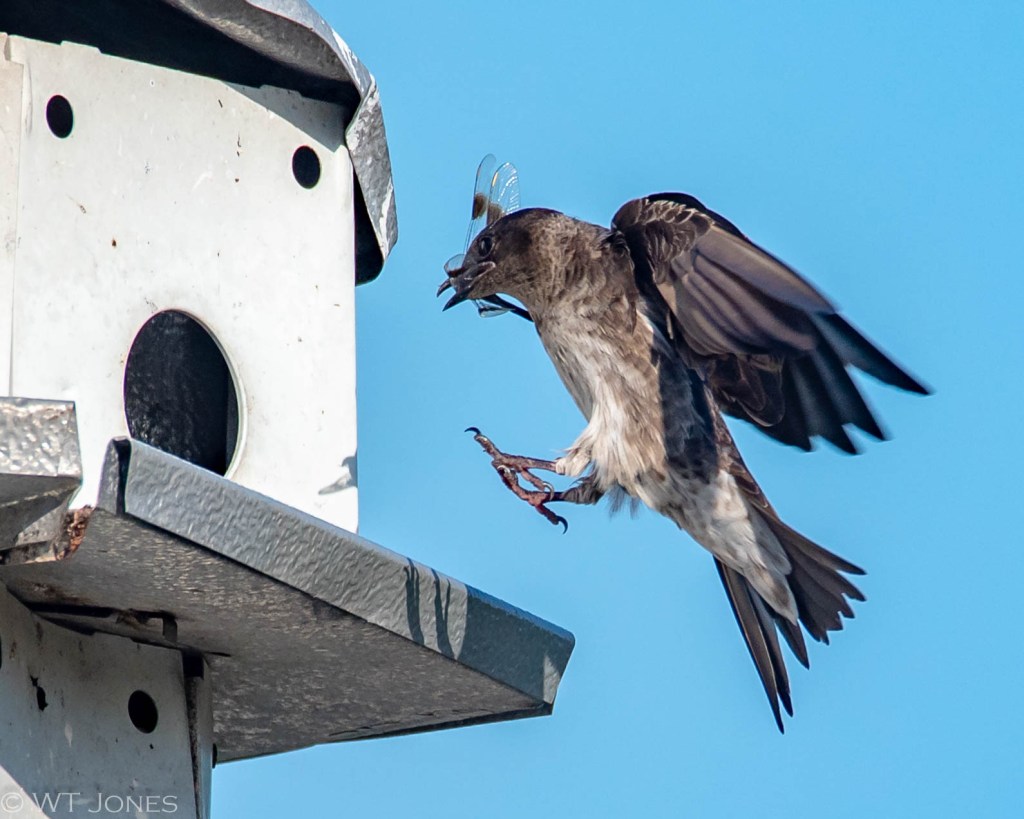
Junior receives a regal repast of Prince Baskettail (Epitheca princeps) as Dad watches to be sure the kid doesn’t choke.

The diligent parent cleans up after junior’s meal by removing the fecal sac from the nest. (Many bird species nestlings produce a mucous sac to contain feces which is removed by a parent to keep the nest clean.)
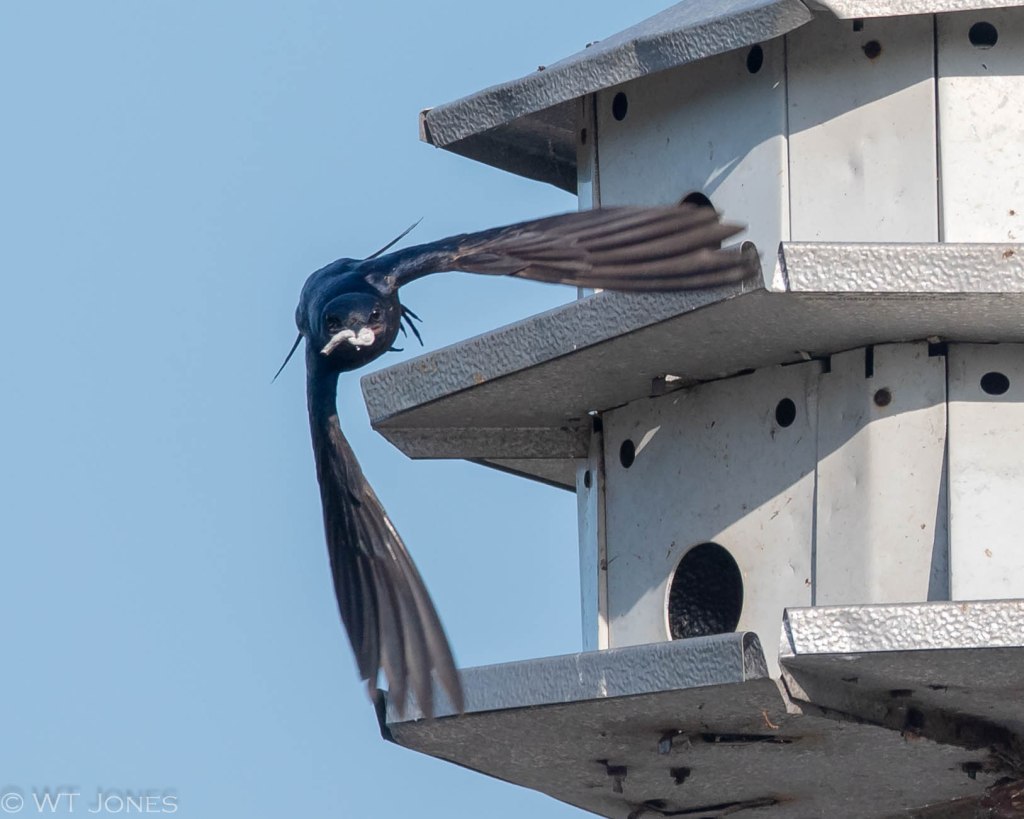
Another female brings a last-minute dragon as it will soon be dark and time for young Martins (as well as Mom and Dad) to rest.

During breeding season, the bill turns blue and the eyes of the Little Blue Heron turn quite dark. There were heron and egret nests in these reeds but they were not visible from the shore.

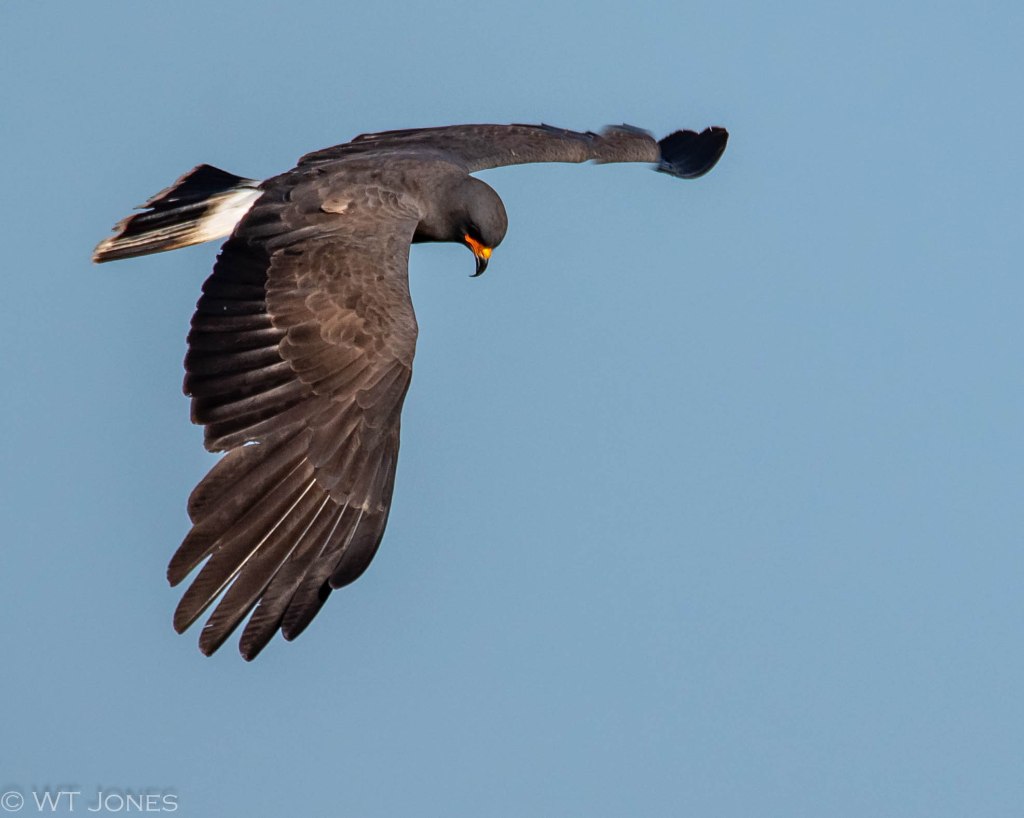
A male Snail Kite conducts one last sortie for some escargot to go with his lemon garlic butter.

Sunset. A Least Bittern tried her best to become a tall reed. I pretended not to see her, but I’m pretty sure she could hear all that “click-click-clickety” going on. It was a great way to end a day.

Although I covered a couple of miles, I can’t really say I benefited from very much “exercise”. Walk three steps, take pictures, walk two steps, take pictures, etc. There was a lot of bird activity at the close of the day and the “golden hours” lived up to their billing. The light was perfect, the drawing was enjoyable.
Enjoy your search for a natural place and come back for a visit!
Header Image: Moonflowers (Ipomoea alba L.)
5/15/22, 9:09 p.m.

5/15/22, 10:55 p.m.

5/15/22, 11:48 p.m.

5/16/22, 00:31 a.m.

Enjoy your search for a natural place and come back for a visit!
Header Image: Black-necked Stilt
When is a birding patch not a patch? The word “patch” denotes something small. Talk to a birder about their local patch and it will usually turn out to be a city park, part of a forest, coastal area, wetland – but near home and with a chance to see a fair diversity of birds. The patch is a spot where a birder can go often and is easy and quick to access.
What Gini and I call our local “patch” fits the above descriptions except for the size. Tenoroc Public Use Area is nearby (less than four miles from the house) and offers an opportunity to observe a good selection of bird life. That size thing. At over 7,000 acres, it probably is not a “patch”! That much area to explore includes 30 lakes (varying from 5 to 230 acres) and over 40 miles of trails. I suppose to be accurate, we could call it a “collection of birding patches”, but that would be awkward, so we won’t be doing that.
There we were, at our local patch again, just after sunrise and a slight mist hung just above the lake’s surface. Most of the lakes within the Tenoroc complex are reclaimed phosphate mining pits and are deep by Florida lake standards. Many average 20 feet in depth and have very little areas of shallow water, even at the shoreline. This feature means one has to hunt a bit for wading birds.
One of the lakes has a series of reeds and mud bars which is suitable for long-legged waders to search for a meal. On this morning, we were treated to a pair of Black-necked Stilts, Spotted Sandpiper and both Greater and Lesser Yellowlegs mixing with the “normal” egrets and herons as they chased fish and crustaceans. Terrific entertainment for the first hour of the day!
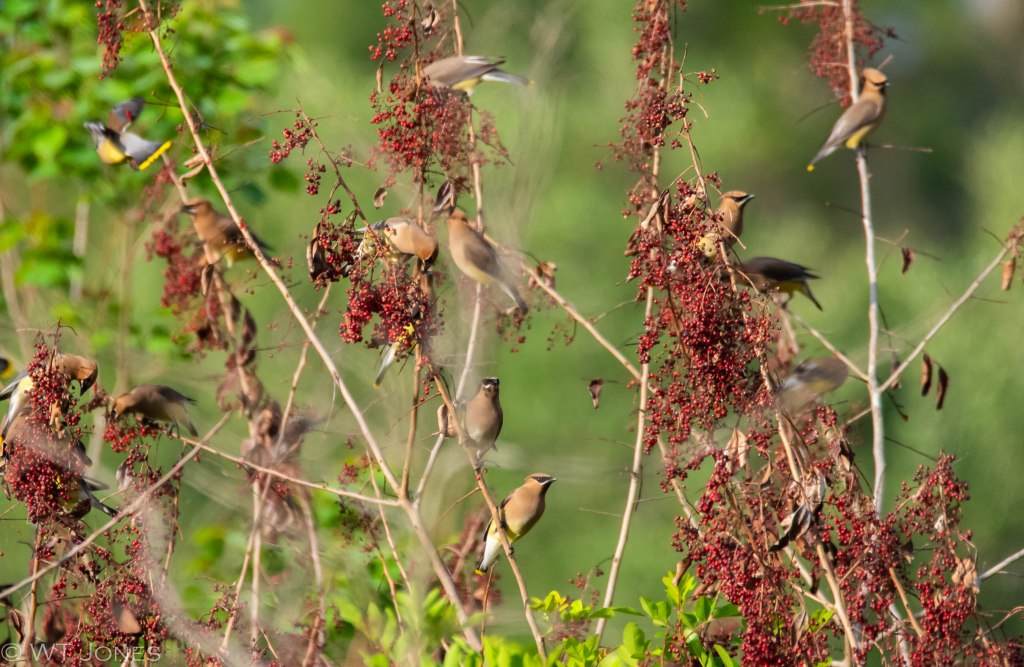
The remainder of the morning involved several dozen Cedar Waxwings plundering the Brazilian Pepper for the juicy red fruit it produces, observing nest-building by Ospreys and woodpeckers, listening to White-eyed Vireos and Tufted Titmice singing from the tree canopies, chasing dragons and damsels and finding a few Florida Soft-shelled Turtles laying eggs in the soft sand. Most of this adventure was accomplished with an incredible lack of effort. Hiking over hill and dale is great fun, but if one can observe nearly 50 species of birds from the car window or by taking only a few dozen steps, well, who are we to argue with less work?
(Note: This trip report is from 15 April and most migratory birds, such as the Waxwings, are now absent from our area. Fortunately, a whole lotta birds call this place home!)
(Another Note: The first five images below were made while standing in one spot. See what I mean about that less work thing?)
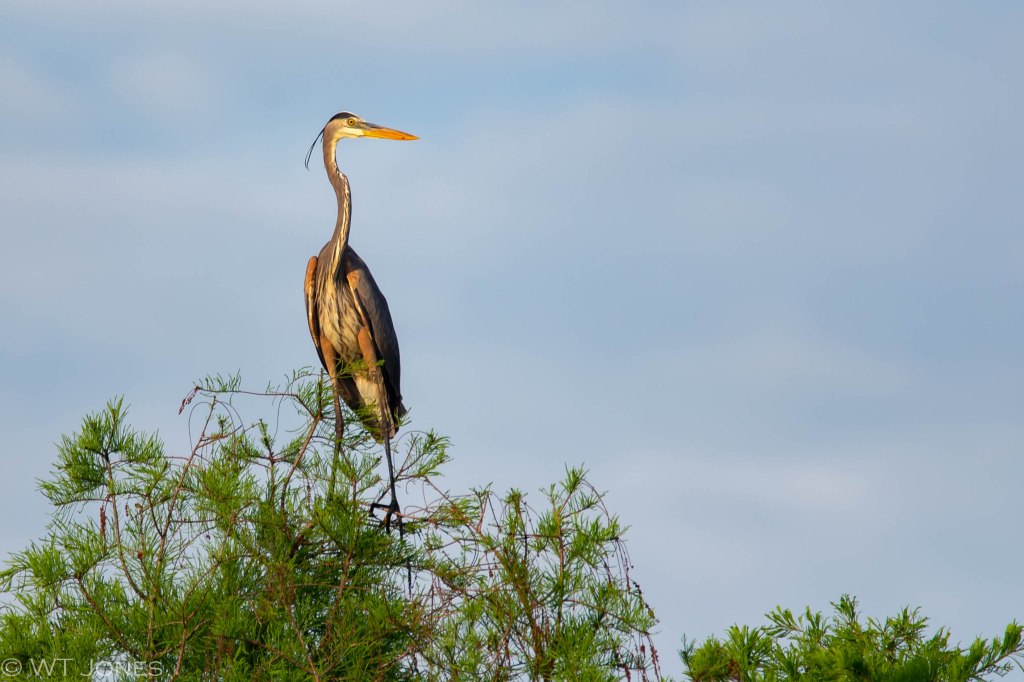
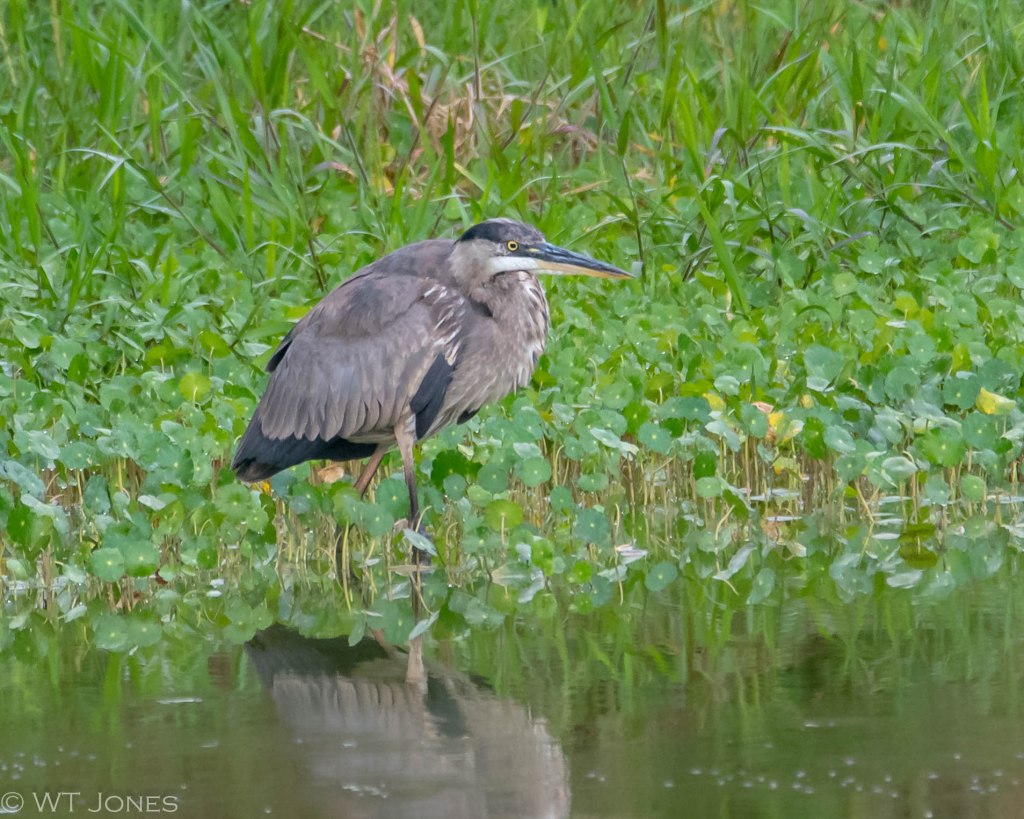
An early morning Great Blue Heron looks pretty stoic from her perch atop a tall cypress tree. We followed her gaze and discovered a young heron poking around the weeds for breakfast.
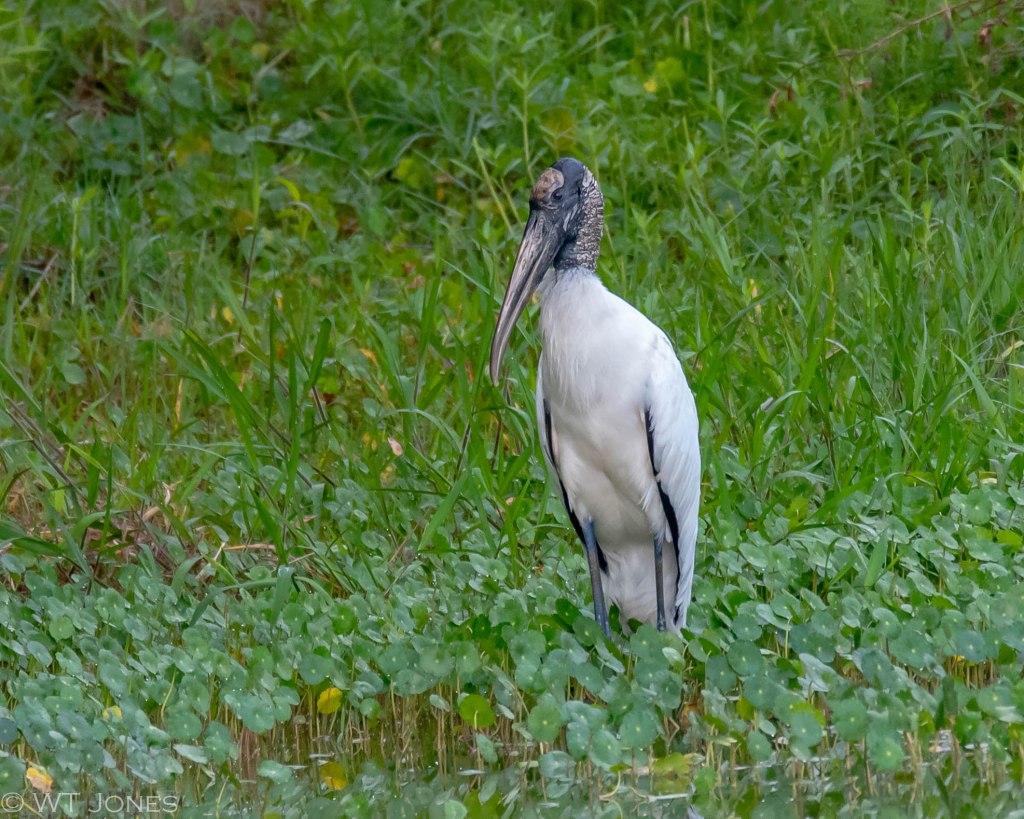
Handsome and Wood Stork may not seem to fit in the same sentence, but I’ll bet this bird’s mother thought he was adorable when he was young.
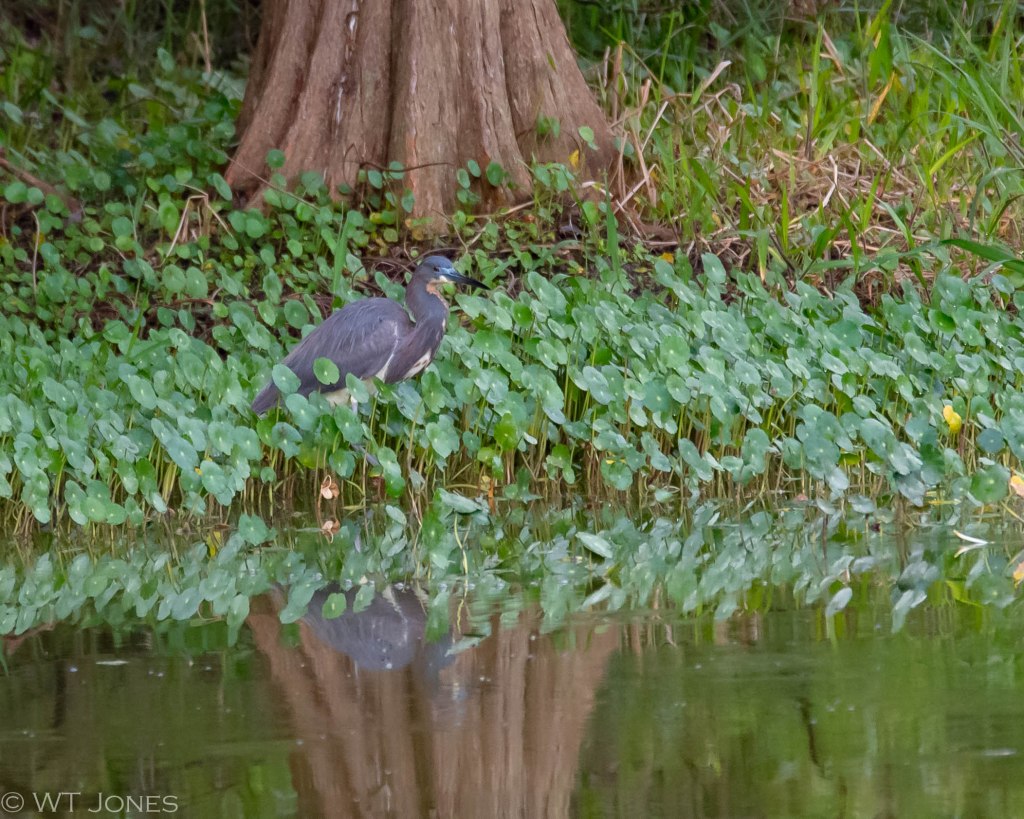
The buffet must have been good in this spot. A Tricolored Heron almost blends in with the busy shoreline background. He’s probably hoping that’s true for the frog under that weed.
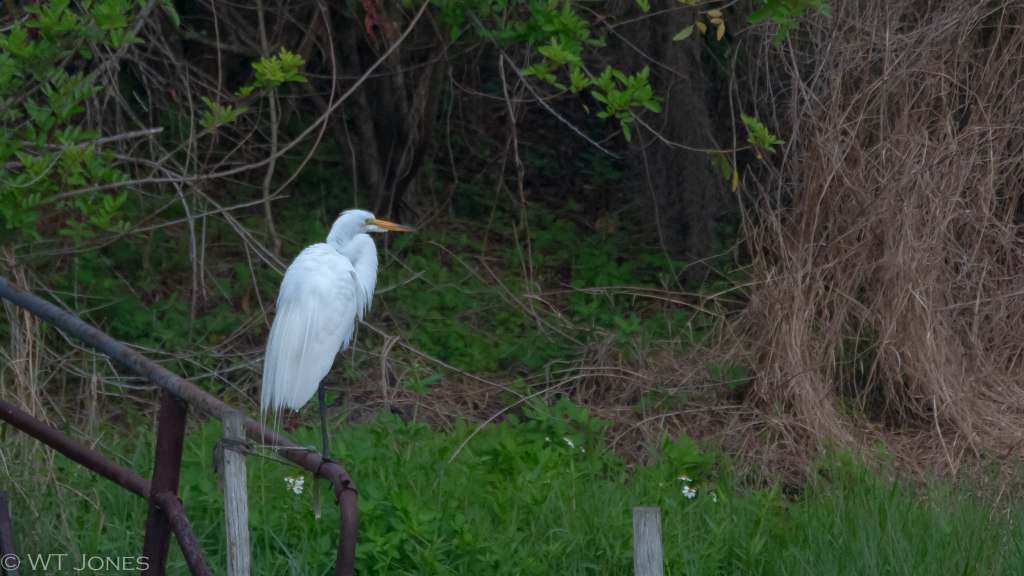
Long feathers (“aigrettes”) on a Great Egret recall the near-demise of the species when these magnificent birds were harvested solely for ladies’ hats to have a decoration. As a reminder, the National Audubon Society adopted the Great Egret as their emblem.
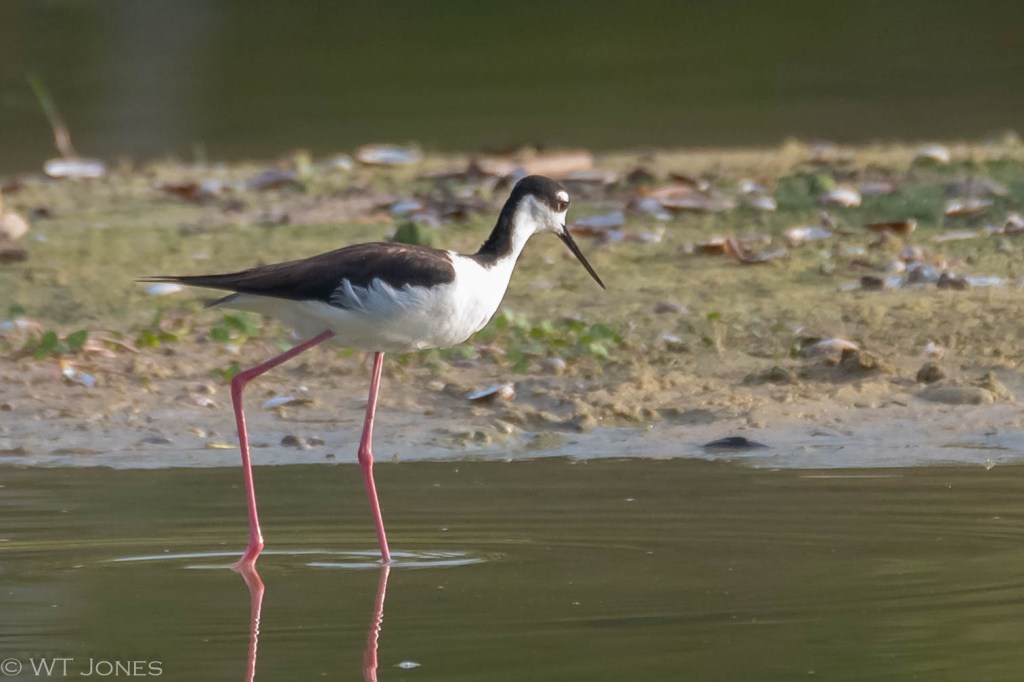
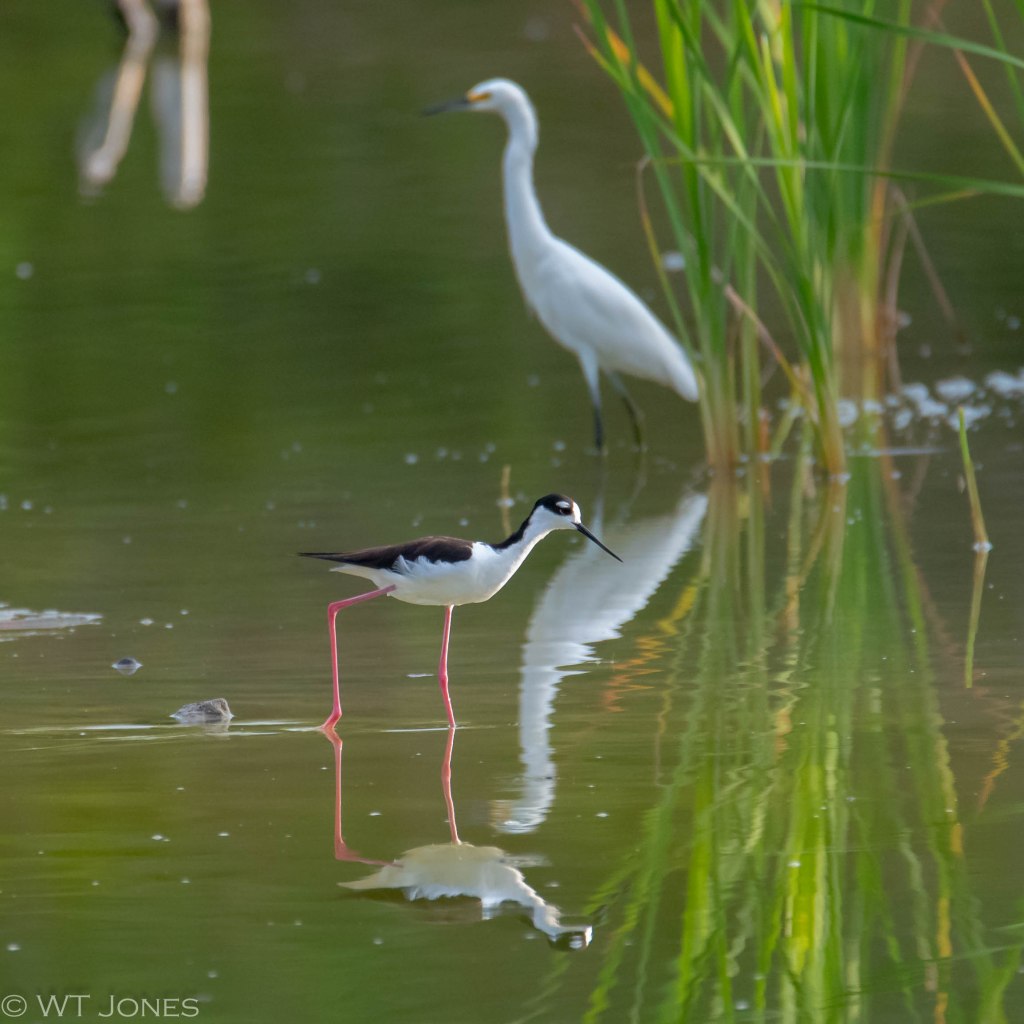
Black-necked Stilts were a bit of a surprise this morning but a very welcome one! The fact we saw a pair indicates they may well breed at this location. Fingers crossed! The second image shows a comparison in size between the stilt and a Snowy Egret.
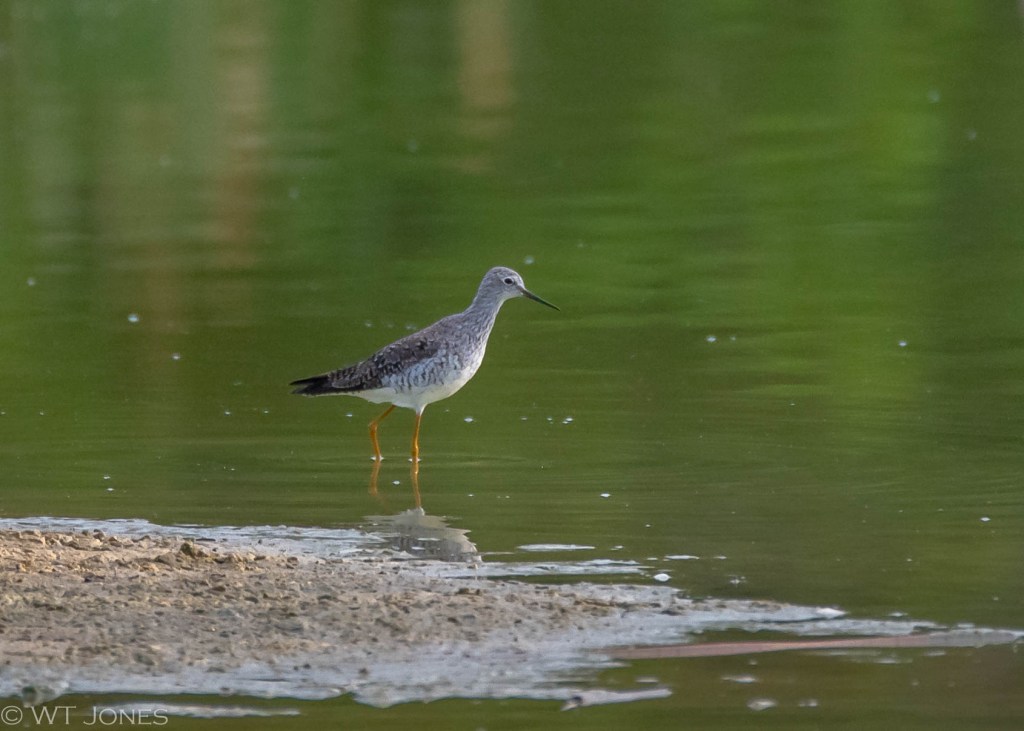
The mud bank attracted three Lesser and one Greater Yellowlegs. When both species are not present to compare size, the call of each is different enough to figure out which is which. This photograph is of a Lesser Yellowlegs.
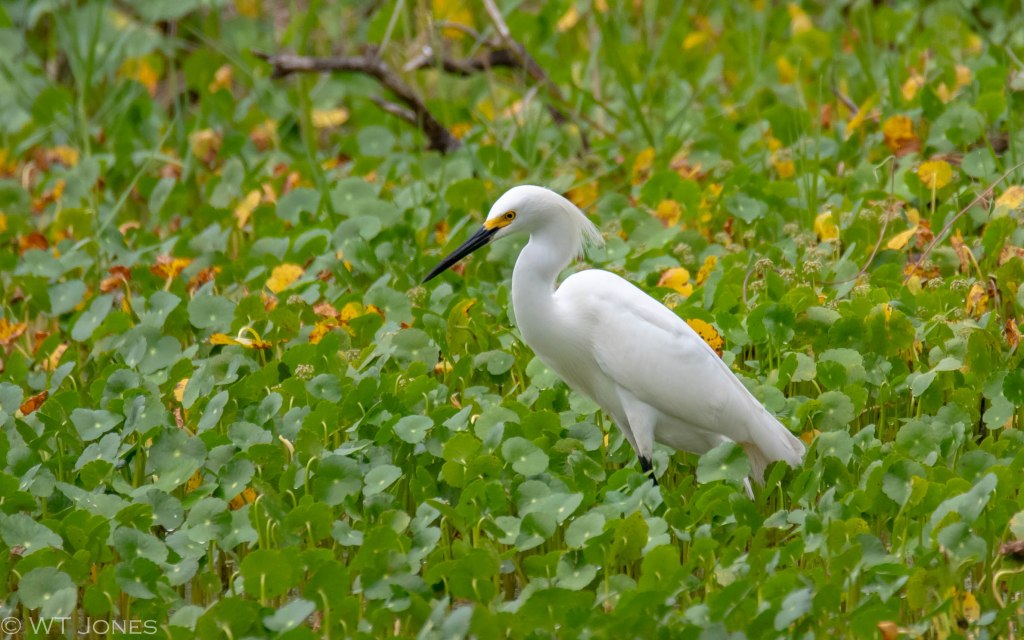
“Golden Slippers” of the Snowy Egret help stir up mud along the lake bottom to reveal potential prey. The feet almost look too big for the relatively small egret. They come in handy for wading across lily pads.

Springtime is alligator mating time! This “teenager” will help raise this year’s hatchlings. It’s not unusual for alligators to remain with their family unit for a few years.

Probably the final curtain call for this spring’s Cedar Waxwings. On our last two visits, Gini and I counted nearly two-hundred of the hungry birds. Today we saw almost fifty. We’ll miss these sleek beauties.
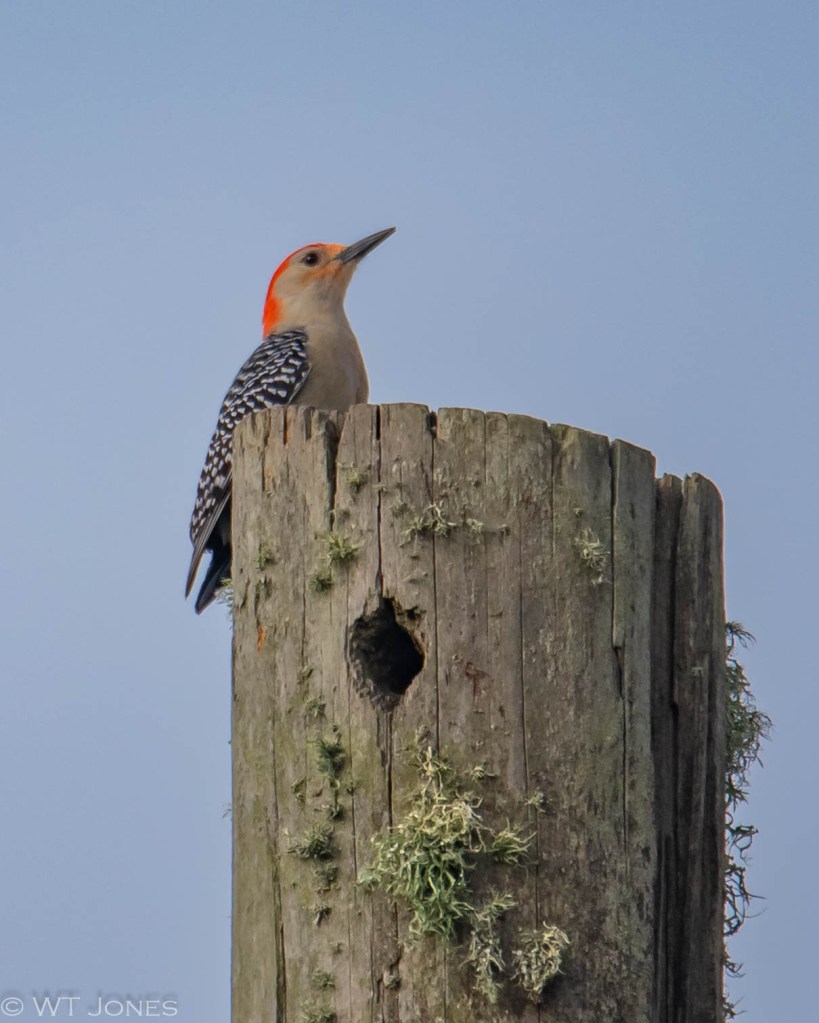
Red-bellied Woodpeckers have adapted very well to human habitation and are Florida’s most abundant woodpecker. Selecting a suitable nesting site may mean excavating a new cavity or choosing a “fixer upper” from last year.
At our breakfast spot, Gini and I found a collection of freshwater mussel shells piled up along the shore. We surmised they were brought here by otters or racoons.

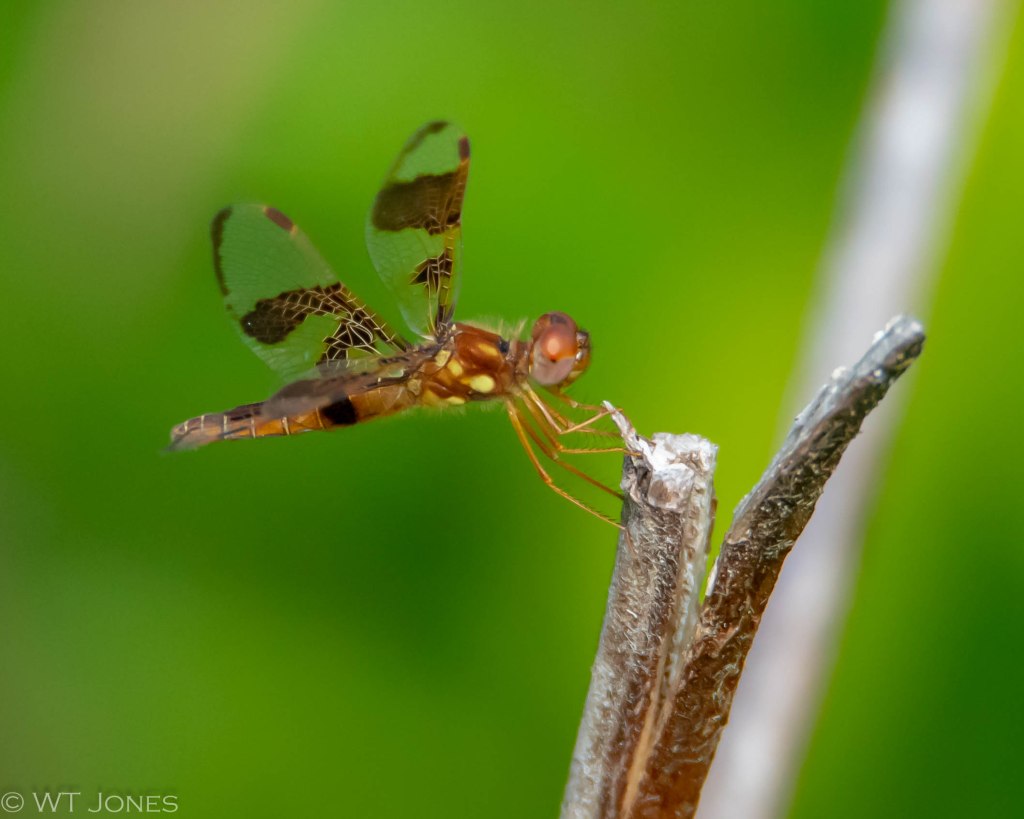
One of North America’s smallest dragonflies, the Eastern Amberwing (Perithemis tenera), is pretty common here. This is a female, as noted by the extensive wing markings. Males typically have very little wing decoration.
Florida’s state bird, the Northern Mockingbird, is, appropriately, quite common throughout the state. At this time of year, the males sing 24 hours a day hoping to impress a female. (I do that, too, but the resident female remains unimpressed.)

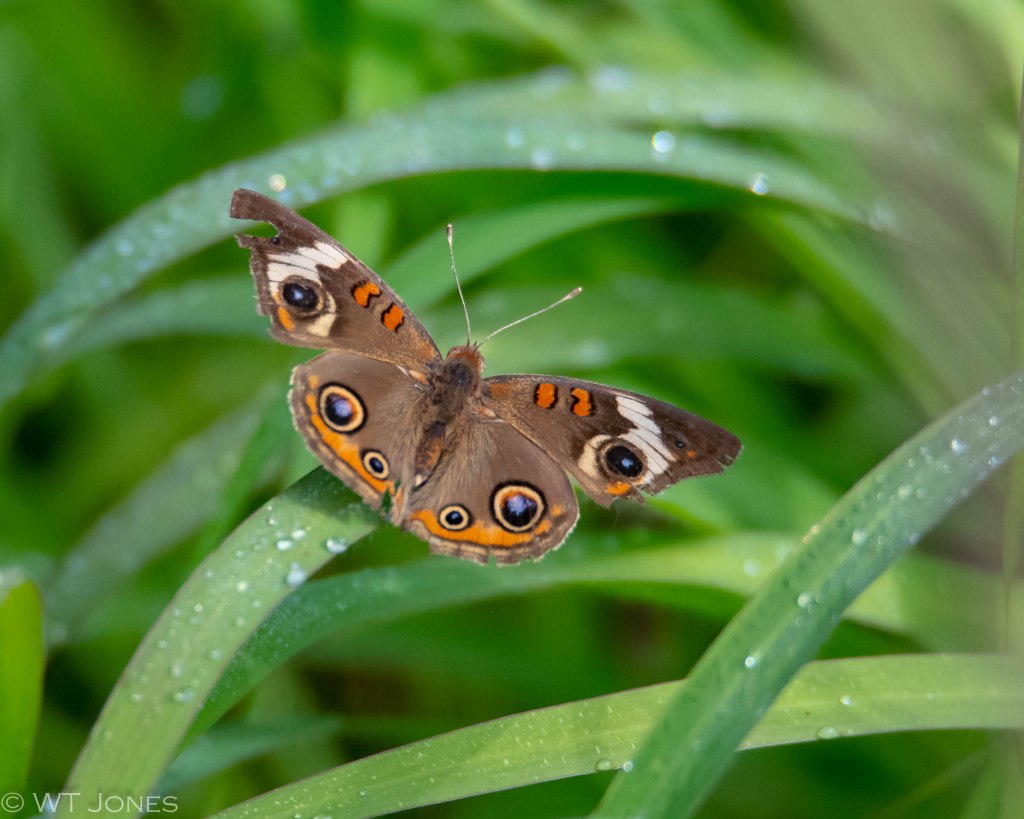
We came across a Common Buckeye (Junonia coenia) flitting through the wet grass.
Another sign of Spring. A Florida Softshell Turtle (Apalone ferox) looks for a suitable spot in which to deposit her eggs. The average clutch size for these turtles is 20 eggs and one female may have as many as six clutches per year.

Turquoise antennal clubs help identify a Great Southern White (Ascia monuste). These lovely butterflies will become very abundant as the days become warmer.

With so many lakes in the area, it’s natural to find Ospreys in large numbers. Many nests are constructed atop utility poles, some of which have had platforms constructed by state wildlife workers. As the nest-building is completed, pairs waste no time in laying eggs. Potential intruders are unwelcome, even the two-legged types who just want a photo.

Our local “patch” may not really qualify as a “patch”, but we certainly do enjoy visiting the place! The fact that it requires very little work on our part to see an incredible diversity of birds, other fauna and flora – well, we are not complaining.
Enjoy your search for a natural place and come back for a visit!
Header Image: Halloween Pennant – (Celithemis eponina)
Our daily human existence is boring, busy, chaotic, emotional and all things in between. We have jobs, chores and responsibilities. Our precisely organized schedules are interrupted by unforeseen circumstances. Loved ones need our attention. We need the attention of our loved ones. Bills must be paid. Politics are ignored but nevertheless intrude rudely into our lives. We plan for the future and the future of our children and the future of our grandchildren and for the future of the planet.
No wonder we are overcome with fatigue.
Each of us must find a way to cope with life. Gini and I have been so fortunate to have each other to turn to, to lean upon, to be there no matter what. We learned over the years the importance of having an escape valve for times when the pressures of life build to critical levels. As often happens, our “escape valve” became a habit. A change of venue worked wonders for all sorts of issues. Visiting a Natural Place invigorated our souls and allowed us to reclaim an inner peace.
A trip to “visit nature” doesn’t need to involve a huge amount of planning and preparation. Those would be called “vacations”, which are definitely nice, but may not be practical to achieve with any frequency. We are fortunate to have several spots nearby and all we need do is get in the car and go. Granted, we typically take along some binoculars, camera and water. But we often only spend an hour or two away from the house. For us – it is enough.
Sometimes we see something new and different. Most of the time, we see the same things. But those same things bring us incredible pleasure and we are still able to marvel at Nature’s diversity. Small blessings make our lives better.
Today’s impromptu trip was to the Bridgewater Tract of Tenoroc Fish Management Area, 4.25 miles from our front door. The sky was blue, the temperature was mild and two hours later we were back home.
A poem.
i thank You God for most this amazing
day: for the leaping greenly spirits of trees
and a blue true dream of sky; and for everything
which is natural which is infinite which is yes
e.e. cummings
Our constant companion, it seems, no matter where we visit, is the White-eyed Vireo. Now, in spring, constantly singing and lurking low in the understory.

Somewhat rare for our area, a small clear sandy-bottomed creek offers a slightly different habitat than is typical. The difference is enough to attract a dark damselfly, the Ebony Jewelwing (Calopteryx maculata).

A Snowy Egret patiently tip-toes through the shallow water hoping to locate a breakfast minnow among the weeds.
Large lily pads holding a bit of water make a nice perch for a male Eastern Pondhawk (Erythemis simplicicollis) to await a passing snack.

New growth each spring at the end of pine tree branches is sometimes referred to as “candles”. On some species, this new growth can take the shape of a cross. Since this growth occurs in early spring, legends are told about how the pine trees know when it’s Easter.

Bright color and extensive wing markings make it easy to identify the Halloween Pennant (Celithemis eponina).

There’s nothing like an expansive patch of bright blue in a field of brown grass to remind us Spring really is here! The color of the Bluejacket, or Ohio Spiderwort, (Tradescantia ohiensis) really is impressive.

Sporting a yellow thorax with dark racing stipes, blue eyes and a white face, this female Blue Dasher (Pachydiplax longipennis) is ready to launch and pursue anything which flies nearby.

Yet another reminder that this is the season of renewal, a large tangle of Sawtooth Blackberry (Rubus pensilvanicus) offers tempting ripe fruit for those brave enough to work through the mass of thorns. Also, these were growing along the bank of a lake and offer perfect hiding spots for our Water Moccasins. Yes, the ones with the short temper and venomous bite. But, the berries are SO SWEET! Risk management ……

We always find something to enjoy when we visit a Natural Place. The bird checklist may be forgotten, the planning may be minimal, the effort may be small – but small blessings are still blessings. We cherish each one no matter the size.
Enjoy your search for a natural place and come back for a visit!
 Our Natural Places