Ridge Redux: Blooms

Pine trees. Tall. Green. Rough, thick, scaly bark. Be careful in handling the pine cone or you may wind up with a hand full of small holes. Close your eyes and breathe in. The air of a pine forest can soothe one’s very soul.
Our two souls were busy being soothed when the shriek of a Red-shouldered Hawk roused us from our reverie. Gini and I have almost come to treat each visit to this section of the Lake Wales Ridge State Forest as a sort of pilgrimage. Each trip seems to offer something different for our senses to absorb.
Beyond all those pine trees we mentioned above, there are areas of smallish oak trees called Florida Scrub Oak or Sandhill Oak (Quercus inopina) which seldom grow taller than ten feet. Open spaces are filled with various grasses, including a threatened species, Cutthroatgrass (Coleataenia abscissa). There are groves of large hardwood trees such as hickory, bay, sweetgum and live oak. Around the lakes and streams are cypress and willows. Vast areas of palmetto cover much of the forest understory.
While we were having fun bird watching throughout the day, our surroundings were incredibly lush as Florida’s autumn blooming season was in – well – full bloom. We once again marveled at Nature’s balancing act as forest, lake, wetland, animal life, birds, insects – all blended to create the world in which we are privileged to exist.
No matter when we visit, there is always something in bloom. Fall can be especially colorful. In addition to many familiar flowers, the Lake Wales Ridge is home to over 30 plant species found nowhere else and which are on federal and state threatened or endangered lists. We may not have found anything rare, but we certainly enjoyed a very colorful day.
We hope you will, too.
Reflecting the sky, Whitemouth Dayflowers (Commelina erecta) were abundant throughout the forest.

Florida Alicia (Chapmannia floridana) is found nowhere else but in Florida. There were many in bloom this morning.

We often encounter pretty pink members of the Rosegentian family, but when they are dressed in all white, they are just as lovely. Several masses of Shortleaf Rosegentian (Sabatia brevifolia) were attractive to us and more than a few nectar-seeking insects.

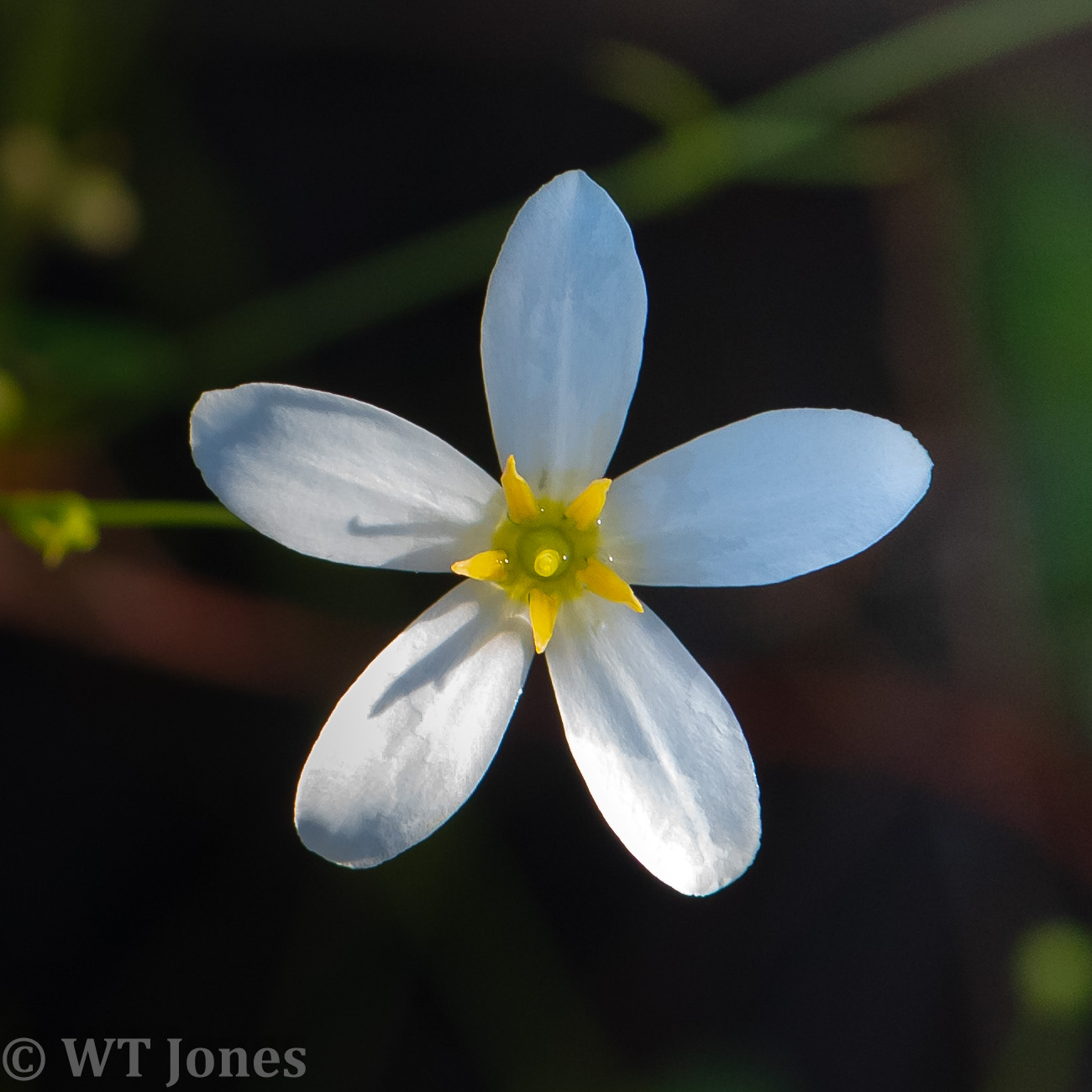

More white. This time in the form of small blooms on thin stalks in standing water. A small photo-bombing metallic green sweat bee thinks the flowers of the Grassy Arrowhead (Sagittaria graminea) are lovely. So do we.

A member of the Aster family, rather than Rosaceae, the Rose-Rush (Lygodesmia aphylla) blooms from spring through fall. A single lavender blossom appears atop a thin stalk about 24-36 inches in height and the flowers are about an inch in diameter. It only grows in Florida and Georgia.

One of the brightest flowers in Florida’s landscape is the Florida Paintbrush (Carphephorus corymbosus). It is also called Coastal Plain Chaffhead and can grow over three feet tall. It occurs throughout the peninsula and in parts of Georgia and South Carolina.


Tubular disk flowers dressed in maroon and white make the Feay’s Palafox (Palafoxia feayi) a really handsome plant, in my opinion. Hordes of pollinators agree. Endemic to the lower two-thirds of Florida’s peninsula, the woody stalks of this member of the Aster family can reach six feet.

Some areas of the forest were painted yellow. One species contributing to the bright landscape was Coastal Plain Honeycombhead (Balduina angustifolia). As the flower petals wilt, they drop and leave just the disk flowers which, at a distance, resemble Yellow Milkwort (Polygala rugelii).

Even the grass is beautiful out here. Several spots had tall Lopsided Indiangrass (Sorghastrum secundum) waving in the breeze.

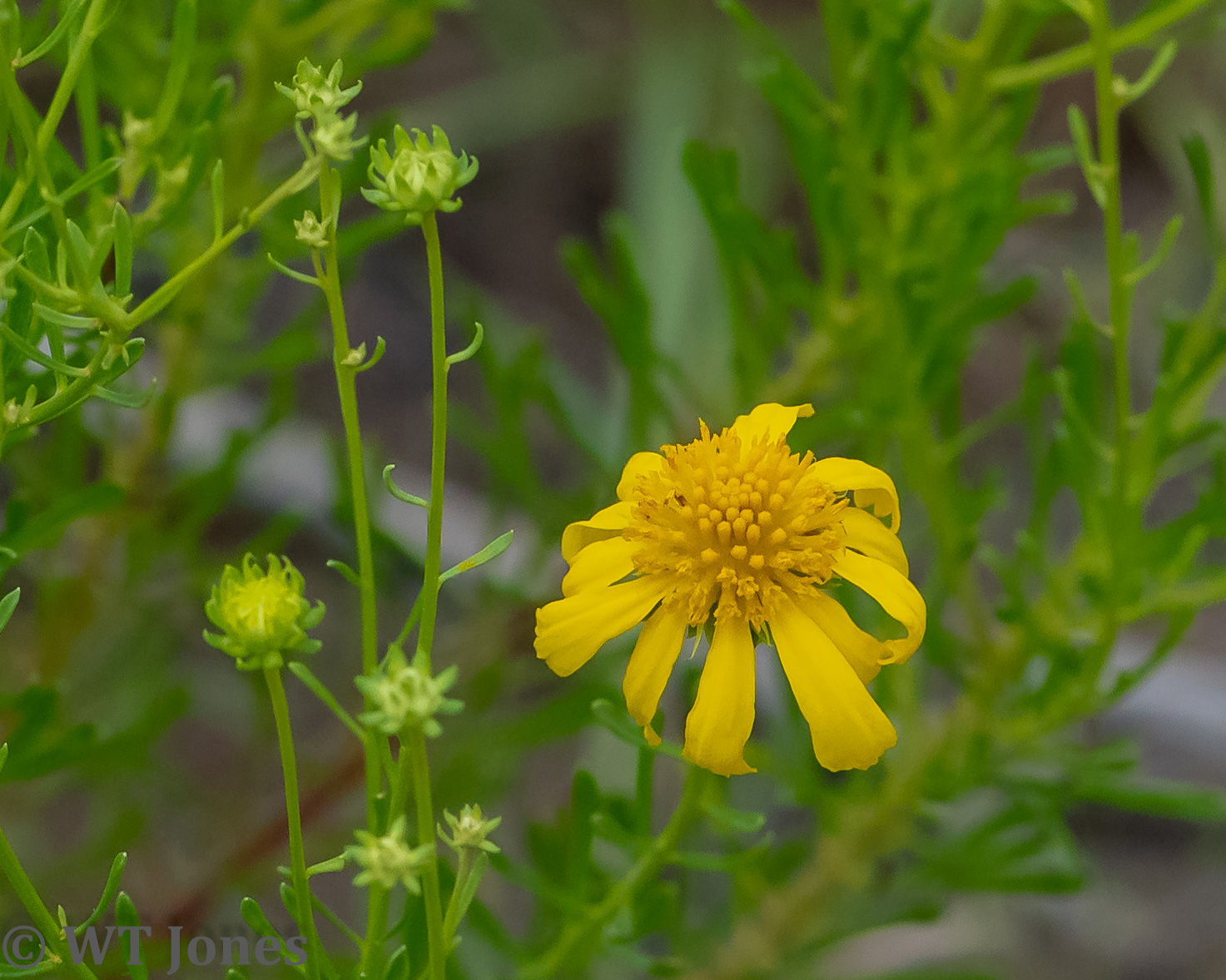
More yellow. This time, small flowers atop many-branched stems and grass-like leaves with fine hairs which give the plants a dull green/silvery appearance. Narrowleaf Silkgrass (Pityopsis graminifolia) is well-named.

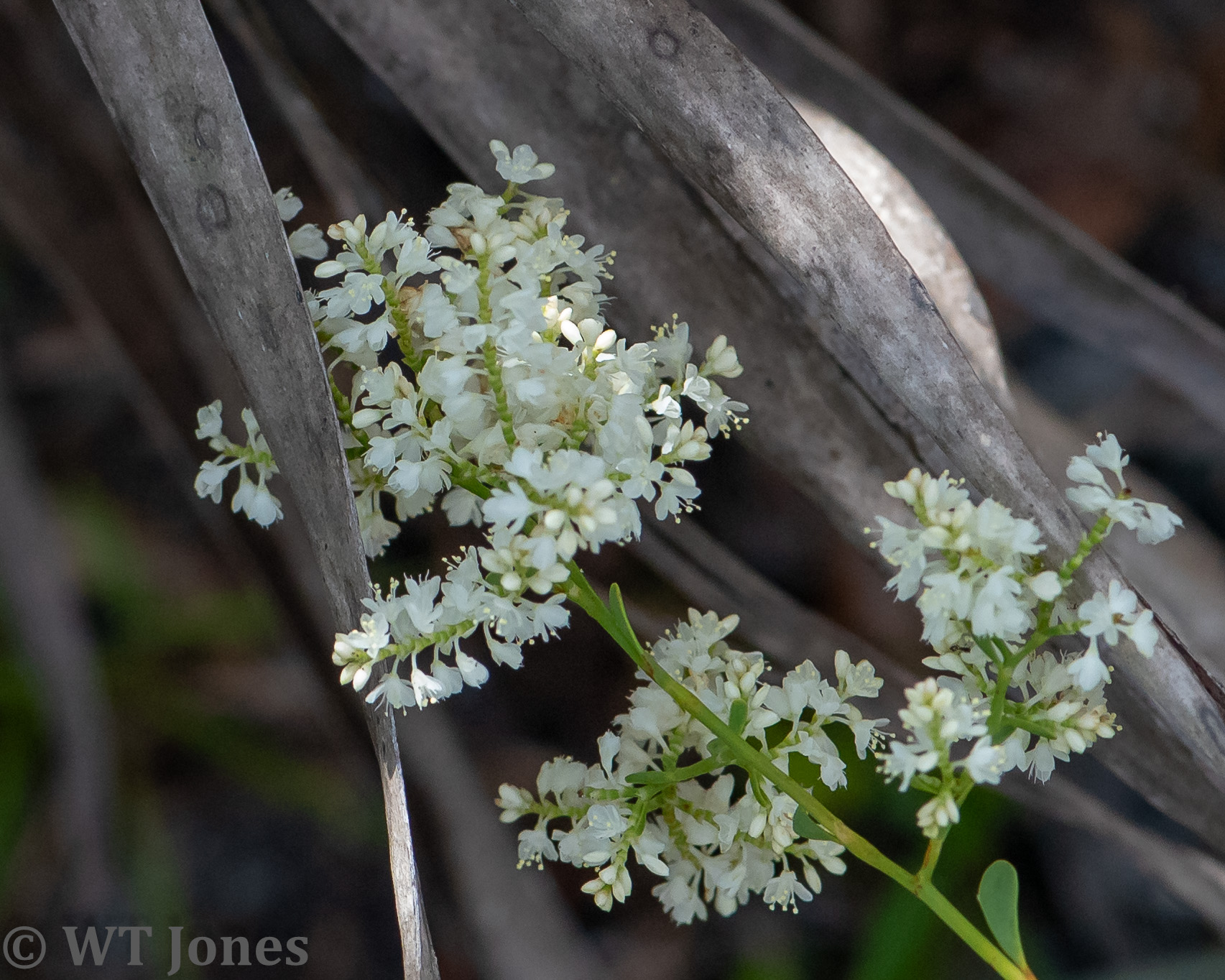
Masses of small white flowers against a backdrop of green saw and scrub palmetto fronds make a dramatic statement. Overlooked much of the year as the plant’s small green foliage blends in with its surroundings, fall is showtime for the stunning performance of October Flower (Polygonum polygamum).

Drupes of burgundy fruit dot the edges of wet areas and, by themselves, appear like small grapes ready for harvesting. Indeed, the fruit as well as most other parts of the Winged Sumac (Rhus copallinum) tree have many recorded ethnobotanical uses, from culinary to medicinal. And oenological.

As one peers through the woods or travels along a path, the vast green canvas is dotted with what could be small red stars. Half a dozen species of holly trees can be found in central Florida. One of the more common in this particular habitat is the Dahoon Holly (Ilex cassine). Bees love the flower nectar in spring. Birds and small animals like the fruit in the fall. (As for Gini – she is in a daze, visions of red-studded Christmas wreaths dancing in her head.)

Our latest pilgrimage into the forest of The Ridge has been memorable. We have seen bodacious birds, beautiful blooms and, as you well know, where there are blooms, there are bound to be — Bugs. Buzzing in soon.
Enjoy your search for a natural place and come back for a visit!


Your flowers photos are dazzling. The close-up of the Rosegentian is mesmerizing. Our only evergreen in immediate view of our windows is a White Pine which produced its first cones this autumn. I harvested 5 of them and set up two as hanging peanut butter feeders. Bluebirds and Downy Woodpeckers love them. The juncos flutter and try to take bites on the fly. Thanks for reminding me of all the floral beauty I am missing at this time of year!
LikeLike
Thank you so much, Ken.
It’s a trade-off. Y’all have all those gorgeous tree colors and we try to make do with a few blooms.
No offense, but you may keep any extra snow you might accumulate this year.
LikeLike
You two lovebirds seem to be enjoying the season of autumn (if there is such a thing in Florida). I enjoyed your blooms and especially the seasonal holly
Meanwhile, yes it another grey day her with a fine drizzle. Fine as in thin and nasty not as in very nice. Sue has gone off to Thornton-Cleveleys with her free bus pass to do Christmas Shopping and to grab a bacon butty and a cup of tea in Wetherspoons – Wetherspoons is the pub that sells pints of beer with breakfast so I do hope she doesn’t come home drunk again.
In her absence I will nip to the supermarket and buy her Christmas presents – a bottle of Gordon’s and a box of chocolates is easily sorted. And then it back to the garden to sweep up more leaves then prep grilled salmon and potatoes for evening meal. Maybe even a bottle of Nero D’Avola . Wish me luck. Stay sane and well y’all.
LikeLike
We are, indeed, loving our autumn. Such as it is. The trees are slowly transforming from a lush green to a lovely shade of brown-ish. We know it’s autumn as the bird feeder visitors have changed from two dozen White-winged Dove and Blue Jays to four dozen White-winged Dove and an energetic Eastern Phoebe.
Thanks for the reminder we should be thinking about Christmas shopping. At the moment, Gini is furiously preparing a half-dozen dishes to take over to the Daughter’s place tomorrow for our annual American Thanksgiving feast.
It would be easy to fall into despair about how little we have to be thankful for in the current world. Then we take stock and realize how truly fortunate we have been.
We are SO lucky, why, we even know a chap across the vast Atlantic Ocean who likes birds well enough to provide them leg jewelry.
As we give thanks tomorrow, rest assured we will inclulde you and Sue among our blessings.
Enough mushy stuff. Off to fix my own version of a bacon butty. See ‘ya.
LikeLike
Your photos of the white Sabatia are splendid. I especially like the long-stemmed third image; what a pristine flower that is. I occasionally come across white examples of our Sabatias, but having a species that color would be special.
One of my favorite spices for cooking is za’atar, and an ingredient often used in the mix is sumac. Your species can be used that way, as can the Rhus species that grow here. You may already know about it, but this is a nice introduction. It’s especially good on fish. While Gini’s working on her wreaths, you could be pulverizing sumac!
One of my favorites is our Lygodesmia species known as the skeleton flower. From your photo, it looks as though your species has the same sort of leafless stem: another family resemblance. The Arrowhead is familiar, of course, but those Palafox flowers are my very favorite here. They’re just so elegant!
LikeLike
Several large bushes of that white Sabatia were certainly attention-getting as they bordered a vast scrub palmetto area. The rising sun made the dew drops sparkle and lit up the flowers’ yellow centers. Gorgeous.
Our “go to” salmon dinner includes za’atar and a lot of lemon and garlic.
Every time I spot a Rose-rush I think “what is THAT”? It is just so striking a bloom alone on that stalk and usually not surrounded by many other flowers. Special.
You are preaching to the choir about the Feay’s Palafox. We have a small patch of them within a mile of the house where they enjoy the company of the Florida Alicia. Less than 50 sq. ft. of perfect habitat. We’re happy they take advantage of it.
Happy Thanksgiving to you!
LikeLiked by 1 person
Great set of colorful thingies – my plant knowledge is nearly nonexistent ha. I do really like the Florida Paintbrush – now those are cool. Wonderful shots and I feel a bit more educated about those thingies now ha.
LikeLike
Google appears to be the winning method of commenting on your site for me now!
LikeLike
That’s good to know. I’ll keep trying.
LikeLike
If it weren’t for the internet, I’d be as ignorant about nature as I was before I got tangled up in the world wide web. Now, however, I are a genius on many subjects!
Happy Thanksgiving Y’all!
LikeLike
Delightful photos of a bountiful bunch of botanical beauties Wally. I found the Whitemouth Dayflower and the Florida Paintbrush to be particularly attractive.
Your notes on the Winged Sumac had me looking for more information, as I was not aware of its uses. You also taught me a new word (oenological) which I was surprised I had not met before. However, I suspect that it will soon drop out of my aged brain!
We seem to be seeing some improvement here, and hopefully medical issues are going to be resolved. We have just come back from a highly enjoyable lunch meet-up with my brother (not seen for a year) and sister-in-law (not seen for four years – mainly due to the pandemic).
Your on-line friendship is so very much appreciated, and has been a life-line in what, for us, has been a difficult year – thank you so much.
With my very best wishes to you and Gini – take good care – – – Richard
LikeLike
Thank you, Richard.
The continuing education in Nature is a fun project. There is so much for me to learn.
How nice you had a chance to meet with your brother. Any time with family is a good thing.
Our mutual interests help foster friendship and Gini and I look forward to much more support for you and Lindsay as needed.
All the best to you both!
LikeLike
Wonderful collection of images and observations. You enticed me to go look something up. “Oenological” means “pertaining to wine”. Low and behold, when I looked up sumac wine, there were all kinds of references. Apparently Winged Sumac berries are very tart, so would lend quite a bit of flavor in small doses; other sumacs are fruitier, and perhaps better suited to be the main flavor component. I also wondered how many birds and bugs might attribute their red or orange coloring to eating the sumac berries. Everything is connected, as they say!
LikeLike
Blogging can be so educational.
New ways to make wine can’t be a bad thing, can it?
Especially if it helps in our search for birds and things.
LikeLiked by 1 person
Love this post Wally. I must admit though I admire flora I don’t really look closely, and rarely photograph it.
LikeLike
Thanks very much, Brian.
I started bird watching about a hundred years ago. That led to studying the birds’ habitat. That led to looking closely at plants and flowers, That led to learning about bugs.
I guess I am just easily distracted. I love it all!
LikeLike
Great macros. I particularly enjoyed the Rose-Rush. 👏
LikeLike
Thank you!
Isn’t that a pretty flower? We always love finding them.
LikeLiked by 1 person
I delight in your tributes to the beauty and wonder of nature. Many thanks to you both.
LikeLike
We delight in you delight, EC.
May your mornings be cooler and your pain less.
LikeLike
You two always come across as in tune with nature and with each other in nature.
I recognize some of these flowers as kin to species that grow in Texas.
That your Polygonum is polygamous raises the question of why.
LikeLike
After 56 years of marriage we stil manage to harmonize pretty well, naturally.
The answer to your question regarding October Flowers may be the same as it is for the polygamous human. “Because I can!”
LikeLike
Wow: 56. I’m sure you pointed out on your anniversary the celebratory fact that 56 consists of two consecutive integers and is the product of the next two consecutive integers, 7 and 8.
LikeLike
The only important products resulting from our union are now 50 and 53. We may not understand mathematics, but we did learn how to multiply.
LikeLike
Well said!
LikeLike
Beautiful shots of the flowers! It’s amazing how things perk up in November around here.
LikeLike
We’re both natives and are still surprised at how much color the fall woods can produce.
Thank you, Dina.
LikeLike
Well, this was a visual treat and supplied a bit of warmth as I scrolled through your posted bouquet. No flowers to be seen here now. Well, I did see one lonely dandelion when walking Bentley. But most are withered and brown. Thanks for the reminder of floral beauty.
LikeLike
Happy to have been of service, Steve.
We’re fortunate to have such an extended growing season. It allows us to enjoy spring-like floral displays in the autumn.
Of course, we really miss ice and snow – 🙂
LikeLiked by 1 person