
(Click on images to enlarge, click again to zoom.)
Our timing was good.
Driving through the fringe of the city limits in the dark of pre-dawn is sometimes a harrowing experience. Drivers tail-gating, anxious to pass at the first opportunity, or in many cases, making their own (dangerous) opportunity. They either love their jobs so much they just can’t wait to get there, or they overslept again. We suspect the latter.
On this morning, however, we seem to have caught the leading edge of the commuting wave. The streets were not empty, but they were not nerve-wracking to navigate. City lights soon faded in the rearview mirror. It was dark enough that we could not yet make out the fields and pastures we knew from experience were now on either side.
More city lights ahead. The small town was not nearly the same congested experience of our own larger municipality. We turned eastward, crossed the river and left the village as the sky began to lighten.
Pastures were now replaced with citrus groves. After an hour-and-a-half of driving, the sun was just breaking the horizon as we turned onto the access road to our destination. Lake Wales Ridge State Forest.
This particular section of the State Forest is our favorite both because it is the nearest to us and due to the incredible diversity of natural treasure it contains. The 26,000 acre Arbuckle Tract is adjacent to the western shoreline of large Lake Arbuckle and runs along the ancient geological ridge of mid-Florida. Unique flora and fauna abound here.
Sounds of city traffic have been replaced by early summer Cicadas, calling Barred Owls, hammering woodeckers, songbirds belting out spring courting melodies and the wake-up screech of several Limpkins. As the sun begins to dry the drops of dew from leaves and flower petals, insects begin their day of trying to survive. Active insects signal predators its time for them to begin their day of trying to survive. All of the above indicates our day will be filled with adventure!
Come with us and let’s see what we can discover.
A small member of the pea family, Elliott’s Milkpea (Galactia elliottii), appears in several spots at the edge of the forest. It is the only native Florida pea to have white flowers.


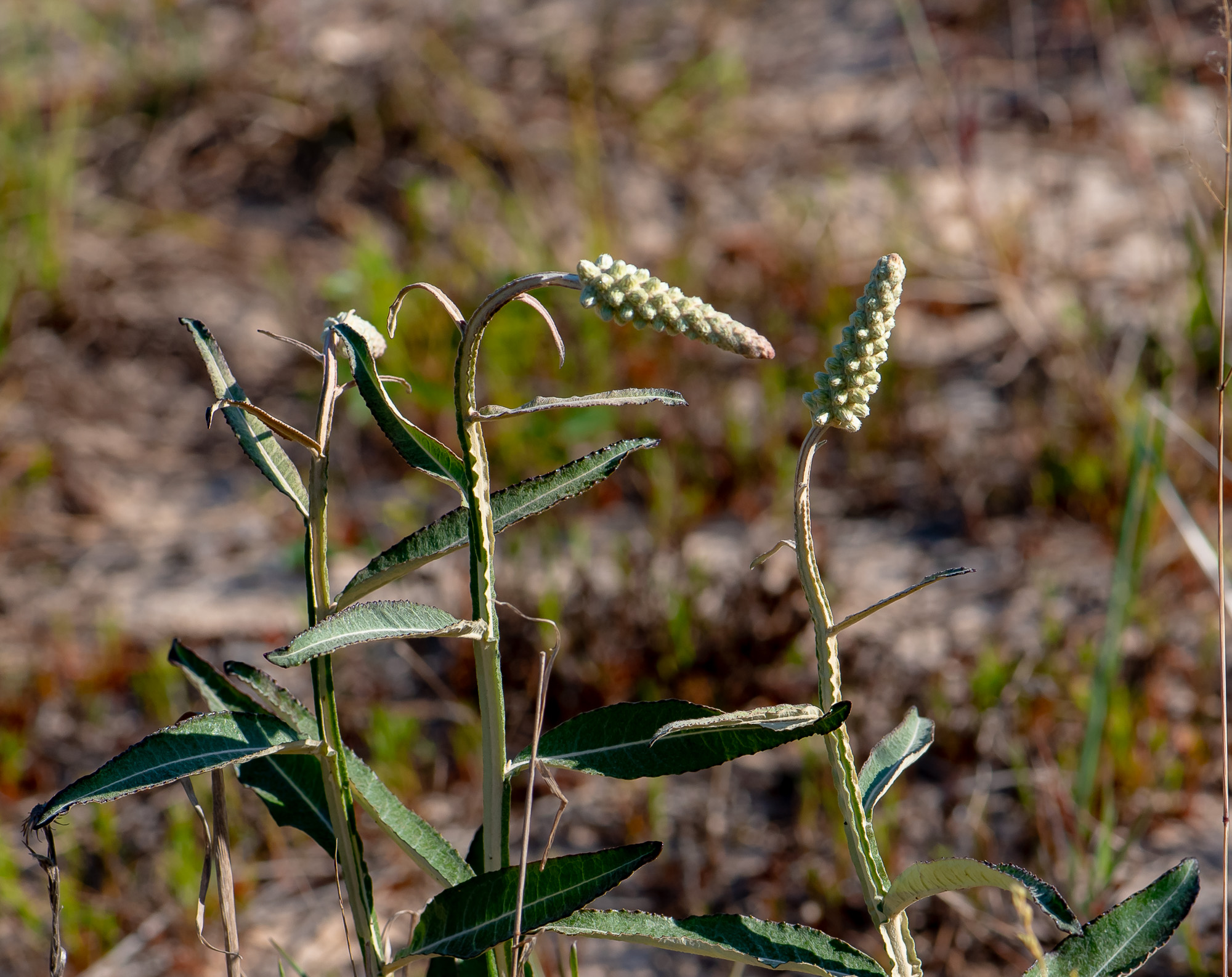
The unique foliage and flower of Blackroot (Pterocaulon pycnostachyum) make this a very intersting plant. Several species of butterfly and other pollinators agree.
Characteristically perched horizontally atop a bare twig, the Red Saddlebags (Tramea onusta) is hoping for an early breakfast treat to appear. We hope it finds plenty of mosquitoes this morning.

As happens when exploring, we found a new flower species as we were heading to photograph something else we had spotted. We’ve been looking for these lovely spiraling orchids for quite some time. Today was the day for finding Grass-leaved Ladies’ Tresses (Spiranthes praecox)!

Thistles attract quite a variety of pollinators. Here, a Palamedes Swallowtail (Pterourus palamedes) enjoys the nectar the spiny plant offers.

One of the most prevalent bird calls we heard all morning long was the song of the White-eyed Vireo. They are quick to investigate trespassers in their forest and loudly announced our presence to all within earshot.

We like the symmetry of the tall (36+ inches) Pinebarren Aster (Oclemena reticulata). Although most of the blooms were past their prime, they still made an attractive display among the palmetto and pine tree setting.


They may be small, but it would be difficult to overlook the very bright blue flowers of the Whitemouth Dayflower (Commelina erecta). We were happy to find them sprinkled liberally along our route.

We love the simple beauty of Rose-rush (Lygodesmia aphylla). A tall (2-3 feet) stem usually only produces one flower at a time. The plant we found as a couple of buds waiting their turn. This species is nearly endemic to Florida, having been reported in only two counties in Georgia.

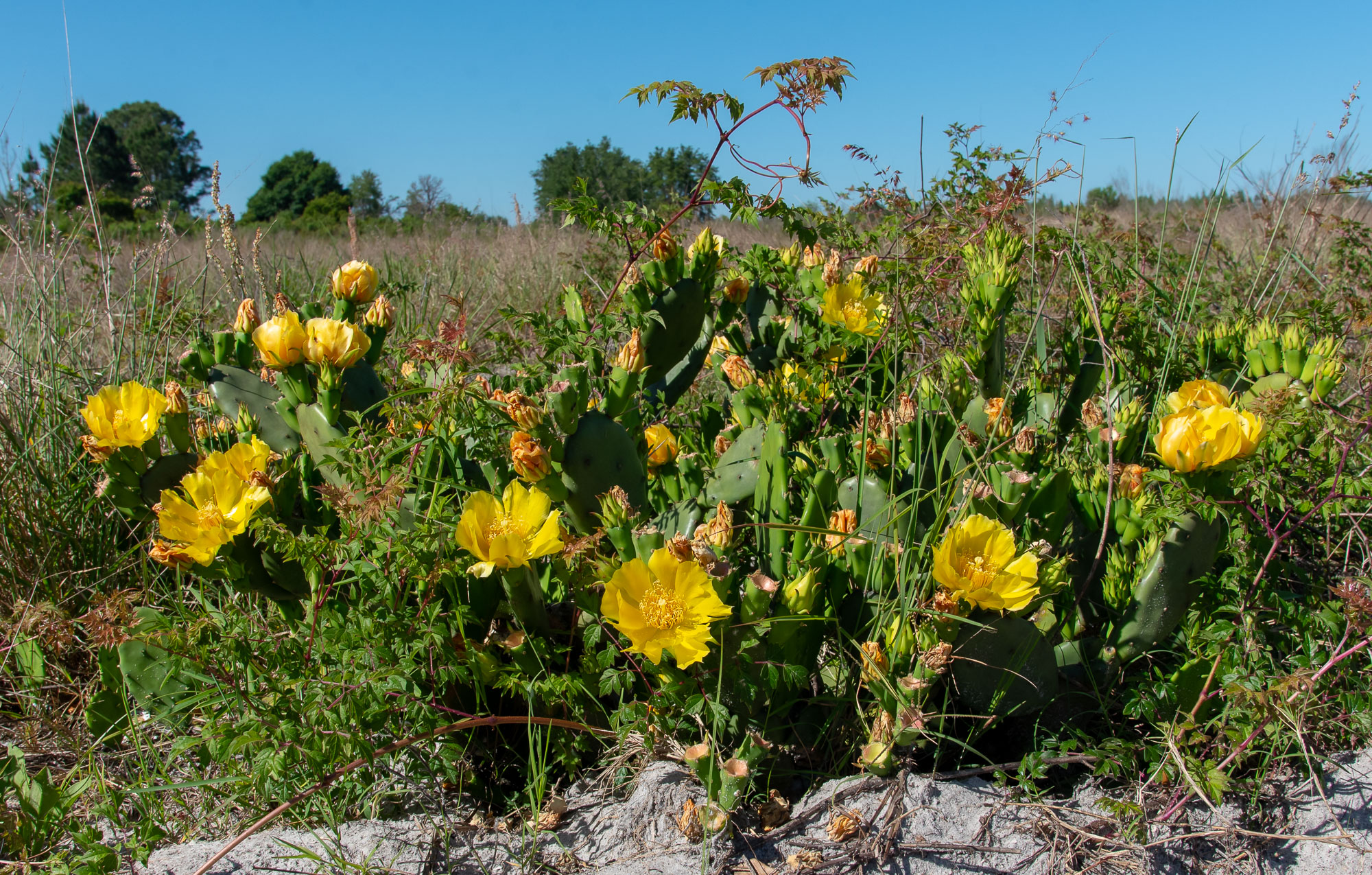
The prevalent sandy conditions of the Lake Wales Ridge provides a welcome environment for plenty of Prickly Pear (Opuntia spp.). Outstanding flowers could almost tempt one to pick a few for the dining room table. Almost – then you notice why it’s called “prickly”.

“Heeeeeere kitty kitty kitty.” The clear whistle and trill from the understory of the pine woods advertised the presence of a Bachman’s Sparrow. This fairly nondescript bird builds a cup-shaped nest on the ground in this type of habitat. The female will often weave a bit of grass to form a dome overhead. We were fortunate to have one pose as they are normally one of those “heard but not seen” species.

I like this scraggly plant. Grassleaf Lettuce (Lactuca graminifolia) often appears to be “dead” but then you find a few of the lovely lavender blooms on a branch. The billowy seed heads remind one of Dandelions.


Time for breakfast. Hope you brought something good. Next up: More Ridge Riches.
Enjoy your search for a natural place and come back for a visit!
Additional Information
https://www.fdacs.gov/Forest-Wildfire/Our-Forests/State-Forests/Lake-Wales-Ridge-State-Forest

(Click on images to enlarge, click again to zoom.)
We continued our slow, stop-and-go travel along the old logging road. It seems we were behaving like the insects who land on a flower, enjoy it, flit away to another bloom and continue on their merry way in the same fashion. Our progress through the forest was slow. But ever-so-enjoyable.
Birds continued their singing beyond our visual range. We anticipate seeing youngsters learning to fly and hunt on our next visit. For now, hearing the music is enough.
Once again, the accidental success of observation has been fascinating. I see a bit of color. Closer inspection reveals a flower and I attempt to record its image. Lowering the camera, another bit of color, within inches of that first bit of color, catches my eye and another photograph is called for. Kneeling down to inspect the second flower more closely brings my eyes to a different perspective and – imagine that – yet another flower a few feet away. Kid. Candy store.
Speaking of keen observation. Gini pointed: “The thistle stems are moving.” Almost. A half-dozen leaf-footed bugs are moving up and down the spiny stems as they go about their daily search for breakfast, lunch and dinner.
Speaking of which, my nature-loving Love asks if we can stop at the BBQ place on the way home. Now, if we can just get to the main road without too many more stops to look for – “Look at that group of Coralbean plants!”.
A late lunch will be just fine.
Yellow Milkwort (Polygala rugelii) is fairly abundant in this upland pine forest habitat. It is endemic to Florida and the bright sunshine color brightens up the landscape. (Note: It seems many species in the Polygala genus have been moved to Senega. Most sources I’ve checked don’t reflect the change, so I’ll stick with the old until I’m threatened with offense against a milkwort.)

More bright color is provided by a very healthy crop of Purple Thistle (Cirsium horridulum). Whether it’s called Bristle, Bull, Horrible, Purple, Spiny or Yellow Thistle, this member of the Aster family is vital to a huge number of creatures.

Gini’s “moving stems” turned out to be busy Eastern Leaf-footed Bugs (Leptoglossus phyllopus).

Bees and butterflies like the beautiful blooms of the Lyreleaf Sage (Salvia lyrata) almost as much as we do. For a different reason, though.

We’re pretty sure this diminutive flower is Browne’s Savory (Clinopodium brownei). It grows in wet areas and is a member of the Mint family.

A female Blue Dasher (Pachydiplax longipennis) perched with her wings forward appears ready to dash away in pursuit of, we hope, a nasty little mosquito.

Since we grew up in central Florida and spent a lot of time on lakes fishing, we almost take the ubiquitous Pickerelweed (Pontederia cordata) for granted. Then we take time to look closely at its structure and colors and fall in love with it all over again.

I suppose some administrative adviser couldn’t figure out which exact species should be Florida’s state wildflower so they just chose the entire Coreopsis genus. The wiry-stemmed Leavenworth’s Tickseed (Coreopsis leavenworthii) is one very lovely representative for the state.

Long nodding racemes packed with tiny white flowers sway in the breeze and invite us to come closer for a better look at the Lizard’s Tail (Saururus cernuus). A pleasant fragrance enhances the invitation. Unfortunately, the plant is usually growing in a very wet place likely filled with snarling snakes waiting for an unsuspecting victim. (Okay, yes, I waded out there and got a picture. No snakes. This time.)

We encountered quite a few patches of Carolina Wild Petunia (Ruellia caroliniensis) this morning. The lavender, tube-shaped blooms attract a large variety of bees and butterflies. Despite their common name, these are not true Petunias (Solanaceae family) but are in the Acanthus family.

Coralbean (Erythrina herbacea). What an interesting plant. From the springtime bright red tubular flowers to the fall brown seed pods filled with scarlet seeds, these plants often grow to over six feet tall. Yet another flower with an adoring audience of nectar lovers.

Velcro. I have no doubt that the person who invented velcro came up with the idea after picking beggar lice (hitch-hikers) from their socks after a day in the field. Who knew the pesky little things had such a pretty flower? Panicled Ticktrefoil (Desmodium paniculatum), one of 22 species of that genus within Florida, can be forgiven its hitchiking seeds as long as it keeps displaying a bloom such as this.

In the unlikely event we had forgotten, a courting pair of small Phaon Crescents (Phyciodes phaon) reminded us – it’s Spring!

Any time we are able to be outside exploring Nature is a good thing. There is something quite special about Spring, though. A reawakening of the land, rekindling optimism about our lives, reaffirming relationships. For us, Spring is also a very special time to be – Among Flowers.
Enjoy your search for a special place and come back for a visit!

(Click on image to enlarge, click again to zoom.)
The calendar for this excursion was near the end of April. Florida’s heat and humidity will be here soon. In the meantime, the mild clear mornings are glorious.
We turned off the county highway onto an old logging road as the eastern sky began to lighten. A coating of dust on the plants beside the dirt track testified to the recent dry conditions. Gini (“super-ears”) was already ticking off bird calls. Cardinal, Mockingbird, Mourning Dove, Northern Parula, Carolina Wren, Tufted Titmouse, Red-bellied Woodpecker. Beams of sunlight streaked through the tall pine trees.
Experience has taught us to go slowly when exploring Nature. Just opening the car door and scanning the ground before I step out reveals a scattering of tiny purple-and-white flowers some call “match-heads”. We’ve always referred to it as Frogfruit. Other names include Capeweed, Creeping Charlie and Carpetweed. The United States Department of Agriculture, as befitting an official spokes-botanist of the entire Government, deems this miniscule bloom the Turkey Tangle Fogfruit. Stopping a few steps away from the vehicle to just look around reveals a panorama of springtime lushness.
Different species of trees have emerging leaves of varying shades of green. Kneeling to examine one small plant reveals a different plant just a few inches away. “Looking” turns into “observing“. Our day has begun.
Gini continues to marvel at the variety of birds she hears. Although they are singing, this is breeding season and most are not lingering on a branch posing for the camera. Singing, yes. In plain sight, not so much.
In addition to the music of the birds, exploring the swamp’s forests and savannas is a smorgasbord of sensual experiences. Aromas of blooming flowers, the tactile pleasure of one’s hand brushing the leaf of a fern, the sight of a bright orange butterfly flitting just ahead of our steps.
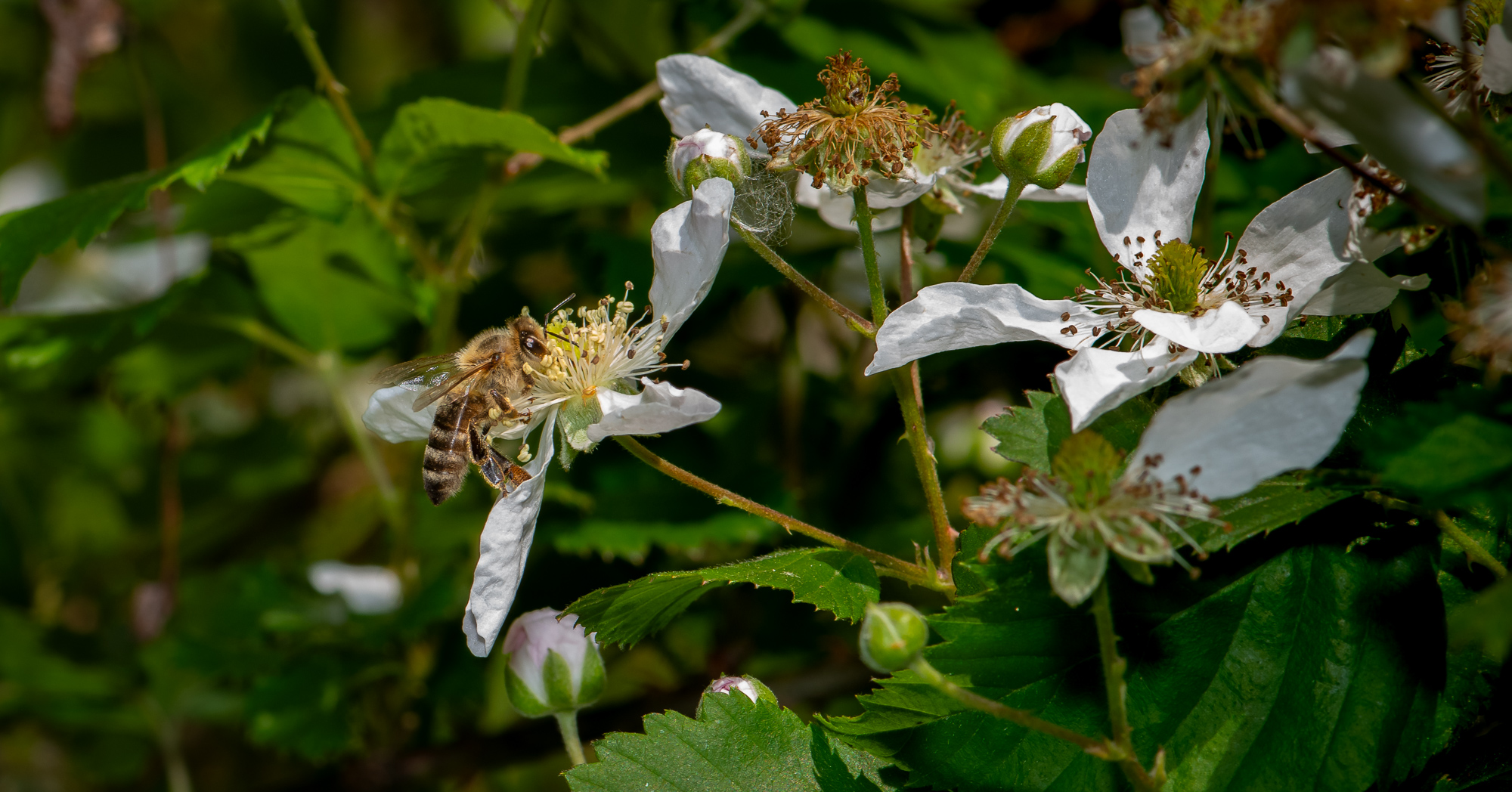
Bending to more closely examine a pink Swamp Rose, a large Bumble Bee buzzes up from an adjacent blossom. A squeal of delight followed by a plea (“Oh! Please come back!”) encapsulates the essence of why I love her so very much.
We hope you enjoy flowers.
(Thanks to Steve Schwartzman for pointing out I forgot to include the Frogfruit. Here it is now.) The little flower with so many names seems to consist of a group of tiny flowers. Hard to believe this little thing attracts so many pollinating insects. Frogfruit (Phyla nodiflora).

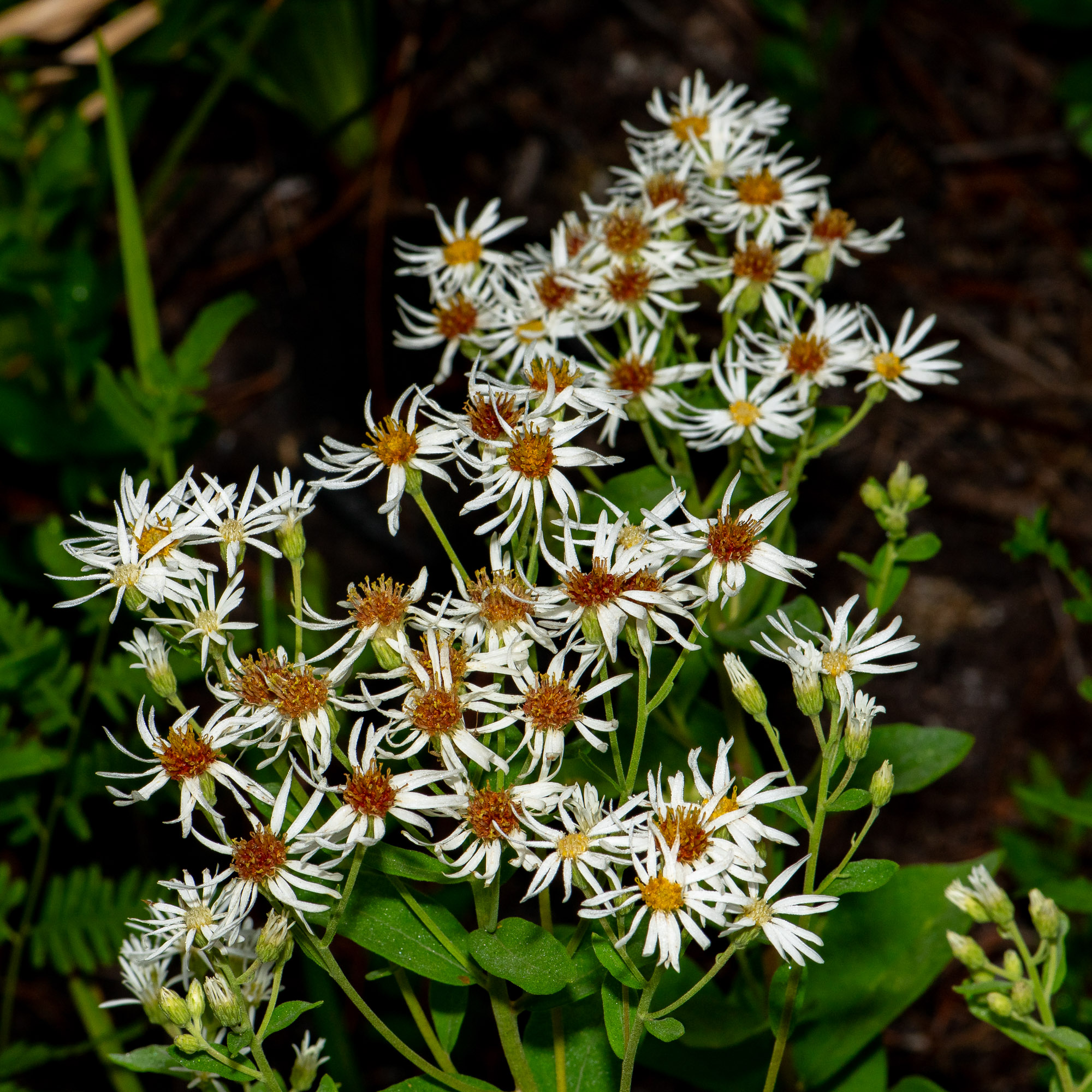
Bouquets of Pinebarren Aster (Oclemena reticulata) were scattered in profusion in some patches of the pine forest understory.
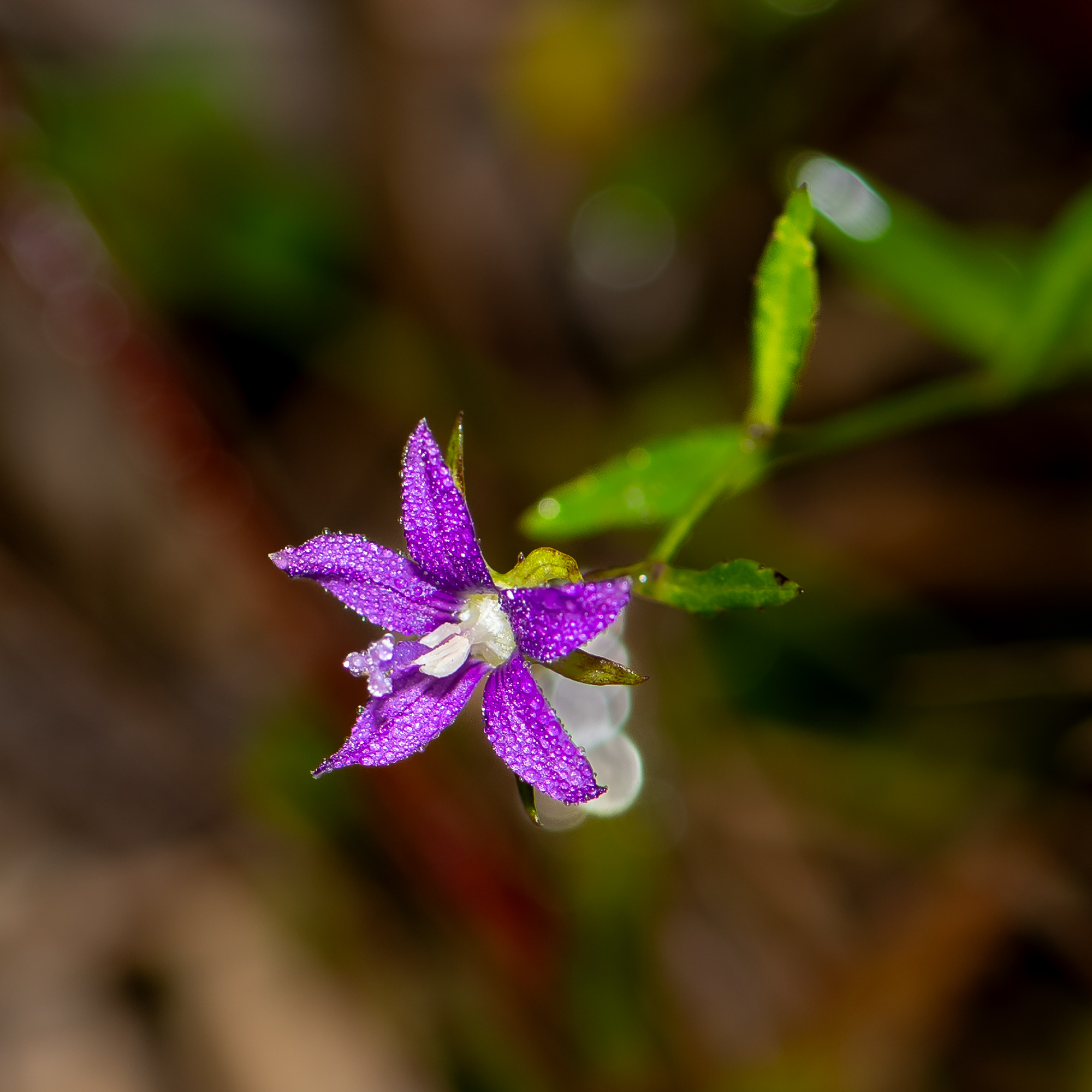
Tiny flower, large beauty. The Florida Bellflower (Rotanthella floridana) is endemic to the state.
For some reason, I thought the Southern Beeblossom (Oenothera simulans) was more widespread. It appears to be limited to just a few southeastern states. Delicate flowers attract a large variety of pollinators.

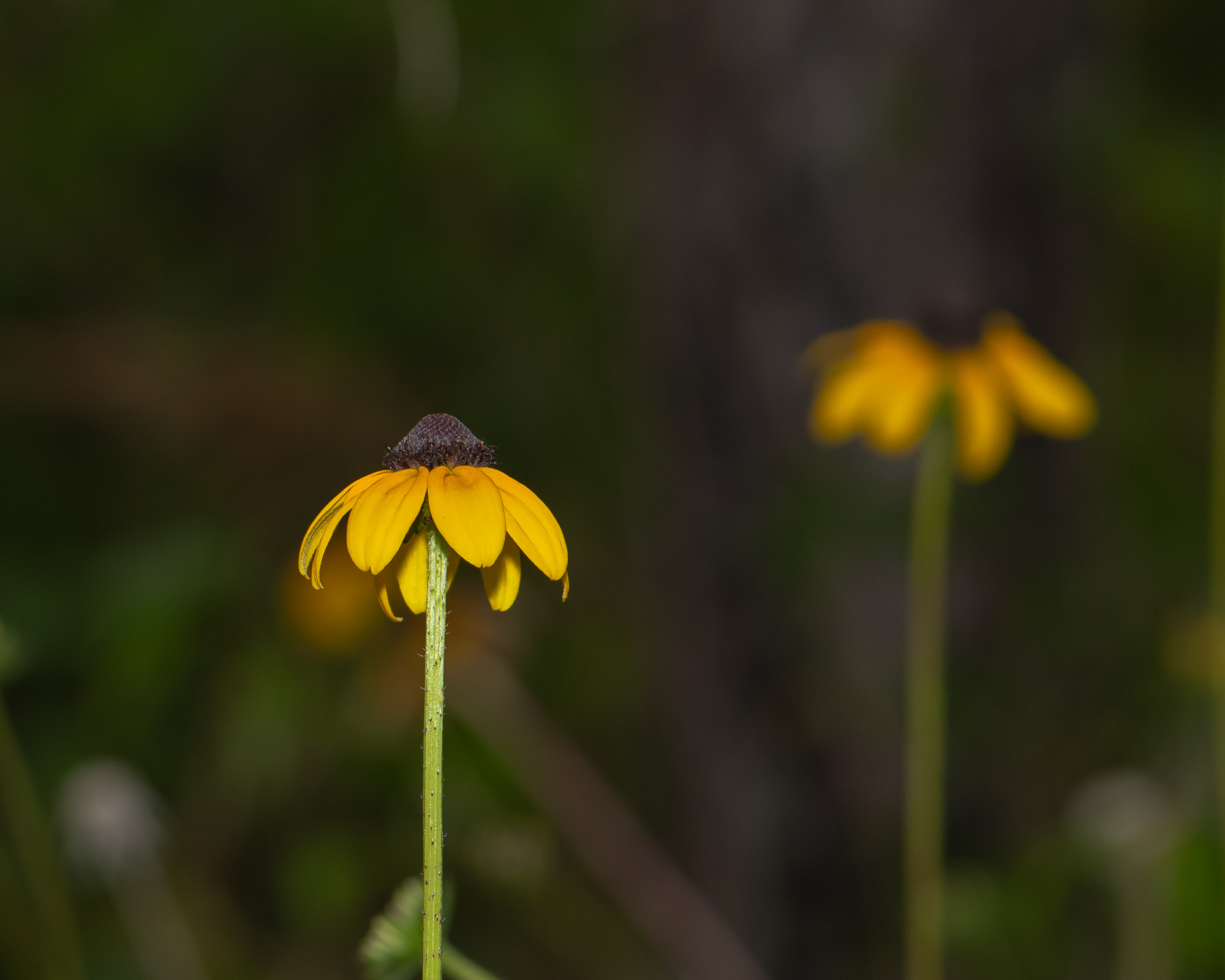
One bloom which IS common around the U.S. is the Black-eyed Susan (Rudbeckia hirta). Common flower, uncommon beauty.
From a distance, this plant seems fairly inconspicous. Closer inspection reveals a remarkable display. Longleaf Milkweed (Asclepias longifolia) is gorgeous.


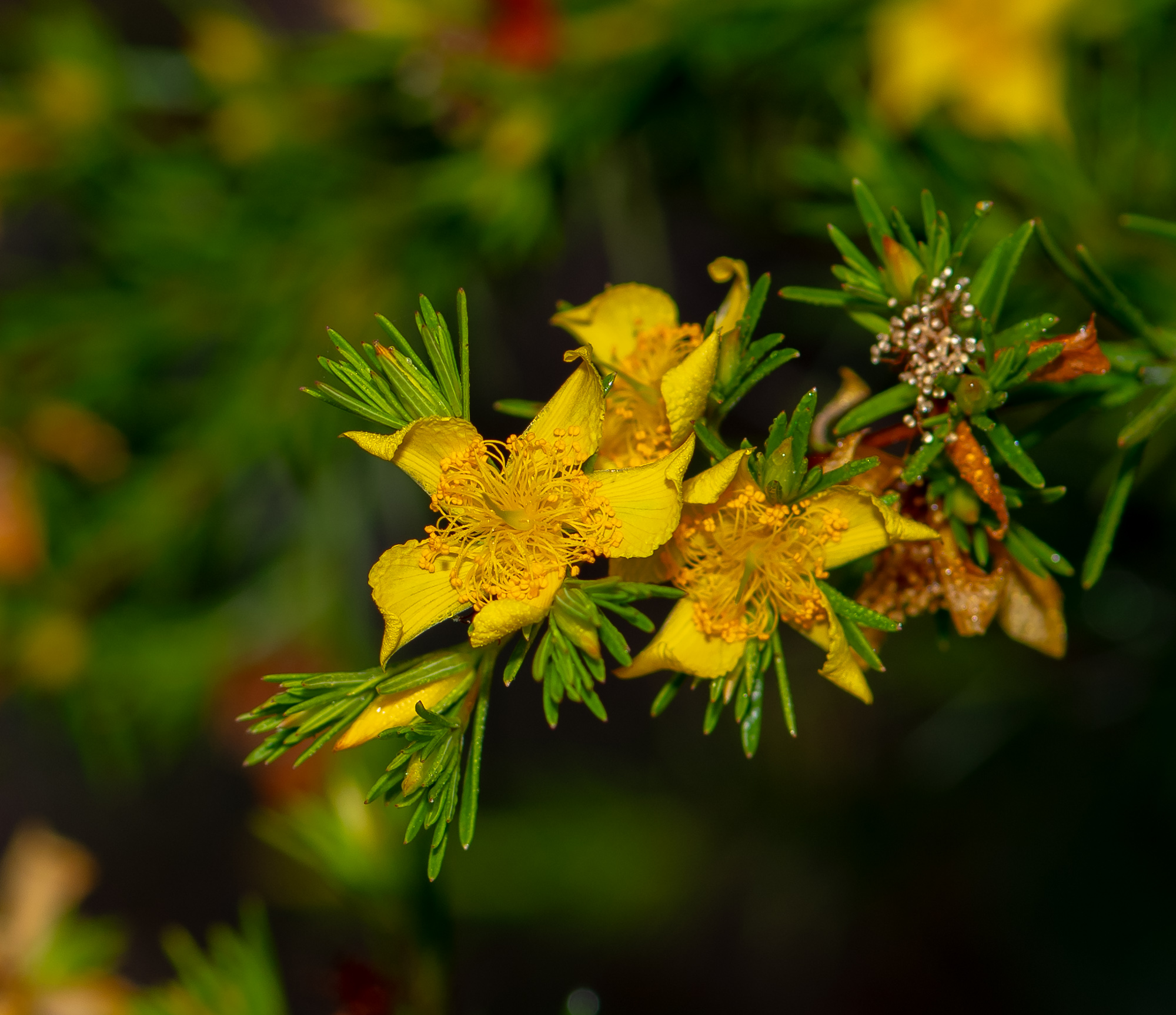
Flowers with many bright yellow-orange stamens and evergreen-like leaves help identify Peelbark St. John’s Wort (Hypericum fasciculatum), also known as Sandweed.

We always love the first blooming of the Spurred Butterfly Pea (Centrosema virginianum) every spring. The climbing vine winds itself around whatever is nearby for support. I learned a new word in researching this plant: papilionaceous – butterfly shaped flowers.

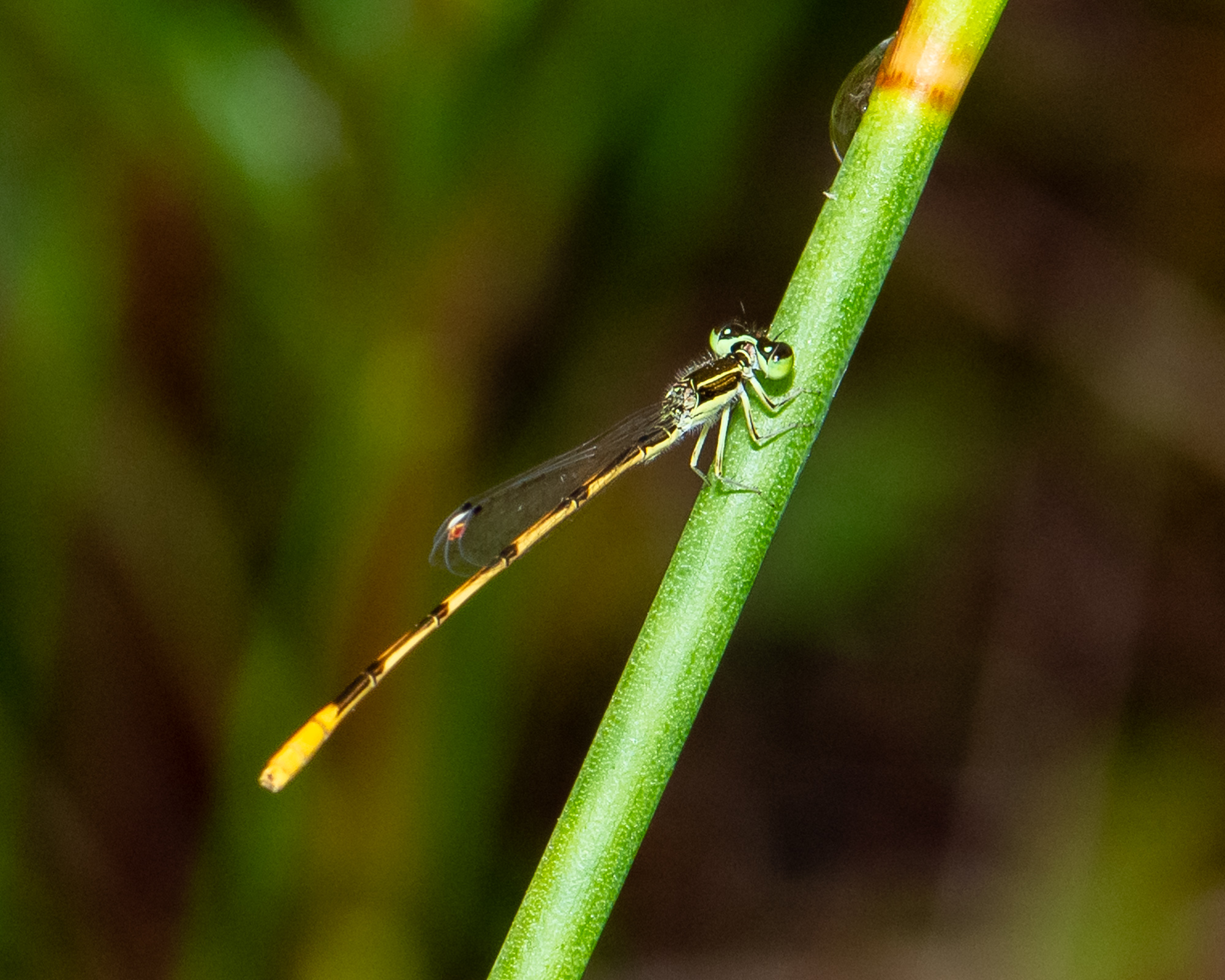
One of the smallest damselflies in North America, the male Citrine Forktail (Ischnura hastata) is quite handsome, once you can spot him.
Hatpins, bogbuttons. There are a few similar-looking species decorating the swamp. I think these are Whitehead Bogbutton (Lachnocaulon anceps). Corrections appreciated.

A spring morning is more glorious when we can see a morning glory. Tievine (Ipomoea cordatotriloba), also known as Purple Bindweed, provides our glory fix for the day.

Rose. The very name evokes beauty. Even in the swamp. Swamp Roses (Rosa palustris Marsh) were beginning to bloom in profusion throughout our visit today. Can’t wait to return once all the buds we saw become the lovely flowers which is their destiny.

Our morning exploration was filled with an amazing variety of colorful flowers. We saw so many, you will receive another dose of blooms from this same visit in the next post. Hope you don’t mind.
Enjoy your search for a natural place and come back for a visit!
(Click on images to enlarge, click again to zoom.)
Just after sunrise, by the side of a lake, we take delight in the distant, slightly eerie calls of Limpkins. Do they know they are the only living members of their avian Family (Aramidae)? Would they care? We are fascinated with the strange call, answered by calls from several different areas.
An Osprey crashes into the surface of the lake, submerges briefly and comes up clutching a small catfish in its talons. Shaking the water from its feathers, it flies out of sight. Is this the bird’s breakfast, or is it taking it to its mate who may be sitting on eggs in a large bowl-shaped nest?
We continue to enjoy the breaking of a new day as we break our fast of the previous night. Gabbling Gallinules paddle among the cattails. Boat-tailed Grackles cackle above our heads. A curious young alligator barely raises its head above the water line to peer at us from several yards away. Morning flights of White Ibises and Double-crested Cormorants signal the new day has begun in earnest.
Gini and I sigh in unison. We are so fortunate, in so many ways.
As we move through our familiar patch on this mid-April day, we encounter birds, blooms and bugs we have seen many times before. Somehow, each time we see them we react as though it is a completely new discovery. Indeed, it really is. We may have seen hundreds of Red-shouldered Hawks, but we have never seen THIS one perched atop THAT tree on THIS morning. Our day was filled with “new” discoveries.
I had reservations about calling this a “joyful” day, until I looked at the definition: “feeling, causing, or showing great happiness”. Yes. That describes it perfectly.
Take a look at a few things which make us “joyful“.
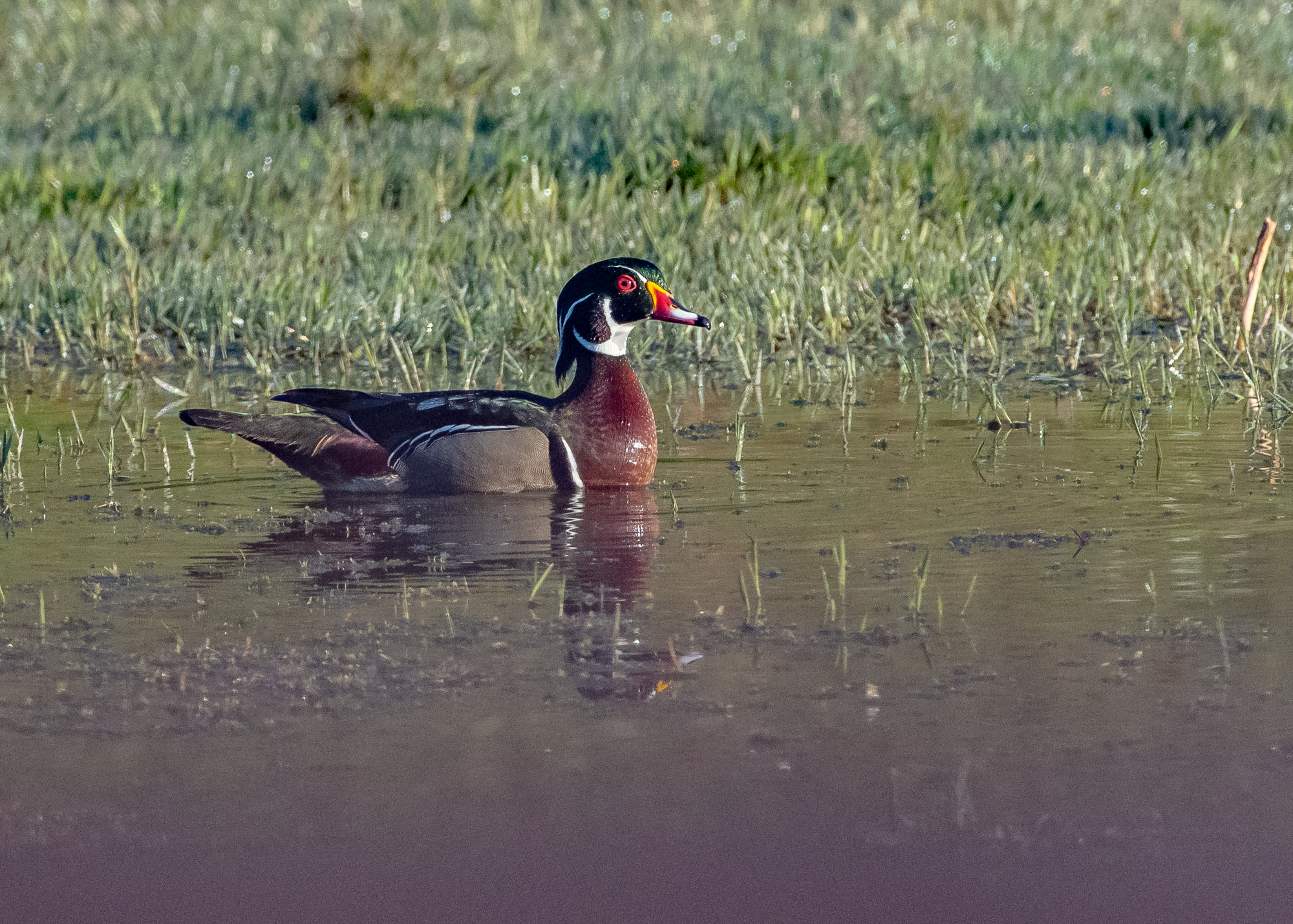
Is the male Wood Duck handsome or gaudy? You decide.
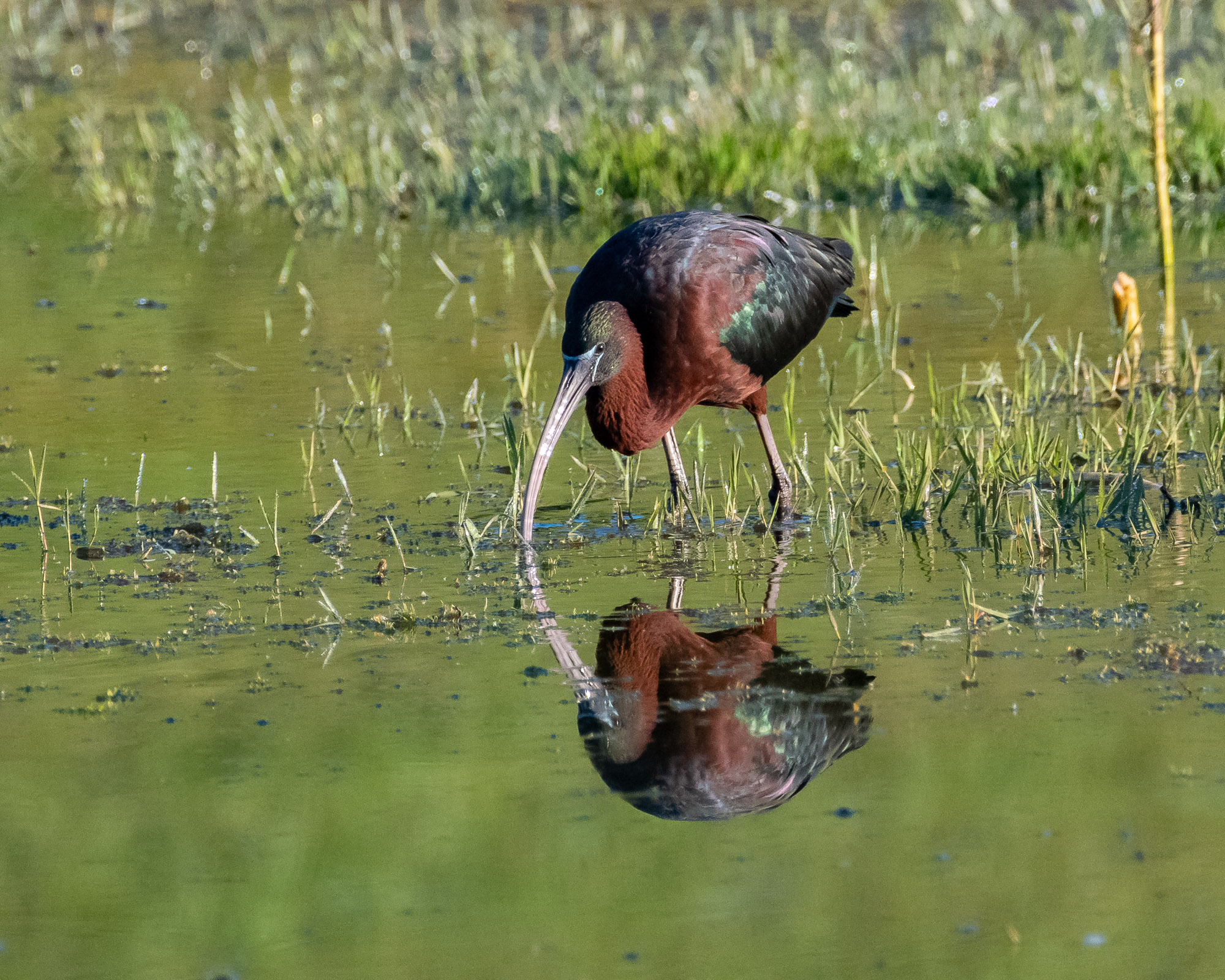
The mother-of-pearl iridescence of a Glossy Ibis’ plumage is enhanced by the early morning light.
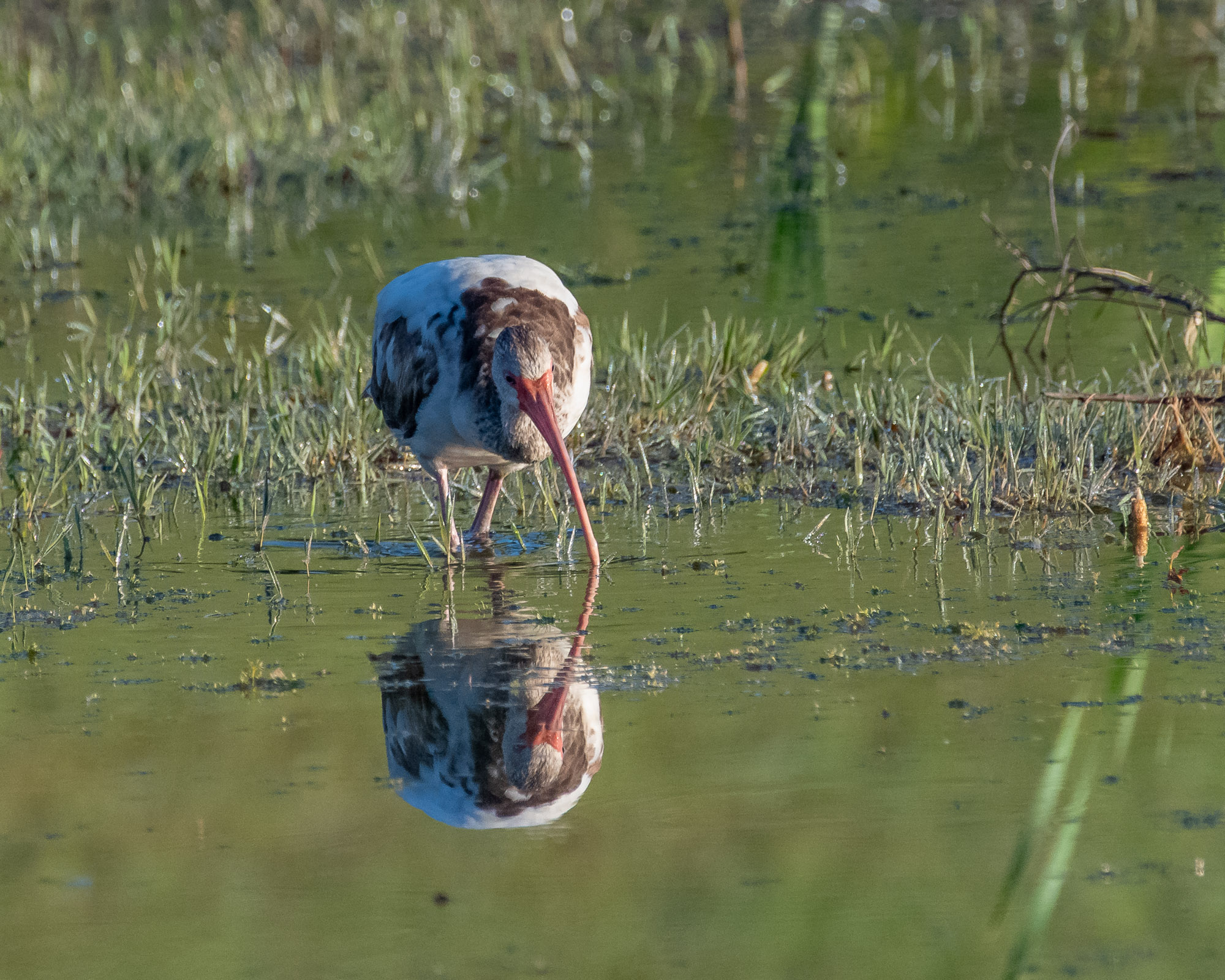
During their first year, a White Ibis is brown. As they approach their first birthday, they begin to change into the pure white of an adult. A few chocolate patches linger into mid-Spring.
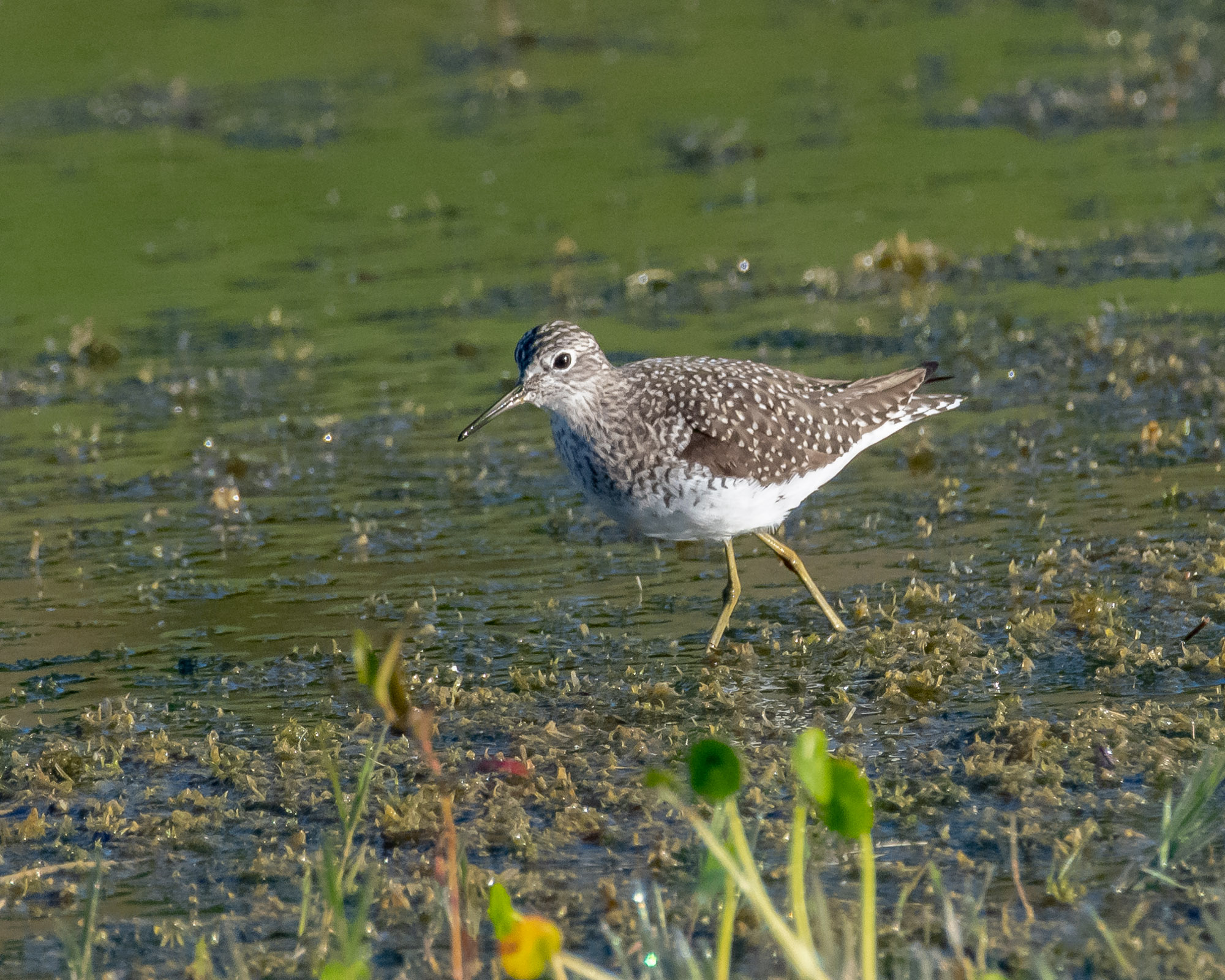
It is difficult (for me) to tell the difference between Greater and Lesser Yellowlegs if they aren’t standing near one another. This one was very helpful and made a few calls (different for each species) which allowed us to identify it as a Greater.

Similar in oveall appearance to the Greater Yellowlegs, a Solitary Sandpiper is much smaller.
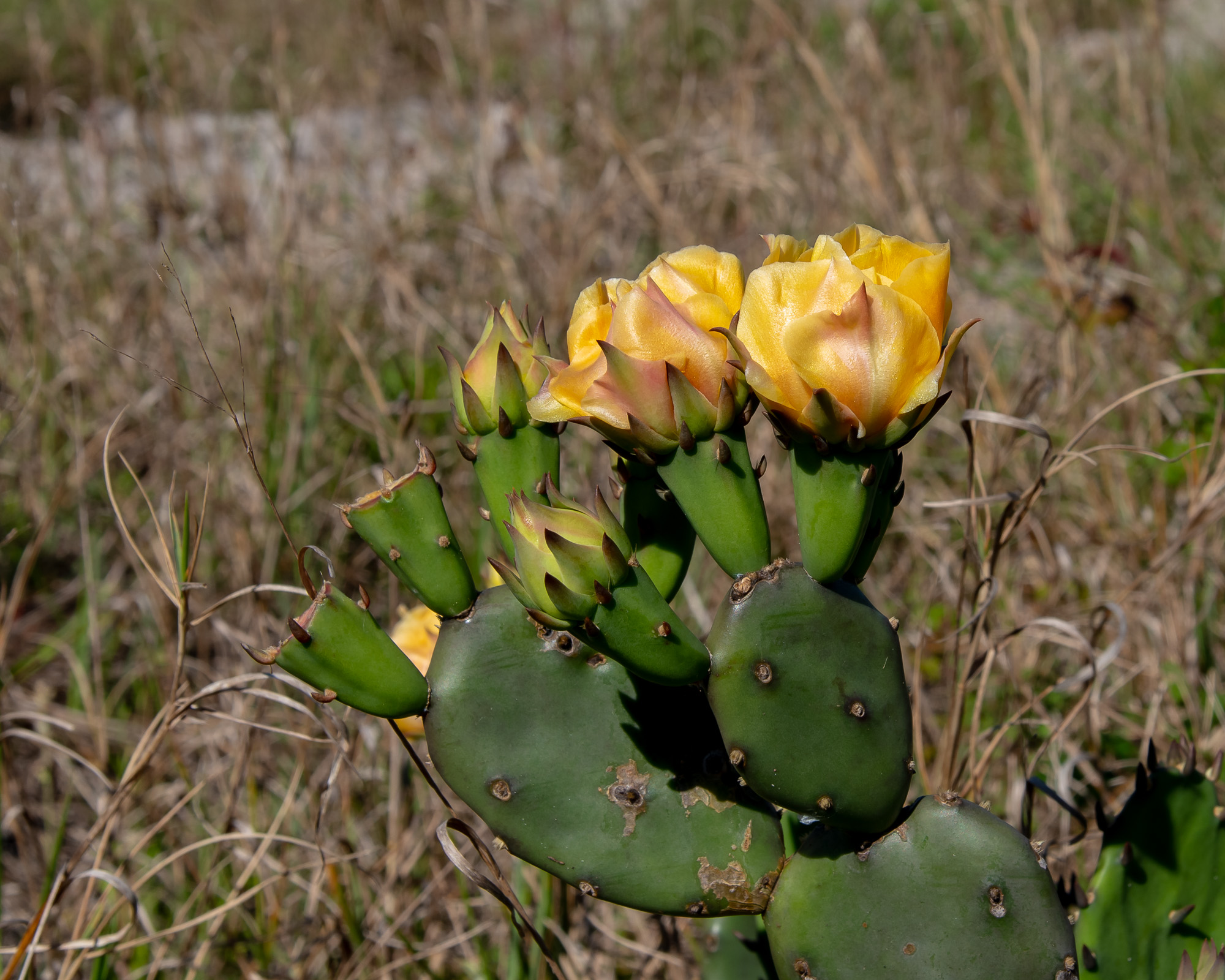
April flowers bring May showers. Wait. Isn’t that the other way around? A gorgeous Prickly Pear cactus bloom resembles a rose.
This Red-shouldered Hawk found a great lookout perch adjacent to an open field.

Although it is not a native, the colorful Lantana (Lantana strigocamara) has been used extensively in landscaping and for many decades has been encountered in the wild. Pollinators don’t care about where the plant originated. This Gulf Fritillary (Dione incarnata) even blends in quite nicely with the blooms.

Black Buzzard Breakfast Bunch. A little preening, discussing the plans for the day, waiting for that first thermal. Life is good in the vulture culture.

Small, delicate, lovely. Southern Beeblossom (Oenothera simulans) is beginning to become very prolific throughout the area.
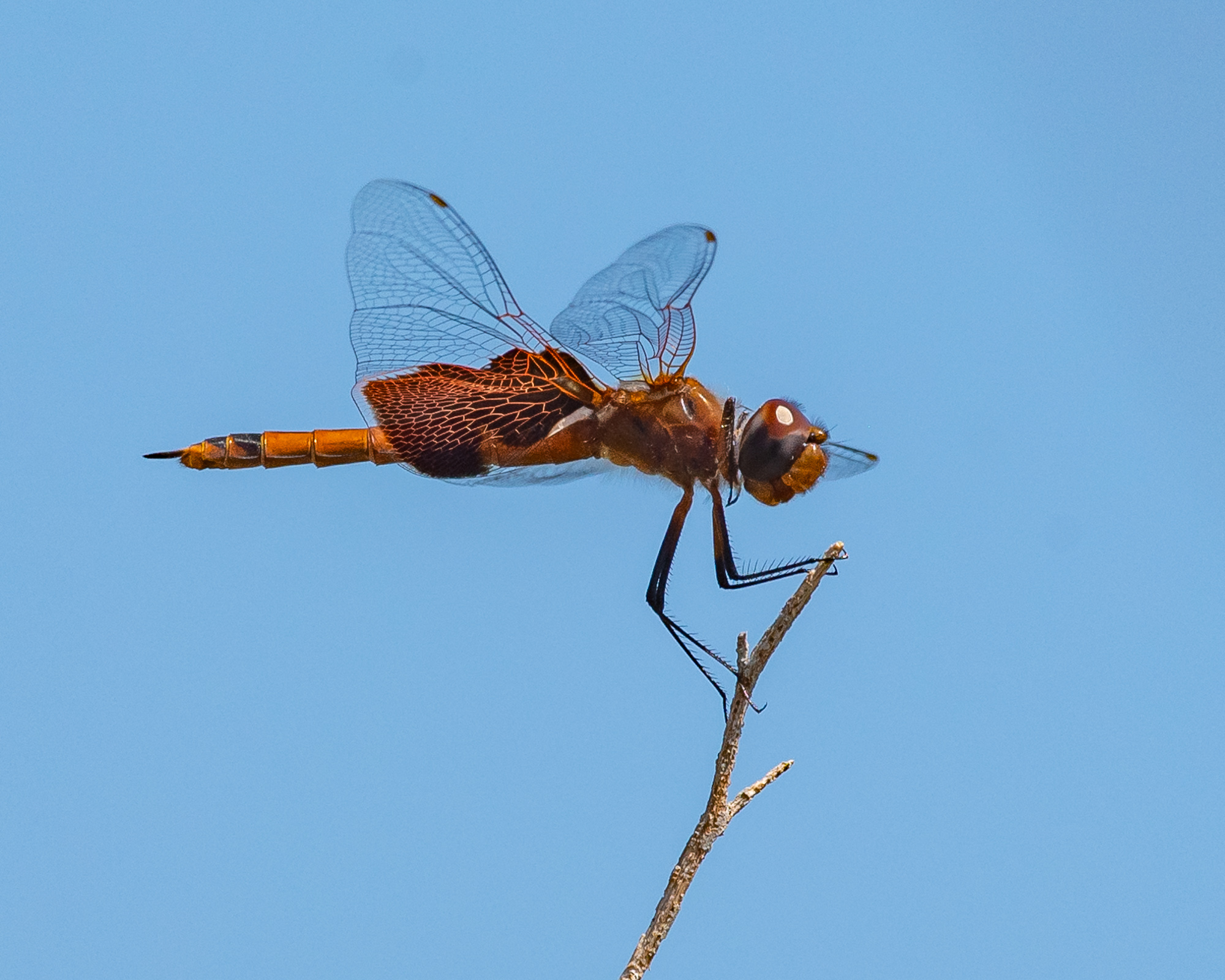
With its characteristic perpindicular perch atop a bare twig, a Red Saddlebags (Tramea onusta) is one of our more abundant dragonfly species. We hope it consumes as many mosquitoes as possible.
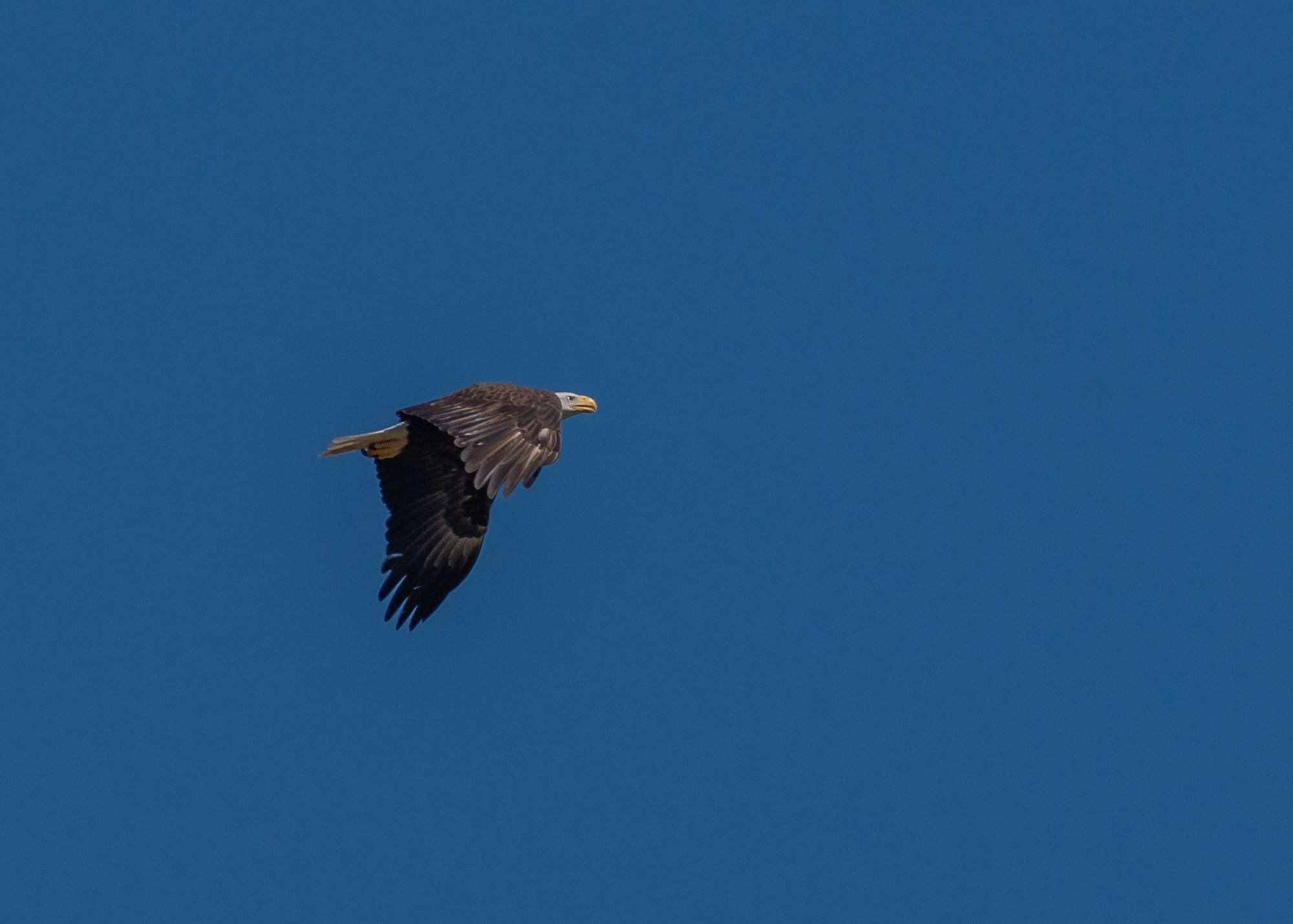
Large, black-and-white, wings held flat – hard to miss the Bald Eagle. We have a very healthy population around here since we have so many lakes filled with fish.
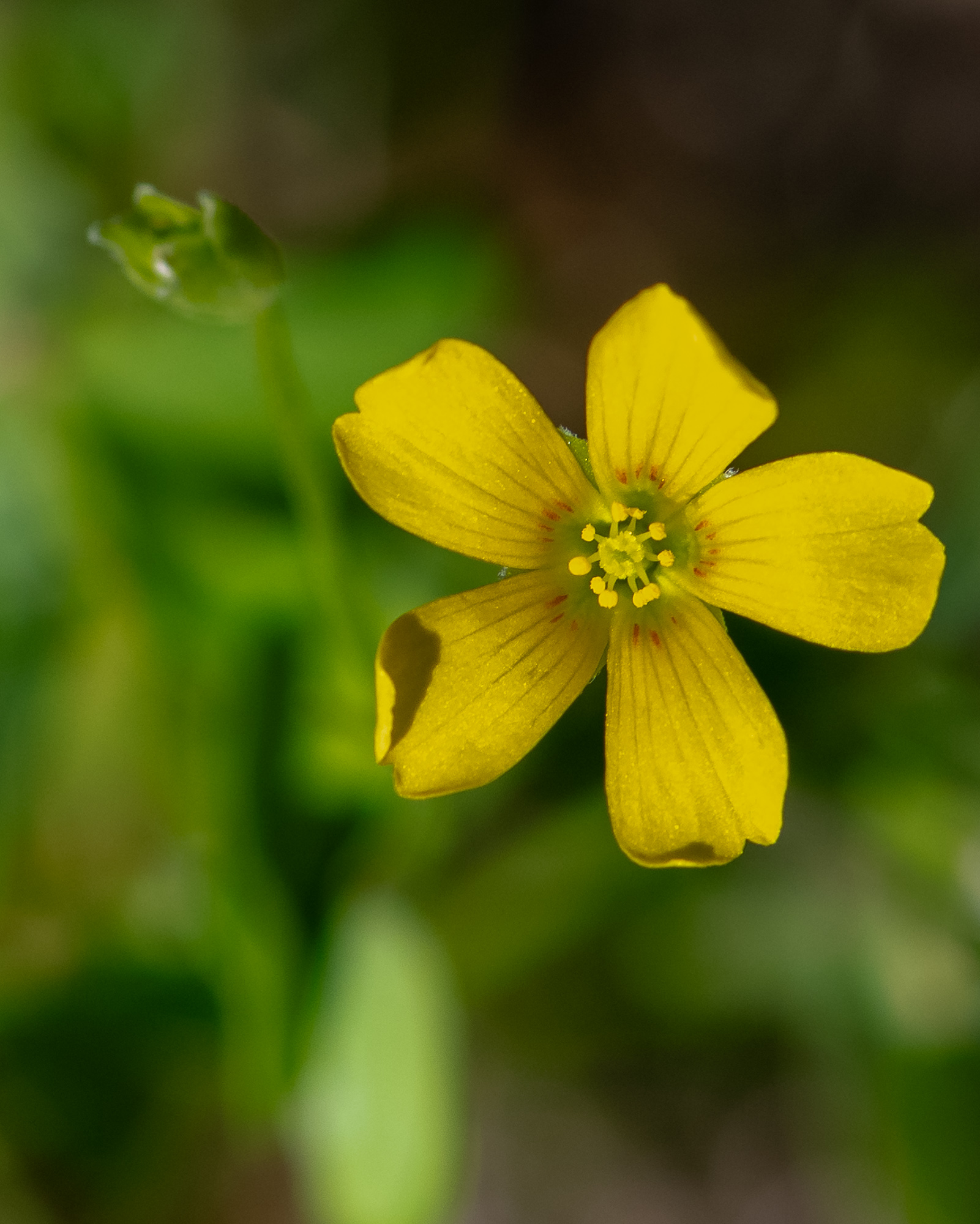
With leaves which slightly resemble a shamrock, the small Creeping Woodsorrel (Oxalis corniculata) has really lovely blooms when examined at close range.
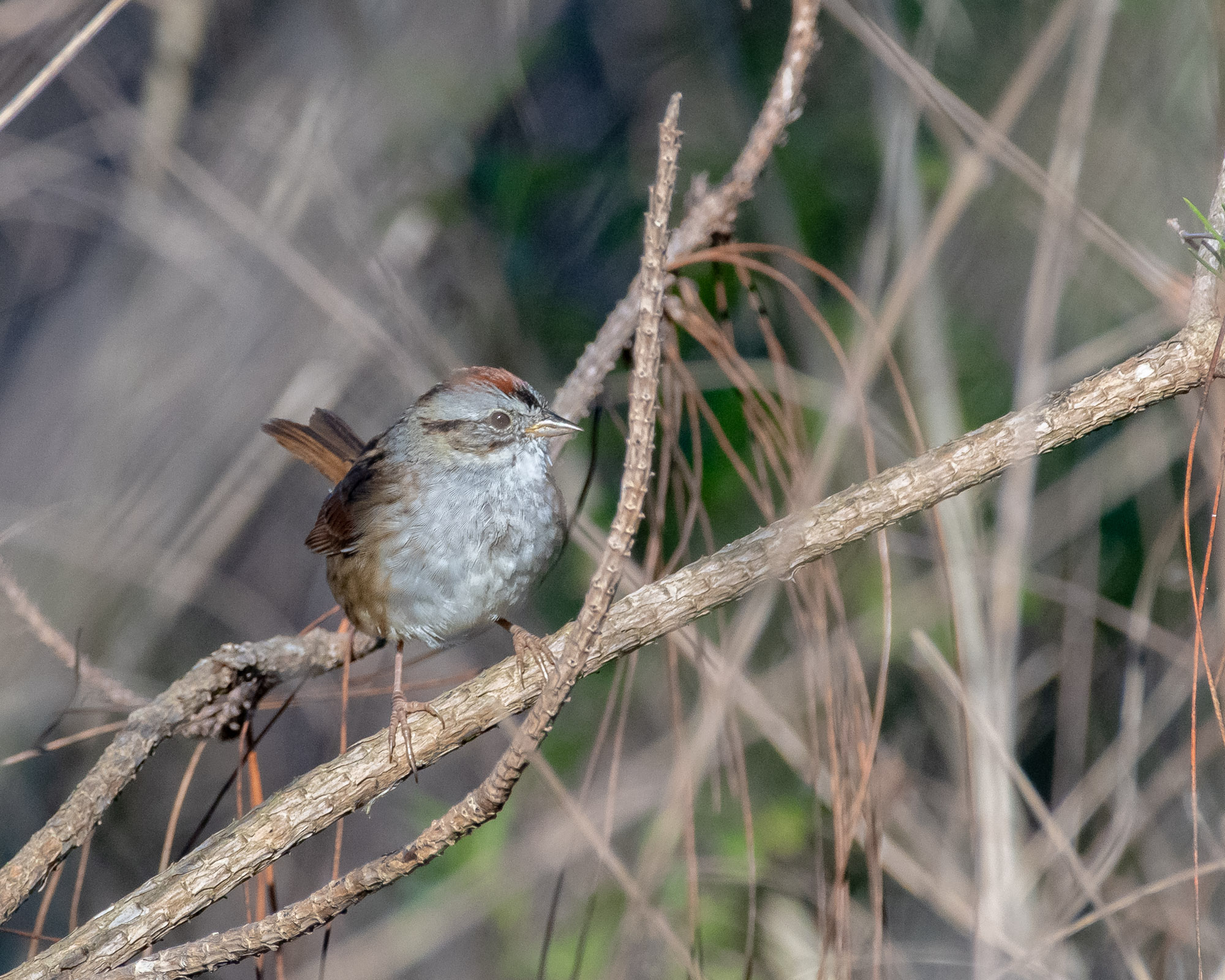
This trip was during the second week of April and a few migratory birds were reluctant to leave the Sunshine State. A Swamp Sparrow will soon head back to its northern breeding territory but promises to return in the fall.
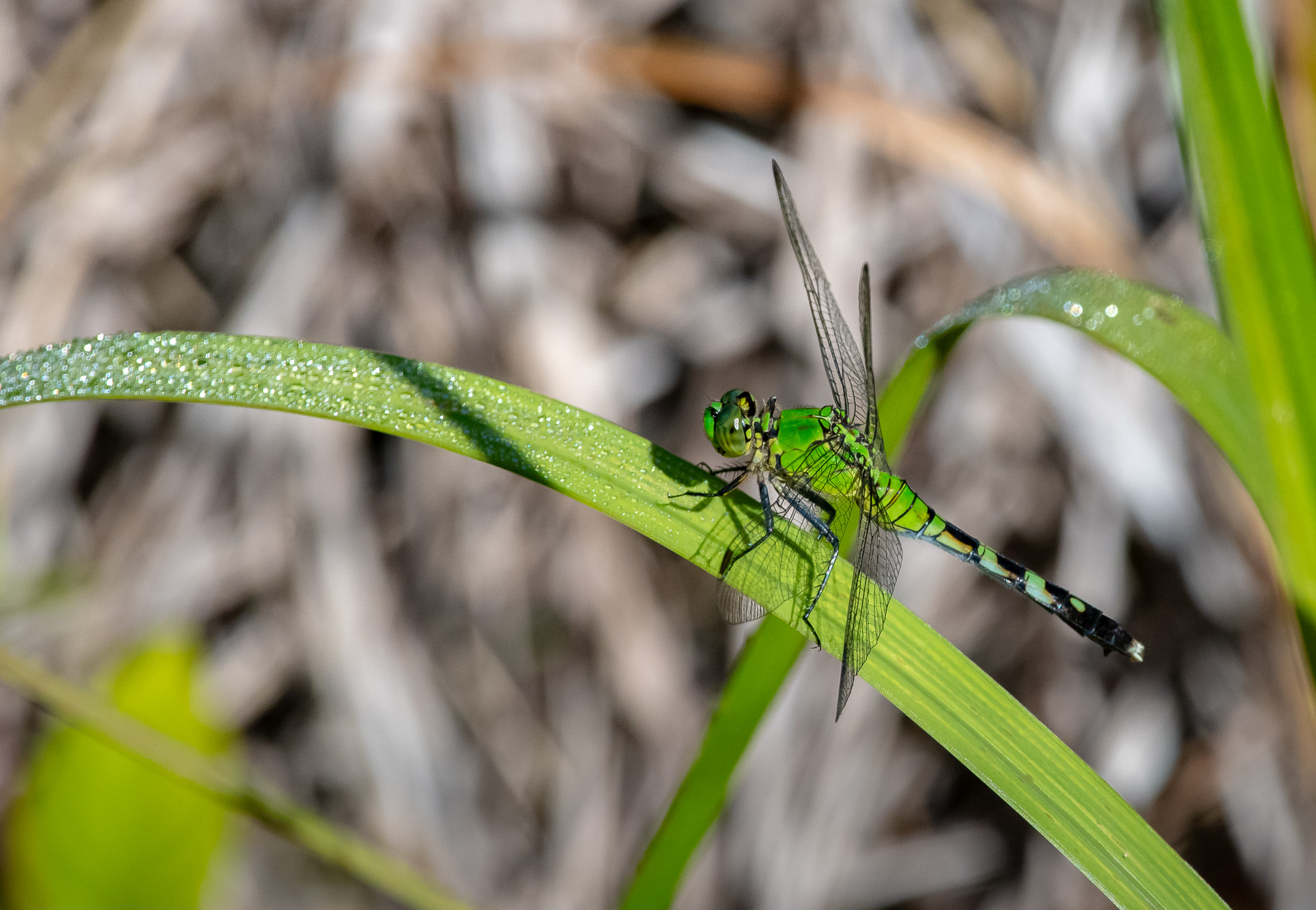
Bright emerald blends in with the fresh new grass where this female Eastern Pondhawk (Erythemis simplicicollis) hopes to ambush a breakfast bug.
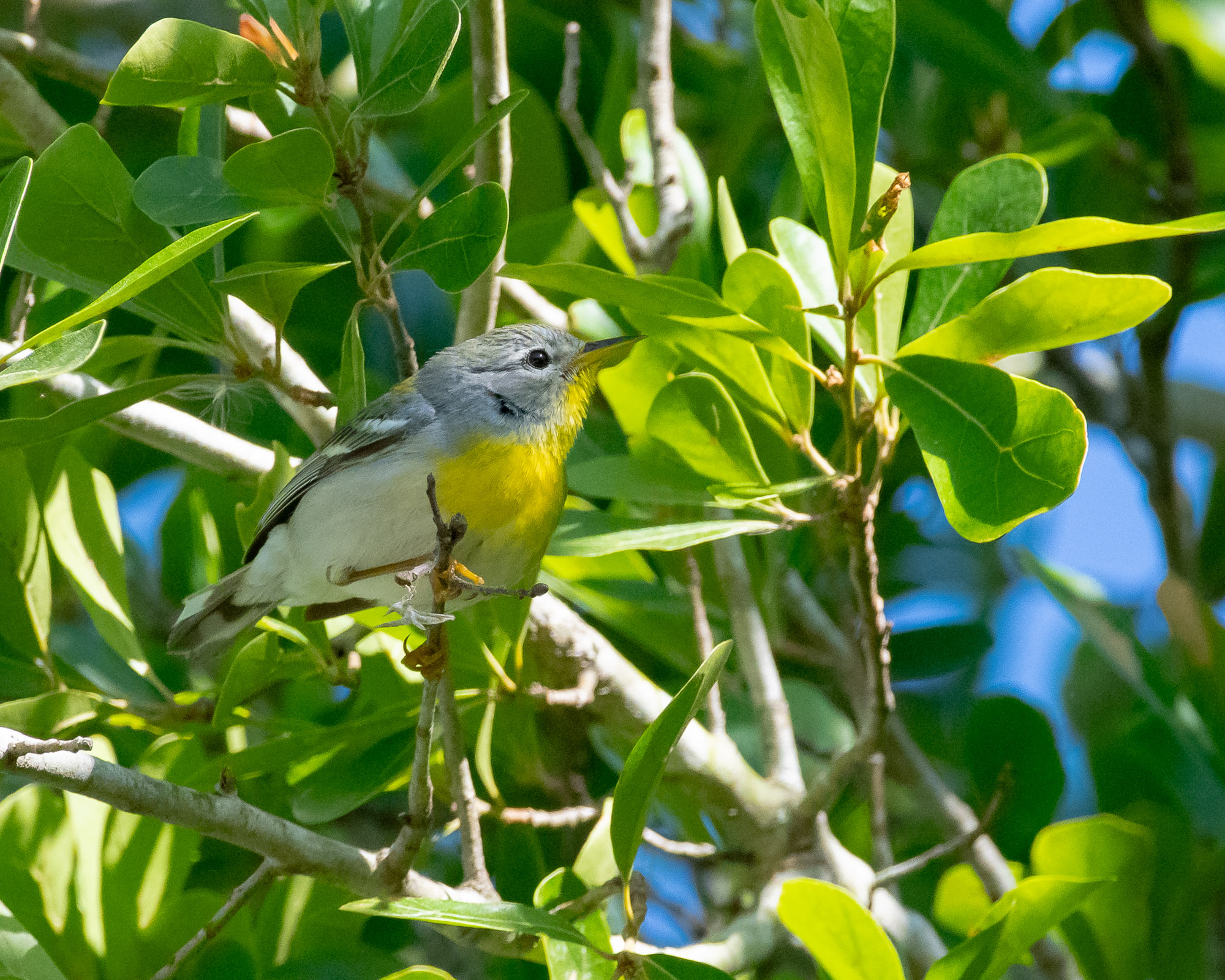
The Northern Parula is a small warbler which breeds in our area. Each winter, they relocate to the southern part of the state or beyond but are now beginning to return to fill the woods with their upward spiraling trills.
Who says taxonomists don’t have a sense of humor? Someone decided this lovely member of the camphorweed family should be referred to as Sweetscent (Pluchea odorata). To be fair, perhaps they had just gotten a good dose of the plant’s cousin, P. foetida – Stinking Camphorweed, and thought by comparison this one was pretty sweet.

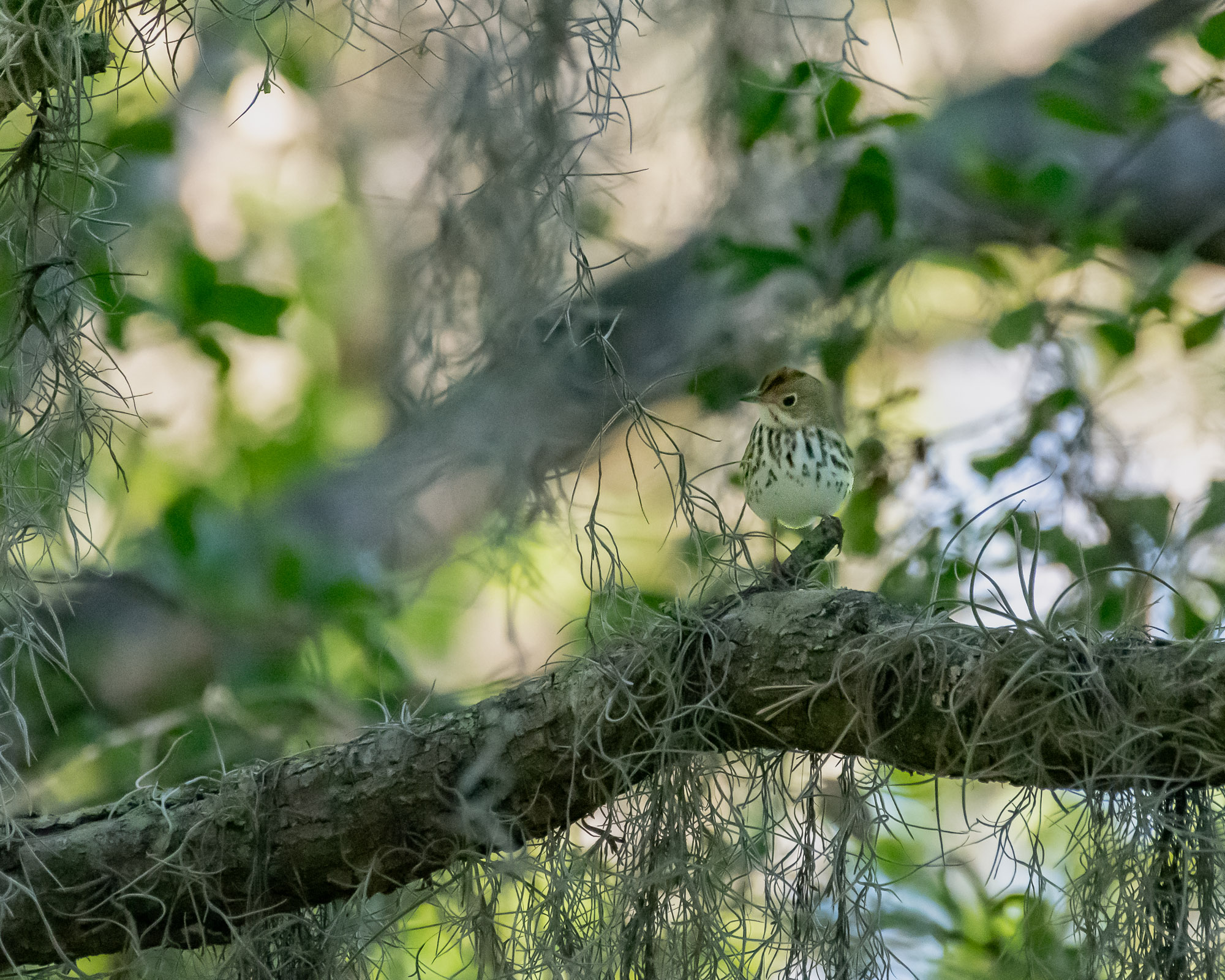
Another procrastinating passerine. An Ovenbird skulks along a tree branch looking for just one more juicy Florida snack before winging northward.
It may not have all the brushy, spiky leaves around its blooms like its horrible relative, the Bristle/Purple/Yellow Thistle (Cirsium horridulum), but Nuttall’s Thistle (Cirsium nuttallii) will still give one pause if they attempt to grab a stem without noticing those substantial thorns.

In the Spring, one can see how the Red-bellied Woodpecker received its name. This female was joined by a male and as we watched, the two seemed to be testing limbs for nest suitability.

The days are warming and the dragonfly population is becoming ever-more abundant. A lovely golden Halloween Pennant (Celithemis eponina) perched a moment for us to enjoy.

Large patches of Oakleaf Fleabane (Erigeron quercifolius) gave the impression of dozens of small orbs of sun among frilly white clouds.

One morning in April filled with sights and sounds we found exhilarating. One truly joyful day!
We hope you enjoy your search for a natural place and come back for a visit!
(Click on images to enlarge, click again to zoom.)
The bottom of that shoebox we found for the previous post held a few more pictures, so we thought we would share.
Looking in our rear view mirror back to the second week of March, we found ourselves surrounded by Spring. The Green Swamp was decked out in multiple shades of green thanks to the diverse species of trees and plants found here. A small dilemma arose as we motored slowly along the criss-crossing logging roads. We had to choose our parking spot carefully as the edges of the roads often contained blooming flowers which we didn’t want to crush.
A few roads have become impassable over time and these made good places to park and hike around a bit. Additionally, there are a couple of primitive camping areas which offer plenty of shaded parking with nearby trails to explore. Unless it is hunting season, we seldom encounter other people in this section of the swamp.
Gini expressed the feeling that, despite the vast displays of colors we were seeing, that it seemed the area was really on the verge of really bursting into bloom. Visits since then have proven her correct.
Sit back. Feel the warm sun, a slight breeze, pine tree aroma, singing birds ……
A Carolina Wren flitted from perch to perch and never stopped singing. They have a pretty incredible repertoire.

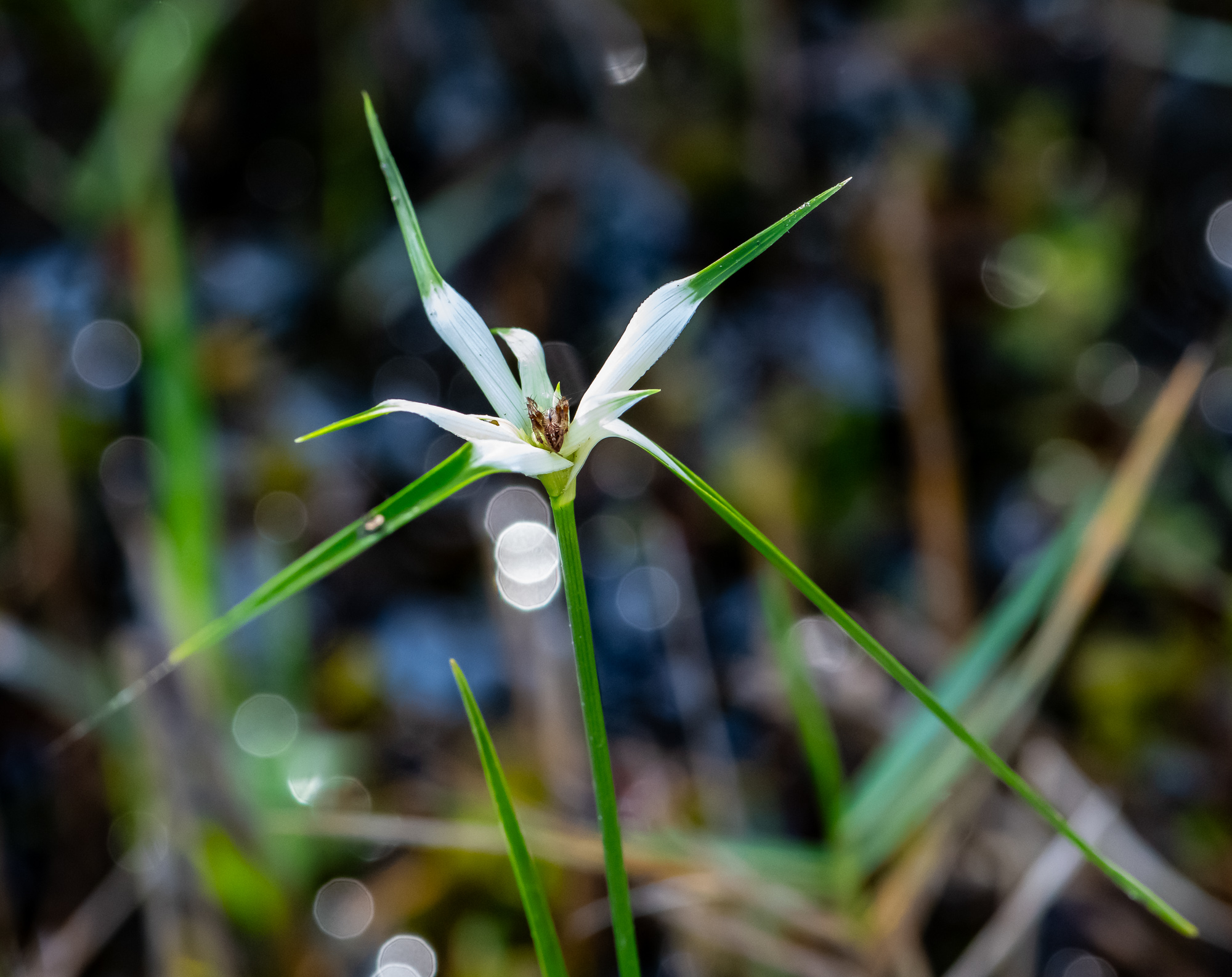
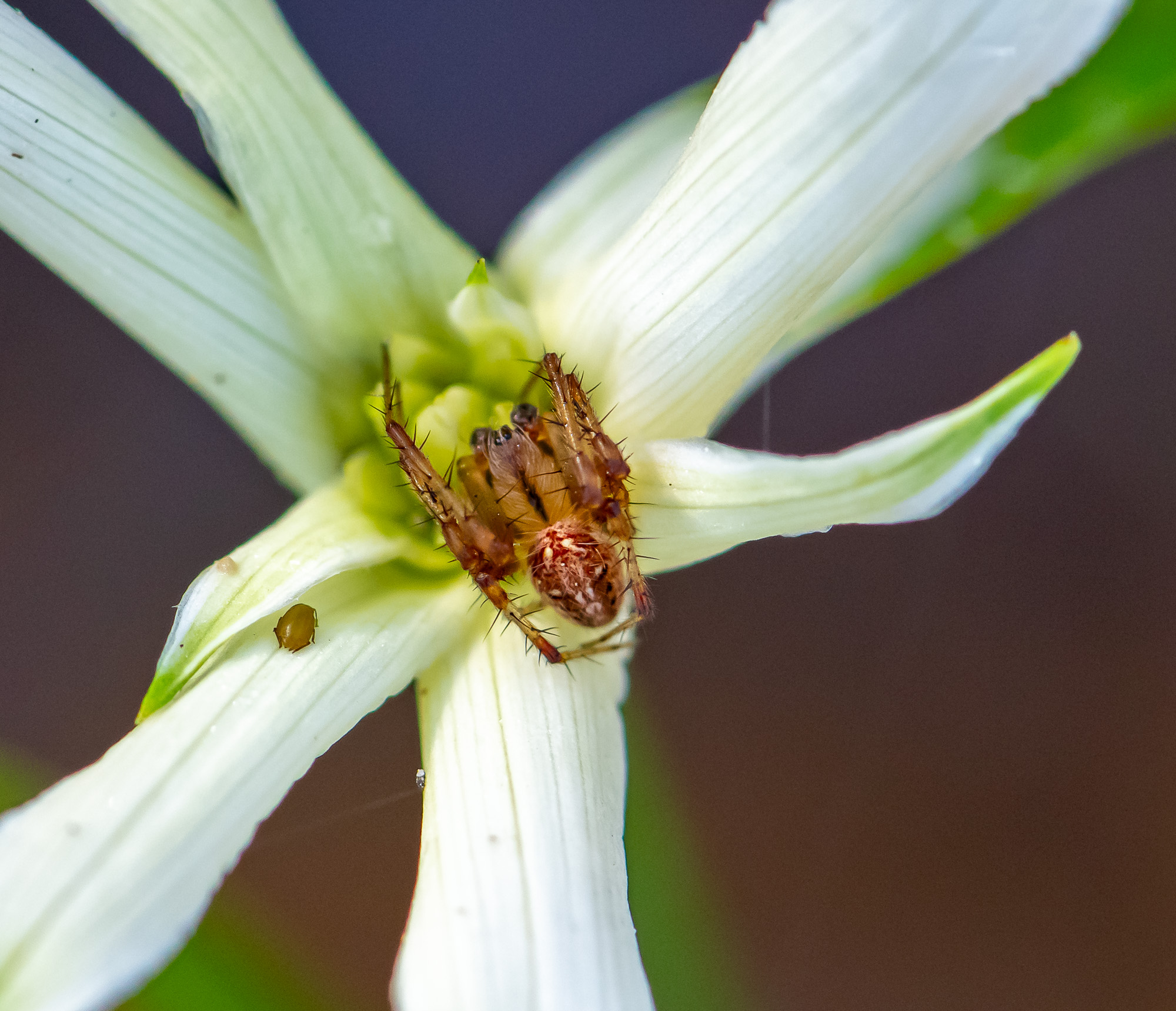
It gives the impression that it’s a flower, but the lovely Starrush Whitetop (Rhynchospora colorata) is actually a sedge. At least one critter doesn’t care if it isn’t a flower as a spider found a nice place to hide. I think it’s a Green Lynx Spider. No idea what the other tiny photo-bombing bug is.

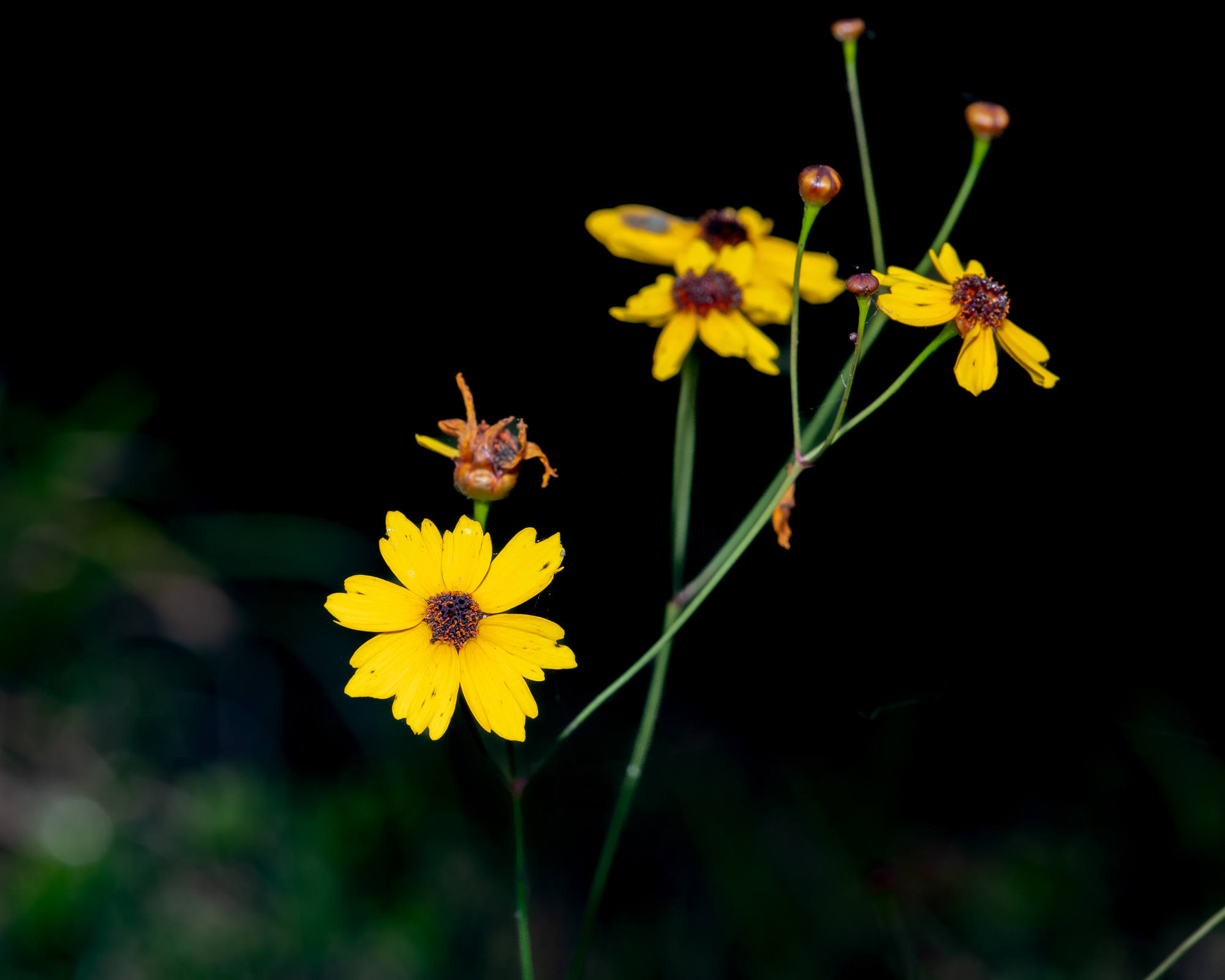
This plant can look pretty gangly as its wiry stems branch in many directions. The bright yellow blooms of the Leavenworth’s Tickseed (Coreopsis leavenworthii) are beautiful no matter what support system they may use.
Found nowhere else but in Florida, the Yellow Milkwort (Polygala rugelii) will soon become abundant throughout this area.

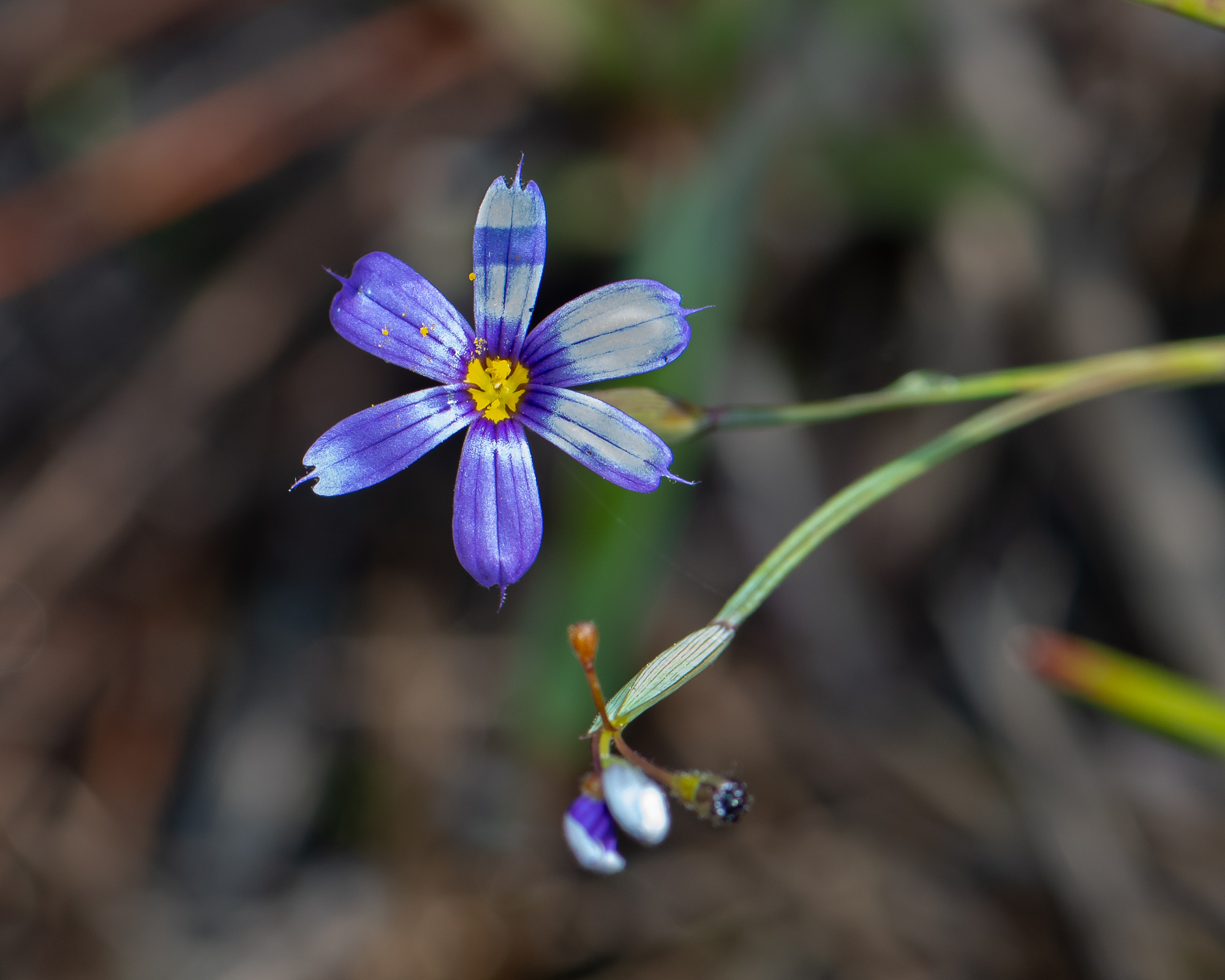
One of those plants mentioned earlier that would be easy to run over at the edge of the road, the blooms of Narrowleaf Blue-eyed Grass (Sisyrinchium angustifolium) are incredibly intense.
We made notes on the location of several Shiny Blueberry (Vaccinium myrsinites) bushes so we can check them in a few weeks. I strongly suspect there are others in the swamp who will be there long before we return. And they very likely don’t need notes on where to find them.

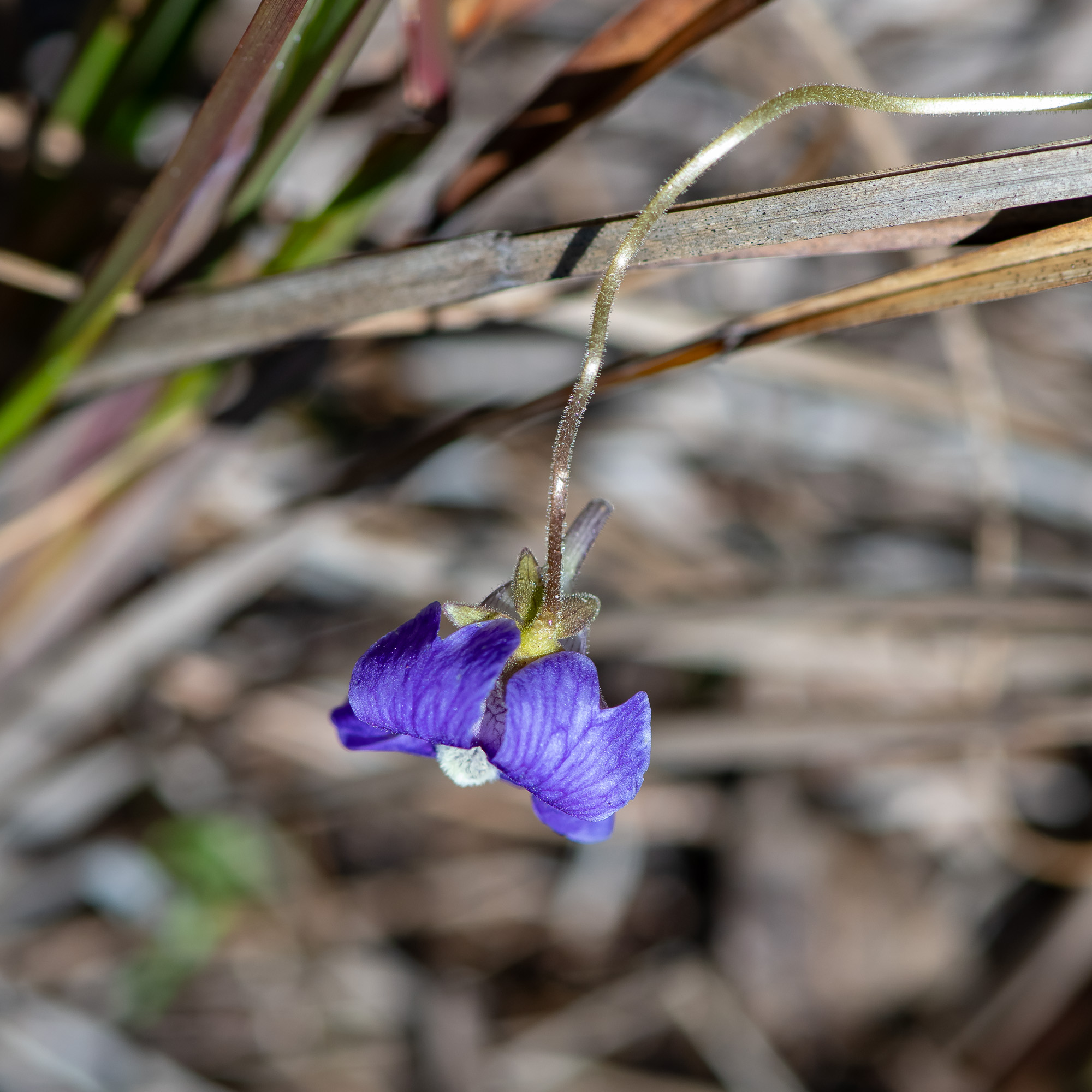
The Blueflower Butterwort (Pinguicula caerulea) is a new plant for us. Like many in the Butterwort genus, this one is carnivorous. The basal leaves are covered in tiny hairs which secrete a sticky substance that helps to trap and digest insects.

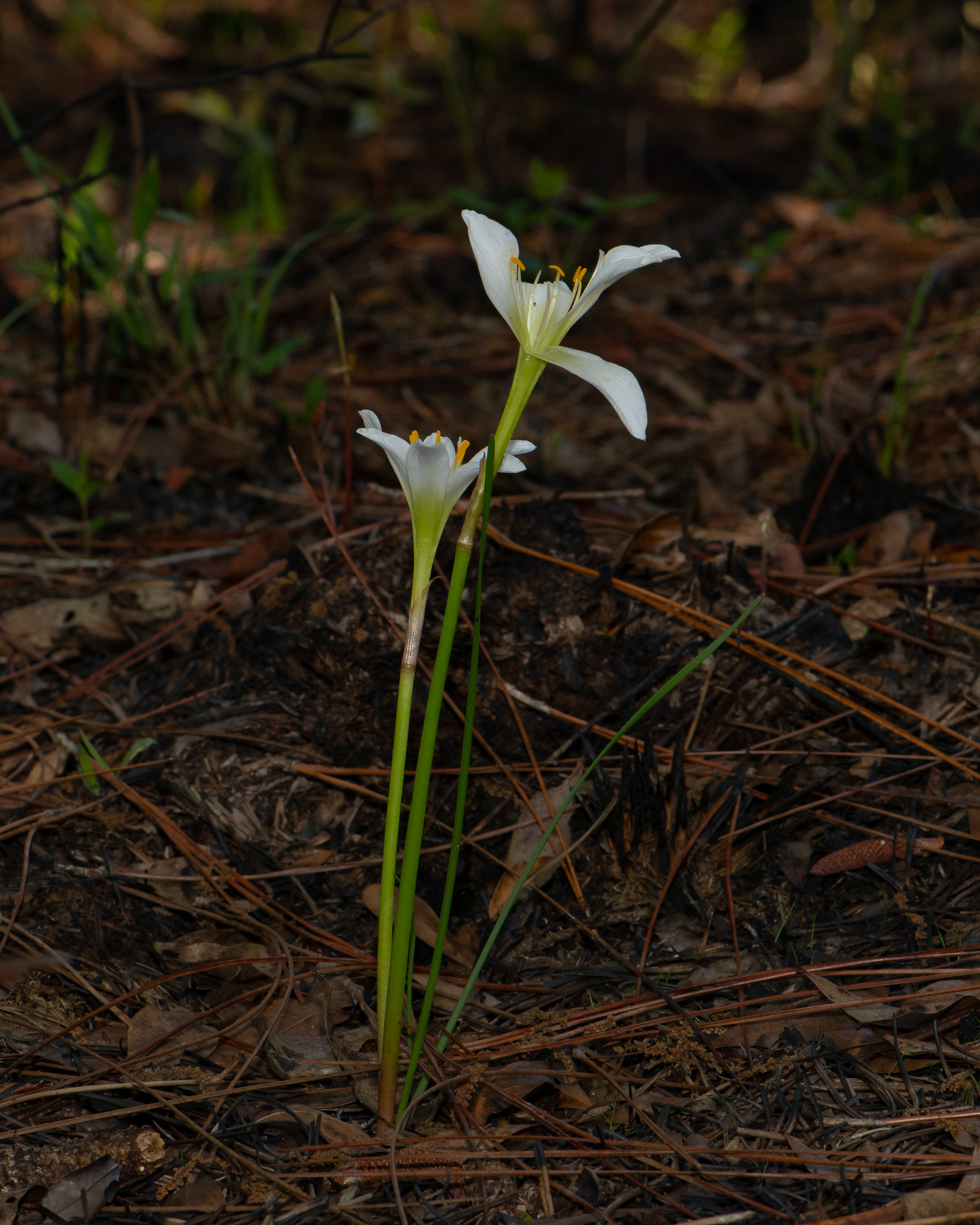
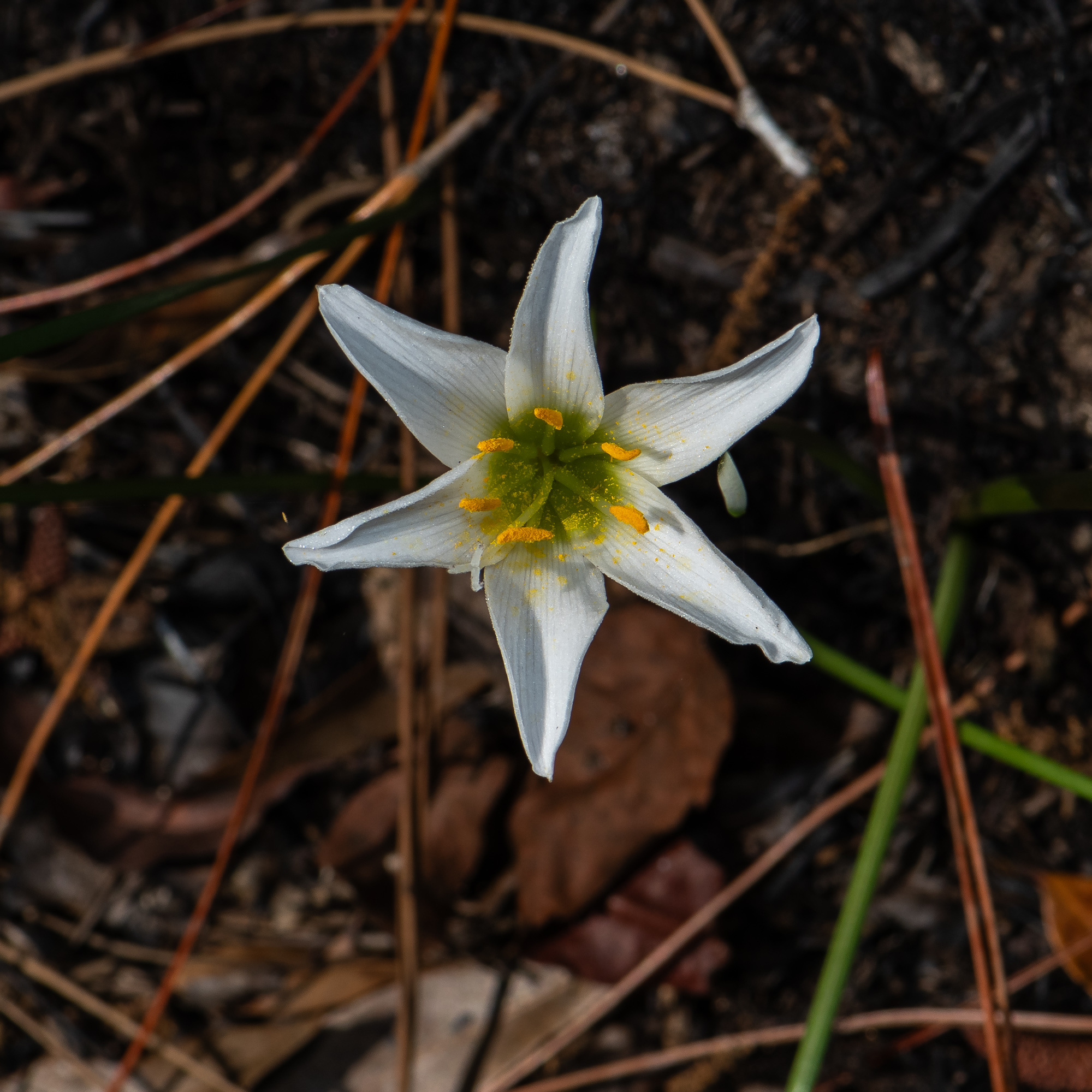
In the understory of pine forest which had recently been the subject of a prescribed burn, we found a few lovely rain lilies blooming. This area of central Florida has two species of this beautiful flower and I believe this one is called Zephyrlily (Zephyranthes treatiae S. Watson). Both species are considered threatened within the state.
Our reporting of the beginning of Spring in Florida’s Green Swamp may have been delayed a few weeks, but the beauty of the season arrived on schedule and is flourishing. We don’t need to be there to witness it, but it sure is nice when we are.
Enjoy your search for a natural place and come back for a visit!
 Our Natural Places