Header Image: Eastern Pondhawk (Erythemis simplicicollis)
A pine forest is welcoming in so many ways. The unique green of the trees, the scent that has become synonymous with “fresh“, the cones on the branches as well as those littering the understory, the texture of the tree bark and the incredible diversity of life which calls the forest home. No wonder we like such a venue!
Colt Creek State Park is one of our favorite places to visit for several reasons. It consists of over 5,000 acres of upland pine forest, mixed hardwood trees, swamps, cypress domes, lakes, creeks, open fields, campgrounds and over 15 miles of well-maintained trails. Okay, the fact that it’s 20 minutes from the house doesn’t hurt.
Today’s visit was short, by our standards. We usually manage to linger here for three or four hours. This time, we spent less than two hours, didn’t stray far from the main road, didn’t get any photographs of birds yet still managed to discover a smorgasbord of life!
Just after passing through the entrance gate a coyote emerged from the trees but retreated as soon as he saw us. No time to swing the camera up, doggone it. A bit further and White-tailed Deer enjoyed their breakfast alongside the road. The neighborhood watch system, a Red-shouldered Hawk, alerted the population that intruders were out and about. Although we saw plenty of birds, none were anxious to have a picture taken today. Must all be in some sort of witness protection program. No worries. Nature provides plenty of subject material!
Gini pointed out all the weeds with dragons lounging around. I had to take photos quickly and move on lest her urge to collect the colorful creatures might overwhelm her normally calm demeanor. We found a new moth species in addition to all those Odonata as well as a few spiders. All too soon, it was time to head back to the house. Next time, we have no doubt the birds will be more cooperative.
No critters were harmed in the production of this adventure to a natural place. (Well, except for a few mosquitoes, who ignored our warning shots.)
Breakfast weeds. The White-tailed Deer in the park are accustomed to humans and sometimes allow a fairly close approach.

The Bar-winged Skimmer (Libellula axilena) is one of three species of the “king” skimmer family in our area in which the male is all dark. A particular wing pattern helps identify this species. We were fortunate to find both male and female today.
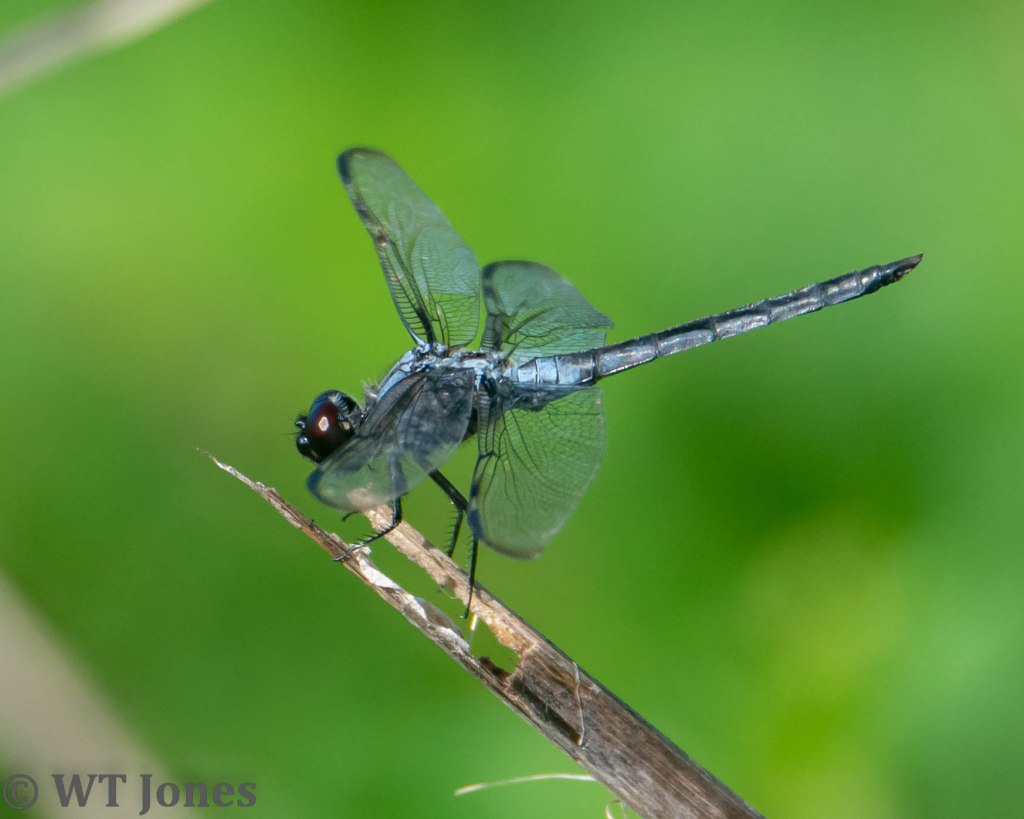

Another of the “king” skimmers, a Great Blue Skimmer (Libellula vibrans) is easy to identify by the white face and blue eyes of both sexes.

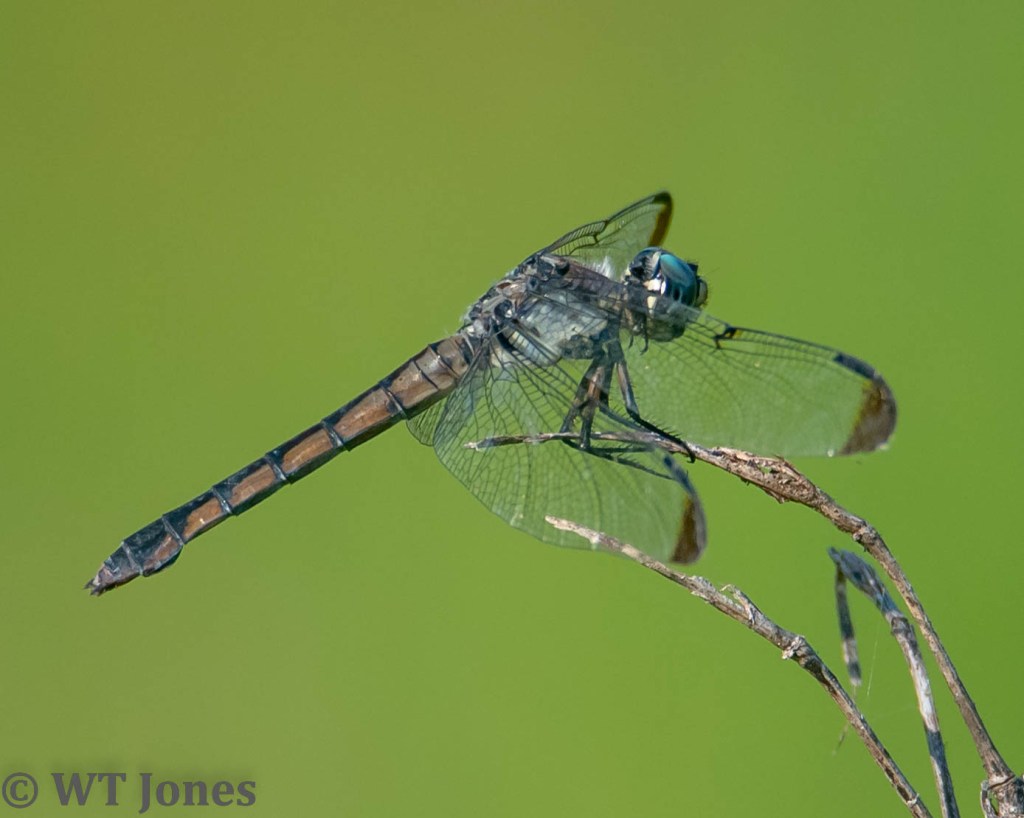
“Become The Branch.” A Cuban Brown Anole (Anolis sagrei) does its best to avoid detection on a sticky looking pine limb.
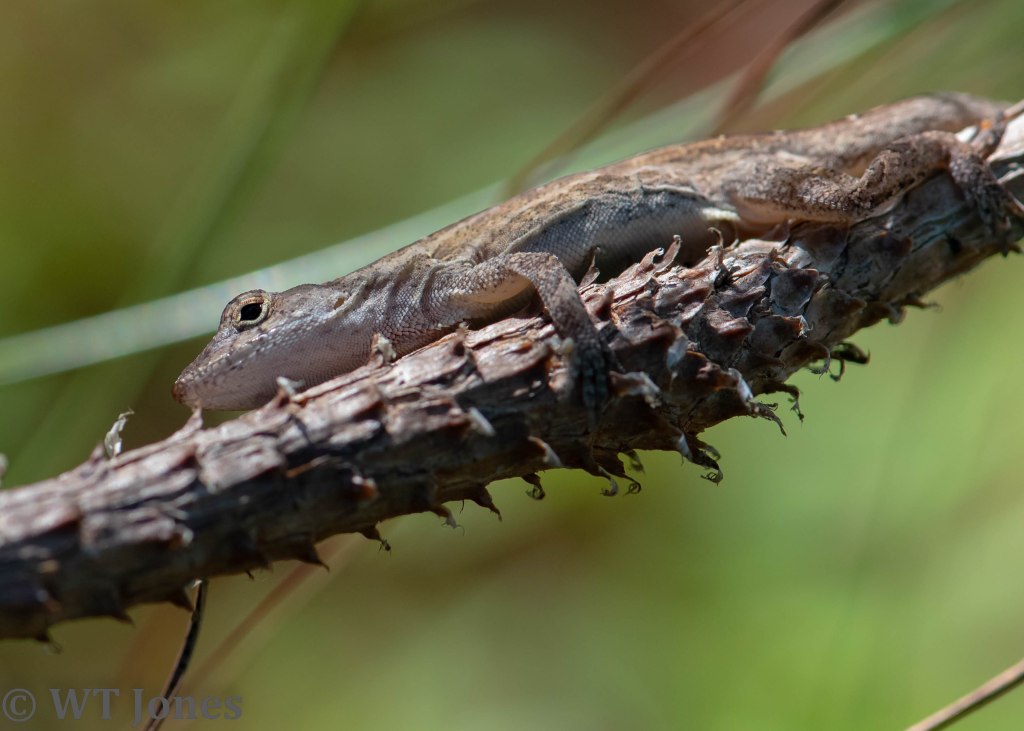
Some species can display a wide variation in appearance. Different shades of the Yellow Garden Spider (Argiope aurantius) are common. The characteristic zig-zag zipper design in the middle of their web is called the stablementum.
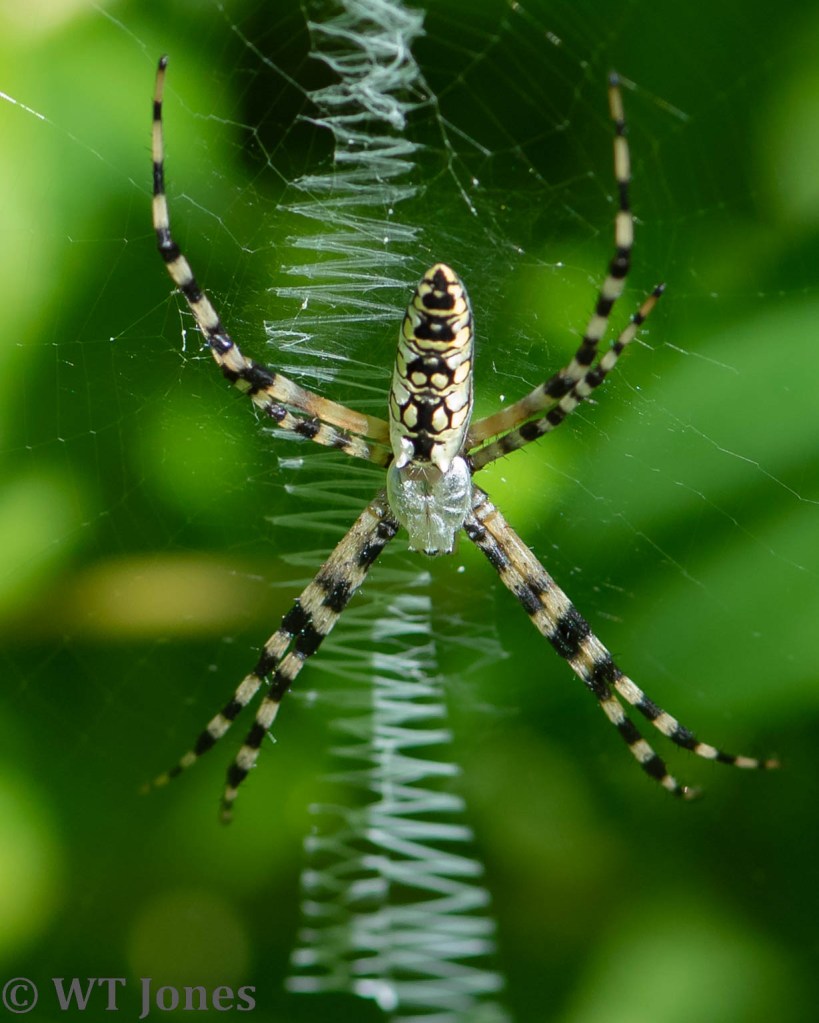

Our new species of the day! A very small critter, the Black-bordered Lemon Moth
(Marimatha nigrofimbria) was pretty hard to miss among the green grass blades.

Speaking of tiny, the Little Blue Dragonlet (Erythrodiplax minuscula) is only about an inch (25 mm) long. This is the male.

Not too much larger than the Little Blue Dragonlet, a Blue Dasher (Pachydiplax longipennis) male is ready for brunch.

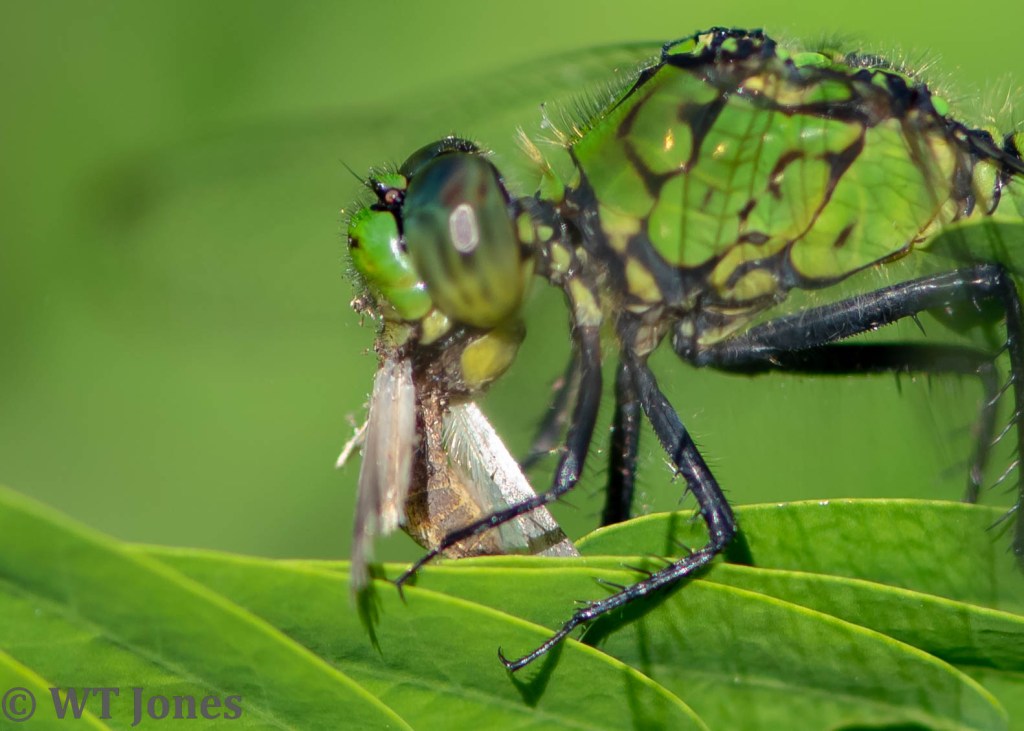
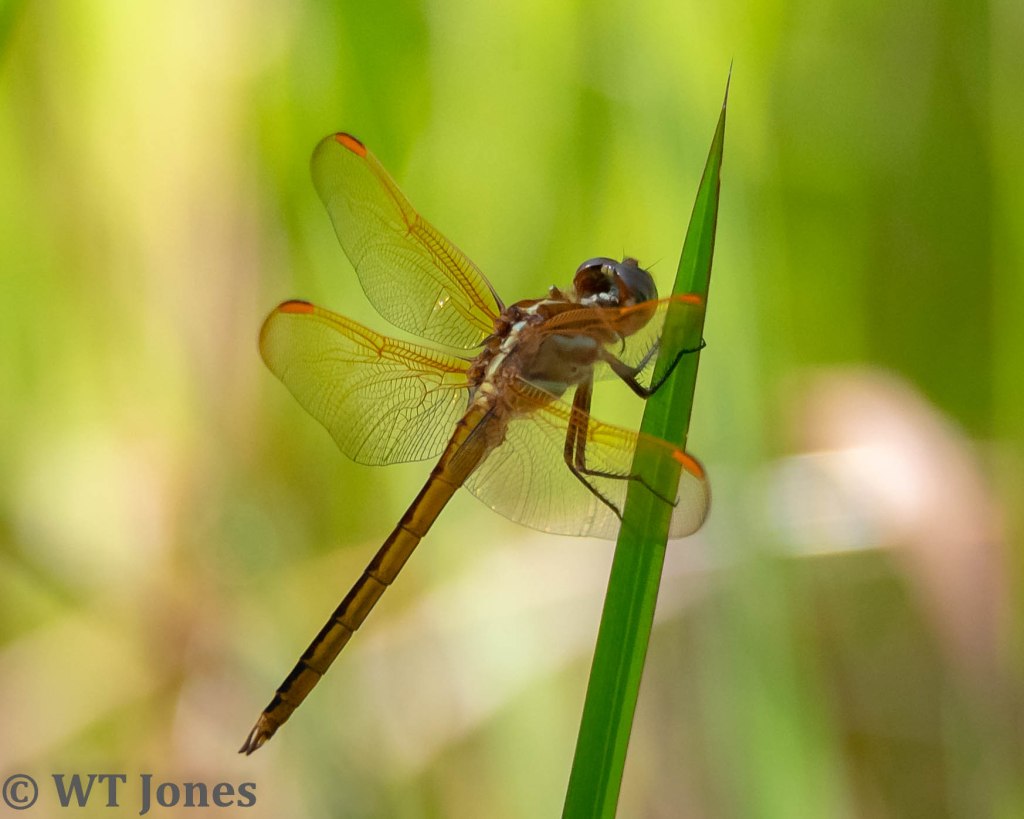
Going to the head of the brunch line is a richly colored female Eastern Pondhawk (Erythemis simplicicollis).

Our adventure today may have been short as measured by the clock, but it was long on satisfaction. A new species discovered, activity happening all around us, holding hands under the pine trees. Life is good.
Enjoy your search for a natural place and come back for a visit!
Additional Information
https://www.floridastateparks.org/parks-and-trails/colt-creek-state-park
Header Image: Prothonotary Warbler
It’s her fault, you know. She said: “Go birding. I have some crafting to catch up on.” I should have known to be wary.
For some time now, I’ve wanted to explore part of the “Blue Loop Trail” at Tenoroc Public Use Area. According to the map, about a quarter mile from the trail head is an “overlook”. Along the way are huge oak, bay and hickory trees and some willow tangles that looked promising. The overlook was okay, especially since it was from a rare Florida ‘hill” created a few decades ago when this area was mined for phosphate.
The plan. Walk to the overlook. Return to the car.
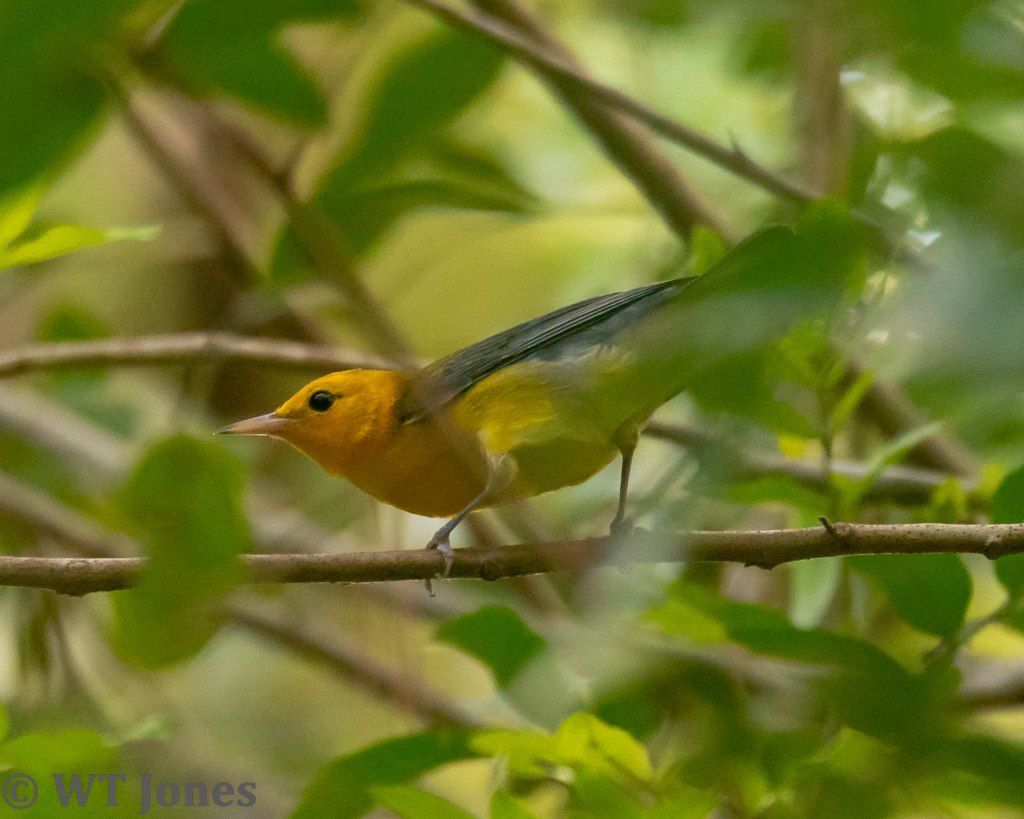
A few birds flitted along the short walk. Northern Cardinals, a White-eyed Vireo, a Carolina Wren. Then, a flash of bright yellow in the willows! Those slate-colored wings! The first Prothonotary Warbler of the fall migration! Camera – uhh, no. The target took off down the trail.
That is the moment I should have paid attention to the “wary” alarm.
For the next 30 minutes, a frustrating game of hide-and-seek took me further along the trail. In a grove of hardwood trees adjacent to a lake, I finally managed a few poor-quality images. As a bonus for my efforts, a pair of Prairie Warblers and a trio of American Redstarts made an appearance. Throw in two more Prothonotary Warblers, Carolina Wrens, woodpeckers, flycatchers, spiders and butterflies – well, a good day became better.
Then, reality smacked me in the face.
How far was I from the car? Check the map on the phone. No signal. How long was this trail? Senior memory failed. Go back or go forward? Might as well see what the rest of the trail looks like.
It looked good! Lots of great habitat and things were going great. Another 30 minutes through some heavy weeds, soaking wet from dew and humidity, temperature rising. A drink of water — the bottle is — in the car. After all, it was only going to be a brief quarter mile walk. Sigh.
An hour-and-a-half later, phone back in service! Map says another half-hour to the parking lot. Called Gini to let her know I was going to be later than anticipated. “Did you take breakfast with you?”
Looking forward to lunch. But first, water.
It was, in retrospect, a terrific morning! The trail is a good one and at least I’ll be better prepared the next time. The Prothonotary Warbler has been a bit of a nemesis for me in past years, so I was happy to get any images at all.
The even better news in this episode is, with the sightings of American Redstarts and Prothonotary Warblers, we can officially say “autumn” migration is under way! Yep, it is still hot. The “dog days” of summer, according to some almanacs, ended a couple of weeks ago. After today’s sightings, I feel cooler already.
To the overlook, and beyond.
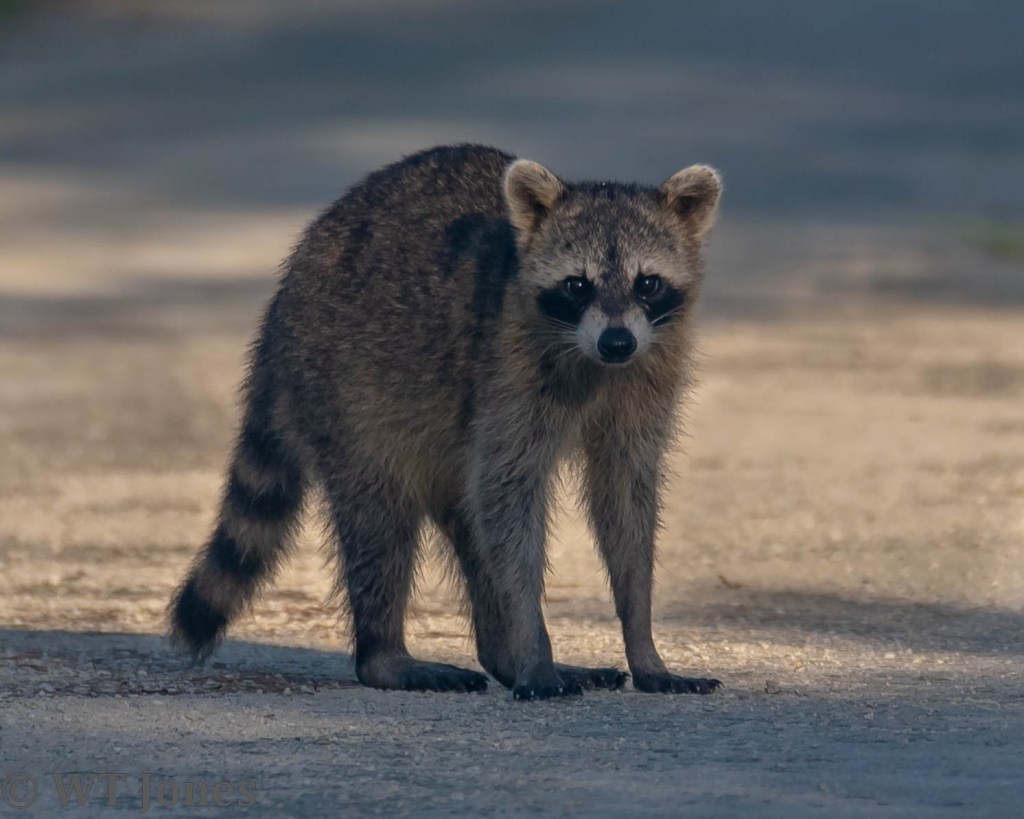
As always, beware masked bandits along the way. This must have been a young Raccoon as it just stared a bit then calmly walked into the brush.
The overlook. This is actually a somewhat unusual scene for Florida. We seldom have a chance to be this far above the landscape. There is a trail on the other side of this lake, too. Another day maybe. (Photo-bombed by a dragon.)

Several Carolina Wrens were seen and heard during the morning. Some are still in the process of molting.


At this time of year, several species of birds begin to form into groups as they prepare for migration. I encountered four Prairie Warblers today in the same general area.

Walking through spider webs is an occupational hazard for birders who sometimes amble along gazing upward instead of looking where they’re going. Thankfully, I saw this one just in time to duck under it. The owner, an Orchard Orbweaver (Leucauge argyra) appreciated my consideration.

A resident in central Florida, the Great Crested Flycatcher is an eye-catcher with that lemon-colored underside.


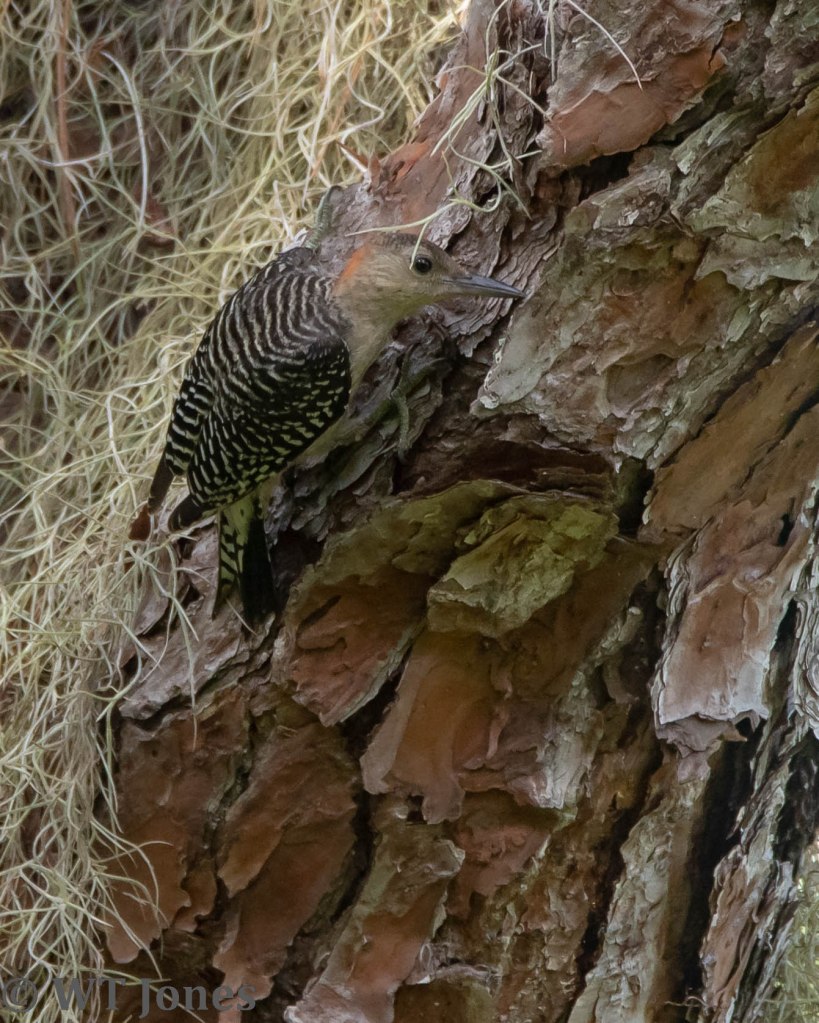
The Red-bellied Woodpecker is very common in our area and has been able to adapt to human habitation. The woodpecker in the second image doesn’t have much red on its head yet as it is an immature bird.

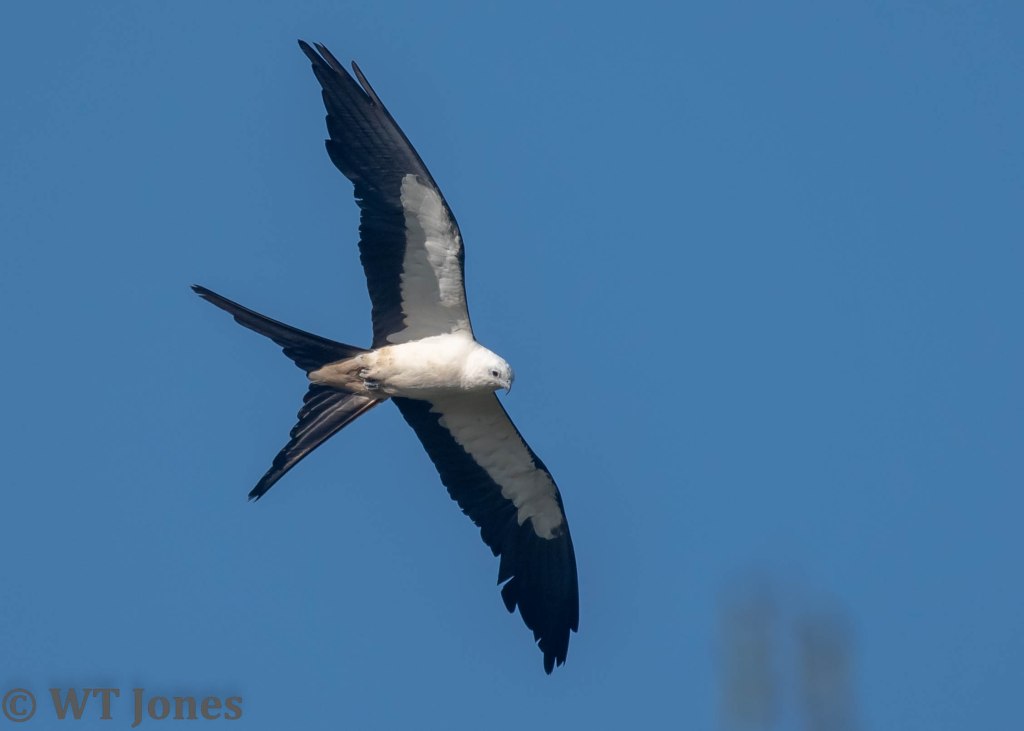
In just a few more days, the Swallow-tailed Kites will be gone. By the end of August, they will be well on their way to enjoying the juicy grasshoppers of the Argentine pampas.
A Northern Cardinal still molting new plumage.

Thankfully, this thoughtful Golden Silk Spider (Trichonephila clavipes) spun her web to the side of the trail. These webs are surprisingly strong and once you walk through one face first, it seems to remain with you the rest of the day.

The Prothonotary Warbler has pretty basic coloration. Perhaps the simplicity is what I like.
With no red marking on the head, we know this is a female Downy Woodpecker.

I counted over two dozen Spicebush Swallowtail (Papilio troilus) butterflies during the morning. They liked this trail as much as I did. But they didn’t have to hike back to the parking lot.

The intensity of the Dog Star is on the wane. Our hot weather will subside. Birds will move from breeding grounds to warmer climates. Nature moves forward pulling us inexorably toward what awaits.
Enjoy your search for a natural place and come back for a visit!
Further Information
Header Image: Blue Dasher (Pachydiplax longipennis)
Excitement is hoping aloud a diminutive damselfly will arise from its blade of grass and land on your windowsill. It happened last year about this time and at this spot. Alas, not today. Gini’s disappointment was short-lived as we reminded ourselves this was only the fourth time a Seepage Dancer (Argia bipunctulata) has been observed in our county.
We had little time to think about it. The weeds and grass and tree branches were alive with all manner of life! Although we kept an eye out for unusual bird activity, insects were the stars of the day. We tried to keep an informal count of some species but gave up. During the morning, we found over two dozen Gulf Fritillaries, twice as many Eastern Pondhawks, over 50 Four-spotted Pennants and became deliriously dizzy trying to keep up with them all!
Breakfast was a tangerine and a banana, consumed from one hand while the other hand held the bins or camera. Later, at home, citrus juice had to be cleaned from all the optical gear. The heavy dew kept a few insects grounded for a bit, but once the sun was up for an hour, the sky filled with buzzing and whirring all around us.
I was disappointed I couldn’t manage a single decent shot of any of the big dragons we encountered. Common Green Darner, Swamp Darner, Two-striped Forceptail – all had a bad case of camera shyness. Next time.
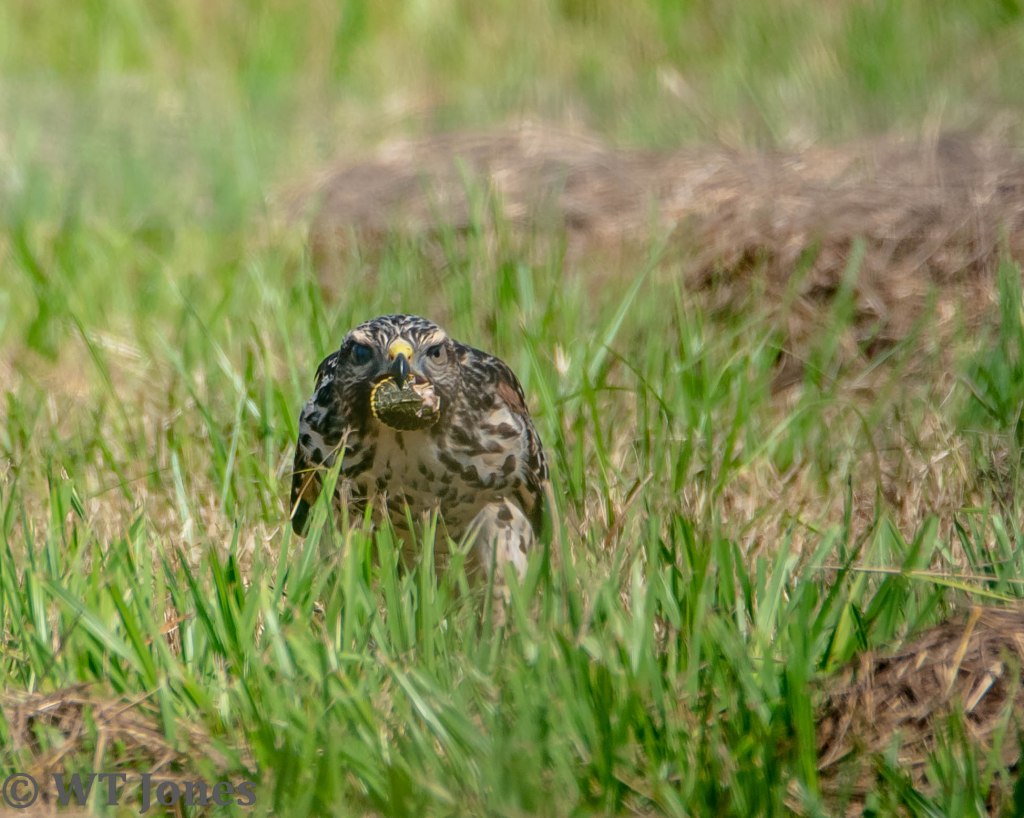
At least a young hawk posed with her brunch but glared as if we were going to try and steal it. It did look appetizing.
Our wet season is living up to its name. The rains happen mostly late in the day, so we get an early start. Heavy dew and high humidity result in soaking wet clothing and shoes before half an hour passes. By 10:00 or 11:00 the heat becomes oppressive, and we head for the house.
Before we head home, come along and see for yourself.
Last year, a male Seepage Dancer (Argia bipunctulata) flew in Gini’s car window and posed all over the place. Today, at the same spot, a female lounged on a grass blade but couldn’t be coaxed into going for a ride.

Many of the duskywings are named for Roman poets. Such as this one, Horace’s Duskywing (Erynnis horatius). Quite attractive for such an overall dark butterfly.

Although not as brightly colored as its Gulf cousin, the Variegated Fritillary (Euptoieta claudia) has a muted beauty all its own.

A common species in our area, a White Peacock (Anartia jatrophae) typically flies low to the ground.

The circle of life can get messy. An Eastern Pondhawk (Erythemis simplicicollis) with a Fiery Skipper (Hylephila phyleus).

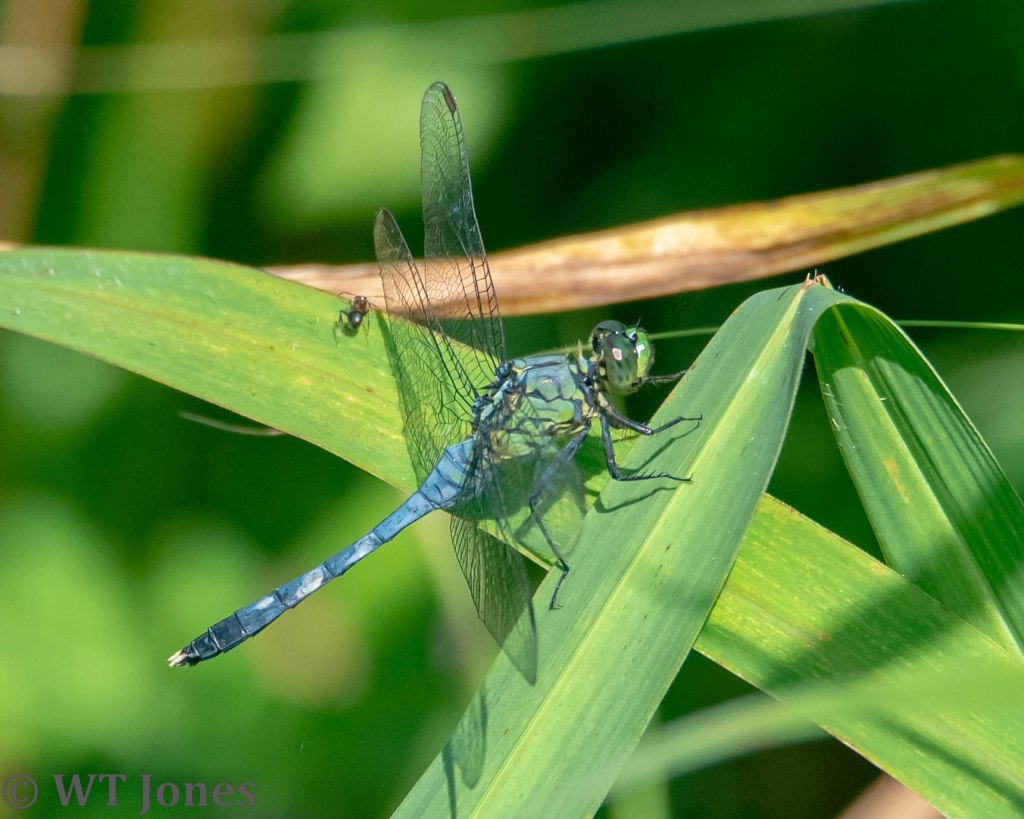
Immature male Eastern Pondhawks (Erythemis simplicicollis) initially look like females before achieving the overall pruinose blue of an adult male. This one is in transition.
Florida chose well in naming the Zebra Longwing (Heliconius charithonia) our state butterfly.

Compare the more intense orange of the Gulf Fritillary (Agraulis vanillae) to the duller tones of the Variegated above.

As summer progresses, the female Great Southern White (Ascia monuste) can become quite a bit darker than the male. A quick identification of this species can be made by observing the turquoise antennal clubs.


Not a very clear photograph, but I seldom get two different species in one frame, much less with one in flight. Great Southern White (Ascia monuste) and Variegated Fritillary (Euptoieta claudia).

If they hold still, it’s pretty easy to overlook a small damselfly, even with that blue tail. Rambur’s Forktail (Ischnura ramburii).

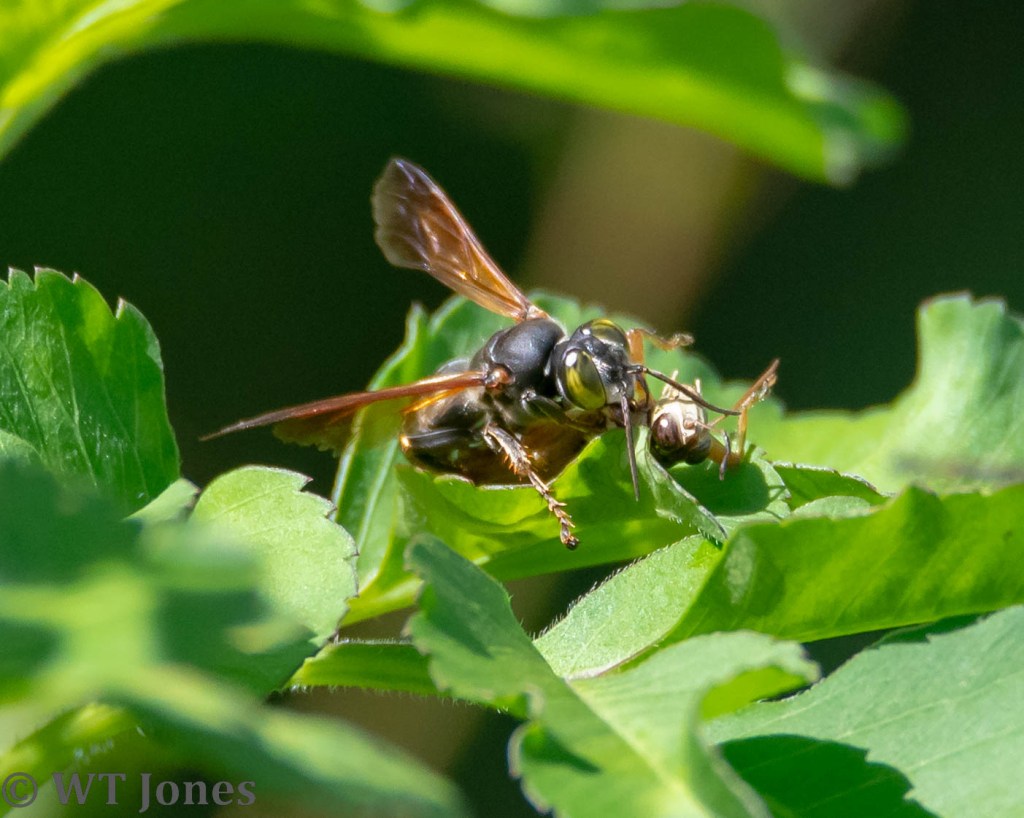
Often called “Sand-loving Wasps” the uniquely colored eyes help identify this large predator as being in the Genus Tachytes. This one has captured a grasshopper.
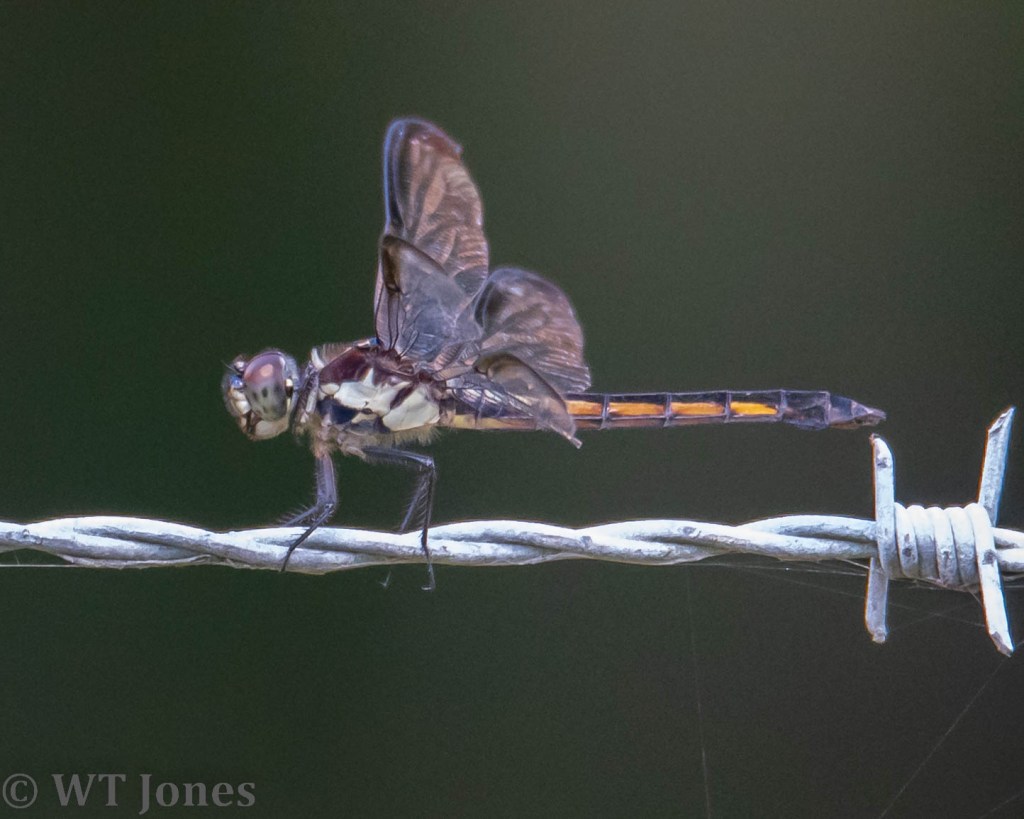
In a week or so, this immature male Roseate Skimmer (Orthemis ferruginea) will have turned into the bright purple hue of the adult.

By far, the most numerous dragonfly of the day was the Four-spotted Pennant (Brachymesia gravida).

Female Bar-winged Skimmers (Libellula axilena) appear much different than the dark males.
The young Red-shouldered Hawk was upset we were within her sight, and we soon saw why. She had no intention of leaving her fresh catch and likewise was not about to offer us a bite of turtle.

We say, “let’s go birding“. If we meet someone who asks, “are you birders?”, we answer “yes“. We DO go birding and we ARE birders. But we certainly do enjoy a day filled with nature’s creatures, even if they all don’t have feathers.
Enjoy your search for a natural place and come back for a visit.
Header Image: Great Egret
Our current summer has caused childhood memories to flood my conscience lately. It is hot. I walk barefooted to the mailbox and as I cross the concrete driveway, my pace quickens as it seems I’m walking in a frying pan. As a kid, my feet were tough enough to walk on sandspurs without ill effect. A dish of ice cream last night (yes, I know, apparently verboten at my age) conjured up long-ago Sunday drives to the dairy, where petting calves, holding our noses and a free ice cream cone made the day special. Regular rains helped maintain lake levels, irrigated crops and filled drainage ditches. Gini vividly recalls wading in those freshly filled depressions, marveling at wiggletails (mosquito larvae), chasing frogs and catching tadpoles for “show-and-tell” at school.
The smell of impending rain has not changed over time.*
Summer moves forward. The temperature is declared to be the “hottest on record”. Television no longer has a “weatherman”. Nor do they have anything called a “meteorologist” anymore. Prognosticators of sky and clouds and fronts are now all “Climate Specialists”. In Florida, it is hurricane season. Local “Climate Specialists” breathlessly advise this will be the worst storm season ever, as hurricanes are becoming more numerous and stronger than anything we have previously experienced.
Perhaps.
The rain during the night cleansed the air. Early morning skies are bright, cloudless and without haze. Wet fields glisten with myriad gossamer webs displaying thousands of minute prisms bending the rays of the sun. Treading softly on wet pathways we hear the guttural murmuring of a flock of White Ibises as they move from their nighttime roost to fields where they will forage most of the day. Northern Cardinals and Mourning Dove always seem to be the first birds we hear in the woods. A White-eyed Vireo sings its name from the underbrush. Our movement has alerted a Red-shouldered Hawk and she loudly screeches a warning to the natural world.
Leaves and grass begin to dry under the glare of the sun. Insects go about their endless tasks of eating, mating and surviving. Larger insects attempt to interrupt the survival of their smaller kin. More potential predators appear in the form of spiders, lizards, snakes, birds.
Nature. A seemingly infinite amount of activity occurs every day whether we are there to observe or not. Today, we are privileged to be there.
Here is a small sampling of our experience on this day. Wish you had been with us.
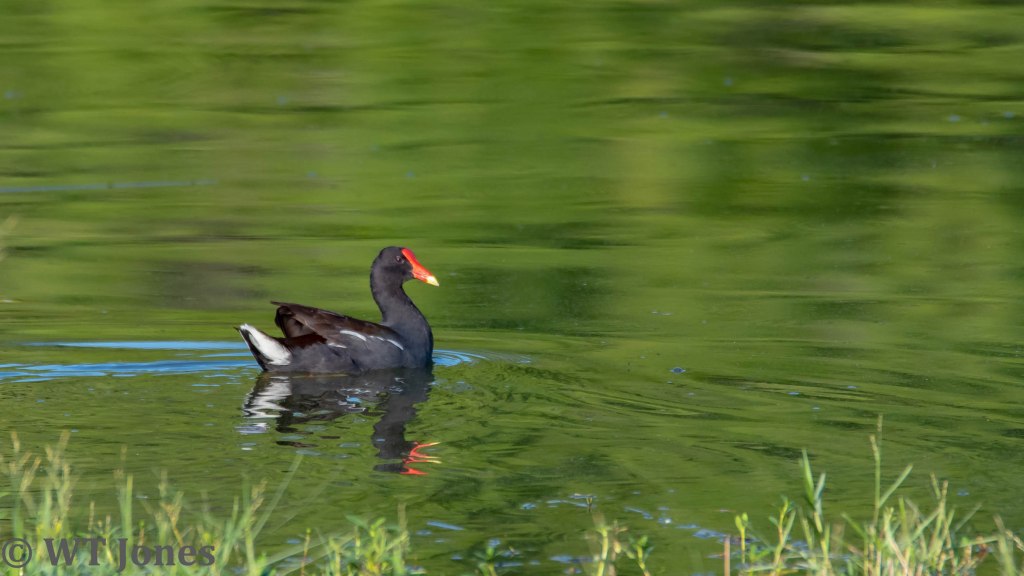
Common Gallinules are, well, common in Florida wherever there is fresh water. That means there are a LOT of gallinules around here!
It seems almost rare lately to find a Dorantes Longtail (Urbanus dorantes) with both “tails” intact. They evidently make good grabbing points for predators.

Shiny red seeds of the Balsampear (Momordica charantia) are very pretty but, unfortunately, this plant is one of those very successful invasive weeds which choke out native species.

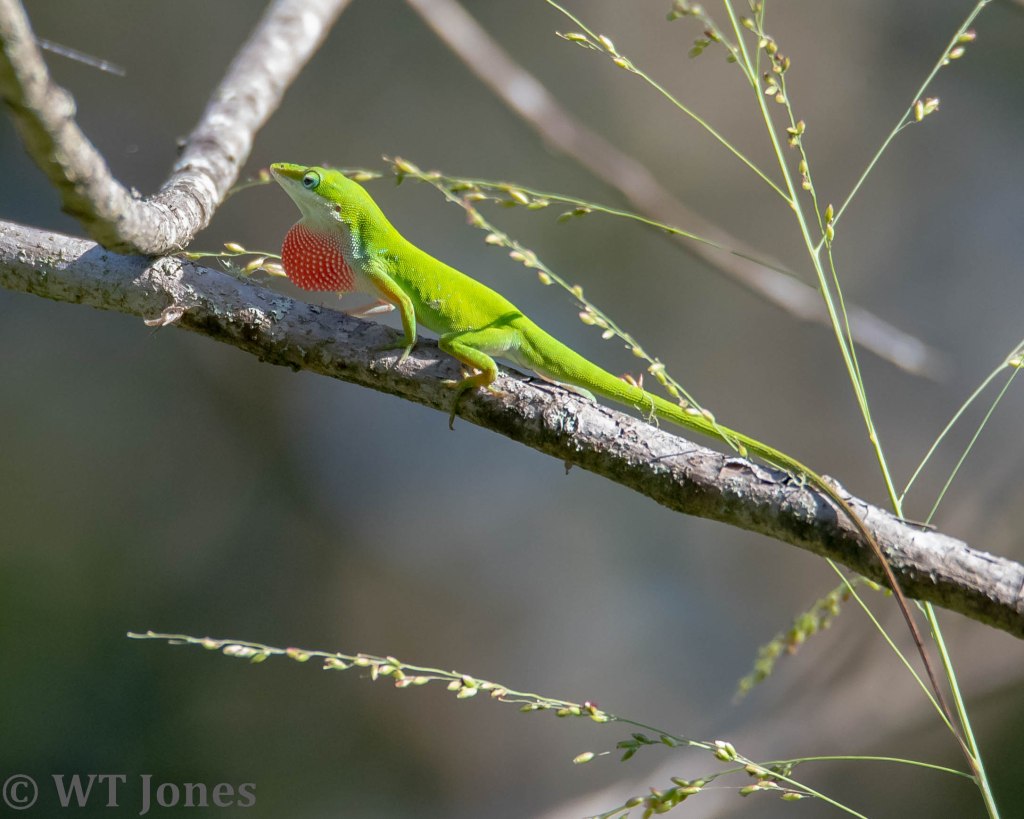
Although not related to a chameleon, Florida’s native Green Anole (Anolis carolinensis) does have the ability to change from green to brown to help it blend in. Hard for the male to hide that strawberry-colored dewlap, though.
Rain means healthy plant growth. Healthy plants mean flowers. Flowers mean butterflies! One of our prettiest, as well as most common, is the White Peacock (Anartia jatrophae).

The raised crest of a Green Heron is the result of a Red-shouldered Hawk flying by a little too close for comfort.

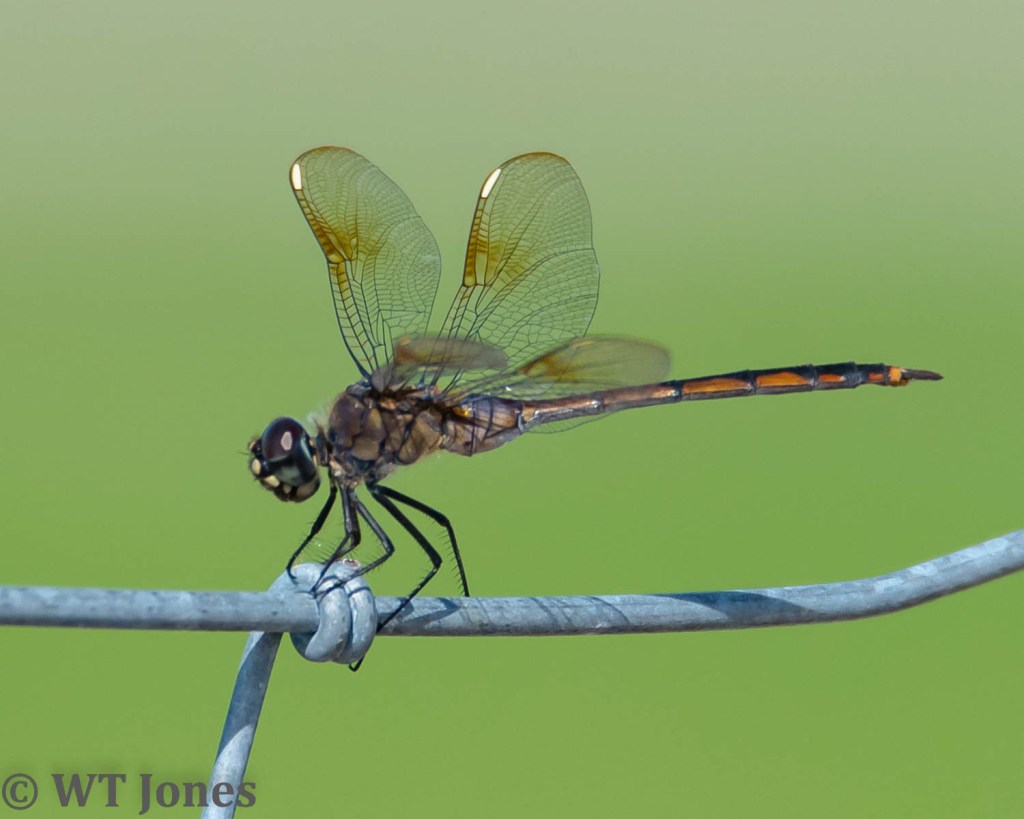
An open field adjacent to a wooded area with water nearby is a great potential location to scout for dragonflies. Add a fence for perching and before you know it, you’re looking at a Four-spotted Pennant (Brachymesia gravida).
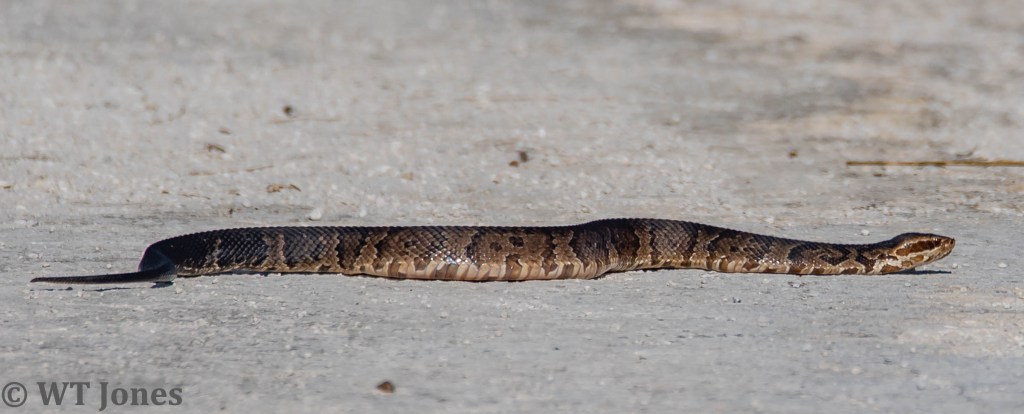
Regular rain produces wet places for all sorts of creatures. We didn’t expect to see this Water Moccasin in a spot which is normally dry and grassy. Thankfully, we saw him on the road, not under our feet!

A good example of sexual dimorphism in dragonflies. The female Roseate Skimmer (Orthemis ferruginea) is brownish/orange with a distinctive thorax pattern, while the male exhibits its namesake coloration. Even the male thorax shows the same pattern as the female if you look closely.


Snails! We rounded a bend and scattered around were “dead” looking twigs of brush, two to three feet tall, with light-colored snails on almost every branch! We have never seen anything quite like this. We found the same phenomenon here and there for the next half mile. There were easily over a hundred snails.


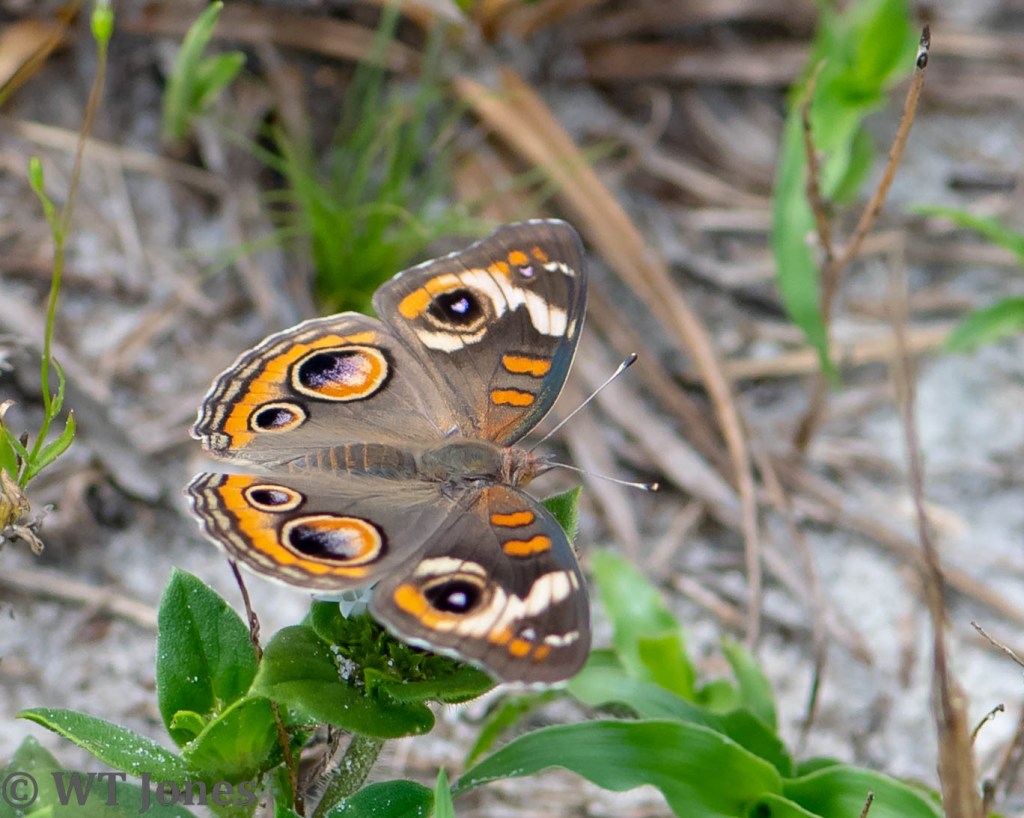
Flitting among green weeds and sand, a Common Buckeye (Junonia coenia) stands out with its bright colors.
The very small Eastern Amberwing (Perithemis tenera) mimics a wasp’s flight characteristics in the hope of thwarting predators.


One of our larger butterflies, a Spicebush Swallowtail (Pterourus troilus) is missing a “tail”, likely due to an encounter with a predator.


This female Needham’s Skimmer (Libellula needhami) glows in the morning light.

At nearly three inches, the Cloudless Sulphur (Phoebis sennae) is one of our largest and most common sulphurs. This one is nectaring at a Wild Bushbean (Macroptilium lathyroides).

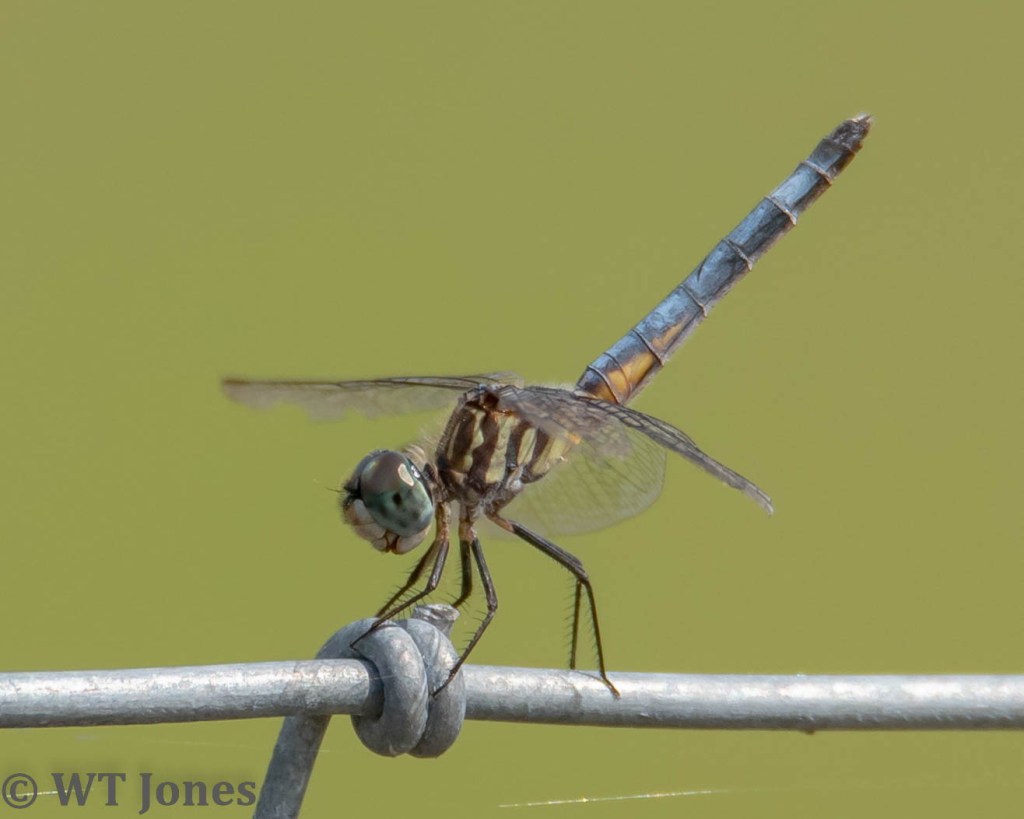
Small. Handsome. Fast. With racing stripes. That’s the male Blue Dasher (Pachydiplax longipennis).
A small falcon, this female American Kestrel made quick work of her breakfast. We could not figure out what the prey was. She said it was “delicious”.


Parts of the planet are in need of rain while other areas suffer with flooding. Humans attempt to “tame” nature. Life on earth endures.
*(For the scientifically curious: the smell of rain is known as “petrichor” and the causes of that smell are “geosmins”. Have fun with your research.)
An American poet of the late 19th century captured how I feel about summer rain and nature.
Summer In The South
The Oriole sings in the greening grove
As if he were half-way waiting,
The rosebuds peep from their hoods of green,
Timid, and hesitating.
The rain comes down in a torrent sweep
And the nights smell warm and piney,
The garden thrives, but the tender shoots
Are yellow-green and tiny.
Then a flash of sun on a waiting hill,
Streams laugh that erst were quiet,
The sky smiles down with a dazzling blue
And the woods run mad with riot.
(Paul Laurence Dunbar)
Enjoy your search for a natural place and come back for a visit!
Header Image: Golden-winged Skimmer (Libellula auripennis)
The sun has barely managed to get out of bed and already the cicadas are buzzing their raspy chorus in glorious surround-sound. Walking into a meadow requires slogging through a small ditch where the weeds hide six inches of water under bright green tangles. No matter. The dew is so heavy my feet were wet before I made it to the ditch. The humidity is thick enough that everything above my feet is also pretty damp.
Ahhh. Florida in summer!
Clouds of gnats hover just above the expanse of Saw Palmetto where enterprising dragonflies ambush them from nearby twig perches. We have two species of mosquitoes here: big and bigger. Yellow Flies and Deer Flies (members of the Tabanidae family of flies) are most active at this time of year just after sunrise and just before sunset. Good news! They don’t sting! Bad news! They bite! The bite of a deer or yellow fly is painful. Here is how the bug experts at the University of Florida describe it: “Tabanids inflict deep wounds that cause a flow of blood. The mandibles and maxillae penetrate the skin in a scissor-like action. Anticoagulants in the saliva are pumped into the wound and the blood is ingested through the sponging labella.” Nice.
Don’t forget to check yourself (or have a loved one help) for ticks once you get home.
Did I mention the snakes?
For anyone who has made it this far, congratulations on your bravery! (Or are you one of those who loves to read about the suffering of others?)
In spite of all the things out there which might cause one to be uncomfortable, we find the rewards are overwhelmingly worth it! The scent of the pine trees, rays of the early morning sun scattered by the tree branches, the same dew which causes wet feet forms amazing droplets on flower petals, birds calling, the seemingly infinite diversity of insect life (even some which don’t want our blood) and unexpected encounters – all of this and more remind us how good our lives can be. By embracing the less pleasant aspects of nature along with her charms, we seem less likely to take it all for granted. Sort of like friends and family, we accept that all of us have inherently good and not-so-good qualities but do our best to exist together. After all, if we don’t look out for each other, who will?
As is usual for us, we ambled through this forested part of the swamp like a couple of kids in a toy store. Pointing, ooh-ing and ahh-ing, wondering about this or that. Our breakfast was fresh fruit by the side of a big mud puddle in the shade of Long-leaf Pine Trees. The mud around the puddle attracted a half-dozen species of dragonflies and damselflies. A Great Horned Owl called from a distant perch. A refreshing breeze advised us the morning was almost over.
Pulling onto the main road, hands touching, a heavy sigh in unison. We know we are not normal. And we are content.
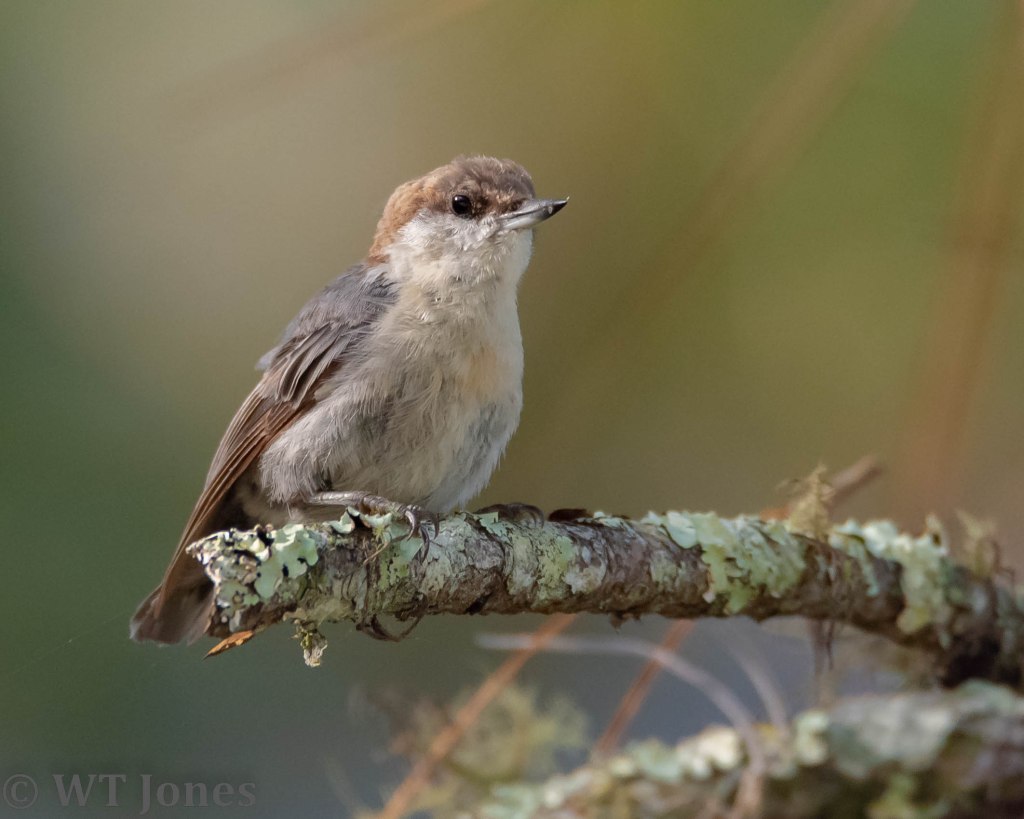
“Rubber ducky!” I immediately knew Gini was referring to the squeaky call of a diminutive Brown-headed Nuthatch. They inhabit older growth pine woods and typically travel in extended family groups. Breeding quite early, in late February, members of this years’ brood are out and about scouring for food and perhaps likely nesting spots for next year.
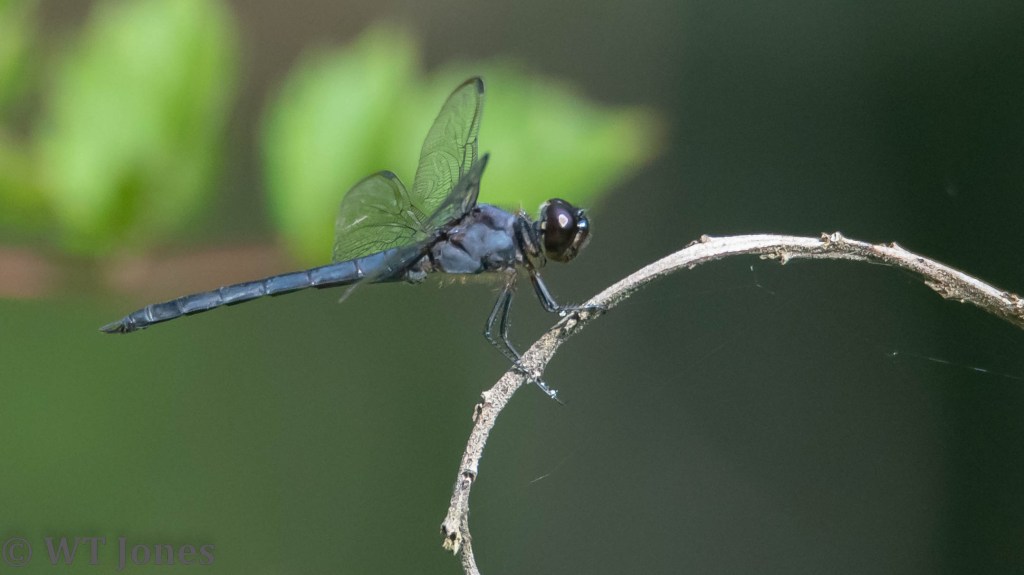
Slaty Skimmer (Libellula incesta) males are distinctive in their overall dark appearance.
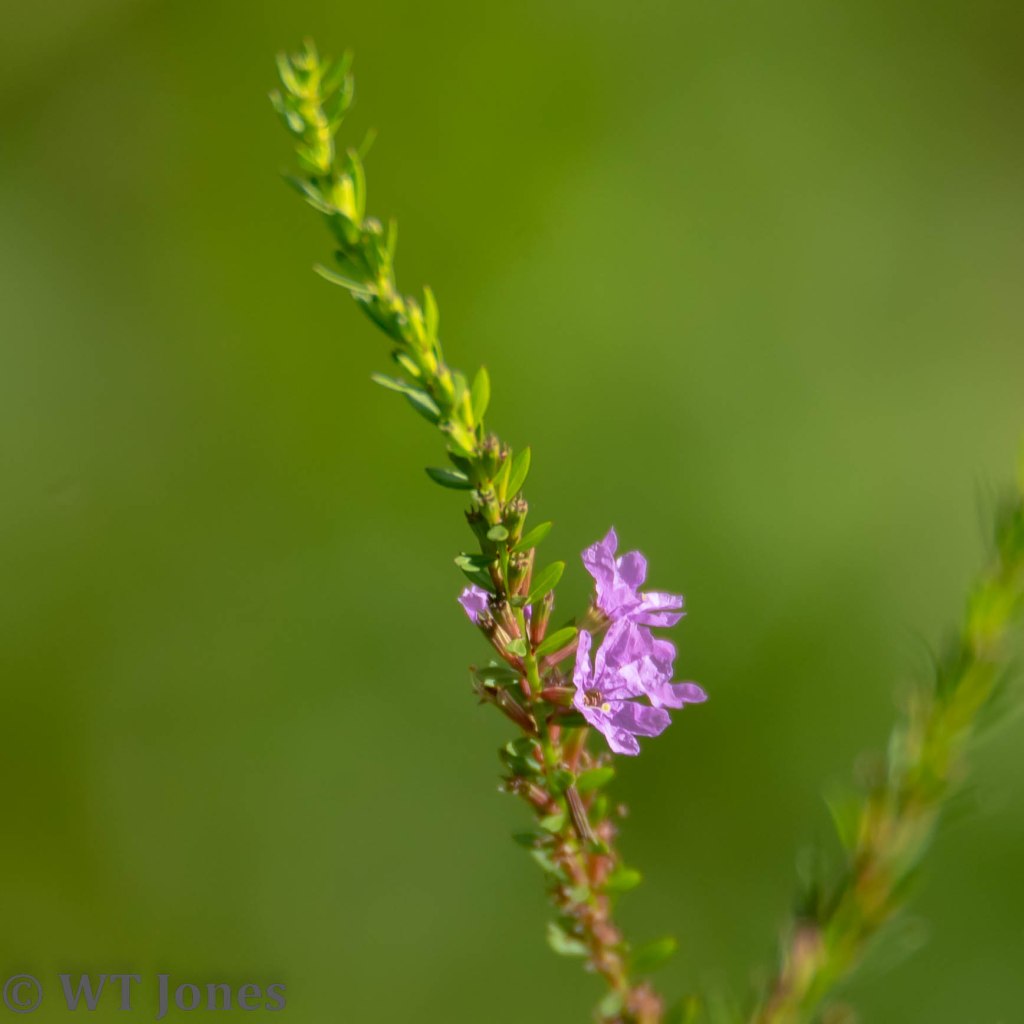
The flowers of the Wand Loosestrife (Lythrum lineare) appear to be made of paper mache with their wrinkled petals.
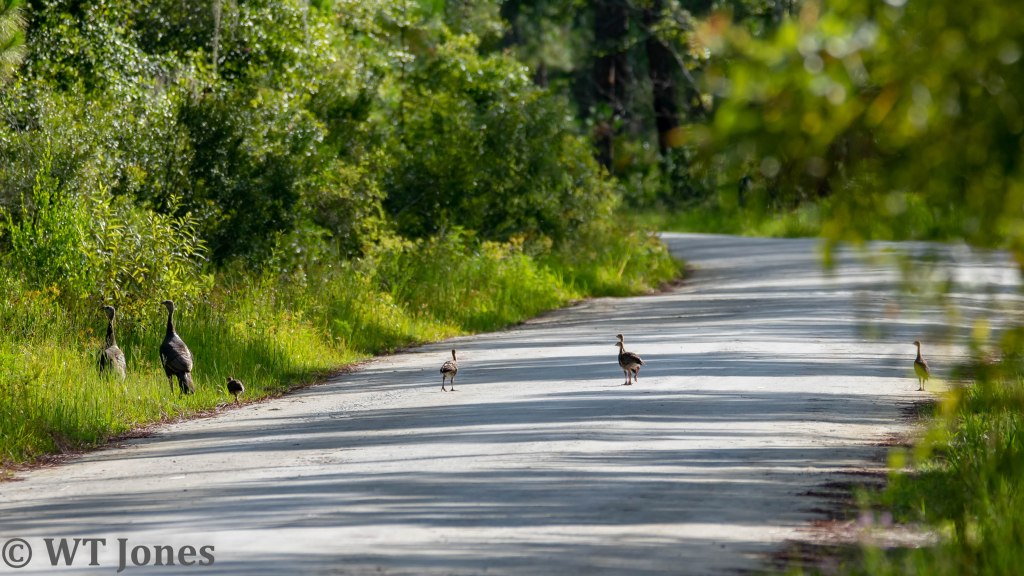
The forest holds an occasional surprise. A Wild Turkey appeared along the side of the road.

Then, two adults and a poult materialized.

More poults!
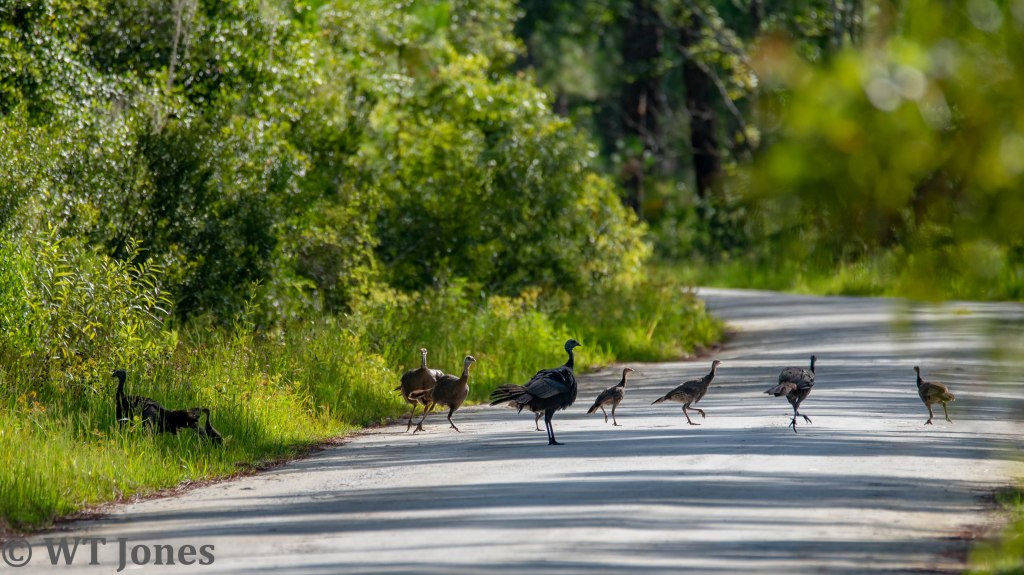
Then, things just got crazy! We eventually counted over two dozen turkeys at this spot including poults, “teenagers” and adults. They chased each other, engaged in aerial “fights” and took their time enjoying the morning. Just like us.
The wing edges of a Golden-winged Skimmer (Libellula auripennis) are reminiscent of fine filigree.
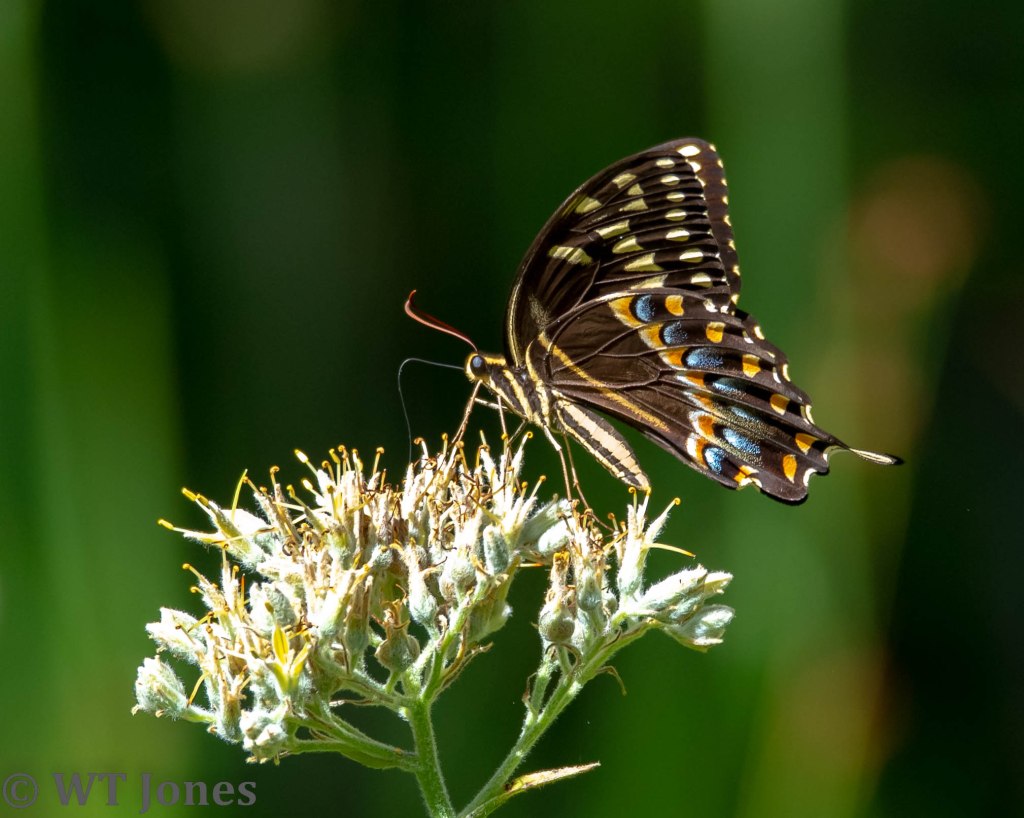
One of our larger butterflies, the Palamedes Swallowtail (Papilio palamedes) has distinctive stripes on its body as opposed to spots seen on other dark swallowtails. (The plant here is Carolina Redroot (Lachnanthes caroliana), extremely attractive to pollinators.)
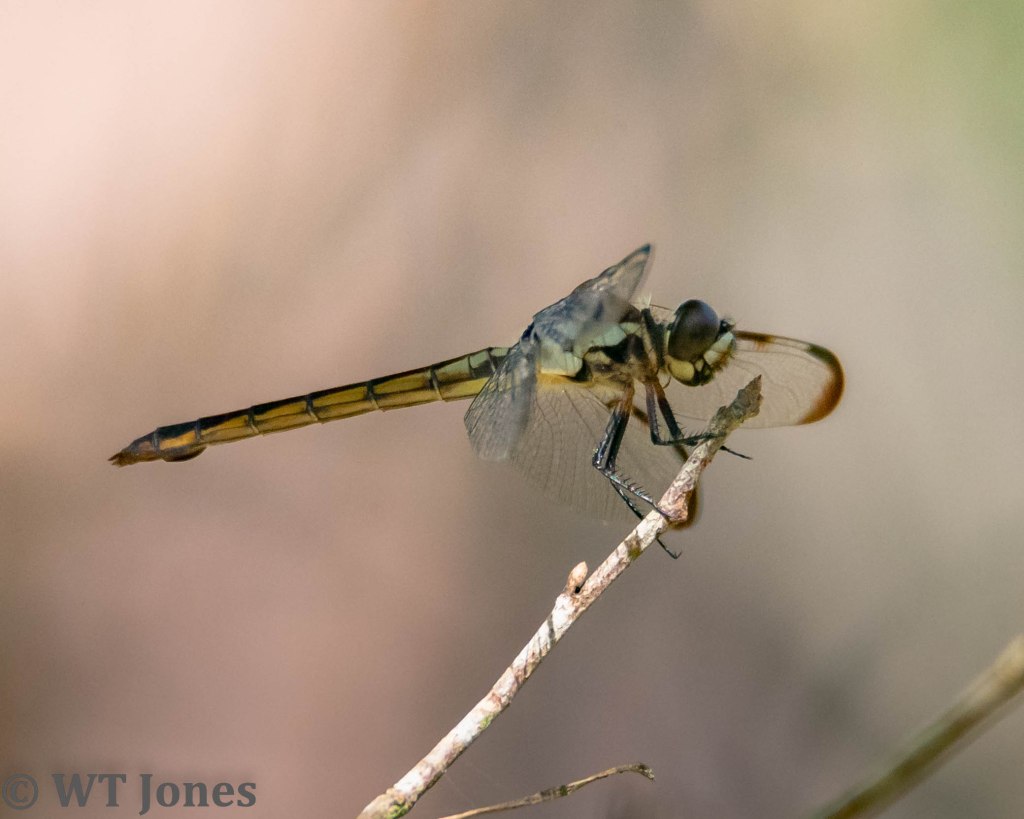
I’m not certain which of these dragons was attempting to capture which, but it was fun to watch them for awhile. The first image is a Gray-green Clubtail (Arigomphus pallidus) and his worthy opponent is a male Eastern Pondhawk (Erythemis simplicicollis).


The Northern Cloudywing (Thorybes pylades) is a dark skipper we’ve only seen once before, about a mile from this spot.

We saw a few female Bar-winged Skimmers (Libellula axilena) during our visit but none of the dark-colored males. Next time.
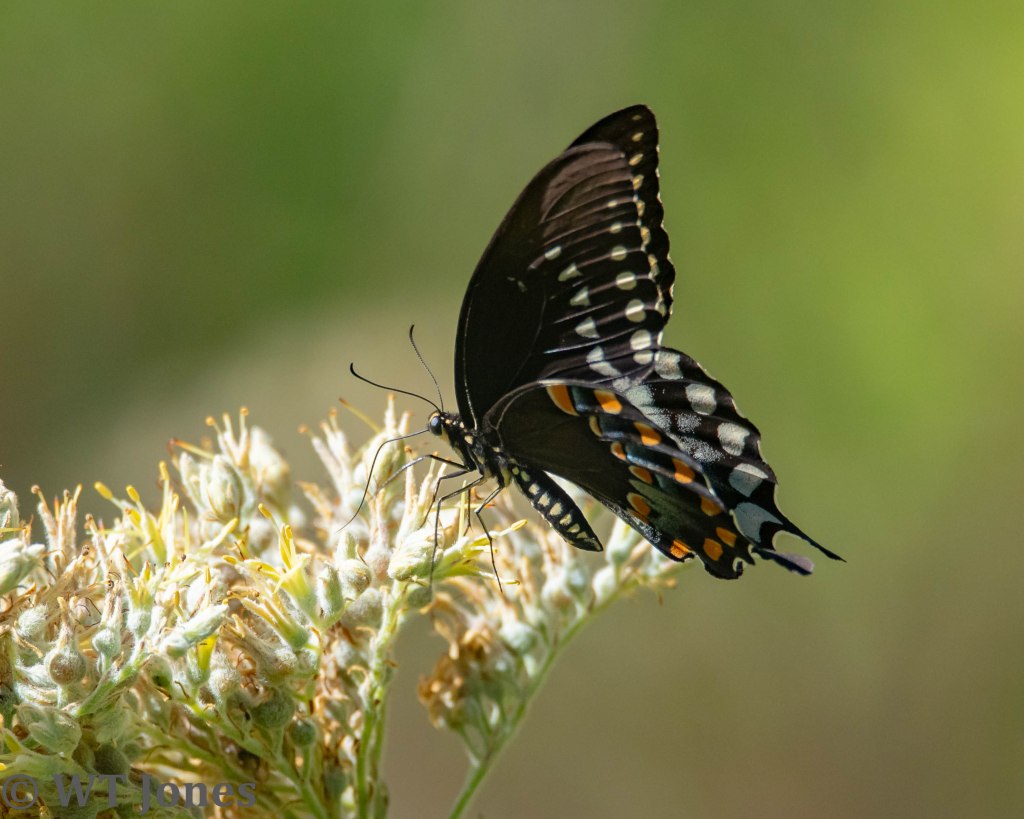
Another large butterfly, a Spicebush Swallowtail (Pterourus troilus), is distinctive for a minimal pattern on its dorsal side. Females (such as this one) have a dusting of blue on the median areas of the hind wing while males have a more greenish swash.

The forest in summer, especially here in Florida, is like our morning mug of coffee. Hot and steamy. If you’re willing to endure a little discomfort, there is a good chance the rewards will be more than worth the effort.
Enjoy your search for a natural place and come back for a visit!
 Our Natural Places