
Heat. Humidity. Hurricanes. Mosquitoes. Traffic.
Plus – the most incredibly diverse natural environment you could possibly imagine. Welcome to our home.
Gini and I were both born in the Sunshine State. Our childhoods were remarkably similar. Fond memories of trips to the beach, going fishing, picking fresh tomatoes for canning (in Gini’s case, for eating as many as possible before her Mom scolded her), earning respect of our elders, learning the value of work. Fate brought us together and the rest is (our) history.
As with most folks, we have had ups and downs and encountered bumps along life’s highway. We have been blessed that the great majority of the road has been smooth. So smooth, we often veer off the pavement to explore those dirt tracts which go who-knows-where. Ever curious, we even abandon the vehicle to hike along a remote trail or cut across a field or wander through a forest where no trail exists.
We like natural places. Thank you all for allowing us to share the results of our explorations with you.
On this day, we drove a dirt road, walked a couple of trails, had breakfast by the lake with the big cypress trees, enjoyed a cloudless blue sky while we held hands. The young Red-shouldered Hawk watched from a nearby branch and finally yelled a warning to Nature’s Neighborhood. Before we headed home, we found a few birds, some colorful insects and an unafraid Cottonmouth Moccasin.
You know. Just another day in Paradise.
A vertical pattern of tear-shaped markings identify this Red-shouldered Hawk as a first-year bird.

Non-native supporting non-native. Western Honeybee (Apis Mellifera) on Balsampear (Momordica charantia). The former, a welcome visitor. The latter, not so much.

An all-white immature Little Blue Heron will soon begin to show dark patches as it transforms into the slaty blue of an adult.

Looking like some hand-crafted precious bit of jewelry, the chrysalis of a Variegated Fritillary (Euptoieta claudia) will eventually burst to reveal a new adult butterfly.

We often see a Water Moccasin (Agkistrodon piscivorus) in our explorations. There are many other species of snakes present in the places we visit, but most scurry for cover long before we spot them. The moccasin is not very afraid of anything and more often than not will stand its ground. I asked it to please open its mouth so you could see why it’s nickname is Cottonmouth. Not today.


A small member of the sulphur family of butterflies, a Barred Yellow (Eurema daira) waits for the sun to dry its wings of morning dew.

Field guides describe the Rambur’s Forktail (Ischnura ramburii) as a “large damselfly”. To my aging eyes, “large” is very subjective in this case. Mating pairs often form a heart shape – at least to this human’s eyes.

The large Southern Carpenter Bee (Xylocopa micans) will probe blossoms for nectar or will often take a shortcut and bite the flower at its base. This female is working on a Showy Rattlebox (Crotalaria spectabilis), an invasive plant introduced in North America for a cover crop due to its nitrogen fixing properties. Unfortunately, the plant is toxic to livestock. Sigh. Another well-researched idea.


Dimunitive Eastern Amberwing (Perithemis tenera) dragonflies behave like wasps in the hope of not becoming lunch for some predator. The patterned wings are typical of the female while the male’s wings are nearly plain.

Another member of the sulphur family, the small Little Yellow (Pyrisitia lisa) is Florida’s most abundant yellow butterfly.

“The song of canaries Never varies, And when they’re moulting They’re pretty revolting.” — Ogden Nash — This Carolina Wren might well agree.

Brighter than its Variegated cousin, a Gulf Fritillary (Agraulis vanillae) was kind enough to pose on a color-coordinated Lantana blossom.

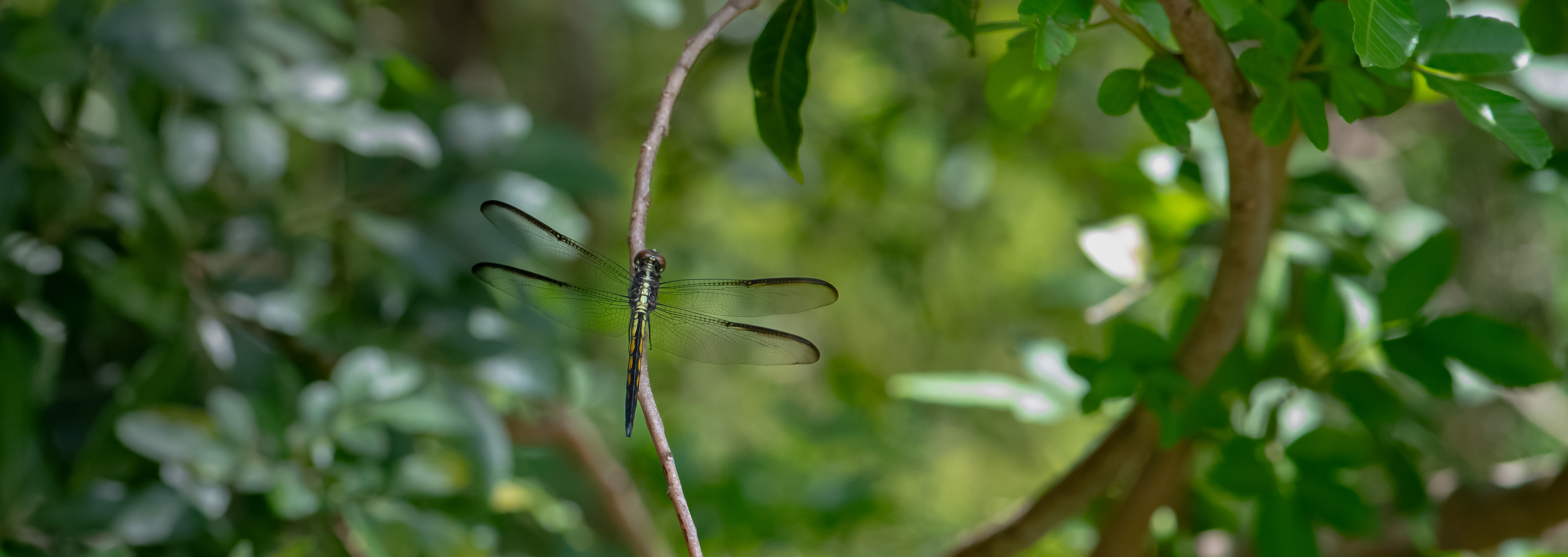
One of three all dark dragonflies in our area is the Slaty Skimmer (Libellula incesta).

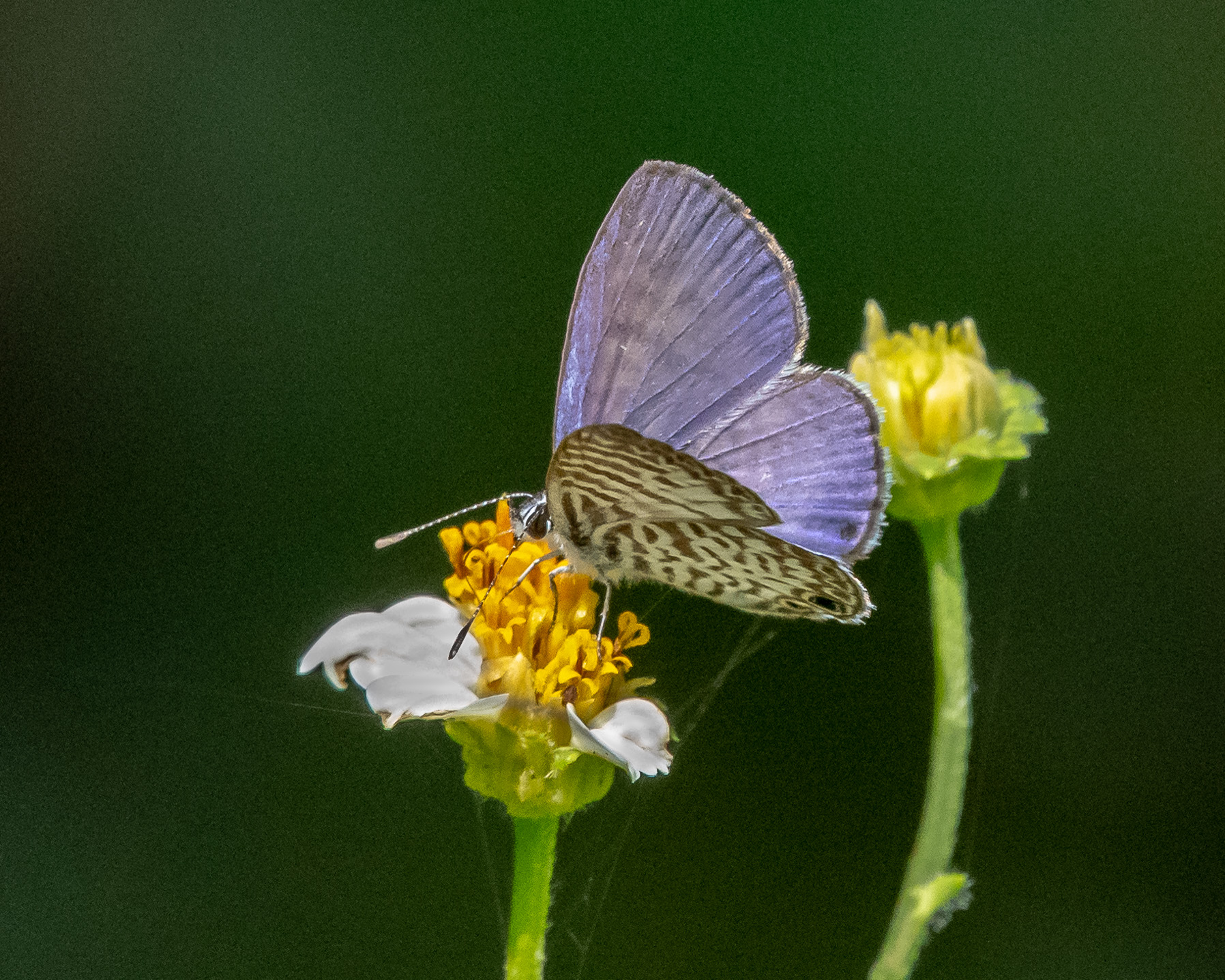
It is not often we get to see the upper wings of one of the “blue” butterflies. This Cassius Blue (Leptotes cassius) offered a very brief glimpse of its namesake color.

We know Florida is not perfect. Thank goodness, we are. (I think the correct modern techno-expression is “LOL”.) Despite the drawbacks, we love exploring our natural world.
Enjoy your search for a natural place and come back for a visit!

It is vital to set goals is life. Without a goal, how do you know where to go? If you don’t know where you’re going it is all too easy to become lost, literally as well as figuratively. Mapping out a route for what you want to do in life is critical to being successful.
Philosophy lesson for the day is over.
Once in a awhile – okay, most of the time – we have no specific goal in mind when we explore Nature. We go. We see. We breathe. We connect – with each other as well as with our surroundings. We are satisfied and “happy”.
I am blessed to have a partner around whom it is impossible to NOT be happy. She is very special.
Today was like any other. That is to say, it was extraordinary! We traveled a short distance to Colt Creek State Park. Open fields, pine woods, lakes, wetlands, cypress swamp, oak hammocks – diverse habitat inhabited by diverse life forms. Moving along at a quick pace produces an amazing array of sights, sounds, aromas, textures. Slowing down reveals an enhanced experience of all of the above. Standing still forces one to appreciate details impossible to see when walking.
We have a favorite spot under the tall long-leaf pines where we enjoy breakfast each time we visit. Today was similar to others. The shrill cry of a Red-shouldered Hawk indicated annoyance at our interrupting her own search for breakfast. A big Pileated Woodpecker flew from one tree to another. Butterflies flitted among blooming Spanish Needles. From low in a scrub palmetto came the song of a White-eyed Vireo and the summertime cicada chorus was non-stop.
A few hours in the park this morning refreshed our souls. Facing a calendar filled with visits to medical practioners and laboratory technicians seems less daunting.
Diversity shared is diversity enjoyed.
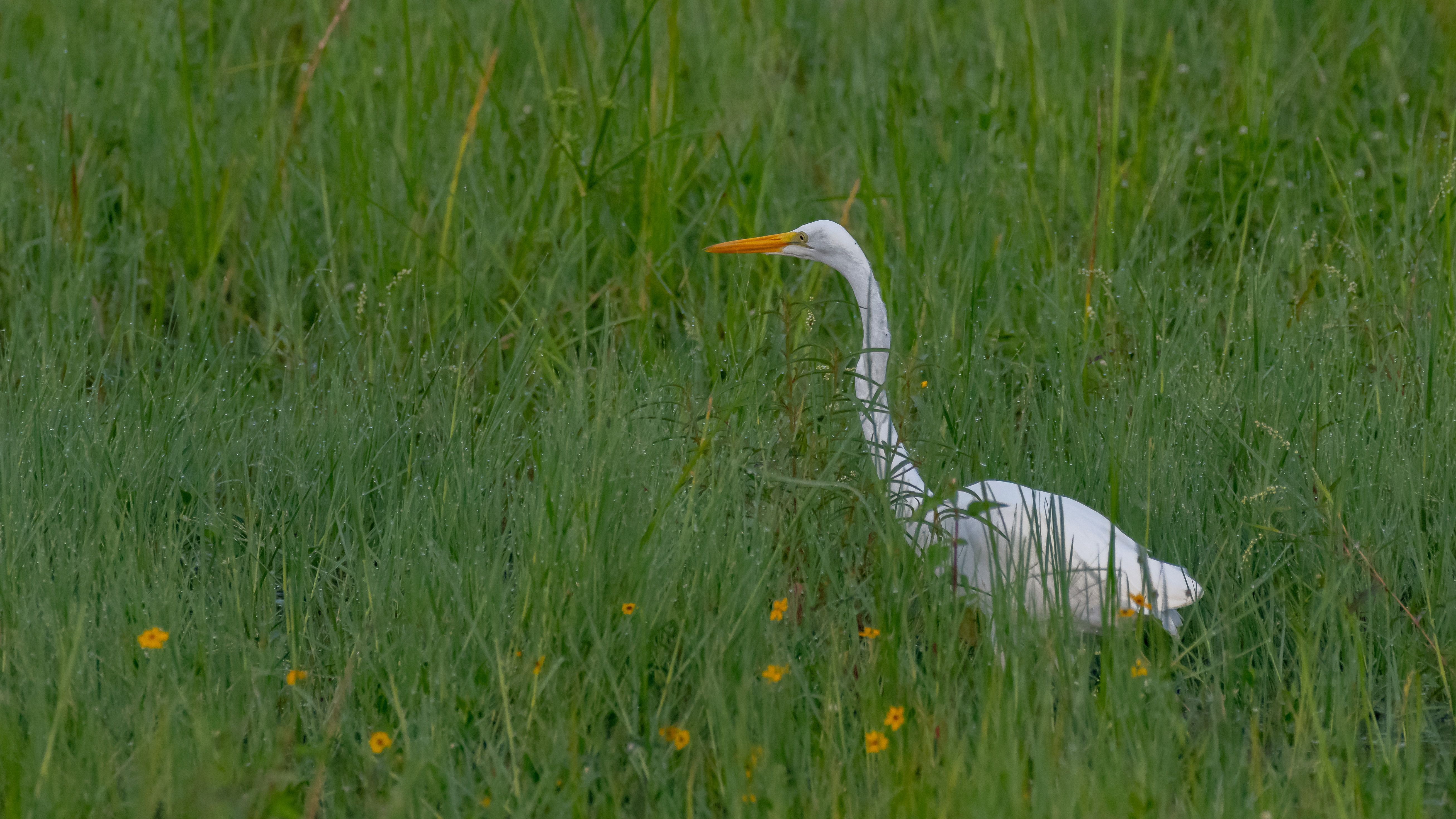
Recent rains have created “instant wetlands” where there is typically only tall grass. Adding water sure can be attractive for some. If you know how tall a Great Egret is then you have an idea how tall the grass has become.
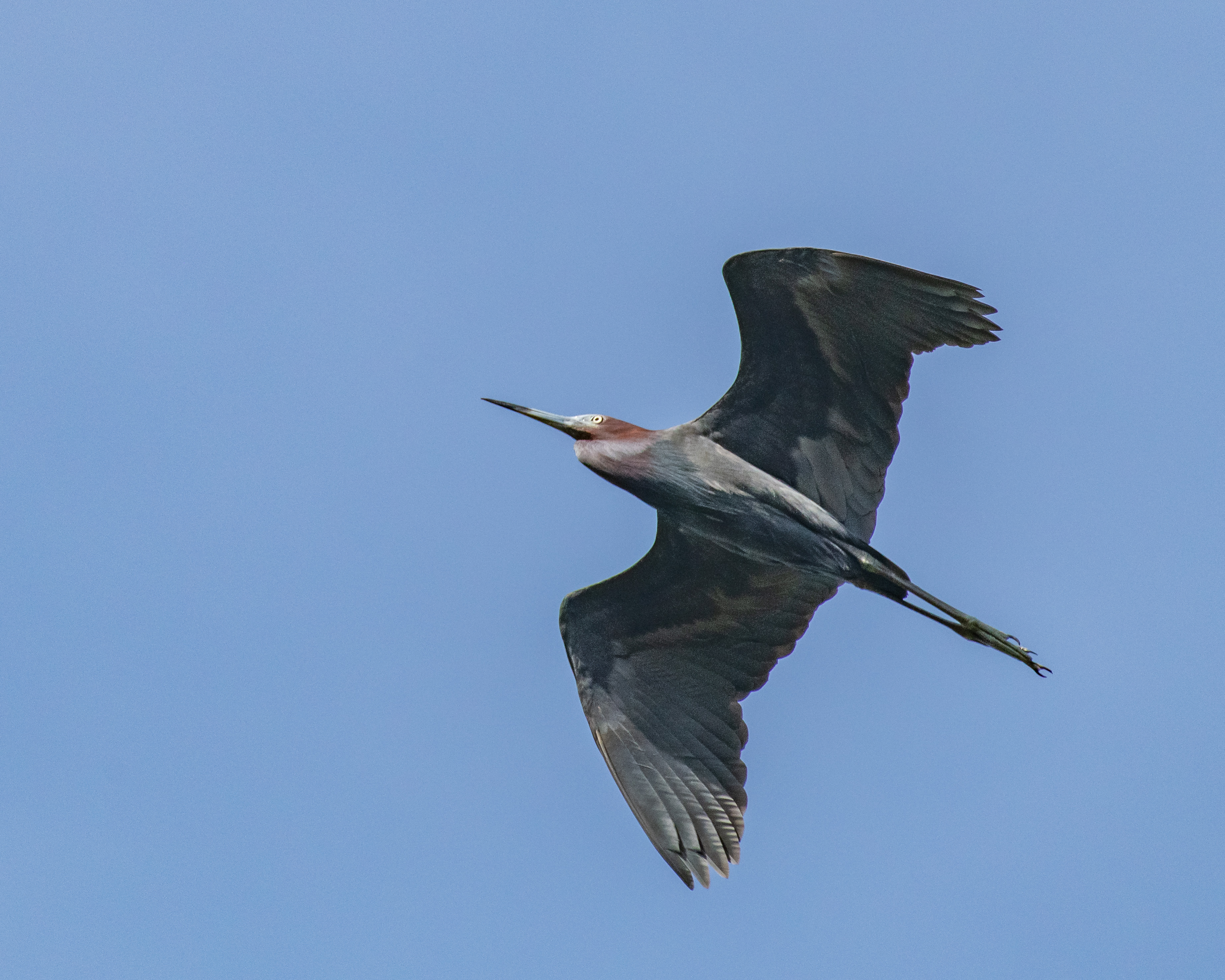
All white tells us this Little Blue Heron is still in its first year of growth. Soon it will become mottled with blue/gray splotches and then next spring will show off its full adult plumage.

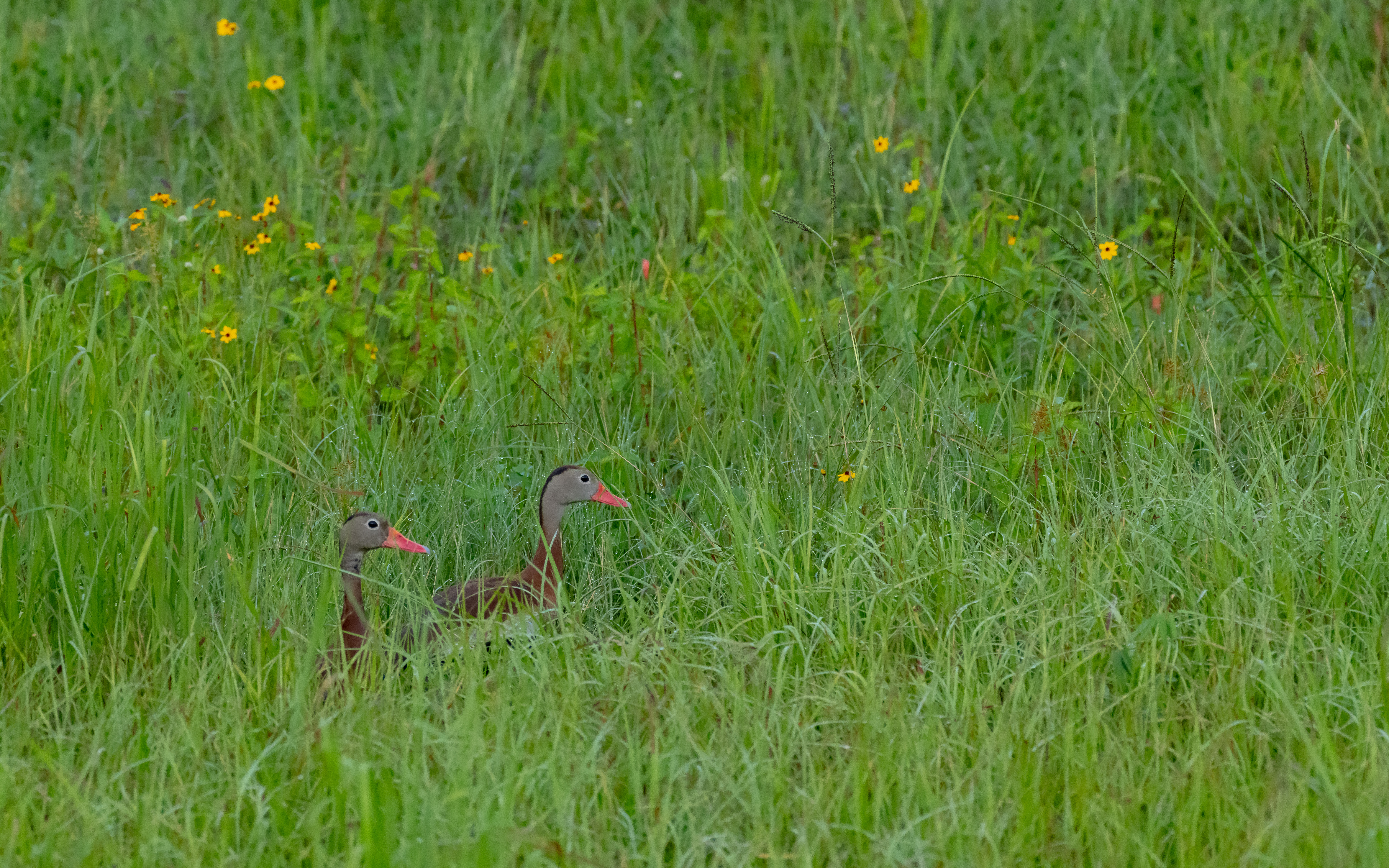
Pretend you can’t see them. We wouldn’t want to hurt the feelings of this pair of Black-bellied Whistling-Ducks who think they are perfectly hidden.
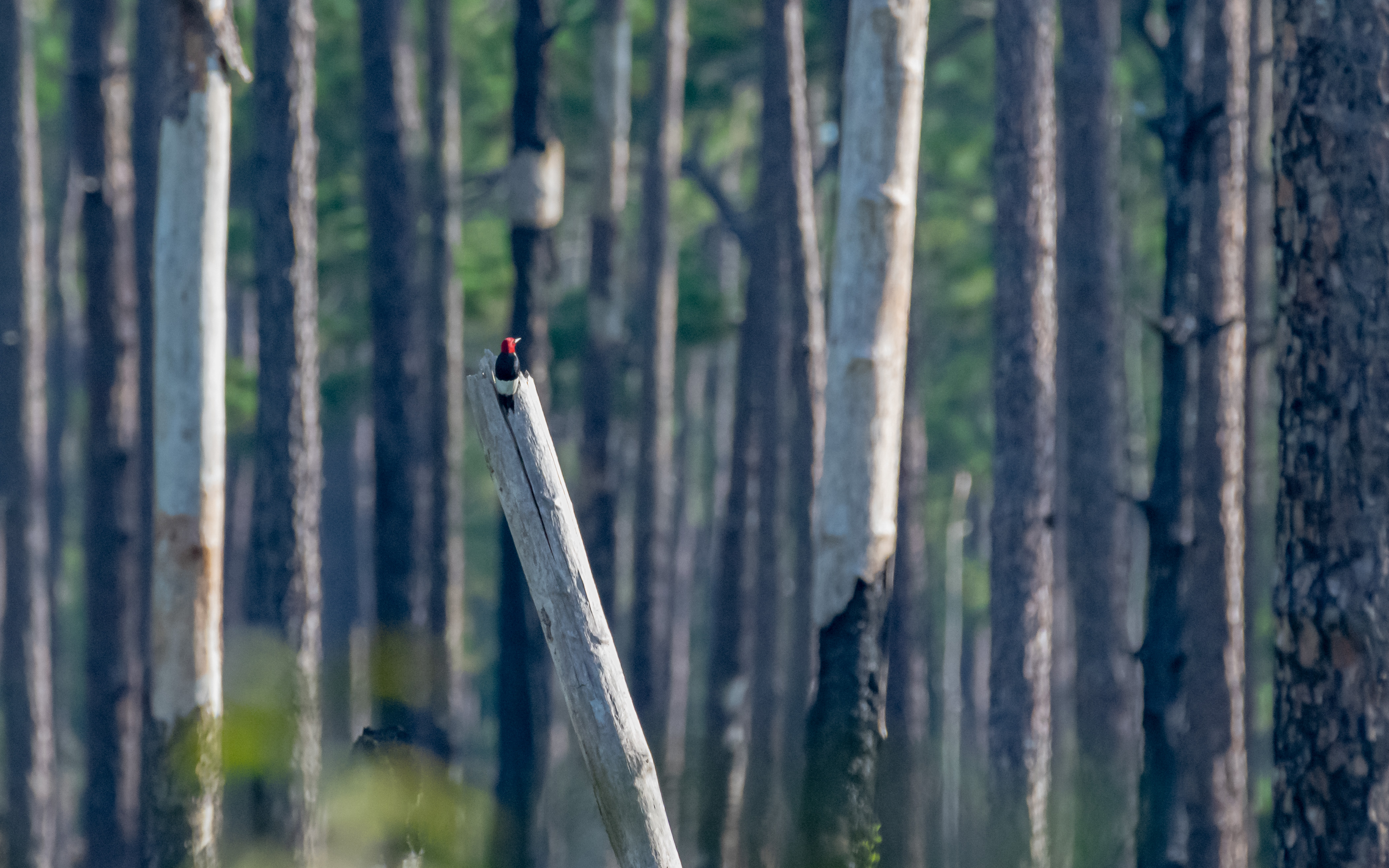
Even at a great distance it is hard to miss the black and white and red of a Red-headed Woodpecker.
Having just emerged from its cocoon, a Gulf Fritillary (Dione incarnata) perches in the morning sun to dry its brand new wings.

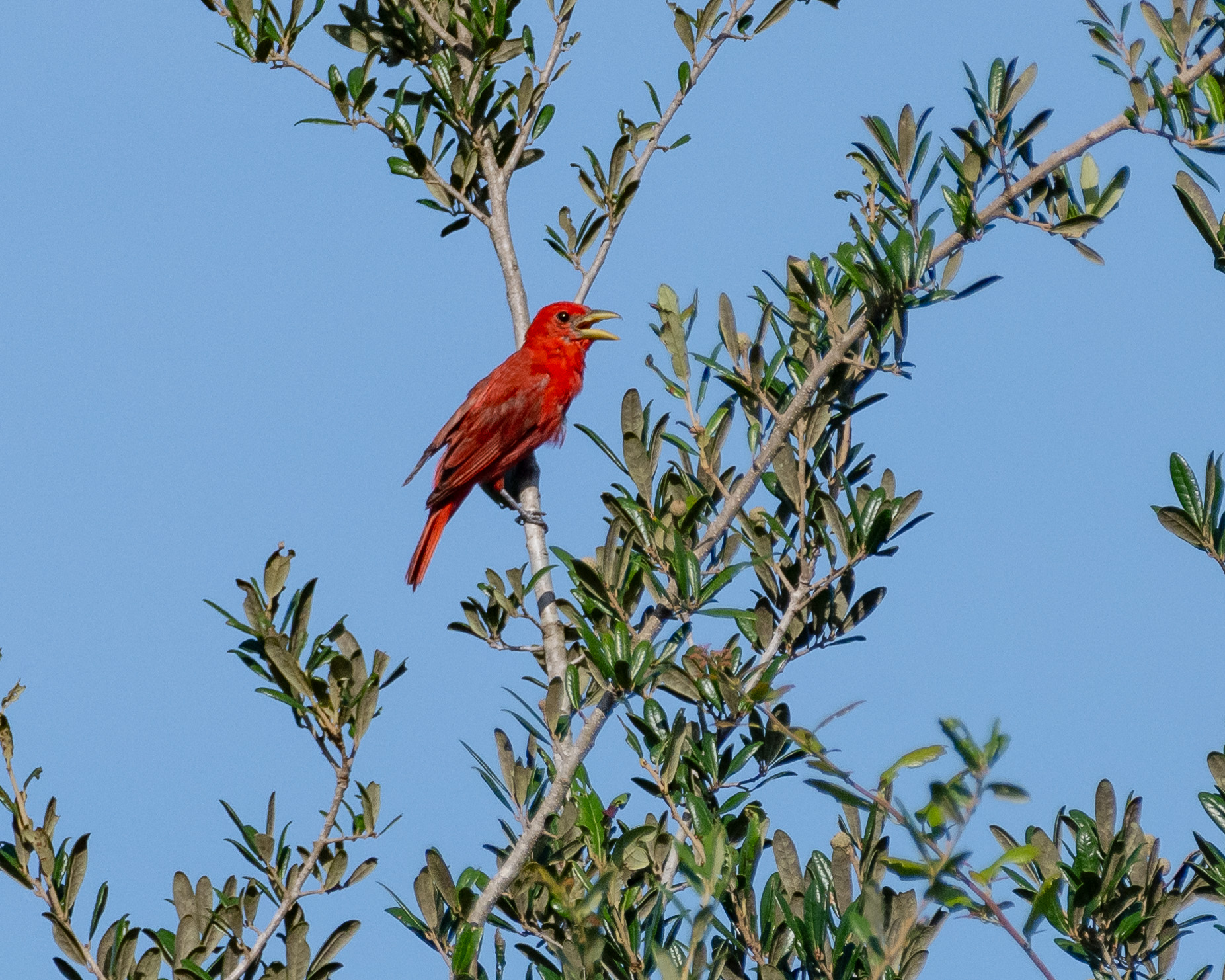
A gorgeous bright red bird AND a beautiful song! Hard to beat that combination this morning. The male Summer Tanager is a joy to behold in any season.
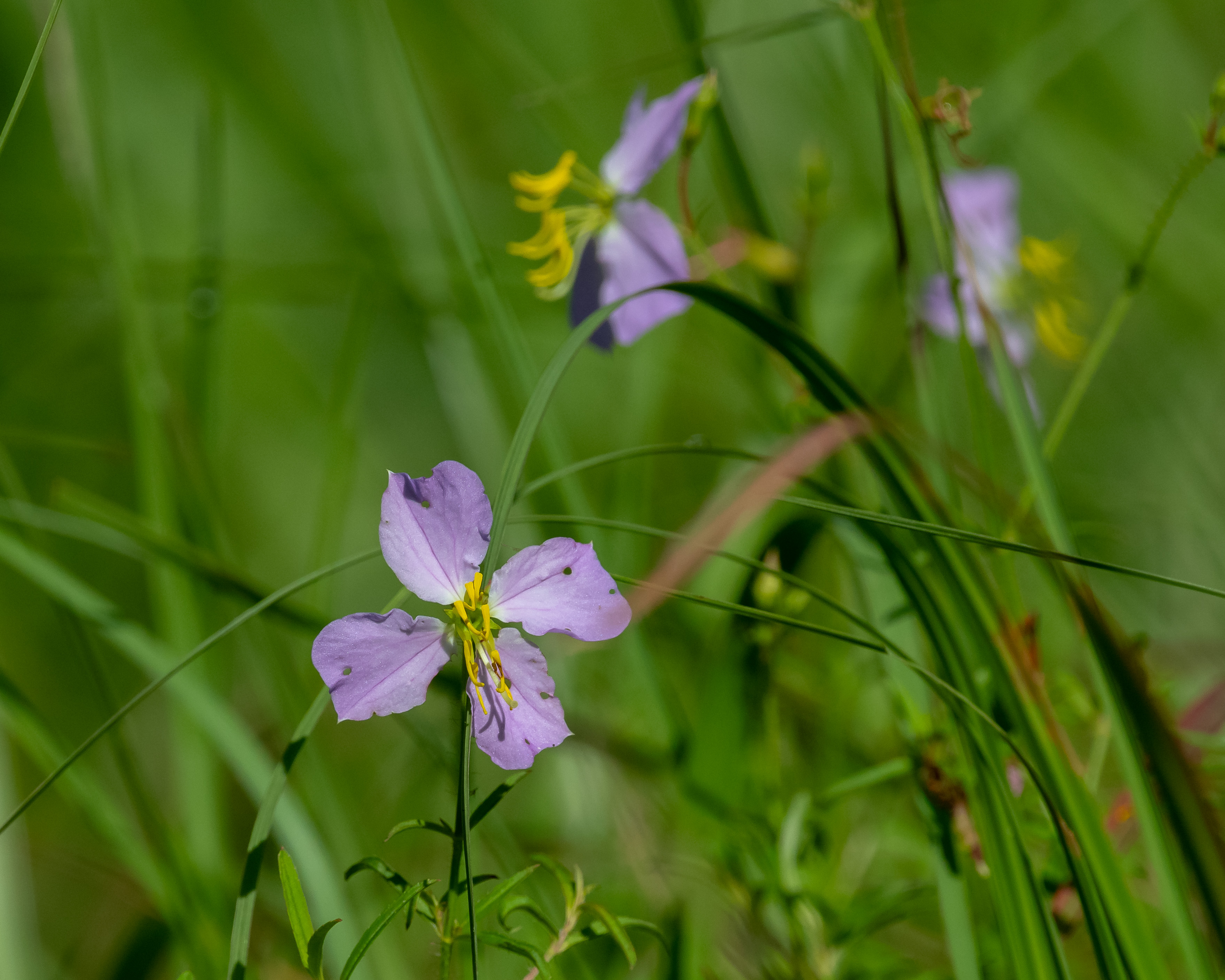
Pale Meadowbeauty (Rhexia mariana). Common in the area, uncommon in its loveliness.
An adult Little Blue Heron illustrates how our immature friend above will eventully appear.
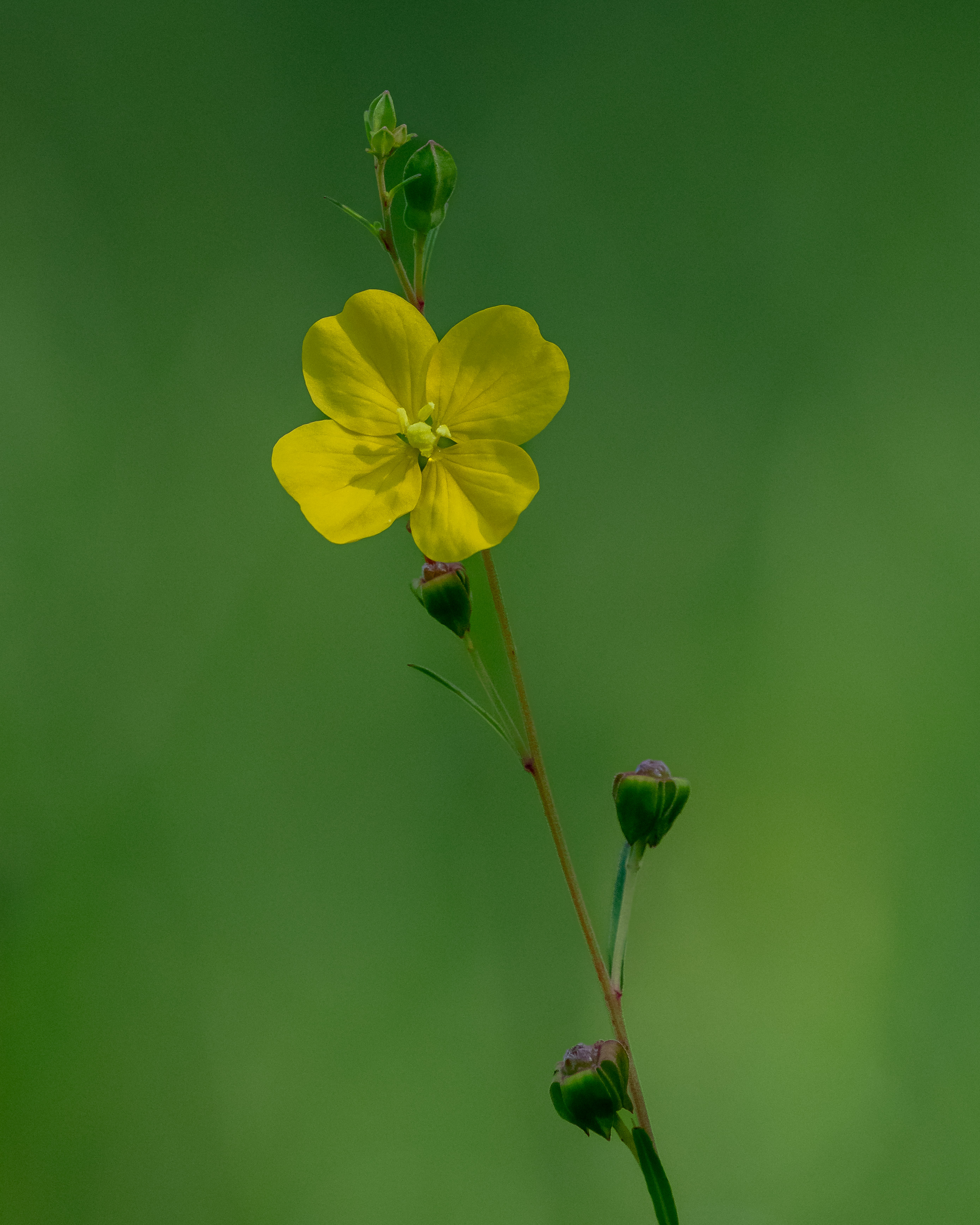
Florida has nearly 30 species of Ludwigia to enjoy with some looking very similar which can make identification difficult. The Narrowleaf Primosewillow (Ludwigia linearis) helps by having, just as its name suggests, very narrow leaves. Bright yellow four-petaled blooms appear on single stalks which can reach up to 36 inches.
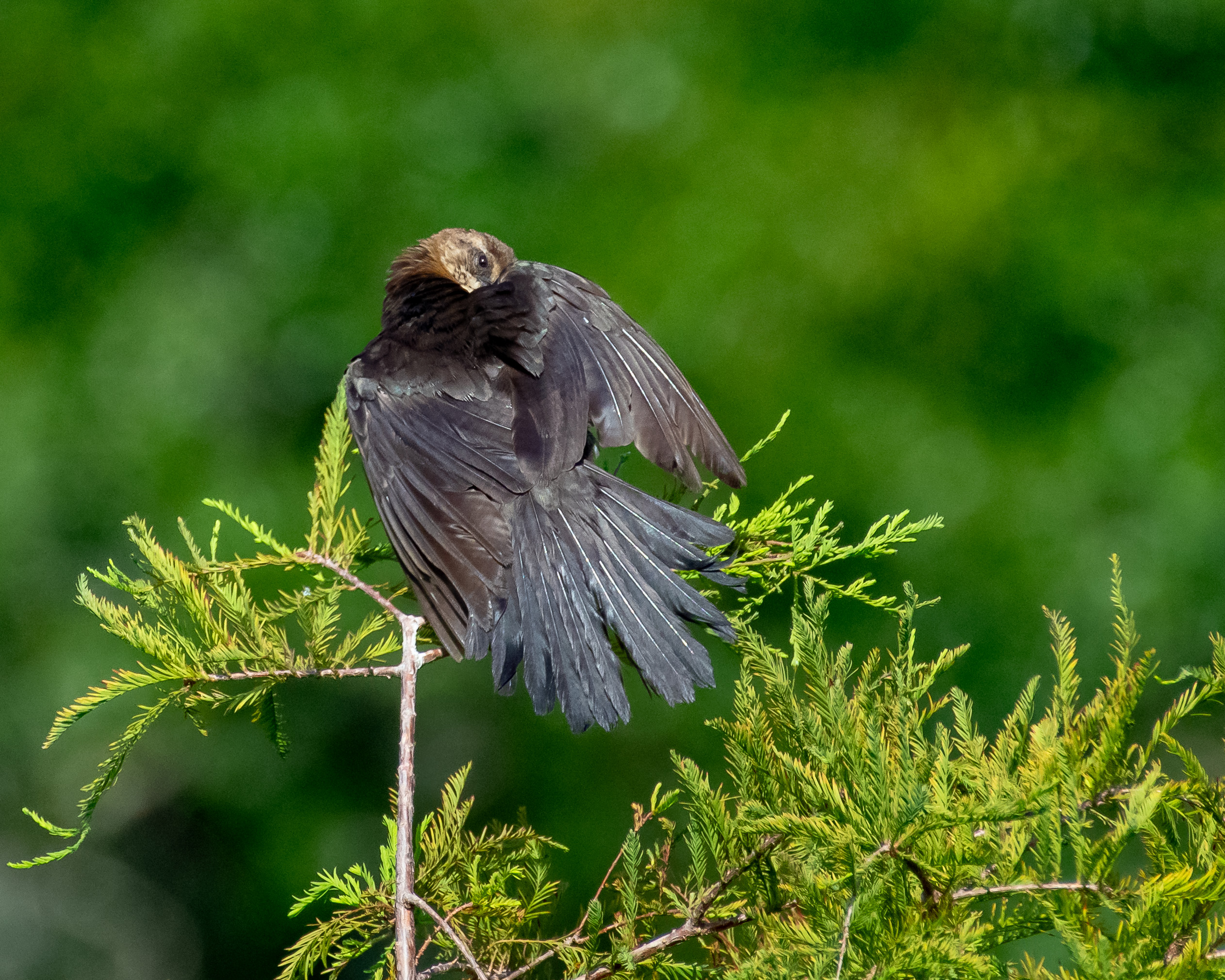
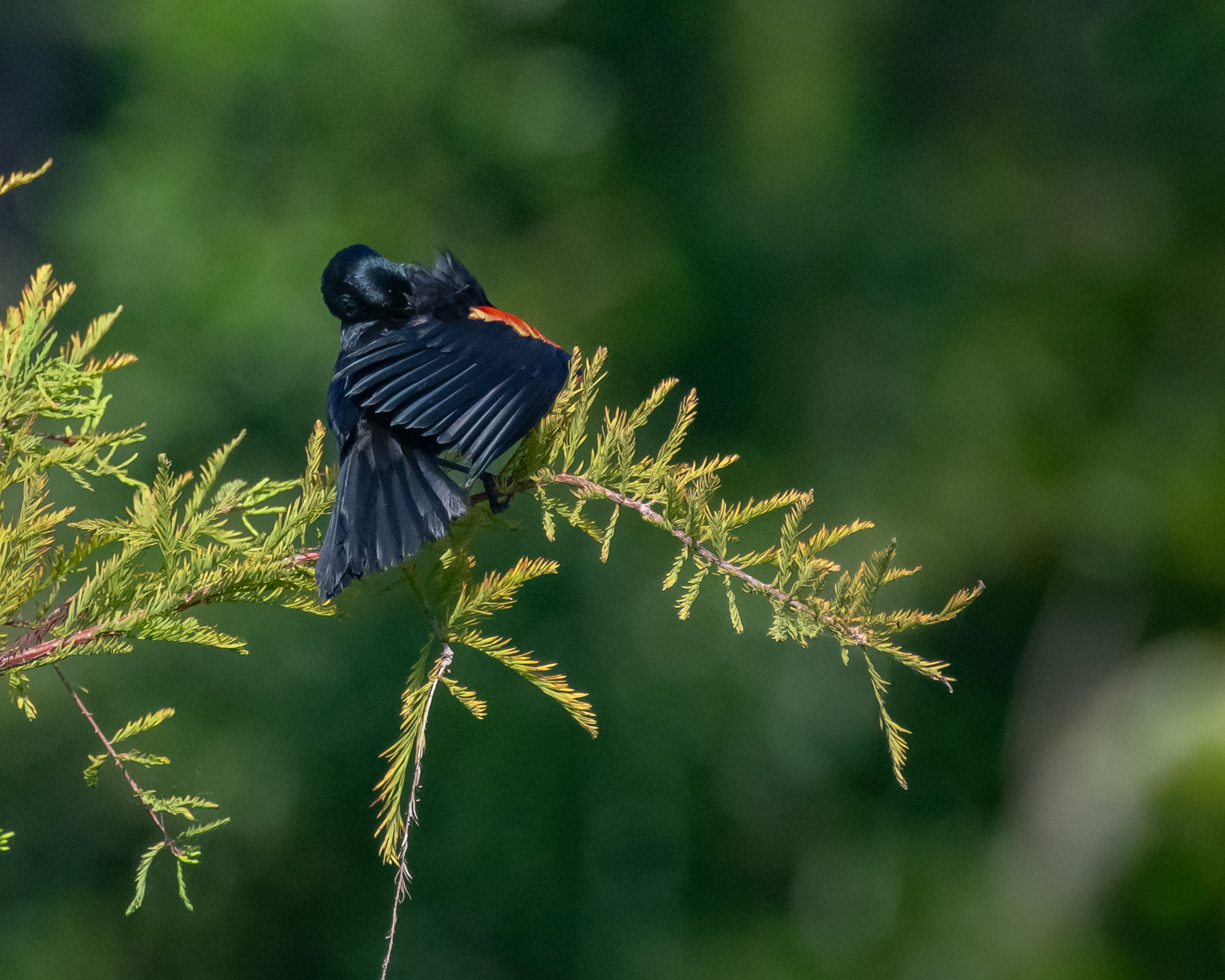
The preening tree. This cypress tree was a favorite spot for perching and cleaning today.
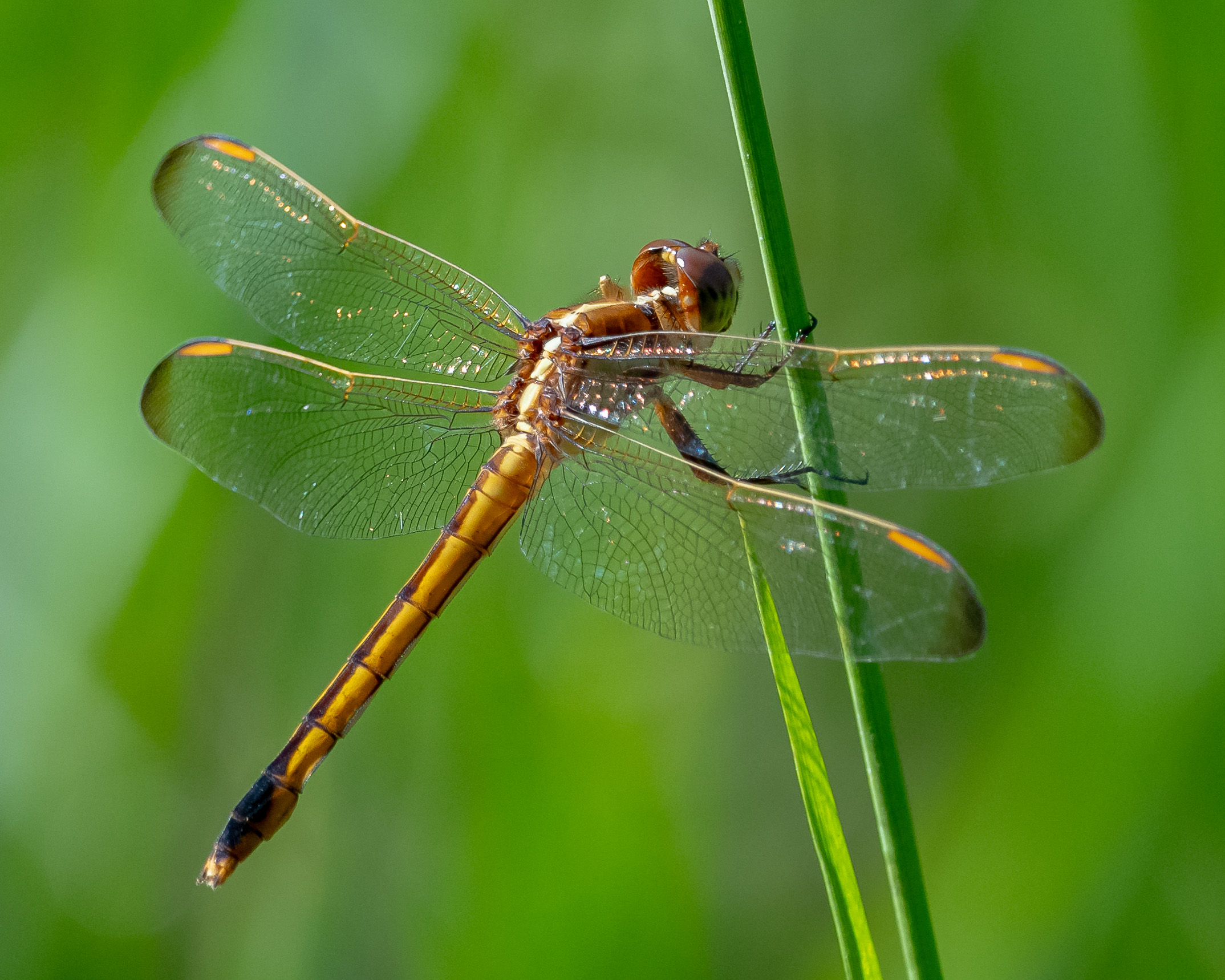
Sunlight can make the wings of a female Needham’s Skimmer (Libellula needhami) glisten even more than usual.
Looking like some alien with large ears, the Hairypod Cowpea (Vigna luteola) is a vine which wraps around sturdier plants, smothering some in the process. A lovely yellow bloom makes us almost forgive its bad growing habits.

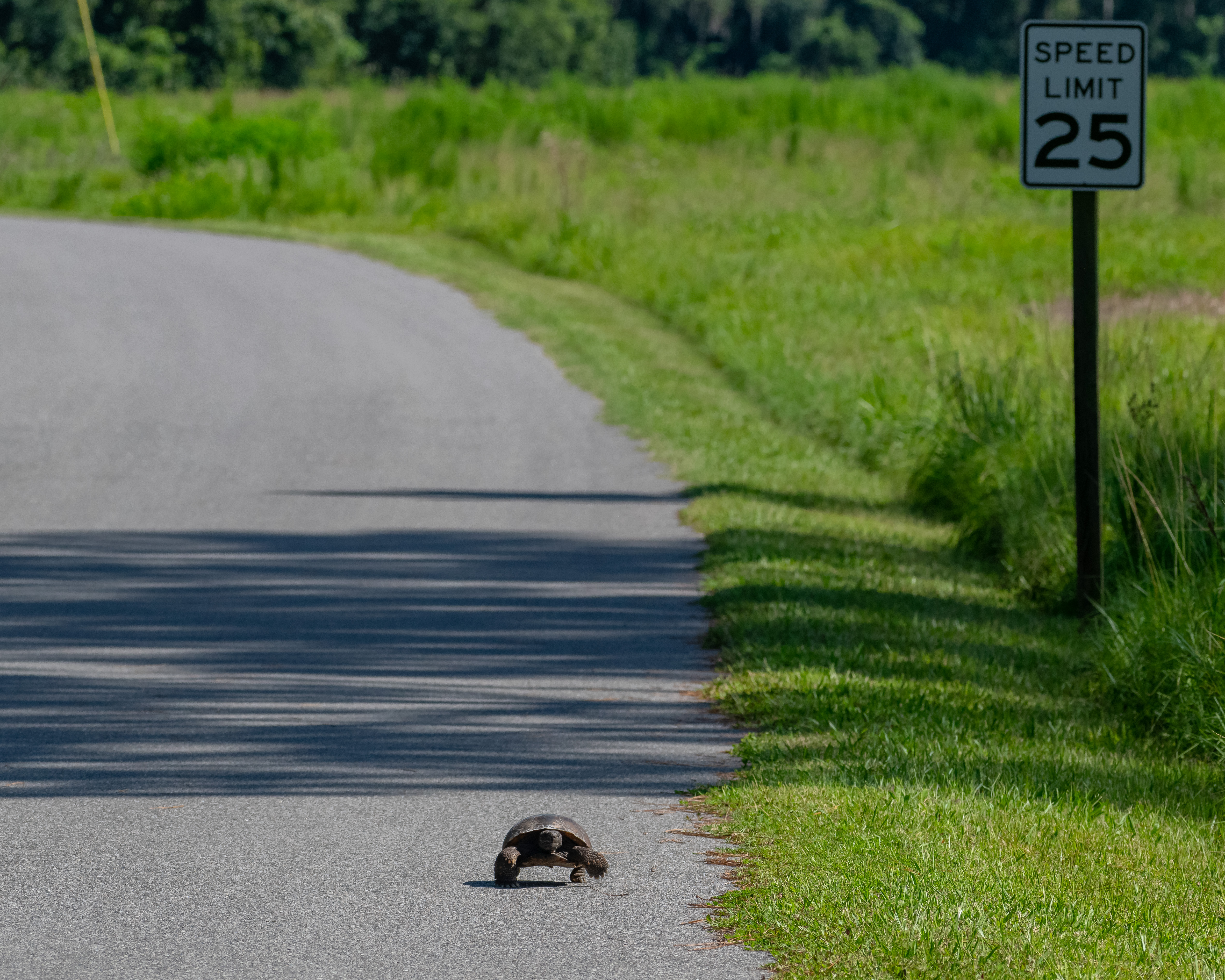
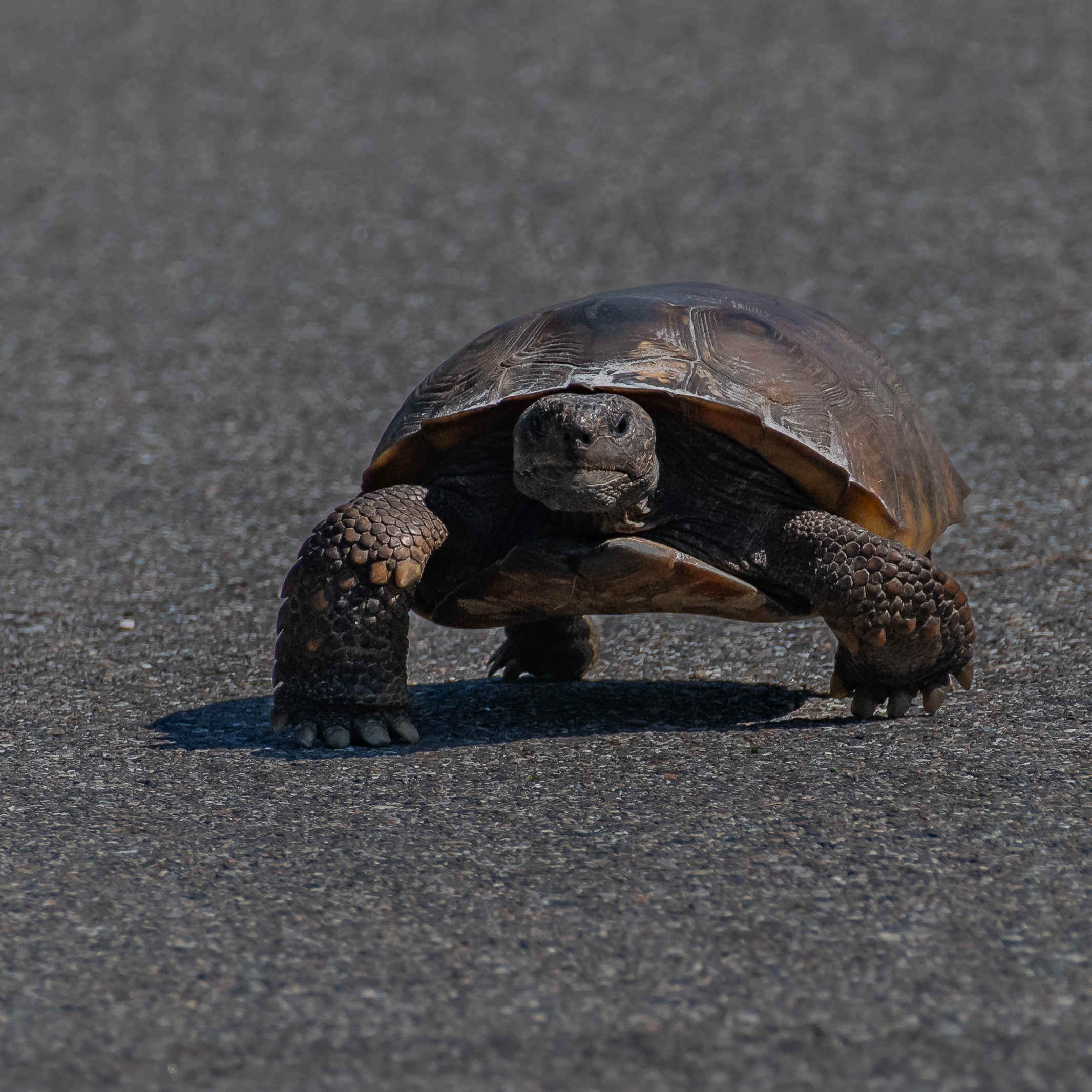
Gopher Tortoise (Gopherus polyphemus). We grew up taking these ancient creatures for granted as here in central Florida they were so abundant. Although still plentiful in some areas of Florida, their habitat continues to disappear due to agriculture, mining and construction development. This one was on a mission and totally ignored us as it trundled down the main park road. Thank goodness it obeyed the posted speed limit.

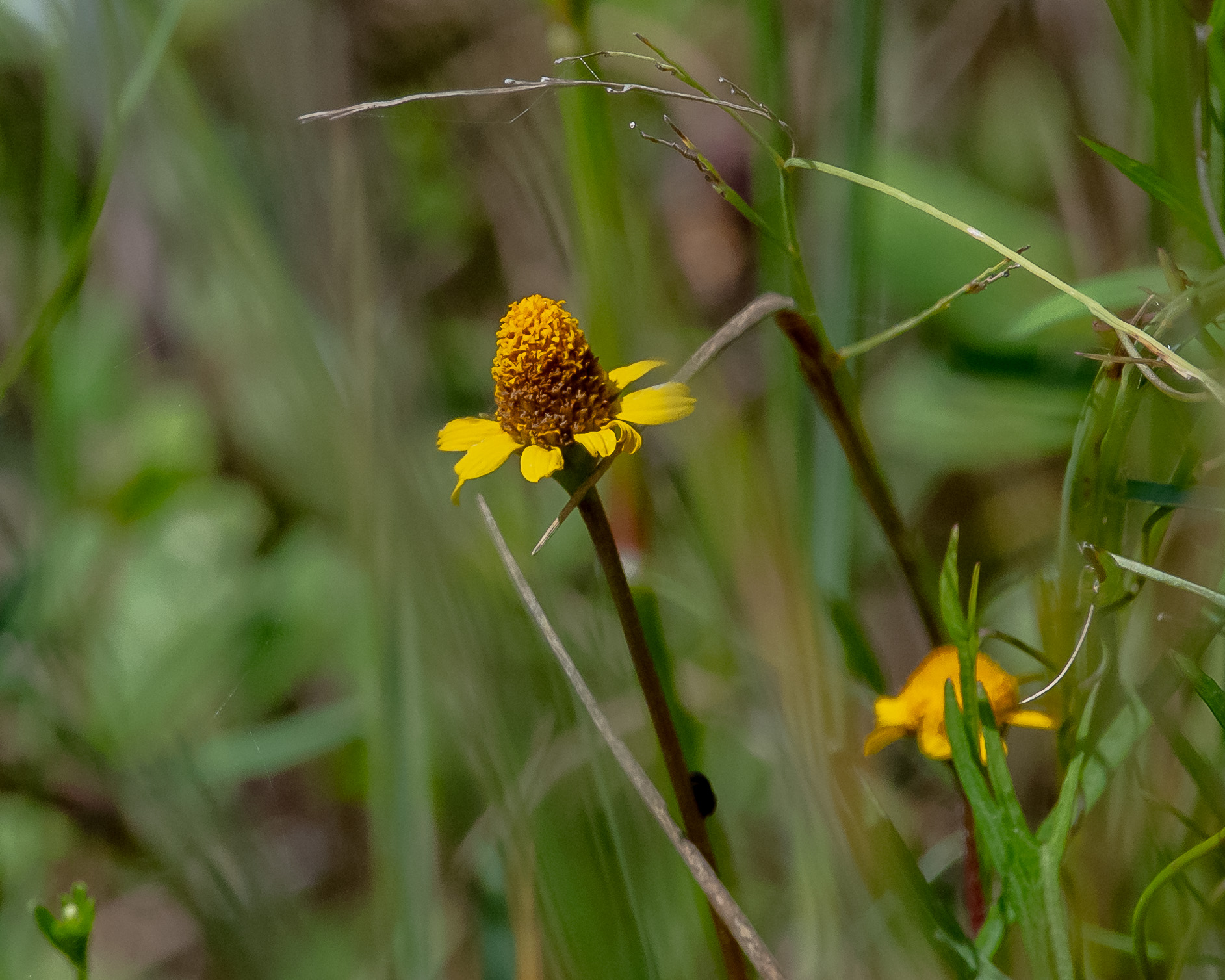
It’s easy to see the relationship to Sunflowers (Asteraceae family) when you spot the fairly small Oppositeleaf Spotflower (Acmella oppositifolia). The plant tends to grow fairly low and sprawls in areas adjacent to lakes and ponds.
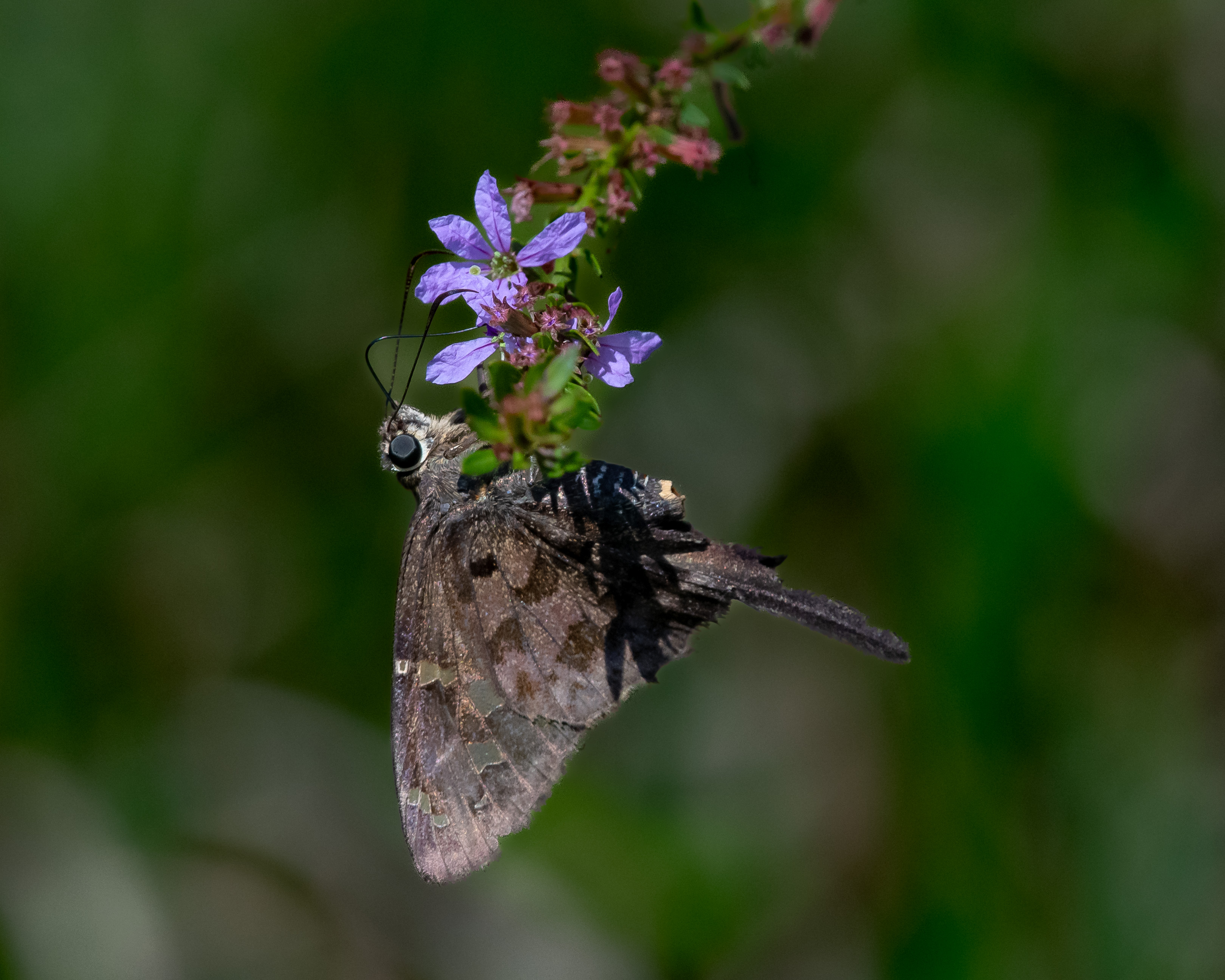
A butterfly demonstrates how to drink nectar while upside down. I tried that with milk and it came out my nose. Dorantes Longtail (Urbanus dorantes) on Winged Loosestrife (Lythrum alatum).
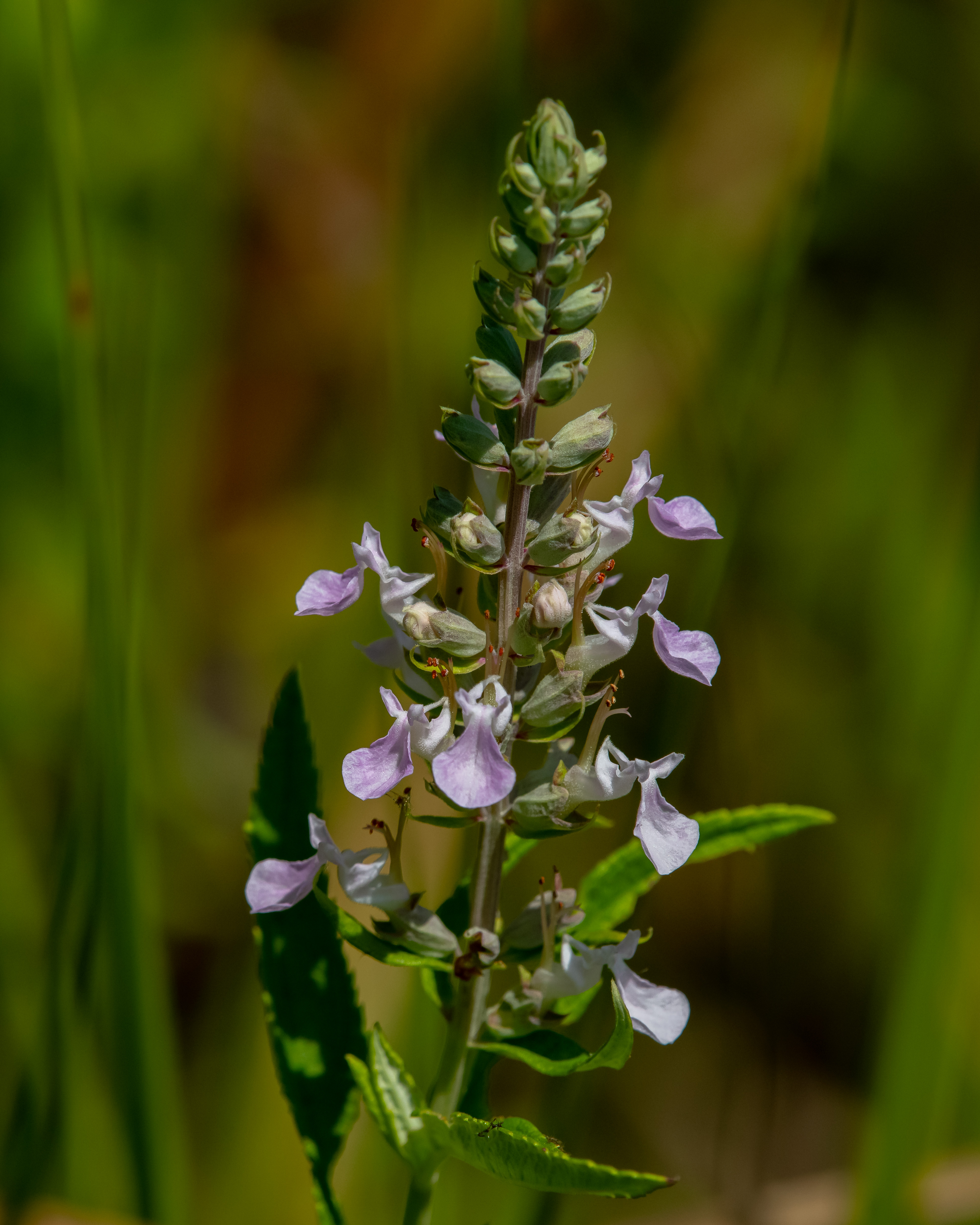
American Germander (Teucrium canadense) is a lovely member of the mint family. It can reach nearly three feet in height. Pollinators have no problem flying to that altitude for their reward. Depending on which taxonomist you can corner, this plant is also known as Canada Germander, Canadian Germander, Hairy Germander or Wood Sage.
In North America there are more than 1,000 species of Robber Fly. Worldwide, around 7,500. Since I diligently researched all of those species, I concluded this is absolutely, positively a Red-footed Cannibalfly (Promachus rufipes). -maybe-

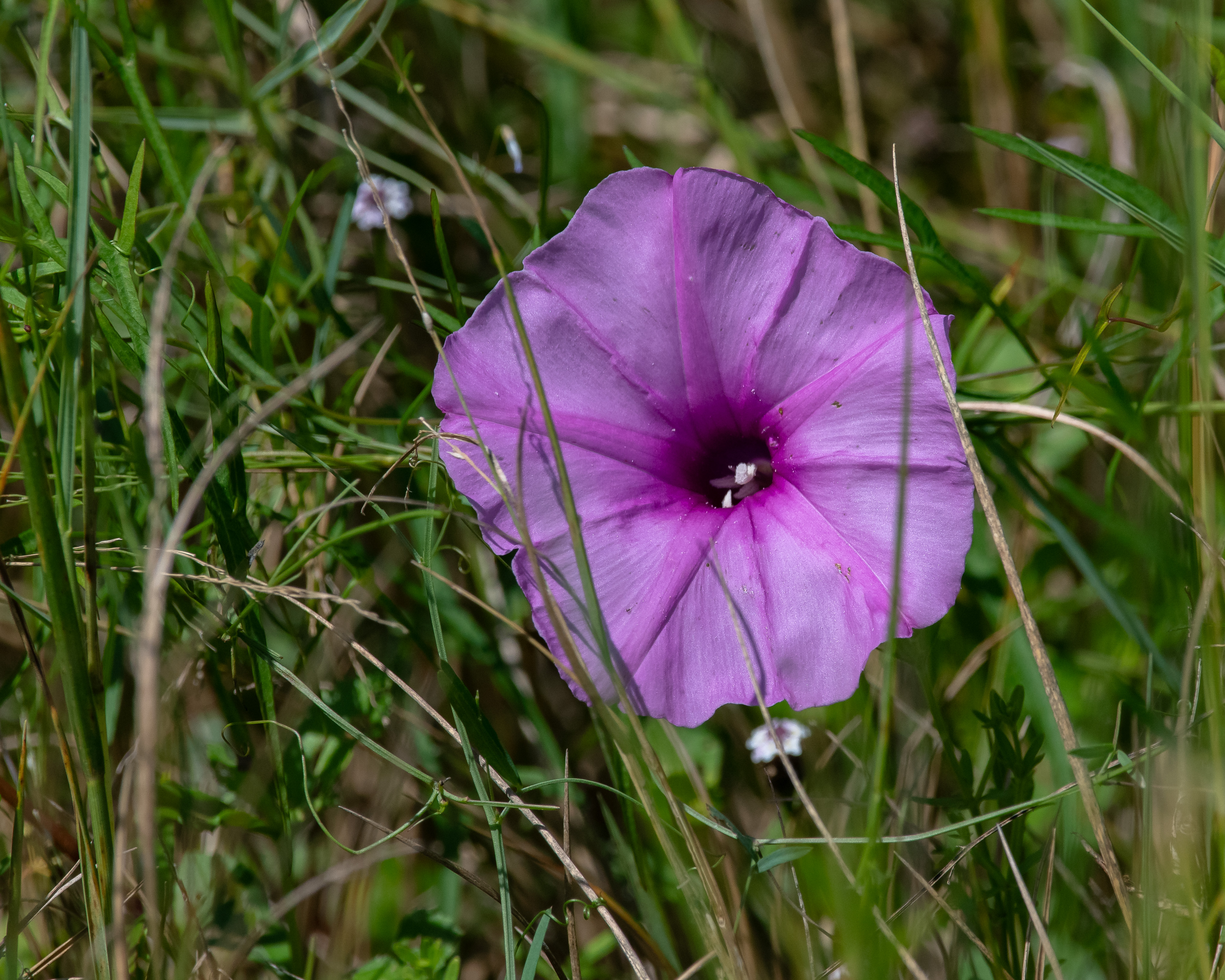
We are not exactly near the coast, but the gorgeous Saltmarsh Morning Glory (Ipomoea sagittata) just doesn’t care. The wetlands of the middle of the state are just fine, thank you very much.
We got up this morning and traveled to our local state park. I guess that counts as having a goal. We returned feeling better than when we did before our visit. I guess that counts as goal fulfillment. Success can be very narrowly defined by each of us.
Enjoy your search for a natural place and come back for a visit.

I gave up wearing hiking boots. For one thing, my days of going on lengthy hikes over rough terrain are in my rear view mirror. Water-resistant linings and treatments for preventing water soaking through footwear can be somewhat helpful, but walking through Florida’s eternally wet grass is pretty much like wading a stream and your feet are just going to get wet. So I now have a pair of very comfortable shoes made for “trail runners” which let water in freely but dry quickly. To be clear, no running is involved, just the slow pace of an old guy with a heavy camera stopping every few steps.
So, there I was, with wet feet and wet everything else, exploring a local wetlands area at sunrise. No breeze, no clouds, plenty of hot sun and even more humidity. Yes, the Smart One was back at the house in the cool and dry comfort of an air-conditioned living room. She was preparing for a doctor’s appointment later in the day and I’m pretty sure I could hear her whining sighing wistfully as I drove away in the dark.
Itchepackesassa. It’s a small wetlands designed a half-dozen years ago to help control localized flooding of two creeks. I just like saying the name. During the planning phase for the wetlands, a couple of us local birding types provided a “before and after” census of avian visitors. We counted birds when the area was still a weedy field and again two years after the project was completed. Quite a difference. The field was converted into a series of ponds with varying depths and native aquatic plants were planted throughout. It’s been a great birding spot ever since.
Today there were overflights of Black-bellied Whistling-Ducks, White Ibises, Wood Storks, Sandhill Cranes, Black-crowned Night Herons and a couple of Roseate Spoonbills. An Eastern Screech Owl called from the adjacent woods. American Kestrels successfully nested here this spring. Soon the ponds will be winter homes for migrating water birds and the vegetation will provide protection for vacationing sparrows and wrens.
A relatively short morning provided some very nice sightings. We hope you agree.
Dew and sunrise highlight the beauty of Seven Sisters (Crinum americanum) blooming across the wetlands. Other common names include String Lily and Swamp Lily.


A Black-crowned Night Heron announces sunrise. Okay, she was more likely letting the neighborhood know I was lurking about.

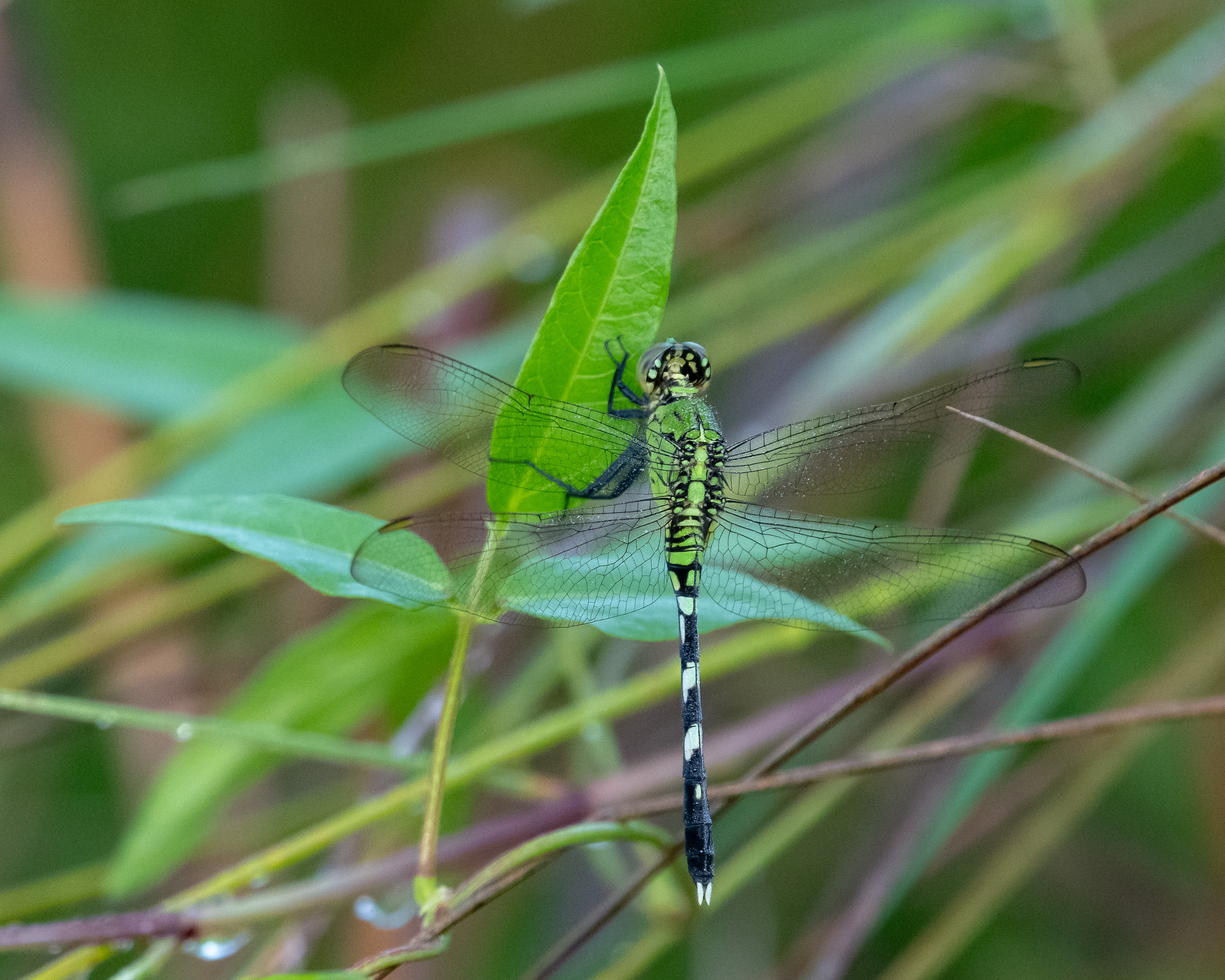
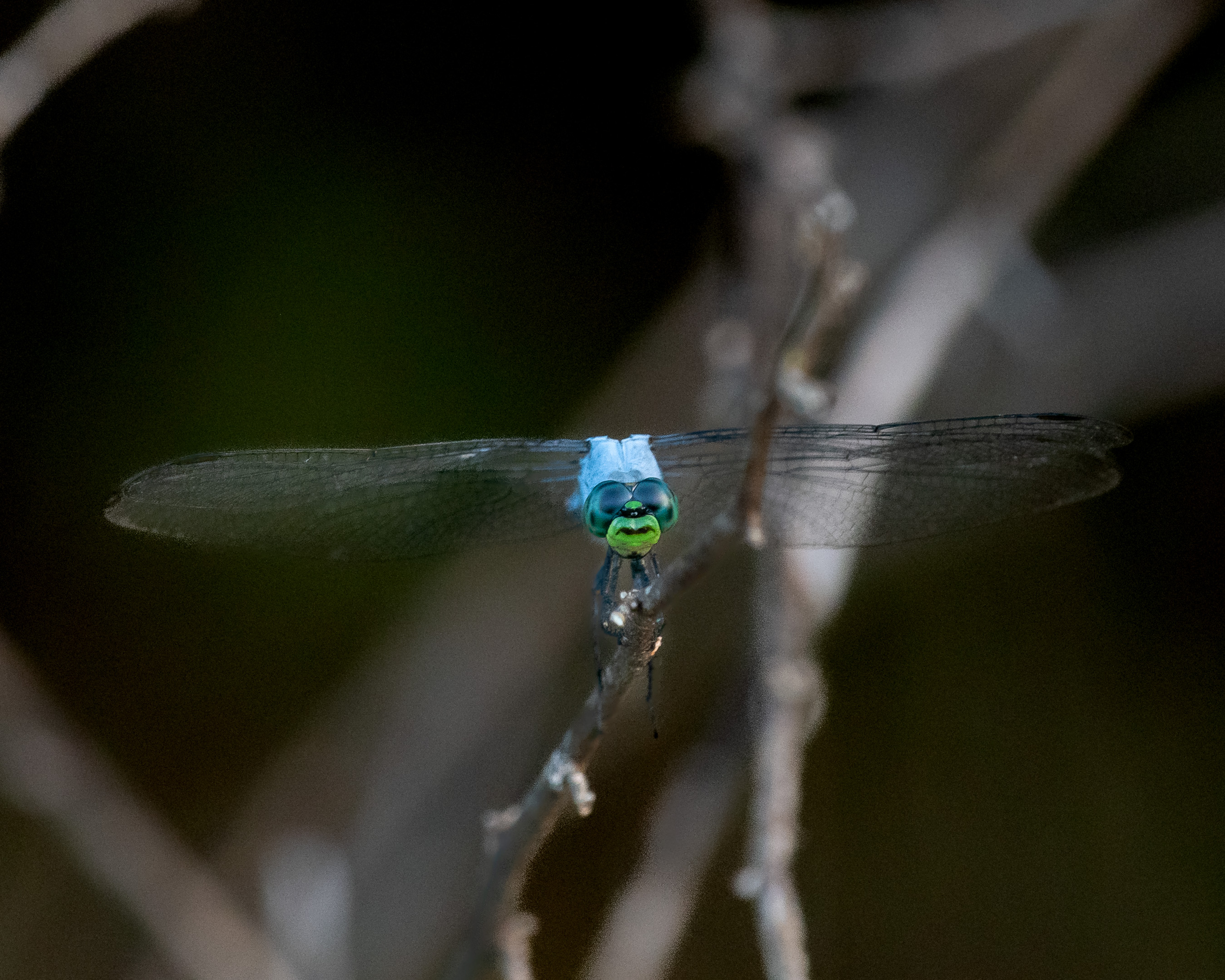
Sexual dimorphism. As far as I know, it still applies to some members of the insect world. Eastern Pondhawks (Erythemis simplicicollis), to me, are attractive whether female or male.
The “Little Brown Jobs” of the butterfly world, grass skippers are large in number, small in size, frantic in flight and, for me, often a challenge to identify. This one remained long enough for a snapshot and is known as a Sachem (Atalopedes campestris).

One of the largest wading birds in North America, even a Great Egret can appear small in the relative vastness of the wetlands.

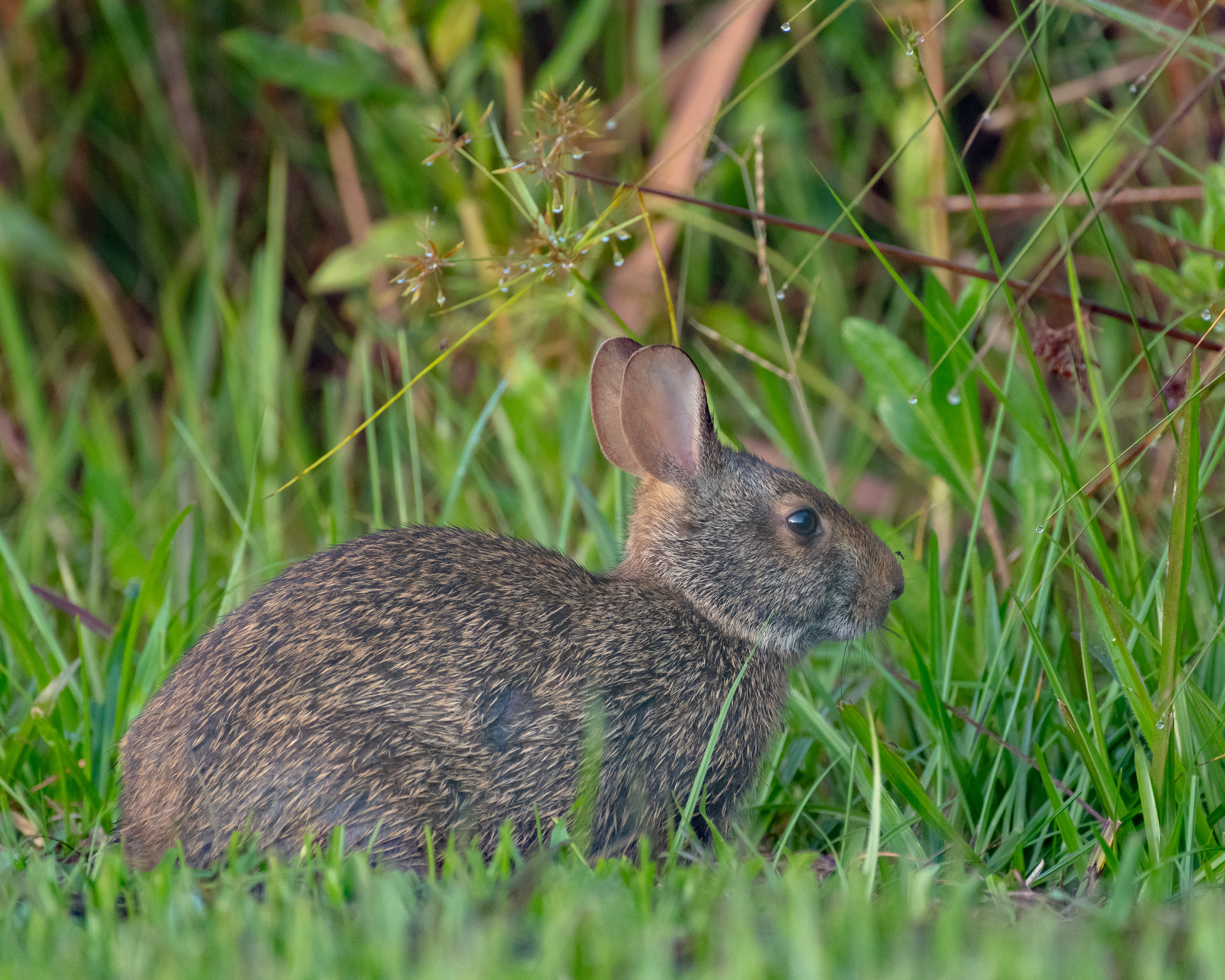
It’s a marsh. It’s a rabbit. It’s a Marsh Rabbit (Sylvilagus palustris)! Smaller than its Eastern Cottontail cousin, Marsh Rabbits inhabit brackish and fresh water wetland areas throughout Florida. Many people don’t know this little mammal is a strong swimmer. (Yes, that IS a mosquito on his nose.)
Common Buttonbush (Cephalanthus occidentalis) is, well, common in many areas which remain wet most of the year. Protruding pistils from the ball-shaped flowers give the impression of pin cushions.

A touch of royalty this morning was provided by the presence of an actual Queen (Danaus gilippus). In the same family as the Monarch (Danaus plexippus plexippus), the Queen is a bit smaller but similar in appearance.

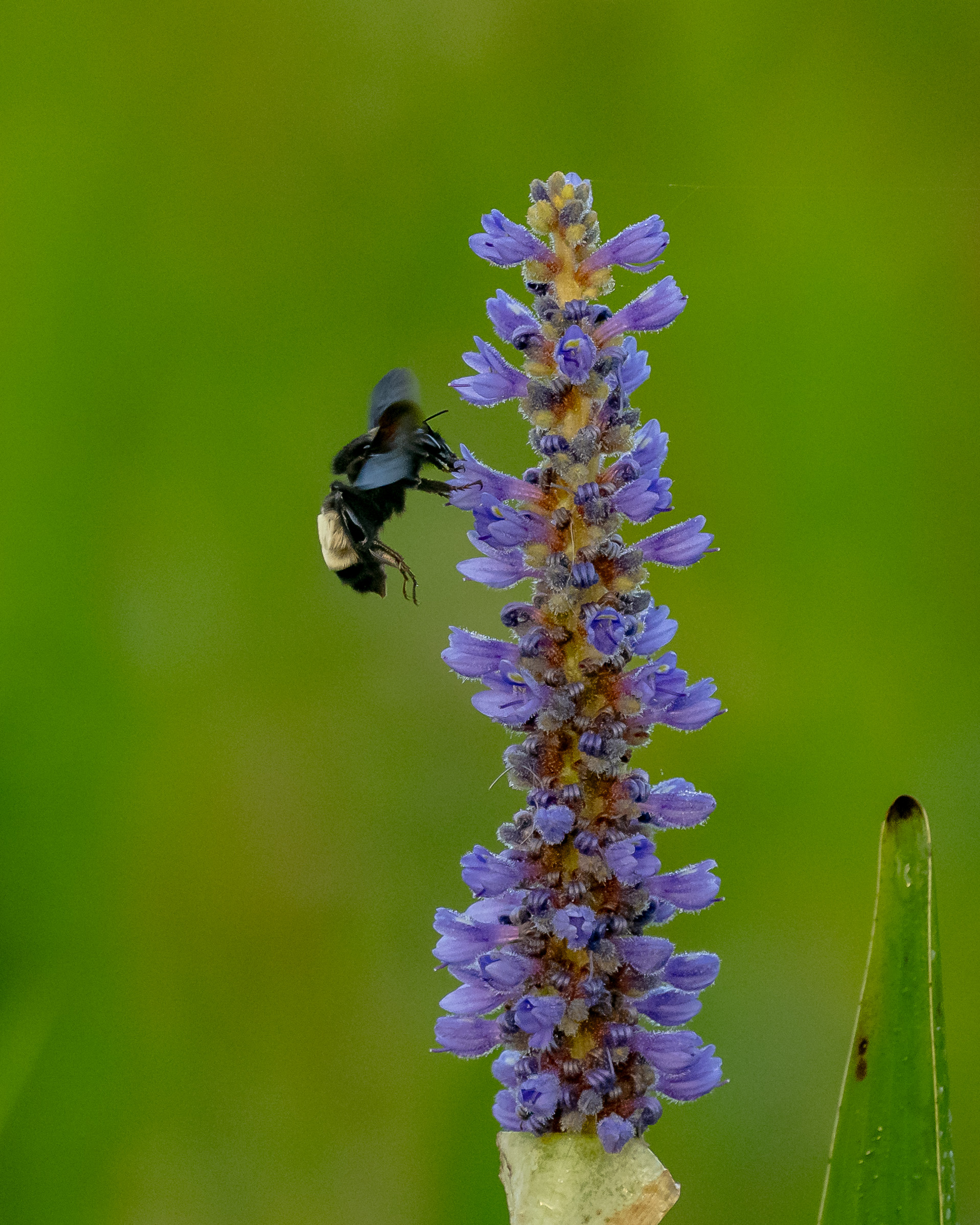
Another very common plant in the marsh, the Pickerelweed (Pontederia cordata), apparently contains some tasty nectar. It’s frequented by all sorts of thirsty pollinators, such as this Bumblebee (Bombus spp.).
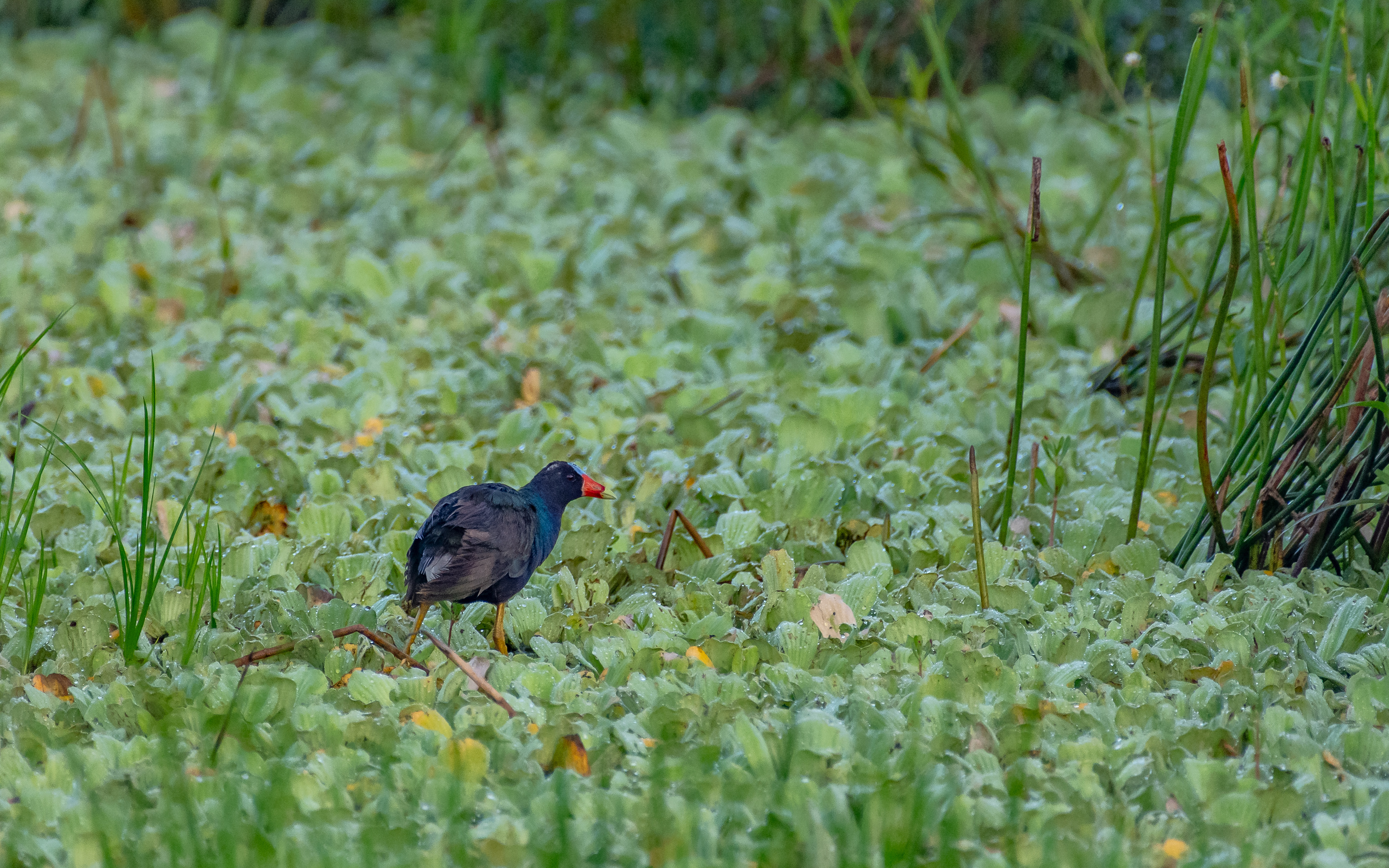
A Green Heron grazes among a dense growth of Water Lettuce (Pistia stratiotes) hoping for a breakfast of fish, frog, crustacean, insect, eel or snake. Mmmmm.

That bright white face, sky-blue eyes, racing stripe thorax – it could only be that speedster of the swamp – the dashing Blue Dasher (Pachydiplax longipennis)!

The Purple Gallinule is one of our more colorful members of the rail family. If you don’t see one, you will usually hear them chuckling at you from behind the cattails.
Matching the bright yellow of the sun’s early rays, several blooming Bandanna-of-the-Everglades (Canna flaccida) were scattered across the wetlands.

Even though it’s pretty common in a variety of habitats, Eastern Gama Grass (Tripsacum dactyloides) can look mighty decorative when in bloom.

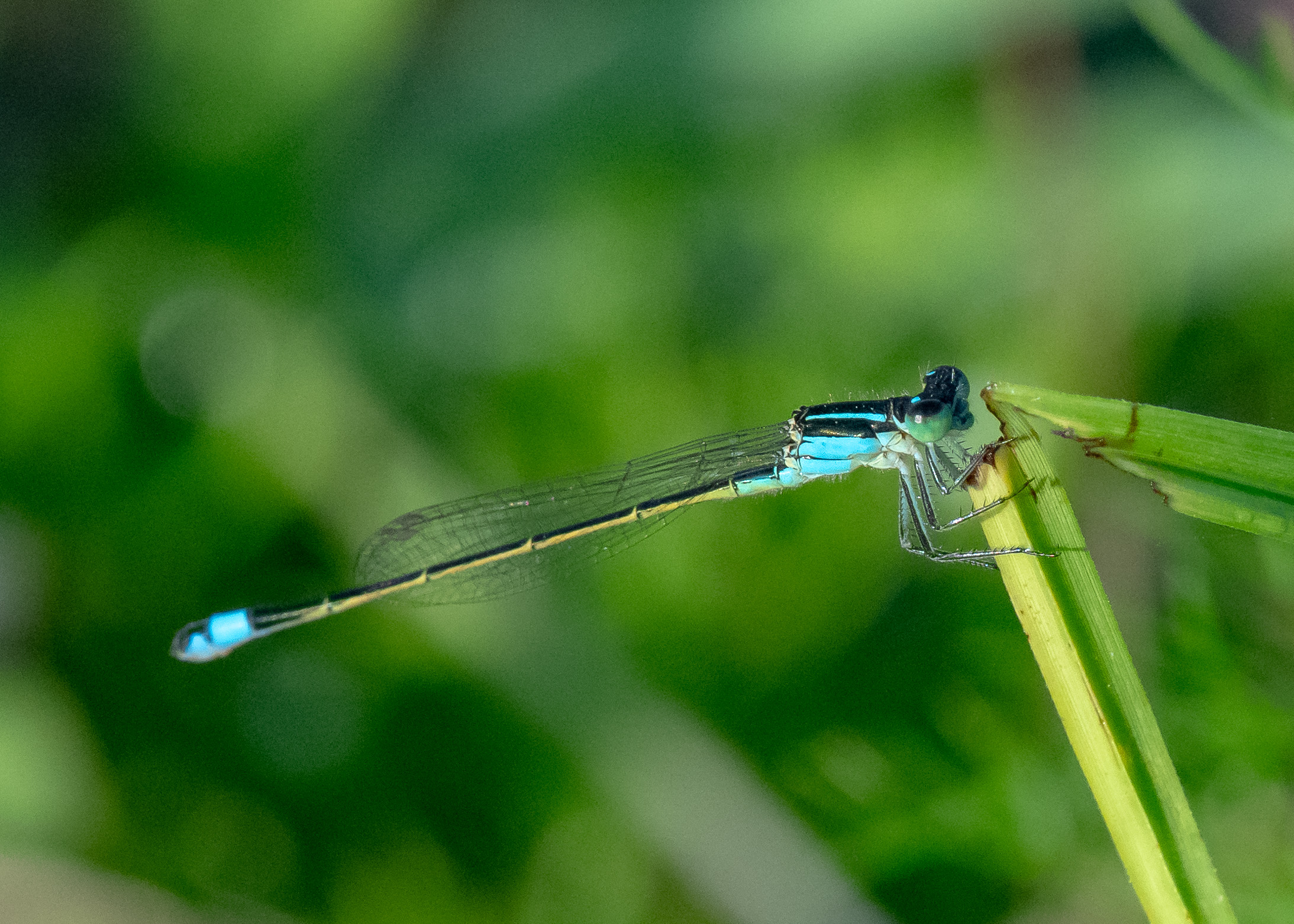
There are four different color forms of the Rambur’s Forktail (Ischnura ramburii) species of damselfly. This is a blue-form adult female.
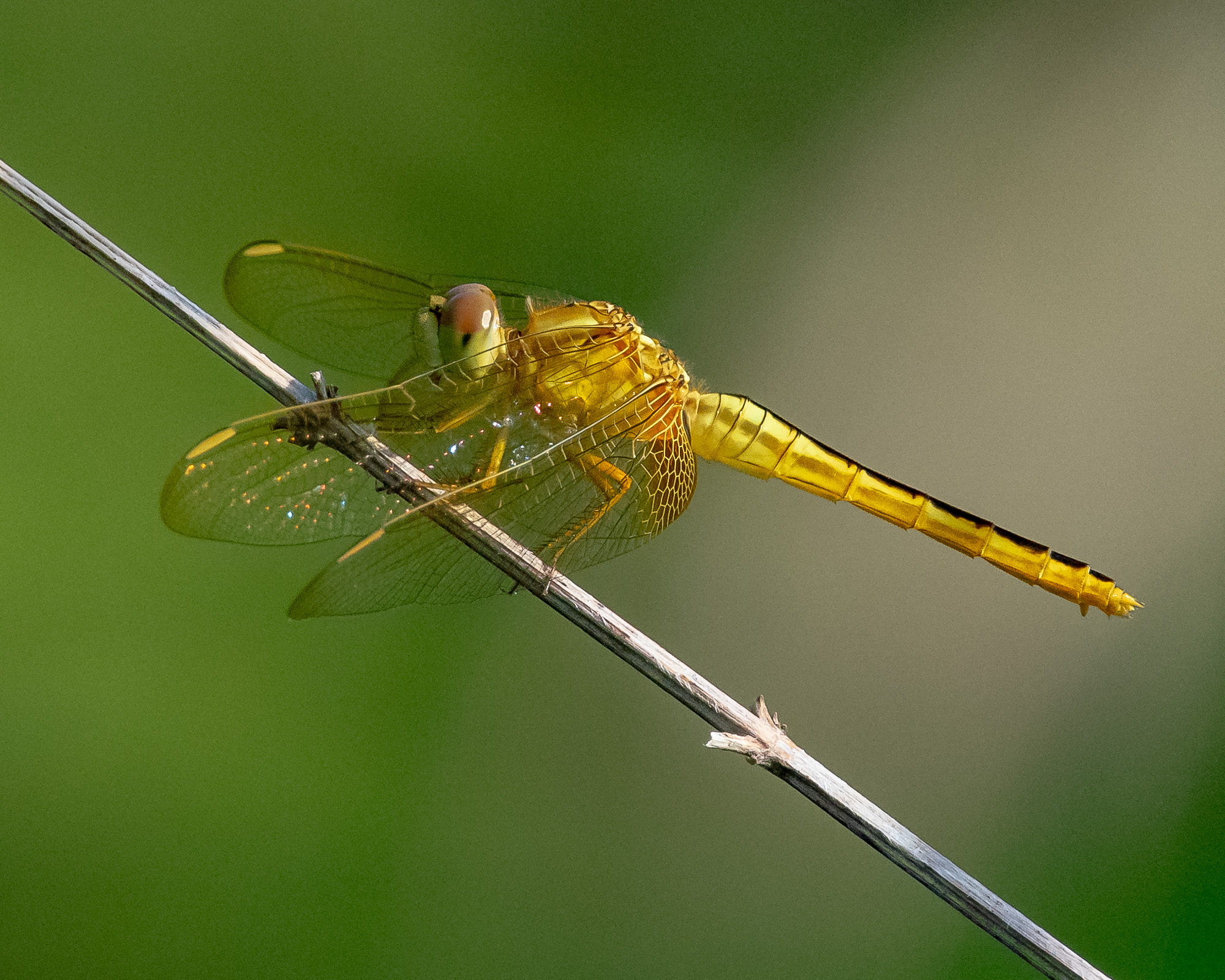
The bright red male Scarlet Skimmer (Crocothemis servilia) is most assuredly eye-catching. But don’t tell this lovely golden female she is not just as attention-getting.
Hot. Sticky. Wet. Hungry. No Gini. I’m going home.
Enjoy your search for a natural place and come back for a visit!
“Did you see that?”
“Nope.”
This is a frequent exchange between my brown-eyed beauty and myself. I often must gently remind her that when two of us are present, although we have twice as much chance of seeing something, it doesn’t work that way all the time. “But how could you miss that bird on the fence post?” “Because I was looking at the butterfly on the flower on the opposite side of the path.”
Over time, our powers of observation in nature have evolved. We have learned to look for certain things within a certain environment. At the lake, we expect to find waterfowl. In the hardwood forest, we expect to find woodpeckers. Likewise, we react to the unexpected. A Green Heron untypically perched on a utility wire. An alligator walking across a plowed corn field. (An actual event.)
No matter how expert we may think we are, there is simply no way we can see everything. Gini comes close but she cheats. She was born with the “Mother’s Radar” gene and is able to “sense” things most mortals cannot.
When we pause to observe a field of grass and weeds bordered by a forest, we “look” and may see some wildflowers, an Ibis flying over the field, a hawk perched in a tree, a few dragonflies hovering above the grass. Closer inspection reveals a spider in the flower, a pair of quail skulking through the stalks of grass, mounds of dirt around a hole which is the den of a gopher tortoise, small warblers in the top of the tree where the hawk sits, a robber fly on the stem of a weed waiting for one of those dragonflies to come – just – a – bit – closer.
There is a difference between “looking” and “seeing”. We have not mastered the art of observation. Nor shall we ever. Remembering to slow down, not only with our gait, but also with our gaze is a challenge but we’ll keep trying to improve. Not only do we hope to see the field and the forest, but also the flower and the hawk, as well as the spider and the nuthatch.
Arthur Conan Doyle said: “You know my method. It is founded upon the observation of trifles.”
Herewith, some of our recent trifles.
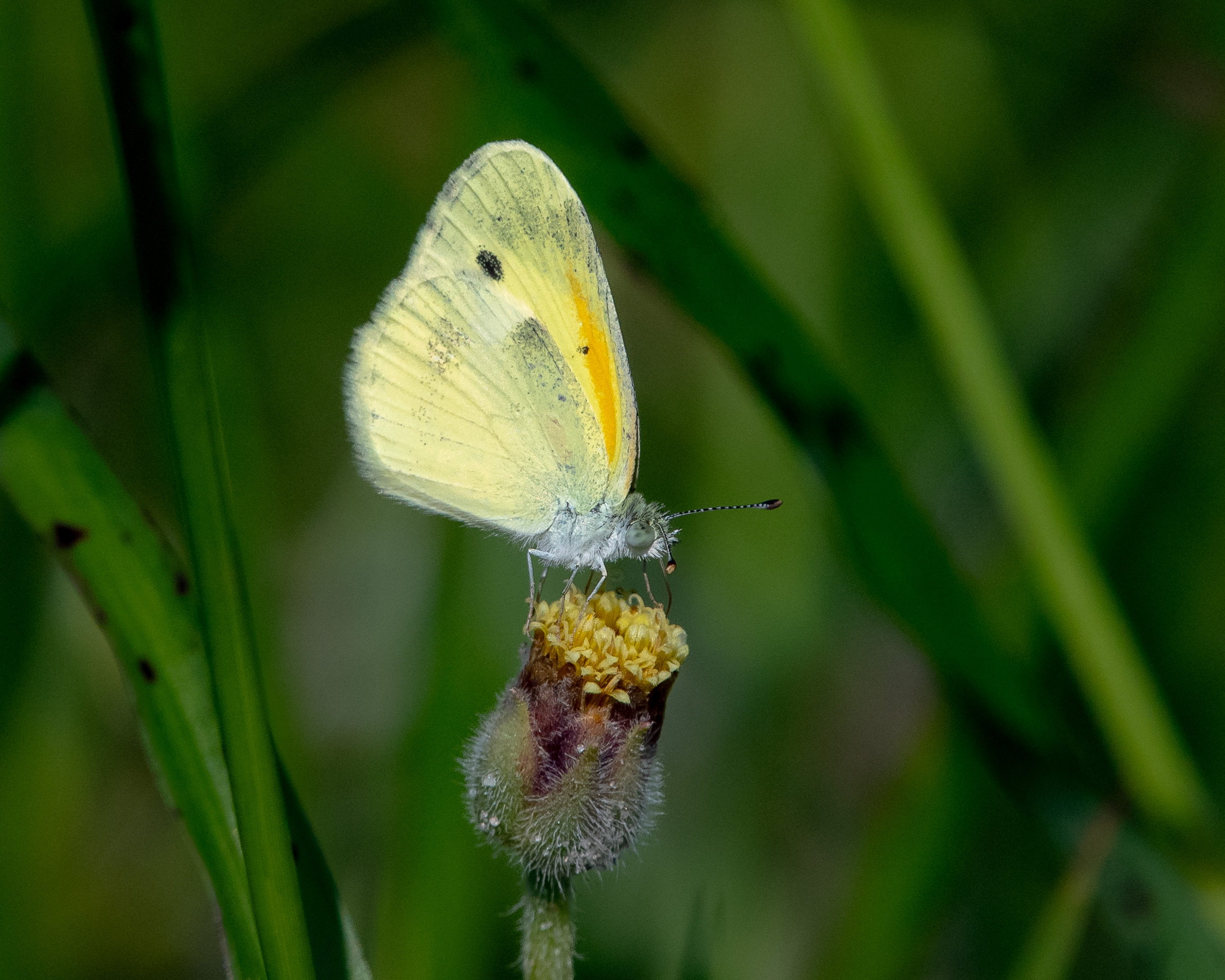
Smallest of the sulphur butterflies in North America, the Dainty Sulphur (Nathalis iole) will become almost gray colored during the winter. It’s bright yellow of summer is a joy to find at any time.
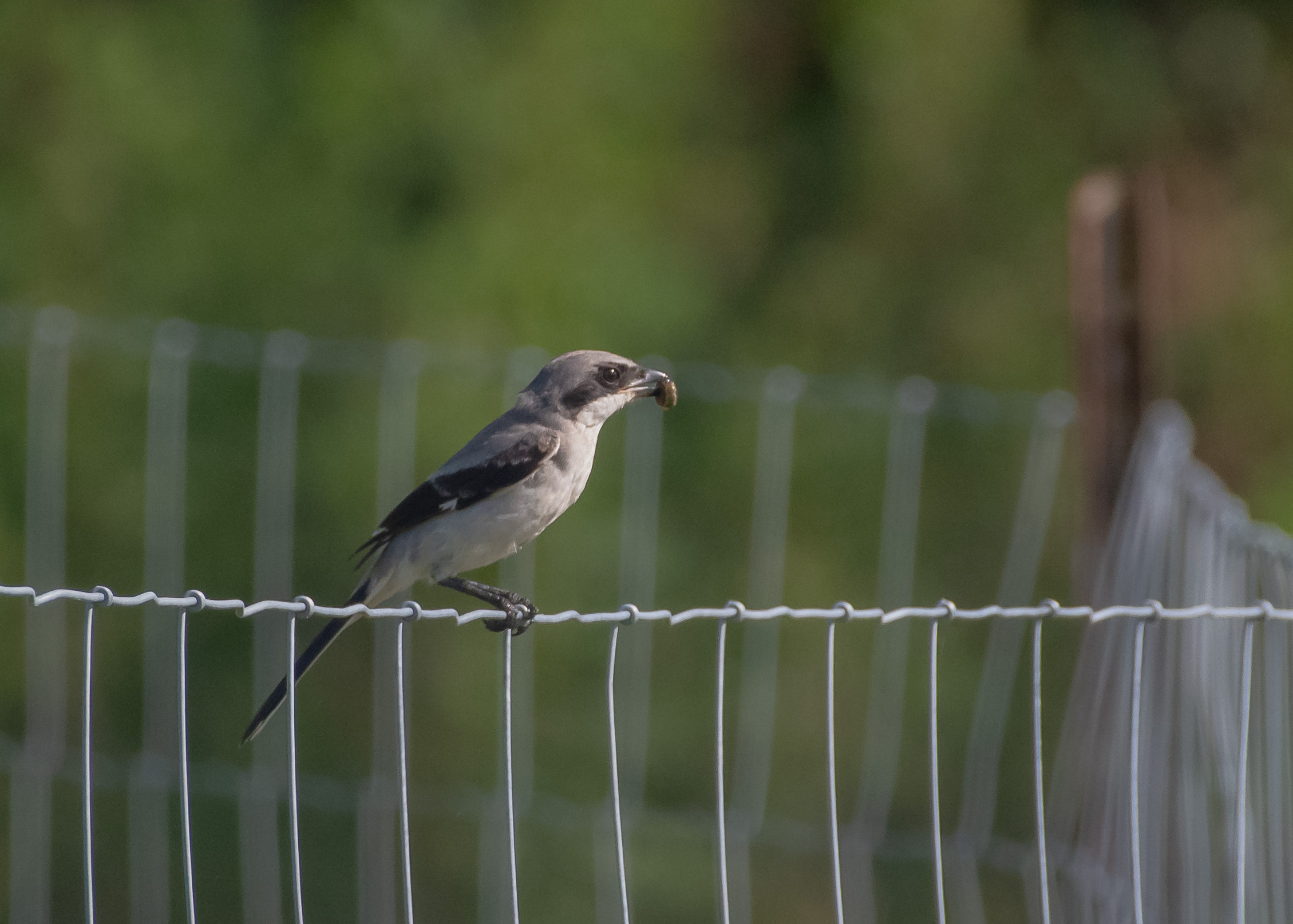
Butcher Bird is the name applied to the Loggerhead Shrike by many due to its habit of impaling its prey upon the barb of a wire or thorn of a branch. This one was too hungry and simply inhaled its grub on the spot.
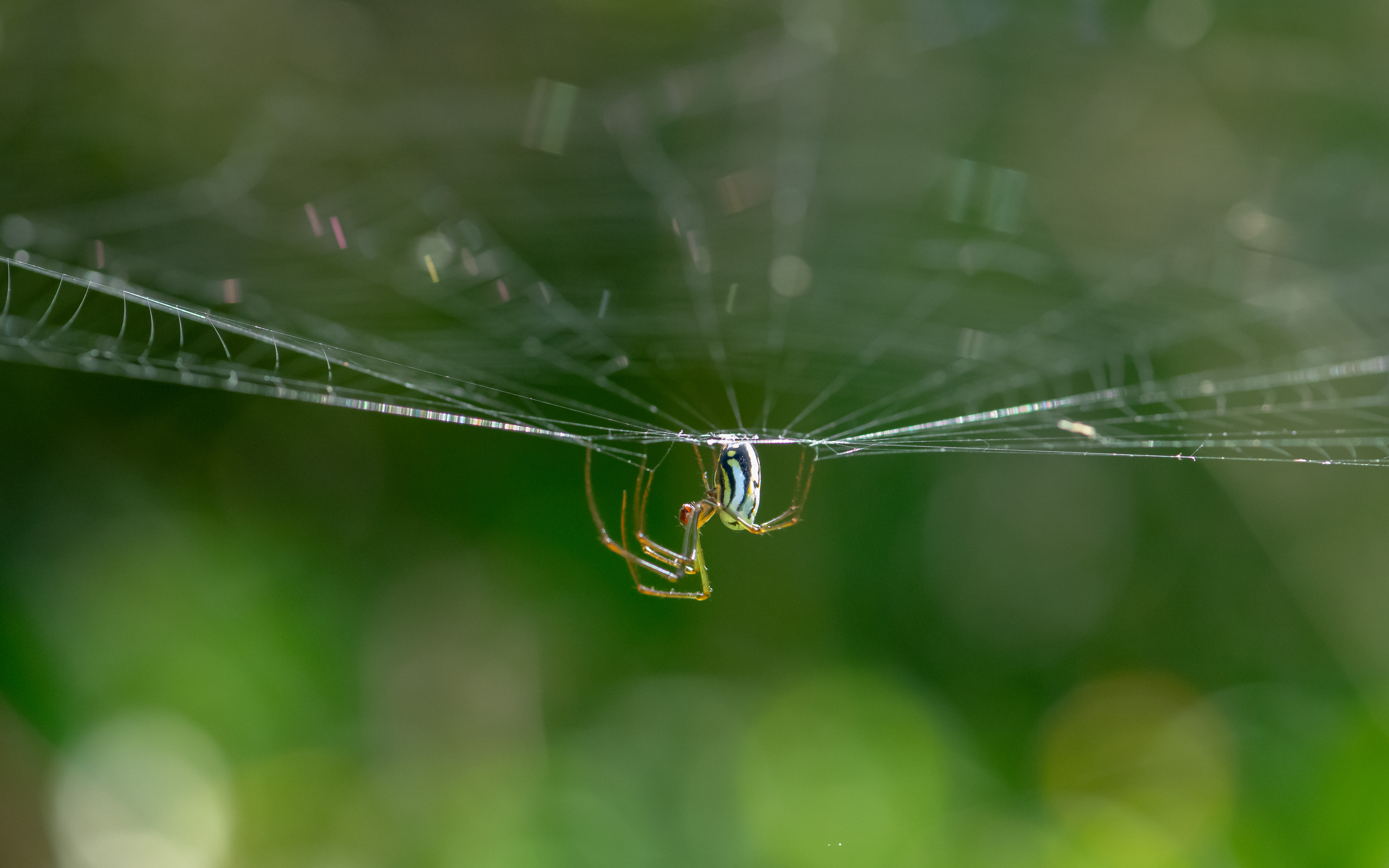
Master web-spinners, the orb weavers are represented world-wide by over 3,000 species with 180 in North America. This representative is an Orchard Orbweaver (Leucauge argyra) whose range is limited to central and south Florida.
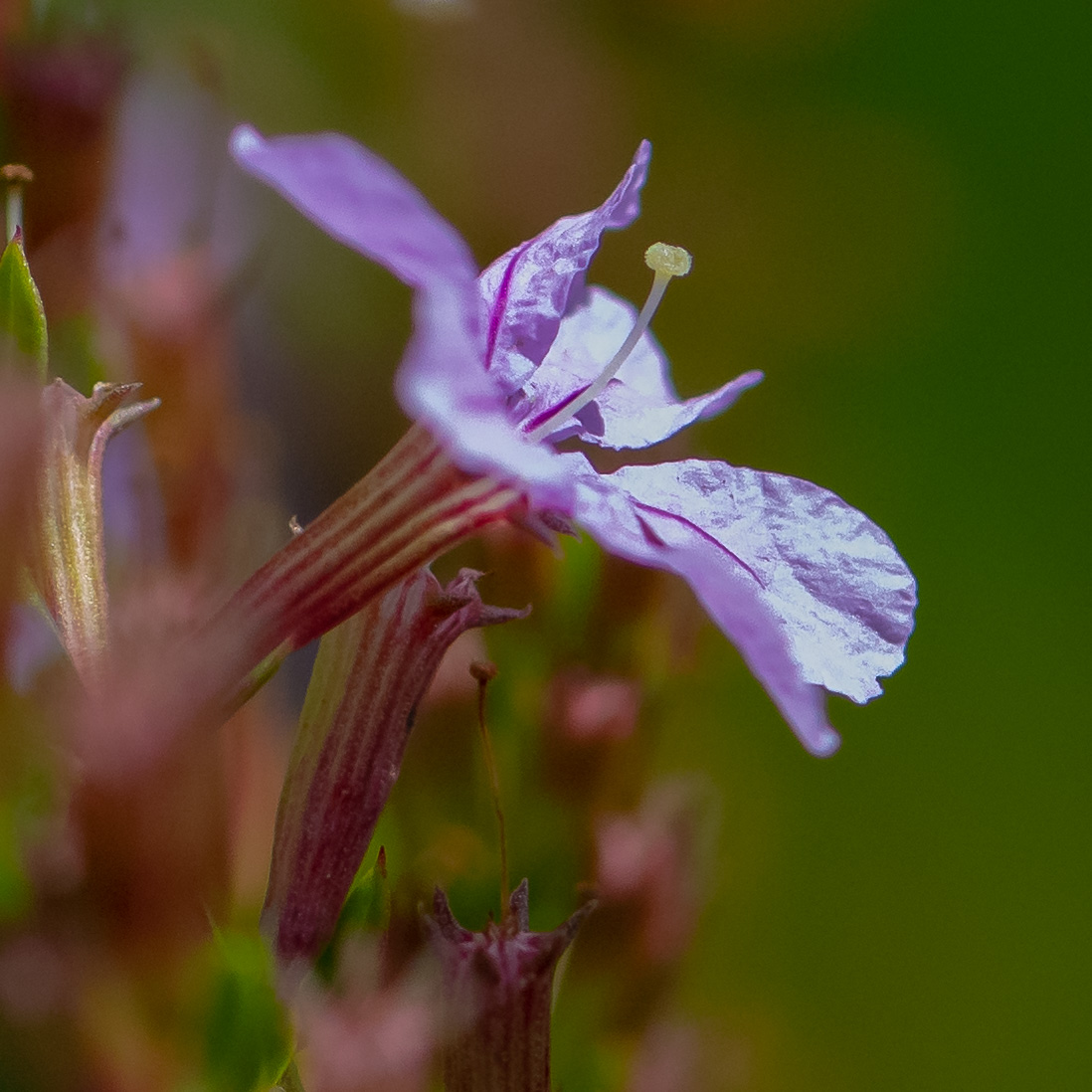
Winged Loosestrife (Lythrum alatum Pursh var. lanceolatum) is one of our favorite blooms to find, not only because it’s Gini’s favorite color, but it attracts an incredibly diverse number of pollinators.
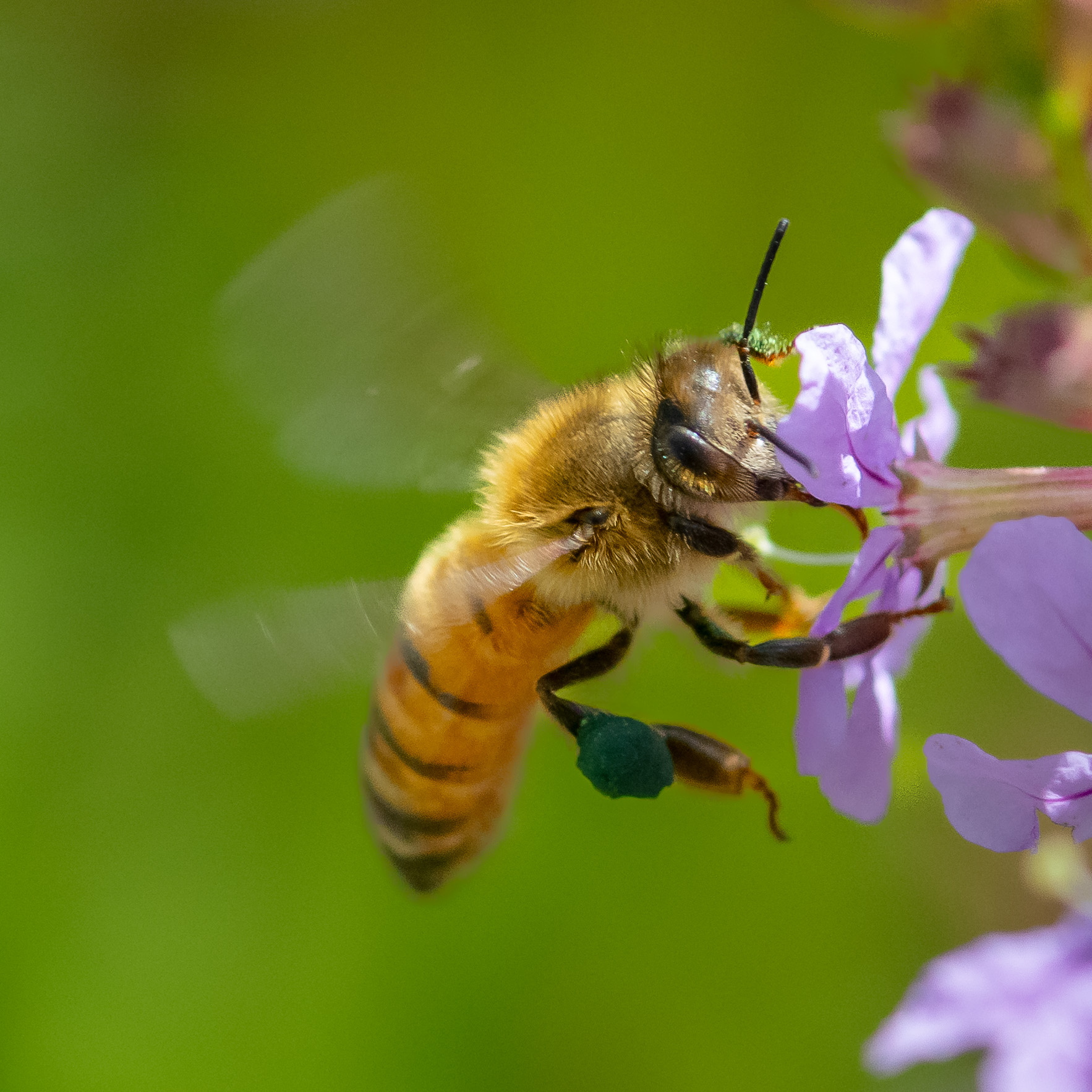
Speaking of Loosestrife pollinators, here’s one now. The common, busy but handsome Western Honey Bee (Apis mellifera). Sweet.
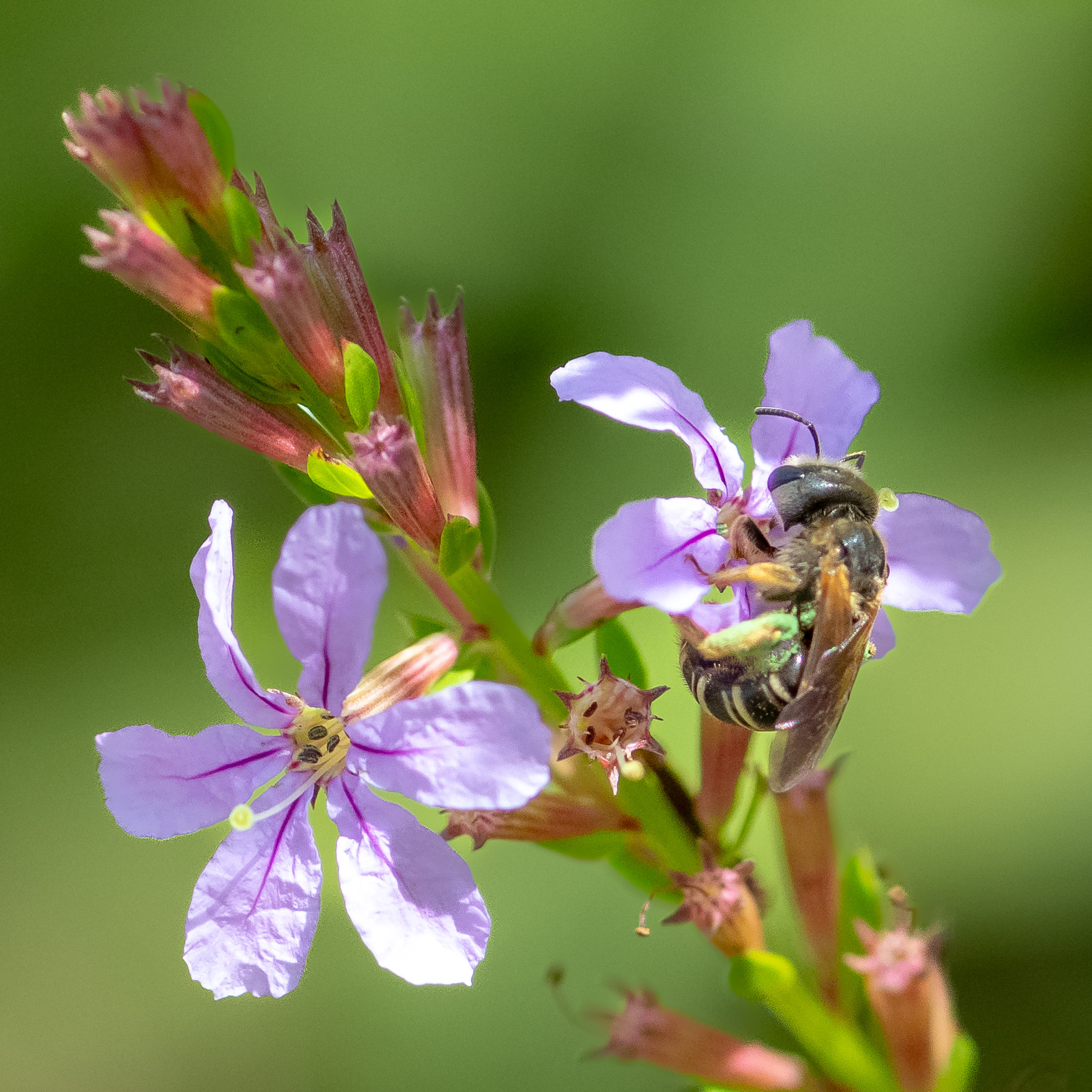
Speaking of Loosstrife pollinators, here’s another one. I had to enlist the help of an entomologist to identify this one. It is “most probably” a Poey’s Furrow Bee (Halictus poeyi), which is in the same family as Sweat Bees (Halictidae).

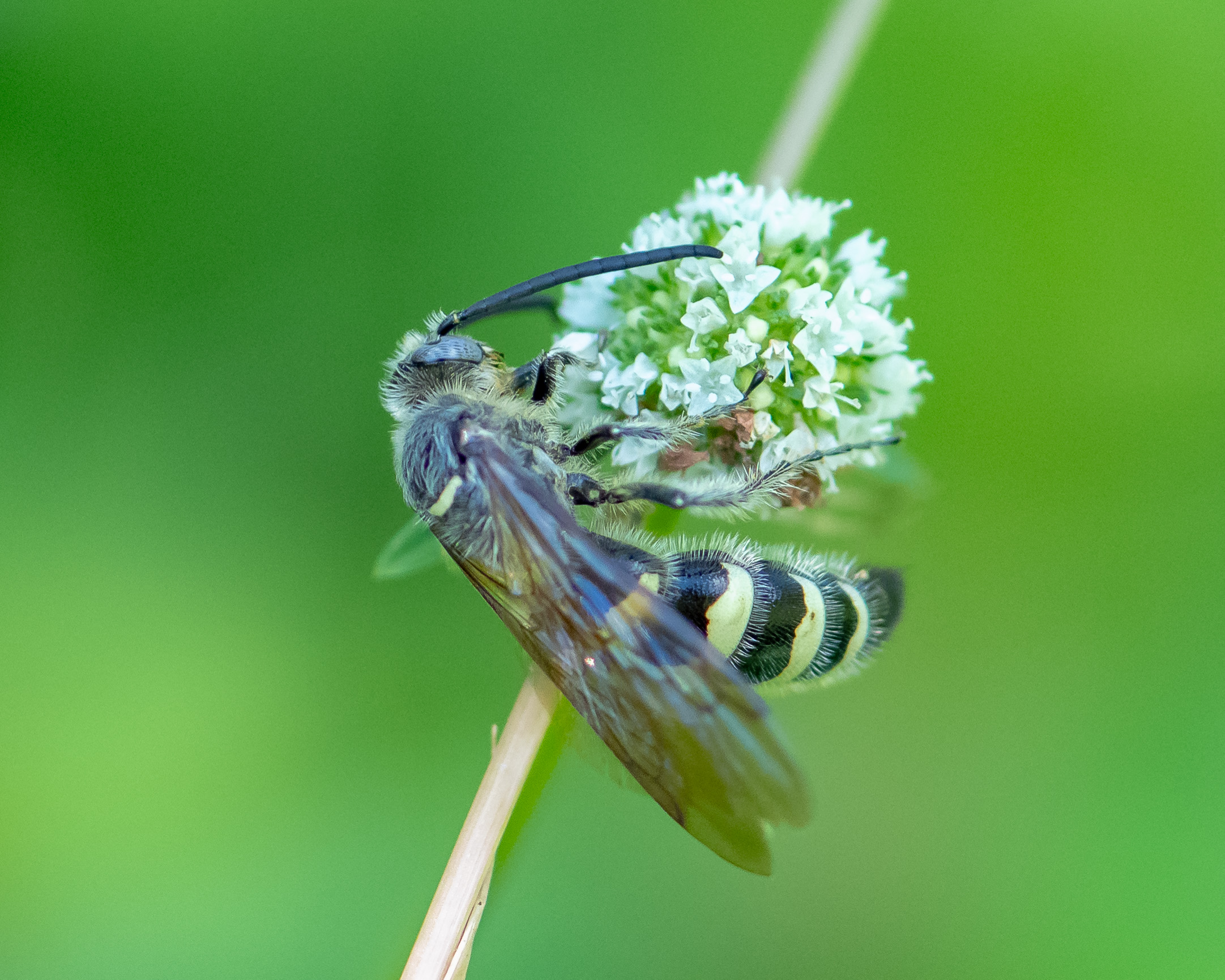
Although I managed to identify this one on my own, I still asked for (and received) confirmation that it is a new insect for us, the wonderfully-named Feather-legged Scoliid Wasp (Dielis plumipes). It’s busy enjoying the nectar of a Shrubby False Buttonweed (Spermacoce verticillata)
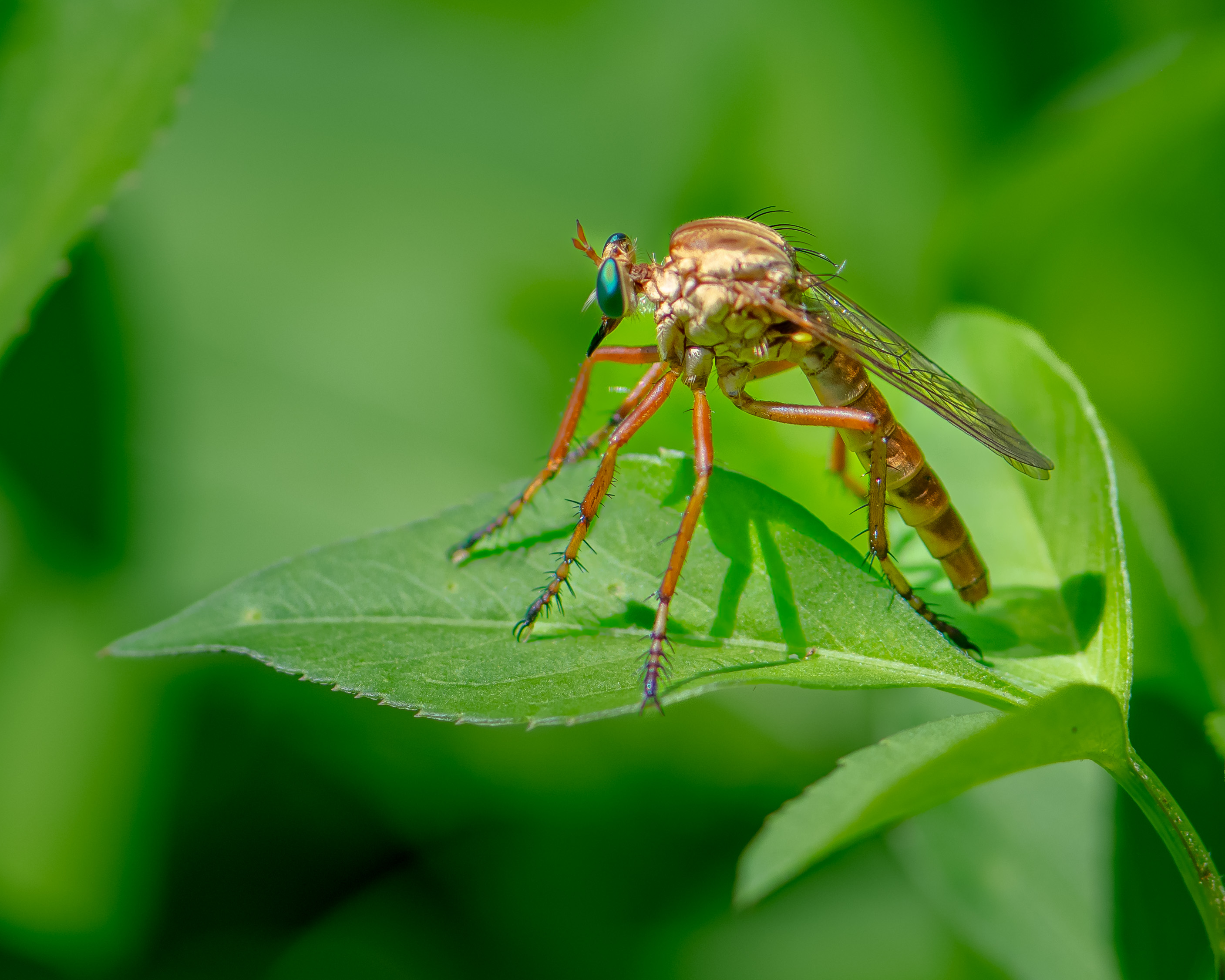
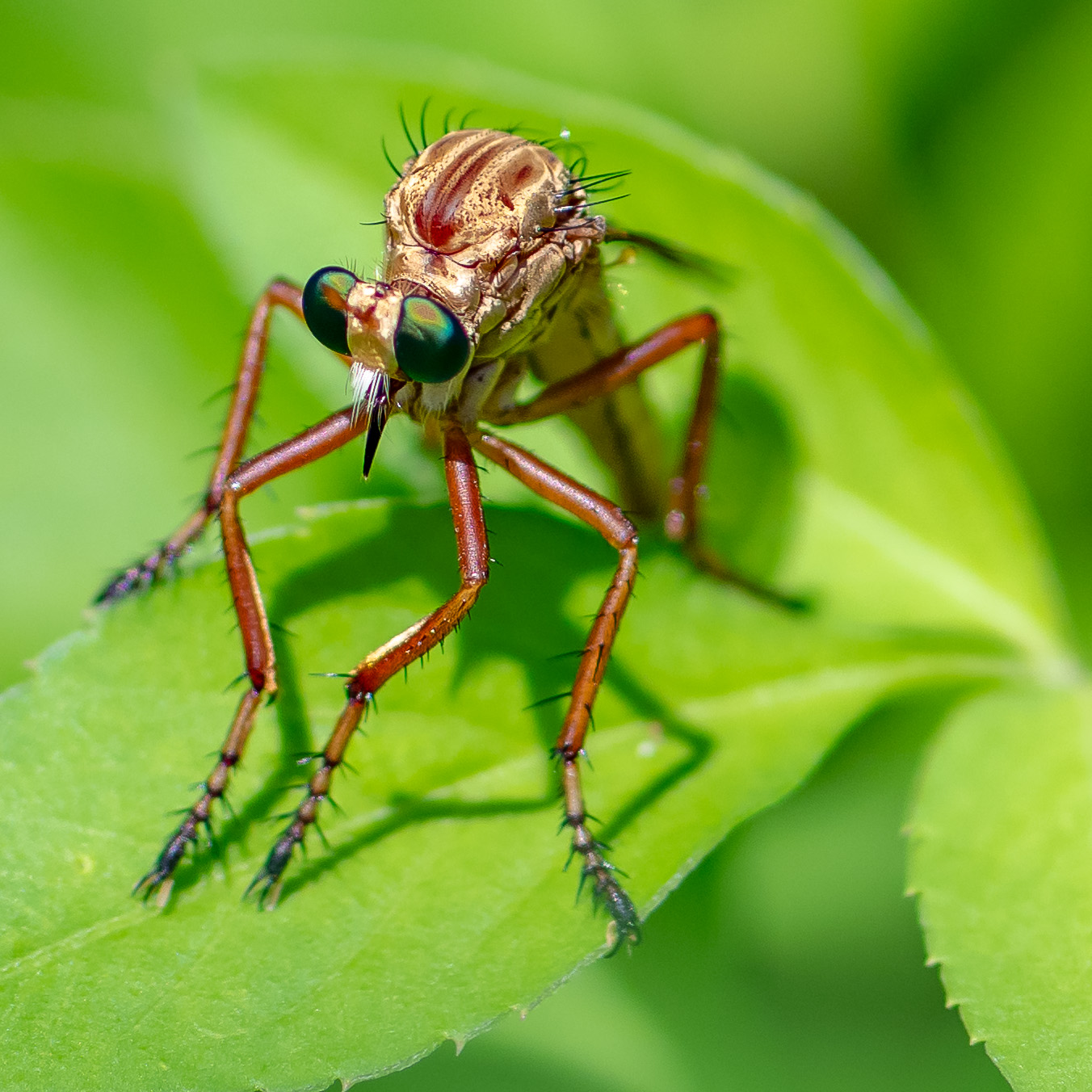
Robber Flies! There are around 7,500 species in the world with over 1,000 in North America. About the best I could do here is identify the genus as Diogmites. Individuals in this genus are fondly referred to as “hanging thieves” for their habit of dangling from a twig as they munch their prey.
A Great Blue Skimmer (Libellula vibrans). Wait – what? Where is the Blue that’s so Great?? Patience, grasshopper. This is a young male which, as is the case with many young dragons, at the moment looks like his Mama. Soon he will morph into a pale blue body with bright blue eyes and Papa will be proud.

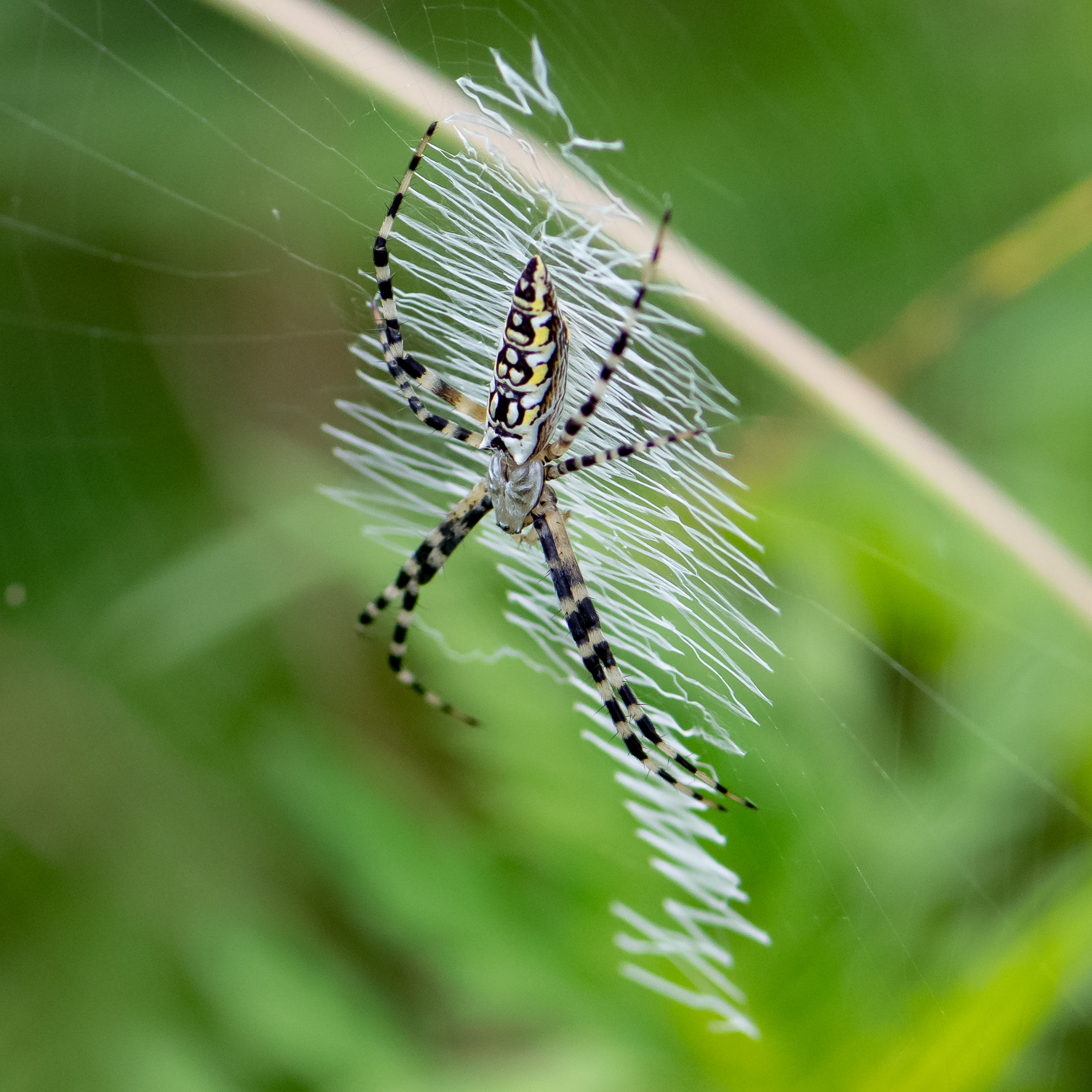
Wandering down the path intent on “seeing” and not just “looking” may occasionally cause one to stumble over a root or receive a face full of sticky silk. The latter occurrence might be due to the work of a really beautiful spider, the Yellow Garden Spider (Argiope aurantius). Large spiders and large webs. Attractive on both counts.

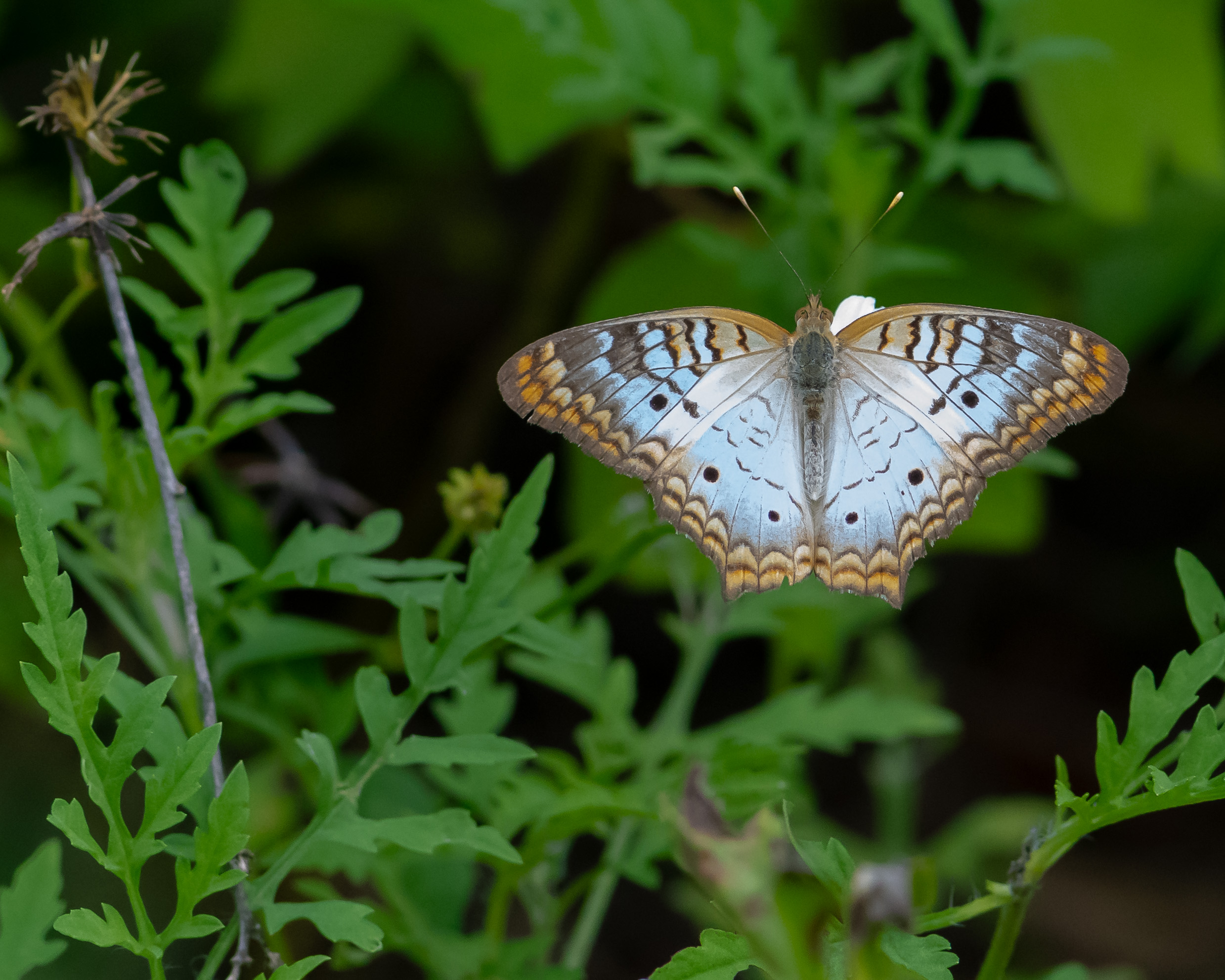
Sometimes we become complacent about “common” subjects. Sometimes we need to remind ourselves that Nature does not create anything which is insignificant. Our human eyes may not call it “pretty”. Our human brain may register it as “oh, just another _____”. We may have seen 40 White Peacock (Anartia jatrophae) butterflies today. The brain finally kicked in with “HEY! THIS IS GORGEOUS! TAKE A PICTURE!”. I just needed a gentle reminder.
We went. We looked. We saw. Forest/trees. Flowers/bees. We will try to improve our obervational skills but we still won’t be able to see it all. This is where you all come in. Get out there and help us!
“It’s not what you look at that matters, it’s what you see.” – Henry David Thoreau
Enjoy your search for a natural place and come back for a visit!

We have turned back the clock to mid-July. I guess it is a testament of sorts to how busy we have been that there are several trips which have gone unreported. As we have an opportunity, we shall attempt to catch up.
Weather-wise, today in the first week of September, it could just as easily be the middle of July. High temperatures, equally high humidity. Regularly scheduled thunderstorms. We recognize that the calendar has advanced as we are beginning to see warblers arriving in small numbers with their autumn suitcases packed with plumage for warm climes. Additionally, our Swallow-tailed Kites have left the area in favor of insect rich pampas in Argentina. Recently, we were rudely reminded that it is actually late summer as Hurricane Idalia raced northward along Florida’s western coast.
Back to mid-July. We had brunch by the lake as a Limpkin stalked an Apple Snail. Overhead, we were entertained by the aerial prowess of a Swallow-tailed Kite. An alligator peered at us from just beyond the shoreline. Gini remarked it was difficult to believe we had been exploring for two hours already.
Time flies …
The intense heat would soon encourage us to seek the air-conditioned refuge of our living room. Until then, we would immerse ourselves in close encounters of the natural kind. We have been to this area often enough that we could almost list what we would see before ever leaving home. Once here, it’s like greeting old friends. We know the address of a butterfly, the branch office of a dragon, the wading pool frequented by the egret.
It was a summer’s day. We loved it.
This bright male Northern Cardinal forced me to break my “cardinal” rule of not including photographs of birds on utility lines.

It was still a bit too early for warm air thermals to support the Swallow-tailed Kite’s preference for soaring. This one likely spent the night on this branch.

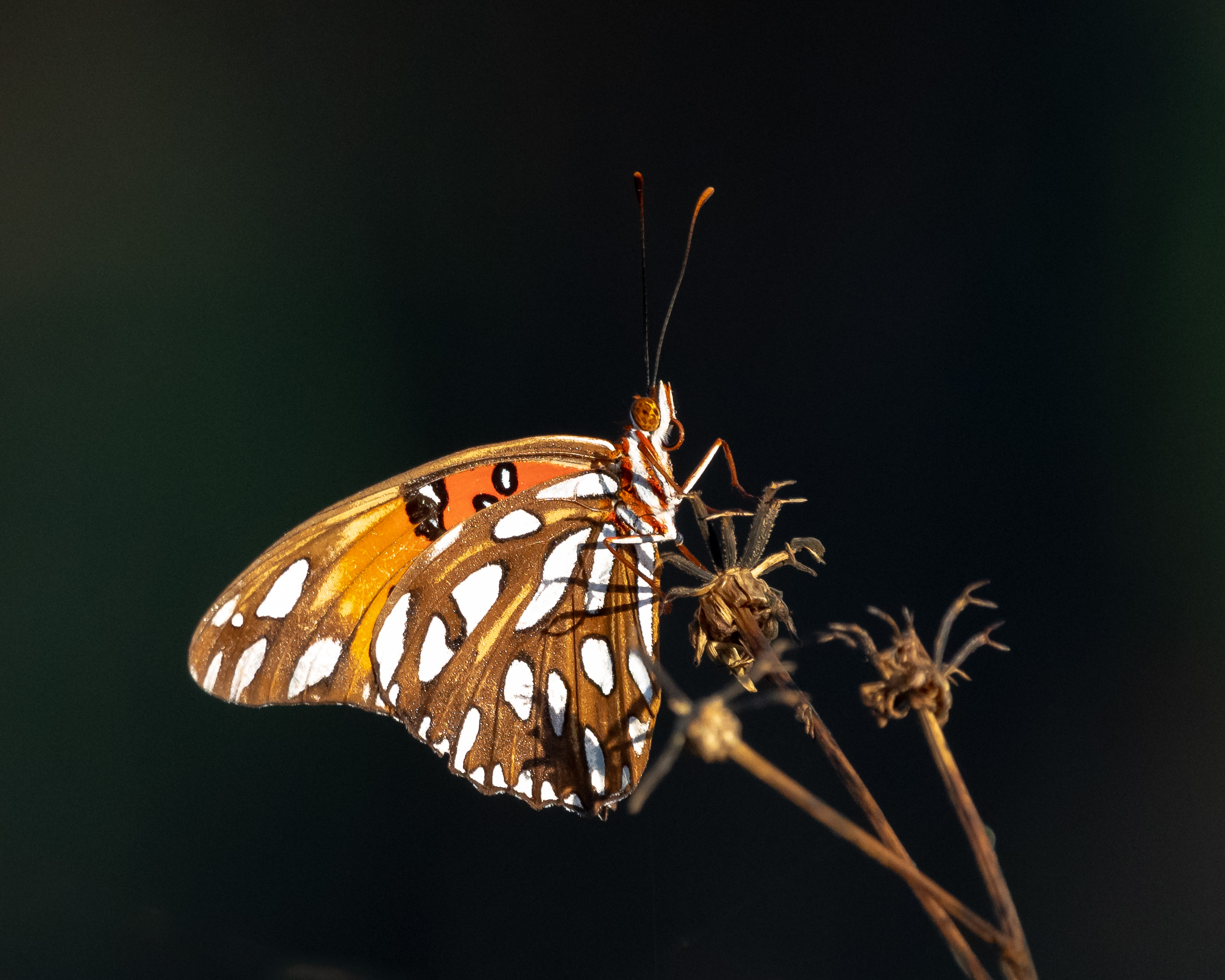
We don’t care that the Gulf Fritillary (Dione incarnata) is one of our most abundant butterflies. It is absolutely gorgeous from any angle!

A twig charred from a recent controlled burn makes a perfect ambush platform for this female Roseate Skimmer (Orthemis ferruginea).

So small that it could be mistaken for a wasp, especially when it flies with legs dangling, the diminutive Eastern Amberwing (Perithemis tenera) hopes would-be predators do exactly that.

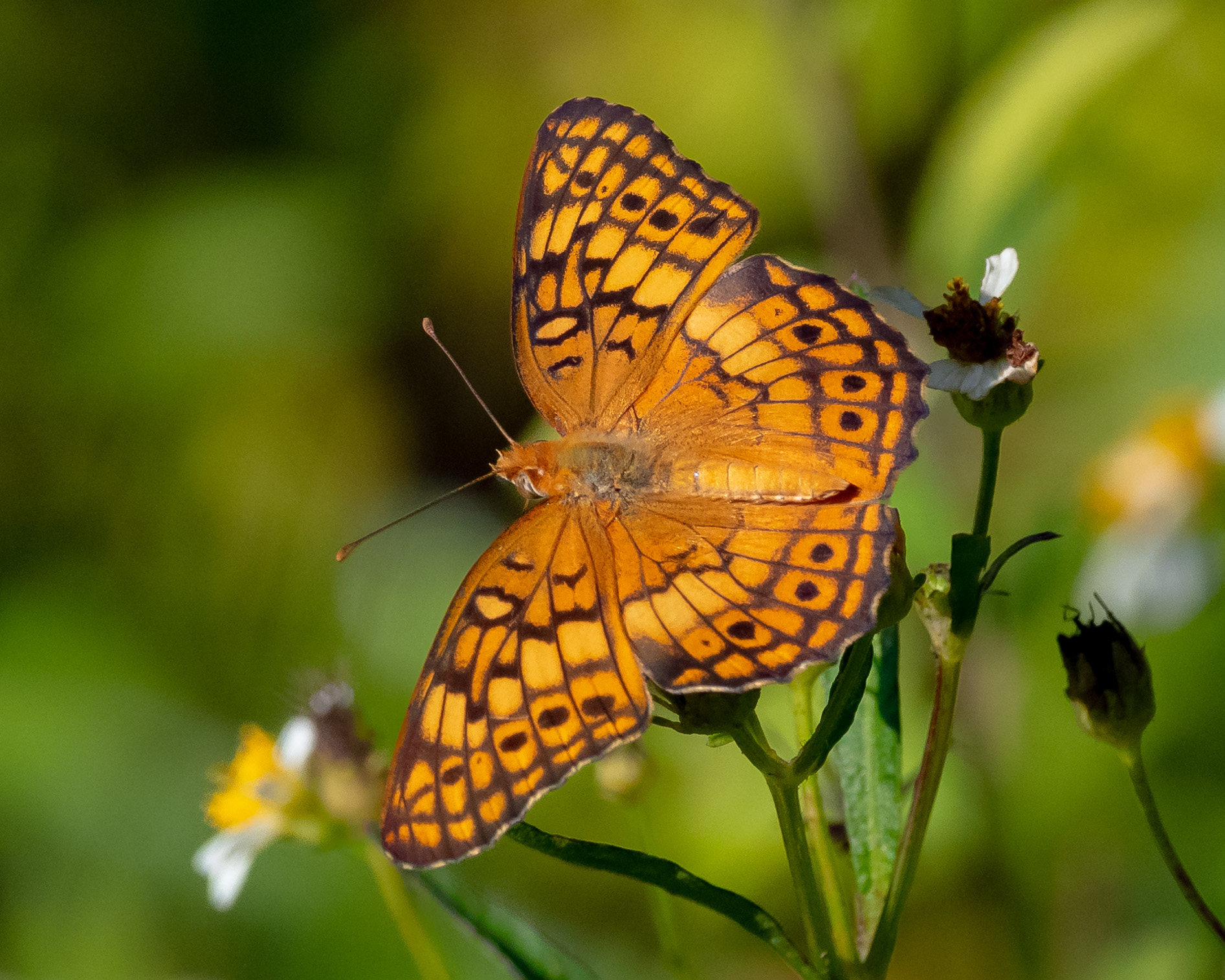
Although it is not quite as bright as its Gulf cousin, a Variegated Fritillary (Euptoieta claudia) has a subtle beauty all its own.

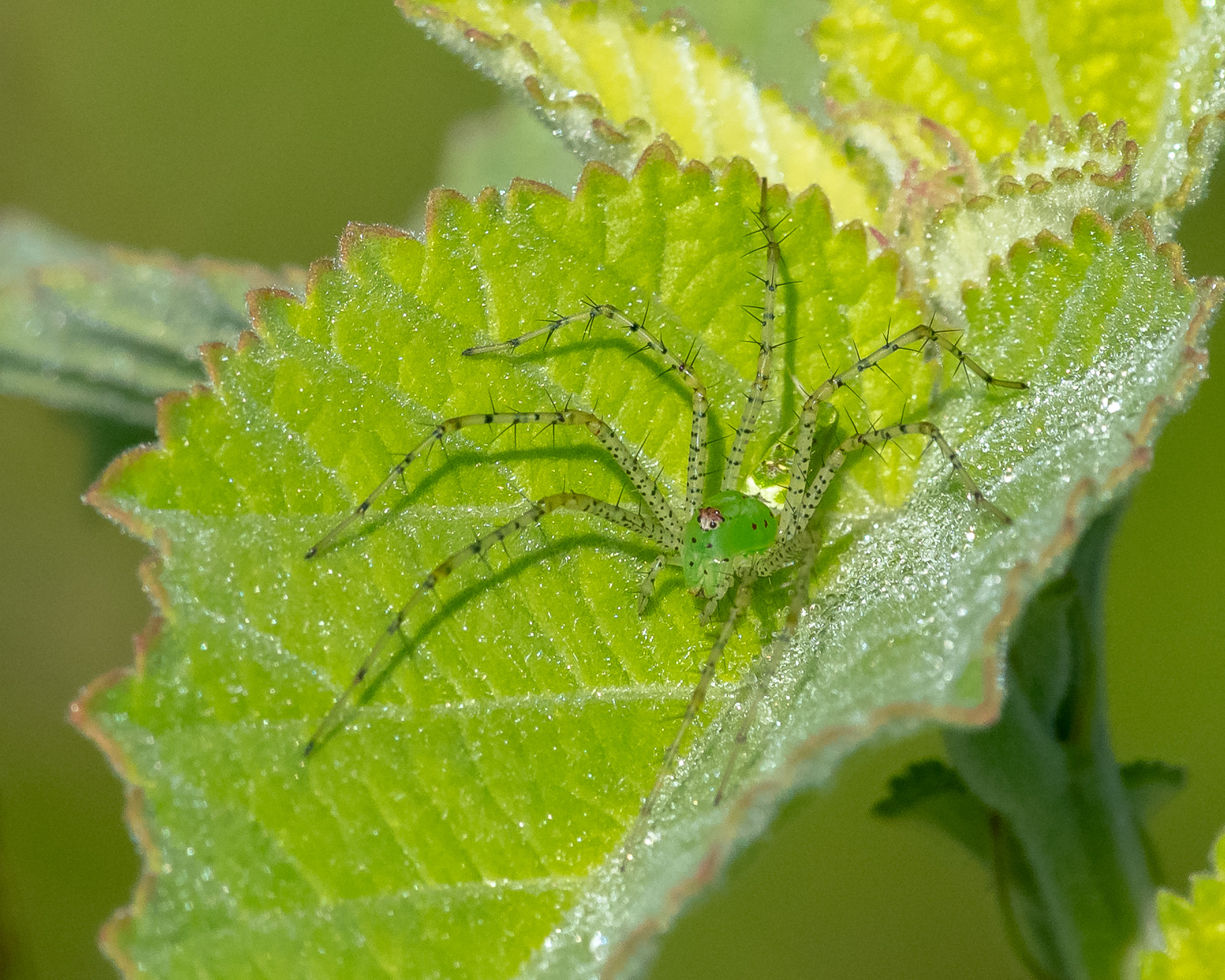
It’s hard to believe one could not help but see a brightly colored lime-green spider just sitting out in the open. Unless it is sitting on a similarly-colored leaf where it blends in rather nicely. This Green Lynx Spider (Peucetia viridans) hopes an insect morsel won’t notice it either.
One of our larger black butterflies, a Spicebush Swallowtail (Pterourus troilus) has really striking markings.

Many of the lakes in this particular area are too deep for wading birds. Recent rains have created large puddles which attract all sorts of creatures, including this Snowy Egret which is busy looking for some of the smaller creatures enjoying the pool.

North America’s smallest falcon, the American Kestrel, is fascinating to observe. We were able to watch this one hunt from a fence perch and then from the air as it hovered and then streaked along just above a grassy field.


Our morning outing in hot July was incredibly enjoyable. Just like our outing in hot August. Very much like our outing in hot September. We’re confident cooler days are just around the hot, humid bend.
Enjoy your search for a natural place and come back for a visit!
 Our Natural Places