Flowerful ! (Belated Part Two)
(So, has our absence made your hearts grow fonder? The year has provided more than its share of challenges for us. The vicissitudes of life have kept us from pursuing our love of exploring Nature. Things may be changing for the better. We made our first trip to the forest since April a few days ago. This post is a follow-up to our last one which describes our spring visit to the Green Swamp. We hope you all have been well.)
(Click on images to enlarge, click again to zoom.)
When we tell people our favorite place to explore is the Green Swamp, it is understandable they think of slimy water filled with snakes and alligators, while they politely back away from us. Truth is, yes, we know where to find some of that slimy water with who-knows-what in it, but the “swamp” also consists of lovely shaded oak hammocks, long-leaf pine forest, open savannas, cypress tree-lined streams, hardwood stands and small remote ponds.
Such diversity of habitat leads to diversity of life therein. Several years ago, we initially went for the bird watching. We keep returning for everything else. The old logging roads twist and turn and the state forest management system has provided multiple trails along those roads. A few steps take us into primitive wilderness where we seldom encounter another human.
Our last post described plant and insect life thriving in the swamp environment. Surprise! This post is more of the same. Hope you don’t become bored.
Bright yellow blooms occur throughout the area which is just fine with us. This eight-petal lovely belongs to the Smallfruit Beggarticks (Bidens mitis). Just as with other members of this family, tiny seedheads annoyingly attach themselves to everything they touch. Since they are so pretty, we forgive them.

Soft pink decorates the edges of the pine woods where it’s wet. The Swamp Rose (Rosa palustris) is simple and beautiful.

Insects love the nectar. Birds enjoy the seeds. Ducks gobble down the entire plant. Although it’s reported to be edible for humans, we’ll enjoy it from afar. Pickerelweed (Pontederia cordata).

Palamedes Swallowtail (Papilio palamedes) on Purple Thistle (Cirsium horridulum). This is one of a handful of “large” black swallowtail butterflies in our area. The yellow line at the base of the underwing and along the body help separate it from the similar Black Swallowtail (Papilio polyxenes).

Small visitor to a small flower. One of the hover flies, Thin-lined Calligrapher (Toxomerus boscii) on Oakleaf Fleabane (Erigeron quercifolius).

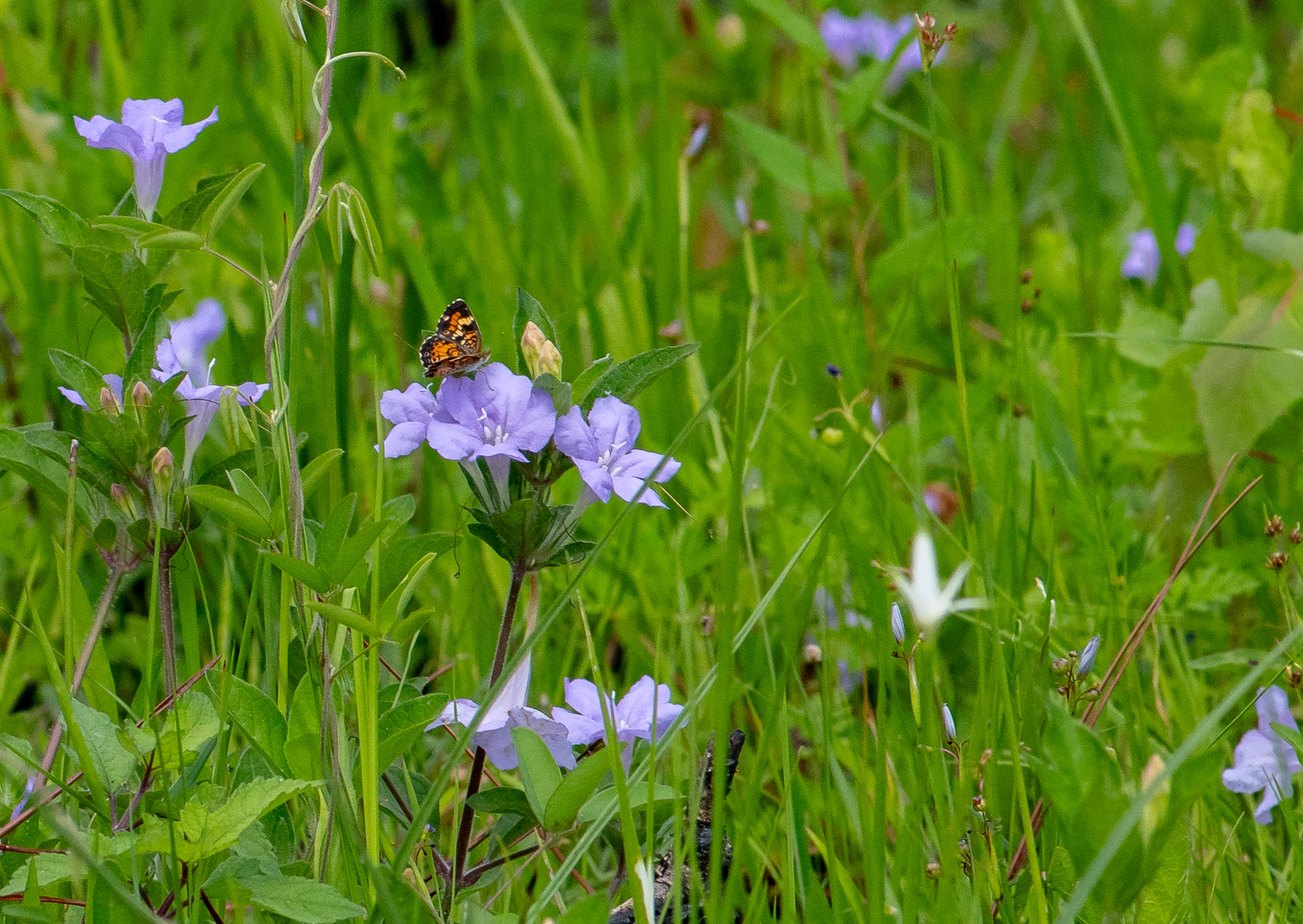
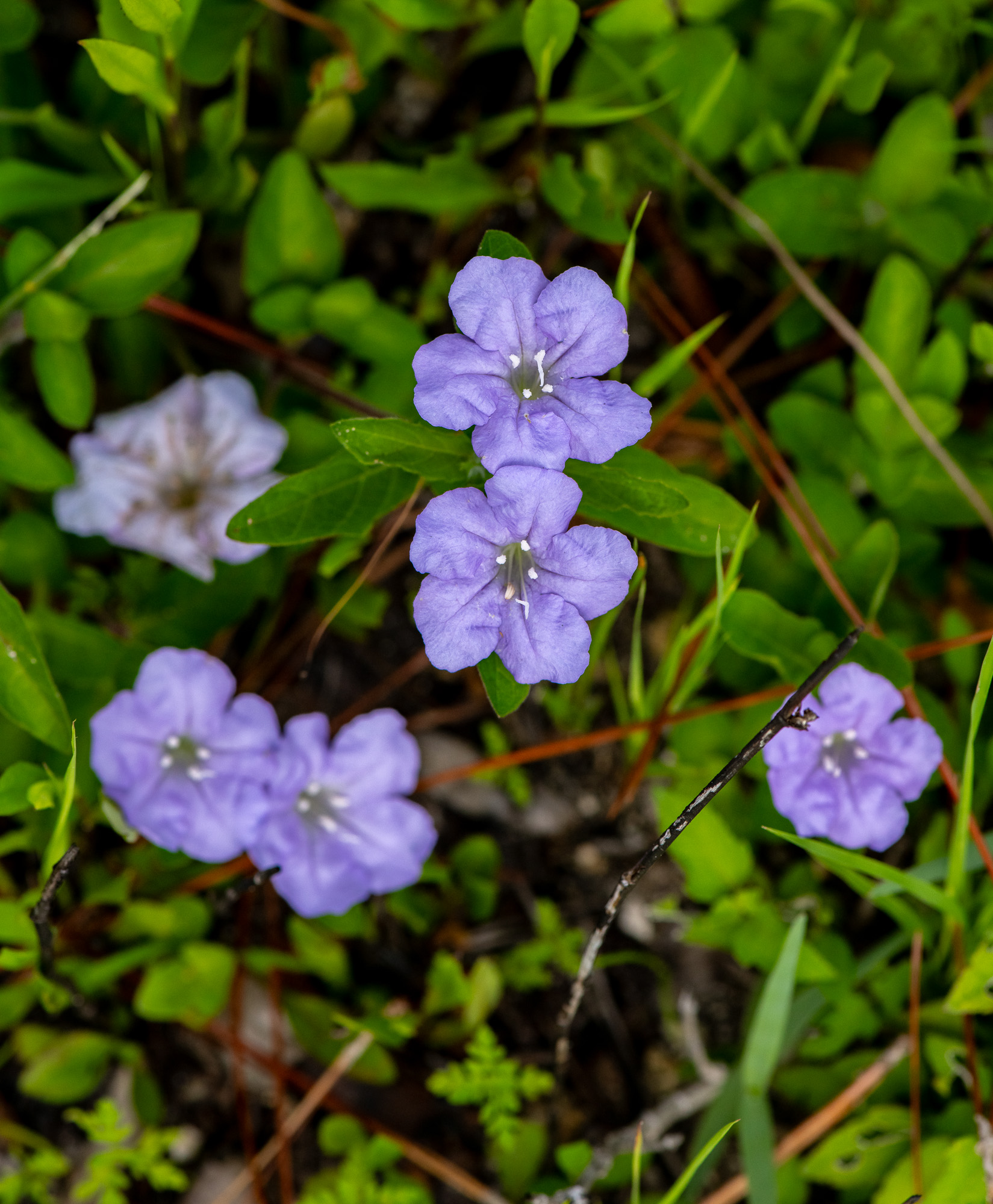
A host plant for the Common Buckeye and White Peacock butterfly larvae, Carolina Wild Petunia (Ruellia caroliniensis) is fairly common. We love its lavender addition to the landscape so much we don’t even care it’s not really a petunia.
More feared (by me) than snakes and ‘gators, the voracious Yellow Fly (Diachlorus ferrugatus). Nice eyes, though.

Nearly endemic to Florida, the lemon-yellow blooms of Coastal Plain Hawkweed (Hieracium megacephalon) poke through browned fronds of a saw palmetto (Serenoa repens).

Immature Eastern Lubber Grasshoppers (Romalea microptera) will soon mature into the more familiar yellow/orange large adults.

Pinebarren Aster (Oclemena reticulata) needs to have frequent moisture to thrive and is thus well-suited for the edges of the pine forest here which receives periodic rain throughout the summer. Growing to nearly three feet tall, several clusters normally occur together, each producing numerous flowers.

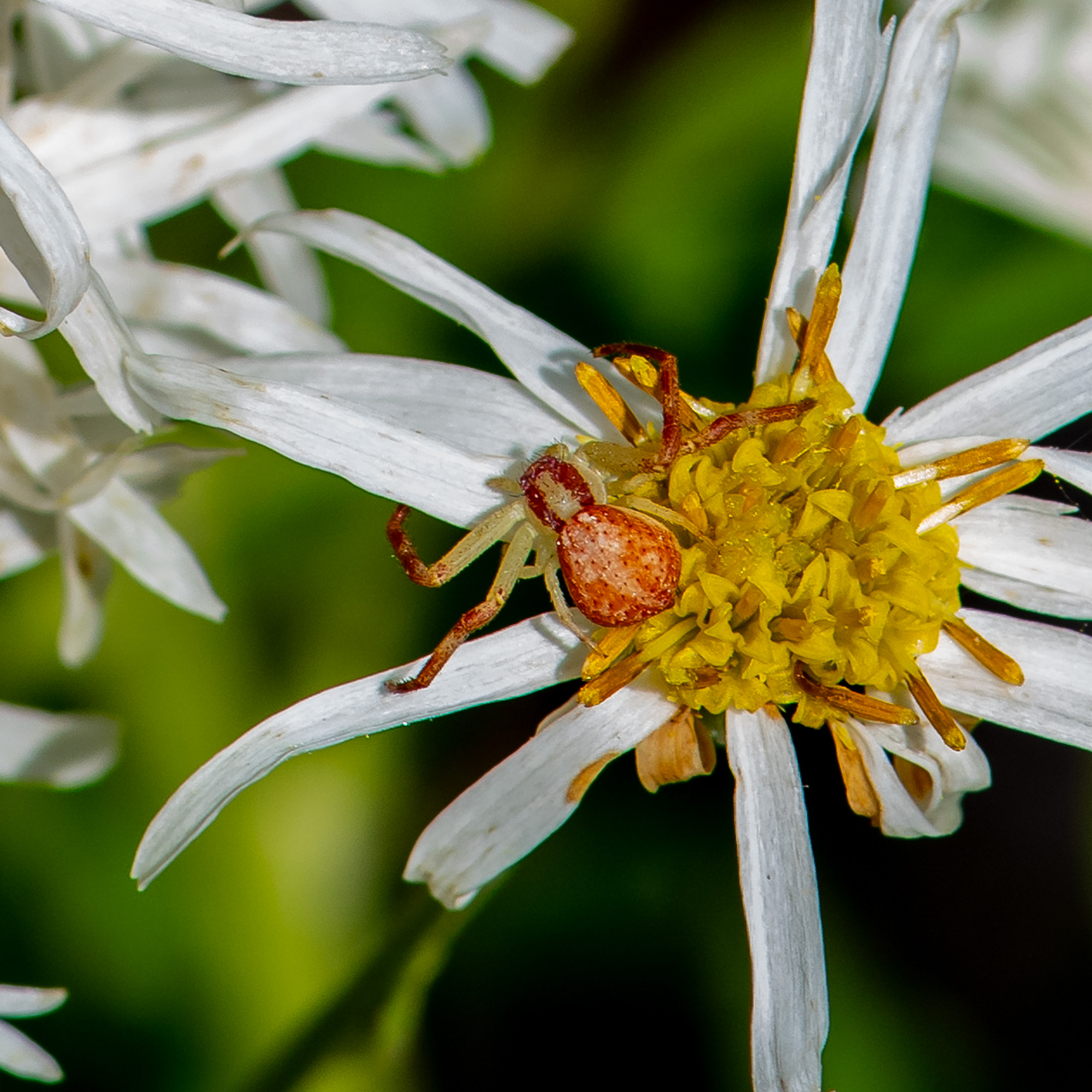
A closer look can often provide a surprise. Crab Spider (Family Thomisidae).
The Southern Redlegged Grasshopper (Melanoplus propinquus) is one of the most common grasshoppers in the state. Its good looks, however, are on the wanted poster of farmers and gardeners who are all too familiar with the damage it can cause.

Sometimes growing in fairly large clumps, the beautiful Blue-eyed Grass (Sisyrinchium angustifolium) is attractive to a host of nectar-loving insects. We may not care for the nectar, but it certainly is among our favorites.

Endemic to Florida, the diminutive Bay Lobelia (Lobelia feayana) is fairly common in roadside ditches and depressions. The small blooms can form impressive masses of lavender and bees really like them. So do we.

A uniquely-shaped plant, Blackroot (Pterocaulon pycnostachyum) can grow to two feet tall and has little knobby whitish flowers. The stems and undersides of the leaves are covered in silvery hairs. Something different.


Found in open areas with moist soils and plenty of sunlight, the Yellow Milkwort (Senega rugelii) is another Florida endemic. Flower stalks can grow up to three feet and the blooms are rounded. Yellow Milkwort seeds are spread almost exclusively by ants. The seeds contain fleshy, oil- and protein-rich structures. Ants collect the seeds and take them to their nest where they consume the protein, but leave the seed intact. The seeds are then tossed from the nest into favorable germinating conditions.


Just as we both decided to have some sort of heart surgery late last year, we also decided “Gee, this would be a great time buy a new house and move!“. We closed on the house in January of this year and spent the next few months remodeling the place while attempting to regain our health. Several other nasty surprises left us emotionally and physically drained. We are almost recovered from it all. Moved into the new place July 1st and are having fun staring at mountains of boxes. Mostly, we’re relaxing. Through it all, we know that – Life Is Good!
Enjoy your search for a natural place and come back for a visit!
 Our Natural Places
I love the flower photos. I always enjoy the birds-eye view as it depicts the symmetry of the whole flower.
LikeLike
Thank you very much, Maria.
It’s amazing how different perspectives can change the way we see Nature.
LikeLiked by 1 person
It’s wonderful to hear from you both and know you are recovering. Moving would require recovery for us….what a lot of hard work. I know you are taking good care of each other and hopefully you can take your time now. The yellow fly is dreaded by me. I’m so sweet…they love me! lol And I love walking through the swamp, preferably on a boardwalk! Enjoy the summer months and keep those fans whirring! Hugs, Diane
LikeLike
What a joy to tarry in your much-loved Green Swamp, Wally. All the details are especially a delight–the beautiful body of the hoverfly, the eyes of the yellow fly, the grasshoppers and flowers. Also enjoyed learning about these creatures like the ants and the seeds of the yellow milkwort. I hope your health continues to improve so you have more wonderful moments here.
LikeLike
We have certainly missed regular visits to our natural places this year!
One more major hoop for Gini to navigate and we hope to re-ignite our exploration fever. (She’s getting new knees! A good thing, indeed.)
Jet, thank you very much for visiting and providing such gracious comments. We really appreciate it.
LikeLiked by 1 person
Very glad for Part II Wally. It’s a great reminder for those of us continually looking up for the birds, that we are missing a show just as good right at our feet.
LikeLike
Thanks, Brad.
One thing that helped me evolve from being “exclusively” a birder was the purchase of a macro lens. Forced me to slow down and do stuff like examine the undersides of leaves and lay down in the forest for a better angle of a mushroom.
Nature offers a great show just about any time. “Seeing” it – well, that’s a whole ‘nother story!
LikeLiked by 1 person
Absolutely stunning captures. Thank you 😊 so much for sharing and warm greetings from Montreal, Canada ❤️ 🇨🇦
LikeLike
Good Morning, Linda.
We really appreciate your visit. Hopefully, more to come soon.
As much as we like the warm greetings, any chance you could spare a breath of fresh and cool Canadian air to relieve our heat stroke?
Hope your day is terrific!
LikeLike
Welcome back Wally! Continued wishes for things to settle down for the two of you. Adding a move on top of all your other goings on can definitely add significant degree of stress. Another set of lovely captures. I especially like the Thin-lined Calligrapher on the white flower shot, but equally horrified by the Yellow Fly – that thing belongs on my haunted trail ha. Very intrigued by the Crab Spider. Never seen one of those before, I need to do some research on that one! Take care and try not to push yourselves too far.
LikeLike
We’re good, overall. Beginning to schedule “get away” days each week to help with maintaining our sanity. We figured out all these boxes will wait very patiently to be unpacked.
The Yellow Fly could be TOO scary for your trail. Not to mention, it may eat the other monsters.
LikeLike
Sounds like life threw you a few curve balls! You were indeed missed and I for one am glad to see that you are back and read your tale. Hope all is well with you now and you are ready for more adventures!
LikeLike
Thanks, Jim. We’re still ducking the curve balls but are beginning to escape now and then into the forest and swamp.
Things are settling down and we’re gradually getting back to “our” normal.
LikeLike
Nice to visit your blog again. Gorgeous photography. I love those psychedelic fly eyes!! Congrats on your new digs!
LikeLike
Nice to have something for visitors to visit again.
Thank you, Peter. I got dizzy thinking about your high altitude adventures and was happy to hike around the flat forest landscape yesterday. No snow, but some of us don’t consider that a bad thing.
LikeLike
Meandering through your posts is like a day spent meandering through (wherever). It’s wonderful, and wonderful to have you back. It’s not wonderful to encounter our deer flies: a relative of yours. They do take chunks of flesh, their bite is painful, and I’ve yet to find anything that repels them. I can keep mosquitos, chiggers, and ticks away, but those flies are aggressive. I have read that they attack from above, and that wearing a hat helps. If I ever can make myself wear a hat, I’ll test the theory.
The color’s different, but the structure of your milkwort is strikingly similar to one of my favorite flowers: Maryland milkwort (Polygala mariana). Is that an egg on the Bay Lobelia? or perhaps some kind of seed? I’m always tickled by the similarities in our flora, like the Carolina petunia and the blue-eyed grass, but I found an unexpected coincidence today: the thin-lined calligrapher. I’d never come across that one until recently, and the photo’s not as good as yours for detail, but various sources confirmed the identity of this one.
LikeLike
I don’t often get bitten by insects. I wear a hat. However, my secret weapon is never straying too far from someone who is far more attractive to insects and pretty much all other living organisms. Gini = Sweetness.
P. mariana is sprinkled around Florida and you’re right about the similar structure. I pondered about that speck on the lobelia and could not determine if it was a speck of pollen, egg or seed. Your hover fly certainly looks like it could be the same species.
It’s good to be back. Now, if we can just clear the schedule of all those medical appointments and get back to what’s really important!
LikeLiked by 1 person
Two heart surgeries followed by selling an old and buying a new house: no wonder we haven’t heard from you in a long time. Rewelcome. (How come we can’t say that?)
As you mentioned, the patterned eyes on the yellow fly are impressive. Wikipedia explains why you called it voracious: “Diachlorus ferrugatus, commonly known as the yellow fly or yellow fly of the dismal swamp in the United States or doctor fly in Belize, is a species of highly aggressive biting horse-fly of the family Tabanidae native to North and Central America to Costa Rica…. It is notorious for its propensity to inflict painful bites on people, having been described as the most aggressive fly species in Florida.”
Yellow rehabilitates itself in the Senega rugelii, whose flower head has a fractal look to it.
I’ve so often found crab spiders staking out flowers that you could say, paradoxically, the surprise of finding one on a flower is an expected surprise.
LikeLike
We appreciate the rewelcome.
I definitely prefer that fly’s eyes to its foul mouth.
The pattern of the milkwort blossom is quite mesmerizing. We lucky to have both yellow and orange varieties.
I still have not yet learned the lesson of thoroughly inspecting plants while in the field. As a result, post-processing often elicits a “look at THAT!” followed immediately by regrets about not using the right lens or settings for a subject I didn’t even see at the time.
LikeLike
It’s safe to say all of us veteran macro nature photographers have had that experience many times.
LikeLiked by 1 person
So glad ‘Life is good’ for you. As I said in response to your comment on my blog I’m thrilled to see you back in action. Moved home?! That’s fun.
Anyway, just love your images. Sadly my knowledge of botanics is very limited. I guess filled with butters, birds and dragons the poor little brain can’t take in any more info.
Brilliant shot off that fly’s eyes! I imagine that is what we here in Norfolk call a ‘Hoss Fly’, others call the ‘cleggs’. Silent then bite, and don’t they half hurt!
Keep it shiny side up you two, look forward to more adventures.
LikeLike
That Yellow Fly is one of three Horse Fly species we enjoy here and they all have little scissors for a mouth and hurt like the devil when they start “cutting” on your arm!
Fortunately, my lovely bride has been a “shiny side up” person for our nearly 60 years together. That has made all the difference.
Take care. Working on more exploration to share.
LikeLike
Glad you are both well. As for the other nasty surprises…let it all go!
LikeLike
We would love to let it go! Now, if it will just let US go!
Thanks again for your cool, snowy images to help keep us comfortable.
LikeLiked by 1 person
Glad things are settling down for you. Did you move far – are you still in Florida?
Those grasshoppers remind me of John Deere combines lined up in rows to harvest a field, even down to the yellow rectangles trimming their faces.
The distribution of the Milkwort seed by ants is fascinating, I learned something totally new today! And its blossom has that fibonacci flair, and such a buttery color. Lovely.
Wonderful walk, wonderful photos, wonderful to have you back!
LikeLike
It’s good to (almost) be back, Sam! Thank you.
We only moved a few dozen miles. This part of Florida will always be “home”.
Lubbers can definitely do some crop damage so they’re not favorites of farmers. We always love coming across the Yellow Milkwort. Little balls of sunshine.
LikeLiked by 1 person