Flowerful !
(Click on images to enlarge, click again to zoom.)
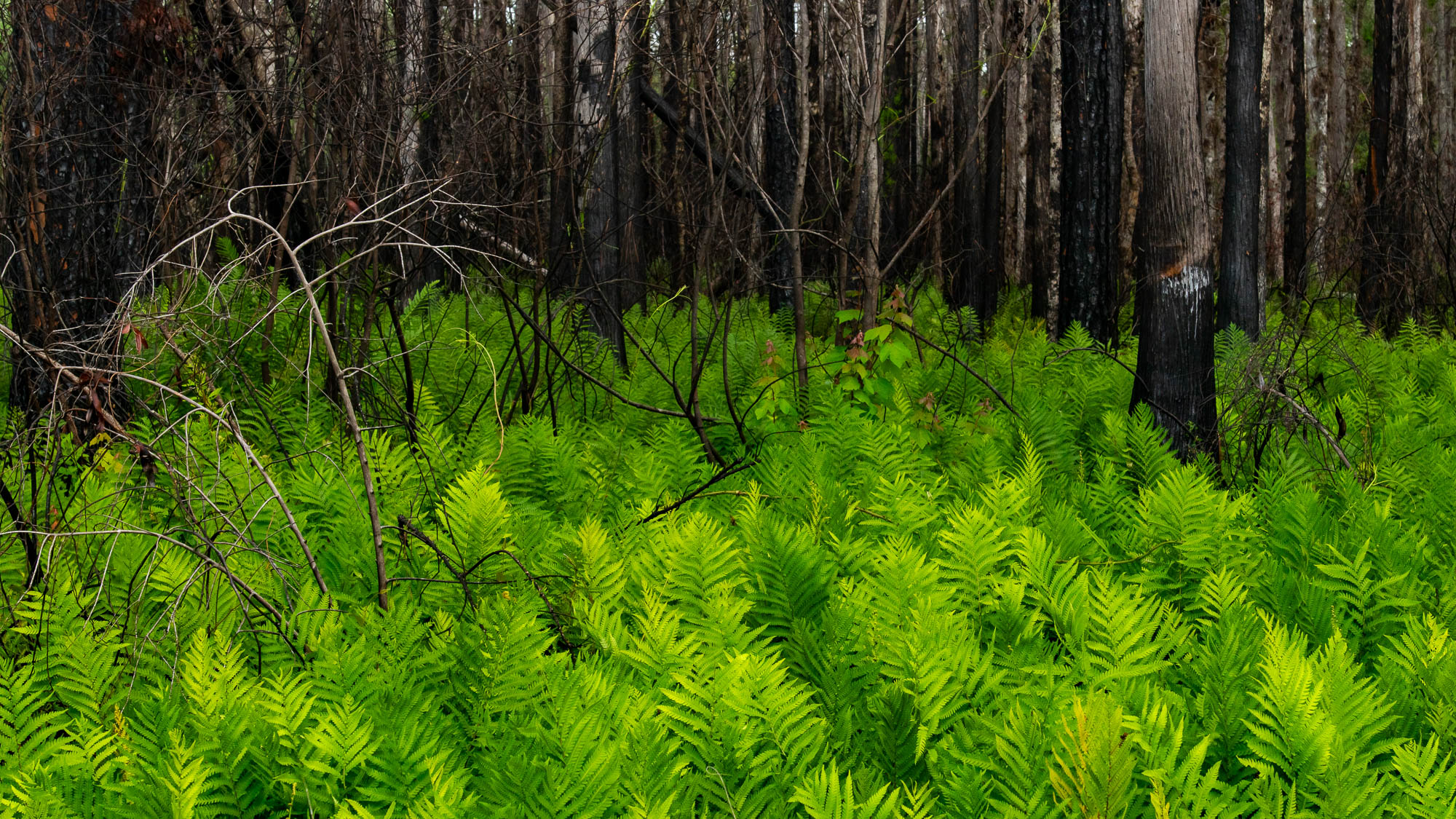
Pre-dawn mist which had settled into depressions appeared as little ground-clouds across the vast pastureland adjacent to the Green Swamp. Morning flights of White Ibises were landing among the browsing cattle hoping for breakfast to be hopping and crawling away from moving hooves. Abruptly, now we were driving through what seemed like a tunnel of trees. Mostly long-leaf pines with an occasional bay or hickory and stately cypress standing guard along streams and the Withlacoochee River.
Transitioning from paved to unpaved road meant slowing down. Speed. There has to be a metaphor for living our lives in there somewhere. The effect of barely moving forward along the old logging road was immediately rewarding. Ubiquitous Spanish Needle, little “fried-egg” blooms of Oakleaf Fleabane, “non-flowers” of large patches of Starrush Whitetop – would we have noticed any of these at “highway speed”?
Our feet are immediately soaked by dew clinging to grass and plants and we strain to remember our science lessons of how dew forms. Humidity, condensation, transpiration, radiation. My head hurts. Our biggest question is, if there is so much dew this morning, why has it not rained in a couple of months? Central Florida is having its driest spring in almost ten years.
We need rain.
Gini. Beautiful brown eyes and incredible hearing. (Okay, she cheats. She retains that “Mom Hearing” trait where she could hear our kids, and me, clearing throats or whispering two blocks away.) On this beautiful morning, she ticks off songs, calls and scoldings of myriad unseen avian audiences. Brown-headed Nuthatch, Tufted Titmouse, Carolina Wren, Northern Parula, Blue Jay, Eastern Towhee, Red-bellied and Downy Woodpeckers. (None of the songsters posed for pictures today.) From deep in the forest a Barred Owl was loud enough even I could hear it.
With no rain, we were not certain what to expect in our search for spring blooms. The swamp provides ample satisfaction every time we visit. Today was no exception.
We reveled in the power of the flower.
Bees love the lemon-yellow flowers of the Fourpetal St. Johnswort (Hypericum tetrapetalum). So do we. The plant is almost endemic to Florida with it also being reported in a couple of counties in south Georgia.

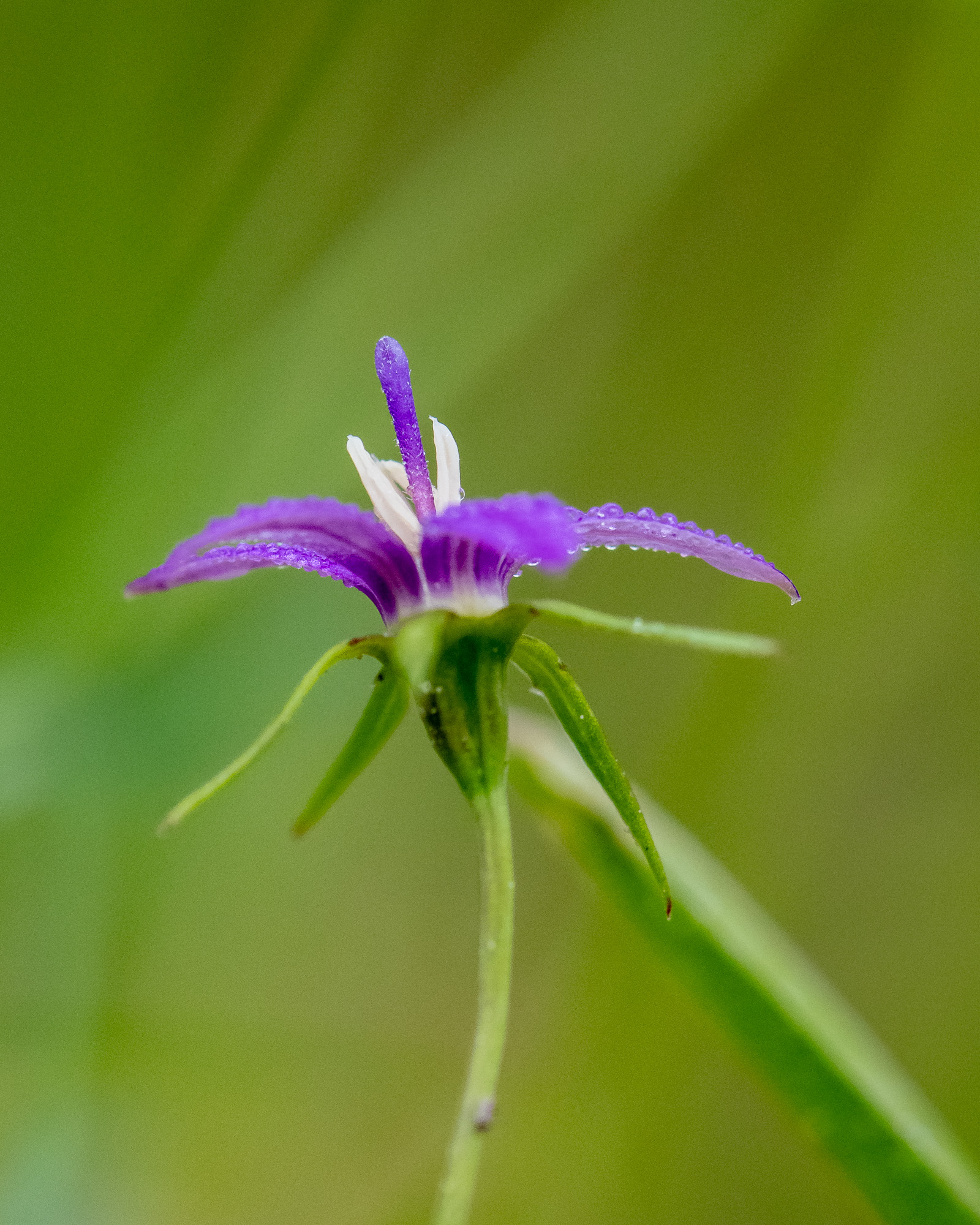
Small and delicate, the Florida Bellflower (Campanula floridana) is found only in Florida. We think it’s beautiful from any angle.

So nice the state couldn’t make up its mind. In 1991, they decided to name the entire species of Coreopsis as Florida’s state wildflower. This one, Leavenworth’s Tickseed (Coreopsis leavenworthii), is near endemic to the Sunshine State and we love its wispy attitude.

At first glance, the Starrush Whitetop (Rhynchospora colorata) looks like a white flower with green-tipped petals. It is actually a sedge and quite common in ditches and low damp places.

Although we saw a few different species of butterfly, by far the most abundant today was the Phaon Crescent (Phyciodes phaon). In Greek mythology, Phaon was an old and unattractive boatman. According to myth, he ferried Aphrodite a long distance, but would not accept payment. As a gift, Aphrodite gave him back his youth and made him beautiful.

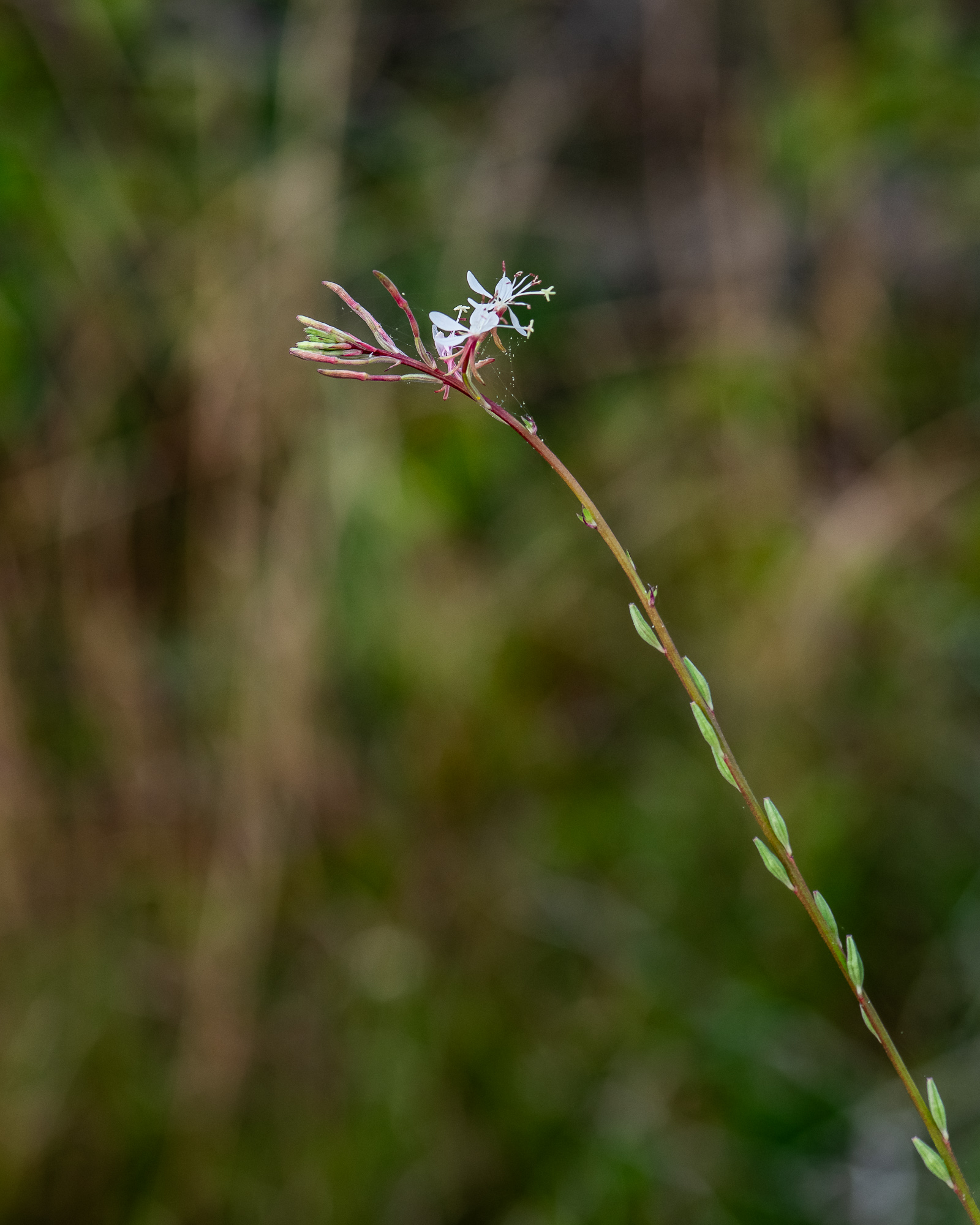
Southern Beeblossom (Oenothera simulans), the plant formerly known as Gaura angustifolia. Taxonomists just want to have fun. This lovely bloom opens when the sun sets and begins to fade the next day. Nighttime pollinators appreciate the all-night nectar bar.
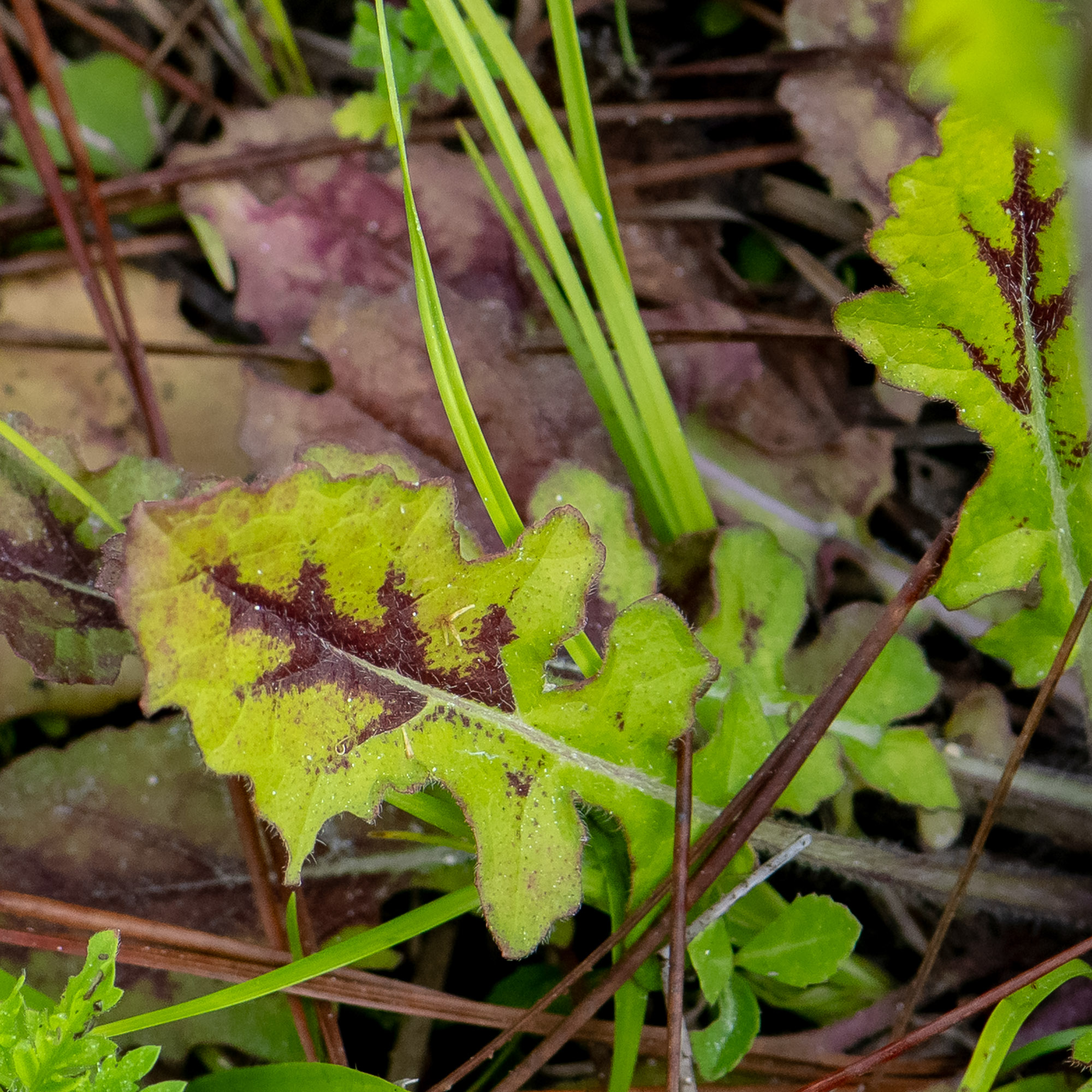
Lavender to bluish blooms attract a variety of insects, as well as those of us who appreciate stuff that is just nice to look at. The Lyreleaf Sage (Salvia lyrata) is, fortunately, abundant in the swamp/forest. Basal leaves help identify the plant even when blooms aren’t present and their shape is how it gets its common name.

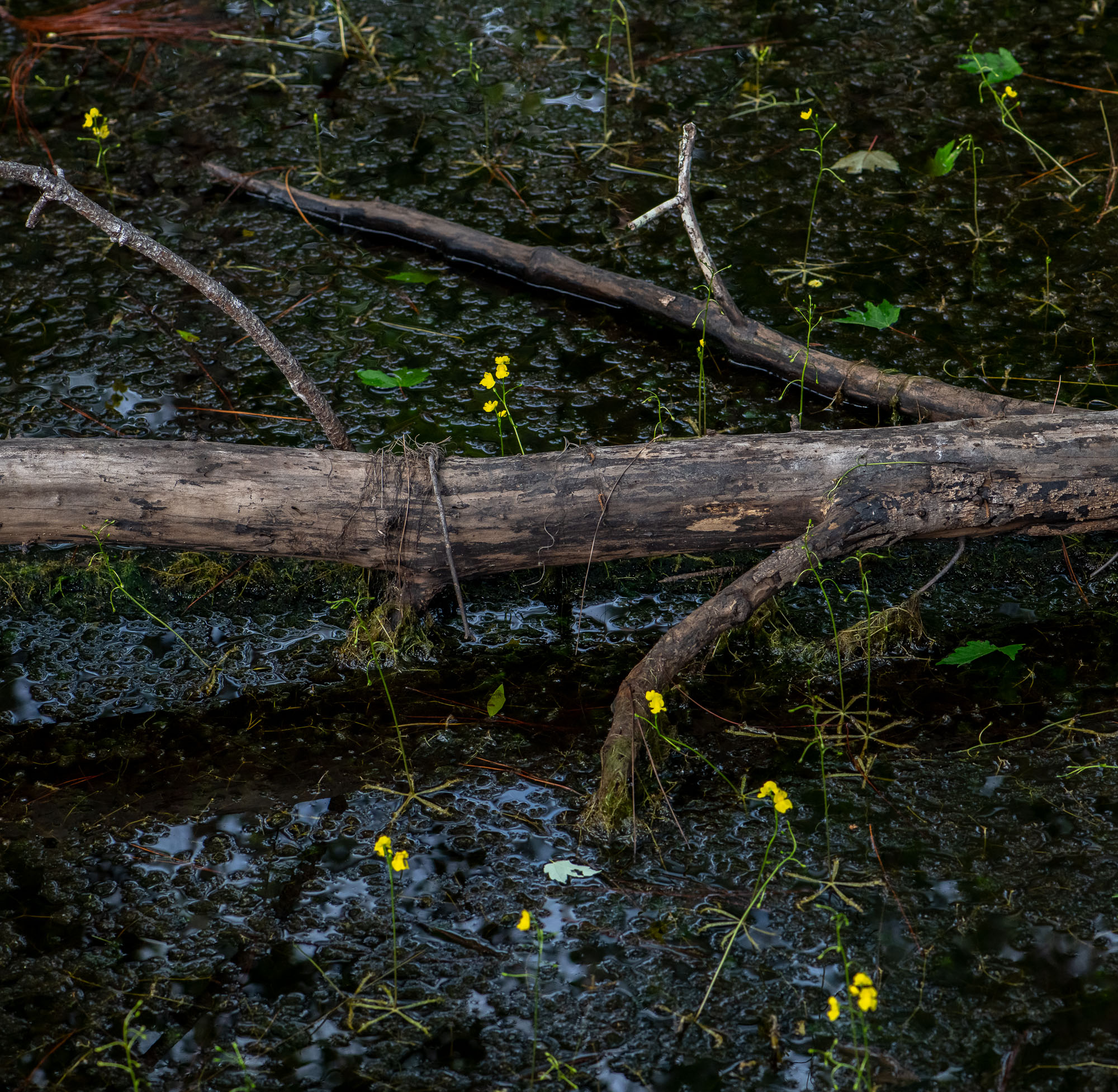
Looking like little alien creatures atop the water, the Swollen Bladderwort (Utricularia inflata) has attractive yellow flowers and really neat “feet”. These carnivorous plants float innocently along until a little fishie or shrimp thingy touches those “feet” and then – “gulp” – gone.
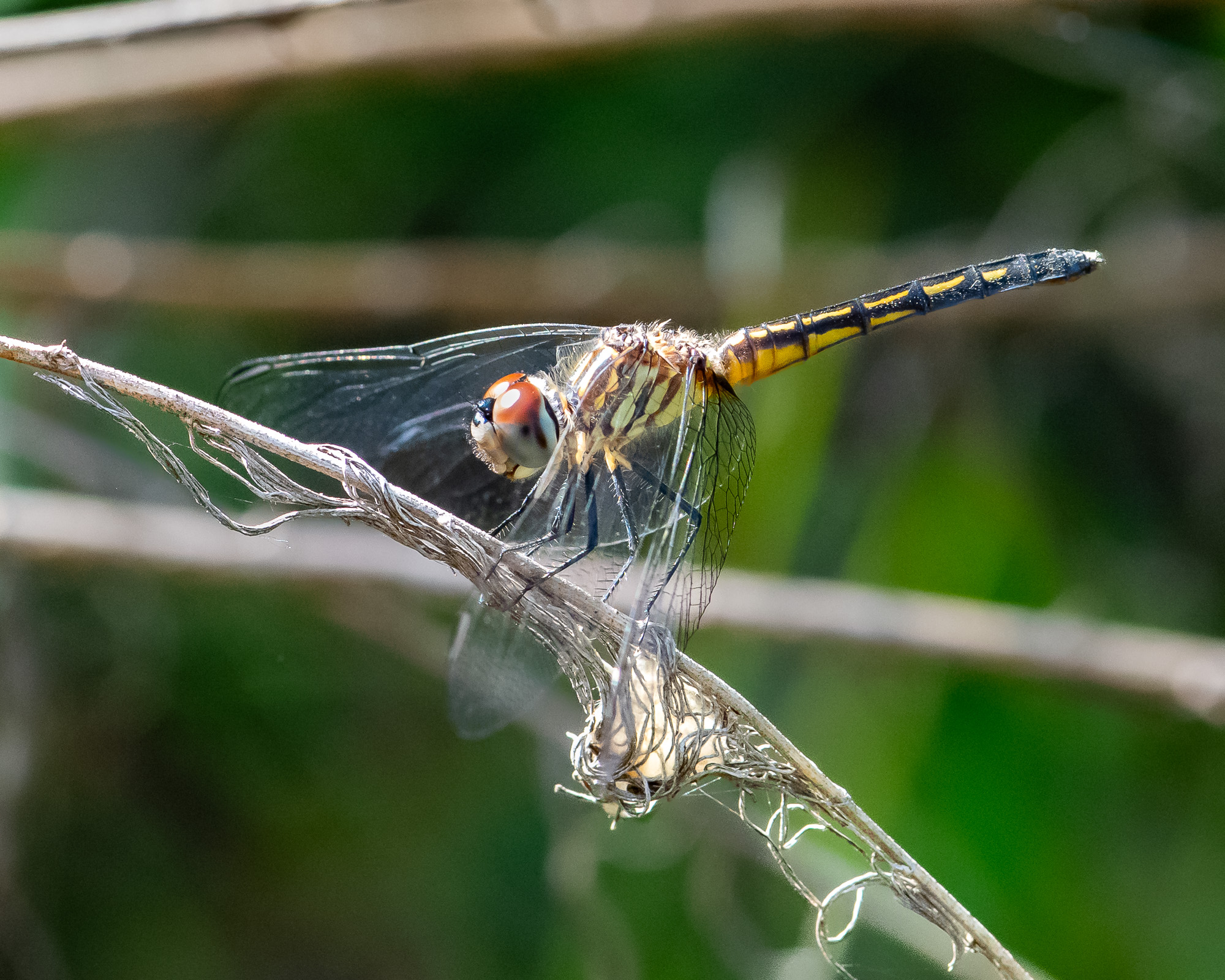
A very common dragonfly throughout central Florida, the Blue Dasher (Pachydiplax longipennis) is small and quite handsome. The male sports a slate-blue abdomen while his mate prefers the more sporty gold-with-racing-stripe look.

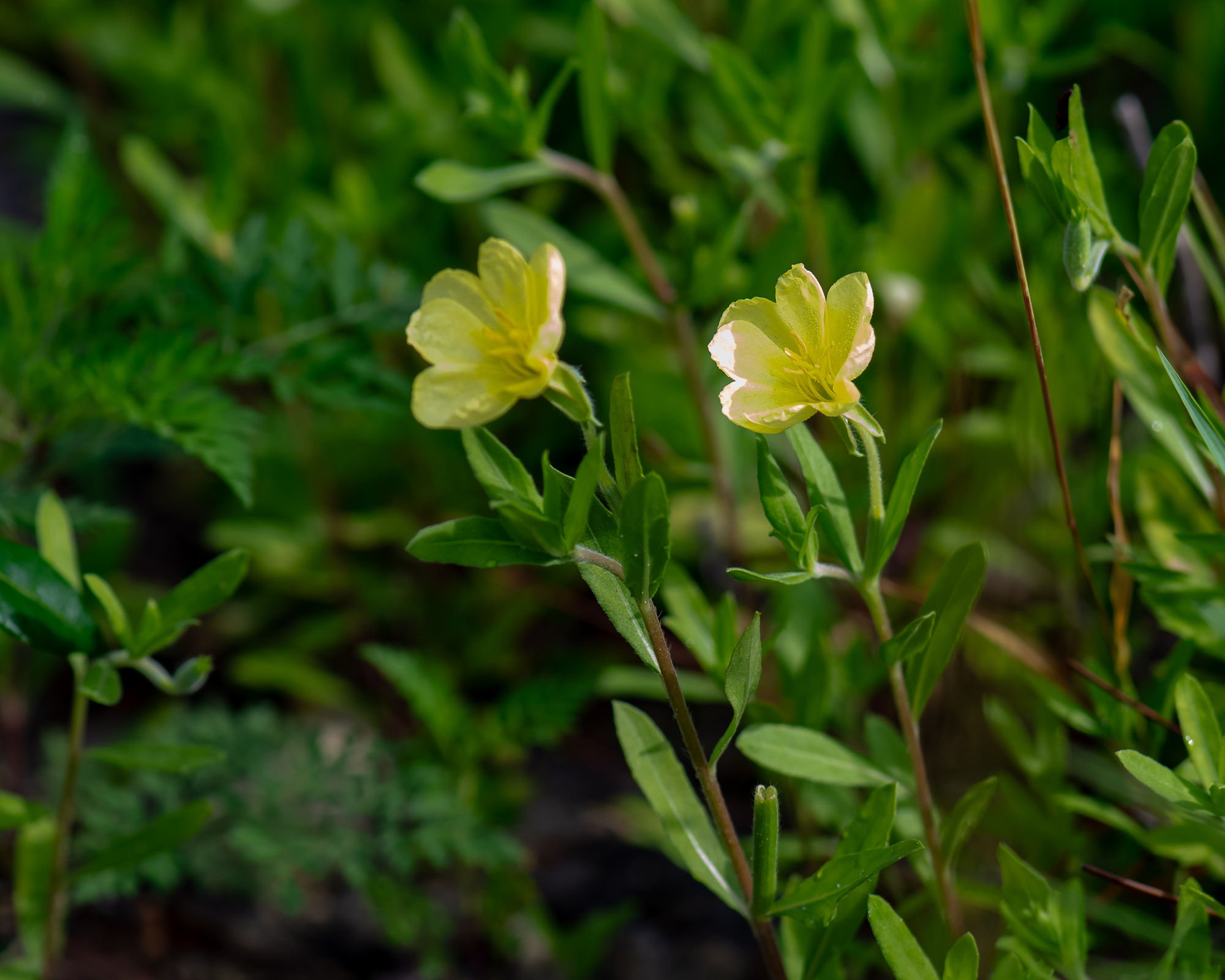
Another night-bloomer, the Cutleaf Evening Primrose (Oenothera laciniata) has delicate four-petal flowers. Thankfully, the blooms remain open for much of the morning so those of us who don’t spend the night in the swamp too often can enjoy them.
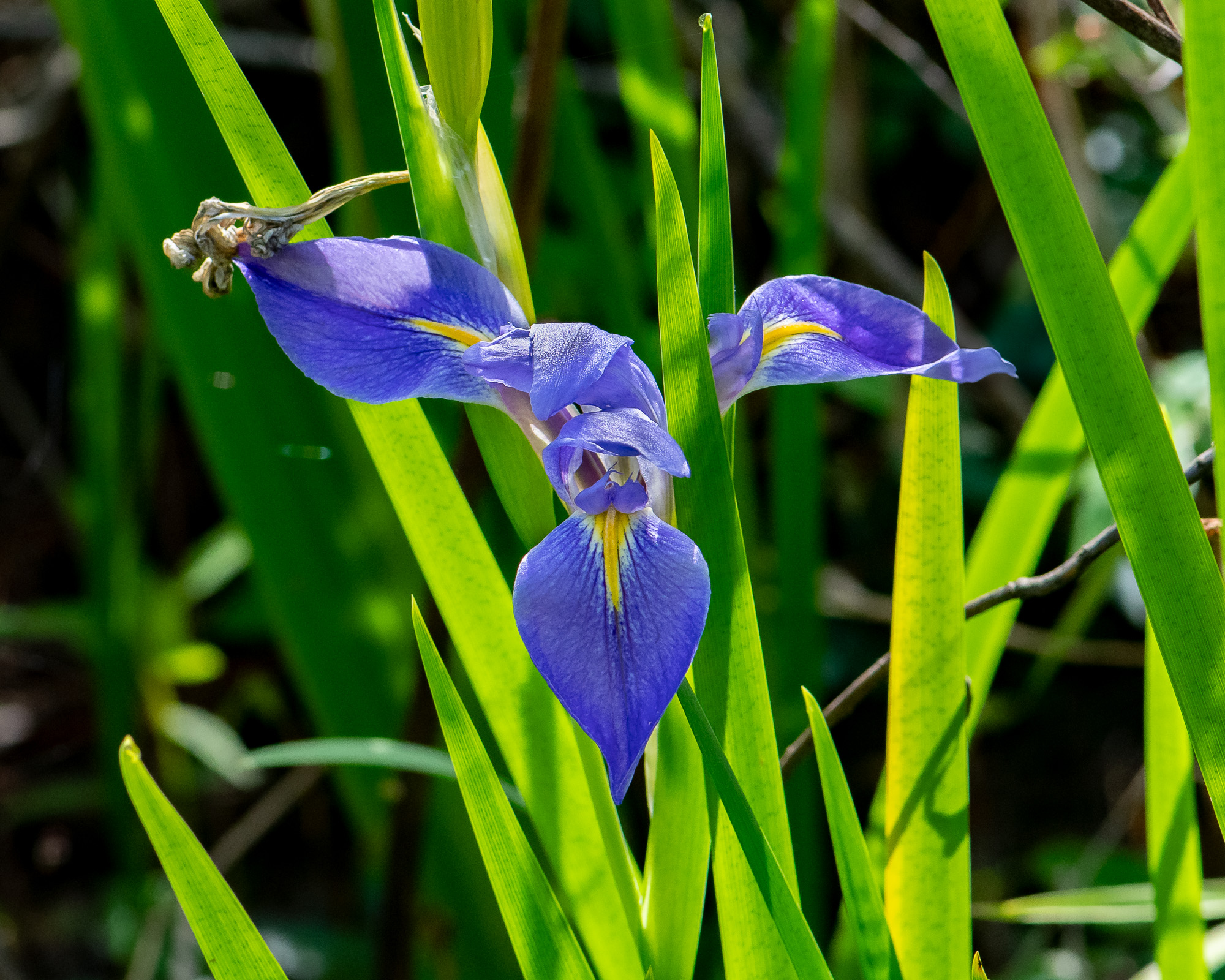
Speaking of taxonomy. One could get dizzy trying to track down Iris identifications. We’re going to call this one Savanna Iris (Iris savannarum). It is also commonly referred to as Prairie Iris. It is also easy to go down a rabbit hole when you try to get agreement on a scientific name. No matter. It is, quite simply, one of the most attractive flowers in our spring landscape. The Green Swamp is awash in purple today.
NEW BUG ALERT! We are not the only ones attracted to the attractive Iris. Ever have that feeling you’re being — watched? In this case, by eight eyes. This colorful jumping spider, Phidippus princeps pulcherrimus, apparently has no common name. That color against the nice green of a Savanna Iris stem certainly stood out.


Thistle Time!
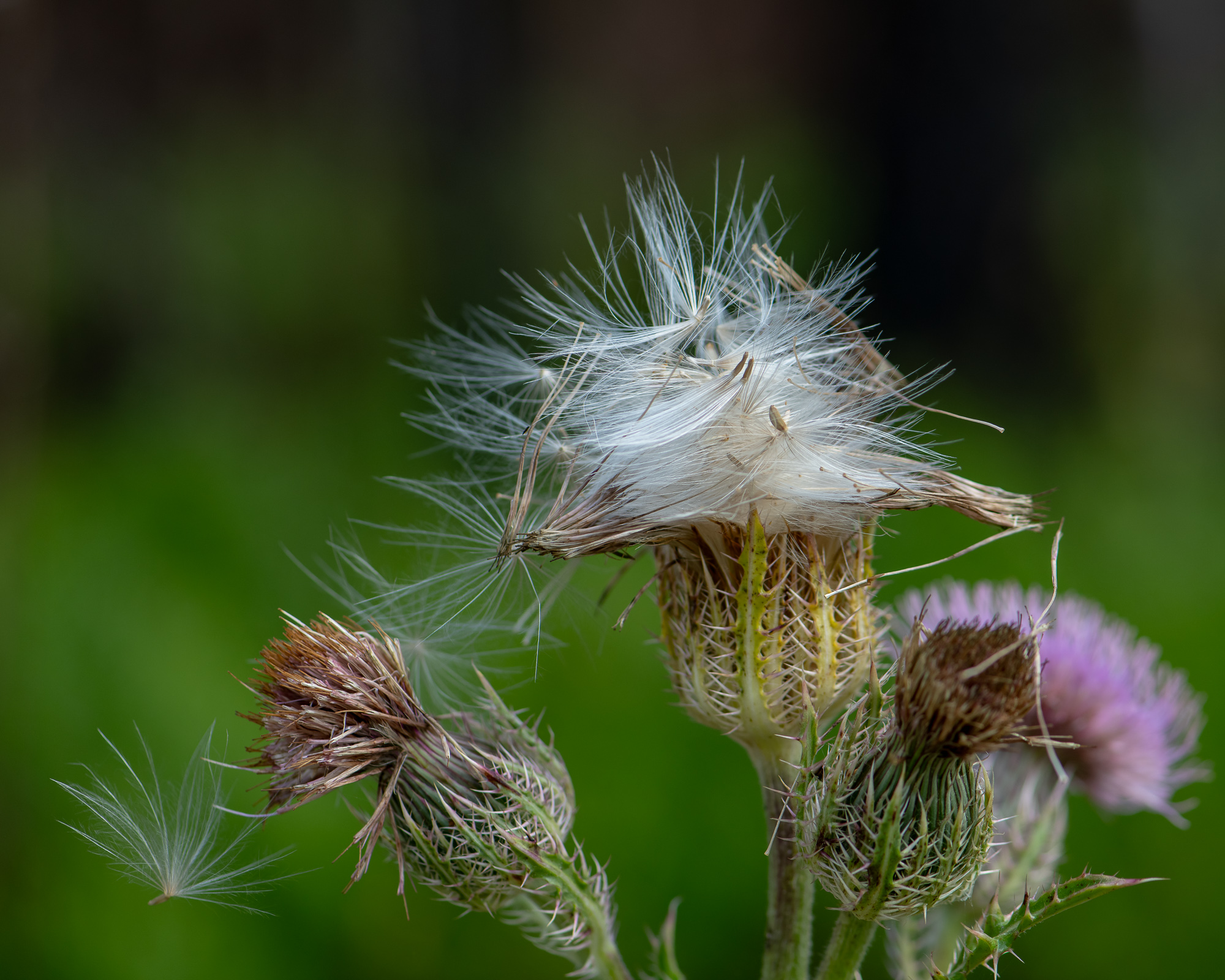
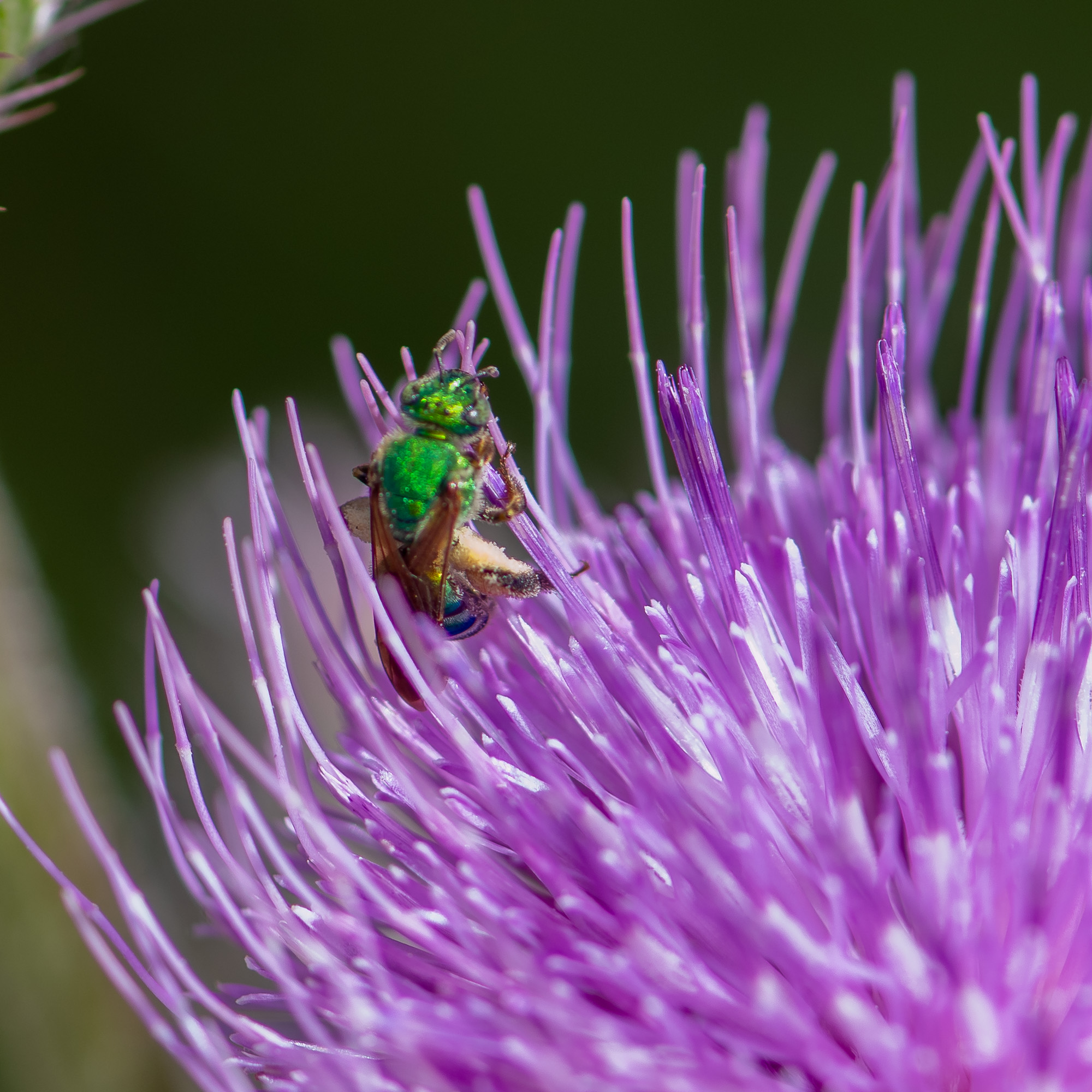
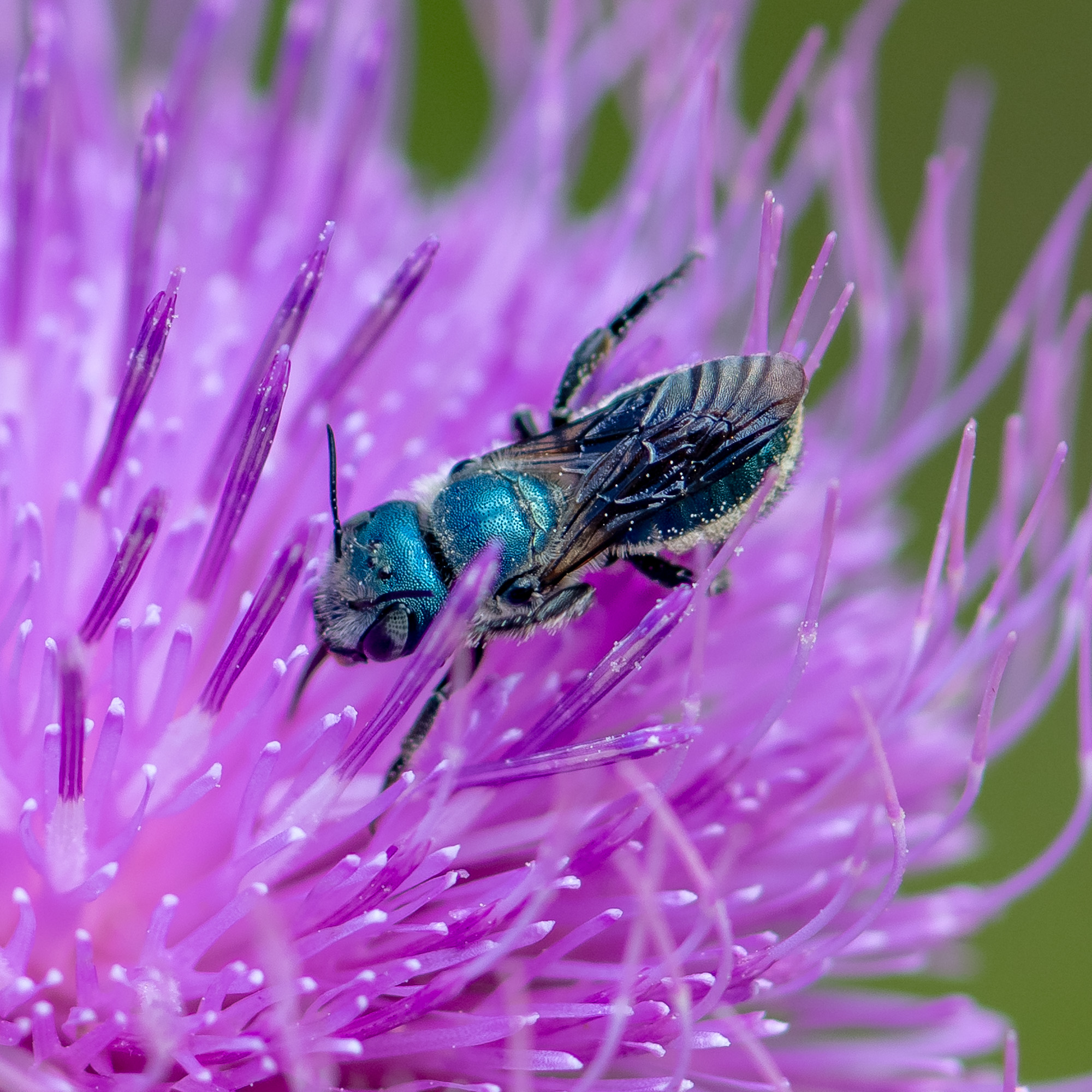
Spring in the swamp means thistles. Today we found a terrific number of Purple Thistle (Cirsium horridulum). Which, as we all know, can also be called Bristle Thistle, Yellow Thistle, Horrid Thistle, Spiny Thistle or Bull Thistle. Pollinators (and, to be honest, us, too) simply don’t care what it’s called. It’s pretty and, apparently has delicious nectar once you get past the thorny things.

Thistle lover. Brown-winged Striped Sweat Bee (Agapostemon splendens).

Another lover, of thistles. A Mason Bee (Osmia chalybea), with no apparent common name.
Our spirits were definitley improved today through the astounding magic of flower power. All that and there shall be a Part II, coming soon to a blog near you.
Enjoy your search for a natural place and come back for a visit!
 Our Natural Places
The Mason Bee and the Phidippus princeps pulcherrimus spider are amazing. I wonder if you used a tripod for these.
LikeLike
For these, no. Macro lens, hand held.
The jumping spider kept moving to the opposite side of that stem. I got dizzy chasing it. Not to mention I realized I was walking around in ankle-deep water where I’ve seen Cottonmouth Moccasins residing. Fun!
LikeLiked by 1 person
Oh how I enjoyed this swamp walk, Wally. Your photos and descriptions are wonderful with the wildflowers, insects, and interesting carnivorous bladderwort of the Florida landscape. I especially loved seeing the close-ups of the thistle and thistle lovers.
LikeLike
Your kind remarks are really appreciated. The very belated Part Two is now available at a blog site near you. 🙂
LikeLike
It was great talking with you earlier, but man, I really miss our living in a Longleaf pine forest! Of course, I know that wouldn’t stop you and Gini. Buck and I just need to get out there and find some new woods to enjoy. Meanwhile, the pond life is plentiful and great fun to watch. But, wow, your wildflower photos — so lovely — and I think , after the incredible new spider, the prehistoric woodpecker is probably my favorite photo. As always, your writing stitches it all together into a beautiful tapestry. Love you both!
LikeLike
I totally understand the feeling you must have, like a hole in your soul, being away from that incredible paradise. Keep looking. There are others out there waiting to be discovered.
With all that’s going on, it will be awhile before we get back to any sort of expoloration schedule (of course, we never had one to begin with). Hopefully, we’ll all continue to improve our health and maintain our worldview through our rose-colored glasses.
Talk to you soon. Love you.
LikeLiked by 1 person
Greetings Wally! Your flower knowledge is always outstanding – I have the Dandelion down…beyond that it’s given the very descriptive moniker “plant”. I know I’ve said it before, but I do like that Florida Bellflower. The spider is really cool – I like the color pattern on it and will keep that in mind for my next Spider prop! Good to hear from you again – both of you take care.
LikeLike
I’m thinking a 20-foot tall version of that jumping spider would be just the thing! With glowing eyes and iridescent fangs.
Hope all is well with you. We are still a few weeks away from returning to our exploration efforts.
LikeLiked by 1 person
I like the way you think Wally, a haunter at heart. As far as health goes I am pretty sure I am heading back to surgery..first have an MRI next week to confirm the ankle is toast
LikeLiked by 1 person
Wally, it is so good to hear from you again! I’ve been counting the weeks since you last wrote, and trying not to be a worry-wort… whew!
Your spiders and bees are lovely, and I’ve actually been trying to find and carefully watch jumping spiders – they are fascinating. But I have to admit the star of your show for me was the Swollen Bladderwort. What an ingenieous plant. I’ll be looking it up and reading more about it.
Take it easy, rest and relax and strengthen. I’m looking forward to the next installment!
LikeLike
Thank you so much for your positive comments, Sam. We really appreciate it.
Looks like at least another 3-4 weeks before we can get back at it. We are not very patient.
Hopefully, I’ll soon find some of those bladderworts that are not so far away. The flowers are lovely, but small.
Typical of most subjects in nature, when I go looking for a jumping spider, none are within 20 parsecs. Then, boom – here’s an orange one peering at me from a lovely iris stem. Go figure.
More flowers almost ready to bloom —
LikeLiked by 1 person
Fantastic confirmations that Spring has arrived and is doing quite well. Thanks for sharing Gini and Wally.
LikeLike
We missed the “April Showers” but, happily, found plenty of “May Flowers”.
Hope all has been well with you. Will try soon to catch up on your posts.
LikeLiked by 1 person
What a pleasure to see the results of your latest foray into a natural place! I was thinking of you this weekend, when large flights of dragonflies began appearing. Given that our rains have encouraged the mosquitoes, the dragonflies were a welcome sight. It’s a shame that you’re lacking rain; when it arrives, I hope it comes without a name.
In the past few weeks, I’ve posted photos of the lyreleaf sage and starrush whitetop, and I’m processing some thistle photos: a nice reminder of how many species we share. I was quite taken with your photo of the Florida bellflower. I noticed for the first time last night that our Venus’s looking glass also has a lavender pistil and white stamens; the deeper colors of your bellflower are even more appealing to me.
But that spider! It’s just wonderful, although I never can resist a metallic bee. There’s no doubt why splendens was applied to this one! Thanks for sharing your splendid day; here’s to many more!
LikeLike
Unexpected challenges have been like speed bumps along life’s road this year. We have both recovered nicely from heart rearrangements. One more hurdle to negotiate (at least this one was planned for), and we shall once again plunge the depths of forest and swamp. Soon, we hope.
The area where we find the Bellflower is also home to Venus’s Looking Glass. It would be neat to photograph them growing together.
That adorable spider was a special treat. And you’re right, metallic bees grab our attention immediately.
Yay! It rained and the land took a great big sigh of relief.
LikeLiked by 1 person
Never doubt the power of a proxy raindance! Glad you moistened up.
LikeLike
You may dance for us any time.
LikeLiked by 1 person
Glad to see you’re being yourselves and still getting out in nature.
My morning mind wanted to read pastureland as pasteurized land. Pasteur and pasture in fact have a close etymological relationship. And speaking of names, the lack of a common one for that orange jumping spider comes as a surprise, given how conspicuous and attractive it is. And again speaking of colors, those little green sweat bees are always a pleasure to see. I don’t know that I’ve heard of mason bees, but the blue of the one you closed with is also appealing.
Florida shares Cirsium horridulum, Pachydiplax longipennis, Salvia lyrata, Phyciodes phaon, and Oenothera laciniata with Texas.
LikeLike
Good Morning, Steve.
We are still not back into our “normal” exploration routine but hope to have a “summer restart” soon. In the meantime, we’ll sneak away every chance we get.
That adorable spider is a sub-species of a relative with a common moniker, Grayish Jumping Spider (Phidippus princeps). Perhaps this one just prefers the more distinctive Latin rather than being called “something related to gray”.
We’re happy to share as much as possible with the Lone Star State.
LikeLike
Beautiful shots of the flowers but those spider shots are amazing!
LikeLike
Thank you Dina.
Pardon the pun, but the color of that little spider really “jumped” out at us.
LikeLike
Wonderful photographs and amazing shots of insects. Especially the Mason Bee!
LikeLike
Thank you very much for the very kind comments. Welcome to Our Natural Places.
We have been absent from Nature and blogging for a few months, but we will hopefully be resuming our exploration soon. You are welcome to come along with us any time!
(Your blog looks incredibly interesting and I’m looking forward to reviewing your posts.)
Alles Gute für den Tag.
LikeLike
I am so happy to see a new post from you this morning. I just wrote a post and featured the thistle! I always learn more about wildflowers from you. Thanks for sharing your research! And a jumping spider…oh my….don’t like the sound of that but it’s beautiful, if a spider can be beautiful. Glad to hear you could both get out and enjoy nature! Take care! Hugs for you both!
LikeLike
We were just glad to get out for awhile. A few more weeks and we should be outside more than inside. A good thing.
Love seeing thistles because so many critters seem to hang around them. They’re mighty pretty, too. If you find a jumping spider, try to watch it for as long as it will allow. You’ll soon find yourself wanting to find more of them. They are adorably addictive. (And not harmful in the least.)
Now that we’ve had a bit of rain, the humidity should kick in any time now. Oh, here it is now!
LikeLike
Great to see you out and about enjoying your floral joys. However I must throw in a trump (not that one) card, we are having our driest spring for 69 years!
Like you I now have to rely on ‘she who must be obeyed’ to tell me about birdsong. This last year has seen my range decrease rapidly, yet I can hear a car engine on a road a mile away!
LikeLike
Thanks, Brian. It’s great to be able to be out and about for change. Hope to be getting back into it in a few more weeks.
Good weather news here. We had good soaking rains over the past few days. Hope your dry spell well end soon as well.
I found out the military will pay the full cost of testing and providiing hearing aids, so maybe I’ll be able to hear the small singers again soon.
Take good care.
LikeLiked by 1 person
Oh what a beautiful morning, oh what a beautiful day.
Thank you so much for sharing some of the beauty and wonder that surrounds you.
LikeLike
Good Morning, EC! Gini and I hope all is well Down Under and that you are feeling good today.
It’s been a challenging year so far but we think we see a light at the end of the tunnel. Just hoping it’s not another train, like the last several have been!
We will share a few more flowers and bugs and things in a day or two.
LikeLike
It’s nice to know that you two are still enjoying your natural places with their beautiful denizens.
Dew gives us wet shoes and socks but transforms the bedewed plants into glittering gems.
Even for someone with a slight residual case of arachnophobia, your little arachnid is quite attractive.
Take care,
Tanja
LikeLiked by 1 person
Thank you, Tanja. We’re hoping to be back to our regular roaming soon. Another month, maybe.
That spider was a fun find. I spent quite awhile walking around to find a better angle and it just hung around peering at me with all those eyes. All animal subjects should be so nice!
LikeLiked by 1 person