Happy New Year!
(Yes, we’re late to the party but we hope you are all well into living your best life as a new year brings so many new opportunities. Gini and I are both recuperating well. However, our rehabbers are not ready to release us back into the wild just yet. Soon! In the meantime, please enjoy a few images from a trip we made on September 11, 2024.)

(Click on images to enlarge, click again to zoom.)
Many of our posts are from exploring an area just northeast of us within the vast Green Swamp, the Richloam Wildlife Management Area. This tract is one of several which make up the Withlacoochee State Forest. The Withlacoochee River is one of Florida’s major rivers and has its source within the Green Swamp. A smaller tributary, the Little Withlacoochee River runs through the Richloam WMA.
This tract consists of over 58,000 acres where pine flatwoods with scattered oak hammocks, bottomland hardwoods and cypress swamp are the main natural communities. On this date, we were treated to displays of fall flowers and a nice variety of birds and insects.
We hope you enjoy the morning sights as much as we did.
Scanning the open areas early in the morning reveals an abundance of spider webs. This large net was built by a Golden Silk Spider (Trichonephila clavipes). Also known as a Golden Silk Orbweaver, this female has captured some sort of flying insect and is wrapping it in silk. It will then be stored near the center of the web until she’s ready to eat. The male of the species is much, much smaller and keeps his distance until she tells him he is needed. He hopes it will not be as an hors d’oeuvre.

One of our favorite flowers often found at this location is the Skyflower (Hydrolea corymbosa). The incredibly blue blooms really do seem to mirror the bright sky overhead.

At first, a Tufted Titmouse seemed content to watch us as if trying to figure out what we were and whether we might be a threat. Soon, his instincts kicked in and he started the incessant alarm call to alert the neighborhood to our presence. Tattletale.

This is an immature Eastern Lubber Grasshopper (Romalea microptera). Based upon the length of its wings, it will soon be an adult. When mature, these large grasshoppers can be yellow/orange, brown or all black.

Widespread in wet areas, the dimunitve flower of Virginia Buttonweed (Diodia virginiana) appear like small stars scattered throughout the swamp.

Another large spider of the early morning is the Red-femured Spotted Orbweaver (Neoscona domiciliorum). Often, the female will dismantle the web after sunrise and rebuild it at dusk.


Around the edges of the pine flatwoods, trailing vines of Spurred Butterfly Pea (Centrosema virginianum) show off their lovely lavender flowers. This is a host plant for several species of butterfly.

You’re just walking along, enjoying the outdoors and you have that “feeling” someone is watching you. Amazing how these large swamp lizards can blend in as they lay mostly submerged in a small pool. American Alligator.

With fall flowers come fall butterflies. Sleepy Orange (Abaeis nicippe) on Winged Loosestrife (Lythrum alatum).

Once upon a time, the tobacco industry used the leaves of the Vanillaleaf (Carphephorus odoratissimus) to flavor some products, especially pipe tobacco. The advent of artificial flavoring curtailed the harvest of these wildflowers. More for us to enjoy.

It’s always exciting to see a spot of bright color among the browns and subtle greens of the pine flatwoods. Pine Lily (Lilium catesbaei), also known as Southern Red Lily and Catesby’s Lily, provides that excitement each time we spot one.

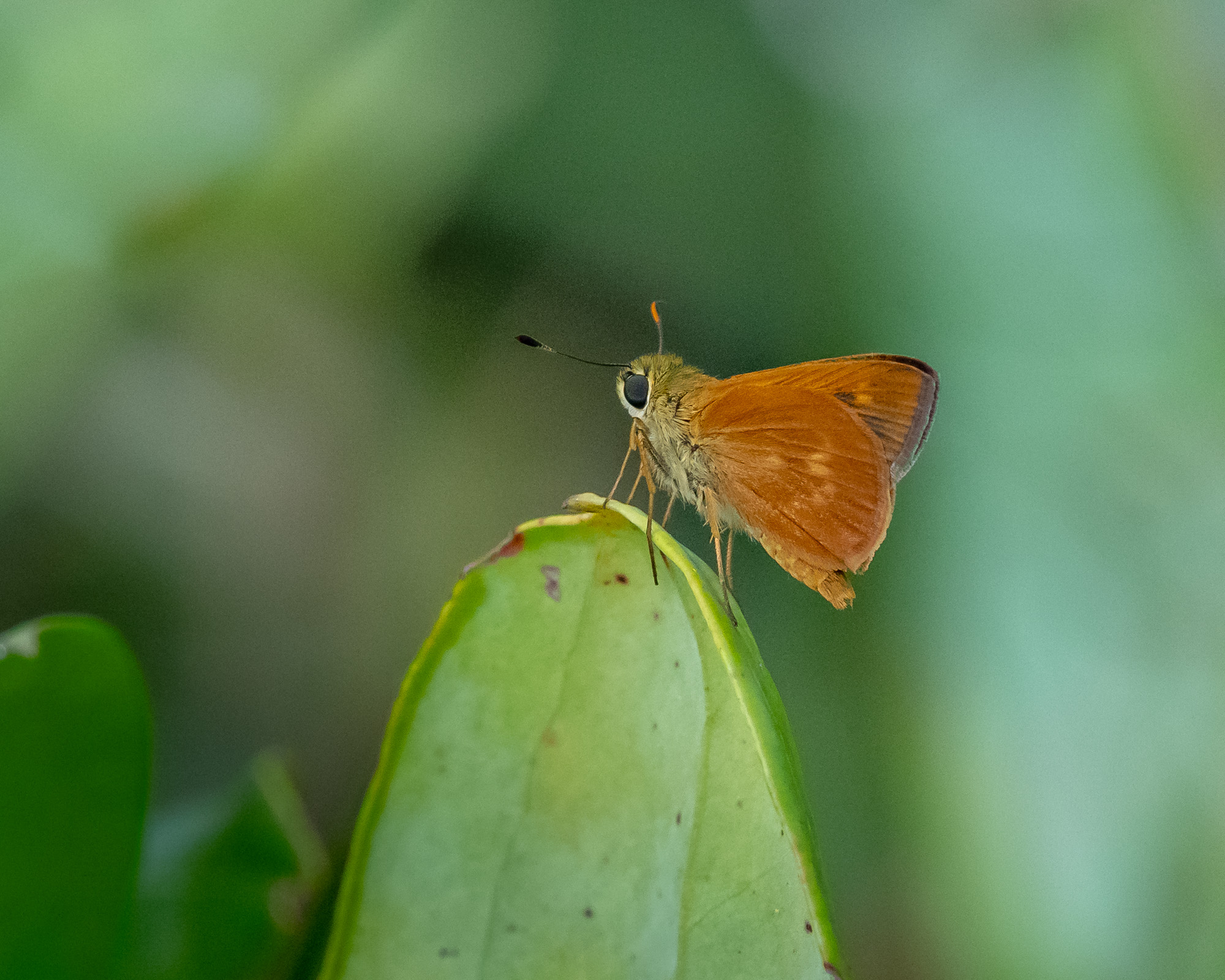
Part of the large butterfly family of Grass-Skippers, a Southern Broken-Dash (Polites otho) shows a bit more contrast of brown and orange than many of its cousins.

Pink and yellow together make quite a pleasing combination. Cloudless Sulphur (Phoebis sennae) on Purple False Foxglove (Agalinis purpurea).

Velvety leaves and pretty pink flowers don’t really come to mind when thinking of this plant’s name: Tall Elephantsfoot (Elephantopus elatus). Supposedly, the common name stems from the shape of the large basal leaves (which I failed to photograph). I need a better imagination.

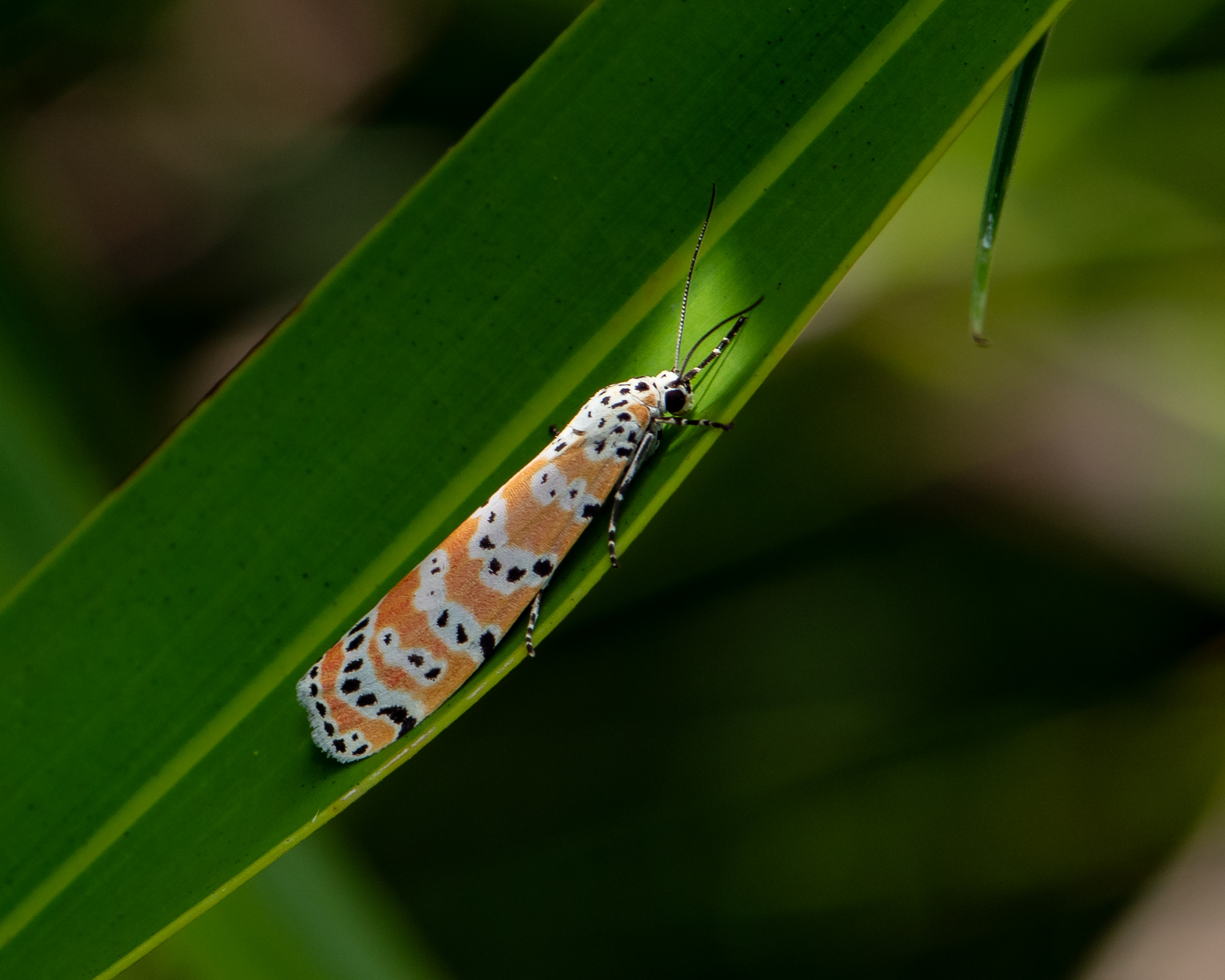
A moth which works the day shift. My kind of moth. Not to mention it’s not too bad in the looks department. Ornate Bella Moth (Utetheisa ornatrix).
I know. It’s not yellow. We are not in Carolina. Those crazy botanists. No matter what it’s called, Carolina Yellow-eyed Grass (Xyris caroliniana) is delicate and wonderful to behold. We’ll try to find an actual yellow variety soon. But we still won’t be in Carolina.


One of our smallest dragonfly species, the Little Blue Dragonlet (Erythrodiplax minuscula) remains close to the ground. If they don’t move, good luck in seeing one.

We had a terrific time exploring this section of the state forest. Four weeks after our visit, Hurricane Milton marched across this area with 100+ mph winds and over 20 inches of rain in 24 hours. We are anxious to head out there and see how it is recuperating. Just as soon as we – recuperate.
Enjoy your search for a natural place and come back for a visit!
 Our Natural Places
I always enjoy your photographs, except the spiders! I have not been in a very photographic mood as of late, but we are finally in a warmer climate and we are hitting a National Park tomorrow so I am hoping we get out with our cameras!
LikeLiked by 1 person
Warmer sounds better! Hope you see some great sights and are able to relax along the way.
Just walk on by those spider webs.
LikeLike
It’s wonderful to hear from you and know you are both on the road to recovery. We really do suffer together when we’ve been married for so many years. I love the photos of the small flowers and critters you see when you stop and take the time to look. And yes, I do believe someone is watching you when you do! lol Take care and take it easy! Hugs to you both from a little bit North of you, Diane
LikeLike
Thank you very much, Diane. Yep, 57 years together and we’re pretty inseparable, in so many ways.
Appreciate the gentle hugs.
LikeLike
Beautiful shots! Take your time to rest. You’re not missing much lately since it’s been so cold.
LikeLike
Thank you, Dina.
Happy to see the sun and 70+ temps today!
LikeLike
With apologies to poet Robert Browning and his Pippa’s little song:
“The year’s at the spring,
And day’s at the morn;
Morning’s at seven;
The hill-side’s dew-pearl’d;
The lark’s on the wing;
The snail’s on the thorn;
Wally and Gini are back in their swamp;
All’s right with the world!”
OK — maybe your being back in the swamp is only metaphorically and in retrospect at this point, but that’s a great first step!
I’m completely entranced by the white yellow-eyed grass. If I’d come across one, I would have assumed it was a natural variant, not a different species. I need to see if ‘yours’ might also be ‘ours.’
Initially, I was confused by your Ornate Bella Moth. Both the common and scientific name were different from what I remembered for one of our common moths, which I thought was the same as yours. Not so! The one I’ve found is the Ailanthus webworm moth (Atteva aurea), which has roughly the same shape and colors, but a different design.
That view from above of the Southern Broken-dash could be an O’Keeffe painting, especially the wings. Can’t you imagine it on a 6’x6′ canvas?
LikeLike
I don’t care what Mr. Browning thinks, I like your version best.
I have some photos of the yellow Yellow-eyed grass but am hoping for finding the two together.
A pretty pink and white moth which is active in the daytime is a moth I like.
Trying to envision an image of that butterfly of that size has overwhelmed my imagination. More coffee shall be needed.
LikeLike
Good to hear you will soon be released back into your natural environment. Spring is coming and adventures await.
LikeLike
Thanks, Brian.
Yep, our back yard is filled with migrants as we speak. (Avian types, that is.) Shouldn’t be imprisoned for much longer.
LikeLiked by 1 person
Good Morning Wally and Gini. Here’s wishing you a belated Happy New Year for 2025.
We are well enough, just sick of our alternating endless days of grey skies, rain and wind. This is a very long winter. Once in a while we see a glimpse of sunshine that simply reinforces our desperation to return to Greek sunshine. May 5th for 19 days we’re on countdown.
It’s good to hear that you are both in recuperation mode and luxuriating in the Florida sunshine.
My blog has taken a back seat while we spend time together, concentrate on family matters, trying to keep warm whilst looking to the stock market to pay for our extended holidays. On the few days I have managed to get out and about I have some new pictures that I hope to share very soon.
Wow, What a speech from Donald. We watched it all. Inspiring, positive and full of promise, all the things that our politicians are not. Hopefully some of his ideas and policies might be adopted over here but don’t hold your breath. I really do believe that they are in thrall, maybe even the pay of China.
All the best from what is left of Britain. Enjoy your days.
LikeLike
Happy Tuesday, Phil.
We feel like we have been in limbo for the past two months. Sunny skies have finally returned and warm days are straight ahead.
Taking care of what is important should always be our priority. Your faithful crowd will wait patiently for when you’re ready to offer wisdom and images.
President Trump’s second administration is certainly off to a frantic beginning. Just seeing the confused panic of the so-called “mainstream media” has been a joy to watch. Fingers crossed for Britains to demand change just as we did. It can happen.
Heading out to the back yard to peer into the sun. Gini and I send hugs, but gently, please.
LikeLike
Thank you so much for sharing the wonders that surround you. I am sure you are both itching to get back outside but take it slowly please. You matter.
My very best wishes to you both.
LikeLike
No worries, EC. Gini – the one with the common sense – won’t let us do anything too soon.
Hope your days are pain free.
LikeLike
Continued well wishes on the recovery to both of you. Take your time, I know first hand the dangers of rushing things – Brad is always having to tell me to let things fully heal before getting back out there. I have to say, that Ornate Bella Moth is pretty cool. Not one I have seen before “it’s purdy”. We are on the last leg of our Texas migration and should be back in the cold Midwestern tundra sometime next week and can start processing all the tins from the trip. Take care!
LikeLike
We’ll try to be patient but the sun is out and it’s 73 F out there. I may not be able to resist ……
Sounds like your migration south to observe migration has gone pretty well. Anxious to see some details and images. Be safe on the home.
LikeLike
The Ornate Bella moth is my favourite because new to me.
Good to hear that things are getting better. Happy new year and happy new captures to both of you!
LikeLike
We love those moths because of their color and the fact we don’t have to go out at night and search for them like we do other moths!
Love those aerial pictures of the ice!
LikeLiked by 1 person
Thank you very much.
LikeLike
My favorite shot is of the titmouse! They never, ever want to sit still for me, if I get a shot of one, I got lucky! So glad to know you’re both doing well and the rehabbers are getting you closer and closer to being released back into the wild. I’m sure the gators have missed you, as us bloggers have!
Take care, wishing you continued recovery!
LikeLike
The Tufted Titmouse breeds in our area and we usually have a pair nest within the neighborhood. As you point out, they are incredibly active. During migration, these little loudmouths travel in gangs with other species and constantly shout as soon as they see us.
We knew we were missed when we received flowers from one of our local alligators. “Snapdragons”.
LikeLiked by 1 person
Dear Gini and Wally,
Happy new year to you. I hope traveling back in your mind to this tract and reliving your beautiful encounters through your equally beautiful images helped you on your road to recovery.
I definitely enjoyed the vibrant colors and fascinating shapes. The red lily really jumped out, it looks almost too showy for a wildflower.
Heartfelt wishes for your recuperation,
Tanja
LikeLike
Thank you very much, Tanja.
You’re right. Reviewing older photographs of nature’s beauty can definitely help – at least our mental well-being.
We’re both doing very well. Should be on the trails soon.
LikeLiked by 1 person
I’m glad to hear you are doing well. I’m sure you will do even better once you can get back to your natural places.
LikeLike
So according to your rehabbers you’ll soon be re-havers of experiences with wild nature. Your Phoebe on Agalinis is proof that in the world of nature photography, pink and yellow thrills a fellow. And in the world of red, we understand why you get excited each time you spot one of those spotted lilies. Your portrait of the golden silk spider makes clear why the species got christened clavipes, which is to say “hooked feet.”
LikeLike
Most of us who have grown up in Florida claim we only have two seasons: brown and green. In reality, as illustrated, there is quite a range of colors in our environment.
We need to find a way to convince those orb weavers to build their webs parallel to the path instead of across the path. Early morning walks in the flatwoods invariably mean a face full of sticky silk strands.
LikeLike
Now you’ve got me imagining a scientific study to determine what portion of orb weaver webs in an area lie across an obvious path, as opposed to being in other sorts of locations.
LikeLike
I strongly suspect the spiders have been doing their webbing for much longer than humans have been cutting pathways through their homes.
Perhaps we should have a study to determine where the webs are and make our paths around them.
After all, man was smart enough to create a world wide web.
LikeLiked by 1 person
Another wonderful walk shared. Your yellow-eyed grass looks a bit like an iris, with its 3-part bloom… and the lily with 6 petals is staying in the family. Wonderful saturated colors in all these photos, the light in your Florida climate is lovely. Though I generally have no issues with grasshoppers getting quite close, I think I might be just a bit taken aback if faced with a large solid black speciman. Welcome back to the blogsphere, take your time, there’s no rush. Nature is patient.
LikeLike
Thank you, Sam.
The big ‘hoppers are fun to watch. When in the nymph stage, they tend to climb upward as night approaches to avoid predators. We found a fence post a few years ago with over a hundred young ones on it.
We hope to be back in “real time” very soon now.
LikeLiked by 1 person