Early One Summer Morning

(Click on images to enlarge, click again to zoom.)
The turn-off is immediately after the bridge. I almost always miss it and have to do a U-turn. One problem is the highway is a shortcut for 18-wheelers heading for Interstate 75, typically from Interstate 4 to the south. The road saves them quite a bit of time as they don’t have to travel to where the two expressways intersect on the edge of Tampa. Early morning commuter traffic in that area is legendary. (The meeting of those two roads is referred to as “malfunction junction“.
Our little two-lane road through the swamp is a straight shot for 50 miles and the big trucks waste no time moving north. In the dark and often foggy pre-dawn, poking along searching for our turn-off can get dicey in a hurry as several behemoth transports traveling at 80+ mph are loathe to brake for small animals and cars who might be in their way. So, now you know my excuse for driving past my target and opting for a safer U-turn.
Now that we are off the highway, we are in a completely different world. Dirt road, dense pine forest on either side, drainage ditches full of water, green palmetto understory. This continues for a couple of miles and gradually evolves into small bayous among oak hammocks. Here there be alligators. The scenery changes again as we are now in pine savanna habitat. Listen as the noted naturalist explorer, William Bartram, describes the exact scene at which we’re now looking (from his journals in the late 1700’s):
“We find ourselves on the entrance of a vast plain which extends west sixty or seventy miles…This plain is mostly a forest of the great long-leaved pine (Pinus palustris), the earth covered with grass, interspersed with an infinite variety of herbaceous plants, and embellished with extensive savannahs, always green, sparkling with ponds of water…”
Our Green Swamp is a very special place. With its incredibly diverse habitat, it attracts an equally diverse population of insects, amphibians, reptiles and mammals. Two of those latter are extremely thankful we are able to enjoy such boundless natural riches.
(Today’s post is from a visit we made to the Green Swamp during the last week of May this year. Our attempt to check on the condition of the area yesterday was thwarted due to flooding of all the access roads from Hurricane Milton May 9-10 last week. It’s okay. The swamp is now doing what swamps do. It collected excess water and will slowly release it into the vast underground limestone aquifer. We’ll return once the process is complete.)
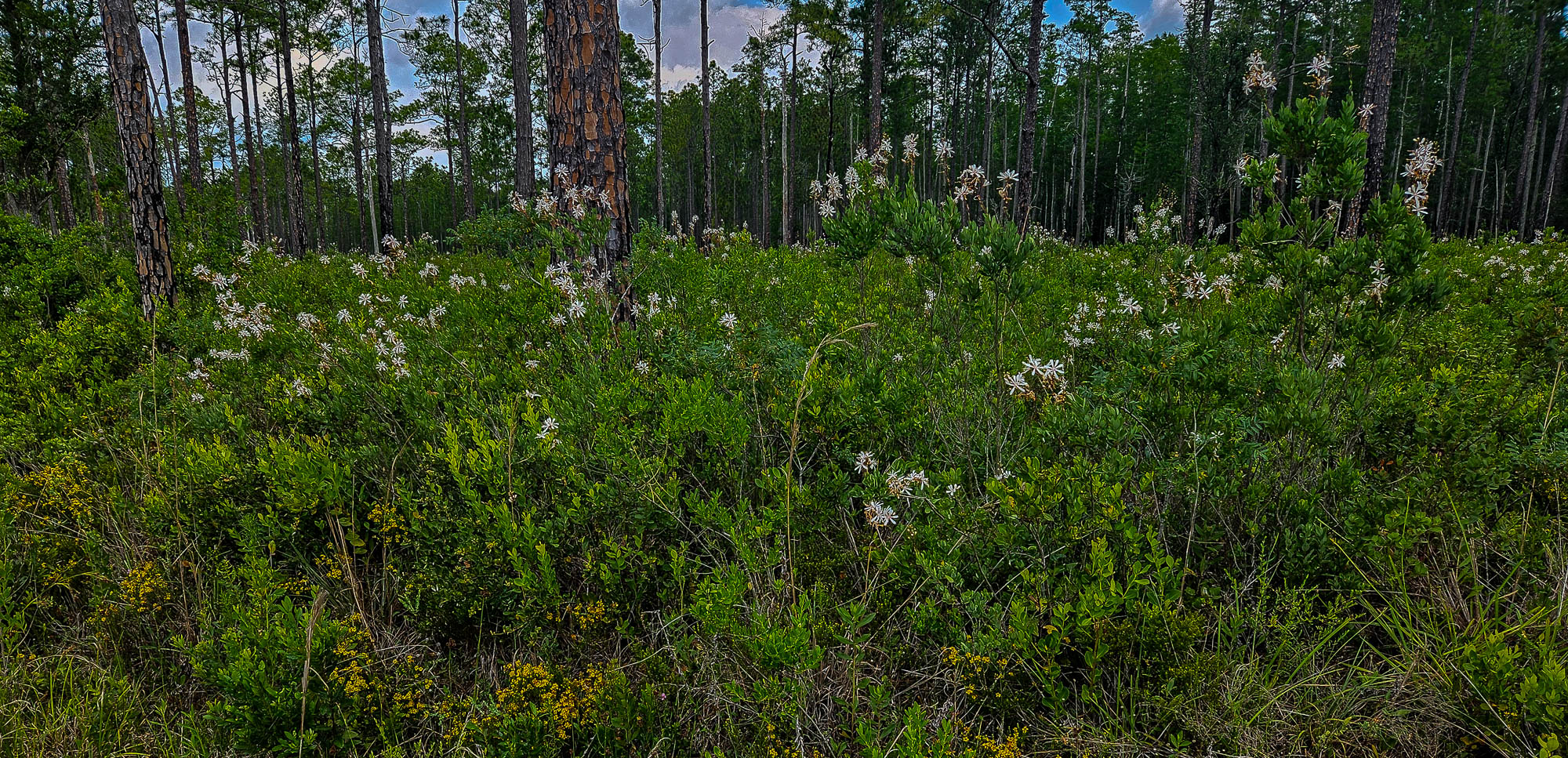
A woody shrub native to the pine forests of the southeast, Tarflower (Bejaria racemosa) gets its common name from sticky flowers which entrap insects. These plants often exceed ten feet in height. They smell nice, too.

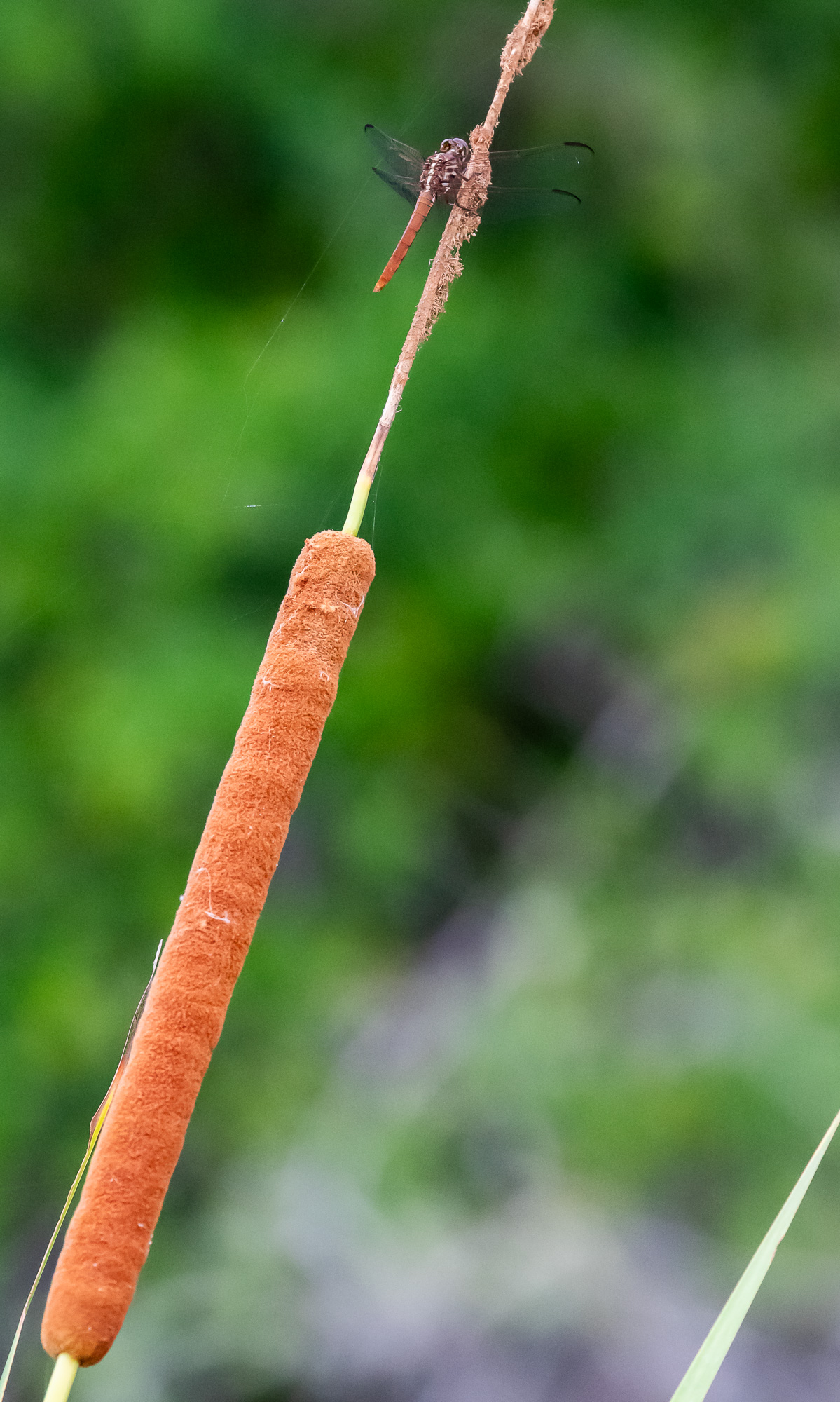
An immature male Roseate Skimmer (Orthemis ferruginea) blends nicely with his cattail perch. In a few weeks, his incredible change to lavender and pink will make him a neon sign flashing through the swamp. At which time he’ll be able to catch insects AND attract a potential mate.


Roundpod St. John’s-Wort (Hypericum cistifolium) is one of the five-petal St. John’s-Worts. It usually consists of a single stem with many flowers on top.

Always alert to potential danger, it seems there is a Tufted Titmouse at each new place we decide to explore. That’s just fine with us.

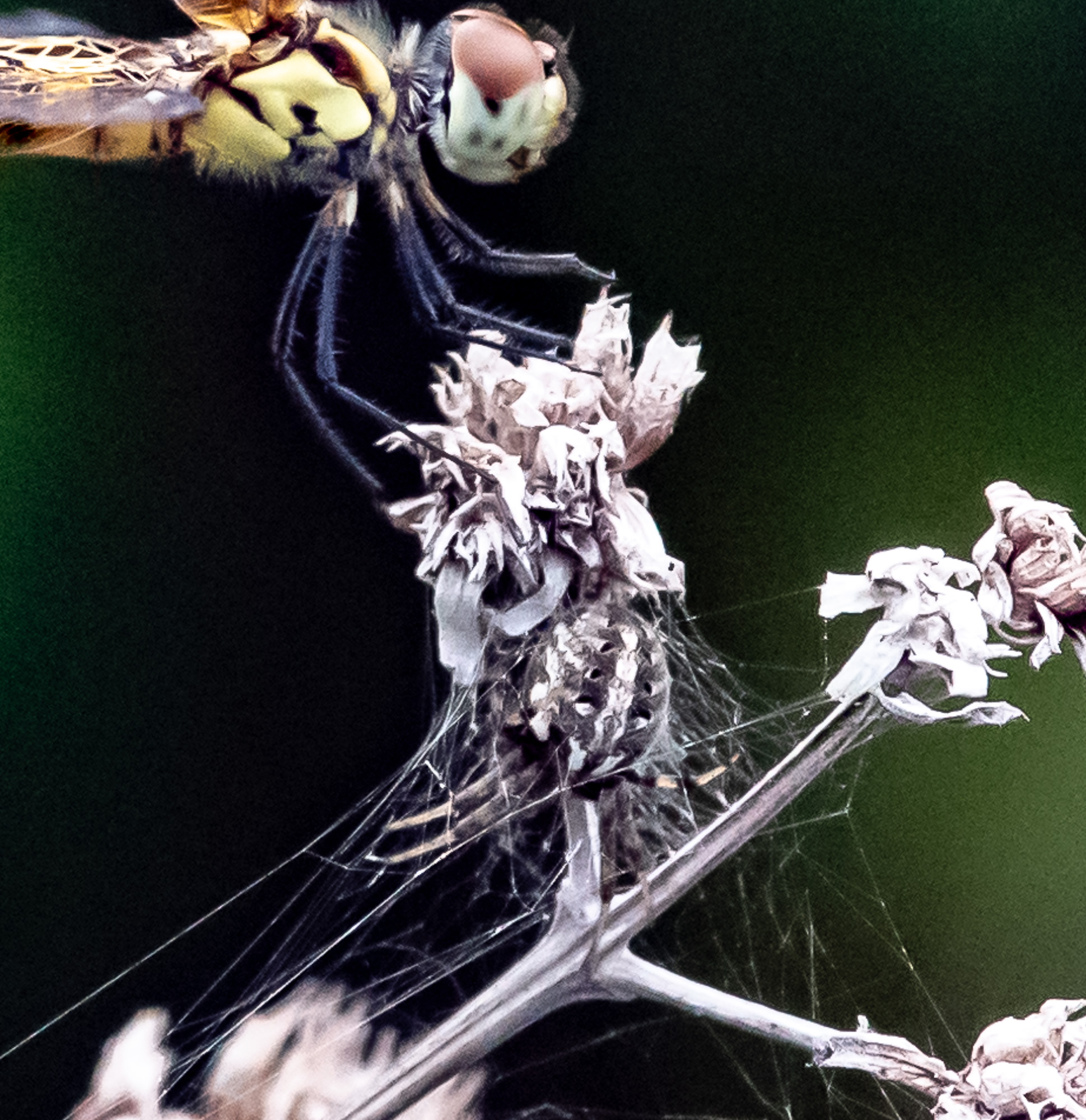
Hooray! A new dragon for us! We appear to be near the southern limit of the range for Amanda’s Pennant (Celithemis amanda). Hopefully, she won’t linger too long at this perch. Astute observers will have already noted why this wouldn’t be a good idea. A Spotted Orbweaver (Neoscona sp.) might think this lovely morsel would be perfect for brunch.

A lovely Eastern Black Swallowtail (Papilio polyxenes ssp. asterius) has no problem navigating the sharp spines of a Nuttall’s Thistle (Cirsium nuttallii).

Gini is of two minds on the small gorgeous bloom of the Showy Milkwort (Asemeia violacea). On the one hand, the flower reminds her of an elephant’s head. She also thinks these plants are very orchid-like. I agree with her on all points.

When the light is right, a Golden-winged Skimmer (Libellula auripennis) can shine as bright as any jewel.

Beautiful green leaves, simple 5-petal flowers, bright yellow and plentiful. What’s not to like about the Pitted Stripeseed (Piriqueta cistoides)?

One of our area’s larger all-dark dragonflies, a male Bar-winged Skimmer (Libellula axilena) perches atop a blooming young pine.

Also known as Sandweed, the Peelbark St. John’s-Wort (Hypericum fasciculatum) offers yet another shade of yellow in the pine forest. We love how this plant always seems to have a profusion of blooms.

Loblolly Bay (Gordonia lasianthus). I like saying the name almost as much as I love looking at this large tree with the big white flowers. A resident of wet areas, pollinators don’t care how you say the name, they really like the nectar offered by these stunning blooms.


A morning in the swamp provides so many benefits. We see, hear and experience so much that nature has to offer. Our spirits are lifted.
Enjoy your search for a natural place and come back for a visit!
 Our Natural Places
Wow, that Roseate Skimmer is a stunner. I have never seen one of those..at least in its splendor colors. Oh, and congrats on the new Dragon, a nice notch for the day. I can say without hesitation that my Dragon and my Spider knowledge is abysmal (can I blame my parochial education?). Would that Orb try to take on something as big as a Dragon? Intrigued minds want to know ha. I always figured those Dragons would just slap it across the face with one of those nimble legs. How long does it take to get the word “Loblolly” out of your head…appears to be on an endless loop at the moment – damn earwigs ha.
LikeLike
There are really some colorful dragons out there. That Orbweaver would definitely have no problem with that dragon. I may have a pic in the archives. I’ll check. Some dragon species would eat that spider if they could get first bite.
I told Gini that “Loblolly Bay” should be included in a country and western song. It’s got a rhythm all its own.
LikeLike
Beautiful photos from a summer morn. I’m sure not a fan of big trucks. In the “good old days” they were known as the safest drivers on the road and always kept to the far right-hand land. Now our California freeways are chocked with them, in all lanes, and traveling well over the speed limit. My photo award goes to the swallowtail on the thistle. What a gorgeous photo!
LikeLike
Amen to the “good old days”. Best drivers on the road. Then.
Thanks for the compliment on what is one of my favorite pics, too.
LikeLike
Although it sounds a little dicey getting into this oasis, it is definitely worth taking the extra step and doing the u-turn. Our insects and flora are either dying off or heading to warmer climates like Florida. We had our first frost the other day giving us a peek of things to come!
LikeLike
Yeah, dodging speeding logging trucks is a small price to pay for a glimpse of a few swamp critters.
We’ll try to take good care of your flora and fauna while they’re here on vacation.
Hope you both are having a good week. Remember, less work and more darts make for healthier relationships.
LikeLike
Oh, whoops! Your Hypericum fasciculatum looks so much like one I found in east Texas, I went searching in BONAP. This one doesn’t appear in Texas, but I learned thirteen species can be found in my eastex haunts. I need to spend a little more time with them, and sort out what I’ve actually found.
I’ve seen only one adult Roseate Skimmer, but they certainly are show-stoppers. I had no idea of the difference between the immature and the adult, so thanks for that illustration.
I wondered whether the tar flower was carnivorous. It seems others have assumed so, but I found this interesting passage about the flower’s stickiness:
“… the reason the tar flower has sticky flower petals is to capture pollen-stealing crawling insects such as ants and beetles. While pollinators like bees will alight at the center of the flower, where pollen adheres to their bodies, and then fly from flower to flower, ants do no such thing. They climb up the flower stem, along the leaves and petals, into the center of the flower where they take pollen and nectar and carry it away to their nests — or in the cases of other crawling insects, simply eat it. These “thieves” do not contribute to the plant’s ability to reproduce, and it is thought that the tar flower has developed sticky flower petals as a defensive mechanism.”
This stuff just knocks me out. Clever flowers!
After you mentioned the Loblolly Bay, I went back looking for the word “baygall.” That’s one of the ecosystems in the Big Thicket that I’m not sure I’ve come across, although many of the plants common in them I’ve seen: wax myrtle, titi, water-spider orchid, rose pogonia, Joe Pye weed, pepperbush. Then, I asked the venerable Google if Florida has baygalls. Why, yes, they do — and Loblolly Bay is one of the signature plants of such areas. Cool!
LikeLike
A plethora of Hypericum species keeps me returning to field guides often.
Many young male dragons start life looking like Mom. But when your Dad shows up all in neon purple, well, so long Mama!
Terrific research on the Tarflower. I had read somewhere they were not “actually” carnivorous, and now you’ve explained why not!
I found that bayhead is a synonym for baygall and a term I’ve used in the past. I think I like baygall better so will impress all my friends with a new word. Oh – wait. I only have one friend and she just read this. Sigh.
LikeLiked by 1 person
Hi Wally and Gini. It was heartening to read that the hurricane caused not too much damage to your immediate area. At the same time the pictures on our TV told a different tale for other parts of Florid and how the cause was global warming without mentioning that hurricanes are the norm for your good selves.
I hope that you are both now well and fit enough to take me to your Green Swamp and to share some of those insects and flowers. Today it is raining and I take the opportunity to catch up with all that is behind schedule. Last evening Sue and I spent the evening in The Shovels Inn to celebrate our wedding anniversary (life sentence) of xx years with a meal of Cajun Chicken and Fish and Chips (fries).
Today I will be trying to post something on my much neglected blog. Wish me luck. Stay Safe Both.
LikeLike
We have finally come to grips with the fact that “Global Warming” is what we senior citizens once referred to as “summer”. It’s difficult to keep up with changes in the lingo these youngsters use.
The TeeVee was not wrong, unfortunately. There are many areas which suffered disastrous damage. We attempted to check out a few of our favorite spots but roads are still flooded and many backroads still have trees blocking them. Most now have utilities back in service and each day it is becoming easier to find gasoline. Slow process, but steady.
We are in good health, good spirits and are blessed with good neighbors and family.
Now, spicy chicken and fish with some chips sound really good. Off to the grocery.
LikeLike
I love the Eastern Black Swallowtail image on the thistle. I think it’s great!
LikeLike
Thank you very much, Maria.
It was nice to have one pose so nicely.
LikeLike
The photos of the Amanda’s pennant are gorgeous! That’s actually one I saw and know now! I have wondered about the yellow flower. I’ll have to go back and rename my photos in my file. Right now they say yellow flower! lol I went to a preserve yesterday and was so happy to see it had some water in it. We’ve been too dry and the rain was needed. Glad you made it through the storms! Hugs to you both, Diane
LikeLike
Thank you, Diane.
Plenty of water, water, everywhere around here just now! Yellow flowers works for me. Sorta like “purty bird” or “cool bug”.
Hugs appreciated at all times.
LikeLike
So the turn-off immediately past the bridge isn’t a turn-off for you when it comes to nature: quite the contrary.
How about that pervasive yellow in the photo of the Hypericum fasciculatum? “Loblolly Bay” made me think I was in for a picture of a body of water. Turns out English has five words all spelled bay. Maybe instead of writing “I like saying the name” you should have said “I like baying the name.”
The roseate skimmer is one dragonfly you share with Texas. And I wonder if entomologists have studies what percent of the time on average a dragonfly and a spider in as close proximity as you show in your photograph leads to the latter grabbing the former.
LikeLike
Our turn-off is definitely a turn-on.
We continue to be amazed at the variations on a yellow theme exhibited by the floral community.
The Bay tree is much more impressive than any words I may bay about it. So, I saved two-thousand words by providing a couple of pictures.
My entomologist cousin used to tell me the predators of the insect world were statistically inept at successfully capturing their prey. Otherwise, there would be very little prey left upon which to prey.
LikeLike
Nice close up work Wally.
LikeLike
Thank you. I keep trying to learn. Sneakin’ up on dragons is a challenge.
LikeLiked by 1 person
“The orchestral composition of birds, insects, alligator growls and scolding squirrels – well, that is our kind of music.”
This for us is real music too, dear Wally and Ginny.
Was floored by the spectacular transition of the Roseate Skimmer!
Thank you for taking us along and so glad to hear you are safe, and doing well.
God bless loads. 🙂
LikeLike
Thank you very much, Natasha.
We really love that place. (Can you tell?) It has so much to offer in any season.
Life after the storm is slowly returning to “normal”. We hope all is well with you and your family.
LikeLiked by 1 person
I also like saying Loblolly Bay–a new word for me. I suspect my husband will grow tired of having to listen to me repeat it again and again. It could easily turn into an earworm. 😊
I’m glad the big trucks didn’t run over you–there should be a speed limit on that road, not only for the sake of other drivers, but for the sake of the animals who need to cross to the other side.
LikeLike
Thank you, Tanja. Gini says anytime a husband can be annoyed, her job is done.
As for the truckers, there are speed limits and there are schedules. Sometimes, the two are not related.
LikeLiked by 1 person
I’m glad to know I am doing my job. 😊
And I’m not surprised at your comment about speed limits. After all, I live in the Wild West, where traffic laws seem to be considered mere suggestions by the majority of drivers.
LikeLike
You live in an area PACKED with riches. Thank you for sharing some of them with us.
LikeLike
If we can’t share riches with our loved ones they wouldn’t be riches, would they?
Hope you’re having a great start to a whole new week, EC!
LikeLike
The Loblolly Bay is a striking plant, and I love its ruffle-edged blooms! I’ve been trying to learn more about the pine trees of Texas, and found that the Loblolly Pine gets its name from the Old English term for a thick gruel or porridge – an apt name for the pine that doesn’t mind having its feet in boggy areas. I assume the Bay has the same tendency, since you found it in your Green Swamp. A lovely May visit, nice to reflect back upon, as the swamps clean your hurricane runoff.
LikeLike
Those Loblolly Bay trees grow to over 60 feet tall and coming upon a dozen of them at the edge of a swamp all with those big white blooms is quite an experience.
We can’t wait to “get back out there”.
LikeLiked by 1 person