Petrichor
(We are still experiencing limited opportunities to explore nature. ONE of us, who shall not be named, seems to prefer the ambience of rooms filled with busy technicians, quizzical doctors, equipment with flashing lights/beeps/boops to that of our lovely damp swamp. Due to this hopefully temporary aberration – you will now be forced to view treated to summer reruns.)
(The situation described above is also responsible for our inattention to all of your recent blogs. We apologize and will do our best to catch up as we have a chance.)

“Smell that rain!”
The last week of May this year kicked off our summer, also known as “the wet season”. Gini uttered the above as I had just opened the patio doors to see if our night-blooming Cereus was serious about blooming. Not yet.
I really love our summers. That evening rain meant there would likely be fog early in the morning as we headed away from the suburbs. Our local patch, Tenoroc Fish Management Area, would be bustling with activity. Ibises, Egrets, Herons and Anhingas would be leaving their nightly roosts as they spread out over the area’s several hundred acres and dozen lakes in search of breakfast. As the day progresses, the previous night’s moisture will begin to dissipate, insects will busy themselves with the never-ending task of survival and would-be predators will attempt to interrupt that task, to ensure their own survival.
Migratory birds have, well, migrated. Resident birds are busy with nests, chicks and parenting. New plant growth coincides with newly hatched insect populations. Each step through the grass sends grasshoppers, beetles, moths, spiders, butterflies and other creepy-crawlies scurrying out of our way. The yellow American Lotus dots the lakes. A slice of sky above an open field contains Turkey Vultures, a Red-tailed Hawk, a pair of Sandhill Cranes, a flock of Black-bellied Whistling Ducks and a young American Kestrel attempting to snag a dragonfly.
We made our rounds, lingering at familiar spots hoping to see “something special“. I shall tell you a secret. For us, it is ALL quite special.
As May melts into June, Swallow-tailed Kites have found nesting sites near some water source typically in the tallest tree in the neighborhood. They are incredibly aerobatic and catch insects out of the air, pluck lizards and snakes from treetops and often “eat on the fly”. They will depart for Argentina during the second week of August. Until then, we will enjoy gawking at them all summer long.


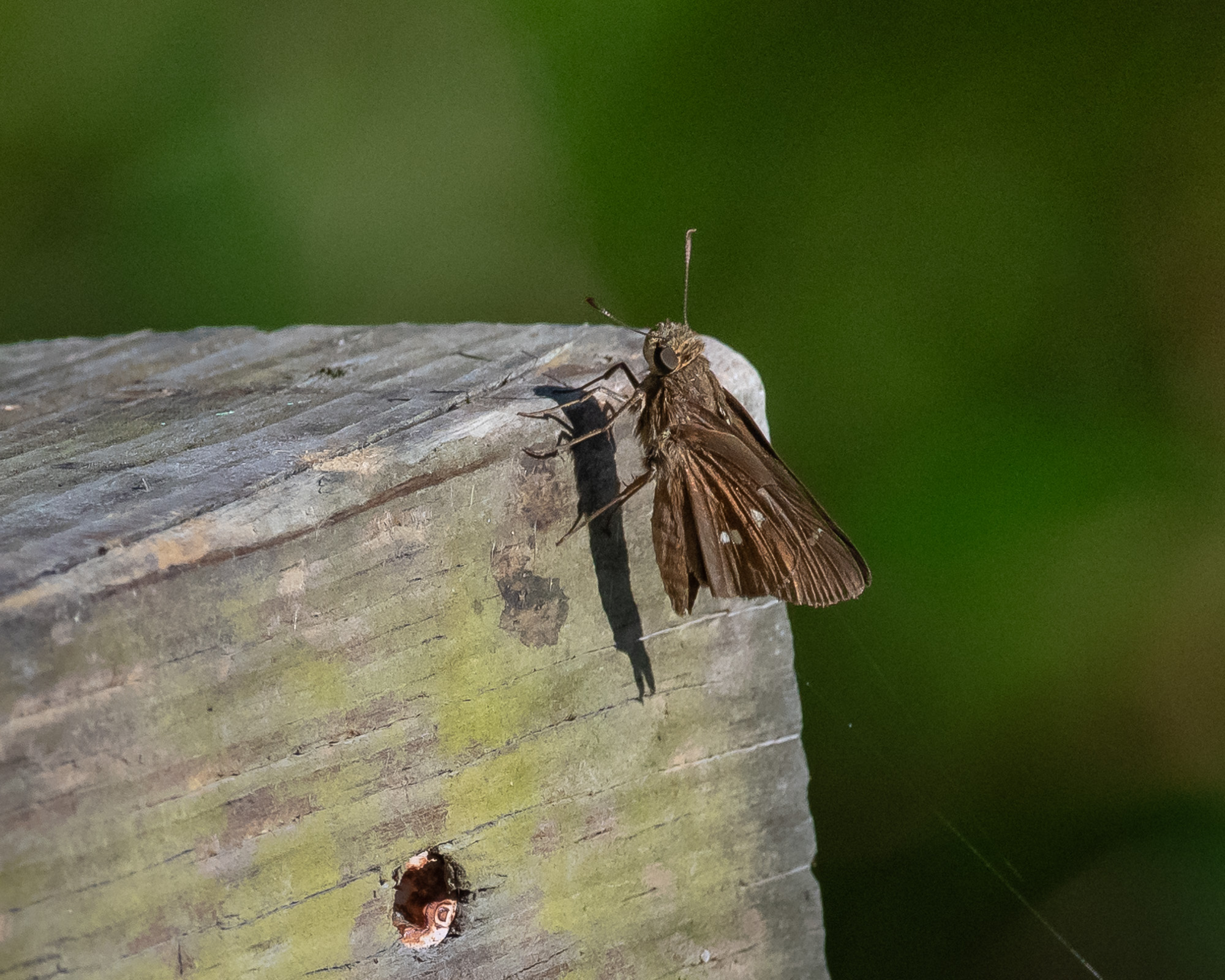
Nearly the same color as the dock post, a Twin-spot Skipper (Oligoria maculata) enjoys the early morning sun.
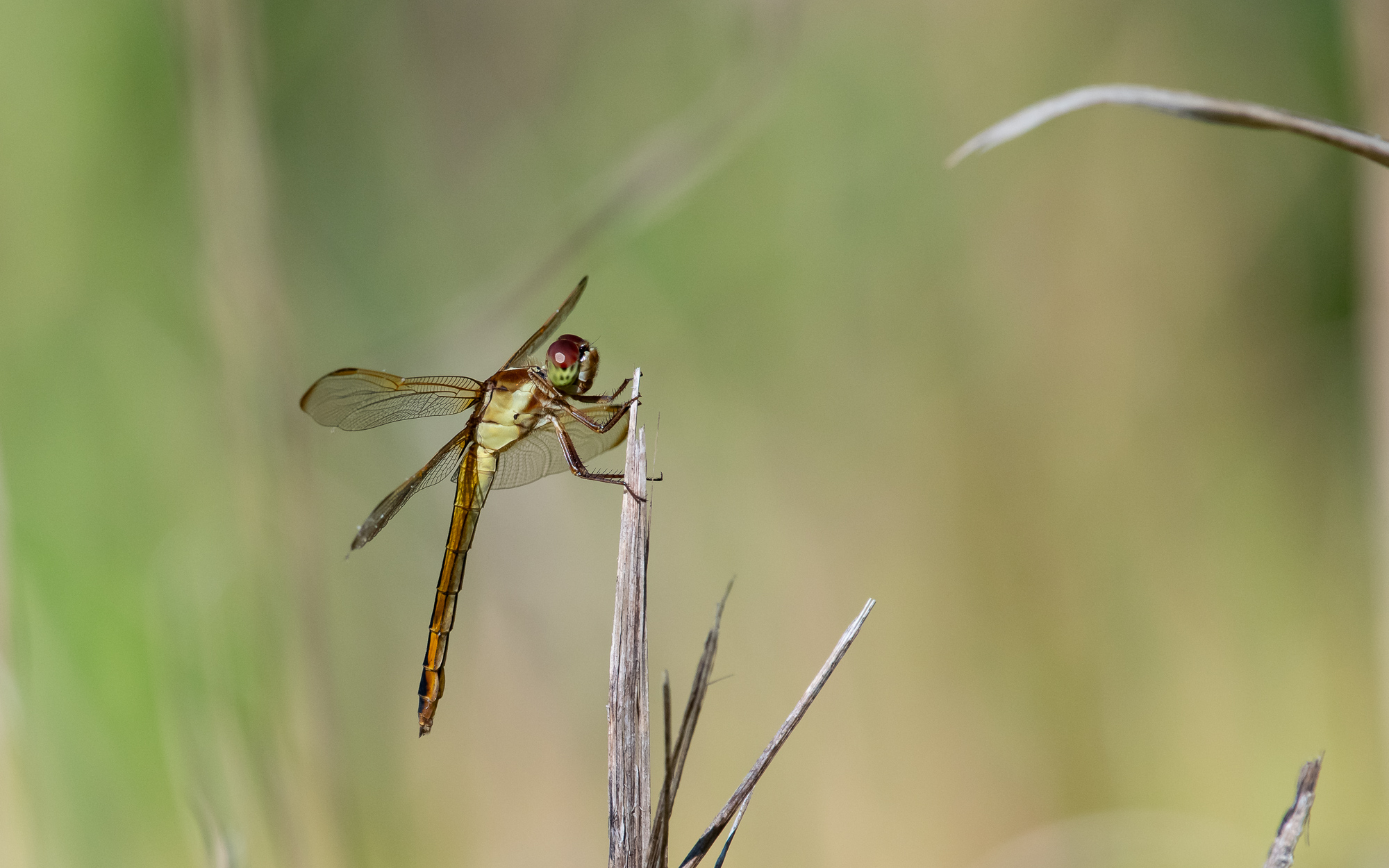
Bright and golden, the female Needham’s Skimmer (Libellula needhami) is a medium-sized dragonfly which is, thankfully, very abundant in our area. The adult male is reddish-orange but we didn’t find one today.

Once again, I am thankful to find a subject with a top speed near my own. This invasive critter is a Ghost Bulimulus (Bulimulus bonariensis), who, along with about a billion of its snail friends have steadily been invading the southeastern United States.

Warm, damp nights mean there will likely be butterflies in the morning attempting to dry their wings. Here’s one! An uncommonly handsome Common Buckeye (Junonia coenia).


She is quiet for now, but about an hour ago, just as the sun appeared above the treetops, a Limpkin chorus provided a screeching wake-up call to all the area residents.

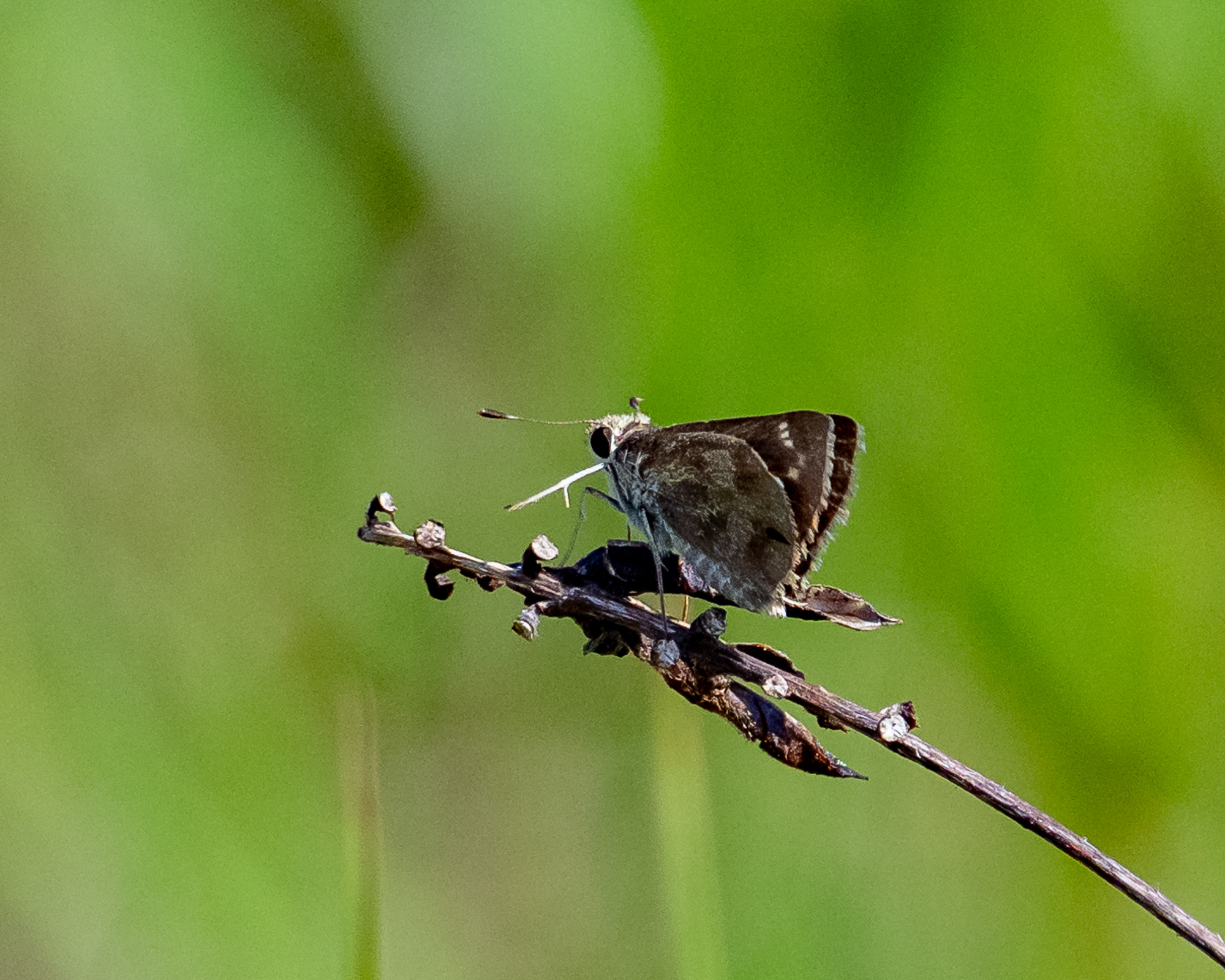
Another one of those small skippers, this time a Clouded Skipper (Lerema accius), remained on the twig for exactly one photo. Poof! Disappeared into the weeds.
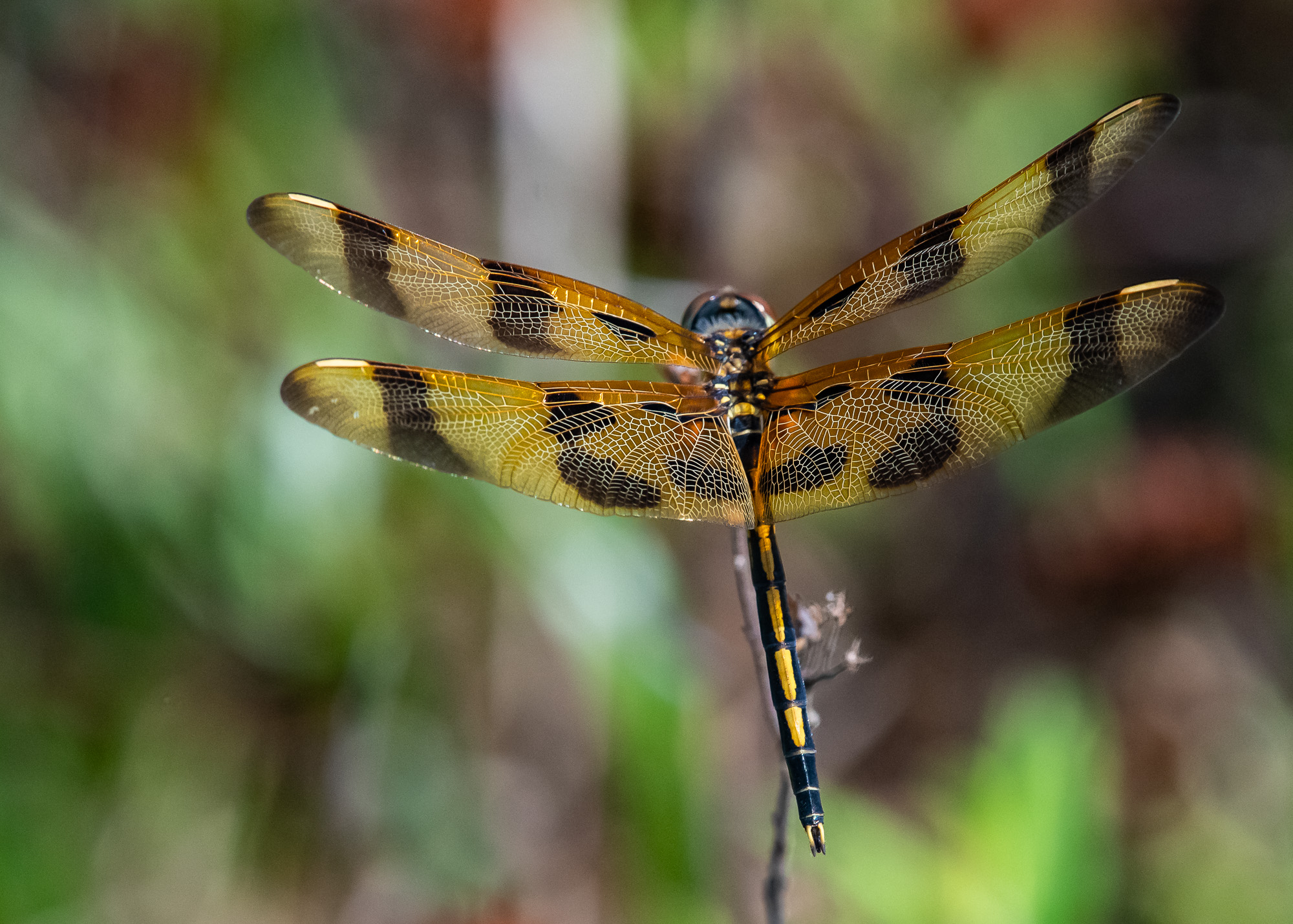
Gini still says the Halloween Pennant (Celithemis eponina) reminds her of a piece of golden jewelry. I can’t argue. (Not that I would.) (Ever.) (Under any circumstances.)

Perhaps it is not as colorful as its butterfly cousins, but finding a moth in the daytime is worth documenting. Besides, the Common Tan Wave (Pleuroprucha insulsaria) has a unique beauty all its own.

Throughout the Fish Management Area this year, we have counted eight occupied Osprey nests. The first two images below are the same nest, where an adult is encouraging a youngster to gain some altitude. We watched for awhile as the juvenile exercised its wings but wasn’t quite ready to step off the edge of the nest just yet. Maybe next week. The third photo is a different nest with one adult watching as the two kids yell at us. (Young Osprey have orange eyes which will turn yellow in a couple of months.)


Summer. The scent of rain conjures up immediate memories of riding a bike through puddles, wading in drainage ditches to catch tadpoles, tilting your head back and opening your mouth to get a drink. Gini and I are, of course too old and sophisticated to partake of such childish — oh, stop it. You would too, if you had a chance!
Enjoy your search for a natural place and come back for a visit!
*If you are interested in the science behind the smell of rain, petrichor, here ya go: https://earthsky.org/earth/what-is-smell-of-rain-petrichor/
 Our Natural Places
I followed the link about rain. I love that musky, earthy scent. It always makes me think of rainy days as a child….sitting on the floor looking out of the screen door and watching it rain.
LikeLike
We have very similar memories. Mine include dashing out that screen door to play in drainage ditches. Mother was not pleased.
LikeLike
I’m sorry that the tests and doctor visits continue. I sure hope Gini improves and you can get back outside. It actually feels a little better this week. I haven’t seen a Limpkin in a long time. That’s a bird that’s fun to see AND hear! Hugs to you both, Diane
LikeLike
Thank you for your positive thoughts, Diane. We’re sneaking into the swamp on short visits between appointments. Shhh! Don’t tell her doctors.
LikeLike
Your fuzzy-headed Limpkin is a real treasure, so endearinbg.
Those are wonderful images of the Swallow-tailed Kites – how fascinating to watch them snack on the wing. I got to see some Mississippi Kites doing the same thing during my recent Colorado trip, but my photos were nowhere near as fine as yours!
I did realize that rain had its own pleasant scent, but didn’t realize it had a name. Now that I’ve done some research, I see that the name has been used for bath scents, perfumes, restaurants and even modern music compositions.
The interesting bit of trivia for me was the dependence of Petrichor on Geosmin, an chemical given off by the soil bacteria Actinomycetes. The human nose can apparently detect geosmin at concentrations of 5 parts per trillion, and at those tiny concentrations, it is the welcome signal of nearby fresh water and plant growth. I learned about geosmin, though, when it was found in much higher concentrations in the city water supply in Tyler TX each spring. According to a local TV news report, the concentrations in the water were perfectly safe, even though they had a disagreeable smell. It’s an annual bonanza for the bottled water companies. As with many things, a leeetle bit goes a loooong way.
LikeLike
Thank you, Sam.
Kites are mighty special birds. With or without the camera, I can be very happy watching their activities for a long time.
I reckon I’m not surprised that petrichor, and just about everything else in the universe, has been commercialized. I’ll stick to just enjoying the scent of fresh rain, no matter what it’s called.
LikeLiked by 1 person
Continue best wishes on the health front – that can definitely be a drain, but keep everyone’s spirits up. Swallow-Tailed Kites are in my top 10 favorite birds (probably more like top 5). They were one of my trigger birds for getting back into birding when one got lost and showed up at my alma mater many years back. I could watch them eat on the wing for hours and hours. Those Limpkins can definitely be a loud bunch. We had quite an eruption of them last year, this year nothing around us, quite bummed, but your pictures will keep me excited.
LikeLike
Thank you for the wishes. Will take all we can get.
Yep, Kites are definitely addictive. We found a nest a few years ago and what a treat to watch the feeding process. Parents brought those kids everything in the zoo!
I reckon I need to record some of our dawn Limpkin serenades. Pretty cool stuff.
LikeLike
I love the kite images. They’re so sharp. I also remember the ospreys from when I was in Florida. Get well soon to your wife!
LikeLike
Thank you, Maria.
We really love the birds of prey.
Your well-wishes are appreciated.
LikeLike
❤️🩹❤️🩹🍄🟫🌸
Prayers and god speed. Been under the weather too and between a move, so haven’t posted.
So much love to both of you. 💙🐬
LikeLike
Thank you very much, Natasha.
We certainly hope this finds you feeling better.
LikeLiked by 1 person
On the mend, Wally. Taking each moment at a time. ❤️🩹
LikeLike
Recovering from a small surgery and been asked to rest 3 weeks.
LikeLike
Very nice photos Wally. I think the osprey had their eyes on you. I learned what “petrichor” was via a Dr. Who episode, “who” would have thought. Always knew the smell, never knew it had a name.
LikeLike
With young’uns in the nest, it’s impossible to sneak up the Ospreys. One thing they teach the kids early is how to screech.
I should have known the good Doctor would have taught us about such an obsucre term!
LikeLiked by 1 person
I hope the temporary aberration will soon normalize so you two can return to your natural places for some healing and soul time. And, selfishly, for more marvelous photos for us to look at! 😊
Gute Besserung!
Tanja
LikeLike
Danke, Tanja.
We’ll get there. Stuff just takes too long for those of us who have no patience. We’re like little kids – “But we don’t WANT to go to the doctor!”. 😦
LikeLiked by 1 person
I can relate to those feelings.
Wishing you both only the best!
LikeLike
BTW, thank you for a cool new word: petrichor. I love it as much as I love that smell!
LikeLiked by 1 person
Beautiful shots of the little critters! It’s too hot to be out right now anyway.
LikeLike
Thank you, Dina.
Wait – it’s never too hot to be outside! (Says the guy from the comfort of his air-conditioned office.)
LikeLike
The smell of rain is wonderful, and more discernible than most people think. Snow, too. The few times we’ve had snow here since I’ve lived in Texas, friends have rolled their eyes at my firm pronouncements that “there’s snow coming!” It’s an even more interesting scent than rain, in that it’s no almost no scent at all, but I’m at the point in life when I’d rather smell rain.
The Halloween pennant was one of the first dragonflies I learned to identify, for obvious reasons. As Gini says, it’s a beauty, and would make a beautiful brooch. It’s also easy to spot, given its predilection for perching atop plants. I’m curious about the blue in the second photo. Is that an effect of the light, or do they also show color variation (seasonal, male/female, etc.)?
It’s great that you were able to capture both views of the Buckeye. They’re one of my favorites, partly because they’re so accomodating. I found a Buckeye caterpillar this weekend, gnoshing away on Agalinis hererophylla flowers. Such fun!
Finally, the Kite. I’ve seen exactly one Kite in my life, and I can’t remember which species it was. I do remember the experience. I saw a cluster of people with binoculars and lenses trained on the top of a dead tree, so I stopped to see what the excitement was. One of the fellows said, “There’s a kite up in that tree.” My response, of course, was “Did one of you lose it?” There’s nothing like a whole group of birders turning to look at you with a combination of amazement, disbelief, and disdain!
LikeLike
The only aroma of snow I recall is that of the wet wool hat I had pulled down over my face when this Florida boy experienced an upstate New York winter.
The abdomen of that Halloween Pennant may have been a trick of the light as they don’t normally appear bluish like that.
I was hoping for a better side view of that Buckeye’s underwing but it had other ideas. Still, a mighty pretty bug.
Kites are so much fun. Some to fly, some to watch fly. I can almost hear a collective “harrummph” from here.
LikeLiked by 1 person
And now I’m remembering the smell of wet wool mittens drying on the steam radiators in grade school!
LikeLike
Excellent pictures, as always.
Sorry to hear about the medical travails of your OH. Rather than being swamped with such things, it’s clear you’d both rather head back to actual swamps.
Your night-blooming Cereus was serious about blooming: how could you not have played with those homonyms? And you know what they say about birds in the Aramidae: like them or lumpkin them. The actual name seems to be limp, from the bird’s halting gait, plus the diminutive suffix -kin (as in pumpkin, catkin, munchkin, and napkin).
Thanks for the link about petrichor. I had no idea there’s a name for that rain smell. The Wikipedia article gives information about how scientists homed in on the concept.
LikeLike
Thank you, Steve, for the positive thoughts. We appreciate all we can get.
About a week after the events of this post (first week of June) the two cacti were awash in white blooms. Cereusly. Of course, as soon as the sun rose, the flowers closed right up.
Alas, the poor Limpkin is the only member of that taxonomic family. Perhaps that’s why it’s cry is so mournful?
Great link to why rain “smells”.
LikeLike
Petrichor is one of my favourite scents. And one I haven’t smelt in tooooo long.
I am so sorry that Gini is still in the clutches of the medicos. I hope that stops soon and that she can get back to a much, much better life.
And thank you for sharing the wonders that surround you.
LikeLike
Good Morning, EC!
We have a few challenges ahead, but overall she is doing well. Shorter drives through the forest and swamp still yield huge dividends.
Thanks for continuing to show us your stunning flowers!
LikeLike