Marsh Madness 2/3
(Click images to enlarge, click again to zoom.)

“All that water looks really shallow but if you wade out in it you would probably completely disappear in the soft mud.”
I’m still trying to work out if Gini was being scientific or making a suggestion.
Indeed, the average depth of the water throughout this portion of Merritt Island National Wildlife Preserve is from six to ten inches. There are a few deeper potholes where diving ducks can sometimes be found. The shallow water, abundant grass, replacement of nutrients and other food by tidal activity – it’s no wonder so many birds are attracted to this area.
We have reached the half-way mark in our excursion around seven-mile Black Point Wildlife Drive. It is now about 0900, the wind has calmed a bit and the temperature has climbed to about 60 F/16 C. Wading birds seem to be everywhere. Flocks of ducks, pelicans, ibises and spoonbills criss-cross the sky. These kids have met their candy store.
To give you an idea of the numbers of birds enjoying this small portion of the 140,000 acre refuge, expert birders report on that day they saw: 200 Blue-winged Teal, 120 Ring-necked Duck, 250 Lesser Scaup, 75 Northern Shoveler, 80 Northern Pintail, 1000 American Coot, 450 Common Gallinule, 75 Pied-billed Grebe, small numbers of Hooded Merganser, Gadwall, Mottled Duck and Ruddy Duck. The variety of additonal birds was also incredible. The average number of species reported for that day was over 50.
Other areas of the refuge had even larger numbers of some duck and wader species but overall less diversity. This does not even take into consideration the song birds in the woods nor shorebirds and pelagic species on and near the beach.
The next couple of miles were filled with pink and white. The final portion of the wildlife drive begins to blend marsh and upland pine woods. Things to see and enjoy were almost overwhelming. Almost.
It’s easy to understand how the Northern Shoveler received its name. The male has spectacular plumage.

We couldn’t convince any of the male Hooded Mergansers to show off their dazzling white crests. That’s okay. He’s still quite handsome.

All around the marsh are small hammocks among the mangroves, typically including cabbage palms, slash pines and wax myrtles.

Pink warning. We saw over three dozen Roseate Spoonbills during the morning. Unique birds.


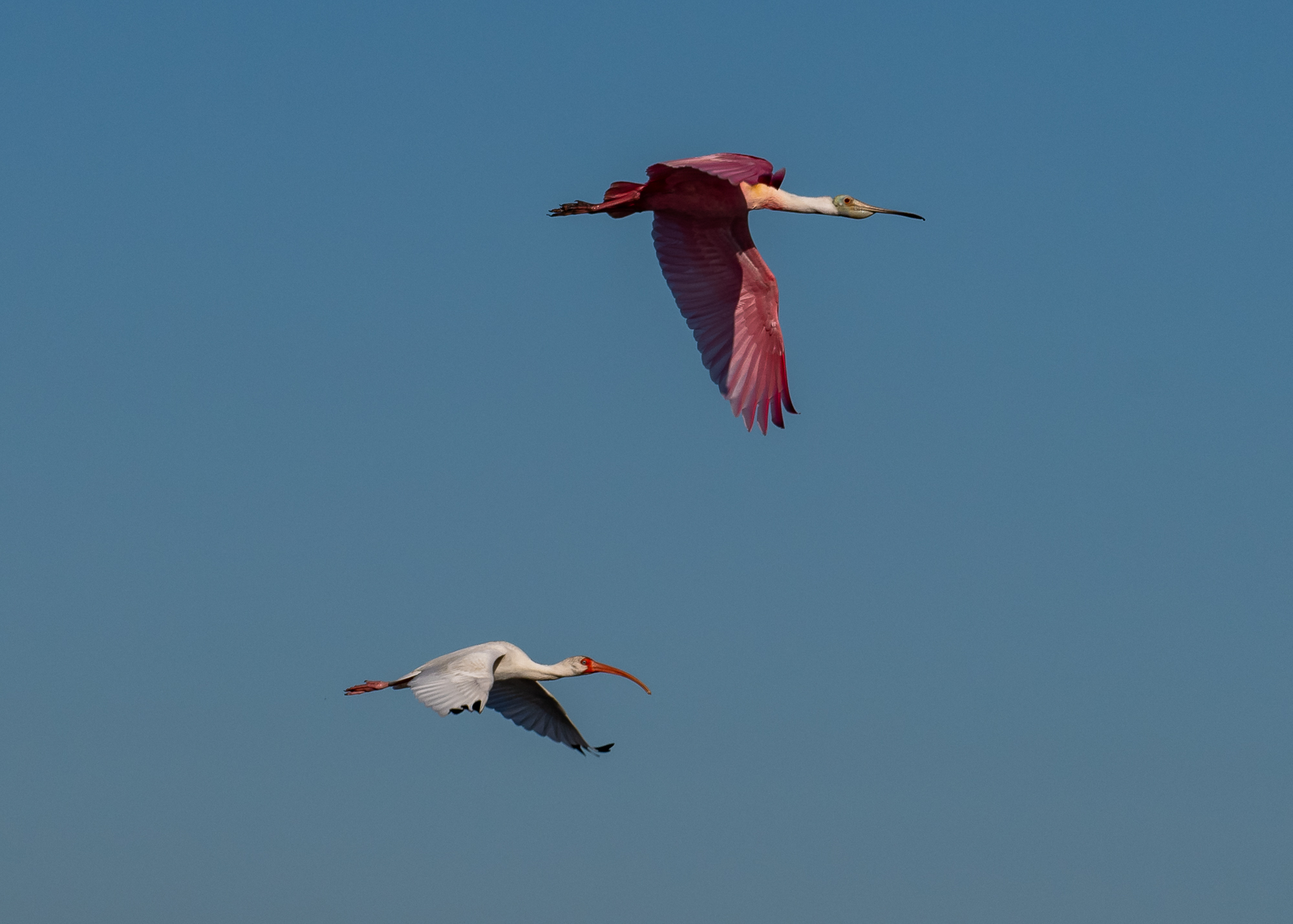


On the far shore of a pool we watched a large group of waders feeding. Included were: Roseate Spoonbill, White Ibis, Wood Stork, Great Egret, Little Blue Heron, Tricolored Heron, American White Pelican and Snowy Egret. A fly by of a Bald Eagle caused a sudden evacuation.


Unlike their Brown Pelican cousins, who dive from the air in pursuit of prey, American White Pelicans often hunt cooperatively. They form a line or circle, flap their wings to herd fish into shallow water and then scoop up a meal. Contrary to popular belief, they do not scoop up a fish and fly to a perch with it, but rather consume it as it’s caught.


Wood Storks march down a canal, stirring the mud bottom with a foot and snatching anything that moves.

Occasional flowers provide a colorful relief to the brown and green of the marsh. Here’s another Indian Blanket (Gaillardia pulchella). We don’t often see a bloom which is mostly yellow.

Potholes, marsh grasses, hammocks – lots of tracks in the mud confirm this is Wild Pig habitat. In the past, we have seen quite a few of the critters in this spot.

Not many predators will challenge a full grown wild pig. Oh, here are a couple who will. American Alligator. The marsh is their happy place. Watch your step.

Even on a winter’s day, Florida offers a few insects for our viewing pleasure. A bright Gulf Fritillary (Agraulis vanillae) was as happy as we were to find blooming Indian Blanket.

As we neared the final portion of the wildlife drive, a Tricolored Heron plying the shallow waters around the mangroves offered a fitting farewell.

It has been an outstanding morning in the marsh. Birds everywhere, alligators, scenic beauty, butterflies. What more could we ask? We have worked up an appetite. Coming Next: Picnic Launch.
Enjoy your search for a natural place and come back for a visit.
 Our Natural Places
That is a LOT of birds… and a LOT of pink! You reminded me I have to get out this weekend and get the Hooded Mergansers checked off the list before they head out. I find the fun begins as soon as a White Pelican actually catches a fish in its pouch – becomes a a game of keep-away from that point on until it can get it down the hatch!
LikeLike
It’s an amazing spot, that’s for certain.
Even in summer there are plenty of birds and interesting things for nature lovers/photographers. Like the B52-sized mosquitoes and gangs of Yellow Flies with switch-blades for teeth. You know. Cool stuff like that.
LikeLike
I know I read this post but I don’t think I commented. The Roseate Spoonbill is my MOST favorite Florida bird so I know I would enjoy going to this area and getting a chance to see them! We sure are blessed to have such abundant wildlife here in Florida!
LikeLike
Just knowing you read the posts is enough. No comments are needed.
If you like our pink waders, this place would be paradise for you. Pink along the shore line, pink waders on the flats, pink clouds flying overhead.
How right you are about our natural abundance. Enoy the rest of your week.
LikeLike
This is the type of madness I would not mind being part of! What an amazing place.
LikeLike
It truly is amazing.
Winter migration brings a host of species we’re not used to seeing. The good news is, birding here in the summer is just as good.
The breeding bird list is a long one. We didn’t even visit the beach where one can find hundreds of shore birds and often see gannets, scoters and jaegers cruising near shore. We also didn’t visit the canal where Lesser Flamingoes have been wintering. Nor did we visit the Scrub Jay area or the spot where uncommon sparrows were reported. And, and — you get the idea!
Amazing place, indeed.
LikeLiked by 1 person
If you are trying to make me drool, it’s working! 😊
LikeLike
I so enjoy the Northern Shovelers, but haven’t seen one in months. It took me a while to figure out that local hunters who kept referring to ‘spoonies’ weren’t referring to Spoonbills, but to the Northern Shovelers.
Is your wild pig the same as our feral hog? If so, do the pigs contribute to the making of those potholes? There are some huge ‘digs’ out at Brazoria, made by those destructive critters. Needless to say, it’s open season on them.
I can’t get over the number of birds you see. The most interesting photo is of the White Pelicans. I have a friend who lives in Calgary, and she has published similar photos of the birds. It’s really something to contemplate: that the same species thrives in Florida and Canada.
My favorite photo of the group might be the landscape shot showing the hammock with its mangroves and etc. That’s a Florida feature I’d really like to see in person.
LikeLike
Gini has a theory that the Northern Shoveler was the inspiration for “Daffy Duck”. We were treated on our visit to watching a dozen in a flock flying across the marsh. Pretty cool.
My understanding is that “feral swine” (Sus scrofa) in North America are all descended from European stock brought to the New World by explorers as food stock. Many were released/escaped and now those porkers’ progeny populate many different areas of the continent. We grew up calling them “hawgs”, but have noted them called pigs, hogs, razorbacks and, most importantly, dinner.
The “feral swine” can really tear up some real estate as they root for roots, fungus and other edible delights. Some areas would make a farmer envious with straight and deeply plowed furrows.
The American White Pelican breeds in more northern spots of the continent and in winter we see large numbers migrate here for the winter. However, some groups remain in Florida all year. I believe this is true for Texas also. I’ve read these are immature birds which do not breed. Each summer we can find several dozen of them at one of our local wetlands bordering a large lake.
I love those mangrove hammock areas. Hopefully I’ll get some sunrise/sunset images of them soon. (Still seeking effective stuff for repelling no-see-ums and yellow flies.)
LikeLiked by 1 person
Spoonies and pelis, what a combo! Another post full of gorgeous shots, WOW on the Northern Shoveler!!
LikeLike
Plenty of models to choose from. Getting them to hold still was another matter.
Great place.
LikeLiked by 1 person
So many different things! And you caught them beautifully. Love those shovelers. What a treat to see so many spoonbills and white pelicans in one day.
LikeLike
Thank you, Dina.
So many birds it was almost overwhelming. But we survived.
Great place.
LikeLike
Your morning excursion yielded a massive collection of birds, and you brought us radiant photos! Thank goodness no hogs were about: regardless of whether they were lounging on hillocks OR hammocks, I would not be pleased. I’m much more leery of them than of alligators, I confess.
LikeLike
It’s a great place for birds, despite a few piggies and ‘gators. It IS Florida, after all.
We had a really nice day. Now we want another.
LikeLike
Very nice Wally! I am always amazed at how birds of different species can co-exist, or at least tolerate each other. Maybe because there are more eyes to watch for danger, or signal a food supply. Either way, it makes great photos.
LikeLike
Thank you, Brad.
It’s sort of like one of my family reunions. My favorite cousin and I would keep an eye out for danger from the prim and proper Aunt and help defend against little brothers and sisters trying to get to the coconut pie before we did.
A fun day.
LikeLiked by 1 person
You got excellent pictures of the spoonbills in flight, especially that second solo one. And what a row of white pelicans.
In Austin we occasionally get an Indian blanket that’s not just mostly yellow but completely yellow.
Augralis vanillae lives as happily on the west side of the Gulf of Mexico (i.e. Texas) as on the east side (i.e. Florida). Likewise for alligators.
LikeLike
I’m totally flabbergasted by the number of different species of bird seen, and the quantity of the birds, Wally – and then there’s flowers, ‘gators, and butterflies too. For me, it would be like being in heaven. Is there a danger of being so mesmerised by the wildlife that a ‘gator sneaks up on you?
Your photos are a delight to behold. Thank you.
Nothing to report from this end – it all kicks off next week!
Best wishes to you and Gini - – – Richard
LikeLike
Thank you very much, Richard.
If Heaven is similar to this, there may be a queue.
As long as Gini is with me, the ‘gators have no chance. She can hear them whispering at half a mile distance. If one should confront us, she has a “Mama Stare” that will cause them to retreat while whimpering. It’s a gift. Ask our kids.
LikeLike
An absolutely wonderful tour of Merritt Island Blackpoint Drive! Super photos!!✨
LikeLike
It makes for a fun day!
Thank you.
LikeLiked by 1 person