Small Pleasures

(Reminder: Click to enlarge images. Click again to zoom.)
A cool morning!
Okay, perhaps not “cool“, but “not as hot“. It was a few minutes past sunrise and our target area for exploration was already buzzing, literally, with activity. Birds were chattering and insects were beginning to move about as the dew evaporated. Today was one of those unplanned excursions and we hoped to find a few subjects willing to pose for the camera.
Although we heard quite a few birds, not many ventured into camera range and even fewer begged for a portrait. No worries. Slow down, change to a macro lens, focus on the few feet around our – feet. Plenty to appreciate here.
Today we had to finish early as other tasks needed attention after lunch. Fresh fruit fueled our endeavors. (Know why we like bananas so much? Because they have “a peel“. Barump -bump.) Several flower species in the area were in full bloom and the nectar seekers obligingly drank their fill and flitted to the next plant for another sip, transporting pollen along the way.
Speaking of pollinators, Gini gently reminded me, for the third time, to brush my pants to remove items ingeniously placed by various plants in an attempt to increase their population. I don’t understand why she doesn’t want me to wait until we get home to do that so we can have a yard filled with beggar lice, sandspurs and Spanish needles. That way, we wouldn’t have to go very far to enjoy having all those hitchikers jump on us for a ride.
Most of the photographic results of today’s exploration were of subjects on the diminutive side. Hope you can see them okay.
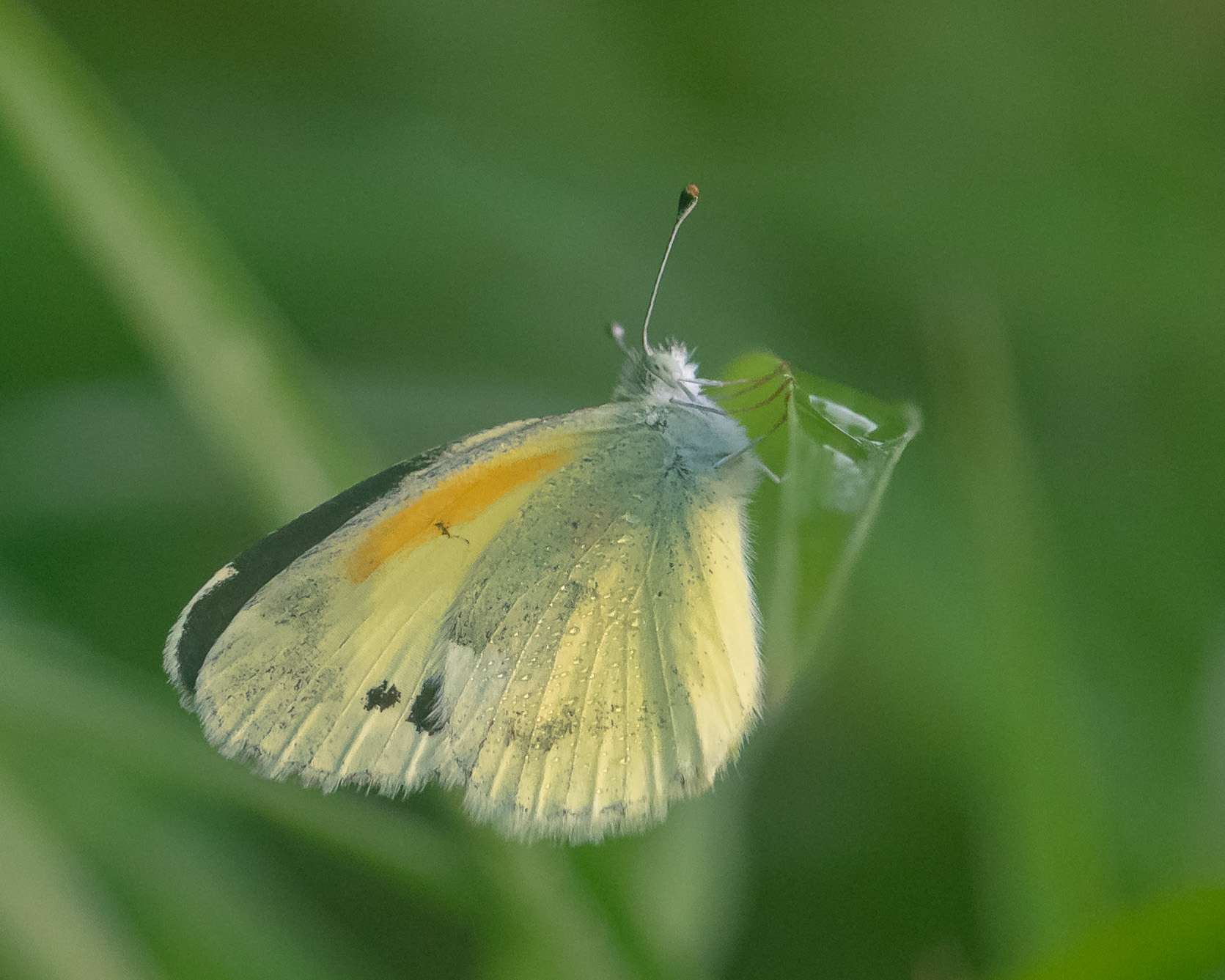
Clutching a blade of wet grass, a Dainty Sulphur (Nathalis iole) patiently waits for the sun to do its job of drying the dew from its wings.
A new bug! This good-sized specimen is a Wedge-shaped Beetle (Macrosiagon octomaculata) feeding on Shrubby False Buttonweed (Spermacoce verticillata).

The brightly colored Milkweed Assassin Bug (Zelus longipes) is known as a “generalist” when it comes to prey. It eats pretty much anything it finds. Any bug which eats Army Worms and Mosquitoes gets my vote as “friendly”.

Often, we become so enamored of the beauty of a butterfly displaying its upper wings that we forget how incredible the other side of those wings can be. A case in point: the Variegated Fritillary (Euptoieta claudia). Gorgeous from above or below.


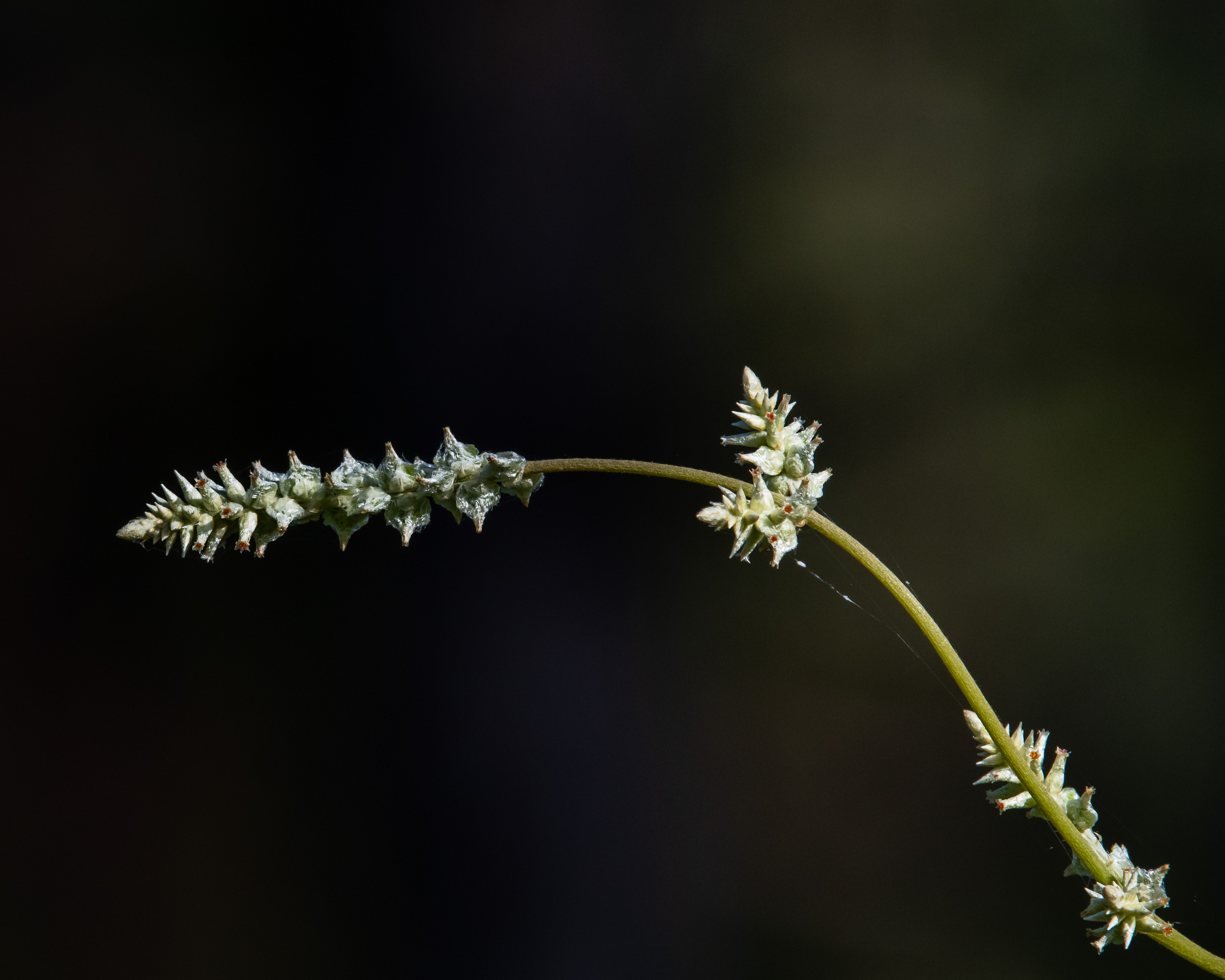
Growing to a height of four to five feet, Plains Snakecotton (Froelichia floridana) is in the Amaranth family. Leaves are near the plant’s base and the small white flowers are borne on tall stalks which wave sinuosly in the wind, giving the plant one of its common names.
It’s always a bit startling to see Fire On The Mountain (Euphorbia cyathophora) growing in the wild. It’s like an early Christmas as the familiar holiday Poinsettia is in the same family.

How can a butterfly have nothing but dull colors and still be so beautiful? I don’t know either, but we always enjoy finding Horace’s Duskywing (Erynnis horatius) during any trip.

We interrupted a preening session of Common Ground Dove. The plain gray birds favored us with a wave of a wing revealing an incredibly rich brown plumage.

Compared to the small brown Horace’s Duskywing above, a large Spicebush Swallowtail (Papilio troilus) appears almost gaudy. Almost.

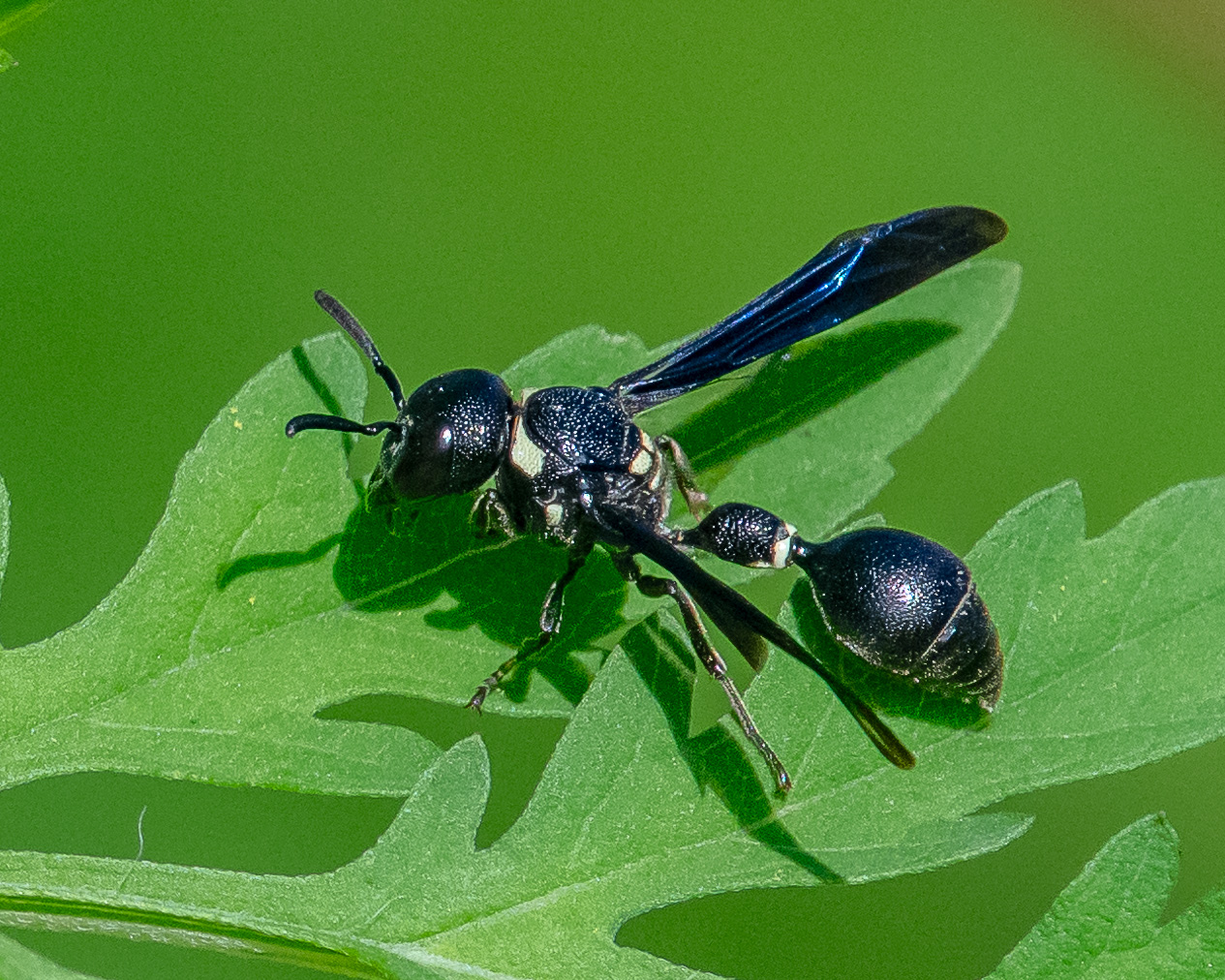
Many wasps receive a negative reaction due to the very real fact they can inflict a painful sting if one is not careful. Most species of wasp are not aggressive, so as long as you respect their space, you should remain pain-free. This handsome Mason Wasp (Zethus spinipes) builds a uniquely-shaped nest which is stuffed with a caterpillar for junior to nibble on once hatched.
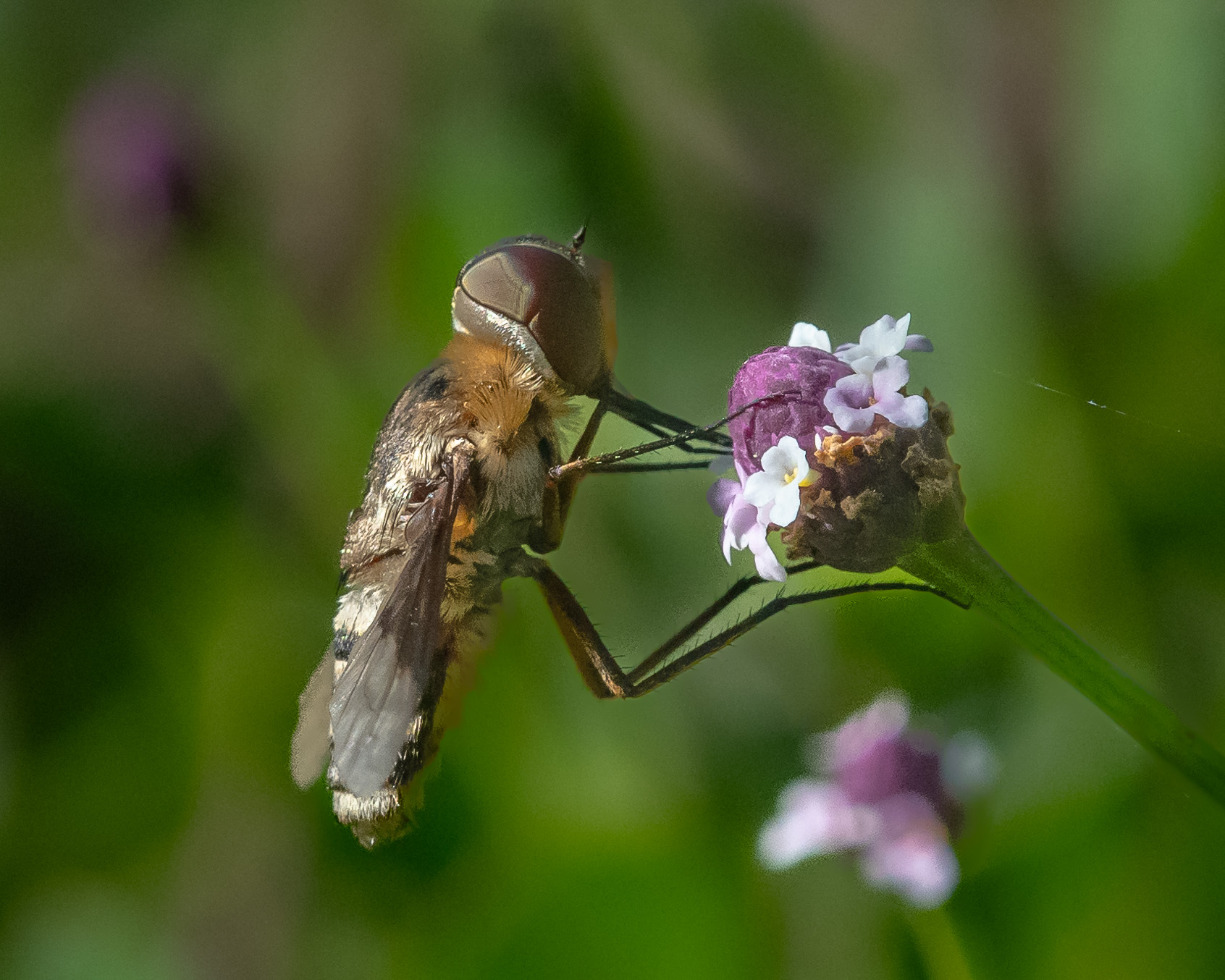
I was unable to determine the exact species, but this little Hoverfly (Syrphidae spp.) was very active. If you know how small the flower of the Frogfruit (Phyla nodiflora) is, then you know how small the fly is.
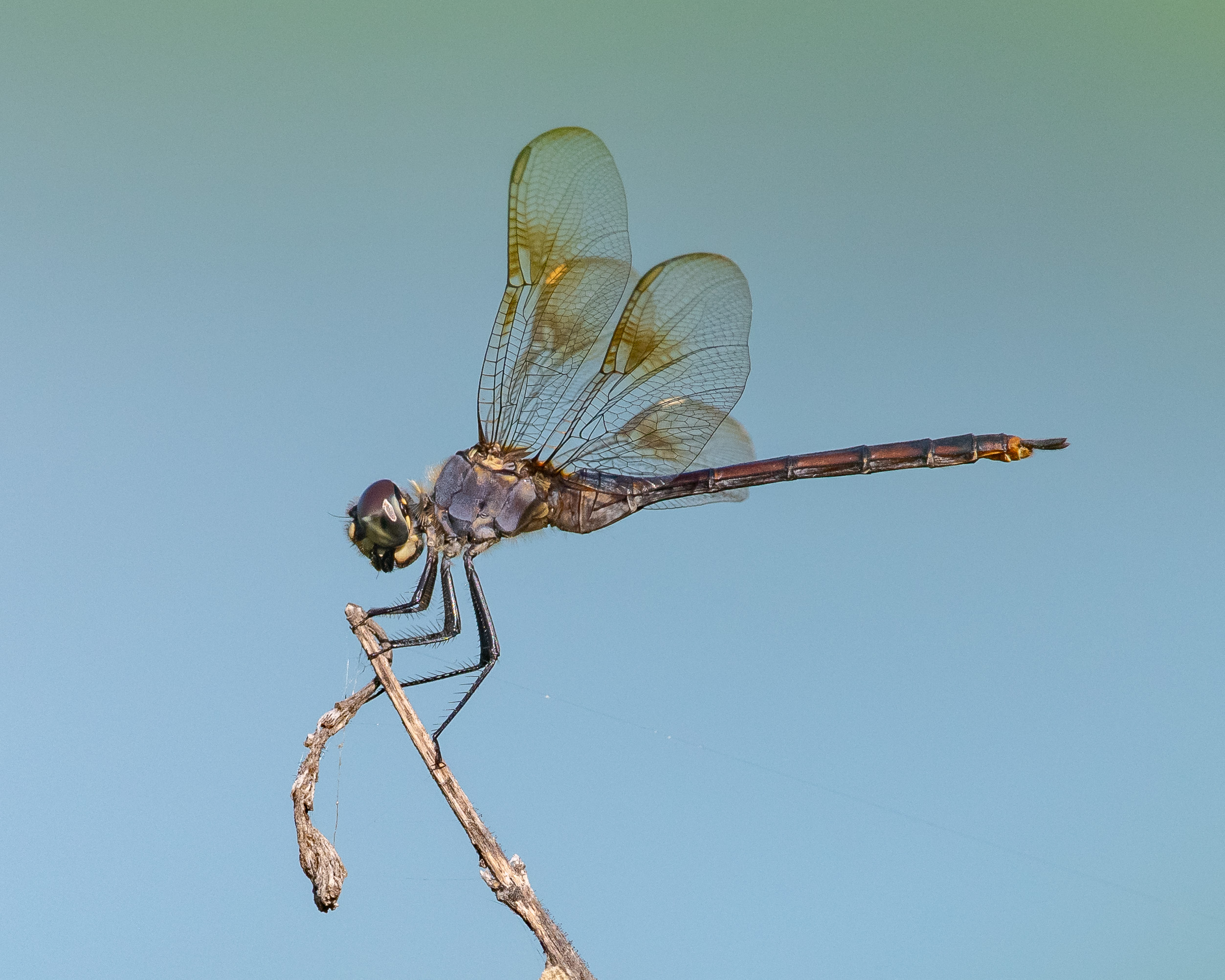
Four-spotted Pennant (Brachymesia gravida) is one of our most abundant dragonfly species. Spots/smudges on the wings and their preference for perching horizontally on bare twigs help with identification.
That eminent entomologist, the Loggerhead Shrike, generously provided a specimen for our viewing enjoyment. She only asks that we not take the Rainbow Scarab Beetle (Phanaeus igneus) from its display since she intends to invite it for dinner.

An immature male Roseate Skimmer (Orthemis ferruginea) still has the coloration of a female but will soon transform into the purple hues of an adult.

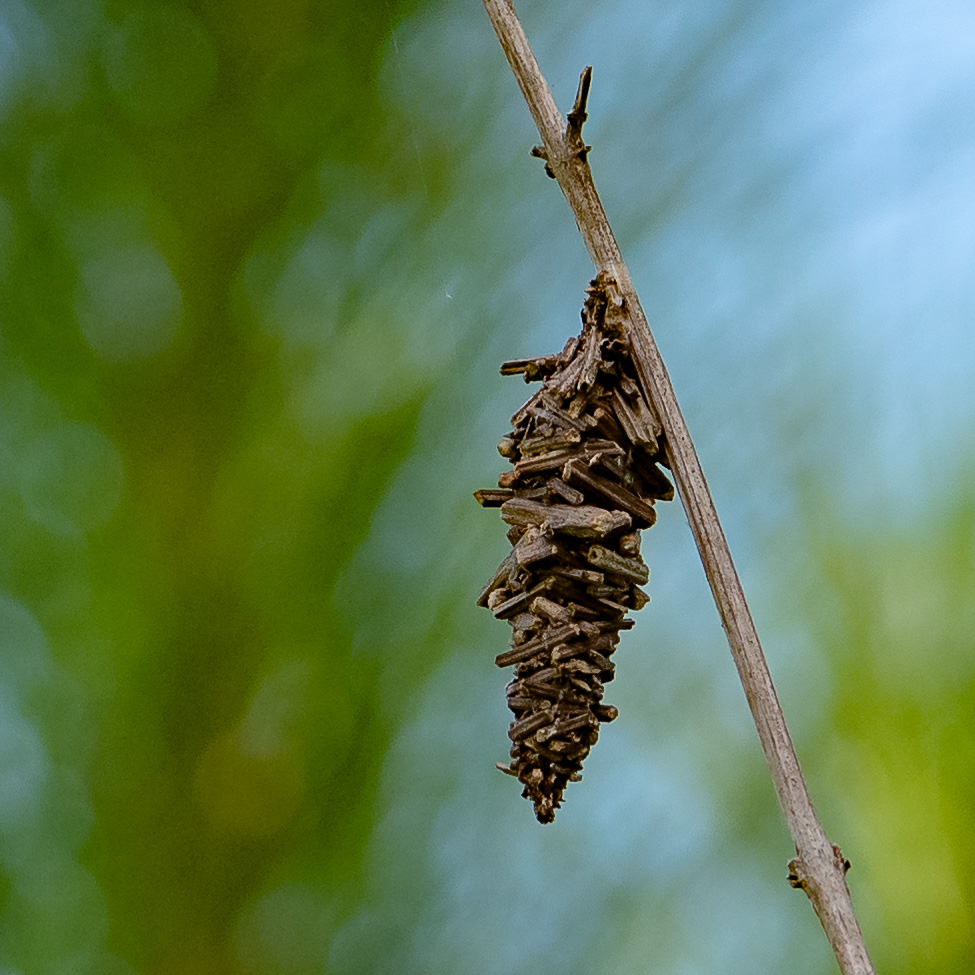
The mobile home expert of the moth world, an Abbot’s Bagworm Moth (Oiketicus abbotii) is seldom seen outside its protective case.
When the sun’s rays highlight a perching female Needham’s Skimmer (Libellula needhami), she seems to have threads of gold woven into her wings.

Tiny damselflies can be so colorful. The Rambur’s Forktail (Ischnura ramburii) takes it even further by having four different color forms. Here are a green and a blue specimen.


We opened with a candid picture of a Green Anole (Anolis carolinensis) and thought we would bid him farewell until our next visit.

Our day was filled with finding small treasures and all produced huge pleasures. In your hunt for a natural subject to enjoy or photograph, don’t forget to look for the little things which make our lives better.
Enjoy your search for a natural place and come back for a visit!
 Our Natural Places
It is often the case that small presents hold large rewards, and I’m glad you experienced just that. I appreciate seeing so many small creatures up close thanks to your efforts and macro lens. Either you are more patient than I, or your insects are more intent on posing for portraits. Ours always fly off before I can get close enough.
LikeLike
Thank you, Tanja.
Insects in Florida are on trained by the tourist industry to pose on command. Easy-peasy.
LikeLiked by 1 person
Lucky you!
LikeLike
Your photos are inspiring me to practice and learn more about close up photography like that. I especially like the one with the Bettle on the barbed wire fence.
LikeLike
Thank you very much for dropping by and saying nice things!
Warning. That “practice” thing never ends.
LikeLike
In Skiathos our friend Kostas would often repeat the phrase “slowly, slowly”, like a mantra of advice to the crazy English who take their fast moving lives to Greece and expect the locals to adapt to them rather than the other way around. No chance.
Your Assassin Bug looks rather splendid even if its title should be extended to include “eats nasties”. And that poor beetle makes for a great picture even though as you suggest the shrike kept a distance from your lenses.
I’m certain that the Green Anole is sat on the very same gatepost on which I photographed a recent Kingfisher. I suspect while I was in Greece you and Gini made a secret trip to Lancashire to take pictures of my gatepost without mentioning it to me.
Meanwhile here in the Northern Hemisphere of Lancashire Global Raining has taken hold again. Our friend Farmer Richard has taken to an expletive filled Facebook post to describe his disappointment at so much water on his land. I didn’t like to mention that the water means we won’t be able to catch him another Kingfisher for a while. He and Helen were very taken by the last one when both mobiles were quickly employed as proof to doubters that our Common Kingfisher is alive and well on quite ordinary farmland.
Luckily our rain filled week has coincided with our days filled with coughs, sniffles and early nights to shake of the dreaded lurgy. But we are promised a global warming event for September, We shall see.
LikeLike
Adapting to a slower life style has been somewhat easier as we have aged. The advantage of not being as physically agile as when younger is that my slower forward progress reveals things I would have passed by in my former hurry to go somewhere.
Skiathos sounds like a wonderful respite from our “normal” world existence.
Regarding your Kingfisher and our lizard on the same perch, since we are bloggers we thought you wouldn’t mind sharing a “post”.
Gini and I certainly hope you both heal quickly so you can resume the whirlwind lifestyle demanded of the citizens of the Empire.
LikeLike
In this little collection of tiny treasures, I’ve found all kinds of items new to me. I’m very impressed with the dewdrops on the Sulphur wing, and close-up, I enjoyed his “bed-head” hair. The Four-spotted has beautiful wings, almost fairy-like. And the Lincoln Log Moth’s house is something I’ve always assumed had a caterpillar inside, not a moth. Enjoyed the visit to your natural place, looking forward to the next!
LikeLike
Thank you very much, Sam.
Turns out, you liked all the same stuff we did.
The more we look the more we see.
LikeLiked by 1 person
What a great collection of treasures you got there Wally. The Wedge-shaped Beetle is a new one for me and I was just introduced to the Assassin bugs on a visit to the Panhandle earlier in the year – admittedly, those things creep me out big time. Nice of that Loggerhead to provide you a viewing opportunity – we more often see them displaying their rodents. Enjoyed the variety.
LikeLike
The shrike defintely earned its moniker Butcher Bird. We’ve found all sorts of things on fences and thorns on trees.
Thanks for visiting with us.
LikeLike
When I found one of those bagworm moth cases at the Attwater preserve, it reminded me of Lincoln logs. I’ve always wished to find another, but so far no joy.
I think the Loggerhead Shrikes are so interesting. I once watched one take a baby bird, then ‘tenderize’ it for consumption. Compared to that, impaling a beetle would be easy-peasy. That is one gorgeous beetle: another option for my insect-jewelry line.
Your macro photos are inspirational. I always think I’m doing well. Then, you switch lenses and I think, “Umm… let’s practice a bit more!”
LikeLike
My goal is to catch an adult bagworm moth out of the case. Best chance is when the male is ready to mate but that only lasts a couple of days. Sigh. Gini and I also call ’em Lincloln Log moths. Those were the days …
Thanks for the compliment on the photos but I think we’re all still practicing.
LikeLiked by 1 person
One thing’s certain. It’s easier to find a bagman these days than a bagworm moth.
LikeLiked by 1 person
I’ve seen a few of these small wonders this week (I stayed out all day yesterday!) and love having the time to observe them. You take the best pics though. I love the ground doves! I enlarged and zoomed! Enjoy your day!
LikeLike
Thank you, Diane.
So much to see out there. I guess that’s why we keep returning.
The day is already enjoyable.
LikeLike
Just another brief comment, Wally, as we’re trying to catch up with various matters after returning from the Isles of Scilly – a jouney that took forur times as long as scheduled – and we’ve come back to a problem with the house.
I am very impressed by both photos of the Green Anole.
Your Dragon photos are, of course, of great interest to me.
For some reason, I can’t enter a line-break on this comment.
Best wishes to you and Gini – – – – Richard
LikeLike
I see that, although the line-breaks didn’t show when I was writing the comment, they actually appeared – sort of – when published!
LikeLike
I should have waited for your second note!
Still not sure why that would happen. Where is a 10-year old when you need one? They could fix that issue without a second thought.
LikeLike
We are very sorry to hear about a house problem. Hopefully, it will be resolved quickly.
Your post looks fine. Not sure about what would cause no line-break.
Looking forward to the Scilly results. Take good care in the meantime.
LikeLike
The line break problem is WordPress’s. I’m currently consulting with their gurus about it. Eventually they’ll figure out that it’s a back end issue and fix it.
LikeLike
Thank you, Linda. I know Richard and others appreciate the information.
LikeLiked by 1 person
If you’re still having the line break issue, try this tip the WordPress gurus sent along this morning. Insert a line break using Shift+Enter. That not only worked for me, it seemed to have reset a mysterious ‘something’ and line breaks were once again possible.
Now, all is working as it should.
LikeLike
Thanks for the tip. I wasn’t having an issue but those that were will also be thankful.
Probably just another case of our machines reminding us who is in charge. (If you don’t hear from me again, you may know why …)
LikeLike
What a great collection of tiny wonders, Wally. So many are unfamiliar to me at this distance. All butterflies are beautiful and the Horace’s Duskywing is beautiful in a way similar to many moths. One does not have to be flamboyant to be so attractive. The Loggerhead Shrike has such an interesting behavior in preparing a meal. I’ve seen the bird but not the behavior. What a shame such a beautiful beetle is treated so. Your Variegated Fritillary’s beauty inside and out reminds me of our Pearl Crescent.
LikeLike
Thank you, Steve.
So much to enjoy in nature, as you are so aware. The Shrike would probably be horrified at how some of humans display our food, too.
The little Pearl Crescent is certainly a stunner!
LikeLike
Thank you for that, Linda. Your help is very much appreciated.
I see that it’s now working for me, without having to apply your work-around.
LikeLiked by 1 person
If you persist in filling your blog with wonderful insect pictures right through the colder months I will have to cross you off the my xmas card list!
Only kidding. It’s a joy to see these beauties when ‘ours’ are calling it a day, keep them coming!
LikeLike
We suffer the inconveniences of this sub-tropical swampy existence so you don’t have to. Thank you for not crossing us off the card list. Yours may be the only one we get.
Hopefully, the bugs will cooperate throughout the frigid Florida winter.
LikeLiked by 1 person
I saw once the Fire on the Mountain in the Canary Islands: awesome discovery! The green Anole is a favourite. Have a nice day!
LikeLike
It’s great to disocover new things!
Thank you for visiting with us today.
LikeLiked by 1 person
Your wordplay with “a peel” ~ “appeal” is a reminder that our word “peal,” as when bells peal, is a shortened form of “appeal.” The pealing of bells appealed (i.e. entreated, from Old French “apeler”) to people to come to church.
You got a good vantage point on the final shot of the anole lifting its head to lord it over any onlookers. Bagworm moths in their little abodes are always fun to find. As usual, you get excellent closeups of damselflies and dragonflies (or darning needles, as kids called them on Long Island in the 1950s)—and everything else.
Four successive pictures in this post show things we also have in central Texas: that assassin bug, the variegated fritillary, snake cotton, and fire-on-the-mountain.
LikeLike
Your first paragraph, Steve, expounding on my wordplay, has caused Gini to withold “pun”ishment for my sad attempt at humor. She said I apparently inspired a teaching moment. Apparently, that is a good thing. Thank you.
Thank you, also, for your kind words. It’s fun to find oddities in nature as well as observe the common.
LikeLike