Fresh From Florida!

Heat. Humidity. Hurricanes. Mosquitoes. Traffic.
Plus – the most incredibly diverse natural environment you could possibly imagine. Welcome to our home.
Gini and I were both born in the Sunshine State. Our childhoods were remarkably similar. Fond memories of trips to the beach, going fishing, picking fresh tomatoes for canning (in Gini’s case, for eating as many as possible before her Mom scolded her), earning respect of our elders, learning the value of work. Fate brought us together and the rest is (our) history.
As with most folks, we have had ups and downs and encountered bumps along life’s highway. We have been blessed that the great majority of the road has been smooth. So smooth, we often veer off the pavement to explore those dirt tracts which go who-knows-where. Ever curious, we even abandon the vehicle to hike along a remote trail or cut across a field or wander through a forest where no trail exists.
We like natural places. Thank you all for allowing us to share the results of our explorations with you.
On this day, we drove a dirt road, walked a couple of trails, had breakfast by the lake with the big cypress trees, enjoyed a cloudless blue sky while we held hands. The young Red-shouldered Hawk watched from a nearby branch and finally yelled a warning to Nature’s Neighborhood. Before we headed home, we found a few birds, some colorful insects and an unafraid Cottonmouth Moccasin.
You know. Just another day in Paradise.
A vertical pattern of tear-shaped markings identify this Red-shouldered Hawk as a first-year bird.

Non-native supporting non-native. Western Honeybee (Apis Mellifera) on Balsampear (Momordica charantia). The former, a welcome visitor. The latter, not so much.

An all-white immature Little Blue Heron will soon begin to show dark patches as it transforms into the slaty blue of an adult.

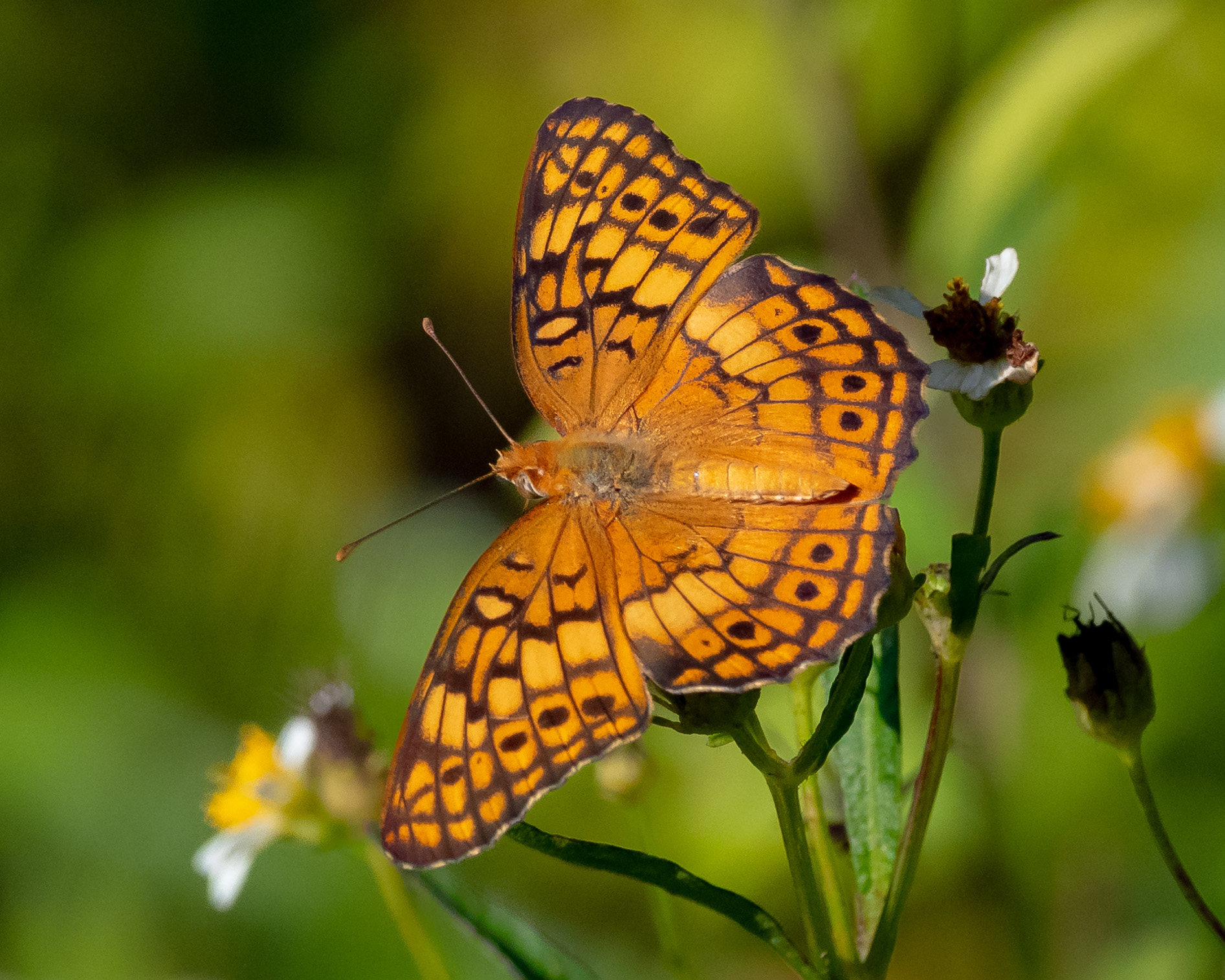
Looking like some hand-crafted precious bit of jewelry, the chrysalis of a Variegated Fritillary (Euptoieta claudia) will eventually burst to reveal a new adult butterfly.

We often see a Water Moccasin (Agkistrodon piscivorus) in our explorations. There are many other species of snakes present in the places we visit, but most scurry for cover long before we spot them. The moccasin is not very afraid of anything and more often than not will stand its ground. I asked it to please open its mouth so you could see why it’s nickname is Cottonmouth. Not today.


A small member of the sulphur family of butterflies, a Barred Yellow (Eurema daira) waits for the sun to dry its wings of morning dew.

Field guides describe the Rambur’s Forktail (Ischnura ramburii) as a “large damselfly”. To my aging eyes, “large” is very subjective in this case. Mating pairs often form a heart shape – at least to this human’s eyes.

The large Southern Carpenter Bee (Xylocopa micans) will probe blossoms for nectar or will often take a shortcut and bite the flower at its base. This female is working on a Showy Rattlebox (Crotalaria spectabilis), an invasive plant introduced in North America for a cover crop due to its nitrogen fixing properties. Unfortunately, the plant is toxic to livestock. Sigh. Another well-researched idea.


Dimunitive Eastern Amberwing (Perithemis tenera) dragonflies behave like wasps in the hope of not becoming lunch for some predator. The patterned wings are typical of the female while the male’s wings are nearly plain.

Another member of the sulphur family, the small Little Yellow (Pyrisitia lisa) is Florida’s most abundant yellow butterfly.

“The song of canaries Never varies, And when they’re moulting They’re pretty revolting.” — Ogden Nash — This Carolina Wren might well agree.

Brighter than its Variegated cousin, a Gulf Fritillary (Agraulis vanillae) was kind enough to pose on a color-coordinated Lantana blossom.

One of three all dark dragonflies in our area is the Slaty Skimmer (Libellula incesta).

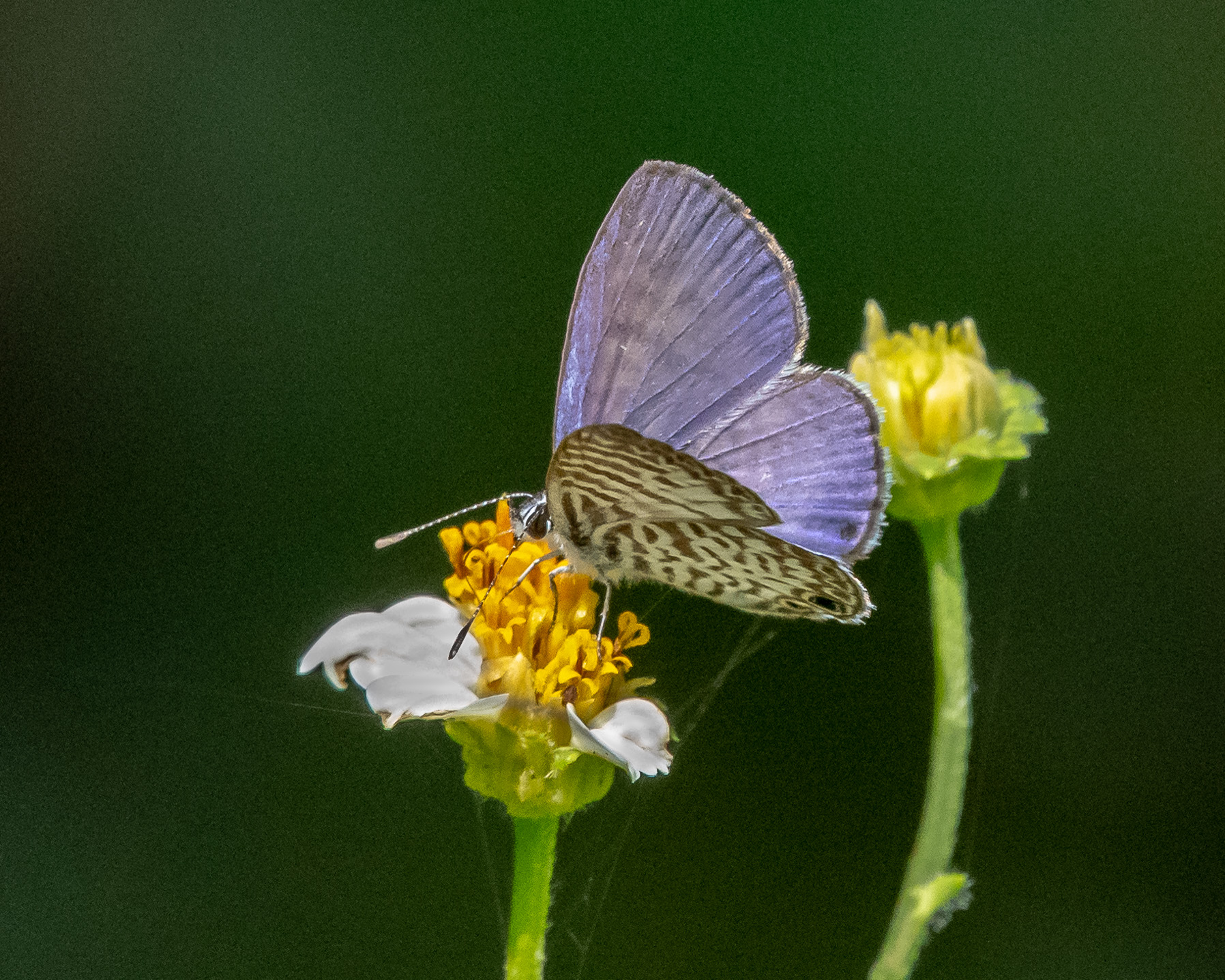
It is not often we get to see the upper wings of one of the “blue” butterflies. This Cassius Blue (Leptotes cassius) offered a very brief glimpse of its namesake color.

We know Florida is not perfect. Thank goodness, we are. (I think the correct modern techno-expression is “LOL”.) Despite the drawbacks, we love exploring our natural world.
Enjoy your search for a natural place and come back for a visit!
 Our Natural Places
Dear Gini and Wally,
I’m so glad that you ran into one another one fateful day ago, that the road you have traveled on together has been mostly smooth, and that you continue to veer off the beaten path to share your wonderful impressions with the rest of us.
May the path ahead of you continue to hold wonderful discoveries for you.
Tanja
LikeLike
I truly hit the Partner Jackpot in Life’s Jackpot. She is incredibly special in so many ways.
Most importantly she likes birds, blooms and bugs. And even tolerates me.
LikeLiked by 1 person
😊
LikeLike
Trying to get caught up from my brief absence (and take my mind off the fast approaching event). We definitely have Water Moccasins here so those I am pretty familiar with (no need for it to open its mouth for me ha). Thanks again for the distinction characteristics you provided me previously to help separate from the watersnakes from a distance. I do suck at Butterfly IDs so very much appreciate your shots and associated names.
LikeLike
Yep, I definitely prefer the “Closed Cottonmouth” species! The butterflies are challenging and it’s fun (so far) trying to learn their names.
Now, if I could just remember mine …
LikeLike
Yes, you can keep the Heat. Humidity. Hurricanes. Mosquitoes, and definitely the traffic. Unfortunately our politicians and media think that we need diversity in everything except points of view &beliefs than their own while having zero understanding of diversity in the natural world. That hawk is watching you for sure, almost as if you had a tasty morsel in your hand but I’m fairly sure that even dangerous Florida, it would not attack you.
I’m hardly back from Greece and people keep messaging me to go out ringing so I have to go. This despite Sue being full of the Common Cold that she caught must have picked up on the plane back home. I’m better out of the house and to leave her in bed with a plate of toast and a cup of English Tea don’t you think? A new friend in Skiathos, Ray by name and his wife, another Sue, estimated his input over the years as 25,000 cups of tea and toast over their 22 years together. I beat him easily.
Go on then, count.
LikeLike
We don’t mind putting up with a bit of discomfort in return for our natural encounters. Suffering politicians and their media, well, we have developed extreme avoidance measures.
We’re sorry to hear of Sue’s discomfort. Now we come to a point of disagreement. Ringing can wait. Spousal moral support takes priority. Just fix two cuppas and share while you tell her to rest easy, you’ll take care of the house cleaning.
All here is good. We hope it will be thus for you two soon.
LikeLike
Catching up on everyone’s posts out of order, I read Linda L’s post about gold and purple fall colors before I read yours featuring that lovely “blue” on the gold and white flower (some kind of thistle, all sticky with sap?). It’s a great color combination, and you were at the right place at the right time. Happy Fall!
LikeLike
Florida’s “autumn” is a bil like that of south Texas. Not much color change in the trees except from green to brown.
That little butterfly was on the smal flower of Spanish Needle (Bidens alba). For such a small bloom, it must produce some wonderful nectar as it’s visited by a LOT of different pollinators.
Here’s to “Fall” weather!
LikeLiked by 1 person
You both were obviously made for each other unlike the number of others not so fortunate. I had to experience many Ms. Wrongs (actually it is more likely I was the wrong one but that’s a different and long story) before I met Ms. Right. Good for you two.
I never really considered living in Florida because of the heat, humidity, and especially the hurricanes. But your posts are always great arguments against my hesitations. Apparently the reward is worth the price.
Unlike your snake, when I have cottonmouth most would prefer I keep mine shut. That Cassius Blue is gorgeous and lucky you to get the top wing. I wonder if that famous boxer was aware of his namesake when he spoke of floating like one. I’ve seen plenty of dragonflies and damselflies in public flagrante delicto but have yet to get a shot of one much less as nice as yours.
As always a fine and entertaining post, Wally.
LikeLike
I suspect that since Gini and I grew up in Florida, we are more accepting of the living conditions than others might be. The side benefits of the natural treasures are certainly positive.
I usually get the blues when attempting to photograph the blues. Once in awhile, they tease their beautiful upper wings.
Thank you for visiting, Steve, and providing such very nice remarks.
LikeLiked by 1 person
I miss the wonderful diversity of flora and fauna of our former home in south Florida. Here in Connecticut we are surrounded by unmanaged secondary growth hardwoods, all crowded together to shade out any new growth on the darkened leaf-strewn forest floor. Without any old trees it is less hospitable to cavity-nesting species, and there are few shrubs to harbor the nests of smaller birds or provide them cover. It doesn’t keep me from enjoying what I have, but I am a bit wistful when I am reminded of what I left behind.
LikeLike
Gini and I are both native Floridians. The military life kept us away for two dozen years and we didn’t realize how much we truly missed home until our return.
At the risk of continuing to make you feel wistful, we’ll keep trying to post a bit of our natural diversity now and then.
Take good care, Ken.
LikeLike
I thought I might have confused our Cloudless Sulphur with your Little Yellow, but I see that the large spot that’s so recognizable is differently placed in each species. I did laugh at your Carolina Wren. When my molting Bluejays showed up, I feared they were diseased. Now, they’re looking far better, with those nice new feathers.
I’ve seen damselflies in heart-shaped flight; it’s great fun to see them wheeling around. This week, it’s been dragonflies: thousands of them. I used to think they always were hatches, but then I learned that there are species that migrate through our area, especially the Green Darners and Wandering Gliders. A couple of times our National Weather Service office has posted radar images of them: great clouds of insects on the move.
I finally found my photo of an unidentified snake from the Brazoria refuge that has about the same length as yours, and the same body shape. It was in the middle of the road, but I wasn’t brave enough to get close for a good photo of its pattern. More research is required! The water snakes and rattlers are easier to identify. I did come nose to nose with a snake a couple of weeks ago. I was lying on a boardwalk to take a photo of a plant, and when I moved a bit to get into a better position and looked over the edge — whoops! It was early and the snake was lethargic. I wasn’t.
LikeLike
To make sulphur matters even more confusing, some of them change their appearance depending on wet or dry season. No fair!
When still new at the bird watching hobby, I asked a friend why we didn’t hear the Meadowlarks in August. He explained during molting they have very limited ability to fly so kept vewy vewy quiet.
Clouds of dragons fuels the imagination.
Although I chased snakes when I was younger and not as wise, today I prefer to admire them from afar. Granted, many of the serpents have not yet received the memo. Adrenaline is our friend.
LikeLiked by 1 person
Thank you for sharing. I enjoy following along with you and Gini. I see and / or learn something new every time!
LikeLike
Oh, no, Ed! We didn’t mean to be teaching anyone anything!
It’s okay. We’ll just try to keep doing what we do and if you accidentally learn stuff we won’t tell.
LikeLike
The Little Blue Heron is a favorite and fun to see when it’s young! Love the blue (lavender) in the butterfly. They look lavender when they fly but it’s impossible to get a good photo. Love living here and enjoying so much nature. We are fortunate to have so much nature to enjoy. And holding hands? Life is good!
LikeLike
Thanks, Diane.
Nature does offer us a buffet every time we venture out. Selecting which item to enjoy first is a challenge, but since I’m insatiable, I try to scoop it all up.
Yep. Life is not only good, it keeps getting better.
LikeLike
Thank you for this brilliant tour peppered with a whole lot of anecdotes, Wally.
I’m a big fan of Ginni and you, and of course Our Natural Places.
Danke!
Have a brilliant weekend, my friend.
LikeLike
Gini and I really appreciate your gracious comments, Natasha.
The weekend is off to an unusually fabulous start. Good things to share in a future post.
LikeLiked by 1 person
Can’t wait. Smiles and sunshine. And a welcome burst of Autumn. 🙂
LikeLike
Wonderful photos! I have a photo of a hawk in my frontyard tree. I’ve been calling him a Cooper’s Hawk. He definitely has the distinctive tear-shapped markings. Is the Red-shouldered the only one with that characteristic?
LikeLike
Thank you, Peter.
Your hawk could definitely be a Cooper’s as their markings are very similar to a Red-shouldered. Other immature raptors show plumage like this, too.
Bird guides, location, time of year – fun stuff!
LikeLike
A very brief comment on this beautiful post, Wally, as I am away from home and without a computer.
Fabulous photos as always, but I am concerned for your safety when I see close-ups of that Water Moccasin.
My very best wishes to you and Gini. Please take good care – – – Richard
LikeLike
No worries, Richard. Telephoto lenses were invented for those of us who love all of Nature’s creatures, even the potentially dangerous ones!
Be safe on your journey.
LikeLike
Awash with butterflies and not short on dragons either, that was a nice little excursion. Our insecty friends are rapidly calling it a day over here, the year is turning.
Like the snake but I prefer the ones that don’t stand their ground.
LikeLike
Hope you’re able to catch a few more bug outings before they all head for their winter’s pub. We’ll try to keep sending a few shots of them to carry you through the season.
I don’t mind snakes that stand their ground as it makes it easier to take their picture. However, I would prefer the ones not carrying a couple of hypodermic needles for teeth which are filled with venom. I see enough doctors already!
Thank you for taking time to visit, Brian! (You still have me thinking of Deutschland.)
LikeLiked by 1 person
I suspect most people don’t know that honeybees aren’t native to the United States. (I didn’t for most of my life.) The only other sort of bee people are likely to know is the bumblebee, even though there are so many other kinds.
As usual, your insect closeups are right on (an expression lingering from the late 1960s). You’re also right about the color-coordination between the fritillary and the lantana, with all that surrounding green serving as a good complement.
LikeLike
I suspect you are correct about the honeybees. Like you, it wasn’t that long ago I discovered the sweet truth.
At some point, I was semi-fluent in ’60’s lingo. Alas, my language recognition skills have deteriorated with age. Along with several other faculties.
Happy coincicidences of nature’s photo targets color coordinating backgrounds are always welcome.
LikeLike
Great shots of all the little critters. That snake is fabulous.
LikeLike
Thanks, Dina.
If nothing else, at least the moccasins hang around a bit to pose. Wait, is that a good thing?
LikeLike
Sigh. Many of your images refused to load more than a tiny snippet for me. The cottonmouth looked as if it wasn’t going hungry and I love the damselfly heart.
Thank you for sharing the beauty and the wonder.
LikeLike
We’re so sorry about the technical glitch, EC. I am not certain as to the cause. My tech expert son-in-law says, when in doubt “clear cache/restart”. Otherwise, I am, sadly, at a loss.
LikeLike
Absolutely love all the butterflies in your post. And I never realised that the mating Damselflies make up the shape of a heart…but that’s true! 😃
LikeLike
Nature offes us so much to enjoy.
Thank you so much for your visit.
LikeLiked by 1 person