Combination and Repetition
Header Image: Common Ground Dove
“It’s orange!”
The mistress of understatement flung her index finger toward the top of a small tree. I followed the track and located the indicated insect. It was, as described, orange. Not only that, it was something new, to us. The bright bug was a Clay-colored Leaf Beetle (Anomoea laticlavia), in the Family Chrysomelidae. There are over 1700 species in that Family, many of which have not yet been named.
Another day of enjoyment and discovery was in progress.
There has been discussion here and there about how similar some species in one area may be to those in a completely different geographical region. Flowers we see in Florida we are certain we encountered in Texas. Except, there are differences. The Black-capped Chickadees we enjoyed in upstate New York certainly appear similar to Florida’s Carolina Chickadees. But, that song?
Nature teaches us about survival. Along the way, if we remain open to learning, she also teaches us that knowing the differences among species may not be our most important task. Observe, instead, the similarities. That may be the key to our own survival.
Incredible variety in our exploration keeps Gini and I returning to field, forest, swamp, coast – outside – not only to discover a new, colorful beetle. We relish the familiar with the same amount of excitement and wonder.
Imitation being the ultimate form of flattery, a beautiful Viceroy (Limenitis archippus) apparently likes the looks of a Monarch (Danaus plexippus) and really hopes you don’t want to eat one!

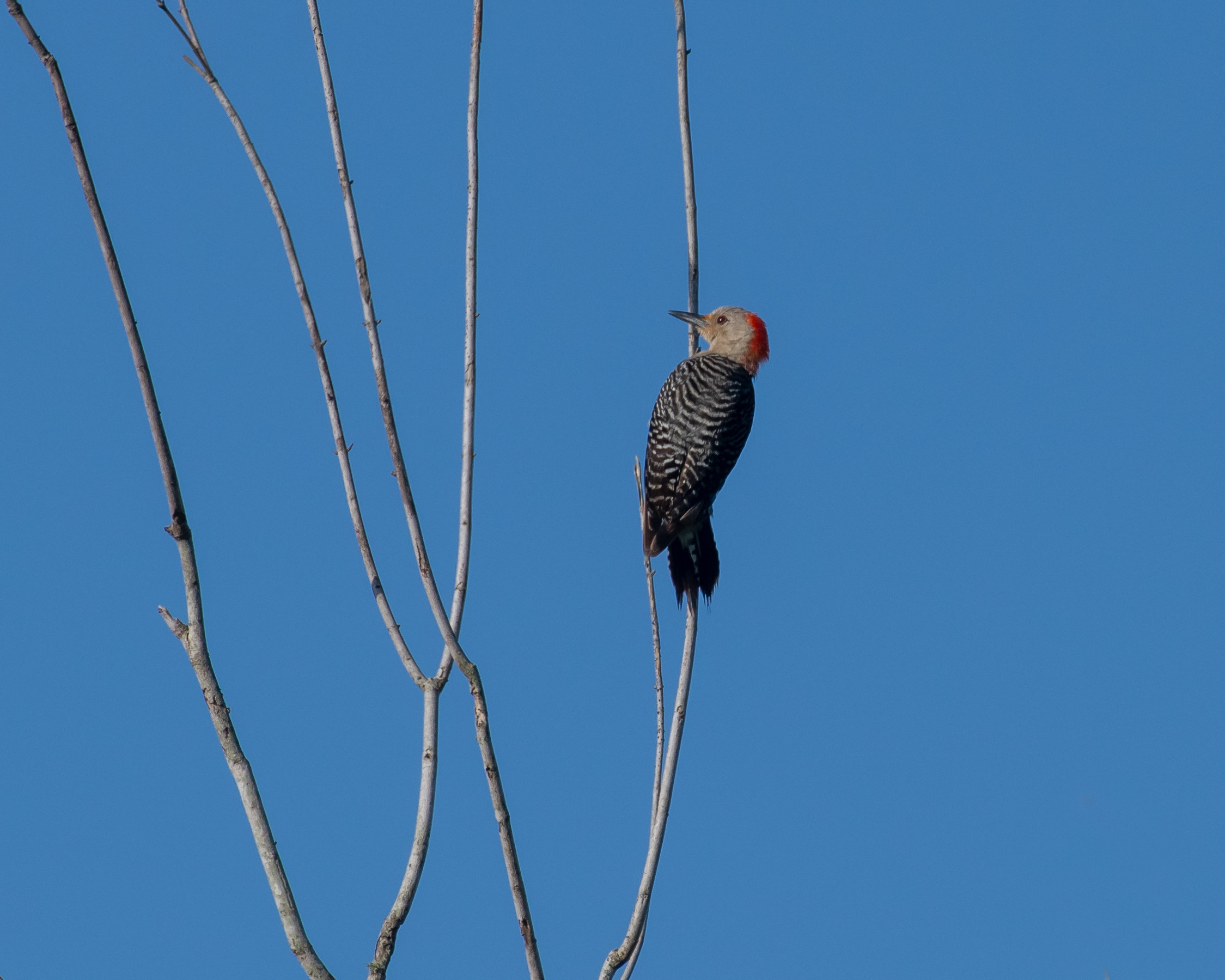
Sneaking around in the woods is not really possible with the local Neighborhood Watch on duty. A Red-bellied Woodpecker wasted no time alerting the locals to our presence.
It’s a Dragonfly! It’s a Butterfly! Nope. Another new creature for us: it’s an Owlfly (Ululodes spp.)! They are efficient hunters of little insects such as mosquitoes – I really love our new discovery!

Feay’s Palafox (Palafoxia feayi) is a unique plant in the Aster family. Endemic to Florida, it’s found only in the central and southern part of the peninsula.

One of those “familiar” individuals we talked about earlier, a small Eastern Amberwing (Perithemis tenera) survives by emulating the flight of a wasp. Who would want to eat a wasp?

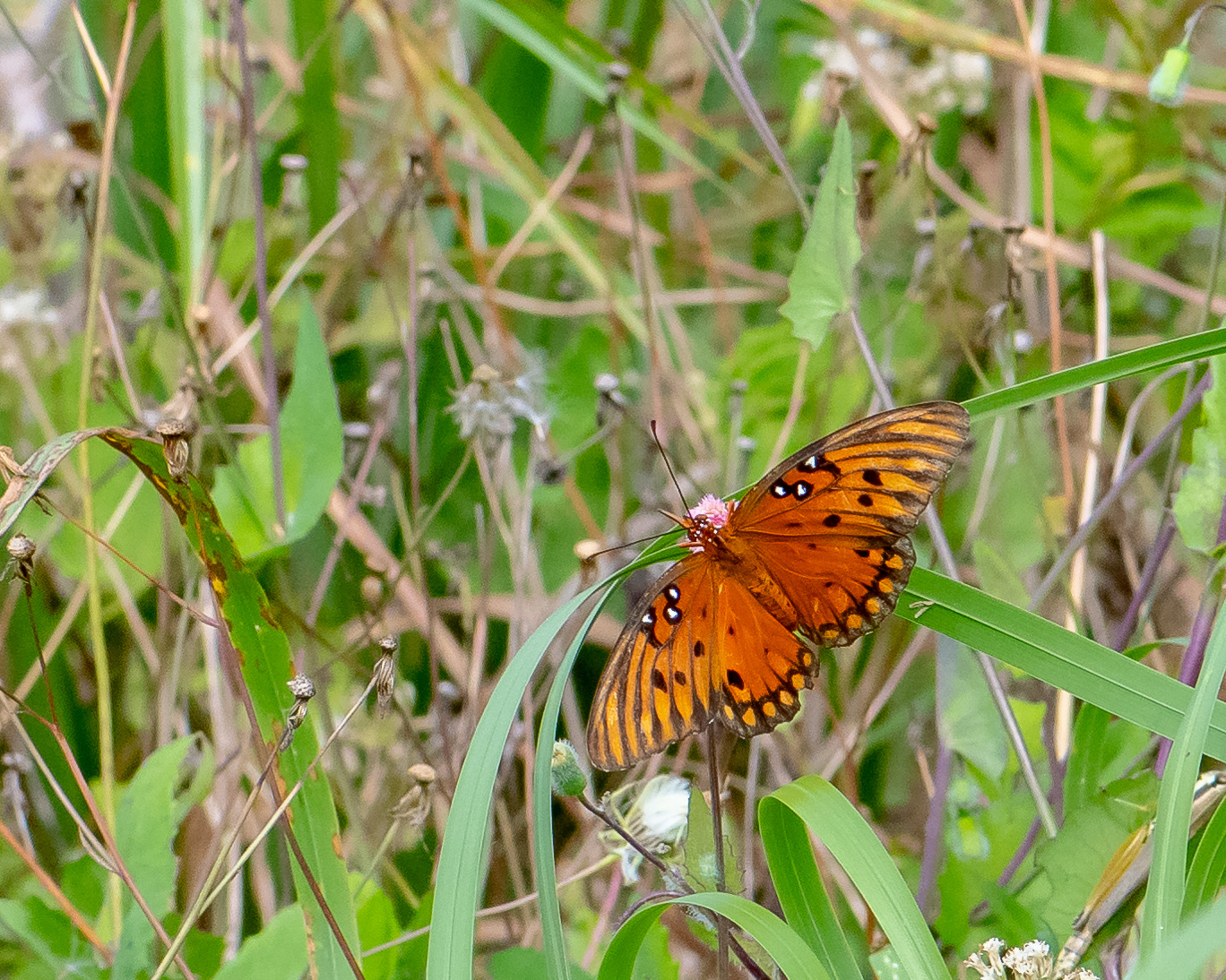
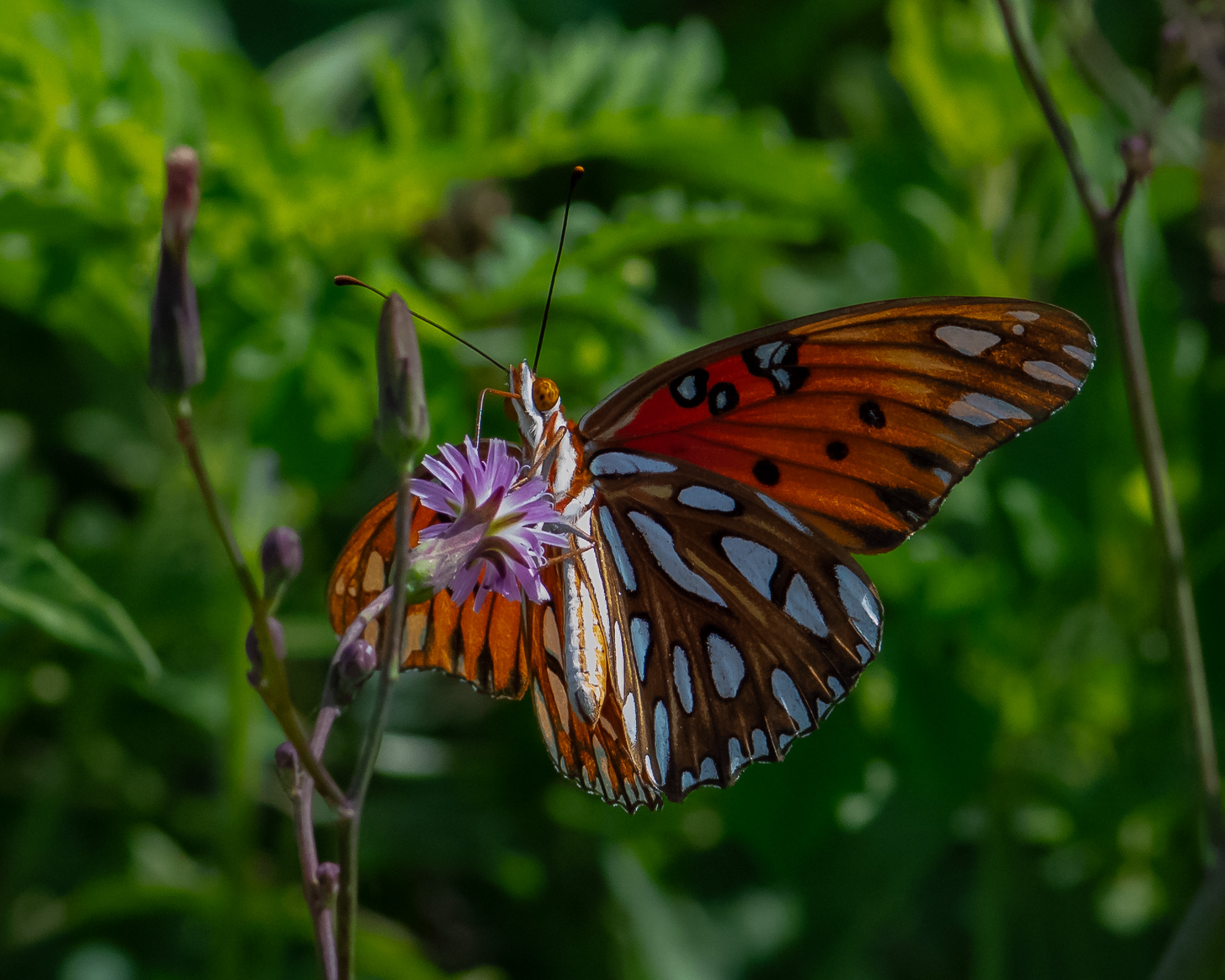
Orange was prevalent throughout the morning. One of the most commonly encountered butterflies in this area is the Gulf Fritillary (Agraulis vanillae). Many were active today and we even chanced upon a larva, hiding under a twig.

In the “not as bright orange” category, is the Variegated Fritillary (Euptoieta claudia). Upper wing color can vary from orange to almost brown. With its wings folded up it can look like a dead leaf. Who would want to eat a dead leaf?


Another plant found only in Florida is the Florida Alicia (Chapmannia floridana). It’s buttery blooms are favored by many pollinators, especially the Southern Carpenter Bee (Xylocopa micans).

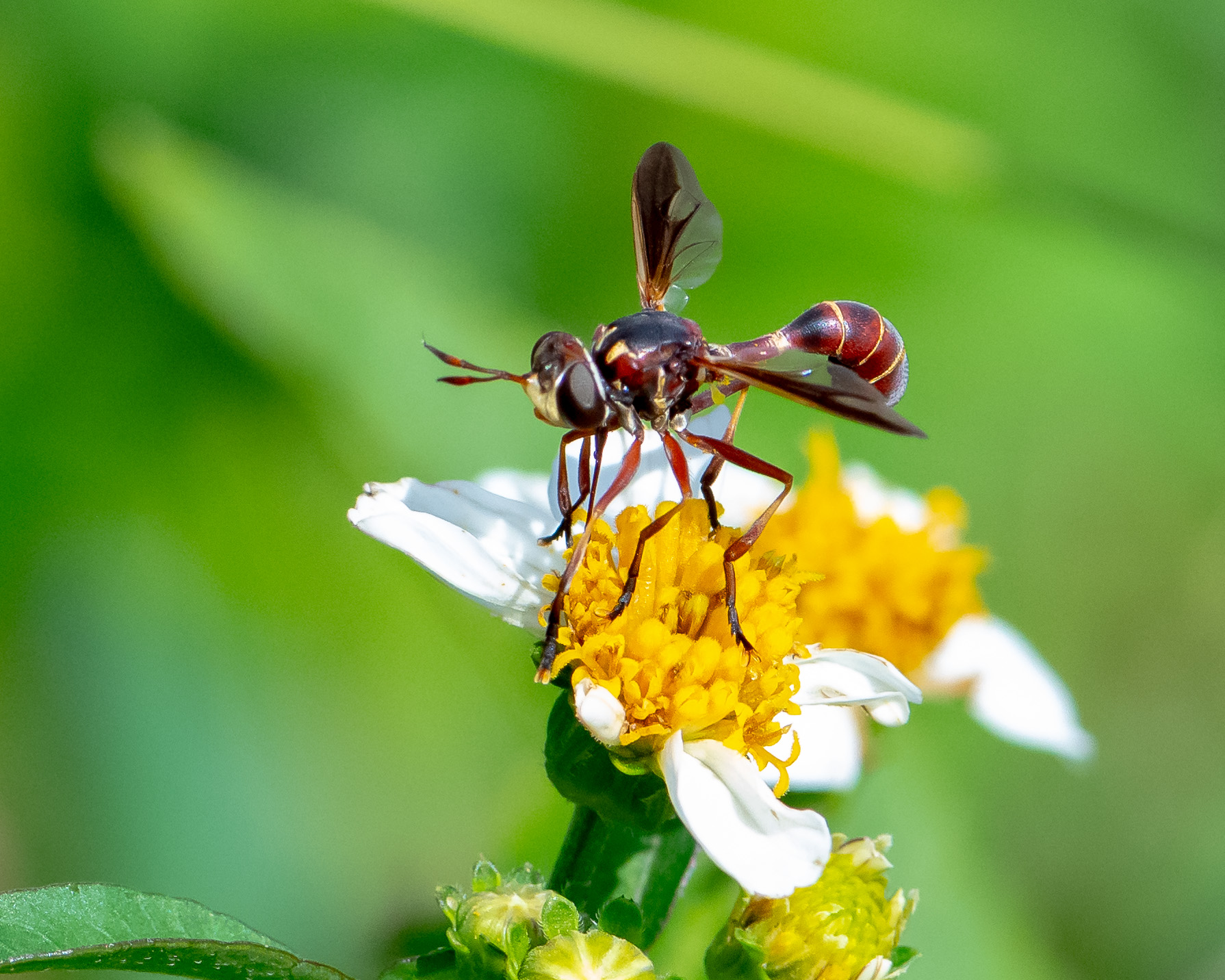
You may be tired of hearing this, but – we found another new bug! This Thick-headed Fly (Physoconops species) is striking in its beautiful appearance as well as its initial resemblance to a wasp. And who would want to eat — you know.
One day, no white butterflies. The next day and they seem to be all over the joint! It’s okay. We’ll look at as many Great Southern White (Ascia monuste) butterflies as Nature will allow. The female is a bit darker than the male.


We already introduced this superstar, so we won’t put you through that “new bug” thing again. At least this Clay-colored Leaf Beetle (Anomoea laticlavia) was a cooperative model. Appearing pure orange at a distance, closer inspection revealed some stylish striped underthings.

To answer the burning question you all have: “Who would want to eat THAT??” – we give you that daring diminutive damsel — Rambur’s Forktail (Ischnura ramburii)!

“Nature is an endless combination and repetition of a very few laws. She hums the old well-known air through innumerable variations.”
– Ralph Waldo Emerson
Our morning was filled with Nature’s variations on a theme. We know the melody. We’re familiar with the rhythm. The words change with the season and the location. We truly hope you each find your very own special combination and repetition of a song Nature intends you to hear.
Enjoy your search for a natural place and come back for a visit!


This was an enjoyable read, love the new stuff, and lots of great images. I am like you, kinda sorta, in that I still get excited by the old been there done that critters. Maybe a little more excited when I find a new to me bug or plant, but still get a thrill from a Monarch, an Autumn Meadowhawk, or in the springtime Painted Trilliums and Lady’s Slippers. They are all old friends and who isn’t happy to encounter one of those? But we do love us a new friend too. Great post, Wally!
LikeLike
Thank you very much, Steve.
Greeting old friends in Nature is comforting. Meeting new ones is thrilling!
LikeLike
What a fun outing! AS I am not versed on plants and much less insects I cannot comment on the regional nuances of those, but I can say those tiny differences in the bird world are one of the aspects that makes birding so enjoyable (apparently the same holds true for the other gems of nature). I had to chuckle at your woodpecker comment – reminds me of the Killdeer which do the same “global announcement” whenever they catch me even flinching. I actually learned about the Viceroy when I was much older – always mistaking them before that as the Monarch – nothing like acting like a toxic insect to improve your longevity ha. Thanks for all the insect education, I have a long way to go there.
LikeLike
Yep, all those little differences keeps it interesting.
I’m somewhat like the Viceroy. I exude a toxic personality which may prolong my longevity as I continue my fairly anti-social existence.
LikeLiked by 1 person
“We truly hope you each find your very own special combination and repetition of a song Nature intends you to hear.”
Amen to that Wally. Your blog always infects me with a vibe that’s innately joyous and radiant.
I recently discovered the Owl fly on our wildlife group and found it dazzling beyond words. Though I am yet to spot one. Soon enough, now that I have intended it out to the universe.
Love all your images. I forget which camera you use. Think you shared once.
Glad to be back here after aeons.
Have a fabulous new week.
LikeLike
Thank you, Natasha, for your very kind words.
Good to see you back. May we both have more Owl Flies in our future!
LikeLiked by 1 person
The analogy to humming the same old song and changing a few words applies to my experience in Florida. Over a 16 year period I birded the same local patch (West Miramar Water Conservation Area aka The Wounded Wetlands) and tallied 183 species. On average, I added a new “word” once every 12 trips. Anything but boring!
LikeLike
That’s exactly the feeling I had when I read Emerson’s words, Ken.
We return to the same areas, see the same birds, occasionally find something new and just keep humming along.
Hope your weekend is a good one.
LikeLike
I should have added that I submitted 1520 eBird checklists from that location over the 16 years.
LikeLike
Wow! That’s impressive.
LikeLike
What a wonderful way to illustrate Emerson’s quote: with your own superb photos and lyrical musings. Thank you!
LikeLike
Danke, Tanja.
It can be instructional to apply thoughts from those who lived before to our current exploration of the very same world.
Life is good.
LikeLiked by 1 person
I’m so glad you feel that way.
LikeLike
An excellent collection, and the culinary theme tickled me. What a beautiful bug that Rambur’s Forktail is, and that was a fantastic shot with the prey in hand (so to speak).
LikeLike
Thank you, Sam.
Gotta have a little fun while we’re out there working so hard.
Tiny damsel with a really tiny snack.
LikeLiked by 1 person
Although this post from you, Wally, is showing some species with amazing ‘differences’, I could not help but also reflect on the similarities too, so thank you for raising, once more, this interesting subject, which you and I have touched on from time to time.
For me, the Owl Fly was the star of the show. I don’t recall seeing a photo of one before, and it got me doing a quick Google search. I see that it comes under the Antlion family.
So pleased to know that Gini is recovering well.
We’ve enjoyed a brief break in the inclement weather this week and the wildlife seems to be appreciating it as mush as we are, but it’s all set to go downhill from today with low pressure taking charge again. Looks like it might just be a three-day summer!
Best wishes to you both – – – Richard
LikeLike
Good Morning Richard!
When I first spotted that Owl Fly I fixated on the wings for a moment and thought it was an adult Antlion, which we’ve seen in the same area. Something different is always fun to find.
Our summer continues to be like those I recall when I was foolish enough to play in drainage ditches during the rain. Oh, wait. I still do that.
Early morning outings are the ticket as heat, humidity and dark clouds build before lunch time.
Gini thanks you for the well-wishes. We both hope you and Lindsay have a brilliant weekend!
LikeLike
What a wonderful variety of insects and butterfly’s. I have not seen to many butterfly’s this year. I think just two monarchs were hanging around here off and on. 🙂
LikeLike
Thank you, Sandra.
They do seem to like our sub-tropical environment!
LikeLiked by 1 person
You captured the great details in those tiny critters. That beetle is beautiful!
LikeLike
Thanks, Dina.
Gini found a nice model. Didn’t fly away and its makeup was perfect.
LikeLike
Hello pals. It’s good to hear that Gini is near back to normal. I think she probably had a caring and expert nurse at her side, bending to her every command.
I agree about the differences in a species, a phenomenon that I have seen and heard in regional bird accents. I kid you not. The song of e.g. Goldfinches, Yellowhammers and Chaffinches plus others can vary in even a small island like the UK. A Scottish Chaffinch song sounds alike but somewhat different to an English Chaffinch. Well why not? My Lancashire dialect/accent is quite different (and more refined) to accents just 50 miles over the Pennines in White Rose Yorkshire. And have you ever tried to understand what a Geordie or an Irishman is saying? Not to mention a Glaswegian.
I am a little worried about your looking at the edibility of so many of those bugs. Did you not take your lunch with you that day? And don’t you dare eat that Clay-coloured Leaf Beetle – it is too good looking to be eaten, even by a bird. And I know how the Thick-headed Fly feels, I have much the same symptoms on a Sunday morning. Good news though. It seems that here in the UK the short-lived craze for vegan food is taking a hit because not only is it expensive but it also tastes vile. Who Knew?
Here in the Wild West we are now enjoying another period of global infernos but they are due to end on Friday evening with rain. Almost a week without is pretty good don’t ya think?
LikeLike
She is a quick healer. As for that nurse – she wouldn’t let me hire one of those caring and expert ones you mentioned so she was stuck with me. Poor thing.
When we lived in Germany, I learned some “conversational” German from our landlord. I was perplexed that the blokes at the local pub and merchants couldn’t understand me. The landlord finally let me know, “by the way, you do know I’m Czech?”. High German, Bavarian and my slavic-slang was an interesting mix.
But we were promised crickets shall be the new beef. Thought we might get a jump start. We’ll soon go from hearing crickets to herding them. Beetles? We’ll just keep spinning their old vinyls.
Regarding the vegan crazies, err, craze – our rancher friend south of town advises all who will listen that since his cattle consume grass and grain they are actually a plant-based food.
A week without rain? We call that “Winter”.
Take care. Eat a steak.
LikeLike
Speaking of splitters, I wonder if the species-splitters didn’t show up to recategorize the Florida Alicia. I recognized it as a member of the pea family, but when I went to find a bit more information, I discovered it’s the only species in its genus. Do you know who Alicia was?
Like others, I’d never seen, heard of, or imagined an ‘owl fly.’ What a neat find, and what a useful creature; anything that eats mosquitoes is to be encouraged.
The highlight of this post for me is the Clay-colored Leaf Beetle. It’s such a cool thing. In your photo, it almost looks made of lucite; it reminds me of a child’s toy, like the plastic ‘Cooties’ we played with as kids. The name perplexed me a bit, since it doesn’t look at all clay-colored. I discovered that it’s also called the persimmon beetle, since it enjoys feeding on persimmon trees; that name seemed to fit its color. But then I looked a little further, and discovered that its larvae are what’s called ‘case-bearing’ — they run around encased in frass and leaves. Behold: at they larval stage, they truly are clay colored.
LikeLike
I’ve tried a couple of times to find out who Alicia was but no joy. I’ll reach out to my resident botany expert, my brother, who lives in Apalachicola where there is a museum honoring Chapman.
Been trying to find an Owlfly forever! Actually, I was headed toward that Florida Alicia to get a picture when I spotted the critter taking a nap.
When I told Gini the name of the beetle she said: “Hmmm, country Georgia road red clay-colored maybe.” Like you, I found the larva to be the likely reason for the moniker.
Nature is fun!
LikeLiked by 1 person
Nice assortment Wally. I, too, have noticed the subtle differences in Chickadee songs. In the past year I’ve been lucky enough to hear three of them: Black-capped, Carolina and Mountain. The songs are similar, but different enough for my brain to say “Hey, that’s different.”
LikeLike
Thank you, Brad.
We all seem to have shared impressions which remind us of something familiar.
At my age, most of my actual memories are fading into vague impressions!
LikeLiked by 1 person
Your advice to emphasize similarities rather than the differences brings to mind the species classification controversies that take place between the so-called splitters who favor more species and the so-called lumpers who favor fewer.
I see that the Emerson quotation comes from an essay called “History,” which begins:
“There is one mind common to all individual men. Every man is an inlet to the same and to all of the same. He that is once admitted to the right of reason is made a freeman of the whole estate. What Plato has thought, he may think; what a saint has felt, he may feel; what at any time has befallen any man, he can understand. Who hath access to this universal mind is a party to all that is, or can be, done; for this is the only and sovereign agent.”
The line you quoted comes from this paragraph:
“Every one must have observed faces and forms which, without any resembling feature, make a like impression on the beholder. A particular picture or copy of verses, if it do not awaken the same train of images, will yet superinduce the same sentiment as some wild mountain walk, although the resemblance is nowise obvious to the senses, but is occult and out of the reach of the understanding. Nature is an endless combination and repetition of a very few laws. She hums the old well-known air through innumerable variations.”
LikeLike
Shouldst thou wish to read the essay, here ’tis:
https://tinyurl.com/p7wzztpz
LikeLike
I have bookmarked it for later enjoyment. Thank you.
LikeLike
Steve, thank you for the expansion of the essay from which the quote was extracted. It helps emphasize the theme I was trying to describe.
LikeLike
Fantastic selection of images!
LikeLike
Anything that eats ‘squitoes has my vote. And the owlfly is beautiful too. Megathanks, for yet another delightful outing.
LikeLike
Some bugs are definitely “better” than others.
Thanks for dropping in, EC.
LikeLike
Te owlfly is simply owl-some. I did not absolutely know it.
LikeLike
It really is unique! We’ve been trying to find one for years, and then – there it was.
Have a wonderful day!
LikeLiked by 1 person
Thanks. The same to you..
LikeLike