Beyond The Bridge
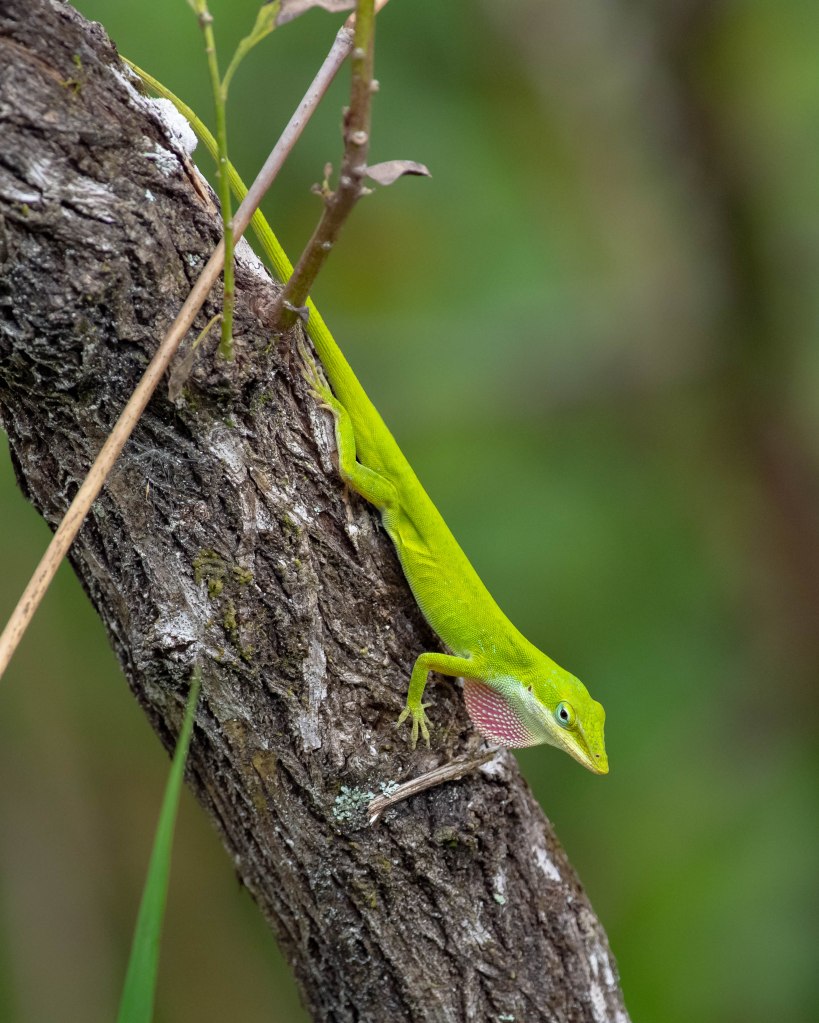
Header Image: Green Anole (Anolis carolinensis)
Why does a plain boiled egg taste better when consumed under the branches of a huge oak tree in the middle of a forest where no sound of man can be heard?
Following our wading bird extravaganza as we paused at one end of the old bridge over the Little Withlacoochee River, we found a nice clearing for brunch just beyond the other end. Lush Resurrection Fern (Pleopeltis polypodioides) adorned almost every tree branch in sight. From the depths of the woods around us came the songs of Northern Parula, Carolina Chickadee, Tufted Titmouse, Common Ground Dove, Downy and Red-bellied Woodpecker and a White-eyed Vireo who didn’t stop calling the whole time.
We drove along old logging roads about a dozen miles, stopping often to walk a bit down trails, examine small creeks and to admire flowers as well as the pollinators visiting them. A lazy morning which ended all too quickly. If I was a better naturalist, I could talk about how there was a visible difference as we passed through changing habitat. Standing water, damp ground above water, sand, mounds which may have been man-made, diverse plant communities signifying the various ecosystems.
Instead, I just enjoyed being with Gini for an outing. Science shall have to wait. There are birds to hear, flowers to smell and bugs to chase. We are content.
Just as we reached the opposite end of the bridge, a lone Climbing Aster (Symphyotrichum carolinianum) bloom poked above the bridge railing. Investigation revealed a few more blooms hiding in the shadows under the bridge. This plant has vine-like tendencies but has no tendrils. Instead, it relies on other structures such as trees or a bridge for support. Although it blooms all year, peak season is autumn.

Even one-legged grasshoppers enjoy the beautiful Trumpet Creeper (Campsis radicans) blooms. I think this may be an Atlantic Grasshopper (Paroxya atlantica), but would love any correction to my guess.

Crinkly lavender petals dotted several areas of the open forest. Wild Petunia (Ruellia caroliniensis) is actually a member of the nightshade family. Along with a thirsty hoverfly, we don’t care what it’s called. It’s absolutely lovely.

For several years, scientists were concerned the population of native Green Anoles (Anolis carolinensis) was being impacted by the invasive Brown Anole (Anolis sagrei). Further research is needed, but it appears the smart native lizards change their habits when the invaders show up. It’s believed they simply move higher in the tree canopies where the visitors don’t frequent. Time will tell. (Please – don’t release any non-native species into the wild. Plant or animal.)
A tall plant with little yellow “bells” grabbed Gini’s attention. We found four specimens of Yellow Colicroot (Aletris lutea). Although a common species, we don’t recall ever seeing one. Most of the plants were nearly three feet tall.


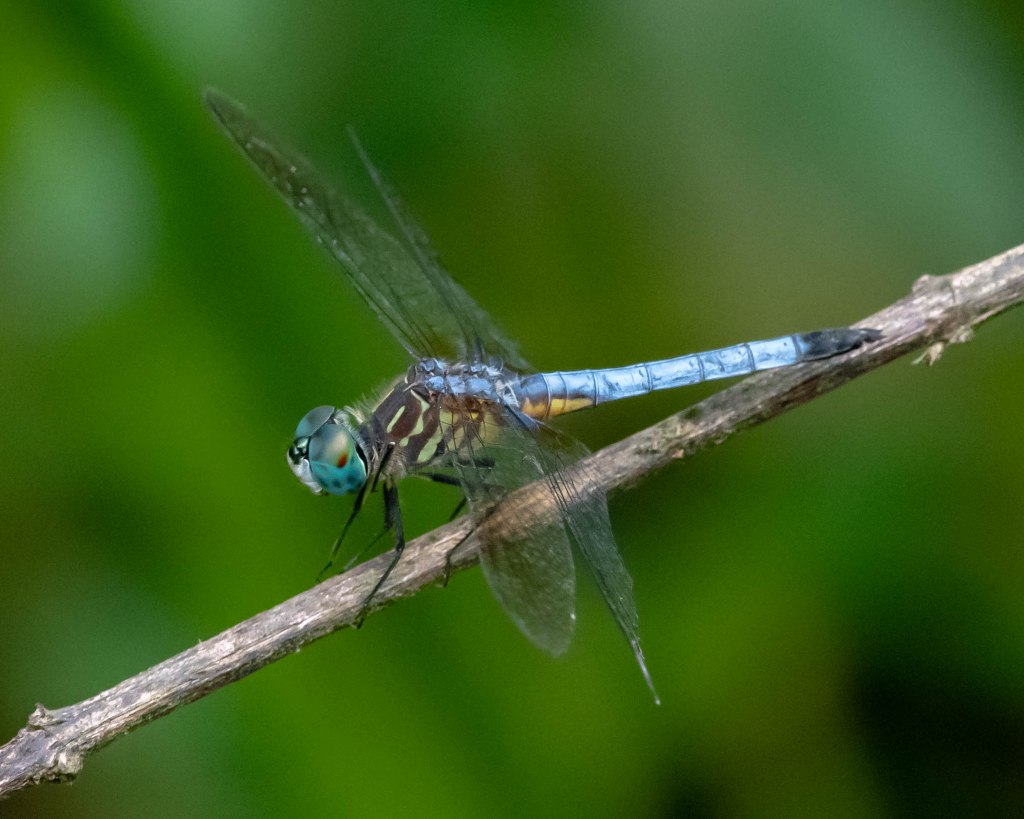
We saw quite a few dragonflies during the morning. Most, as usual, were camera shy. This Blue Dasher (Pachydiplax longipennis) took pity on us and allowed a portrait.
The Northern Parula is an abundant woodland warbler which breeds in Florida. Males, such as this one, have a distinct dark blue/black and orange band across their breast.

An attractive plant with a not-so-attractive common name, the Tarflower (Bejaria racemosa) is an abundant sight in our summer pine forests. These plants can grow in excess of eight feet tall and nearly as wide. That common name is a result of much of the plant, especially the flowers, having a very sticky substance which is as strong as commercial flypaper. Insects can be trapped in the sticky stuff but the plant is not insectivorous. Botanists believe the Tarflower uses a defense system to keep hungry bugs from damaging or destroying it. Tricky business for pollinators to navigate in and out of the pretty and aromatic blooms!


One of our largest dark butterflies is the Palamedes Swallowtail (Pterourus palamedes). Several butterfly species can be observed appearing to “drink” from sand or mud. They apparently are extracting mineral nutrients in this manner.

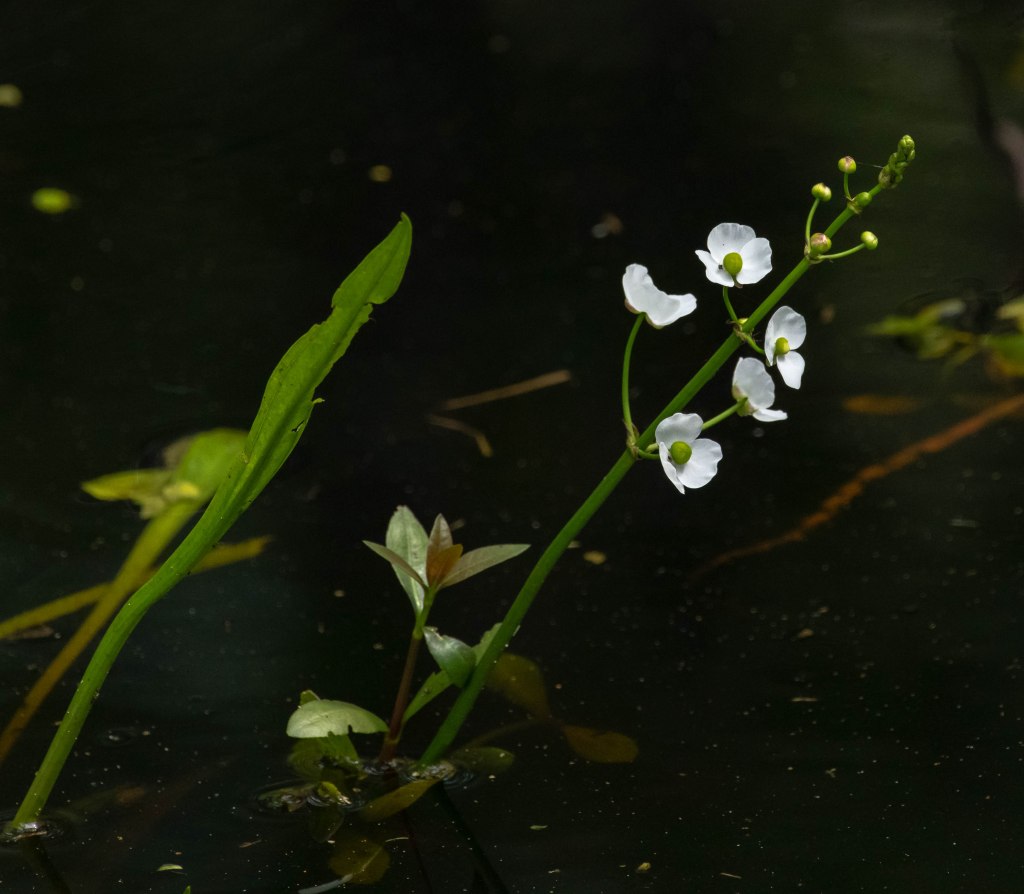
Abundant in our many lakes, we were a bit surprised to see Bulltongue Arrowhead (Sagittaria lancifolia) rising from a very small woodland pool which was in a spot that would seem to receive little sunshine.
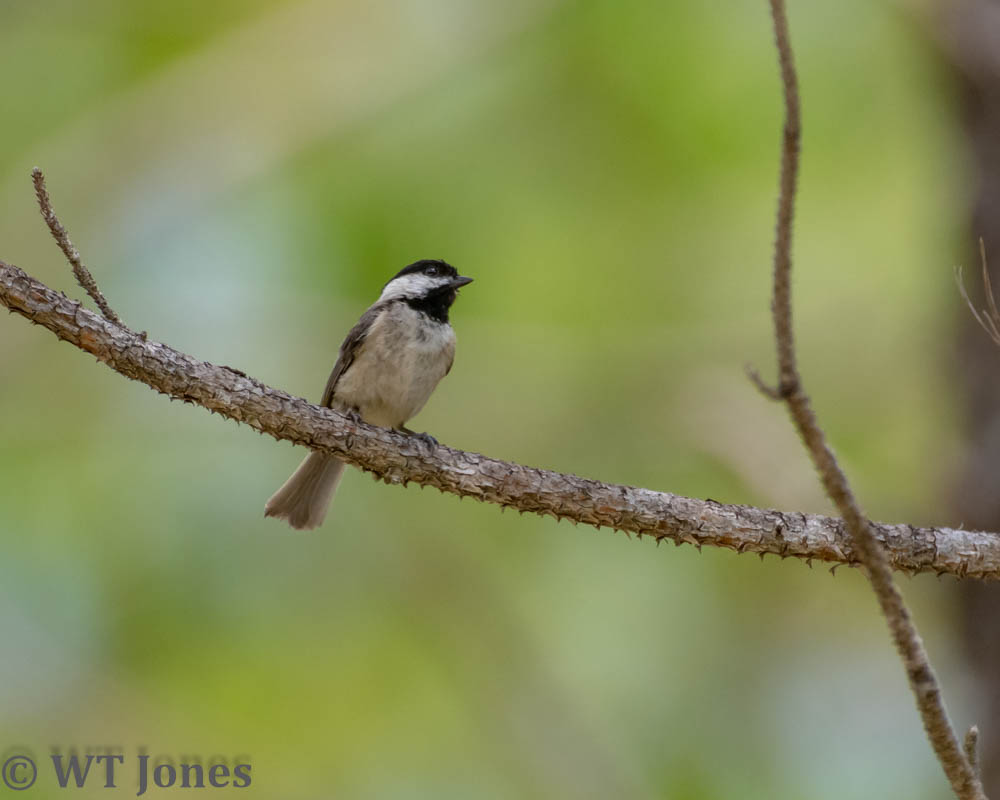
Small with a feisty attitude, the little Carolina Chickadee is usually curious, loudly so, about any visitors to their neighborhood. These small beauties breed throughout our area.
Several patches of bright Blackeyed Susan (Rudbeckia hirta) looked like spots of golden sunshine throughout the forest and along the road.

On the way out of the forest, a stop at a primitive campground facility gave us a chance to see a Green Treefrog (Hyla cinerea). He may need to re-think his choice of resting spots as he didn’t exactly blend in with the gray metal.

Florida’s swamp and forest locales offer so many opportunities to observe our natural world. Today’s excursion began with a gaggle of wading birds, continued across a bridge into a shady hardwood hammock and concluded with myriad flowers displayed in the understory. Not to mention a froggy farewell!
Enjoy your search for a natural place and come back for a visit!
 Our Natural Places
Hello.
What a beautiful description of a peaceful and enjoyable outing in nature! The vibrant flowers, curious wildlife, and good company make for a perfect day. Thanks for sharing this uplifting experience.
Thanks for sharing.
LikeLike
It’s our pleasure to share what we find.
Thank you for visiting with us.
LikeLike
I think that you are a fine naturalist, Wally. The deep science isn’t always necessary to express the beauty and diversity of nature and you’ve done a fine job sharing it in this post. Your walks with Gini always produce beautiful subjects photographed beautifully and I envy the number of individuals you see. Maybe I don’t look hard enough here but you find so many lovelies to photograph.
LikeLike
I’m blushing, and it’s not due to the heat. You are too kind, Steve, but – don’t stop! 🙂
We’re blessed to have so much in the area to share. Of course, we look at your incredible photography and wish we could see what you see and be cooler in the process.
LikeLiked by 1 person
Excellent shot of the Parula, we have to wait for their migration up here, but always enjoy when they show up for their brief stay. Was nice to get that one checked off while we were down along the Florida Panhandle back in April. I was not aware they breed in that area – also witness the largest concentration of Palm Warblers I’ve ever seen while down there. Once again, another set of great shots.
LikeLike
Again, thank you so much for visiting with us and saying such nice things!
The Parula is one of the few warblers which breeds down here so we appreciate them providing some color and beautiful songs to our summer woods.
LikeLiked by 1 person
Sue is very partial to a fried egg but they are difficult to pack for picnics. But I agree about a boiled egg as long as someone else shells it for me.
Those green monsters are fabulous, the colour of my next car I hope.
Back in the UK we seem to have hit a patch of global raining again. It has rained for two solid days whereby England cannot finish off the Aussies because rain stopped play at Manchester (cricket).
‘If it’s consensus, it’s not science; if it’s science it’s not consensus.’ Say “hi” to Gini.
LikeLike
Gini has three words for Sue: “Fried Egg Sandwich”. Hard-fried, a bit of mayonnaise on the bread and she’s a happy camper the rest of the morning. And it’s portable. Sorta.
Make sure the car has a bonnet the color of that guy’s gorget!
Follow the money and it will usually lead in the opposite direction of consensus. Or at least it will lead to the scientists receiving government grants.
Gini says “hi” back.
LikeLike
That butterfly is gorgeous. A wonderful variety of photos Wally. 🙂
LikeLike
Thank you very much, Sandra!
It was another good day.
LikeLiked by 1 person
Beautiful shots! That green treefrog is fabulous! They are so hard to find.
LikeLike
Thank you, Dina.
Finding the green frog was made a little easier by its decision to perch on gray metal!
LikeLike
As always, I love all your wonderful photographs, but the tree frog, anole, and butterfly really stand out. Those colors are something else.
I also think that any food eaten outside in a beautiful natural setting, even if it’s a slice of bread with cheese, tastes so much better than any meal in a restaurant ever could.
LikeLike
Danke, Tanja!
We agree being in Nature is hard to beat. Isn’t it amazing how many colors we can find when we take the time to look?
Have a wonderful new week.
LikeLiked by 1 person
Thank you. I wish you and Gini the same.
LikeLike
Parula, woohoo! That is a great photo of his inquisitive little face. I was intrigued by the name ‘colic root’, so looked it up. The USDA has an entry for White Colic Root, but not for Yellow. Lady Bird Johnson Wildflower Center has Yellow. Colic root is a member of the Lily family… maybe that accounts for the long upright stem and bell-shaped flower. You’ve shared so many wonderful moments, I’m sad to return home!
LikeLike
We love having the Northern Paula in large numbers during breeding season. Colorful, active and, as you say, inquisitive.
The USDA entry for Yellow Colicroot is here: https://plants.usda.gov/home/plantProfile?symbol=ALLU.
Don’t be sad to get back home! Think of all the new adventures around the next bend ….
LikeLiked by 1 person
In the past, Wally, you have spoken of similarities between species of flora and fauna your side of the pond, and those on this side. However, with the exception of Black-eyed Susan, this post from you does not exhibit any such similarities, and is all the more interesting. Having read your intro, my attention was gripped from that very first, beautifully artistic, image.
I note your exchange with Brad – a subject that is all too familiar to me. I have a simple formula which is – ‘1 good day in field = 3 days processing images’. Maybe I’m doing it wrong!
My very best wishes to you and Gini – – – Richard
LikeLike
A review of species from this trip indicates there were more unique species than I thought! It’s a fascinating place to explore. The combination of swamp, pine woods, hardwood forest, rivers, ponds – diversity abounds!
Your formula sounds about right! Apparently, we are not alone. Even though I may complain about processing so many images, the “digital darkroom” certainly beats the old days of the “real” one!
Our late afternoon birding trip has been postponed due to lightning. I have an allergic to reaction when in proximity.
Take good care you two!
LikeLike
Quite the menagerie Wally! You must have had as much fun sorting all of the photos as you did taking them.
LikeLike
Thanks, Brad.
You’d think at some point I would learn to become good at “field editing” and take better quality and fewer photographs to begin with.
Nah.
LikeLiked by 1 person
That’s what the digital darkroom is for. If I think for just a second before hand I can save myself time later, but when the birds are moving, flying, etc. even Photoshop can’t make up a photo with no pixels to start with. Easier to delete a bad photo than to create a good one from nothing. Landscapes are easier . . . they don’t move very quickly.
LikeLike
Colicroot is one of my favorites, and like you I’ve done my share of lining it up with the pines. It’s so widespread in the east Texas areas I frequent I can’t remember a place where it doesn’t occur. That little tree frog’s such a cutie! I see them from time to time, but they tend to be all green. The extra decoration on this one is very attractive, and you found the perfect spot to photograph it. The dark water really lets the Sagittaria shine, too.
I’ve always laughed at the phrase ‘mud-puddling’ for that butterfly behavior, but that’s sure enough what it is. I don’t see it often, but it’s usually swallowtails or larger butterflies that are doing it; maybe their needs for minerals are greater. Of course, they’ll also collect around less attractive sources of minerals: recycling at its best!
LikeLike
That bright tall slim colicroot really got our attention! We love coming across little ponds in the woods as they always attract something interesting. Well, like us!
That butterfly behavior is fascinating. They are less likely to fly away when so engaged, it seems. As to your last observation, yesterday we counted six Gulf Fritillaries on what was likely coyote scat in the middle of the road. To quote my eloquent bride: “Ewwww!”.
LikeLike
What a wonderful collection of images. It is not often that I come across such a wide variety of shots of birds, insects, and tiny flowers. Wow! Your eyes must have been in constant motion to spot so many wonderful subjects.
LikeLike
Thank you Mike!
Location and timing help with the variety. However, I have a secret weapon. Gini has acute hearing and sight. (The rest of her is way above “cute”.)
Thanks for visiting with us.
LikeLiked by 1 person
Love those tiny green things… anole and frog … lovely!
LikeLike
They can blend in really well on a green plant or leaf. On metal and tree bark – not so much!
Have a great new week!
LikeLiked by 1 person
Delightful. And even plain bread and butter would be a feast in the circumstances you describe.
LikeLike
Thanks, EC!
You are so right.
Gini said our heat made her go back and look at your frozen bubbles to cool off!
LikeLike
That’s a nice closeup of the tarflower (and my fourth grade teacher’s last name was Tarbox; it really was). I like how your yellow colicroot lined up with the purplish thing behind it. Don’t think I’ve ever heard of a plant having vine-like tendencies but no tendrils.
Central Texas shares the anole and the black-eyed susan with you. We have different species of Ruellia and Sagittaria.
LikeLike
Thank you, Steve.
Behind the Colicroot is a thin pine tree. Weird color due to lighting. I tried “fixing” in post-production but made it worse so left it alone.
That Climbing Aster can grow upwards of 20 feet from its base as long as it has a support to wrap around.
LikeLike