(P)Laying In The Mud
Header Image: Snowy Plover
The inlet between beach and sandbar was less than knee-deep. Although it was barely past sunrise, the water of the Gulf of Mexico was not shockingly cold like that of the Atlantic Ocean on the other side of the state. Sand as far as the eye could see in either direction was the color and consistency of white sugar. Laughing Gulls and Sandwich Terns splashed a few feet from the shore and flew off with silvery scaly slivers of wriggling fish for breakfast.
I headed north along the sandbar, pausing to gaze at the open gulf. It was difficult to believe Gini and I once plied these waters beyond sight of any land in a small boat under the blazing sun, catching a fish now and then and thoroughly enjoying the incredible sights and sounds of the sea. It all seems like a dream now. A very pleasant one.
A lagoon between the sandbar and main shore was quite shallow in places which made it perfect for wading birds. Retreating tides revealed soft mud for hungry shorebirds. The rising sun was breaking over the sand dunes and I lay in the freshly exposed mud hoping a few feeding birds would come within camera range. It was a good morning.
We were at one of the area’s premier birding spots, Fort DeSoto Park in St. Petersburg, Florida. It’s beach season so we knew to be there early as the sand would quickly be littered with oiled humans hoping to become sufficiently browned without becoming painfully red. Fortunately, the mud flats don’t seem to attract the attention of two-legged sun worshipers like that white sand does. Go figure.
I felt a bit like the shorebirds I was chasing as I lay in one spot, got up, scurried to another spot, lay down and repeated the process three or four times. Covered in mud, I waded into the lagoon to rinse off a bit. The perspective from being in the water and looking toward the shoreline was an interesting change. But that’s a story for next time.
Dunlin remain here throughout the winter but are dressed in their dull gray plumage. It was nice to find one still hanging around and in its breeding suit. As with many shorebirds, Dunlin breed in the Arctic tundra. This individual could be a little late in migrating north. Some first-year birds of several shorebird species often remain in their wintering grounds all year.

Black-bellied Plovers may not breed here but several remain either through late spring or even all summer. This one has not yet transitioned from its winter plumage. This seems like it may be a first year bird based on the look of the individual feathers, but it doesn’t have the “checkered” appearance of a new juvenile.

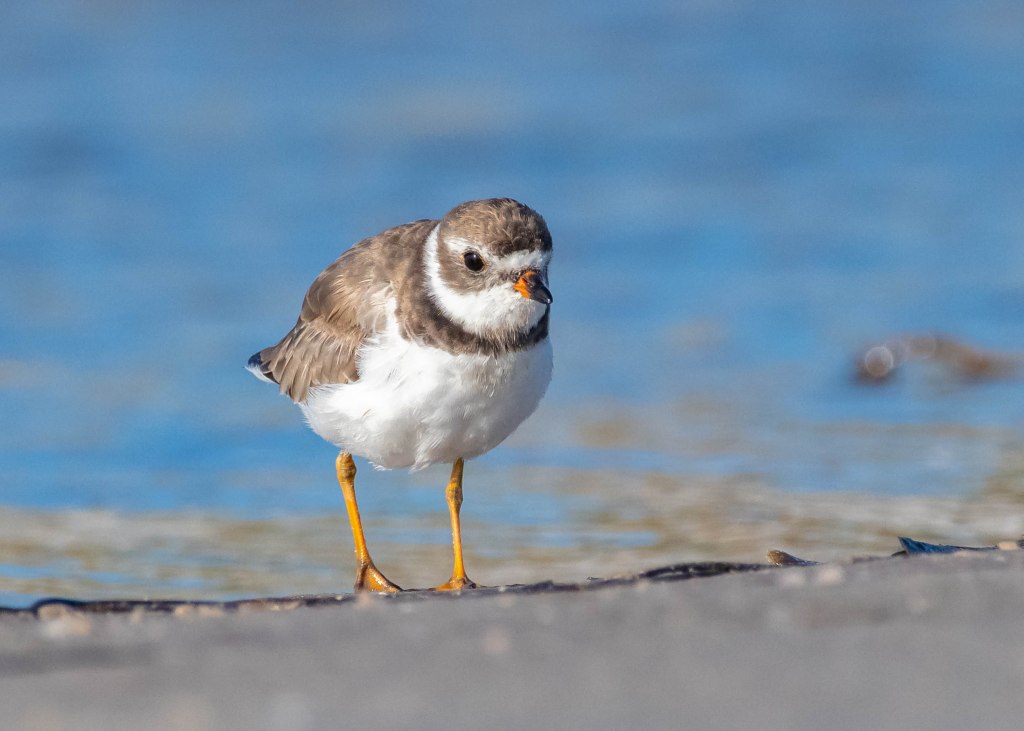
The diminutive Semipalmated Plover also breeds in the Arctic and Alaska. Again, some first-year birds remain with us all year long. Here you can see the webbing between toes which gives the bird its name.
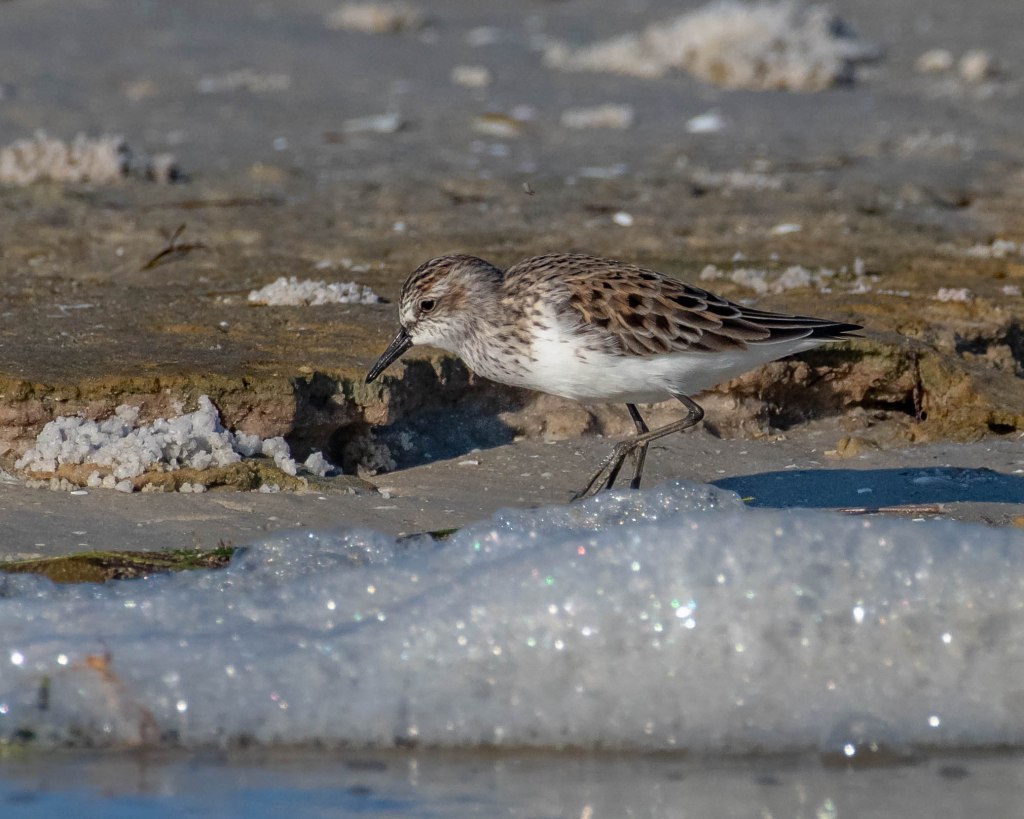
Although not visible in this photo, a Semipalmated Sandpiper also has partial webbing between its toes. This small “peep” sandpiper has a little different profile and shorter bill than its similar cousin, the Western Sandpiper.
It is always a treat for us to spot an American Oystercatcher. I know there are nests around here but couldn’t locate one today. This bird wasn’t telling, either.

Larger than the “peep” sandpipers and smaller than a godwit, this Short-billed Dowitcher should also be flying north very soon. Very similar to the Long-billed Dowitcher in appearance, they can be separated by distinctive calls. Plumage will soon change from non-breeding grayish to an overall cinnamon.

A pair of Ruddy Turnstones preen and rest between searches for food.

As noted above, the Western Sandpiper has a bit different profile and usually a longer bill than the Semipalmated Sandpiper. That long bill has just pulled up a juicy mud worm thingy.

Another migrant late to the party. This Red Knot should be in the Arctic tundra scraping out a nesting spot. Typically, we see most of these in their gray winter plumage so it was nice to see the red in the Red Knot! I saw six Red Knots this morning and this one sported a leg flag. (Again, some of these birds may stay here all summer.) I discovered the flag was attached on February 1, 2022 at Big Pine Key, Florida, part of the Florida Keys, at which time the U.S. Wildlife Service bander noted the bird had hatched in 2021.

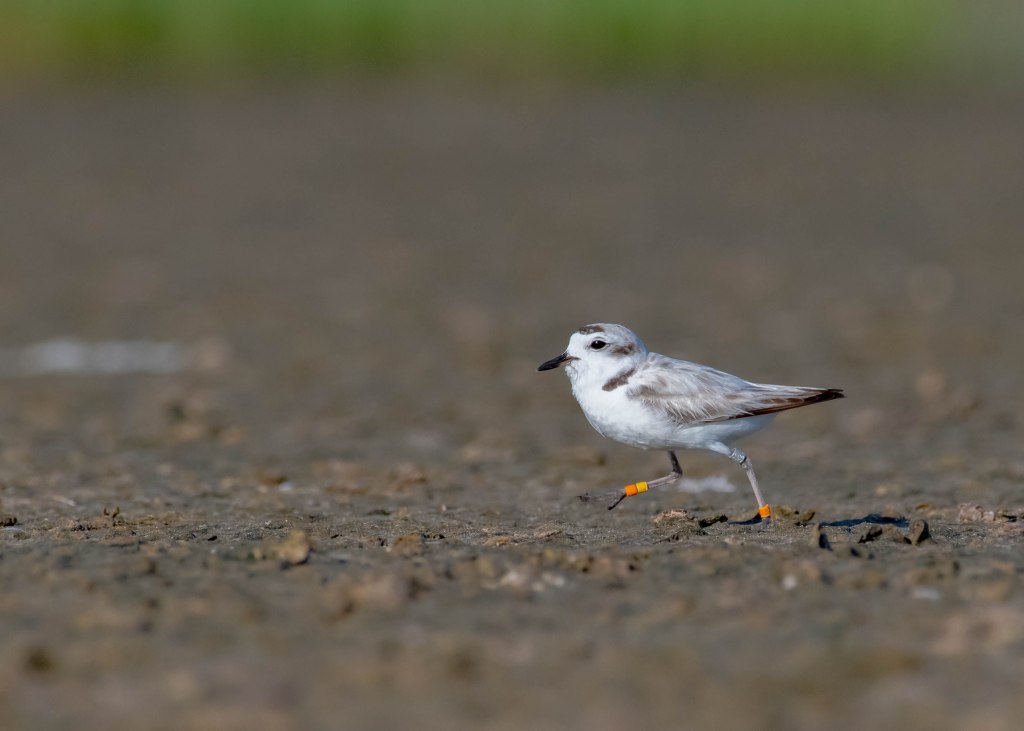
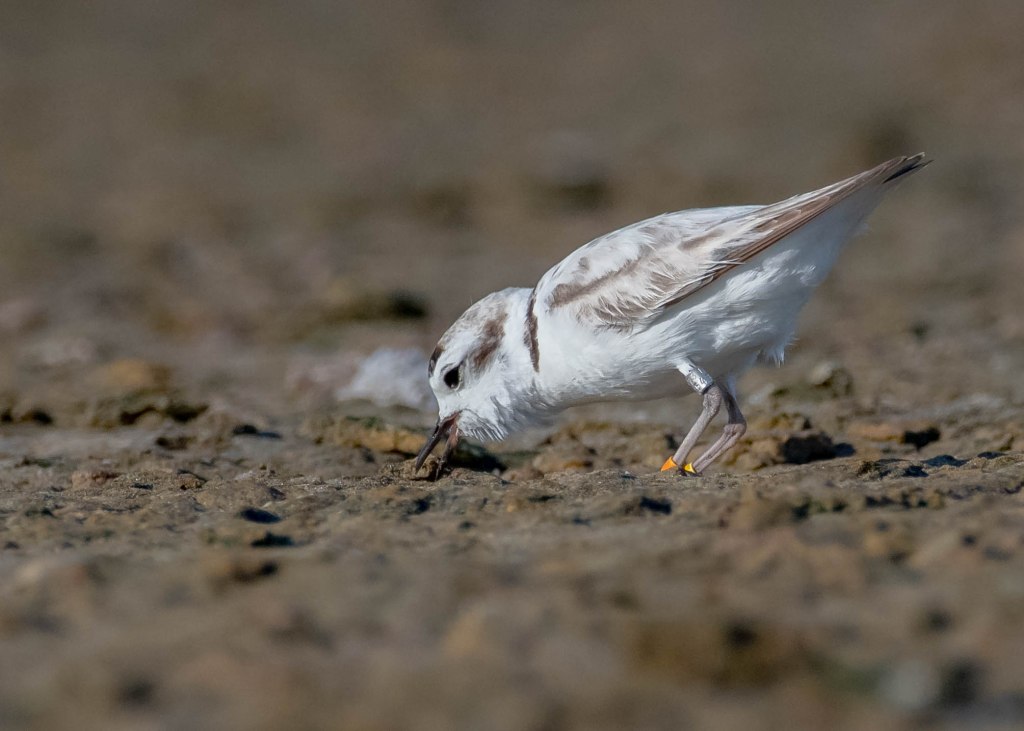
The highlight of the morning was an energetic Snowy Plover. Although he was wary of my presence, it didn’t stop him from his “run-pluck-run” routine all the while keeping an eye on me. These little birds are a threatened species due to development and recreational use of beach habitat. All of the leg jewelry allowed me to determine this male was initially banded less than two miles north of here on May 3, 2021. The bander estimated the bird’s age at the time of banding to be about one year.


Gini and I joke about having salt water in our veins. There does seem to be an irresistible urge for us to be around salt, sun and sand. The fact that there are so many birds hanging around is a nice bonus.
Next up: It’s a Wading Game.
Enjoy your search for a natural place and come back for a visit!


These low-angle shots are just spectacular! I really enjoy seeing the birds “in transition”, in the middle of their changes between breeding and non-breeding seasons.
LikeLike
Thank you very much, Sam.
It’s pretty neat seeing birds in breeding plumage we don’t normally get a chance to.
LikeLiked by 1 person
I do love to watch shorebirds like these, Wally, and you are showing us a beautiful selection, some of which are, of course, familiar to me here in UK. The Snowy Plover is a little gem! Sadly, I’m missing my own annual shorebird fix as we had to cancel our May vsit to the Scottish Outer Hebrides due to LIndsay’s knee situation.
Hopefully, my days of laying in the mud are over – on second thoughts, maybe they’re about to start again, due to my reduced stability!
My best wishes to you and Gini – – – Richard
LikeLike
Thank you very much, Richard.
We’ll try to help supply you with a few shorebird fixes to make up for your cancelled trip.
Be careful if you decide to lay in that mud again. Even the Gulls were Laughing at the sight of me trying to get up!
You two take care.
LikeLike
My favorite park! You caught those shorebirds beautifully.
LikeLike
Thank you, Dina.
It’s a great place, as you well know.
LikeLike
What an interesting spot. I did have to grin when I looked across to the mainland and found Del Webb Bayview, Sun City, and so on. Invasive species take many forms! That said, it surely does look like an interesting place to explore; it’s no wonder it’s a birding hot spot.
Every time I see photos like this, I wonder how you manage to keep your camera dry and sand free. Perhaps yours are sealed, which mine isn’t. Since I couldn’t afford to replace my camera, caution’s the name of my game. That said, photos like this sure do make identification easier. Sorting out the sandpipers and plovers is just beyond me, although if I spent more time with it, I’d probably do better. I have seen Ruddy Turnstones once, and I think there are oystercatchers down around the Bolivar peninsula — but this isn’t the weekend to go looking!
The Snowy Plover is beautiful. I especially like that direct, head-on view. There’s nothing like making eye contact with a bird!
LikeLike
Mullet Key, where the park is located, offers a great resting and feeding spot for migratory birds. During fall migration, there are almost more birders than birds scouring the trees for warblers. Jutting into the gulf as it does, it’s a magnet for water birds of all types as well.
Driving through the blight created by those invasive species you mention can be a challenge. The reward is worth it.
The camera/lens is sealed, however, I try to keep from getting it in direct contact with sand or water. Back home, a really thorough cleaning is called for!
That little plover literally walked (ran, mostly) around me a couple of times but settled down and gave me some great poses.
LikeLike
Heaven!
You probably realise waders (shorebirds) are my favourite bird family. It is odd to see summer plumaged birds when they should be up north but I guess some just can’t be bothered or maybe their internal compass has gone on the blink.
Love the Snowy Plover. Yes I know it’s all for scientific research but I really hate seeing so many rings on a bird’s leg, for me it makes them look a little like a zoo escapee.
You did well getting those shots without too much heat haze.
LikeLike
NOW I know you are partial to the wading family. Me too.
We prefer to thing the migrants remaining all year simply prefer our tropical climate to the wet tundra. I haven’t read a good scientific explanation of why some (mostly first year) birds stay on the wintering grounds. We appreciate those that do!
Being out there early and getting lucky with some birds being in close proximity helped with the haze issue.
LikeLike
What a pleasant sun and salt day! The Snowy plover is delicately enchanting.
LikeLike
Sun and salt is are our favorite seasonings.
Thank you!
LikeLike
Mud, mud, glorious mud, there is nothing quite like it for cooling the blood,
So follow me, follow
Down to the hollow
And there we wallow in mud, sweet mud.
That looks like an excellent start to the day.
LikeLike
I had never heard that song! It’s great! Thank you, EC!!
(Now you have given me an earworm for the rest of the day.)
Yes, it was a most excellent start to what turned out to be a most excellent day.
Gini says we could use a few of your frozen bubbles about now. Beautiful and cooling.
LikeLike
Your mention of getting muddy and smelly made me think that at least you don’t have to put up with chigger bites‚ or do you?
LikeLike
The tidal mud flat is, thankfully, one place I have never encountered chiggers.
LikeLike
Then let’s all raise a chiggerless cheer for tidal mud flats.
LikeLike
Great photos and stories on the birds. Makes me want to head to the seashore.
LikeLike
Thank you, Brad!
The seashore shore would be happy to see you.
LikeLiked by 1 person
Was just on the Atlantic chasing Puffins in the fog.
LikeLike
Whoa! That’s a whole other level of adventure!
LikeLiked by 1 person
There’s probably a story about it in a couple weeks.
LikeLike
Thanks so much for the excellent tour of Ft. DeSoto mud, Wally. My nature and photo excursions have been limited lately so it’s great to follow along with yours.
LikeLike
You’re welcome, Ed. I get muddy and smelly so you don’t have to!
LikeLike