Out and About and Back Again
Header Image: Thunderstorm
“Feel like a ride?”
Florida’s wet season is somewhat predictable. Afternoon storms begin to arrive late in the day usually with a grand entrance involving a sound and light show. Sometimes, animal life becomes more active just before the rains begin. This can be a good time to spot raptors which are trying to spot the animals becoming more active.
We had a particular spot in mind where we have seen Burrowing Owls in past years. Nothing says “adorable” quite like a small owl with great big eyes.
Locating the fast-moving thunderstorm was no problem. Alas, no owls were located.
Many of our trips are like this. Driving, hiking, anticipation … little or no results.
Poor Gini. Our life together has spanned setting up and dismantling households in four different states and three different locations in Germany. As we explored each of those venues, she tried to become accustomed to my unique approach to discovery. Basically, it involves getting “lost” and then attempting to find our way home again. (What? Why, yes, of course I do that on purpose.)
Such trips often result in only a few photographs, if any at all. Over the past few weeks, we have seen a few things we like from a relatively large area and diverse habitats. We thought we would share these miscellaneous tidbits of Nature with you.
Don’t worry. If we become lost, we know how to get home again.
A small local nature preserve is even more intriguing when the way forward is shrouded in early morning fog.

Pine woods with a dense understory of ferns can be especially pleasing with a mix of bright green, reddish brown and fallen limbs.

A pond lined with cattails is a perfect spot for Red-winged Blackbirds to hide a nest.

Even when we may not find a bird or animal to photograph, some paths offer a beautiful consolation prize. This one was in the form of a Four-petal St. Johnswort (Hypericum tetrapetalum).

Rain or no rain, dragons must eat. Once in a while, they will pause for a candid portrait. A female Blue Dasher (Pachydiplax longipennis) was kind enough to wait for me to fumble with the focusing.

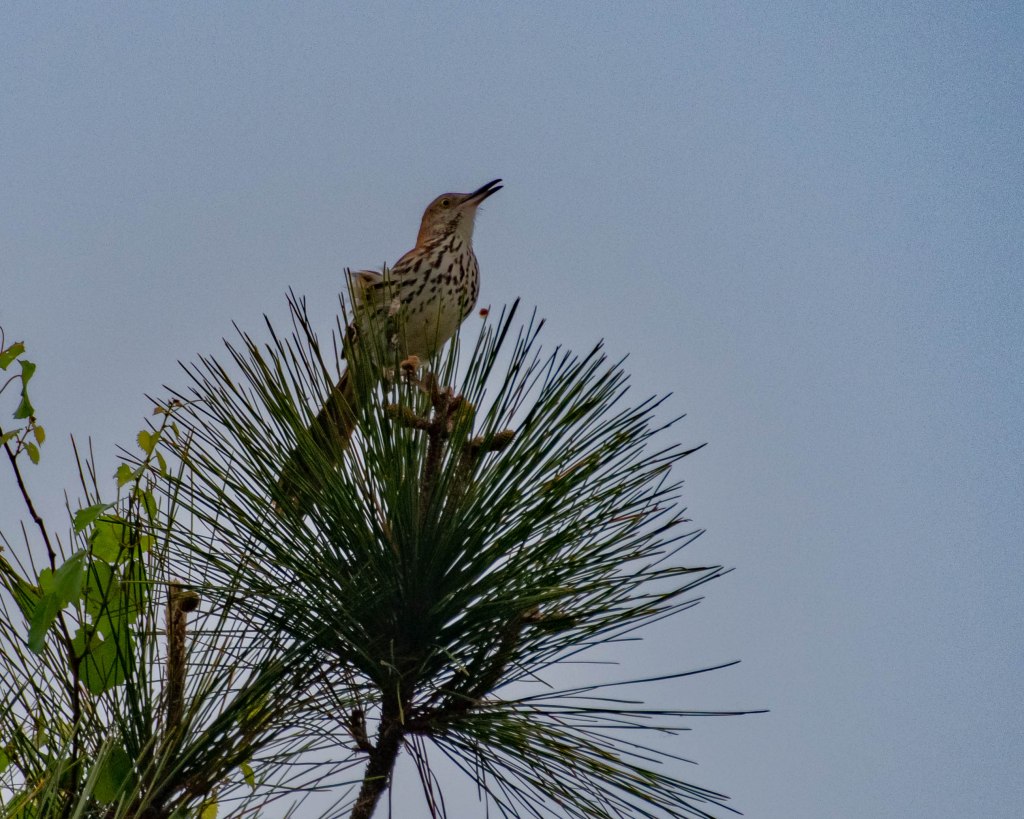
It is still spring and most of our resident song birds are, well, singing. A Brown Thrasher has a surprisingly large repertoire and many mistake the varied tunes for those of a Northern Mockingbird.
One may be forgiven for not associating “jackets” and “Ohio” with Florida. One may be appreciative at finding the Bluejacket or Ohio Spiderwort (Tradescantia ohiensis) during a morning hike.

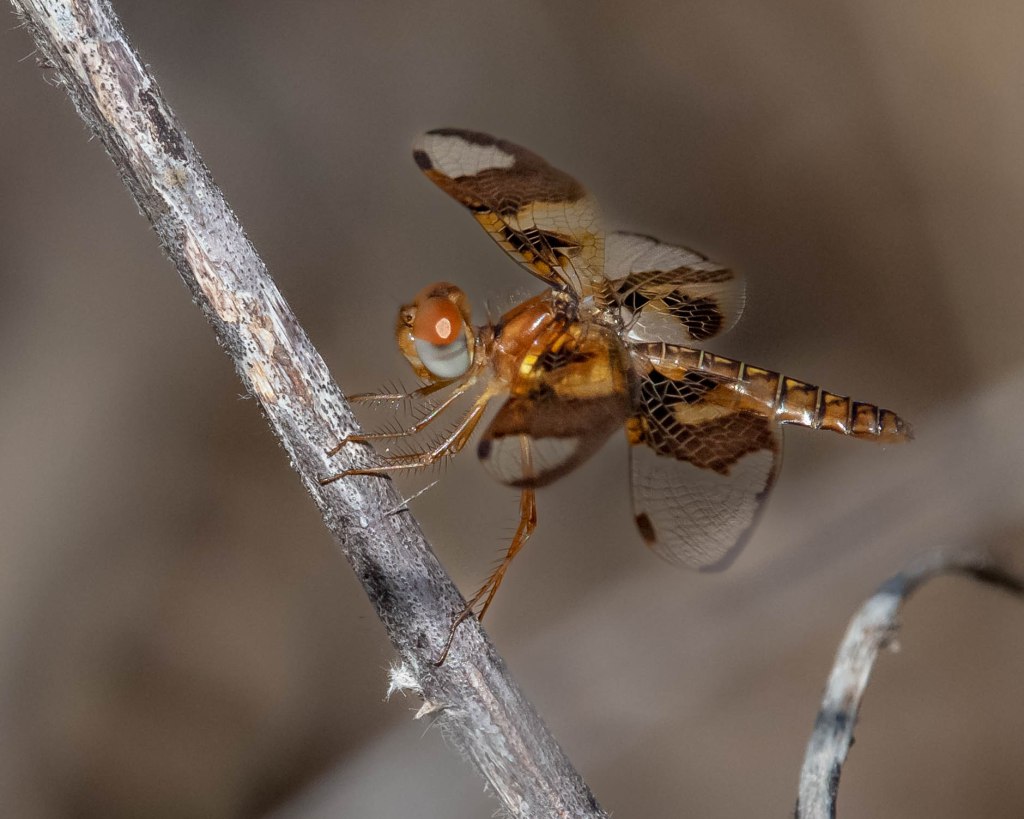
Beauty can often be found in small packages. One of the smallest dragonflies in North America, the Eastern Amberwing (Perithemis tenera), is a prime example. They fly with their legs dangling beneath in the hope a hungry predator will mistake them for a wasp and decide to leave them alone.
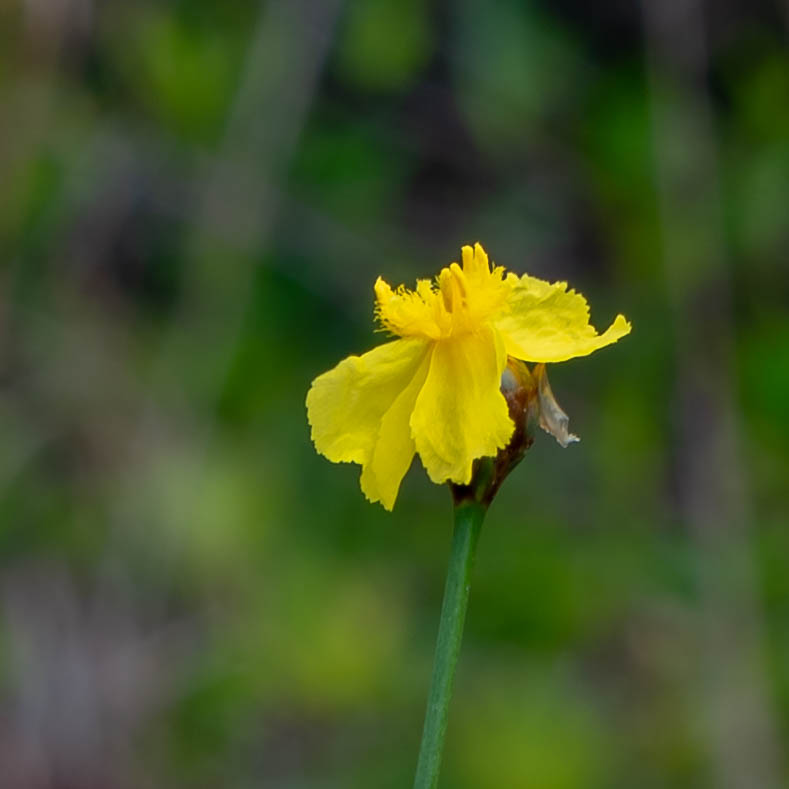
Yet another consolation prize on a walk which yielded no bird sightings, a small but gorgeous bloom of Yelloweyed Grass (Xyris spp.) brightened our day.
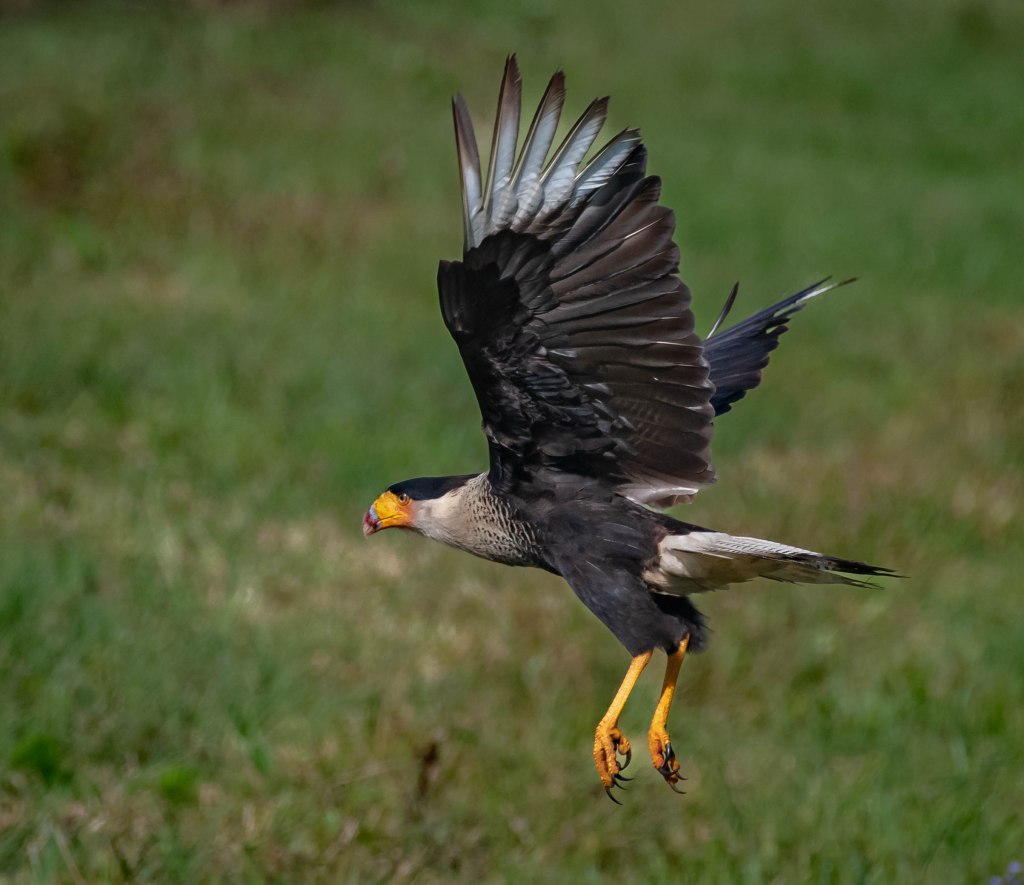
The Crested Caracara is a member of the falcon family. They are skilled at hunting live prey but will seldom pass up an offering of carrion. Turkey Vultures do not take live prey but are carrion specialists. Very often these two species will share a breakfast buffet of recently expired wild pig. Sometimes, a hungry Caracara will decide that sharing is over-rated.



Meanwhile, along a seldom trod path we found a blooming Netted Pawpaw (Asimina reticulata). The large waxy flowers are magnets for all sorts of pollinators. The plant bears a fruit which looks a bit like a pear that has been designed by Salvador Dali. The fruit is edible but good luck finding a ripe one before the animals do!

Spring is a time of renewal. Florida’s resident population of Sandhill Cranes are busy with new families. We spotted this group foraging in the tall grass adjacent to a small scrub oak grove. The young are called “colts” and since nests are usually on or near water, they can swim and walk within hours of hatching.

Grand trips are fun. For us, small journeys are just as much fun. We may not see much on some outings and there is a chance we will be rained on. We might even become lost. Finding our way back from being out and about is always rewarding.
Enjoy your search for a natural place and come back for a visit!
 Our Natural Places
I’ve been on the road – it was great to come back to see your collection of “one of’s”, as well as the Caracara series. Back when I was in college, I couldn’t afford travel, so I would fill the car with gas, grab a state map, and drive in random directions out through the farm country of Kansas and Missouri until I’d consumed almost half a tank. Then I’d stop at some little farming community, find a phone book to figure out where I was, and navigate my way back home. Saw some wonderful vistas in those days.
LikeLike
That’s almost exactly how we have operating for years! Get lost and try to find our way home again. Terrific way to find neat stuff!
Welcome back.
LikeLiked by 1 person
Can’t wait to read this. Been so long Wally and Ginni. ❤
LikeLike
No hurry. No worry. It will wait patiently for you.
Hope today is kind to you.
LikeLiked by 1 person
Good Morning from hot and sunny Lancashire Wally and Gini.
About ten years ago I found an Oystercatcher nest on a gatepost and while it unusual, it is not unique. A rotten gatepost filled with blown debris and cryptic eggs can give a bit of camouflage from a crow high above.
https://www.newcastlewildfowlers.co.uk/very-unusual-find
I regret that I have never seen a caracara instead of the many TVs, as we called them up in the badlands of Canada. Such a size difference but they are handsome beasts for sure.
I never get lost now because I don’t travel far from the confines of Fylde, and in any case Sue always has me on a short lead just a whistle away.
I hope your rains don’t last. Once ours start we are due for a month solid – that’s how it seems to play out in recent years, four weeks on and four weeks off.
LikeLike
Gini and I hope your new day is going well. Strong coffee is helping us to kick-start the morning.
Although summer solstice is still over a week down the seasonal road, Florida has been behaving meteorologically as I remember from when I was in short pants (but had tanned legs). Fairly pleasant early mornings, quite warm by mid-morning, thunderstorms by 3:00 p.m. Wash-Rinse-Repeat.
The rains will continue throughout the summer, the humidity will be oppressive, the sun will make it unsuitable for most humans to be outdoors and the land will be green and lush. Two of us shall rejoice as we seek out mosquito-infested quagmires in our never-ending mission to bring raw nature to this humble blog for your enjoyment.
We are only used to seeing the Oystercatcher along the beaches. That was an interesting link! The caracaras seem to like central and south Florida and we see them pretty often.
I don’t know what you mean by a short lead — Sorry, I must go. Gini just whistled.
Fingers crossed for your weather to improve.
LikeLike
If these are the kinds of creatures one finds when getting lost, I want to get lost very badly. I have read an entire book about caracaras (the spellbinding “A Most Remarkable Creature” by Jonathan Meiburg), but have yet to see one.
Longingly,
Tanja
LikeLike
Go south, young woman!
Looks like your nearest chance for a caracara encounter would be south central Texas. A good place to be for many other things, as well.
We’re quite lucky that this interesting falcon breeds in our area so we get to see them often.
LikeLiked by 1 person
Thank you for the “young woman” address, Wally. 😊
Going south has long been a dream of mine, and I hope to realize it one of these days.
LikeLike
Nice story and great photos. Really liked seeing the crane colts.
LikeLike
Thanks, Brad. We like seeing the kids, too!
LikeLiked by 1 person
Great road trip. Love the caracara. I keep driving inland hoping to find one but I never seem to go far enough across the state.
LikeLike
Thanks, Dina.
Try south. Hardee, Highlands, Glades counties.
LikeLike
Seeing those young Sandhill Cranes is special. Since they don’t breed here, we don’t get to see that unbelievable cuteness. Your Caracara series is unbelievable — such clarity. That would have been enough to make the day for me.
At first glance, I thought that netted pawpaw was yucca of some sort. When I read that the pawpaw also has waxy flowers, that helped to explain the apparent similarity. I found a few stems of yellow-eyed grass in the same savanna where the grass pinks were blooming. I expect to see more of them on my next trip; they’re one of my favorites — although nearly everything is a ‘favorite’ for me.
Speaking of favorites, that photo of the approaching storm is my favorite of this group. Yes, storms can bring downed trees and traffic snarls and tossed trampolines, but there’s real excitement in watching a summer thunderstorm build. We had a doozy Thursday night, with 60 mph winds, hail, and about an inch of rain, but when I took a look on Friday morning, all the nests I know about were intact, and the usual crew was at the feeders in the morning. They know how to cope.
LikeLike
It’s amazing how fast those little cranes will grow! In a few months they will morph from gangly balls of fluffy yellow to become nearly as tall as Mom and Dad.
The flowers of our local Yucca species are quite similar to the Pawpaw. One look at the leaves and there’s no doubt which is which.
In another lifetime I could have been a storm chaser. Thank goodness I married well and now have Common Sense as my constant companion.
If only those human critters could learn to cope with life’s storms as well as the rest of Nature’s inhabitants.
LikeLike
Thanks for bringing the Caracara to me. A nice discovery. 😲
LikeLike
You are very welcome!
Handsome birds should be shared.
LikeLiked by 1 person
‘Not all those who wander are lost…’ And if they are, adventures await.
Thank you (so much) for these excursions.
LikeLike
You are so welcome, EC!
Yeah, we have been filled with that wanderlust thing for many years. She wanders, I lust after her.
Oops. I may have strayed from the main subject. 🙂
LikeLike
Thank you for taking us with you on a short, and very enjoyable journey, Wally. I almost felt that I was there in person – particularly as I am currently sitting in muggy heat – crazy, when its only about three or four days ago we had to put the central heating back on!
Of course, I was thrilled by your dragons, but I particularly enjoyed the Crested Caracara sequence, and the grin will be stuck on my face for some time to come.
My very best wishes to you and Gini – – – Richard
LikeLike
You can come along and become lost with us any time, Richard! Bring Lindsay. With two women along, there will be less chance of us becoming actually lost.
We’re always pretty excited to encounter the Caracaras. Heading out next week to try and locate nesting sites. Around here, they prefer cabbage palm trees which have sparse foliage at the top, usually due to a storm.
Grinning back at you from paradise!
LikeLike
All your closeups are nice and sharp, as are the flying caracaras.
Fortunately you needn’t go far to find a natural place and the things it’s home to.
Regarding Florida’s rainy season, we spent part of a day crossing through the Panhandle on August 19, 2019. Sure enough, late afternoon released a downpour on us.
LikeLike
Thank you, Steve.
I remember the same weather pattern as a kid. We were constantly being yelled at to come in or we’d be struck by lightning. Drainage ditches were our playground!
(Don’t let on that the weather pattern was the same over 60 years ago. Might start a follow the science chant I am unprepared to substantiate.)
LikeLike
Lovely shots, Wally! Love the Crested Caracara especially, I was fortunate to see/photograph them several times while in Florida.
I tend to not worry about getting lost, then….hmmmm….where am I? hehe My husband has told me time and again, he’s gonna put a GPS tracker on me. 😂 Truthfully, though, I tend to not stray as much as I used to, but it was always fun back in the day!
LikeLike
Thank you, Donna.
I think it was Daniel Boone who was asked if he’d ever been lost while exploring the frontier. He said “No, but I was once confused for about three days.” That’s me. Never lost. Constantly “confused”!
LikeLiked by 1 person
😂 Love it! That is me too!! 😉
LikeLike