Header Image: Black-crowned Night Heron
Florida has a unique combination of heat and humidity which can wilt the best of us at times. Late August typically provides us with afternoon thunderstorms which can help cool us down a bit, but at the expense of maintaining very high humidity. Wiping optics lenses for half an hour each morning becomes a reflex. In our area of central Florida, we average 115 days a year with some rain which results in 55 inches (1392 mm) of water falling from the sky each year.
The sub-tropical climate offers ideal conditions for an incredible number of life forms to thrive. Some of the most productive are insects. Species which consume insects as a main part of their diet are happy with this detail. Birders are happy that birds form a large portion of those critters which eat bugs.
So, it may be hot and it may be steamy out there, but the potential for nature watchers is almost infinite!
We keep visiting venues which are close to home because, well, they’re close to home. We can sleep in a bit since we only have to drive ten minutes to reach Tenoroc Fish Management Area near Lakeland, Polk County, Florida. (The fact that it offers outstanding birding doesn’t hurt.)
The eastern sky was turning pink as we made our way along the dirt road. Just inside the entrance gate, Gini spotted a flurry of activity which begged further investigation. A gang of Great Crested Flycatchers were playing tag among the tree tops. Half a dozen Blue-gray Gnatcatchers ignored them as they did their vacuum-cleaner imitation along every twig and leaf. A Red-bellied Woodpecker landed on the trunk of an oak tree about ten feet away and took off immediately when she spotted me. I have that effect on many creatures, great and small.
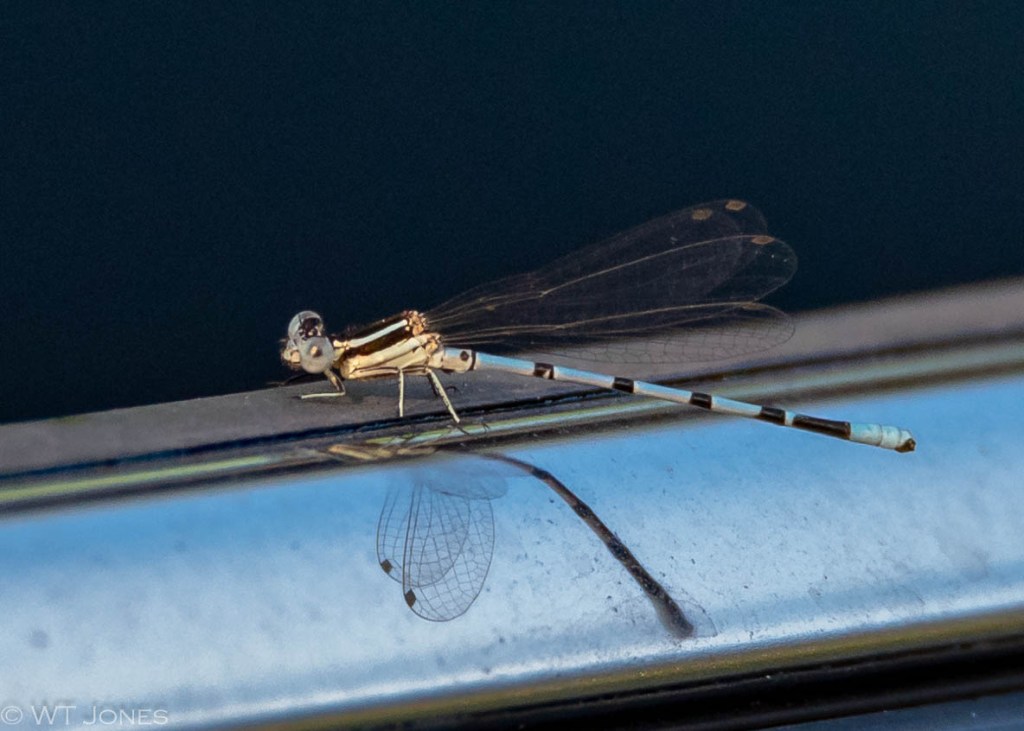
Gini-the-wildlife-magnet. Leave her alone for a few minutes and something will find her and try to convince her to adopt it. Thus, the find of the day! A diminutive damselfly flew in her open car window and crawled around the windshield and ceiling for awhile. Eventually, it moved to the window sill and posed for a few (dozen) candid photos. It turned out to be our first observation of a Seepage Dancer (Argia bipunctulata). Further, it is only one of two occurrences of the species this far south. Awesome start to the day!
More words and a couple of images coming up.
“Snake!” We often encounter snakes crossing the road and I simultaneously try to shift into park, jump out of the car with camera flailing and attempt to focus and click. Wait. That’s a weird-looking snake. Oh, cool! NOT a snake. A legless lizard! The Eastern Glass Lizard (Ophisaurus ventralis). Florida has four species of glass lizard and one species of worm lizard, all “legless lizards”. The glass lizards can reach about 43 inches (108 cm) and this one was around three feet long.


Gini’s new playmate, the Seepage Dancer (Argia bipunctulata). She is still mad I wouldn’t let her take it home.
Time for breakfast. Ours was boiled eggs and fruit. The male Eastern Pondhawk (Erythemis simplicicollis) seems to have selected the butterfly burrito, possibly a Great Southern White (Ascia monuste).

Walking along the shore of a lake, I disturbed a Black-crowned Night heron. He flew away squawking loudly, made a big circle and returned to the same spot after I had moved away a bit.

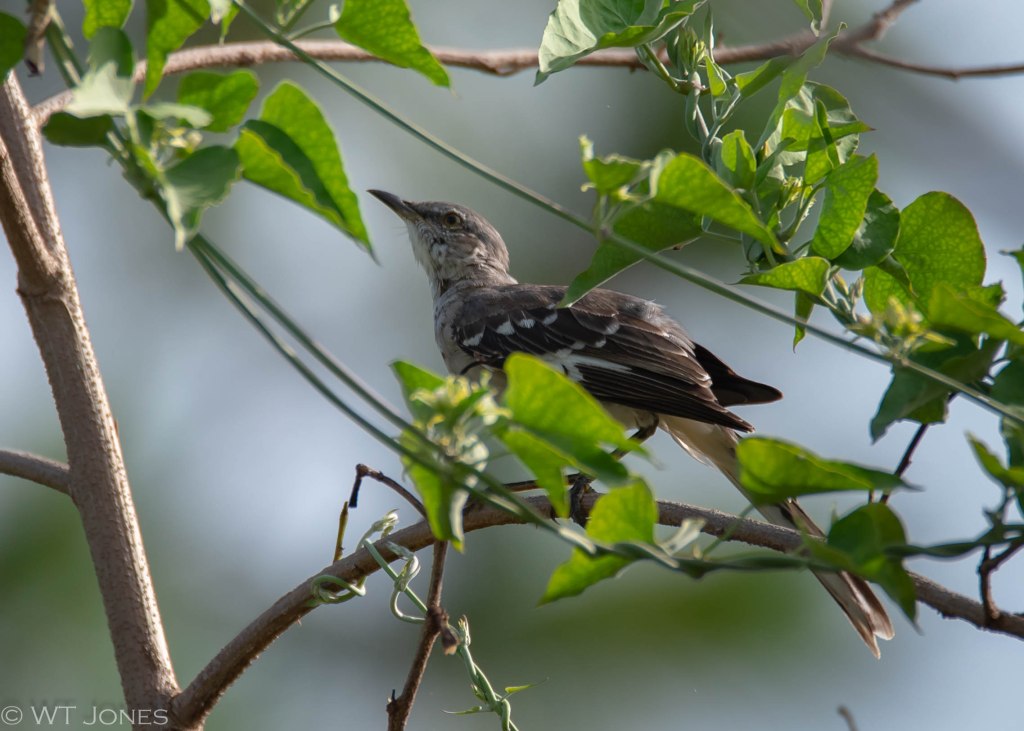
We saw several Northern Mockingbirds during the morning. These are not shy birds and often challenge our presence.
On the road, windows open, driving slowly. Gini hears the thin whistling of Swallow-tailed Kites. Most of these sleek raptors have already departed for South America. Driving among the pine trees our vision was limited. Suddenly, a trio appeared overhead. I jumped out of the car (see notes above for snakes in the road) and became dizzy as the three circled low above the trees. The lead kite had snagged a frog and the other two seemed determined to take it away. They were so low and I only had seconds to focus as they zipped across the road that most of the images were unusable. In the second shot, I’m not sure if those menacing talons were for me or the frog-bearer.


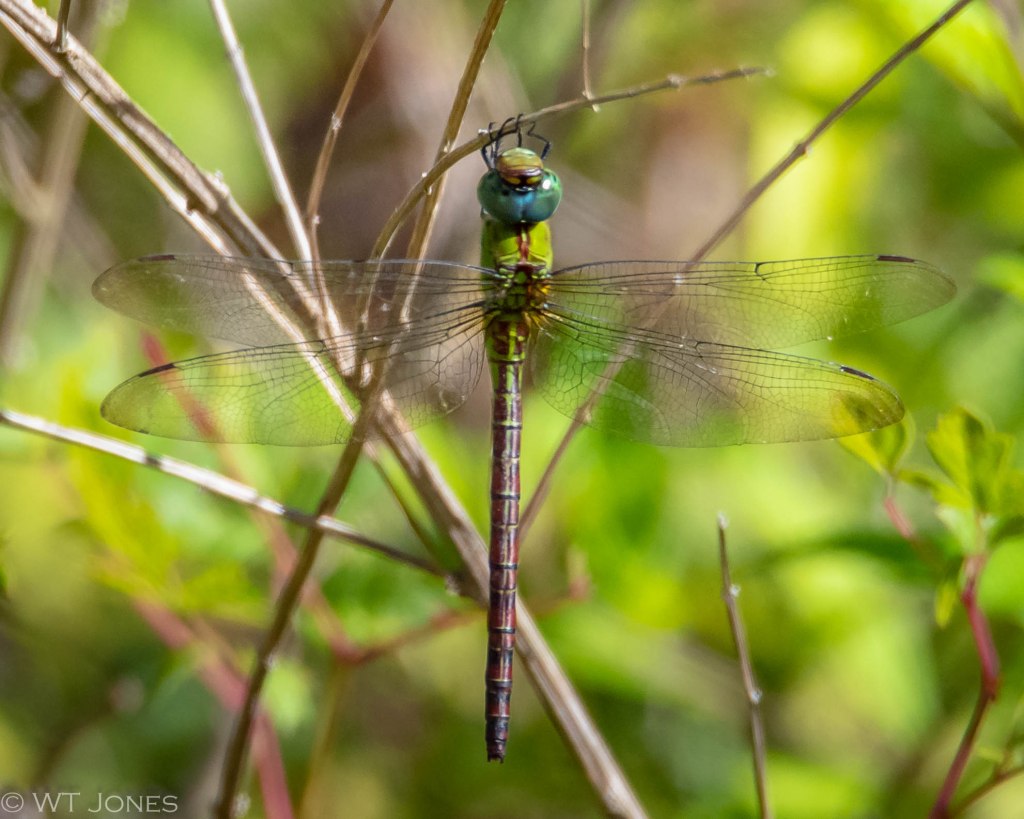
(Note to self: Do NOT leave Gini at home if at all possible.) “Stop! Back up!” Yes, Ma’am. She spotted the lime green body and bright blue eyes of a Blue-faced Darner (Coryphaeschna adnexa) hanging from a twig. Not common in N. America outside central/south Florida. Some have been reported in far south Texas.

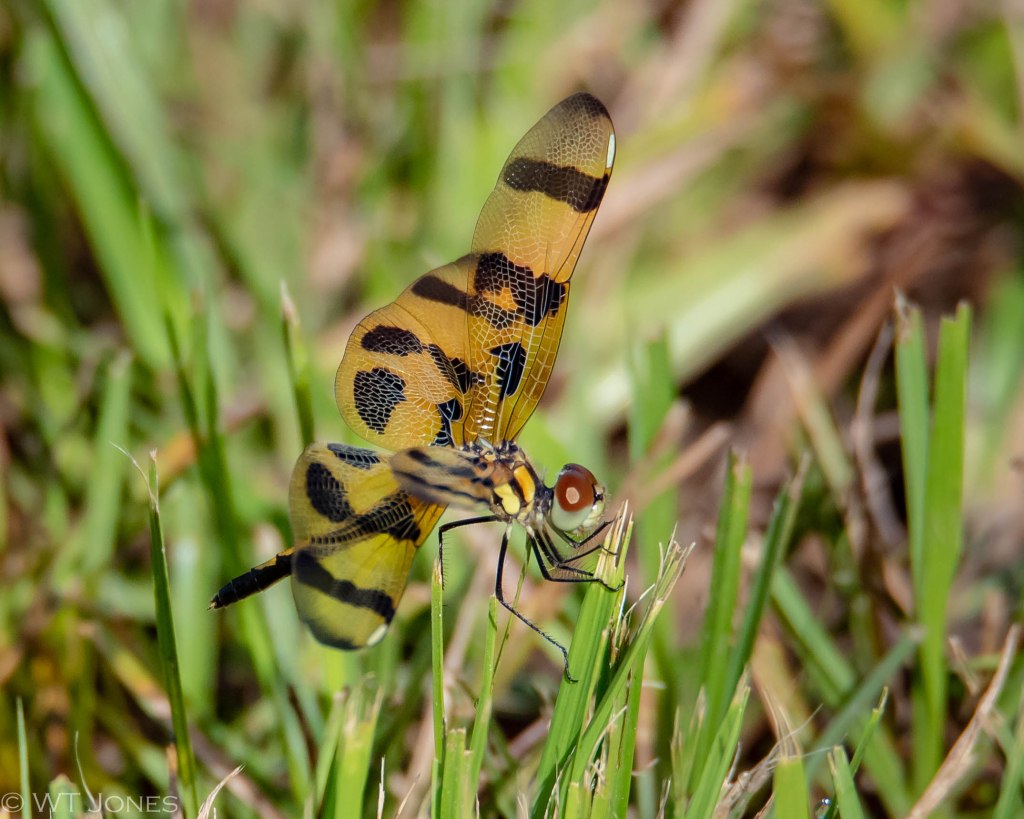
Nothing like a colorful Halloween Pennant (Celithemis eponina) to brighten up a morning!
Although the Brown Pelican is typically a coastal bird, we have an inland population that breeds locally and remains here year round.

A male Four-spotted Pennant (Brachymesia gravida) seems to be warning me to back off. Just one more shot and I will.

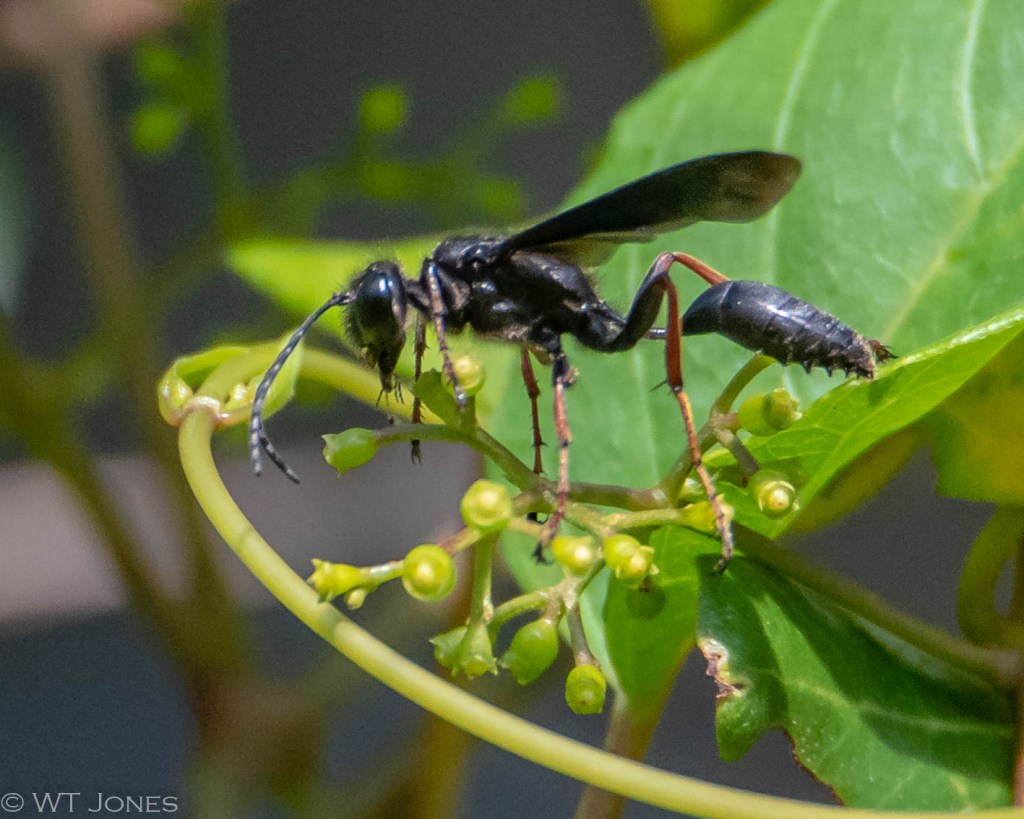
I couldn’t make out what the prey was for this Ringed Paper Wasp (Polistes annularis). They make some very large and impressive nests.

More breakfast images. This time it’s a Two-striped Forceptail (Aphylla williamsoni) with what is some type of grilled sausage. Or perhaps a larva of some sort?

A side view would have been instructional to show the namesake feature of this big dragon. Unfortunately, the Cyrano Darner (Nasiaeschna pentacantha) was on patrol and didn’t have time to take requests.

As mentioned earlier, Florida’s sub-tropical weather means a longer and often more frequent mating season for many species. Here is one now. Rambur’s Forktail (Ischnura ramburii).

Dragon leading dragon. A Four-spotted Pennant (Brachymesia gravida) helps his somewhat larger cousin navigate the lake.

“Don’t hate me because I’m beautiful.” No, agriculture managers hate you because you are an invasive who uproots the natives. Still, she is kind of pretty. Peruvian Primrosewillow (Ludwigia peruviana).

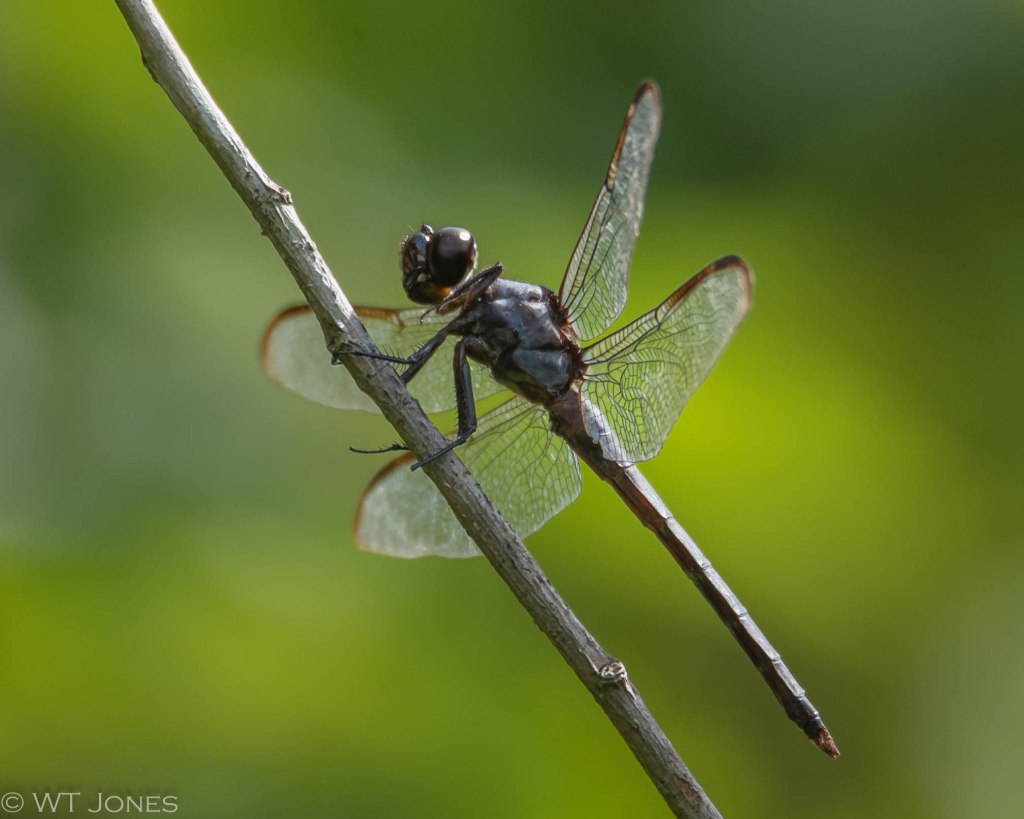
All dark from face to tail, a male Slaty Skimmer (Libellula incesta) is one of three overall dark skimmers in our area.
The very small Eastern Amberwing (Perithemis tenera) has learned to fly with its legs dangling down like a wasp. A would-be predator may think twice before gulping her down.

There are about 3500 species of orb weaver spiders worldwide. In North America, around 180 live north of Mexico. They are a very diverse group! Here are two we found today.


When you visit Florida and wander the trails enjoying our vast array of natural wonders, you may have a feeling you are being watched.

Our late summer is wet and hot and incredibly productive for those who love Nature! We put up with these horrible conditions in Paradise – so you don’t have to. You’re welcome.
Enjoy your search for a natural place and come back for a visit!
Header Image: Sunset After The Storm
“They sure know how to cook fish right!” Once again, I was admonished not to speak with my mouth full.
Gini and I were profoundly fortunate to have been raised in Florida. Surrounded on three sides by salt water with plentiful freshwater lakes throughout the state, it was only natural that fish was on the menu quite often. We were both blessed with parents who taught us the art of fishing and Gini was doubly blessed as her Mother taught her how to properly prepare the catch for the table. We weren’t aware of it when we were growing up, but our knowledge resulted in us becoming “fish snobs”.
An abundance of seafood eateries does not, unfortunately, equate to an abundance of correctly prepared seafood. Indeed, there have been long periods of time when we would shun any such restaurant, preferring to catch and cook our own seafood.
A few years ago, we stumbled across a small shack with a dozen picnic tables under an overhanging roof with a sign out front: “Fresh Mullet”. For anyone not raised along Florida’s Gulf coast, they would most likely think the place sold fish bait. There are apparently some scientific reasons that mullet found along our west coast taste good. I won’t go into that here. Striped (or black) mullet (Mugil cephalus) and white (or silver) mullet (Mugil curema) are the two varieties of mullet commercially harvested in Florida. The most common methods of preparing them are fried and smoked. We somewhat reluctantly ordered two mullet dinners. On our next visit, they had fresh grouper. On the next, shrimp. Each time we have been extremely satisfied with the results.
So there we were the other day, scraping up the crumbs of our most recent grouper meal and Gini wondering aloud if I felt like driving around before heading home. My usual reflexive response jumped out of my mouth like a mullet breaking the surface of the bay: “Is that a trick question?”
It was already late afternoon and there was a better that 50% chance of running into a thunderstorm, but that has never slowed us down before. We headed over the Sunshine Skyway Bridge which spans Tampa Bay and entered Fort DeSoto Park as clouds began to darken in the east.
Along the east beach, a few shorebirds were scurrying along the receding tide line and exploring the wrack for small invertebrates hiding in the seaweed. Large Brown Pelicans were crashing into the deeper water and scooping up sardines. I had the bright idea to hurry to the north beach, thinking there would be millions of birds seeking the shelter of the dunes due to the approaching storm.
Wading across a shallow channel, I explored a sandbar that is normally teeming with birds. I found about a dozen plovers and sandpipers, a few seagulls and ten Black Skimmers. The protective sand dunes along the adjacent beach were devoid of any life. Except me. The storm front began to move westward into the Gulf of Mexico and it began to get dark. Really dark. Turning around, large raindrops smacked me in the face and streaks of lightning lit up the inky sky to the east. Removing the camera from the tripod, I wrapped my hat around it and trudged through the deep sand toward the car. Yes. I got wet.
As we sat in the car, thunder booming and rain pelting down, I asked Gini if she was ready to head home. Since she hesitated to answer, I took advantage of the moment and asked if she minded one more visit to the east beach. The rain had stopped and a break in the clouds just at sunset provided the light I had hoped would materialize. The Sunshine Skyway Bridge, distant shoreline, moon, more gathering clouds and calm water provided a rewarding climax to a thoroughly enjoyable day.
There were several Wilson’s Plover at the east beach. We found a mix of adult and immature birds. The adults were already changing into their non-breeding plumage. A relatively large dark bill helps identify this species.


A bit larger than Wilson’s, the Semipalmated Plover has a smaller bill and shows more yellow in the legs. This one is still in breeding plumage.

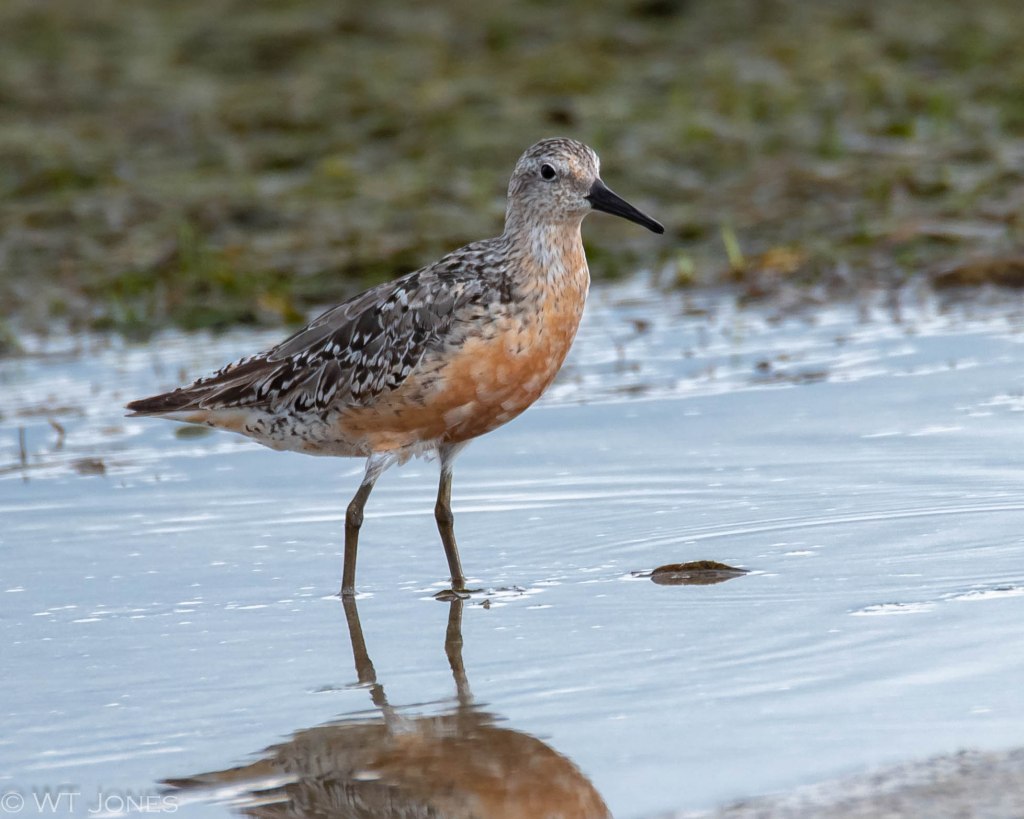
In a few more weeks, this Red Knot will be a dull gray all over. Timing is everything.
Juvenile European Starlings have dark bills and some dark feathers with white tips beginning to show. This one was part of a flock of about two dozen.

Hopes of finding large numbers of birds at the north beach were dashed as storm clouds passed overhead. Birds, having time and again demonstrated they are mentally superior to yours truly, were most likely in the local cafe enjoying a shrimp cocktail.

A Black Skimmer searched for a last-minute snack before the heavy rains started.

Peeking through the sea oats among the dunes, dark clouds moved out into the gulf and teased us with a bit of blue sky. Directly behind me looked like midnight and the rain (not to mention the lightning) persuaded me it was time to find the car.

As I approached the car, a racoon wondered why I wasn’t climbing the nearest tree like she had. Didn’t I know it was raining? Everyone’s a critic.

Perfectly prepared fish dinner, a few birds, a little storm, sunset, moonrise. Our dinner and show could not have been better.
Enjoy your search for a natural place and come back for a visit!
Header Image: Carolina Redroot (Lachnanthes caroliana)
Wait. Don’t you mean “Escape FROM The Swamp”??
We review the news from around the corner and around the world. Local roads and businesses are packed with people. Drama inserts itself into our lives unexpectedly.
A dirt road leads into welcoming green pine forests where we soon encounter a small stream flowing under an old bridge. Cicadas buzz in a cacophonous wave which washes over our senses reminding us it is summer in the Natural World. In the distance, a Red-shouldered Hawk emits a cry which announces to her community that intruders are present.
No. We have escaped TO the swamp. And we are content.
The particular swamp is the Green Swamp in central Florida. It is less than a half-hour from our front door. Over 560,000 acres (226,000 hectares) consisting of pine sandhills/flatwoods, upland hardwoods, wetlands and cypress swamps. Four of Florida’s main rivers have their headwaters here: the Withlacoochee, Ocklawaha, Hillsborough and Peace. Annual rainfall within the swamp replenishes the Floridan Aquifer providing drinking water for many of the state’s inhabitants.
We began our morning getting our feet wet. Not by fording a mighty river or wading the shore of some alligator-infested lake. A small wetland is one of our favorite stops but a summer morning in Florida usually means grass heavy with dew. Wet feet. Totally worth it.
Several species of dragonflies were going about the business of survival. A pair of Least Bitterns took off from the reeds beside a pond and let us know they were NOT happy with our presence. They likely had a nest there but we couldn’t locate it. A nearby Green Heron fluttered and, I swear, smiled a bit.
A quiet clearing provided a perfect venue for Gini and I to share breakfast, thoughts and that most precious commodity – time. It truly does fly all too quickly.
The rest of our morning included more dragons, some new-to-us blooms, butterflies and birds. A highlight was spotting over two dozen wild turkeys, most of them this year’s new birds. We also observed a dozen White-tailed Deer throughout the morning. After a few hours, we somewhat reluctantly returned FROM the swamp.
Of course there are pictures.
Scarlet Skimmers (Crocothemis servilia) are not native to the United States and were likely introduced to Florida over 40 years ago. The bright all-red male is hard to miss.


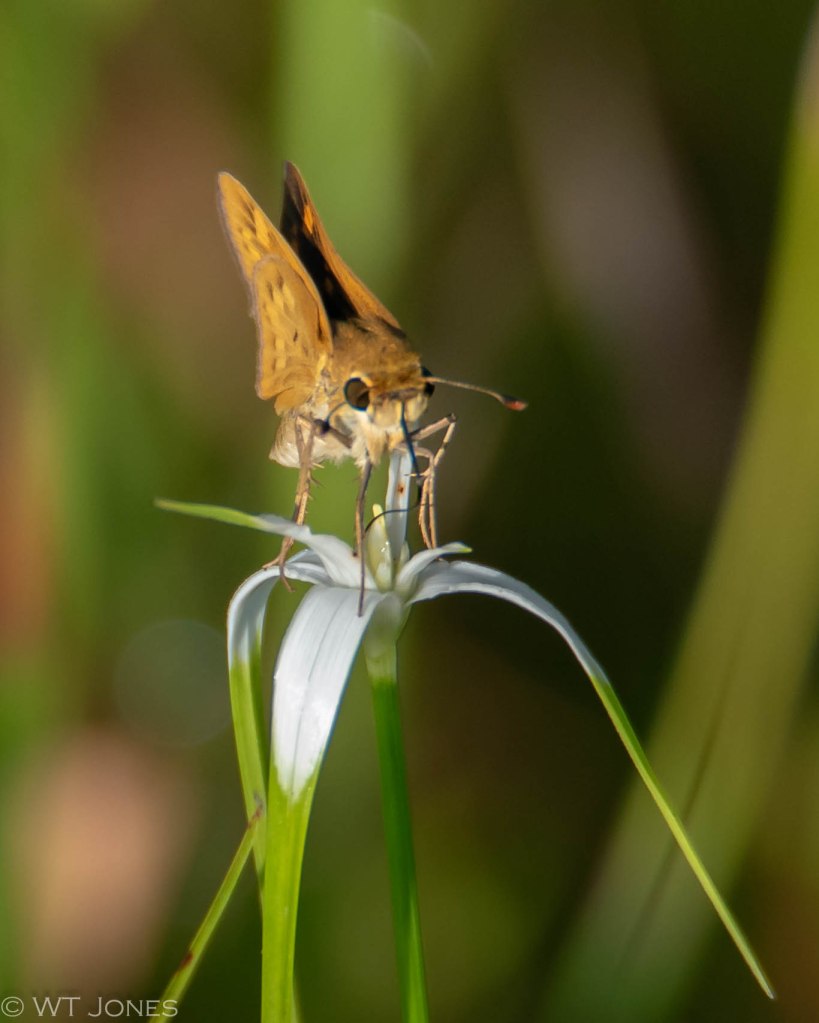
A member of the grass-skipper family of butterflies, the small and very active Fiery Skipper (Hylephila phyleus) visits a Starrush Whitetop (Rhynchospora colorata).

The early light of the sun enhanced the gold highlights of a female Needham’s Skimmer (Libellula needhami). An immature male will soon become more orange/reddish in appearance.


A Green Heron was unperturbed by our stomping around his pond’s shoreline.

One of our more common dragonflies is the Four-spotted Pennant (Brachymesia gravida). The mature male will have well-defined wing spots and will be dark all over.

Roseate Skimmers (Orthemis ferruginea) are large dragons. I tried unsuccessfully to photograph a bright lavender-colored male but this female obliged nicely.

So small, I almost thought she was a wasp, but took a second glance and was happy to discover a Little Blue Dragonlet (Erythrodiplax minuscula) resting on the tip of a reed.

Not a great picture, but Wild Turkey moms herding new baby turkeys are not willing to pose for some crazy two-legged paparazzo!

We came across a male Eastern Pondhawk (Erythemis simplicicollis) munching his brunch on a bridge railing.

The male Slaty Skimmer (Libellula incesta) is one of our three all dark male skimmers. Females look completely different.

With a characteristic “zipper” in the middle of her web, the Yellow Garden Spider (Argiope aurantia) is eye-catching, not only due to her beautiful colors but she’s a sizable predator!

The Green Swamp is pretty much in the middle of Florida, but someone forgot to tell the lovely Saltmarsh Morning Glory (Ipomoea sagittata). No worries. Any marsh will be just fine.

There are literally thousands of beetles in the outdoors! If only they could give us a hint as to their identification. Perhaps something like, oh, I don’t know, a letter on their back? Delta Flower Scarab Beetle (Trigonopeltastes delta).
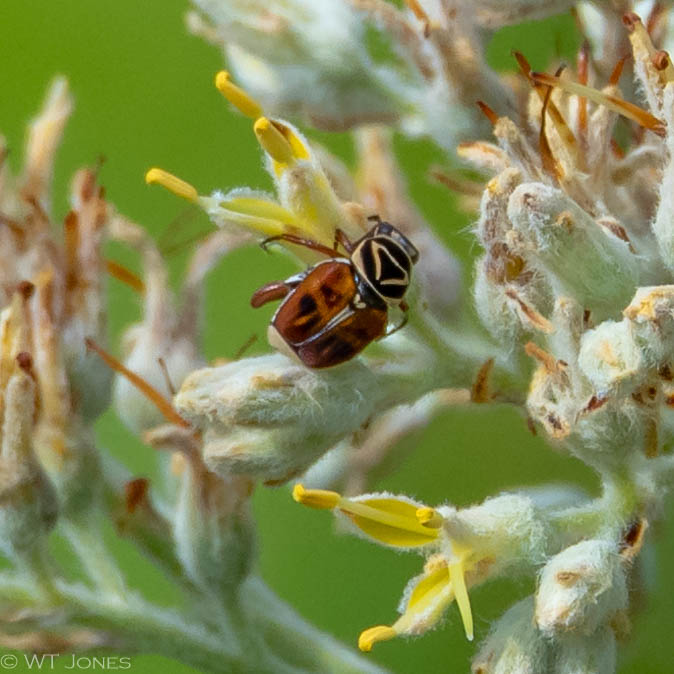
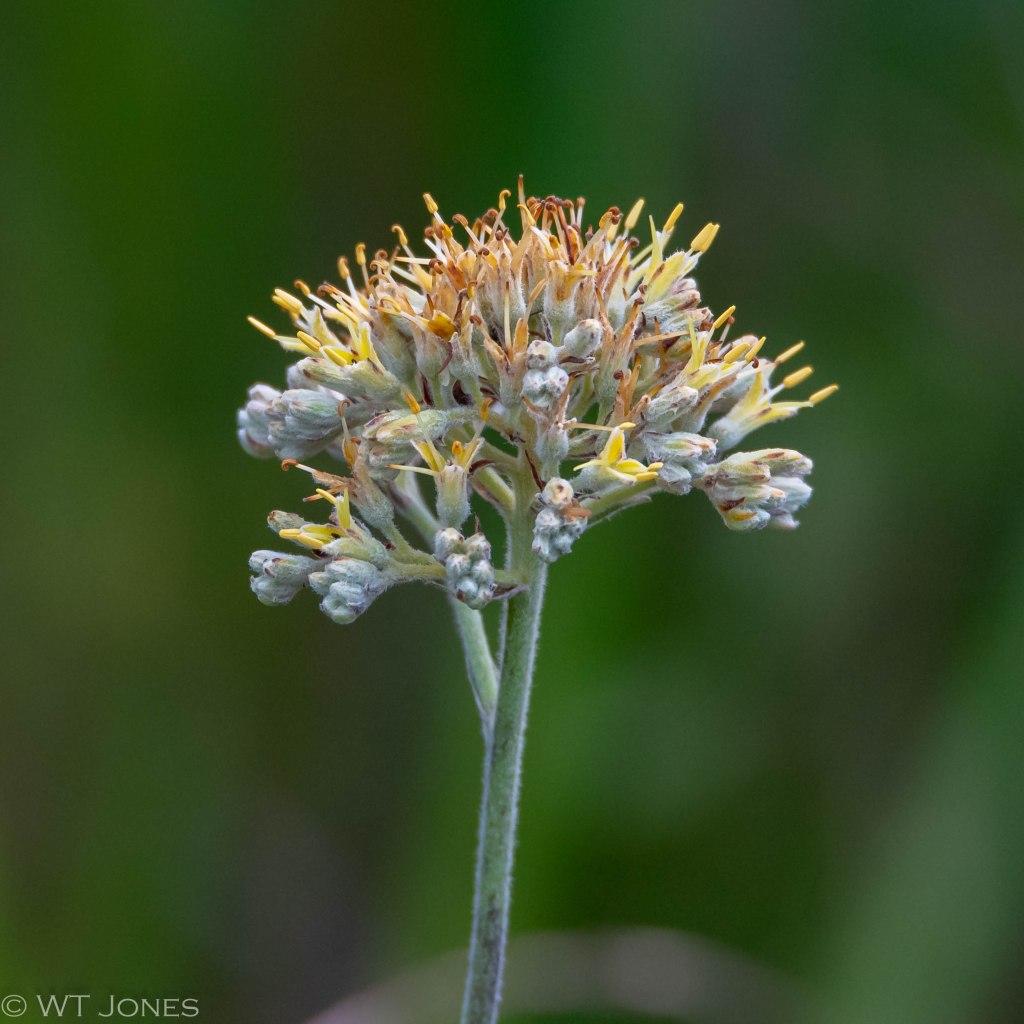
The Carolina Redroot (Lachnanthes caroliana) likes wet places, especially if it’s in a pine forest habitat. The plants grow over three feet tall and have a hairy cluster of creamy white and yellow flowers. Many different pollinators visit the blooms. Like the Delta Flower Scarab above. And the butterflies in the header image. The common name “Redroot” is due to the color of lower stems and roots from which Native Americans and pioneers made a dye.
Trying its best to look like a Monarch, a Viceroy (Limenitis archippus) hopes the ruse is good enough to keep it from being eaten today.

Another of our all dark skimmers is the male Bar-winged Skimmer (Libellula axilena). The light colored inflorescence on the rear wings is diagnostic.

Fungus.

This yellow beauty is the Roundpod St. John’s-wort (Hypericum cistifolium). It grows in a single stem to three feet tall and the pretty yellow flowers bloom most of the summer.


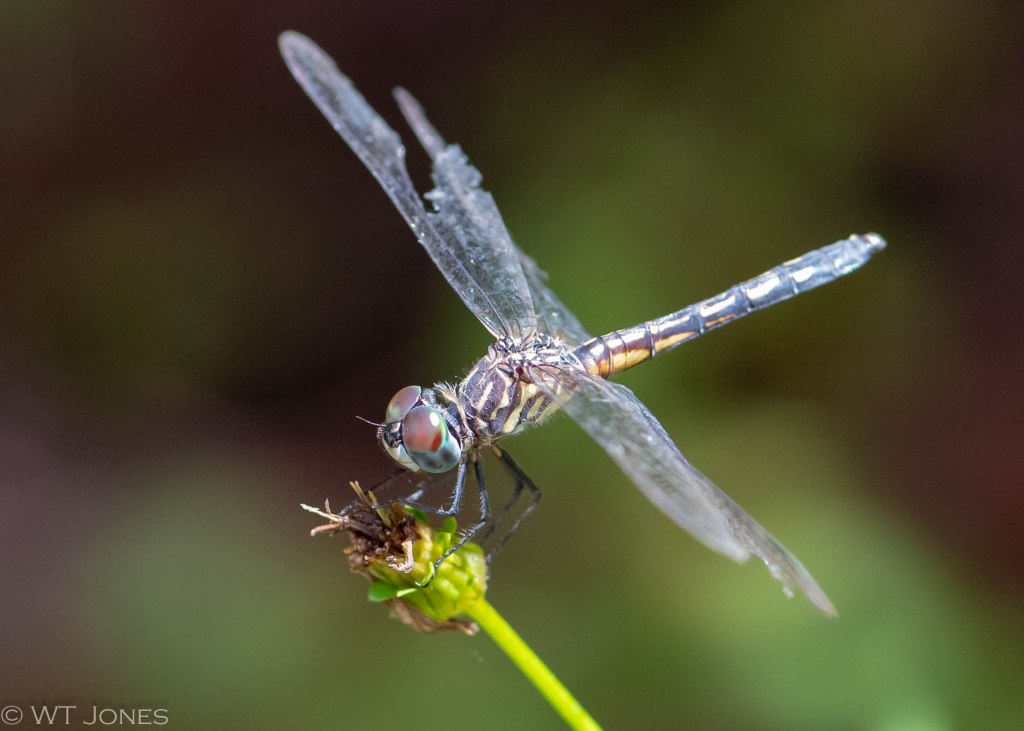
Small and fast, this female Blue Dasher (Pachydiplax longipennis) is looking quite tattered. The males have green eyes and a blue abdomen. Both genders have the “racing stripe yellow” thorax.

As is typical, you wander off in search of some new creature, see some nice things, but nothing different and when you return to your parked vehicle, there, perched on your window – something new and different! In this case, a handsome Obscure Grasshopper (Schistocerca obscura).

Our escape to the swamp worked wonders for our morale the rest of the day. Hopefully, you, too, have a “swamp” in your area which will offer the same sort of respite. If not, you are welcome to use ours any time!
Enjoy your search for a natural place and come back for a visit!
Header Image: White-tailed Deer At Dawn
The early morning mist was light and the woods were just waking. Rude Blue Jays did their best to ensure no one slept in. Nature did not provide them with a “snooze alarm”. Over the path, drops of water rained down from an overhanging oak tree limb as a squirrel scampered to another branch as though late for her breakfast meeting. In a clearing of scattered pine trees and thick palmettos, a distant Northern Bobwhite sounded his name – “Bob WHITE”! A Red-shouldered Hawk joined the Blue Jays in letting the natural world know that a couple of two-legged interlopers were tromping around in their world and were likely up to no good.
Gazing around the tableau of damp woods, small flowers and the endless green of spreading palmetto fronds, there was a sense of being watched. He materialized just beyond a line of pine trees, barely visible above the green undergrowth. The softness of velvet covering his antlers presented a somewhat ethereal image in the filtered morning light. Was he real? The White-tailed Deer and I stared at each other for what seemed like several minutes but which was actually less than 30 seconds. I very slowly raised the camera. He allowed a few clicks before bolting away. The pulse of the day had been set and adrenaline flowed for quite some time.
Gini and I have developed a fairly set pattern of exploring Colt Creek State Park. The park is a patch of central Florida diversity. Lakes, creeks, swamp, open grassy areas, pine woods, hardwood forest – all fairly accessible, much of it by vehicle. Our pattern may change a bit depending on time of year or time of day, but we have a few favorite spots which usually seem to provide something interesting. Today was filled with interesting stuff!
Summer birding can be a bit light due to many species caring for babies or some well into their annual molting cycle, at which time they have limited ability to fly and therefore try to remain inconspicuous. We were happy to spot a few birds and were even happier to find plenty of other subjects which attracted our attention.
All of that habitat diversity I mentioned above attracts a diverse amount of life forms. Even in the middle of summer, flowers of some sort are in bloom which provide food and shelter for a myriad of insect species. Butterflies, moths, wasps, bees, flies, spiders, beetles and unknown small things abound. In addition to the birds, throw in the occasional deer, raccoon, otter, alligator, turtle or snake – and one can understand why we return to this place so often.
Another not-so-small delight is sharing a quiet breakfast with my best friend under a pine-scented canopy while listening to a Northern Parula warbler serenade. This morning, Gini brought fresh Florida tangerines, cherries and boiled eggs.
Recent rains made some of our regular paths too wet to explore. I had the idea to head down one anyway. After all, wet feet will eventually dry out. A few yards down the path, a Water Moccasin slithered into the standing water and I decided Gini needed some company back in the car. (Mine, not the snake’s.)
Humidity and heat once again combined to make the late morning uncomfortable. No complaints. It had been a spectacular day!
A few images to illustrate the diverse nature of – Nature.
A Little Blue Heron heads across Mac Lake.

The early morning light gives a bluish tint to the clear wings of this Red Saddlebags (Tramea onusta).

Gini spied a Sleepy Orange (Abaeis nicippe) butterfly deep in the grass. We followed it until it finally perched for a brief moment and we could record its beauty.

One of the Monarch butterfly imitators, a Queen (Danaus gilippus) has her own beauty for which she can be proud.


A new insect for us! A Brown-legged Grass-carrier (Isodontia auripes) wasp uses long blades of grass to create compartments within its nest.
In addition to its long tail, the body and wing bases of the Long-tailed Skipper (Urbanus proteus) is a blue-green color which helps in identification.

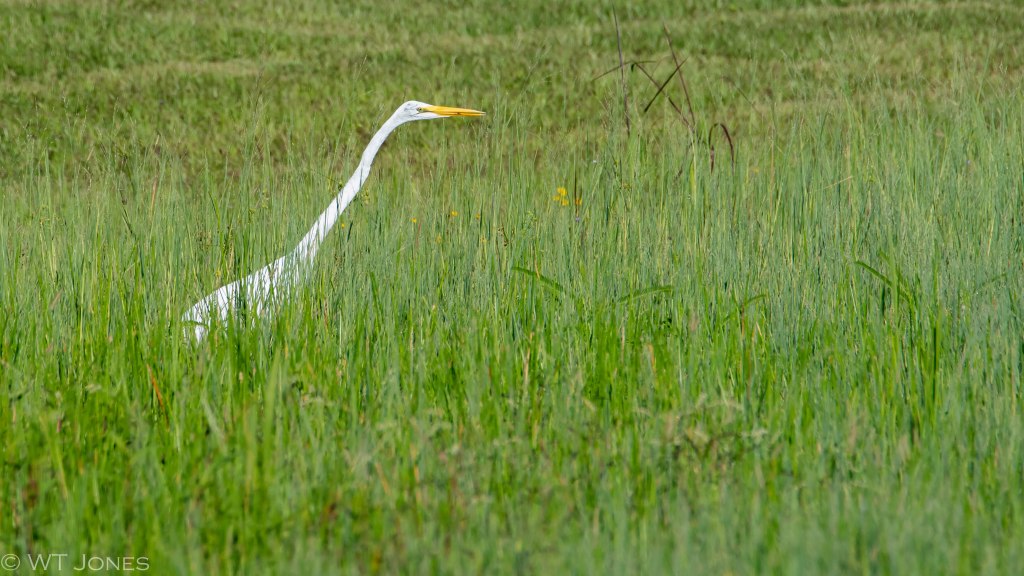
A marshy area provides a great potential food source for wading birds such as this Great Egret.
It is not that easy to make brown look good, but Horace’s Duskywing (Erynnis horatius) pulls it off admirably.

Scrub Palmetto (Sabal etonia). Ubiquitous in Florida. As kids, Gini and I would cut a branch, trim it of its leaves and sharpen it to a point. Perfect for a hot dog or marshmallow roasted over a campfire. Great – now I’m hungry.

Strong fliers which seem to seldom land anywhere, the Zebra Swallowtail (Protographium marcellus) is simply breathtaking.

Primarily a tropical species, the White Peacock (Anartia jatrophae) is found throughout Florida and in some southern states.

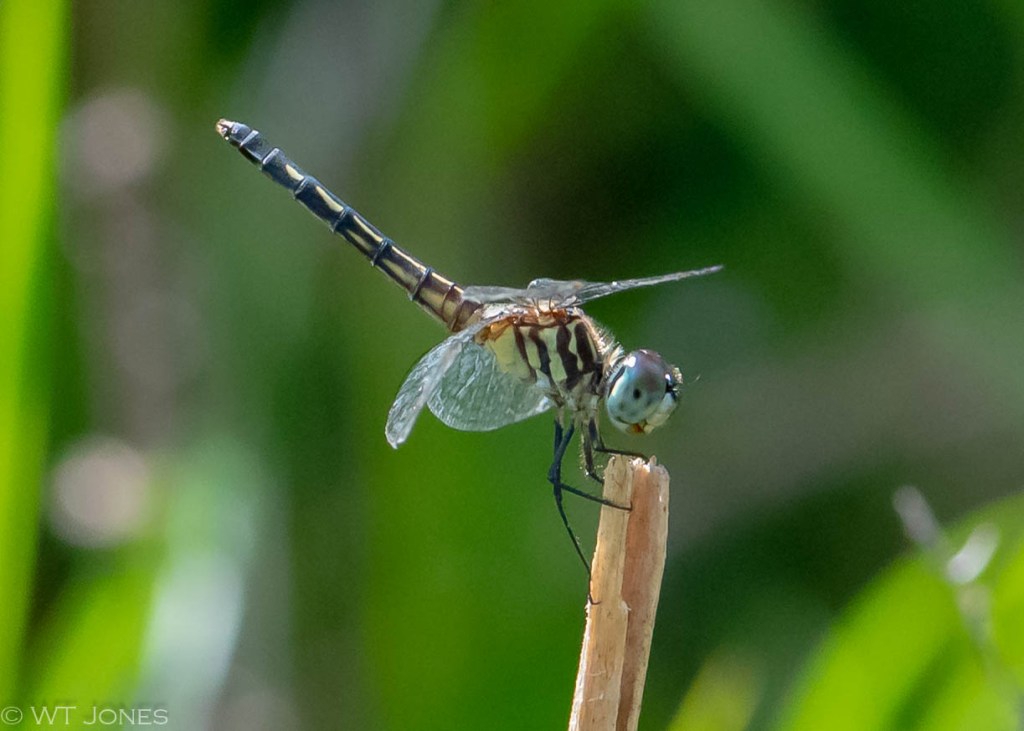
Small but colorful with blue eyes and yellow and brown racing-striped thorax, a Blue Dasher (Pachydiplax longipennis) brightens up the landscape.
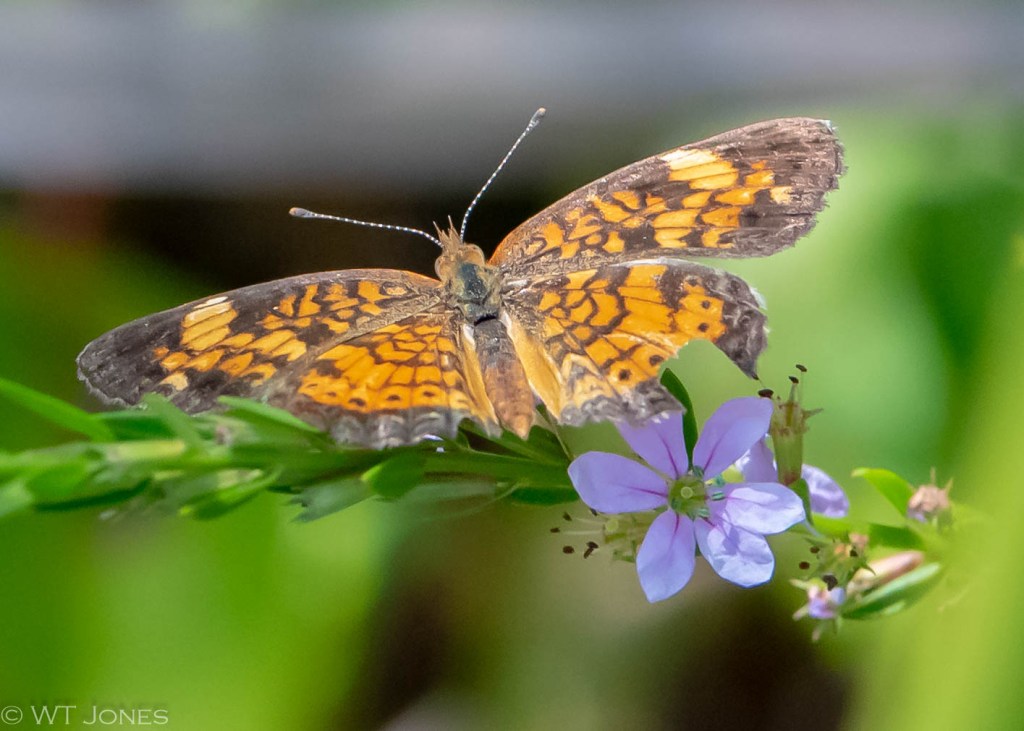
The Pearl Crescent (Phyciodes tharos) is a member of the Brushfoot family of butterflies and is one of the most common in North America. Common, maybe. Beautiful, definitely!
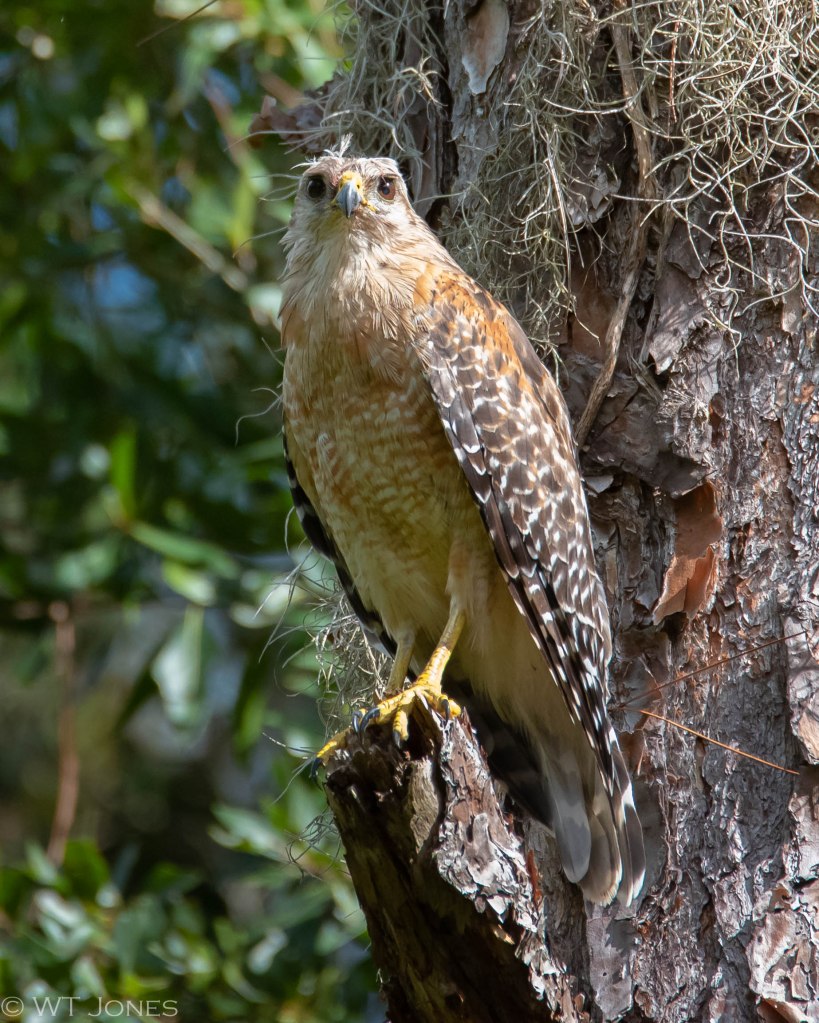
One of the park’s security guards kept a watchful eye on us during our visit. Red-shouldered Hawk.
We really enjoyed the peaceful location, astounding variety of life and, most of all, each other’s company. Hopefully, you can all find those same things near you.
*The title of today’s blog is from a poem of the same name by Henry Wadsworth Longfellow.
An excerpt:
O gift of God! O perfect day:
Whereon shall no man work, but play;
Whereon it is enough for me,
Not to be doing, but to be!
Through every fibre of my brain,
Through every nerve, through every vein,
I feel the electric thrill, the touch
Of life, that seems almost too much.
(See the entire poem here: https://www.hwlongfellow.org/poems_poem.php?pid=56)
Enjoy your search for a natural place and come back for a visit!
Header Image: American Kestrel (Female)
The sun had been up for half an hour as we made our way along the crushed shell road. Summer. We miss the numbers of migrating birds which spend winter with us but relish the sights and sounds of our local avian residents as they go about the routine of courtship, mating, nest building and rearing a family. Northern Cardinals seem to be everywhere! Florida’s long warm season encourages them to have two or three broods each year. Eastern Towhees sing from the tall grass: “Drink-Your-Teeeeeeea“. An Osprey swoops low overhead with a fresh fish clutched in his talons and lands on a huge nest where he is greeted by Mom and Junior with open beaks. Spider webs spun during the night glisten in the morning sunshine as they have captured thousands of jewel-like dew drops. Raucous Blue Jays and Fish Crows try to chase a Red-shouldered Hawk out of the neighborhood.
A new day is underway.
One of my favorite memories from childhood is a Sunday-after-church visit to a local cafeteria style restaurant. Moving along the buffet line, I was mesmerized by the choices in front of me. I can still smell the roast beef and gravy! Unfortunately, my Mother would always insist my plate included “green stuff” or boiled carrots. Yuk. At the end of the line, the sheer volume of desserts available was almost too much for my undeveloped senses to handle. Cake? Pie? Pudding? Ice cream? Mother again: “Only one.” Sigh.
Today, Gini and I experience that sort of feeling each time we venture into Florida’s natural world. An additional benefit is Mother Nature allows us to enjoy as much as we can stand! No limits. We are so fortunate!
Highlights of our morning were a new family of Swallow-tailed Kites, a pair of unafraid Black-bellied Whistling-ducks, our largest hawk and our smallest falcon. Bonus: damsels, dragons and butterflies. (Oh, my!)
Grab a tray and go through the buffet line with us.
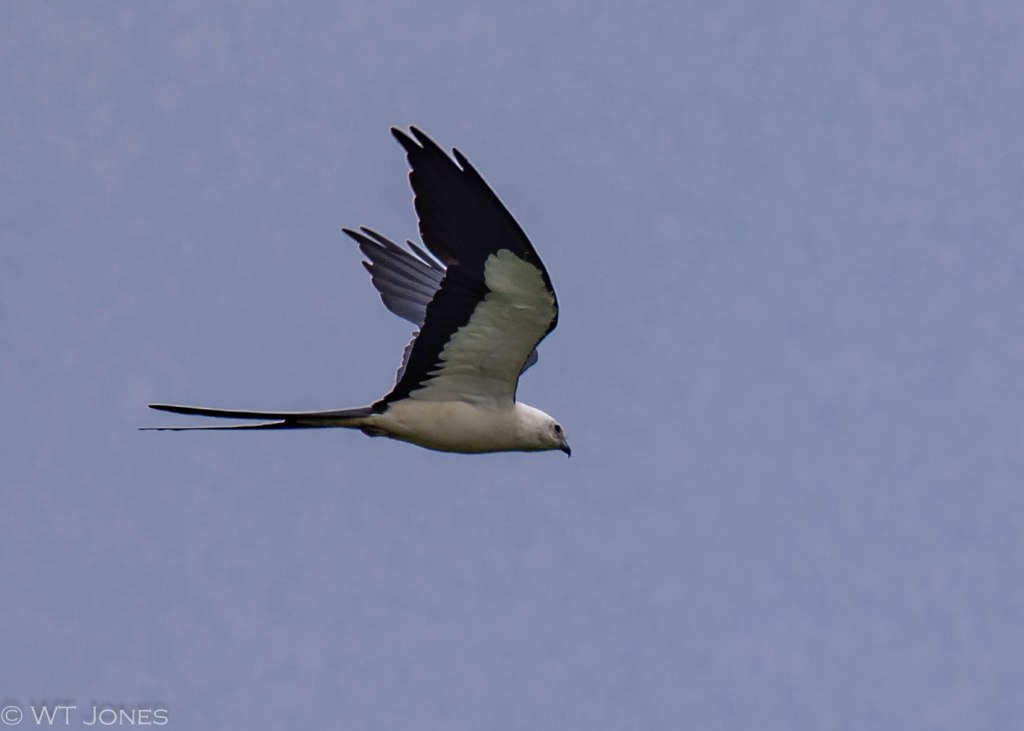
It is a joy to watch these graceful raptors hunt and often munch on their prey as they continue to fly. Habitat destruction has greatly reduced the Swallow-tailed Kites’ numbers over the years. We are very thankful they spend the summer with us.
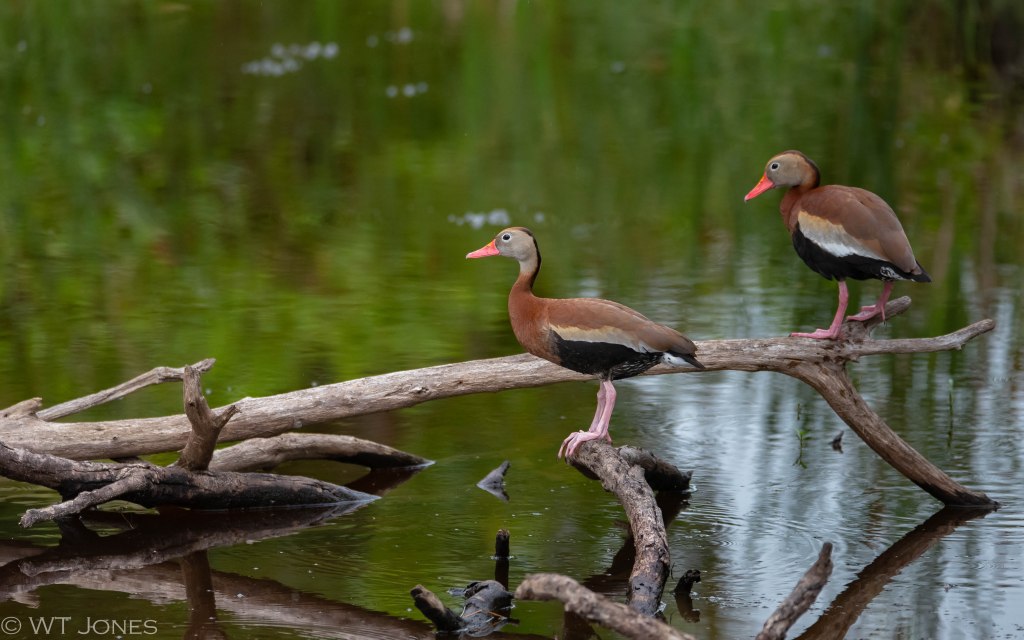
Black-bellied Whistling-Ducks are, like most wild things, skittish and take flight when we get close. This pair remained on their log and permitted a few photographs. It occurred to me they may have a nest nearby, so I backed off and thanked them for the opportunity.
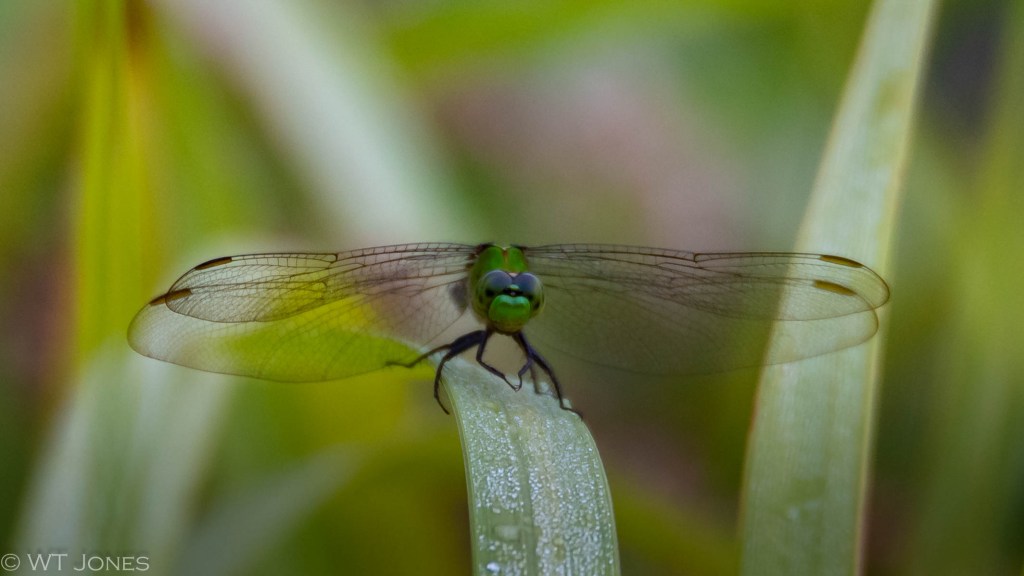
An emerald green female Eastern Pondhawk (Erythemis simplicicollis) contemplates whether to fly or attack. She remained for a moment.
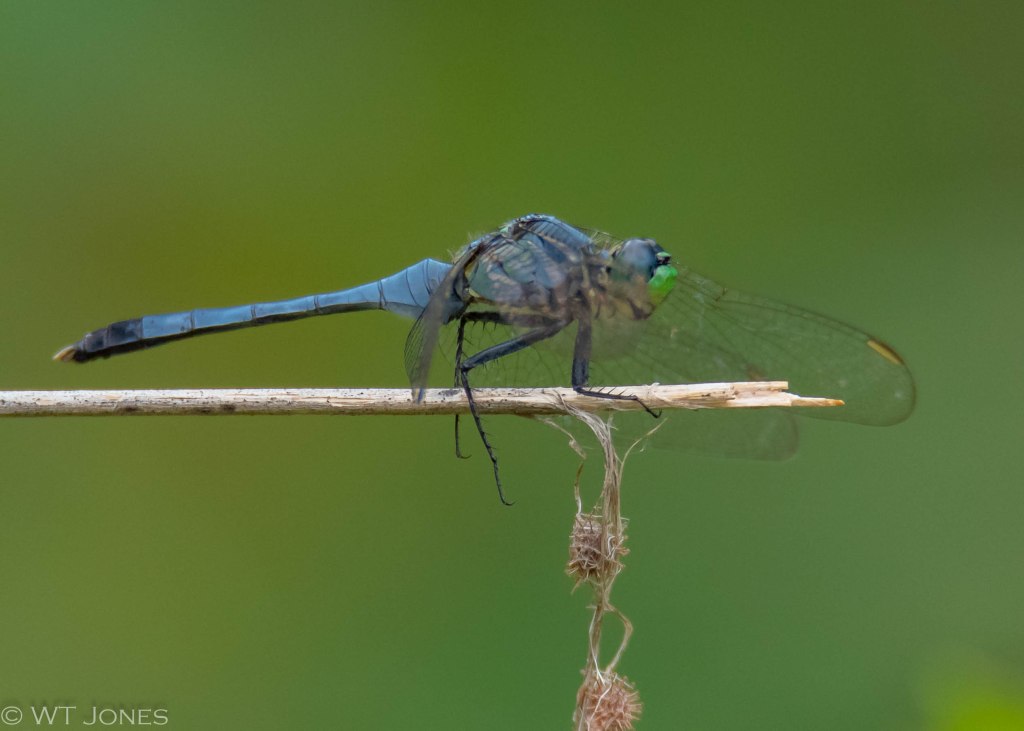
Down the road, a slate blue male Eastern Pondhawk (Erythemis simplicicollis) lies in wait for breakfast.
A young Osprey has fully fledged and we watched as he practiced his flight training for awhile. Mom was perched nearby clucking her approval.

It may be one of our more common butterflies, but the Gulf Fritillary (Agraulis vanillae) is like a flying bundle of sunshine. Bright and beautiful!

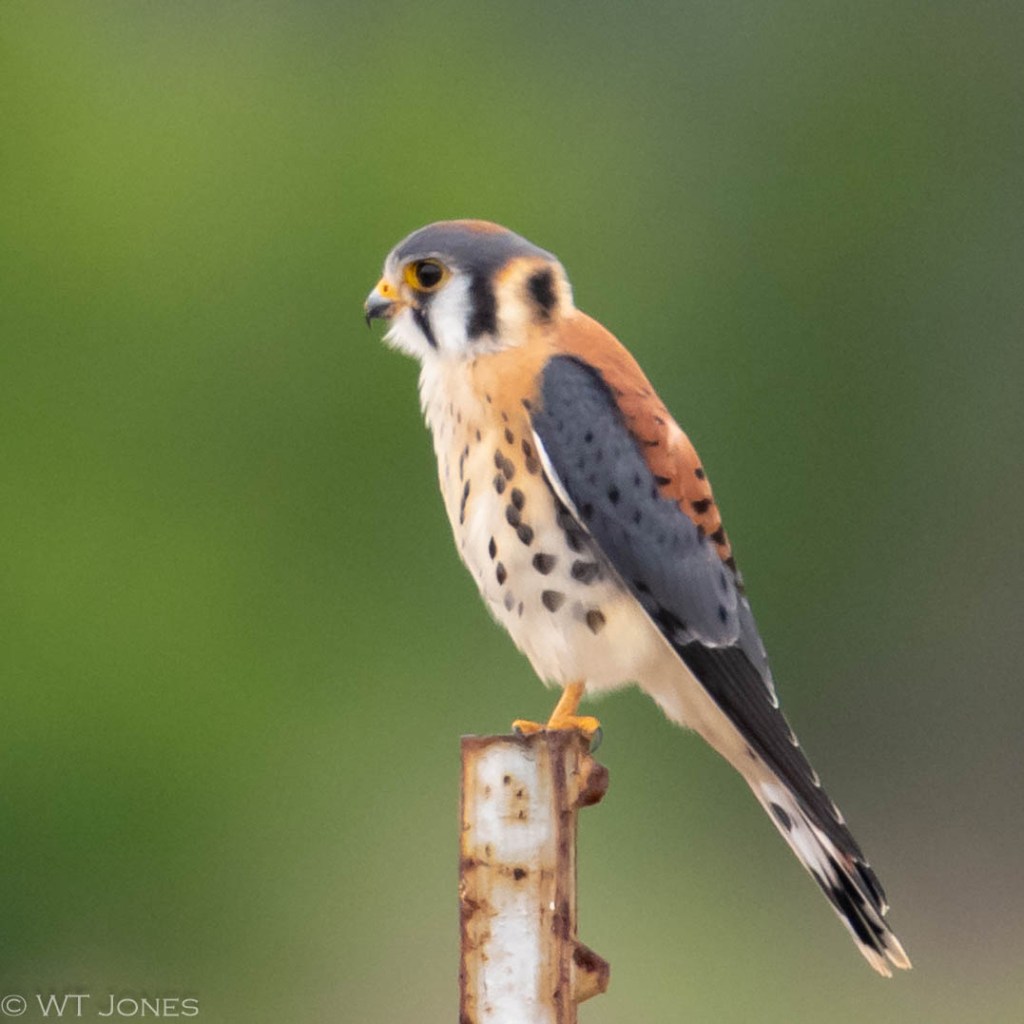
Yet another new family. Biologists have concluded American Kestrels which breed in Florida are a sub-species (Southeastern American Kestrel – Falco sparverius paulus) of the northern species Falco sparverius sparverius. We were quite fortunate to find an adult male and female with two immature birds hunting insects in a large field. North America’s smallest falcons – it was a fascinating treat to watch them work!

At the other end of the field where we found the Kestrels, Florida’s largest resident hawk, the Red-tailed Hawk, kept watch atop a utility pole. Once we arrived, she didn’t hang around and went in search of a hunting spot without humans pointing and gawking.
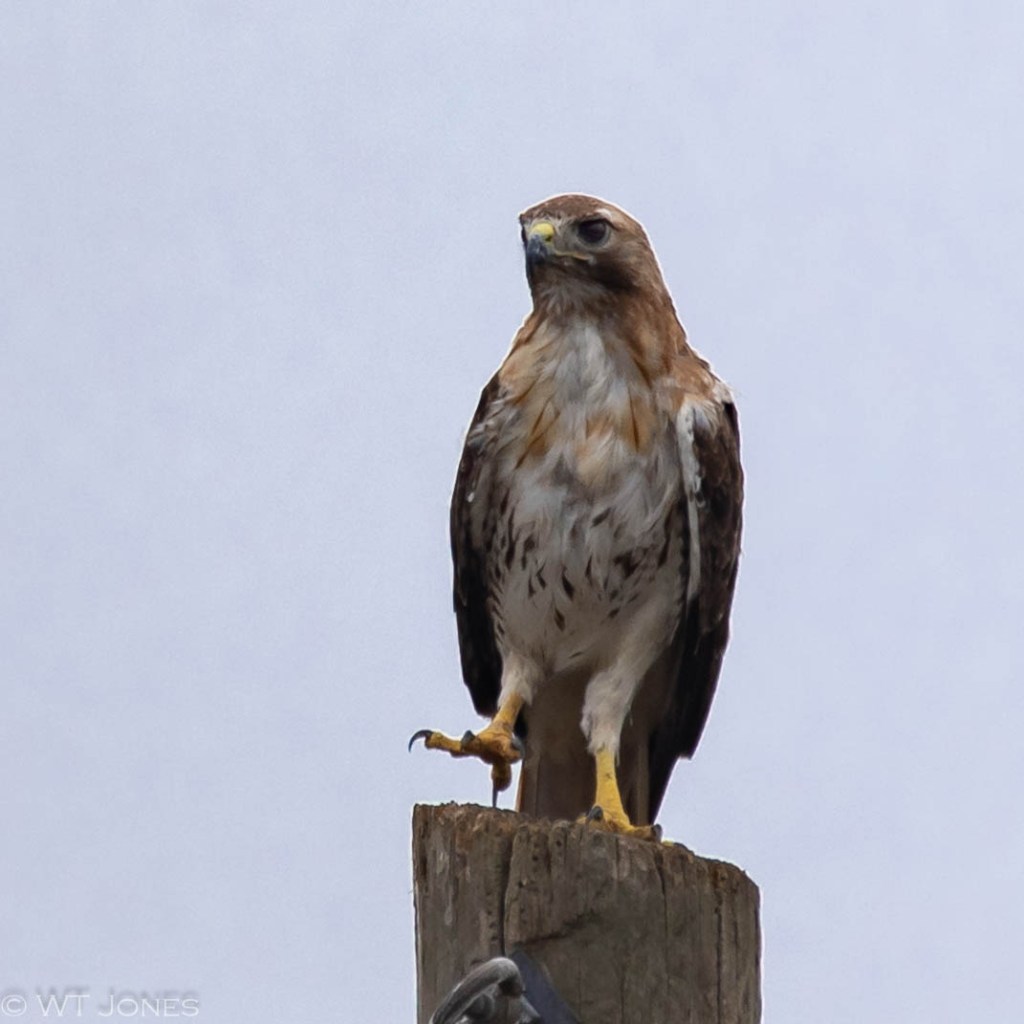

A pair of Brown Thrashers were busy flying back and forth to and from a particular tree. We suspect nest-building was in progress but didn’t actually see them carrying construction material. Perhaps they were just shopping for a good location.

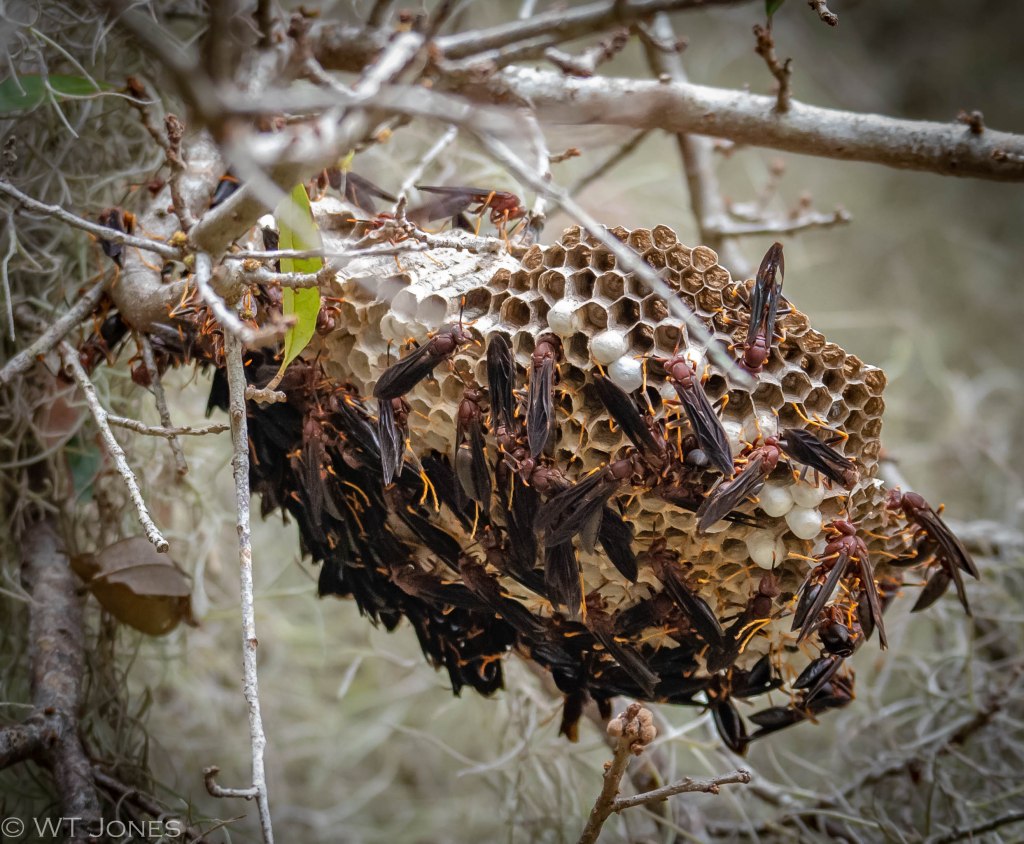
For me, more feared than toothy alligators are some of our large wasps. Painful memories! These are Ringed Paper Wasps (Polistes annularis).
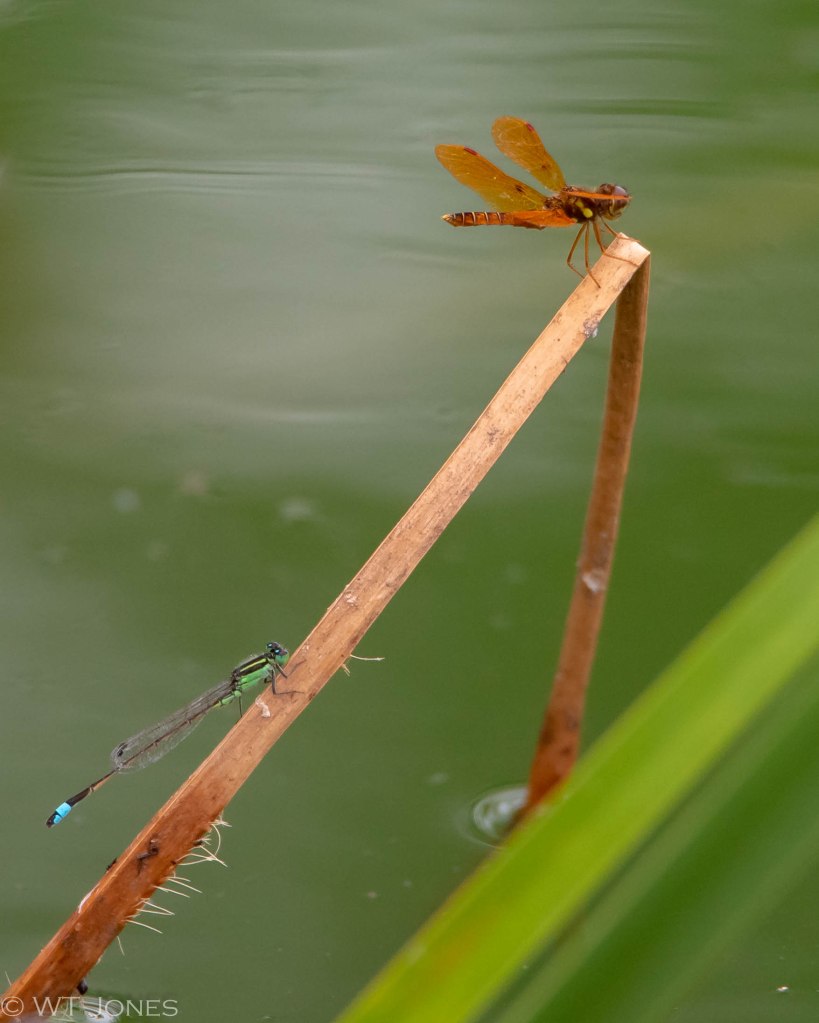
Once in awhile, my photographic motto (“Better Lucky Than Good”) actually works. Today I found an Eastern Amberwing (Perithemis tenera) and a Rambur’s Forktail (Ischnura ramburii) sharing the same reed.
Our dessert today came in the form of a Cicada exuvia. A few years ago, a female Cicada laid eggs at this location. The eggs hatched and the ant-sized nymphs fell and burrowed into the ground. They found a root of grass or tree to feed upon and remained underground for several years, undergoing a series of molts. The final molt causes the nymph to exit from the ground, climb a tree or weed and fasten itself securely. The adult Cicada emerges, sings its summer buzzy song, eats, mates and dies within a few weeks. The cycle begins again.

Our morning buffet was truly outstanding! Nature has a similar offering for you not too far away.
Enjoy your search for a natural place and come back for a visit!
 Our Natural Places