(Reminder: Click to enlarge, click again to zoom on images.)

During the first week of September, Gini and I spent a morning roaming around the Richloam Wildlife Management Area (WMA). The location is part of the Withlacoochee River State Forest and is within a portion of the vast Green Swamp. It’s about a 30 minute drive north of our house so we visit frequently.
As we enter the area, we pass by the state-run Florida Bass Conservation Center. It is one of two hatcheries used by Florida to stock fish in lakes throughout the peninsula. The hatchery has set aside a couple of ponds primarily for families to fish. These are seldom visited during the week and the weedy banks of the ponds and adjacent wetlands are great places for hunting dragons, other bugs and birds.
The vast WMA is accessed via a few old logging roads which can become a challenge during the wet season. This day presented no problems. Plenty of water throughout the swamp, none on the road. That’s a good thing. Our rainy summer has resulted in an abundance of fall wildflowers. All those blooms attract more than a few pollinators. All those blooms and bugs attracted – us!
Once upon a time, I relished visiting my cousin Gerald. He was studying to become an entomologist and was gracious enough to teach a curious 10-year old about biology, insects in particular and how to collect them for further study. Nets were involved. So were lights and white sheets at night. Subjects he wanted to examine were dispatched by placing them into a jar with acetone-soaked cotton in the bottom and a tight-fitting lid. Good times. He went on to receive his BS at the University of Florida and ultimately became head of the Entomology Department at the University of Miami. Gerald was born with deformities of all his limbs. Observing how he overcame challenges to become a highly regarded scientist has always been very motivating.
This trip was the first this year where summer was visibly yielding to autumn. The morning air was slightly cooler, there were only dozens of mosquitoes instead of thousands, flowers seemed to be everywhere and insects appeared to be in hyper-drive. Glorious.
Although entomologists still use jars for gathering specimens, those of us who don’t need to perform autopsies on bugs now have “digital collecting jars”. We can photograph our subjects from several angles, study their physical form, admire their beauty, “pin” them to our album and refer to them next year and they will not have deteriorated at all. We can do this without harming the insect and share our findings with anyone who might be interested.
In case you might be interested, here are the contents of today’s collecting jar.
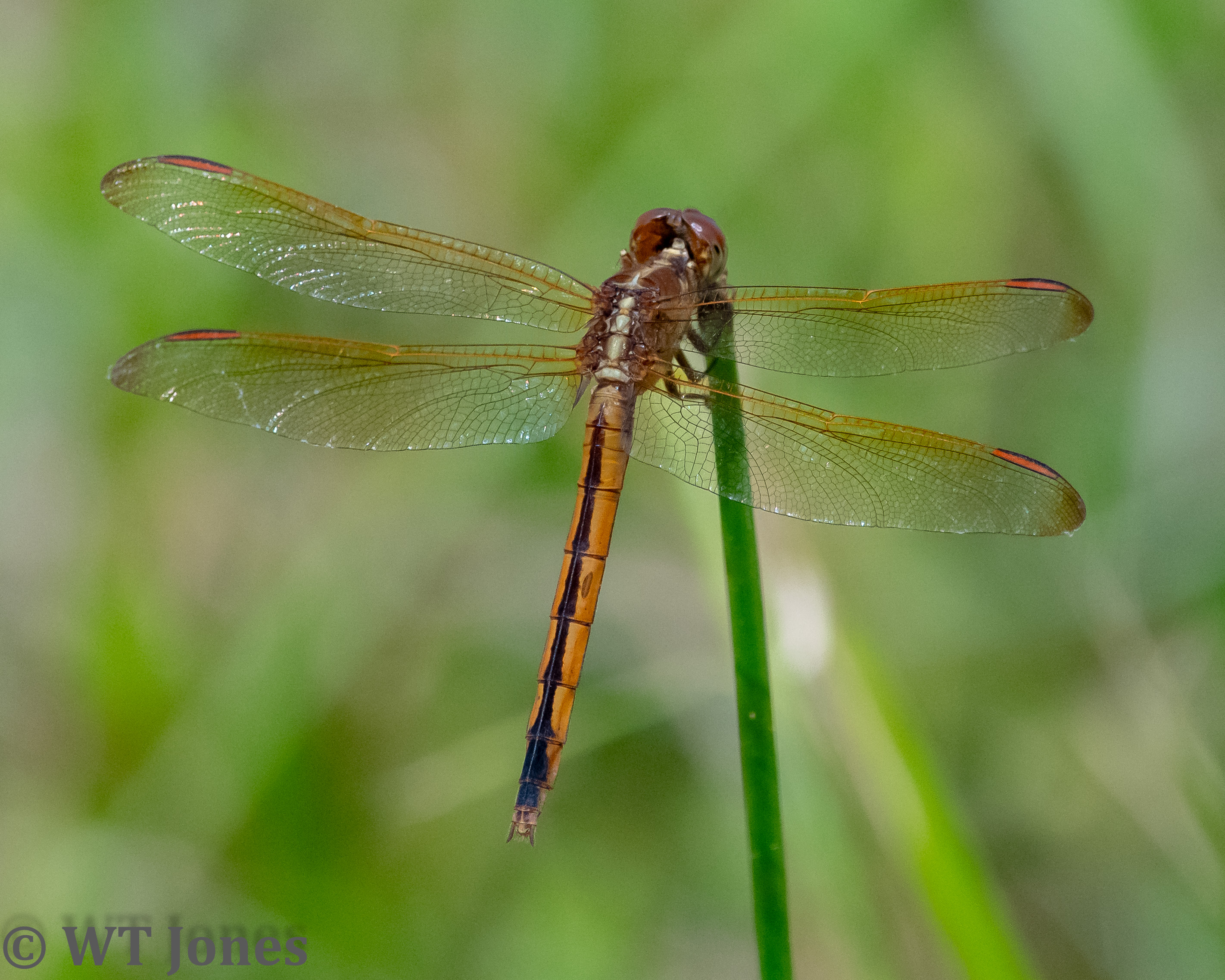
Just because they were abundant does not mean they would hold still for a portrait. Finally, a couple of Needham’s Skimmers (Libellula needhami) took pity on me and perched for a moment.

At the beginning of the trip, it seemed as if there were impossibly blue Skyflowers (Hydrolea corymbosa) everywhere. On one, we found a fragile Crane Fly (Toxorhina magna) had stopped for a rest.


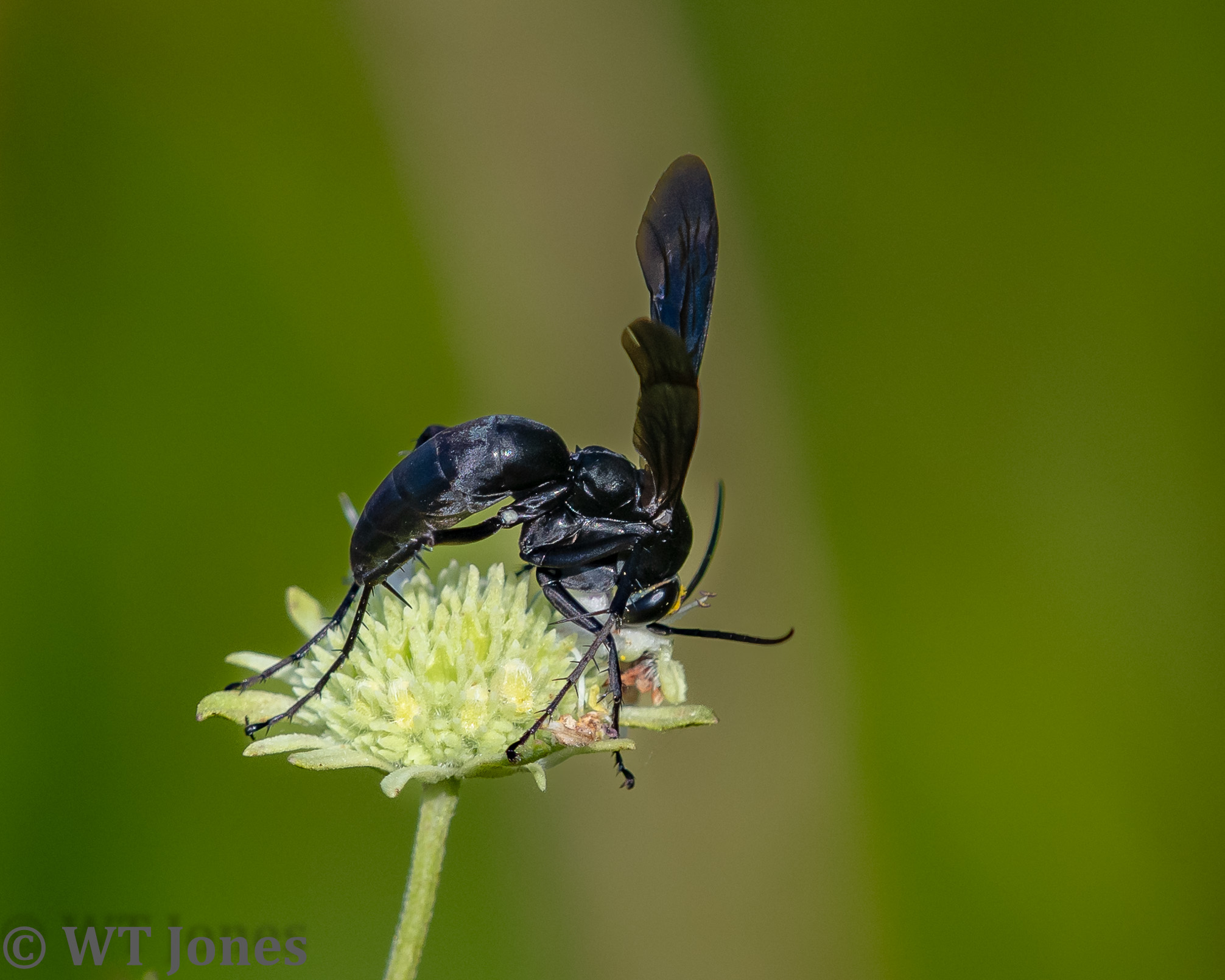
(Updated from original post.) An entomologist has informed me this is a Spider Wasp in the family Pompilidae. We saw several today which were very actively pursuing nectar, mostly among the Clustered Bushmint (Hyptis alata). Or, perhaps they were searching for spiders?
Here and there were small bright red lights shining among the deep green pines. This one is theYaupon Holly (Ilex vomitoria).

Small. Agile. Beautiful. Eastern Amberwing (Perithemis tenera).

Lots of flowers. Lots of admirers. There were plenty of Common Eastern Bumble Bees (Bombus impatiens) busily buzzing from bloom to bloom. The flower here is an attractive invasive species, Peruvian Primrosewillow (Ludwigia peruviana).

Just as busy as the bees, butterflies sipped and flitted, flitted and sipped. This one is a Dorantes Longtail (Urbanus dorantes). (Looks like a leaf-cutter bee was here.)

A specialized assassin, the Mole Cricket Hunter Wasp (Larra bicolor), was imported from South America to try and control, you guessed it, Mole Crickets, which can be an agricultural pest. The linked article is about the importation of this wasp to Florida. Interesting but a bit lengthy. (https://edis.ifas.ufl.edu/publication/IN451)

“Ooohh“, she said. I followed her gaze and agreed with her assessment. Pearl Crescent (Phyciodes tharos).

Speedy little things all over the swamp. Here’s one now. A female Blue Dasher (Pachydiplax longipennis).

A lovely large spider. With a name even bigger. Red-femured Spotted Orbweaver (Neoscona domiciliorum). I can personally vouch for the sticky strength of its web. Ptooey.

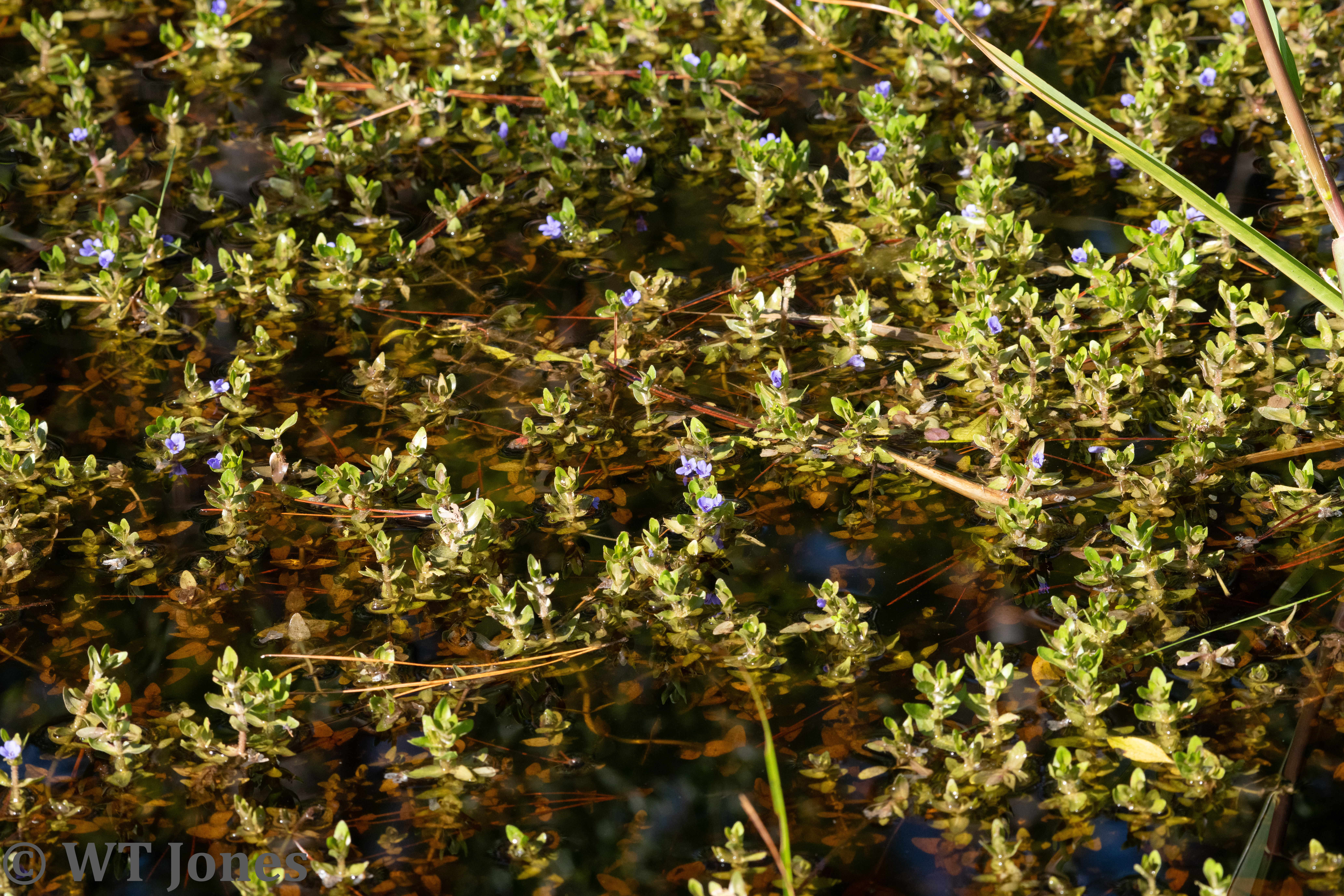
The morning came to a pleasant conclusion with the discovery of a new to us flower species. Standing water seemed to have been sprinkled with small blue stars. Blue Waterhyssop (Bacopa caroliniana) – a beautiful exclamation point on a glorious day!

The days are about to become shorter and cooler. Flowers will be abundant for a bit and we hope to fill our Digital Collecting Jar with dazzling specimens of nectar seekers. We may even share our treasures with someone special. (That would be – YOU!)
Enjoy your search for a natural place and come back for a visit!
(Reminder: Click to enlarge images, click again to zoom.)
Gini and I tend to develop a routine when it comes to exploring. When we become familiar with a particular area through repeated visits, a pattern becomes “comfortable“. Today’s visit to one of our favorite “patches” is a perfect example. Tenoroc Fish Management Area is spread out over several geographically separated venues and consists of nearly 8,000 acres. That is a bit more than we can cover in a morning. Or a year.
Since we are resigned to the fact we only have enough time and stamina to check all the trees and weeds, we follow a well-planned, finely detailed route on each trip. Which usually changes the moment we enter the place. Time of year makes a difference also. It is the kinda sorta beginning of “Autumn”, which in central Florida means some green trees and bushes are transitioning into a lovely shade of brown. The good news is a whole bunch of birds don’t care what our color scheme is as long as there are plenty of bugs to eat as they continue their journey from farther north to farther south. There are plenty of bugs.
This morning we started at one of the lakes where we have seen wading birds on past trips, then to a nice grove of hardwood trees where visiting warblers like the buffet, on past the cemetery where the Screech Owls live, to the lake with big cypress trees, a wetland bordering three lakes and a 200 acre field maintained for dove hunters. Hunting season is from late September through January but only on Saturdays. The field is bordered by pine forest and a lovely creek.
The lake with the big cypress trees is our breakfast spot. Short walks allow us to travel through diverse habitat and all the trails and unimproved roads are well-maintained. On this day we spent about four hours wandering around, roughly following our pattern. We found familiar birds, blooms and bugs as well as some surprises.
Driving through the exit gate, we both sighed contentedly and agreed there could be no better therapy session than that offered by Nature.
Breathe deeply. Come along with us and see the extraordinary.
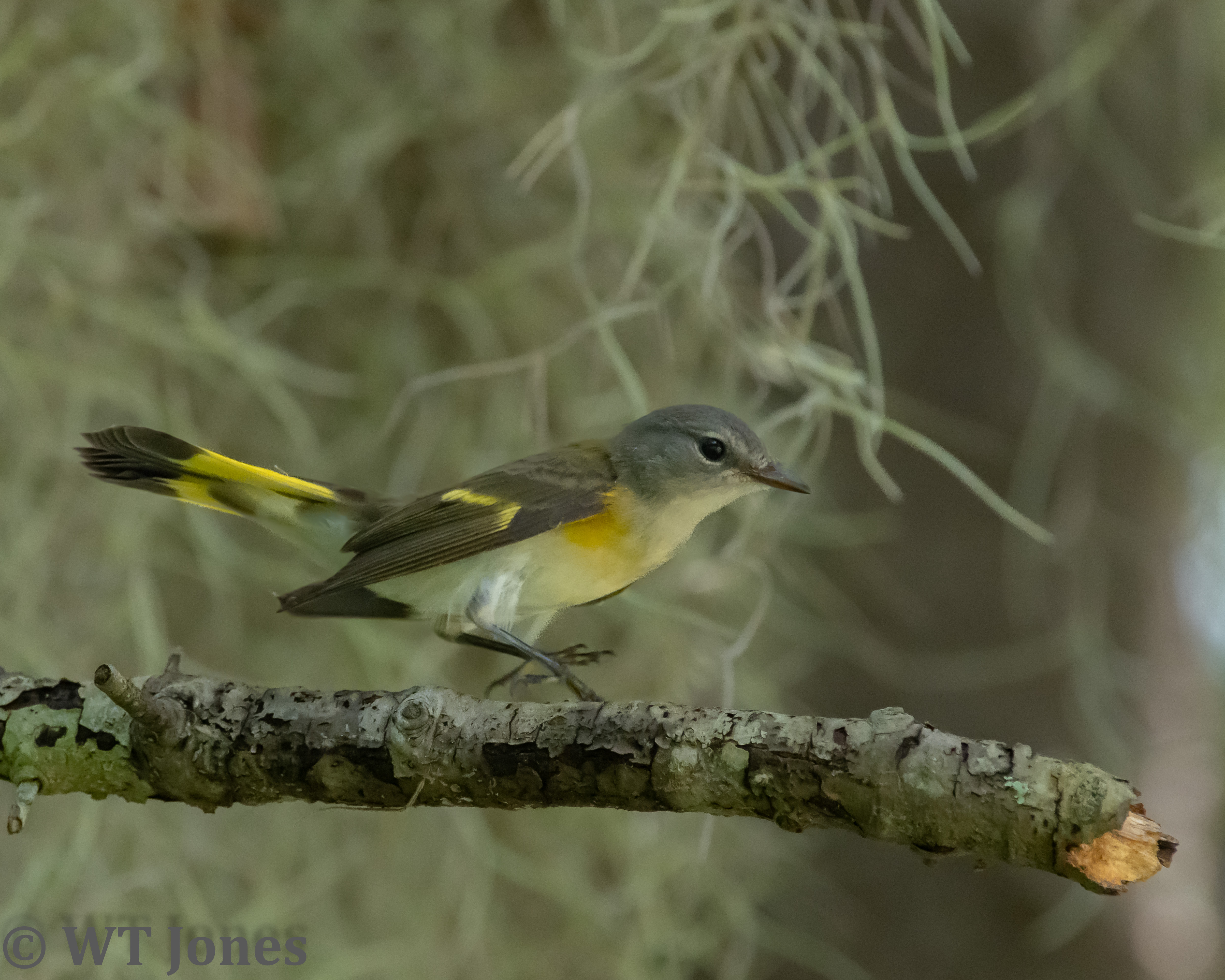
A nice start to the day was watching a female/immature male American Redstart flit from limb to limb, flashing tail and wings with bright yellow spots to frighten insects from hiding places. Immature males look exactly like a female until a bit later in the year when they begin to darken to an adult male’s black plumage.
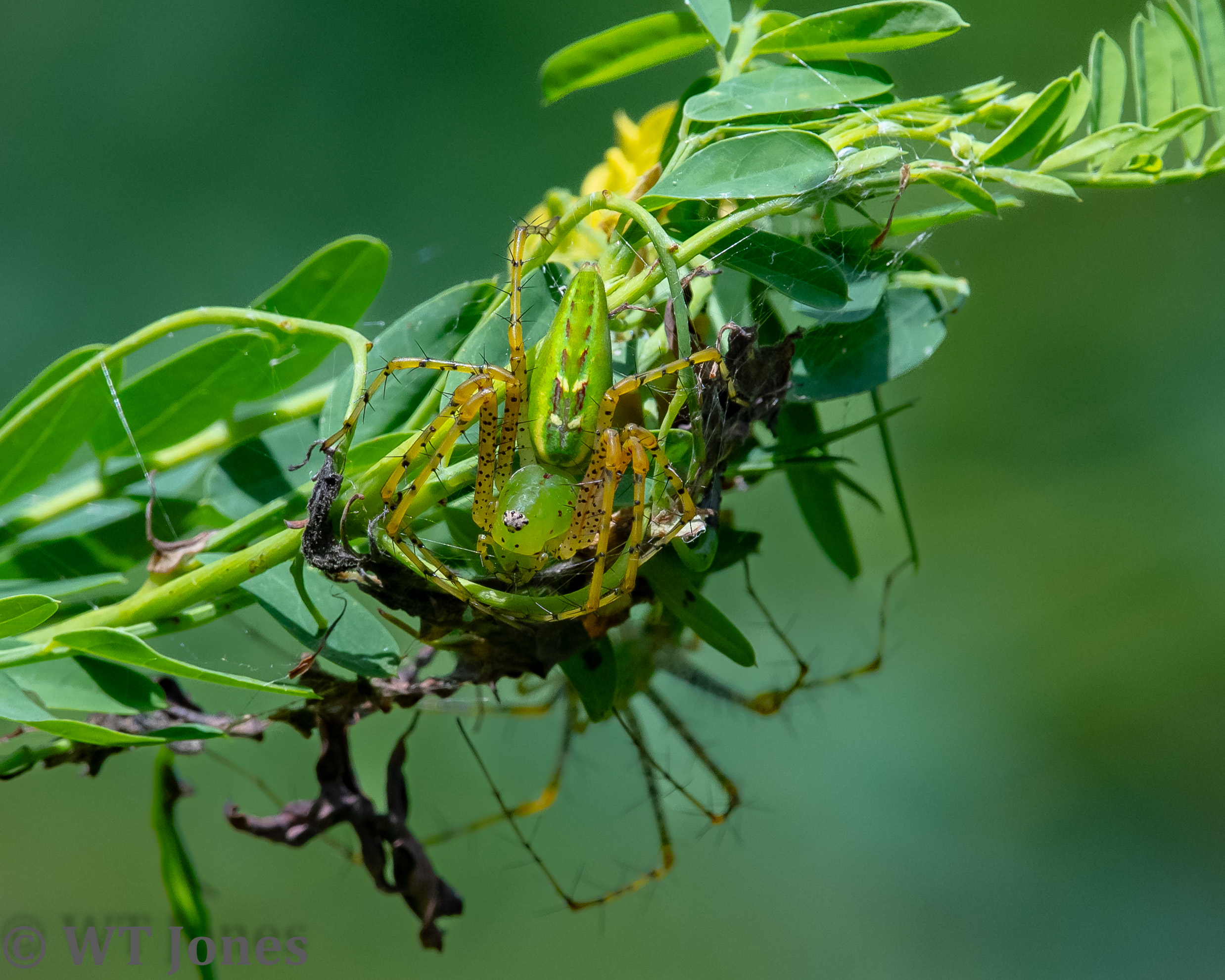
Favorite of the crowd, we found not one but two Green Lynx Spiders (Peucetia viridans). Ambush specialists, they don’t spin a web to capture prey. They just pounce.
Never mind that this is a mighty good-looking bug. I just like the name. Golden-reined Digger Wasp (Sphex habenus).

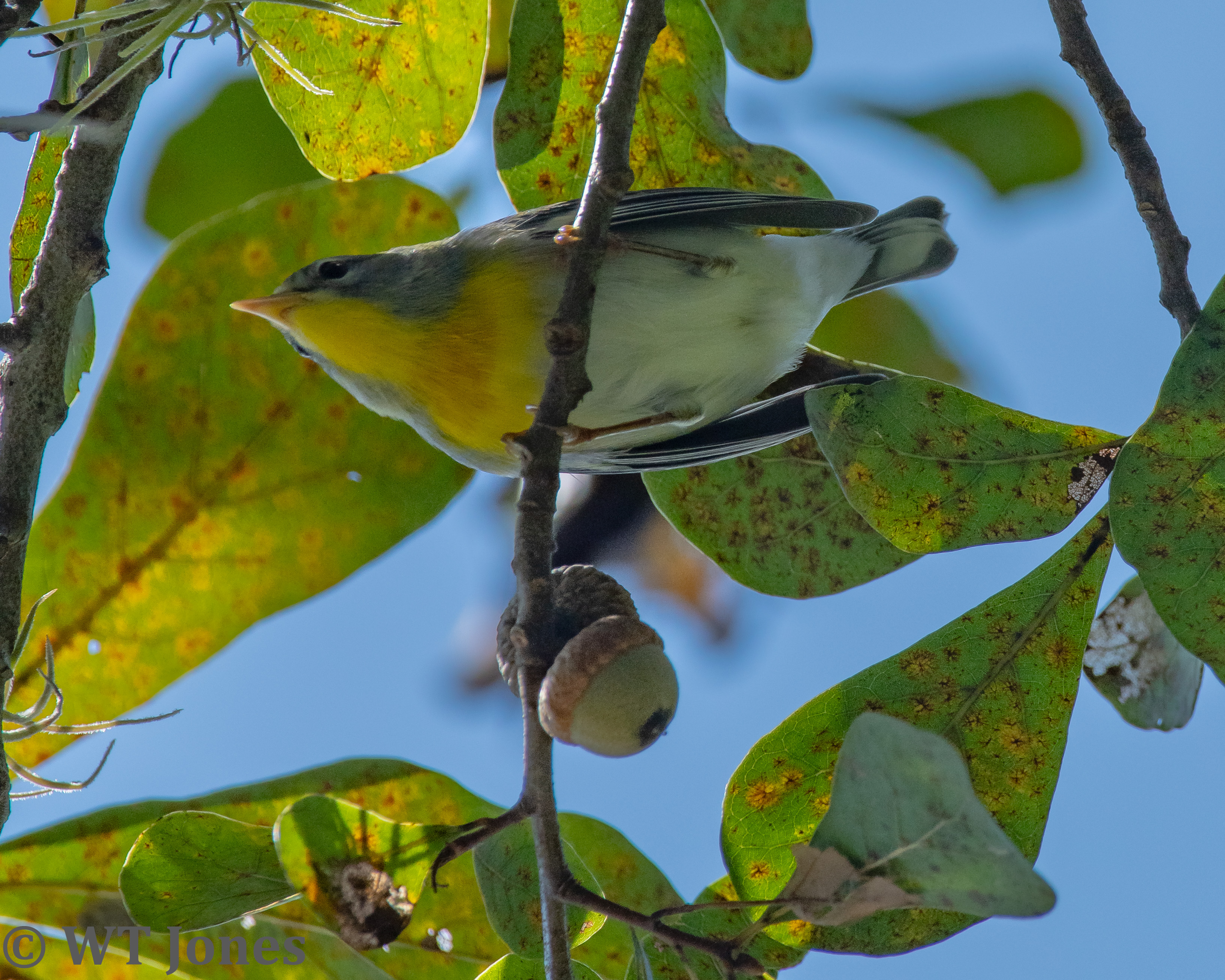
Although the Northern Parula warbler breeds in the area, as fall migration begins, small flocks of local and northern birds form as they begin their journey to South and Central America. Safety in numbers.
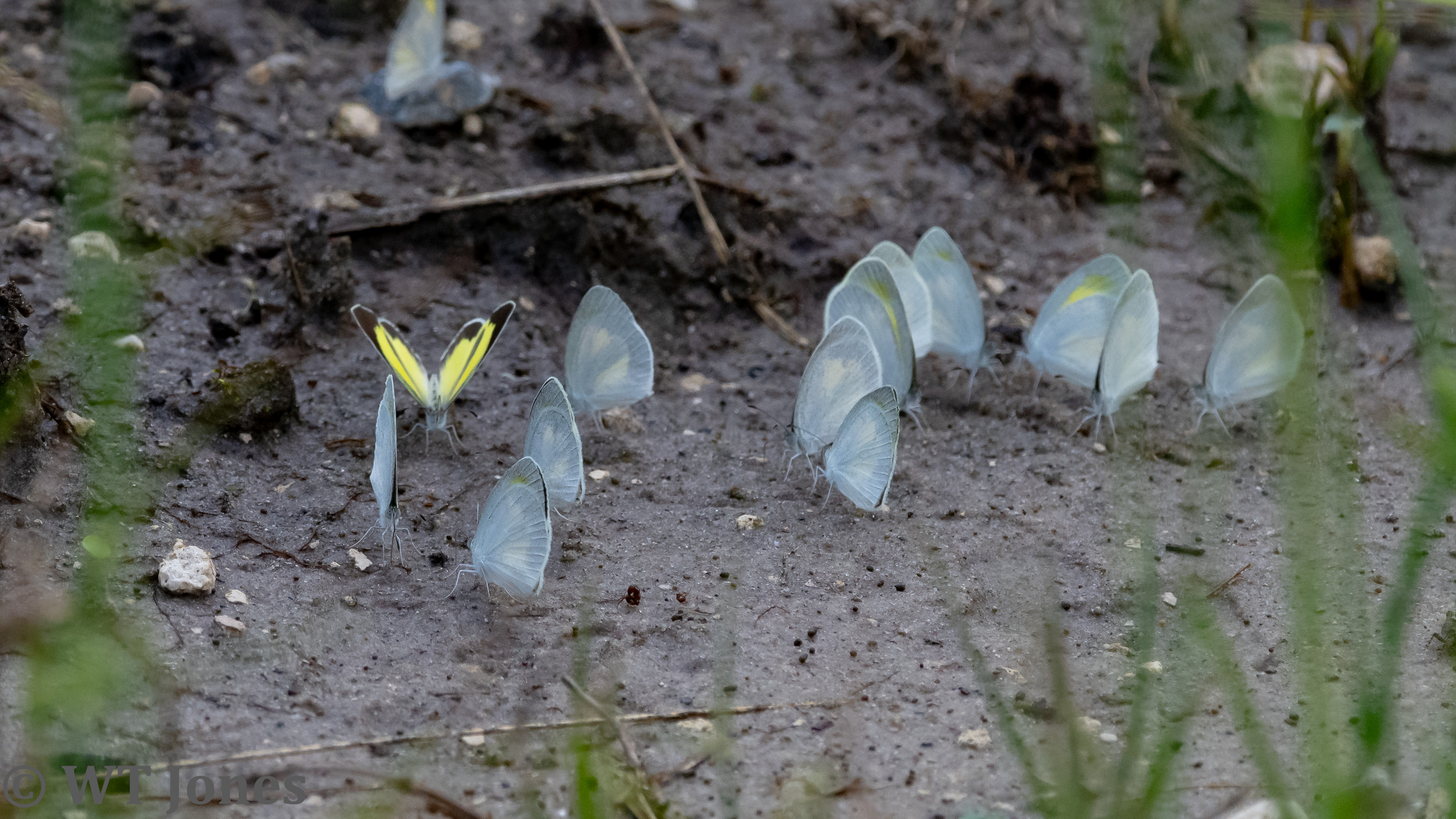
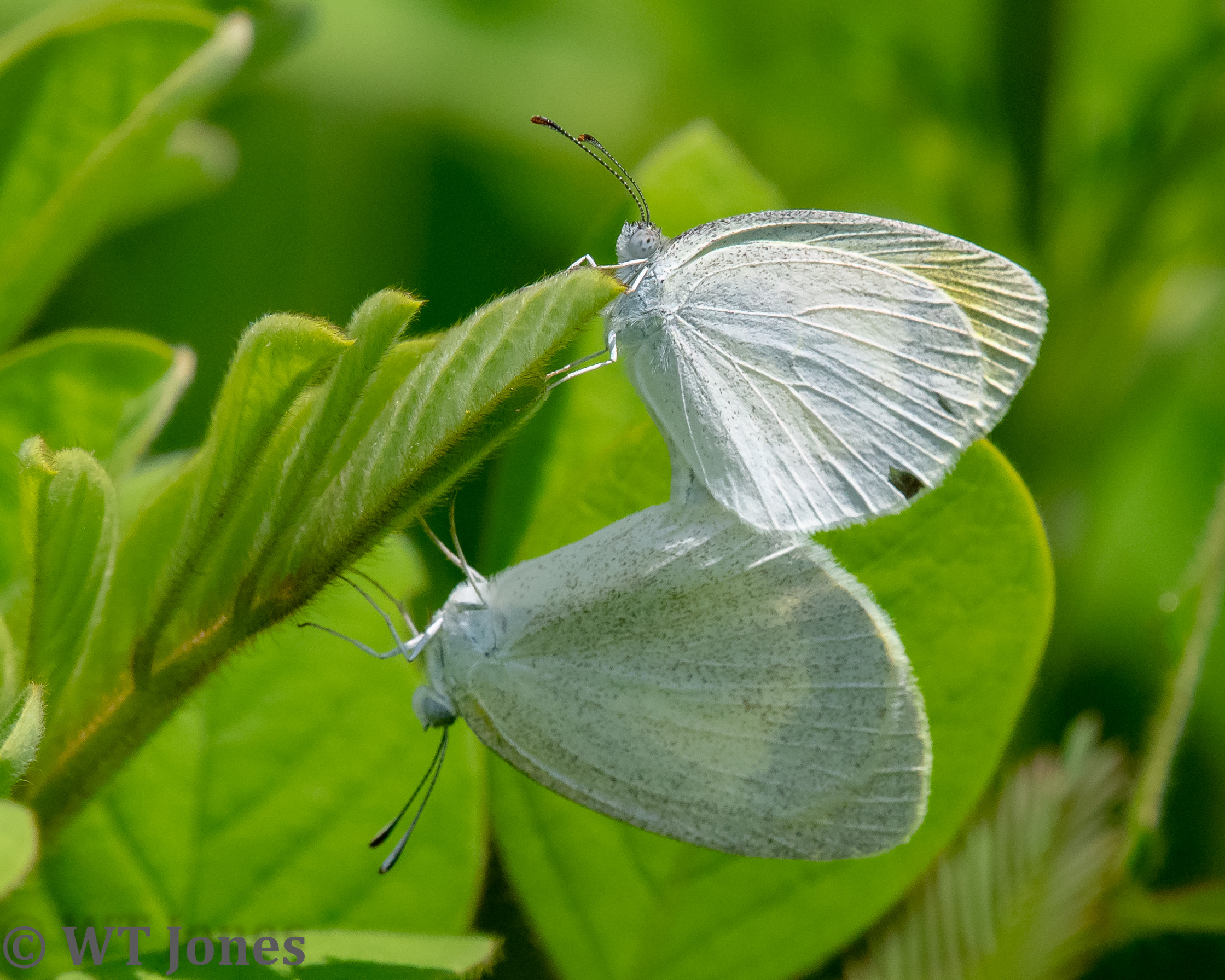
You might have guessed from the lead photograph above that we saw a few Barred Yellow (Eurema daira) butterflies today. Those were engaging in “puddling”, a process of extracting essential minerals and salts from damp soil. The two below are engaged in something quite different, but also essential.
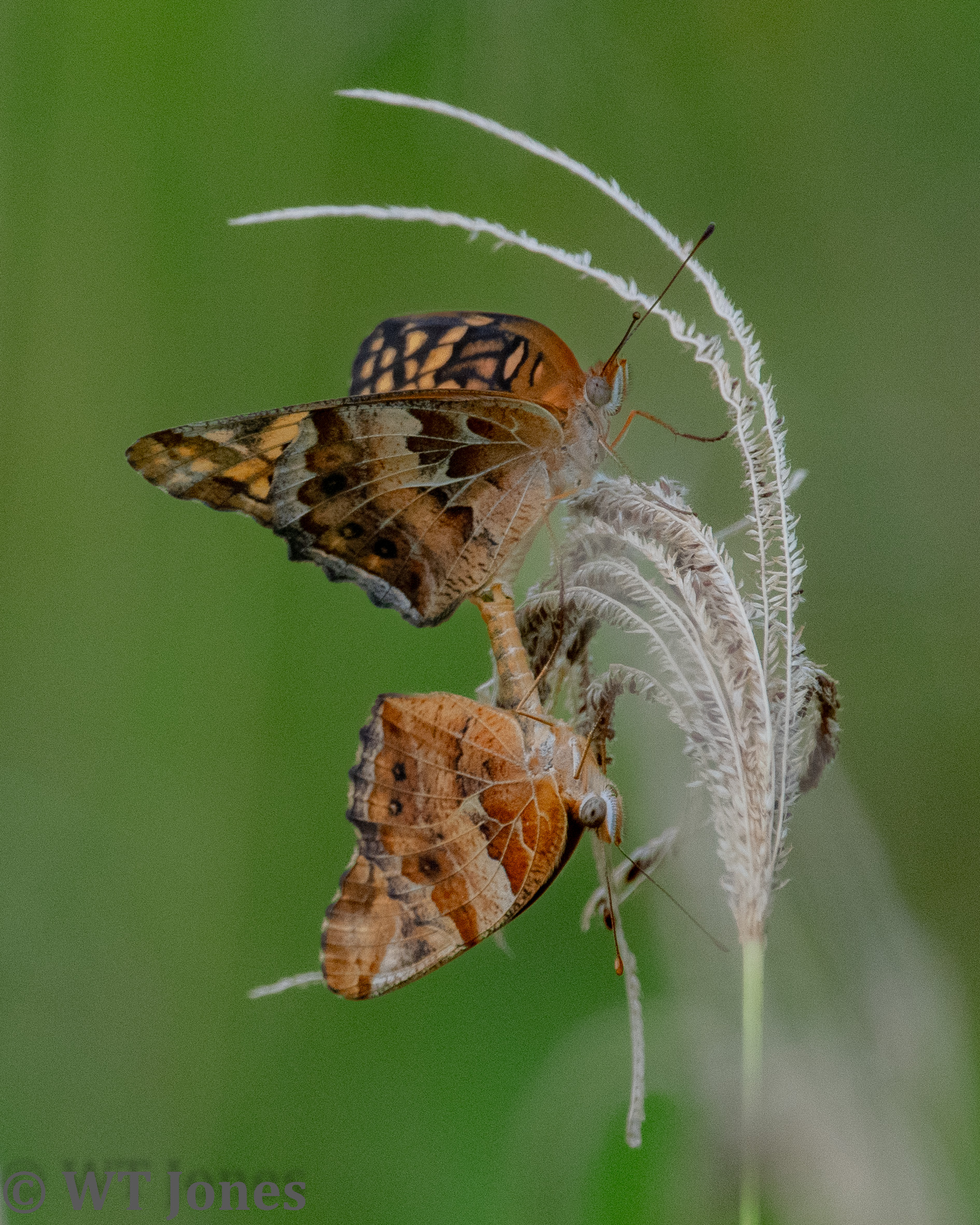
Gini’s sharp eyes spotted these two Variegated Fritillary (Euptoieta claudia) butterflies mating in a grassy field. By the time yours truly tromped into camera range they were finished but at least lounged around for an after-party portrait.
We did not actually see a little suitcase under its wing, so this Carolina Chickadee may be one of our local residents. It will soon be joined by dozens of the little black-and-white songsters for their winter journey.

Once in awhile, one has the feeling taxonomists become a bit frustrated and occasionally burst forth with a designation just for a laugh. This is a rather handsome moth. It was nice to find one in daylight hours. It’s name? Why, obviously, it is an Olive-shaded Bird-dropping Moth (Ponometia candefacta).

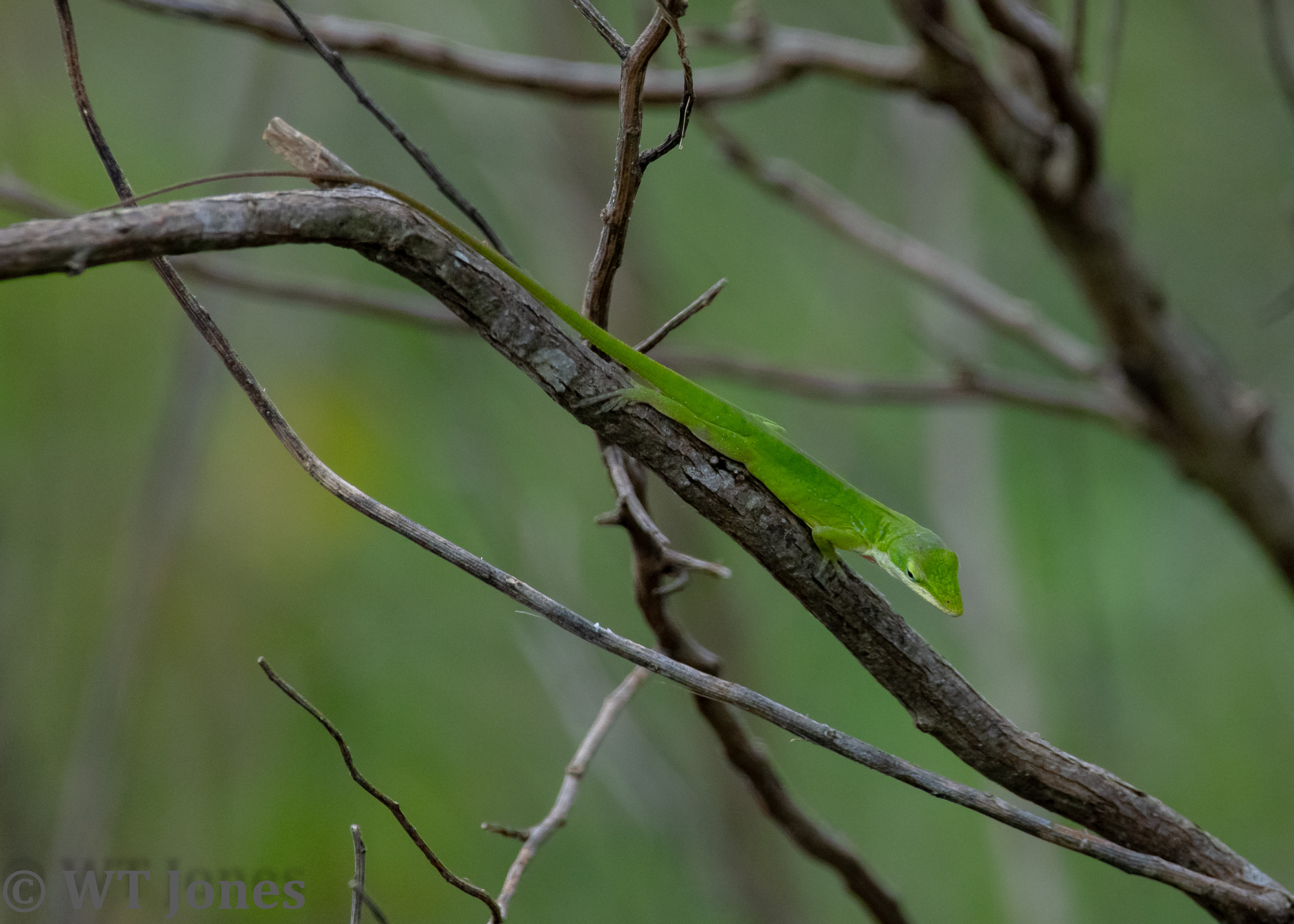
A Green Anole (Anolis carolinensis) may be wondering what a bird-dropping moth tastes like. Yum.
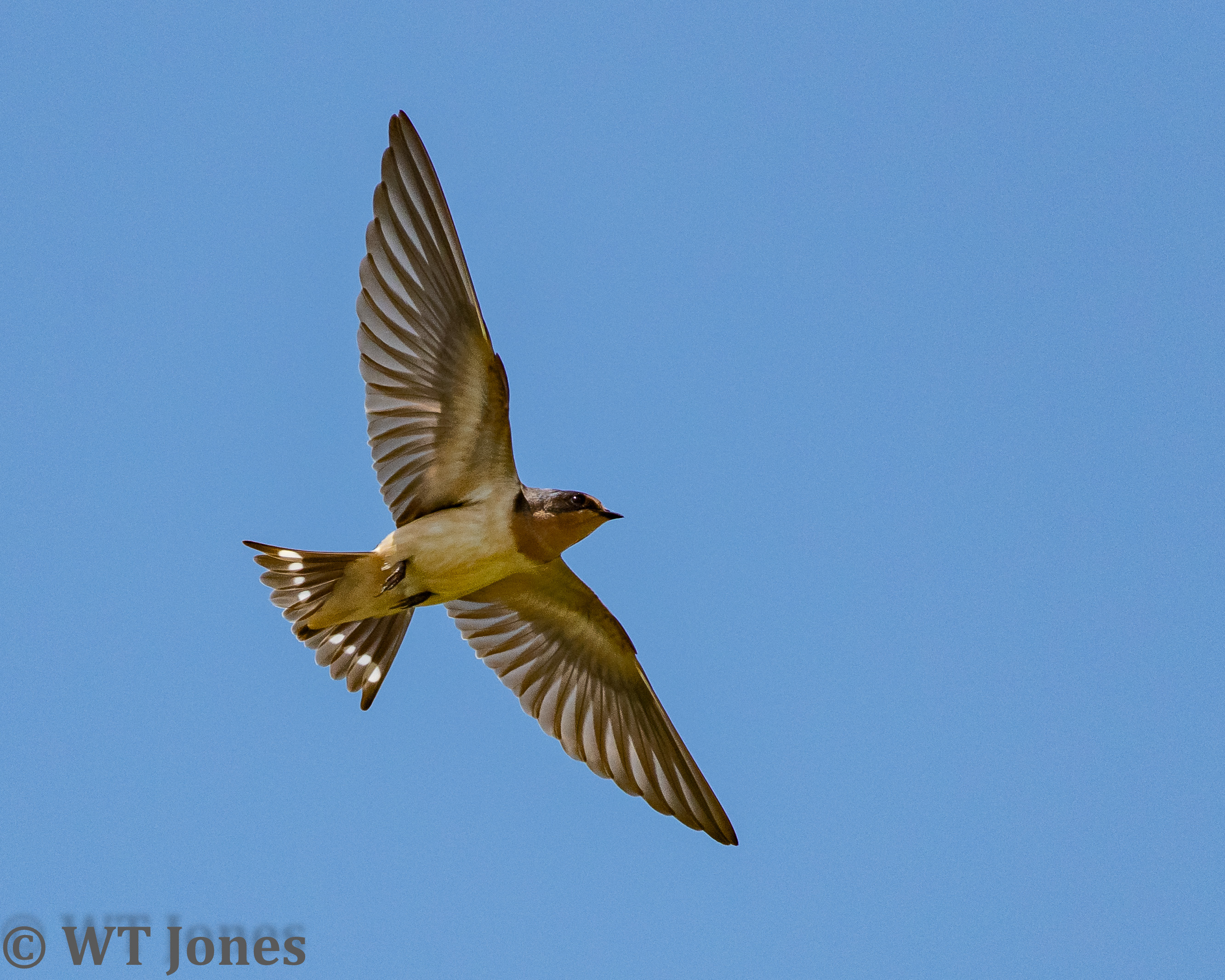
Flocks of swallows are becoming ever larger as the season progresses. This Barn Swallow is a young bird and does not yet have the deeply forked tail of an adult.
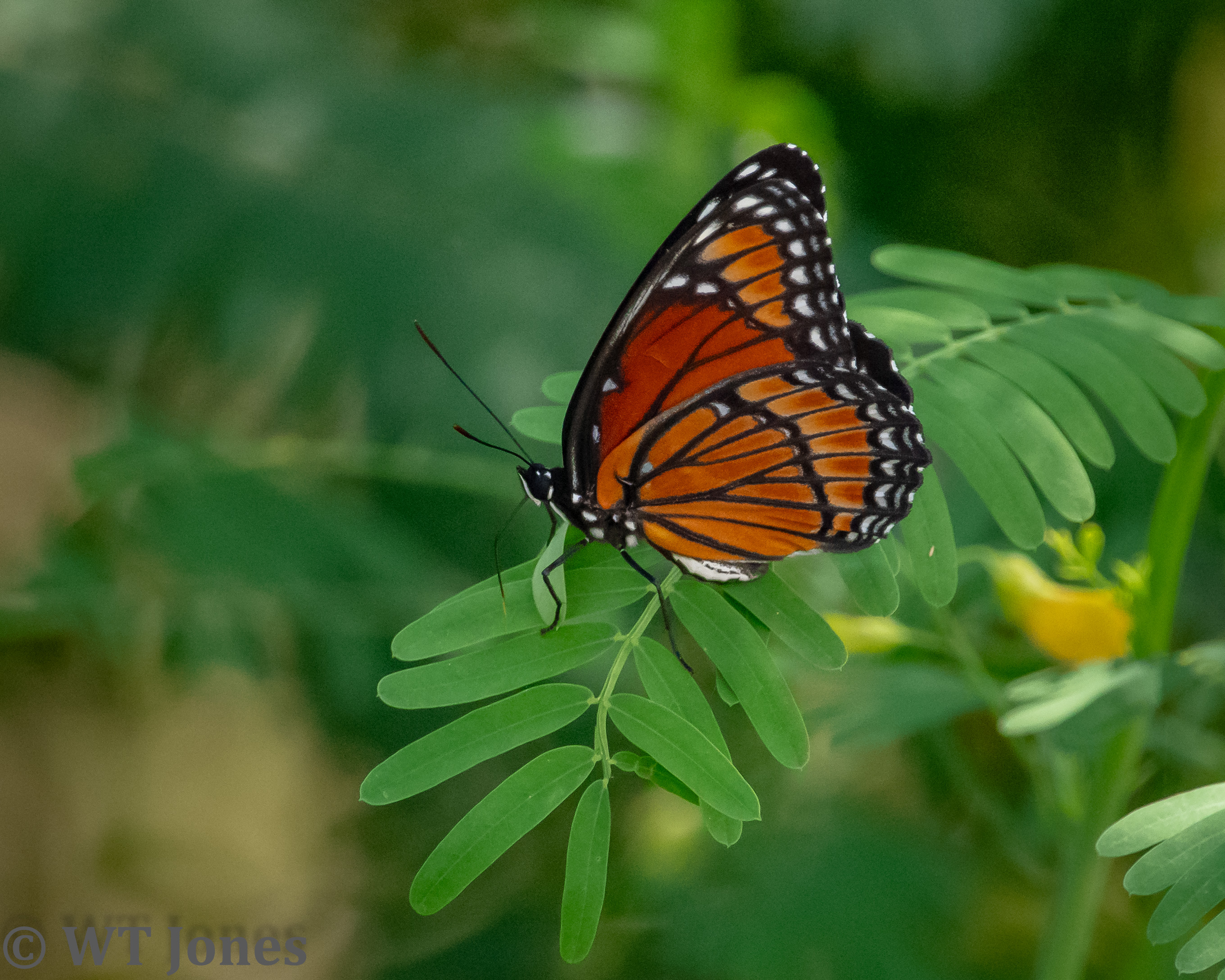
Similar in appearance to its distant cousin, the Monarch, this Viceroy (Limenitis archippus) butterfly is quite attention-getting with its bright color.
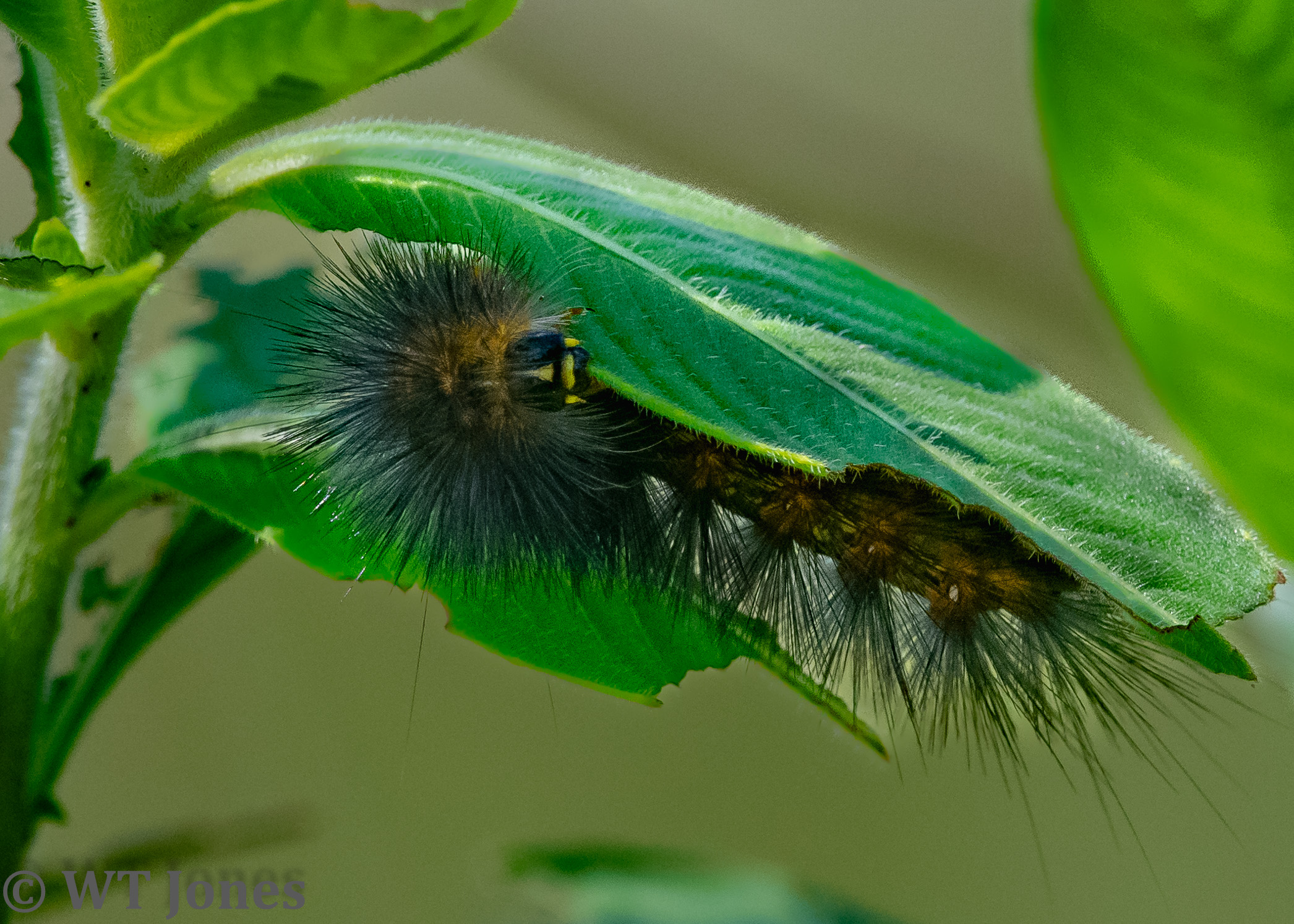
I think this is one of the many variations of the Salt Marsh Moth larva (Estigmene acrea). Please let me know if this is not correct. Some day we’ll find an adult moth.
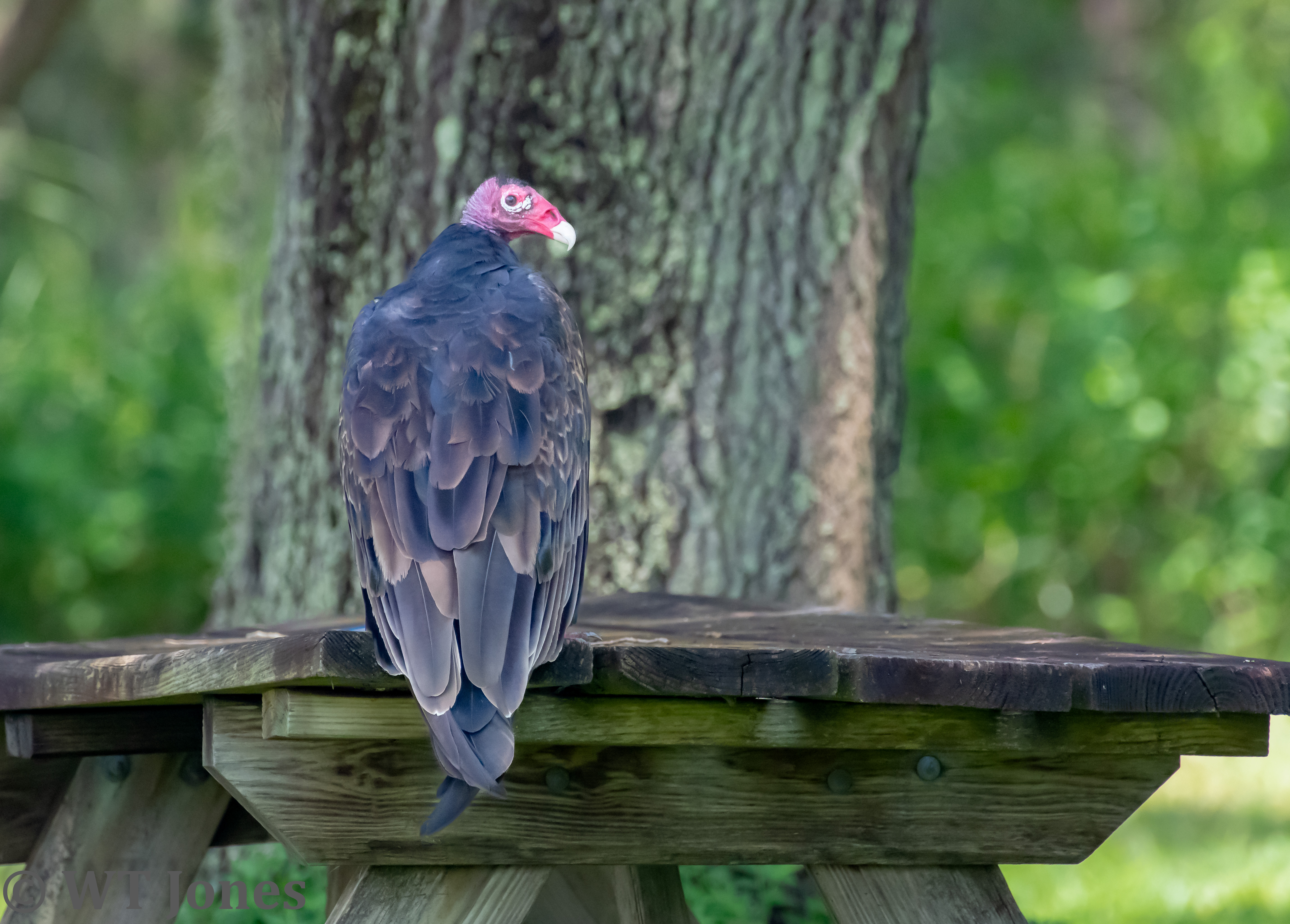
“What? Why, yes, you can join me for lunch. Just have a seat. A few dozen of my friends will be here soon.” Turkey Vultures are so polite.
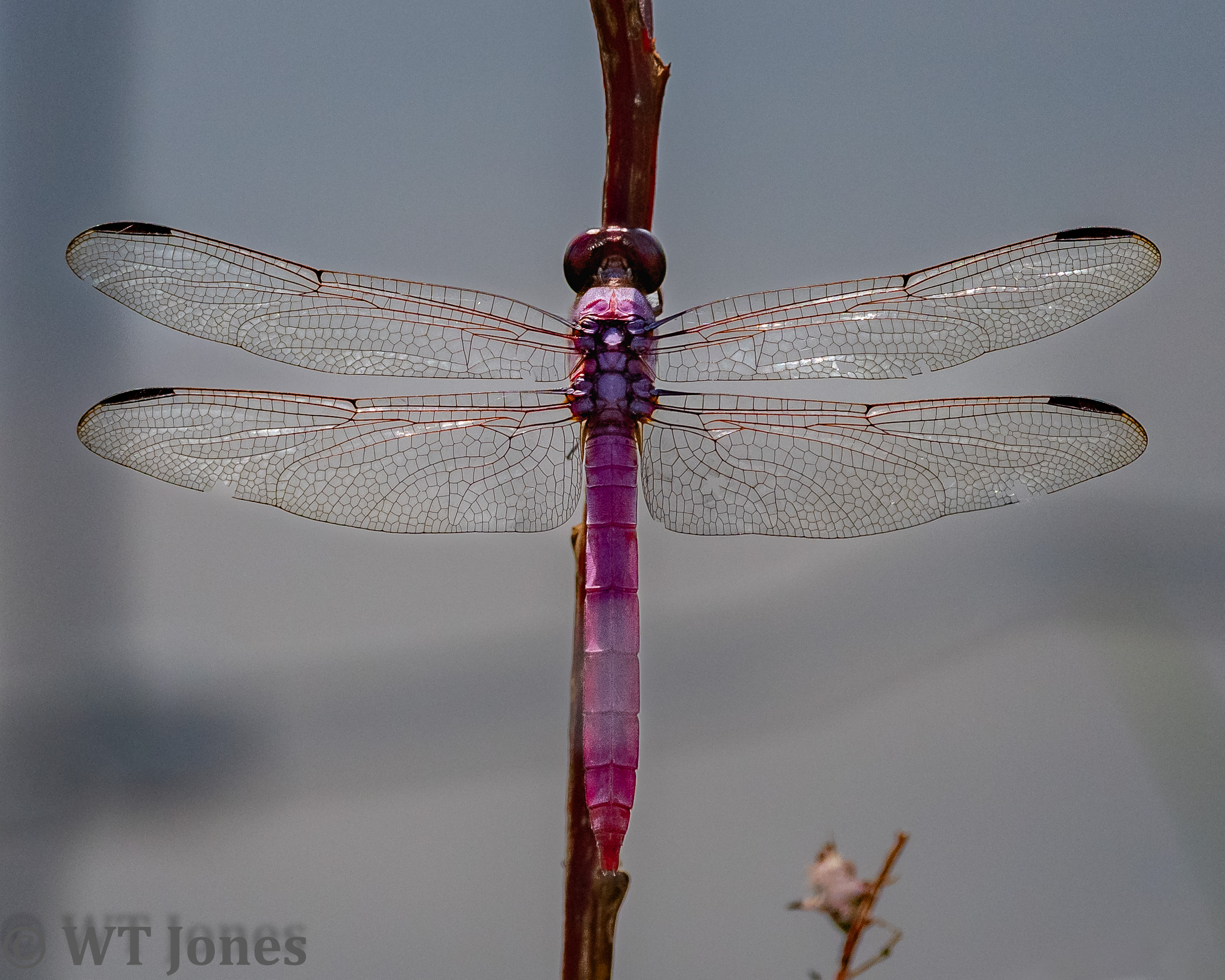
The dove field mentioned earlier has plenty of uneven spots which remain wet all summer. These are perfect places to hunt for dragons, such as this male Band-winged Dragonlet (Erythrodiplax umbrata).

Also from the dove field is a Roseate Skimmer (Orthemis ferruginea). Its color is almost outlandish. Gini says its “beautiful“. I stand corrected. Again.
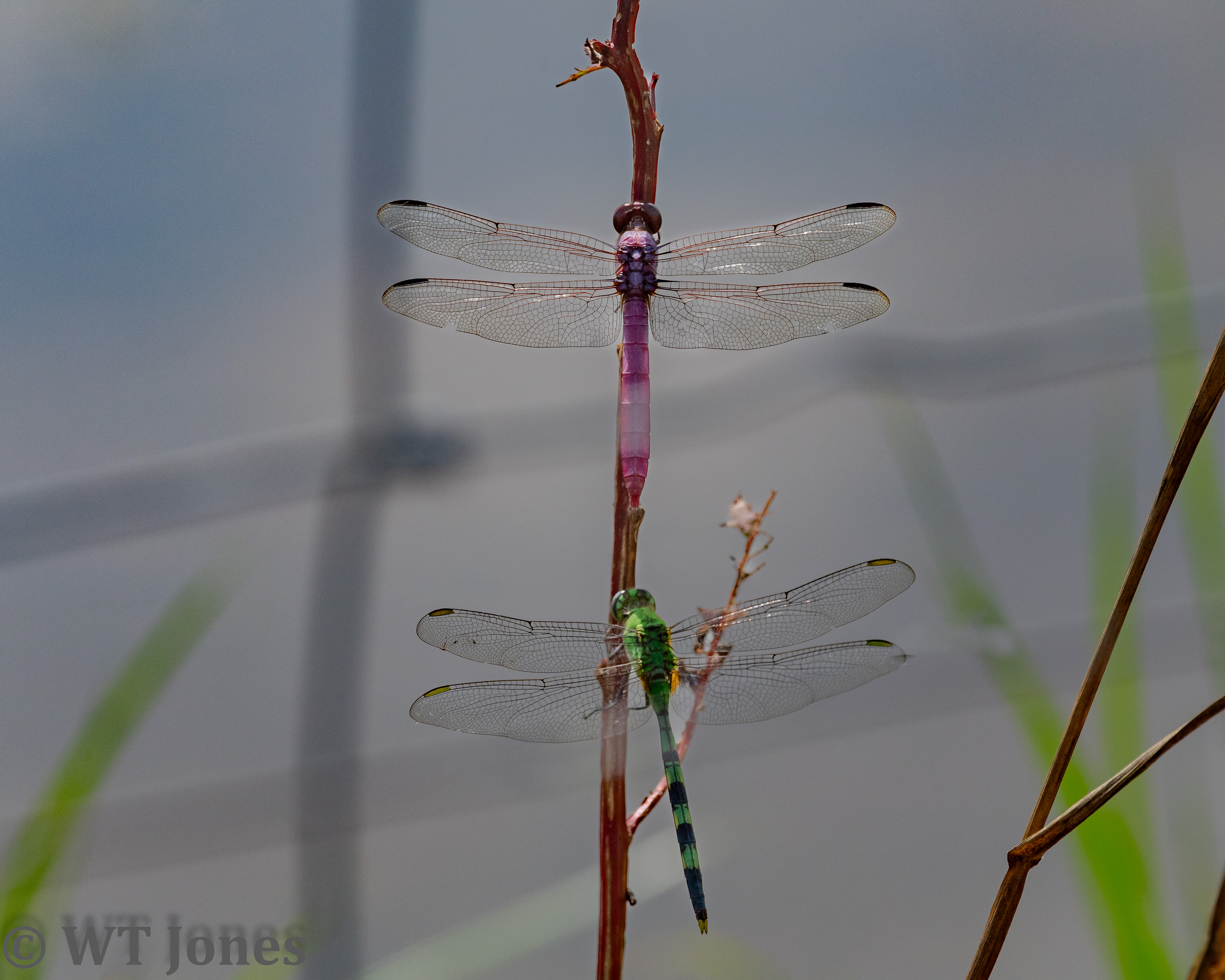
My plan worked perfectly. (It’s called “luck”.) A Roseate Skimmer (Orthemis ferruginea) and Great Pondhawk (Erythemis vesiculosa) perched together briefly.
Gini does it again. “Hey! That’s different!” She found our first-of-the-fall Northern Waterthrush skulking among the willows. Although this handsome bird has streaking similar to a thrush, it is actually a warbler.

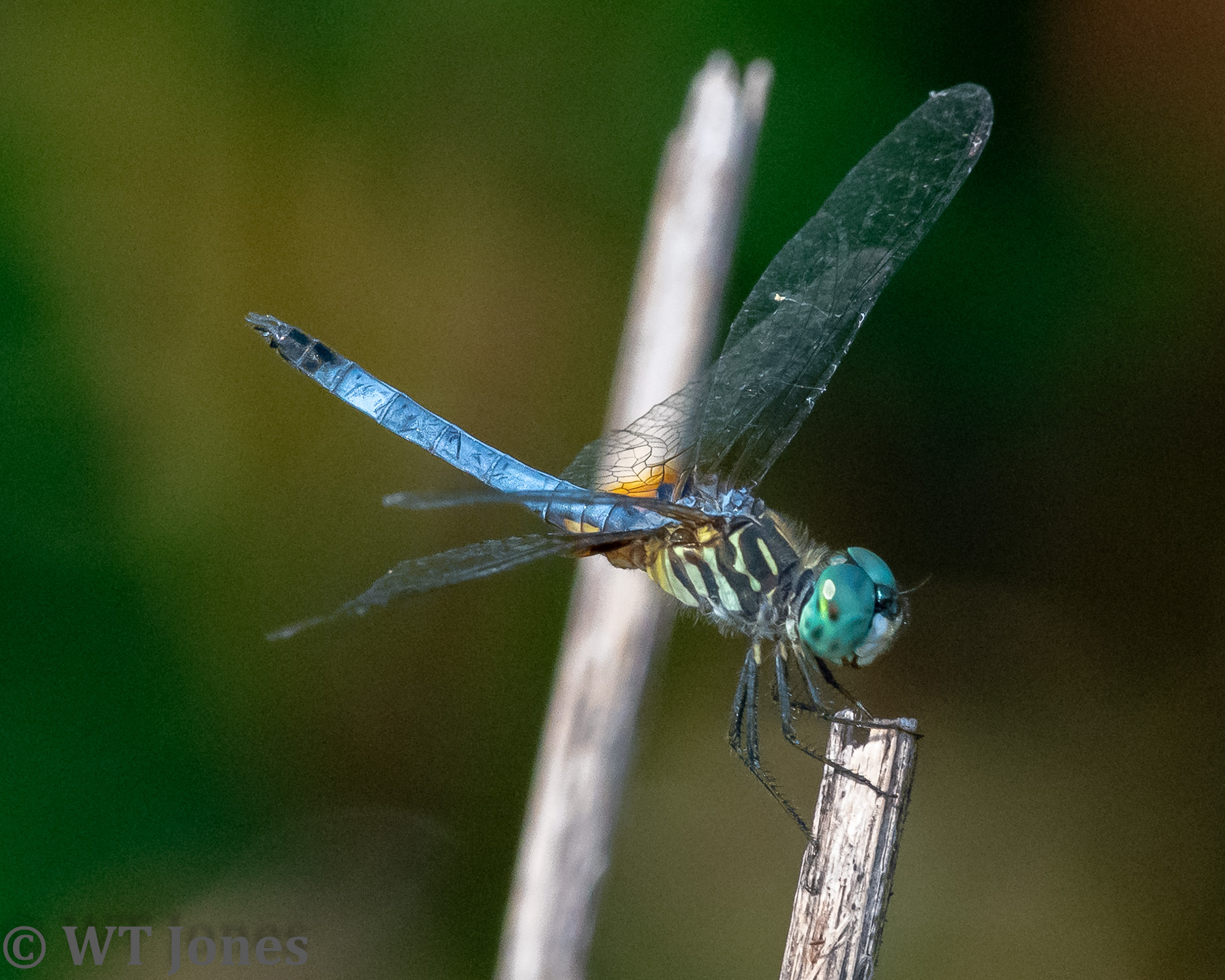
Poised to pursue breakfast. A male Blue Dasher (Pachydiplax longipennis) is a small dragonfly which is easy to identify with its white face and colorful striped thorax.
I have to force myself to slow down and not rush past common subjects. Although I have a full archive of the White Peacock (Anartia jatrophae), each is equally beautiful.

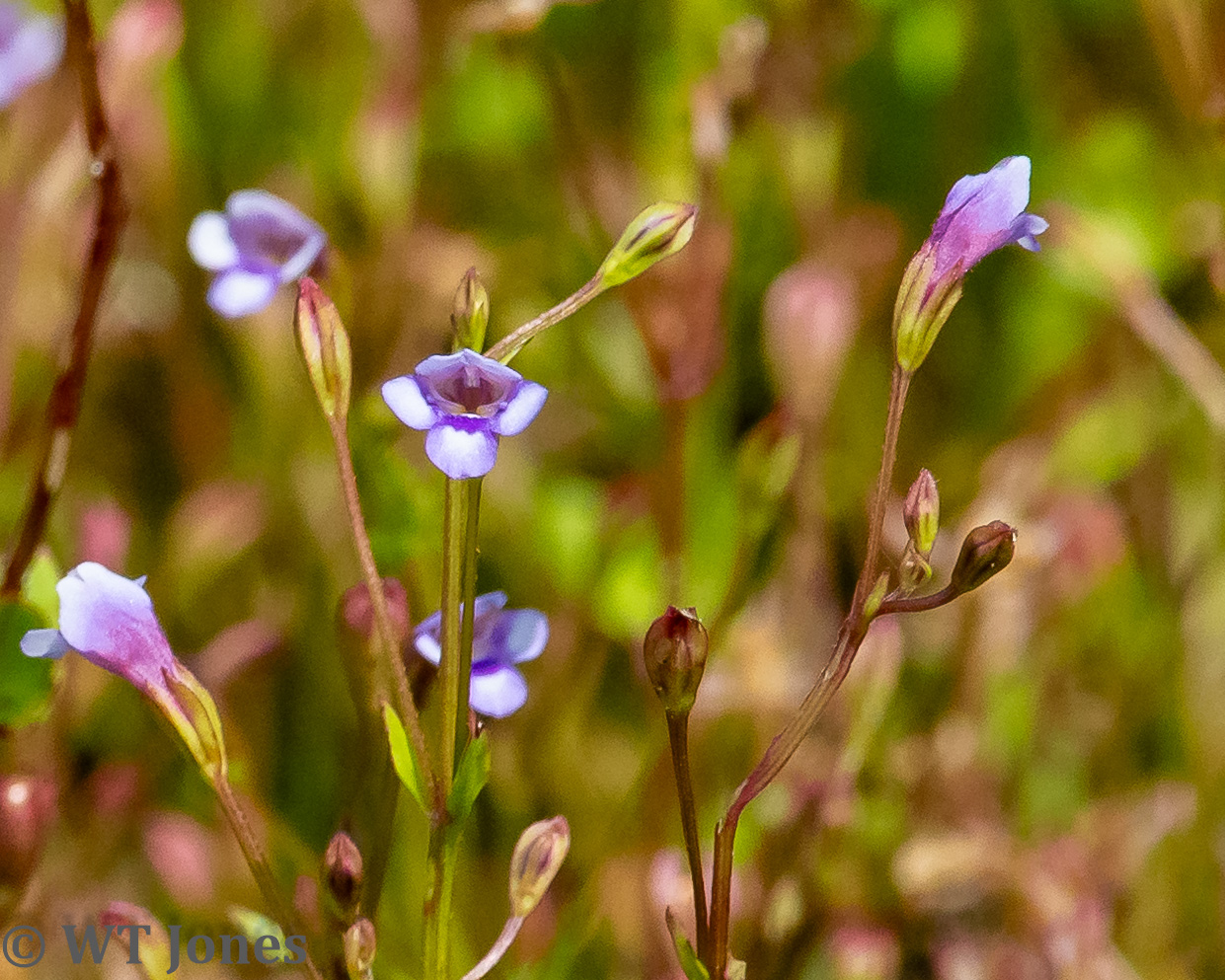
Our morning ended with the discovery of a new plant for us. Several patches of very small and bright lavender flowers grabbed out attention. This little beauty is the Savannah False Pimpernel (Lindernia grandiflora). The plant seldom grows taller than about six inches and forms an expansive mat in wetland areas. It is nearly endemic to Florida with a few reports from Georgia.

Another ordinary day. We traveled a whopping 3.5 miles to reach a familiar place and followed our routine pattern of exploration (sort of). Some observations were wonderfully common. A few were simply extraordinary!
Enjoy your search for a natural place and come back for a visit!

Watching a sunrise is special. Sharing it with someone you love – priceless.
We have an established routine at this spot. Begin near the boat ramp, walk along the lake shore until we reach the canal, check the big trees near the footbridge for warblers and vireos, traverse the open grassy area stopping again to inspect the scattered oaks, linger around the low wet area, look at the small pond for ducks and waders, scan the tall lights around the soccer field for Osprey or owl nests.
Wait. Soccer field?
Yep. Today we traveled a whole 3.25 miles from the house into the city. Although not a large metropolis, a population of over 100,000 means plenty of traffic, big buildings, dense downtown business district and all the positive and negative social influences of that many humans living in proximity to one another.
The city planners have done a fair job creating oases throughout the concrete jungle where urban dwellers can find a respite from the daily hustle and bustle of life and relax by the side of a lake, walk in the shade of aged oak trees or nap on a bench under the rustling fronds of a palm tree. These spots are magnets for picnics, jogging, dog walking, something called “disc golf” and many other pursuits which can cause the parks to become crowded, especially on weekends.
If we visit on a weekday just as the gates open, crowds are not normally an issue. A few runners and dog-walkers don’t present a problem and they typically follow the paved pathways. We do not. (Surprise!)
The magic formula of trees, bushes and water attract an amazing variety of life forms other than humans. In the late fall, it is not unusual to see over 50 species of birds at the park we are visiting. Today we did not keep an accurate tally but observed at least 30 different species, which is normal for most of the year. Fish in the lake, bountiful insect populations, small mammals – plenty of food for a variety of hunters.
We did not enounter any unexpected surprises today but it was nice to see migratory American Redstarts and Black-and-White Warblers. In addition, small flocks of Blue-gray Gnatcatchers and Tufted Titmice were forming in preparation for their southward journey.
Barely two hours, a short trip for us, but it passed very quickly. A quick drive back to the house in time for a mid-morning brunch of cantaloupe, thinly sliced ham and strong coffee.
Now the day can begin.
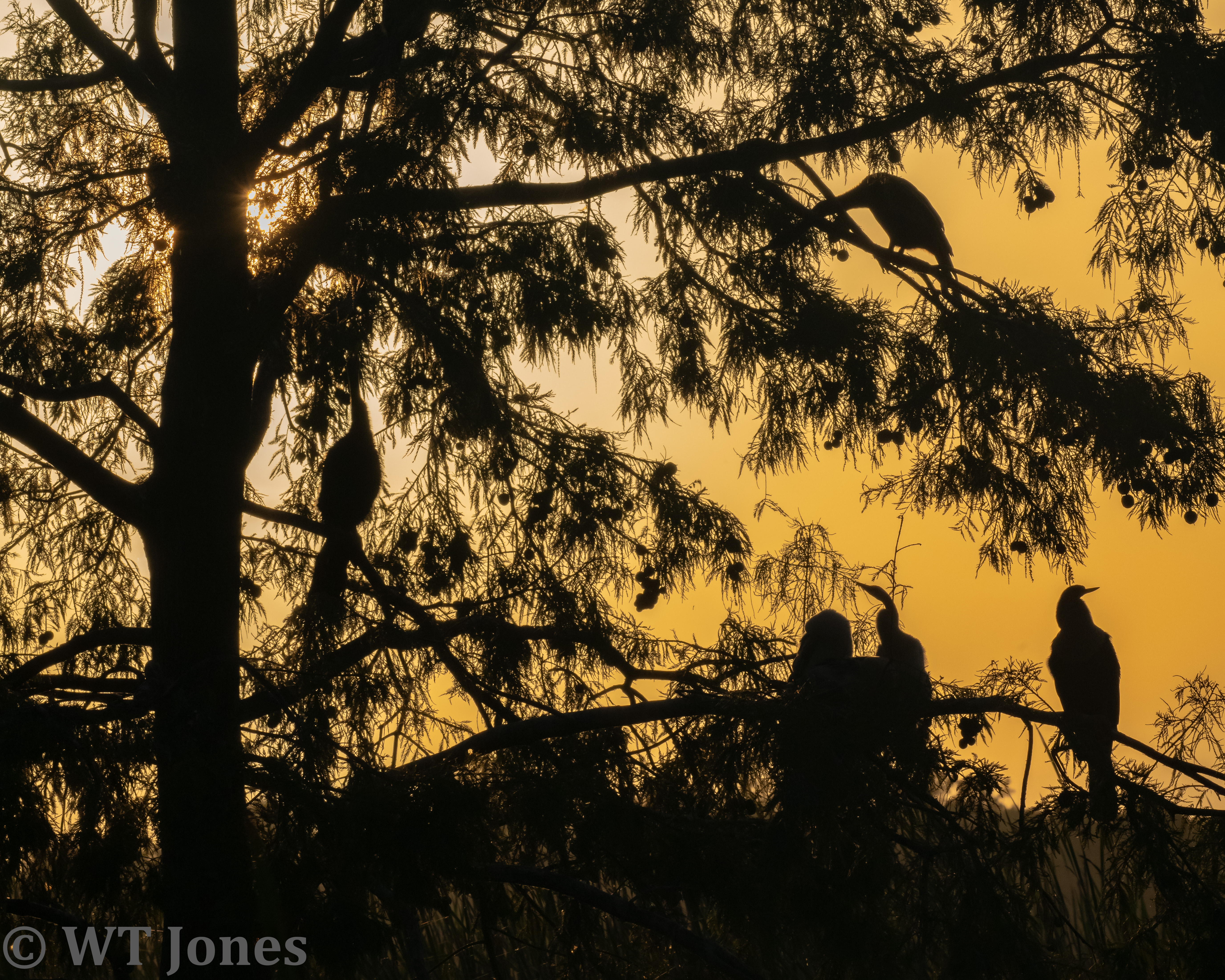
Anhinga roost at dawn.
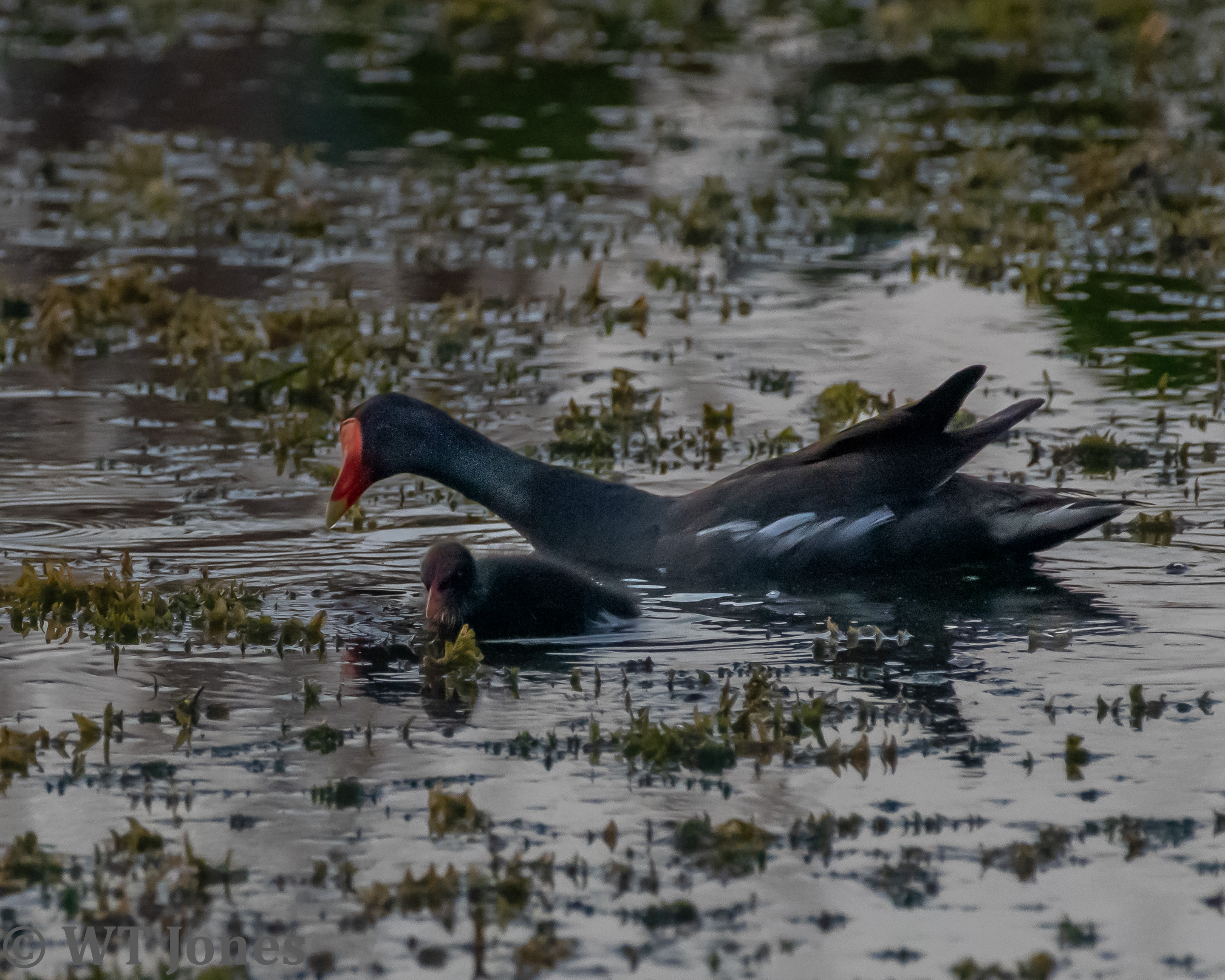
Common Gallinule chicks seem to have hair rather than feathers. Mom is showing junior how to select the best produce.
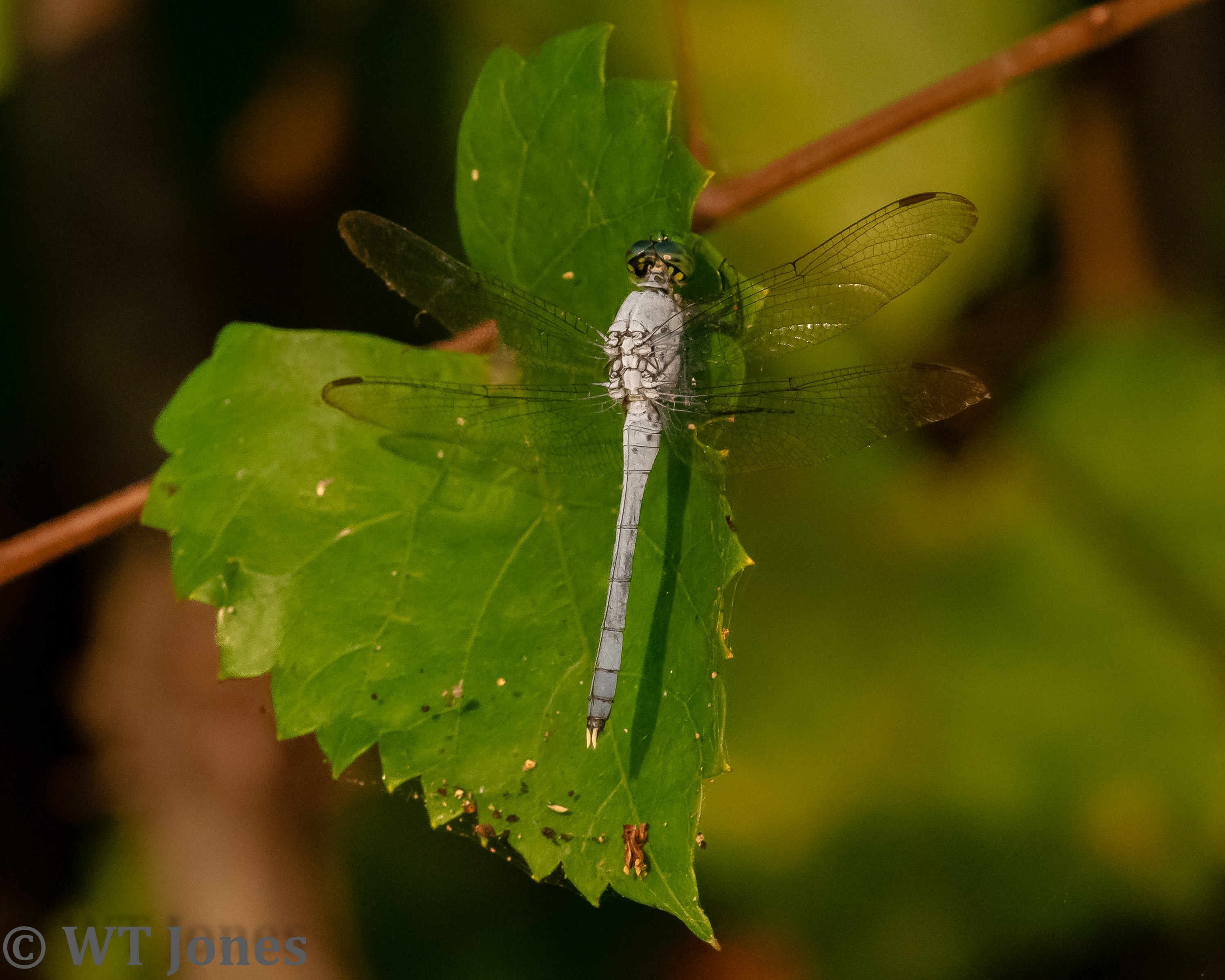
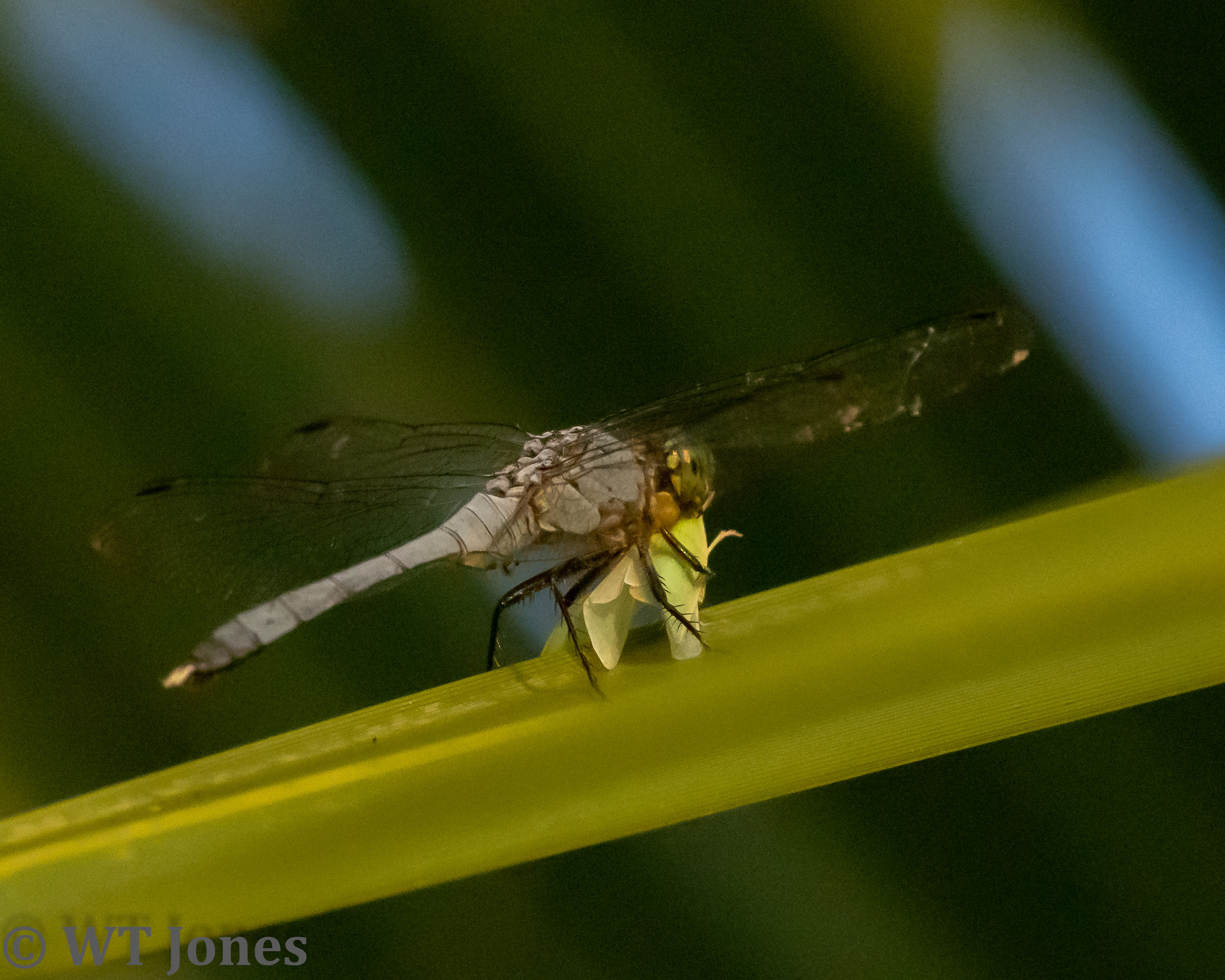
An Eastern Pondhawk (Erythemis simplicicollis) didn’t pose for long and darted off to snag a bit of green breakfast.
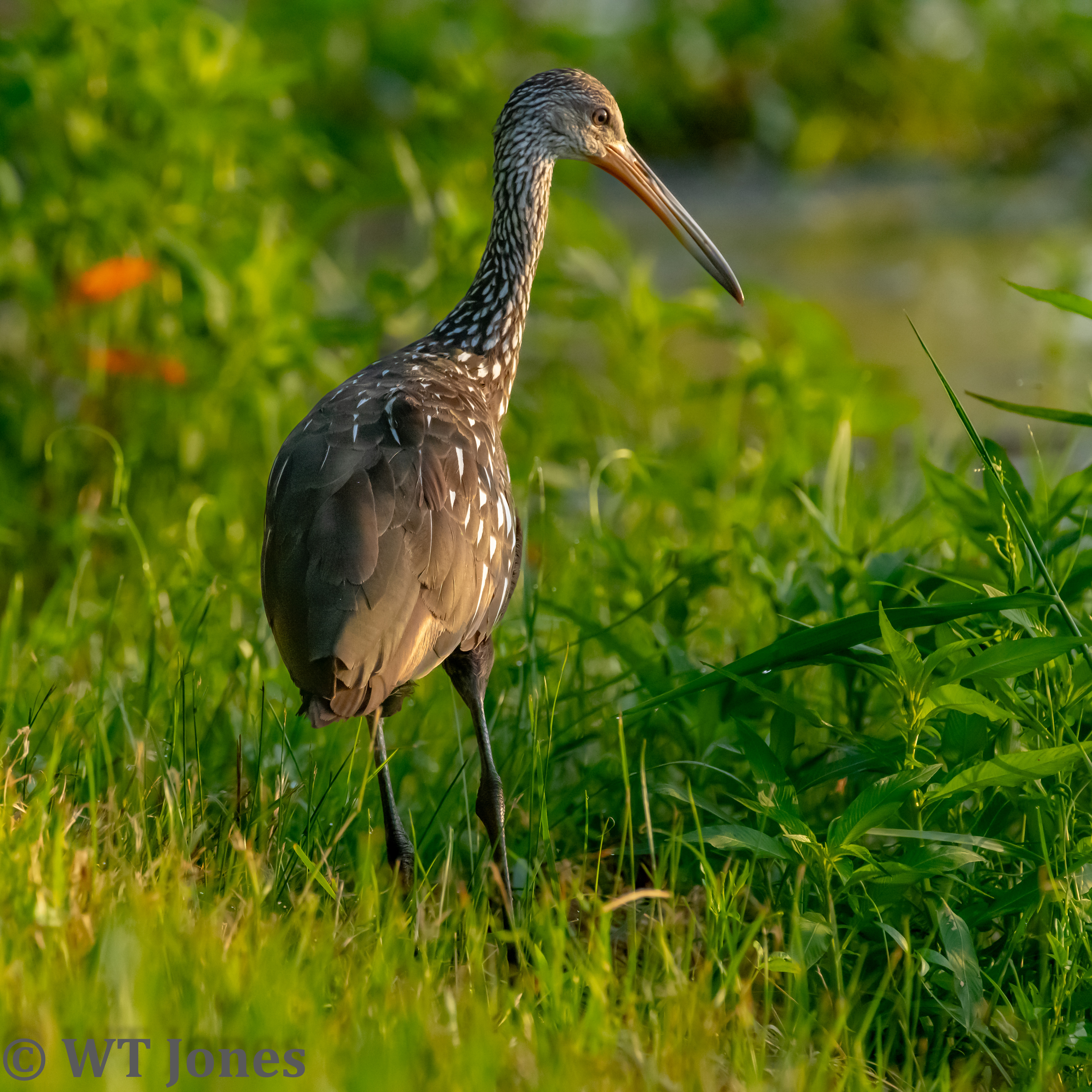
This lake has a very healthy Limpkin population. Snail scanning is popular – and vital.
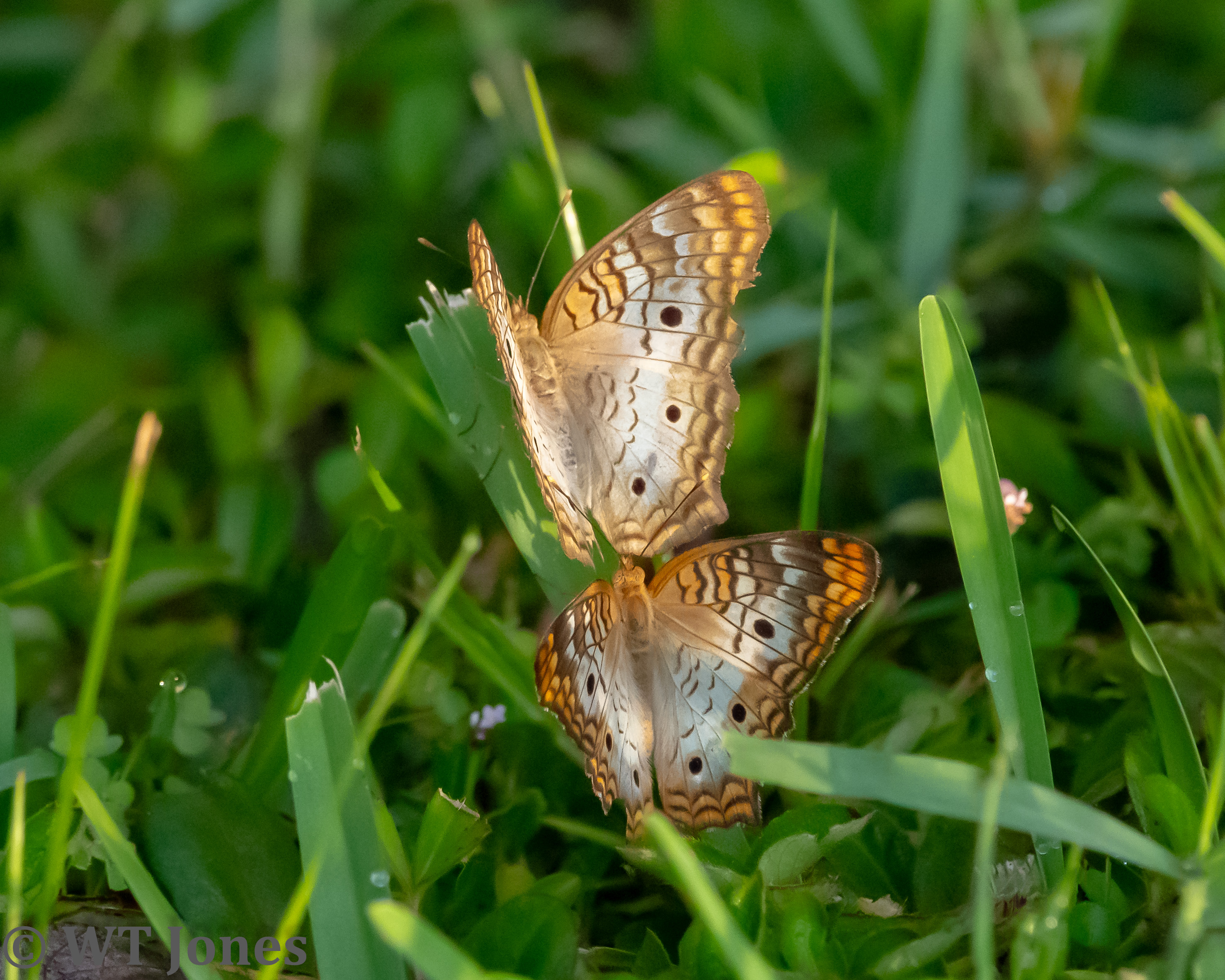
A pair of White Peacock (Anartia jatrophae) butterflies brightened up the early morning.
Birder affliction. Looking up in the trees and not paying attention to what’s at your feet. This little reptile (perhaps three feet long) was quietly watching from a few feet away. Love those eyes!

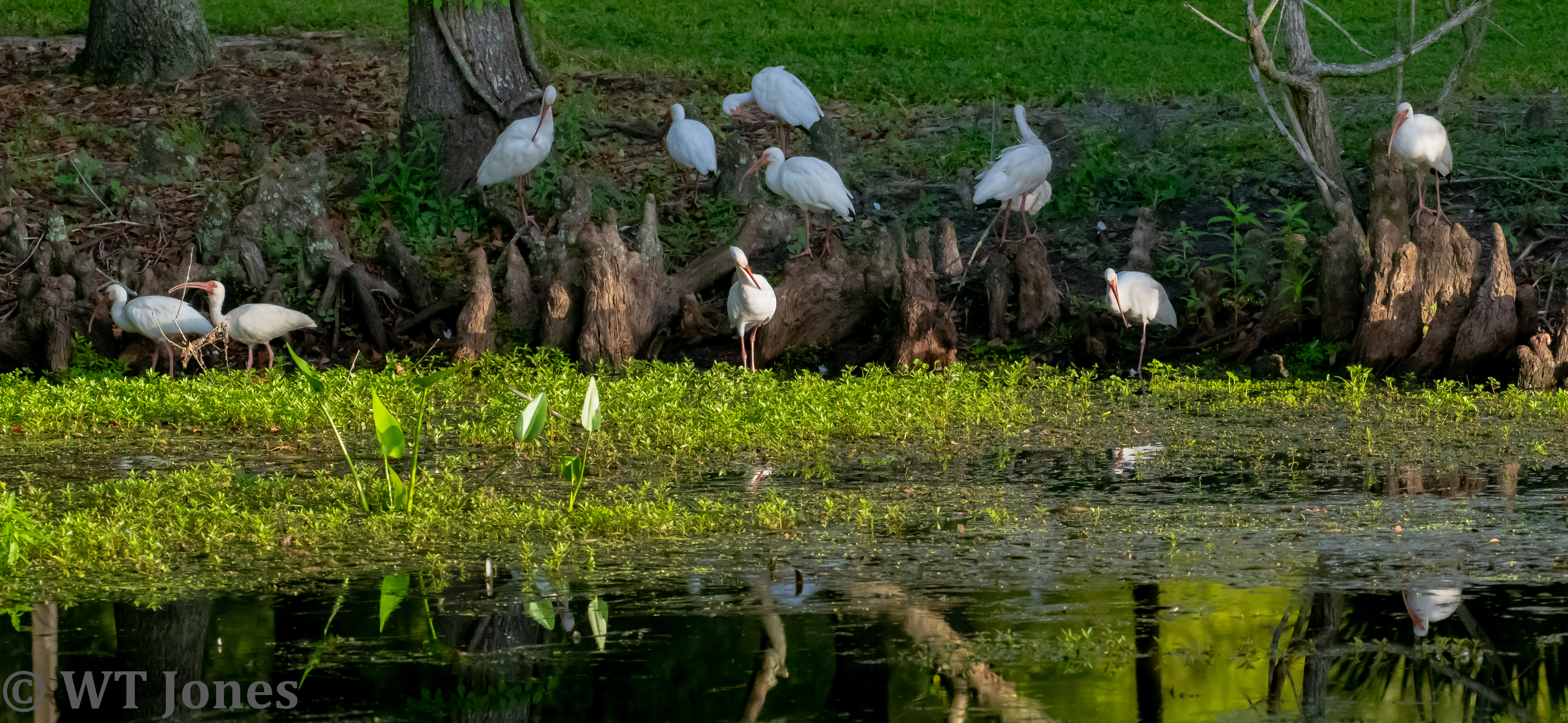
The Morning White Ibis Cypress Knee Coffee Klatch.
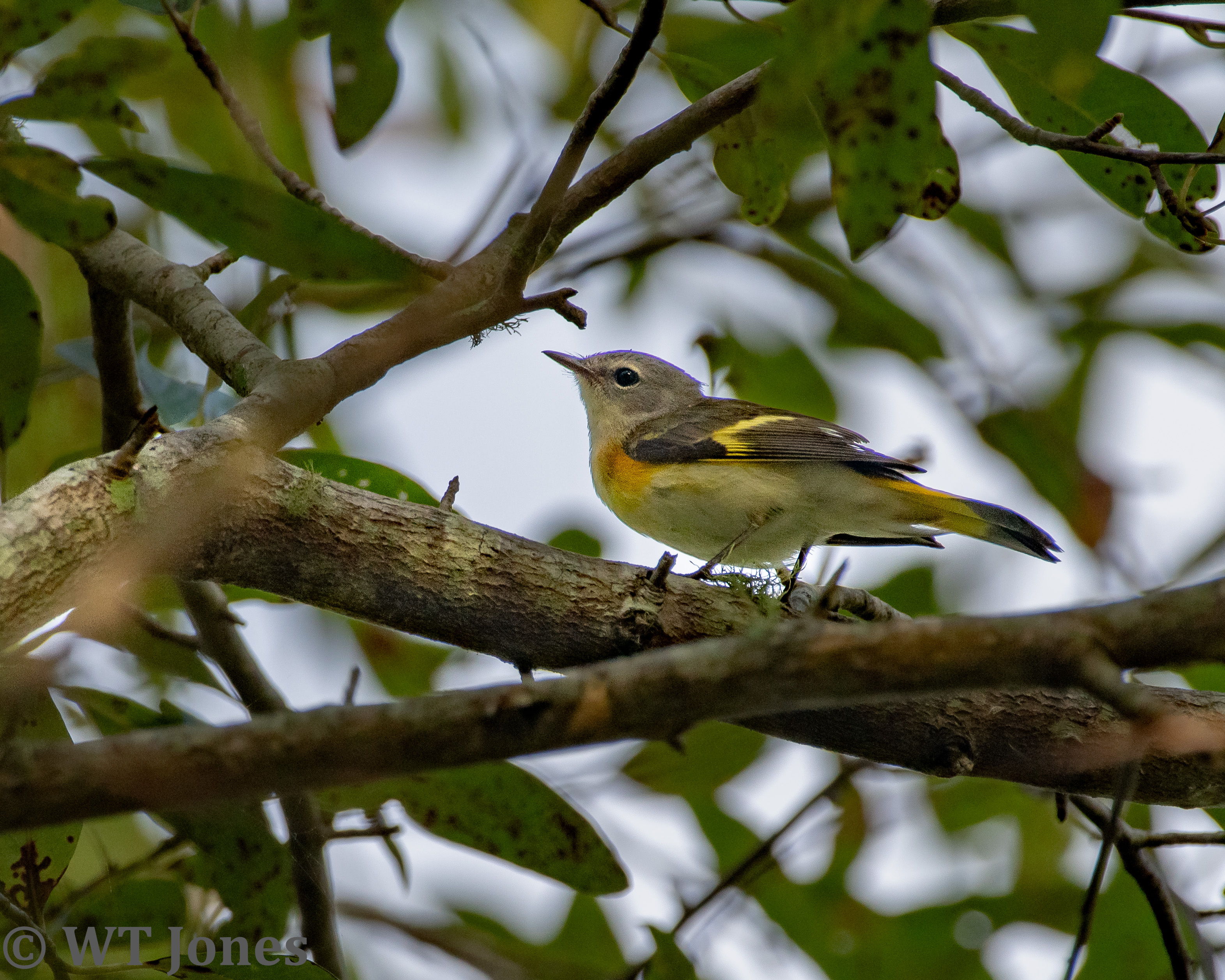
More and more migratory warblers are showing up as the fall movement begins in earnest. A female/immature male American Redstart repeatedly flashed wings and tail feathers to startle insects into revealing their location. Breakfast is served.
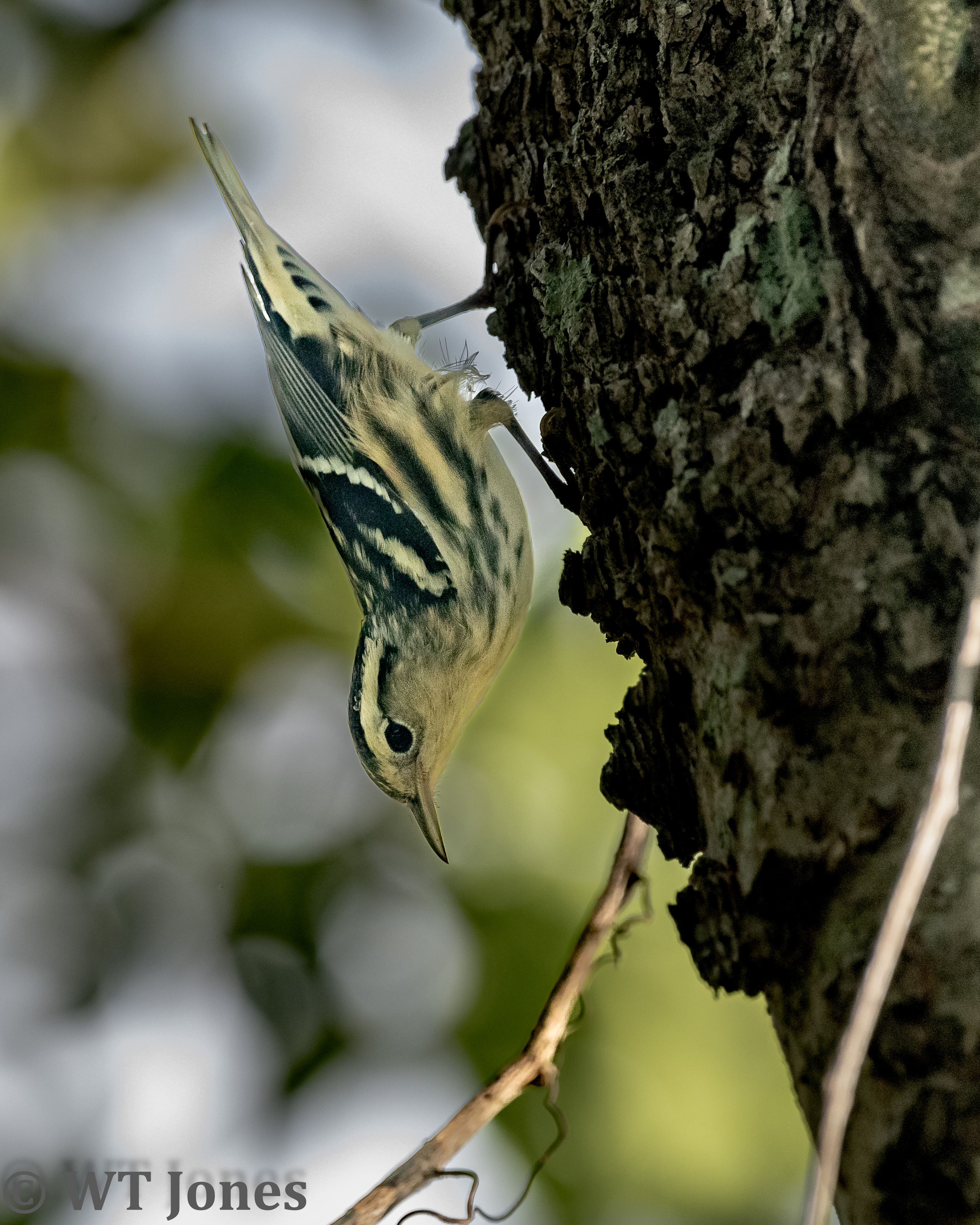
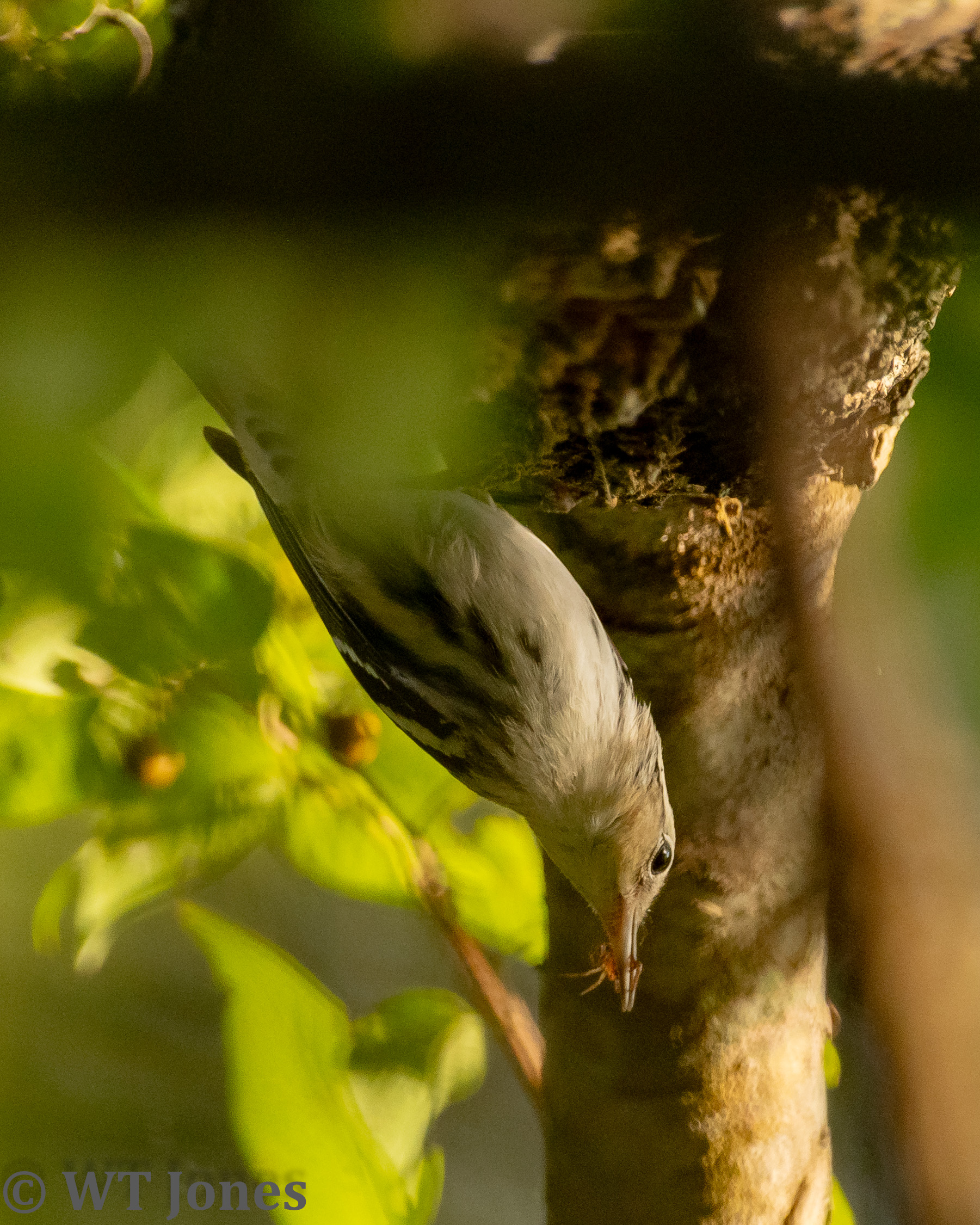
Speaking of breakfast. In the same tree as the Redstart above, a Black-and-White Warbler performed its Nuthatch imitation by running down a tree trunk to wrangle a wriggly spider.
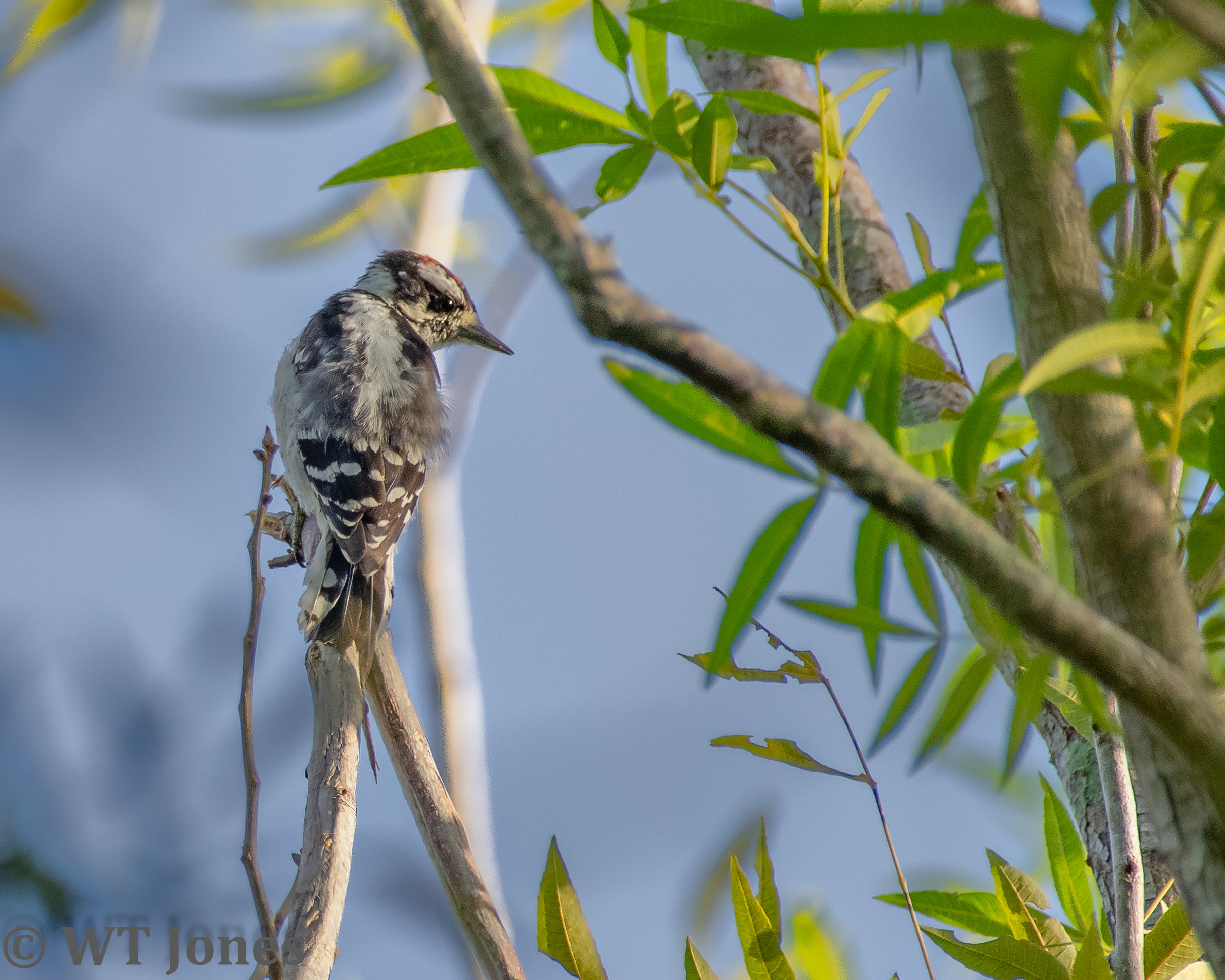
A young male Downy Woodpecker hopes to find his own wriggly morning snack.
Silky black plumage, ivory-colored bill, ruby-red eye. Simple colors combine to make the American Coot mighty handsome.

The sun is now bright in the morning sky. A Little Blue Heron perches in a cypress tree to preen and think about what to have for breakfast. Fish? Frog? Crawdad? Decisions, decisions.

We love to travel and find new and exciting natural places to explore. Sometimes, finding Nature can be as simple as walking into the yard or enjoying a sunrise in the city. Seek. Find. Savor.
Enjoy your search for a natural place and come back for a visit!
At times, later is better. I qualify as a world-class procrastinator, but once in awhile, I actually plan on being late when it comes to nature. No need to arise early if one is planning to photograph a sunset. Of course, if you arrive after the sun sinks below the horizon, your plans sink right along with it. So, later can be better but TOO late is not advisable.
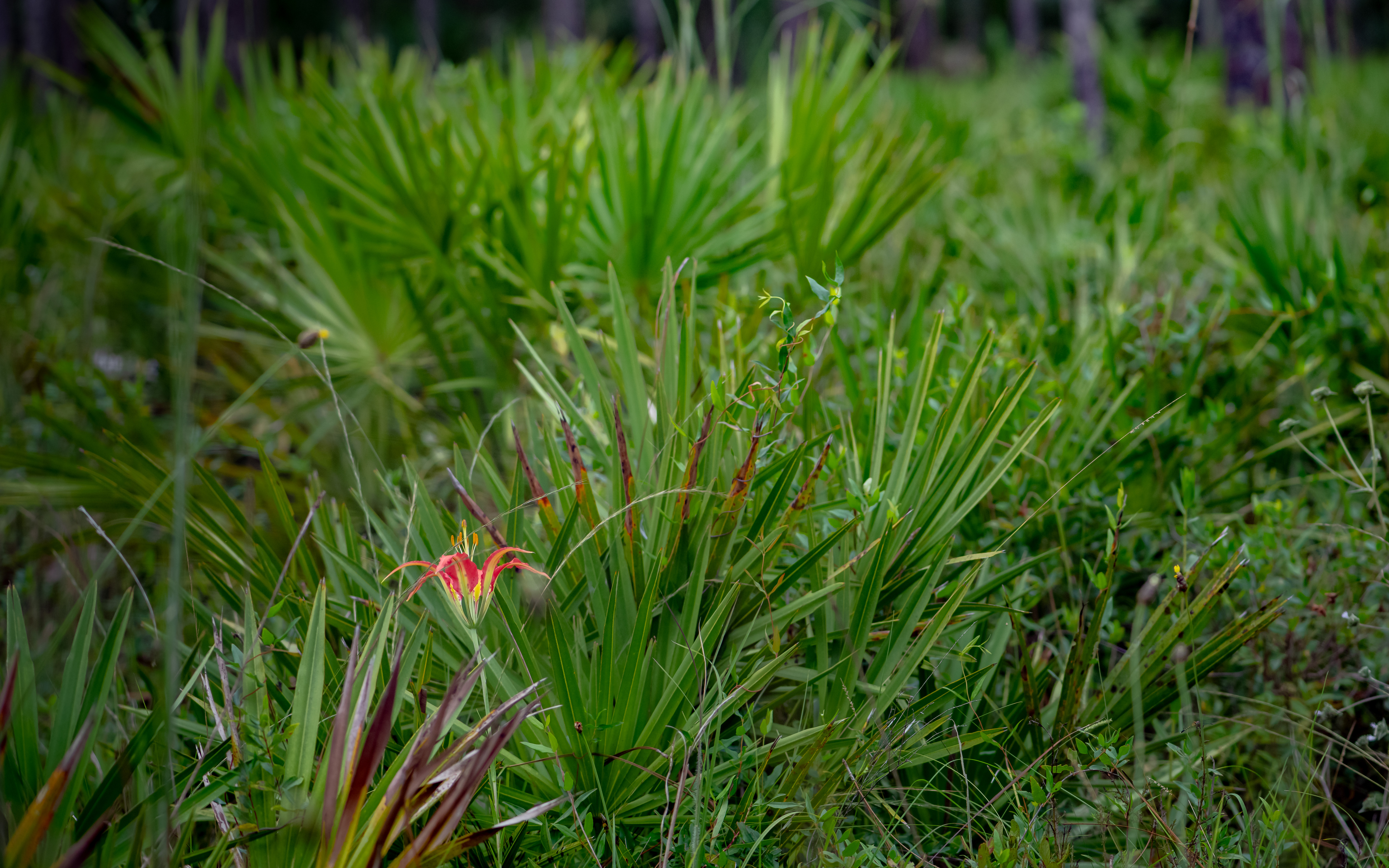
A couple of weeks ago, Gini and I began searching for a favorite bloom of fall in our area, the Pine Lily, also known as Catesby’s Lily. Although not a rare species, it is not exactly common and is pretty picky about where it grows. It likes to keep its feet moist and loves the pine flatwoods and savannahs. It can be found in the southeastern coastal plain states.
Our search for this particular plant included research on its habitat and reports of areas where it had been seen in past years. We have previously found it in a couple of spots and planned to include those in our search. While perusing fall blooming information, we ran across a reference to the Celestial Lily, a very attractive blue flower with which we were not familiar.
Coincidence? Fate? Luck? Call it what you will, the day following our research found us at the entrance of Colt Creek State Park in Polk County, Florida, about 20 minutes from the house. Cheerful Ranger Sunny exchanged our entrance fee for invaluable information. She had found an area of blooming Celestial Lilies and gave us a map highlighting her sightings. An outstanding nature photographer, she also advised the little flowers only bloom in the late afternoon, typically between 4:00-6:00 P.M.
It was a few days before we could return, but when we did, our late-in-the-day excursion produced not only the Celestial Lily but also a trove of Pine Lilies! The afternoon had turned cloudy and a rather gusty breeze made for a bit of a photographic challenge. Lower temperatures and a bit of light mist made the hike pleasant.
Sometimes, arriving late to the party makes us merrier.
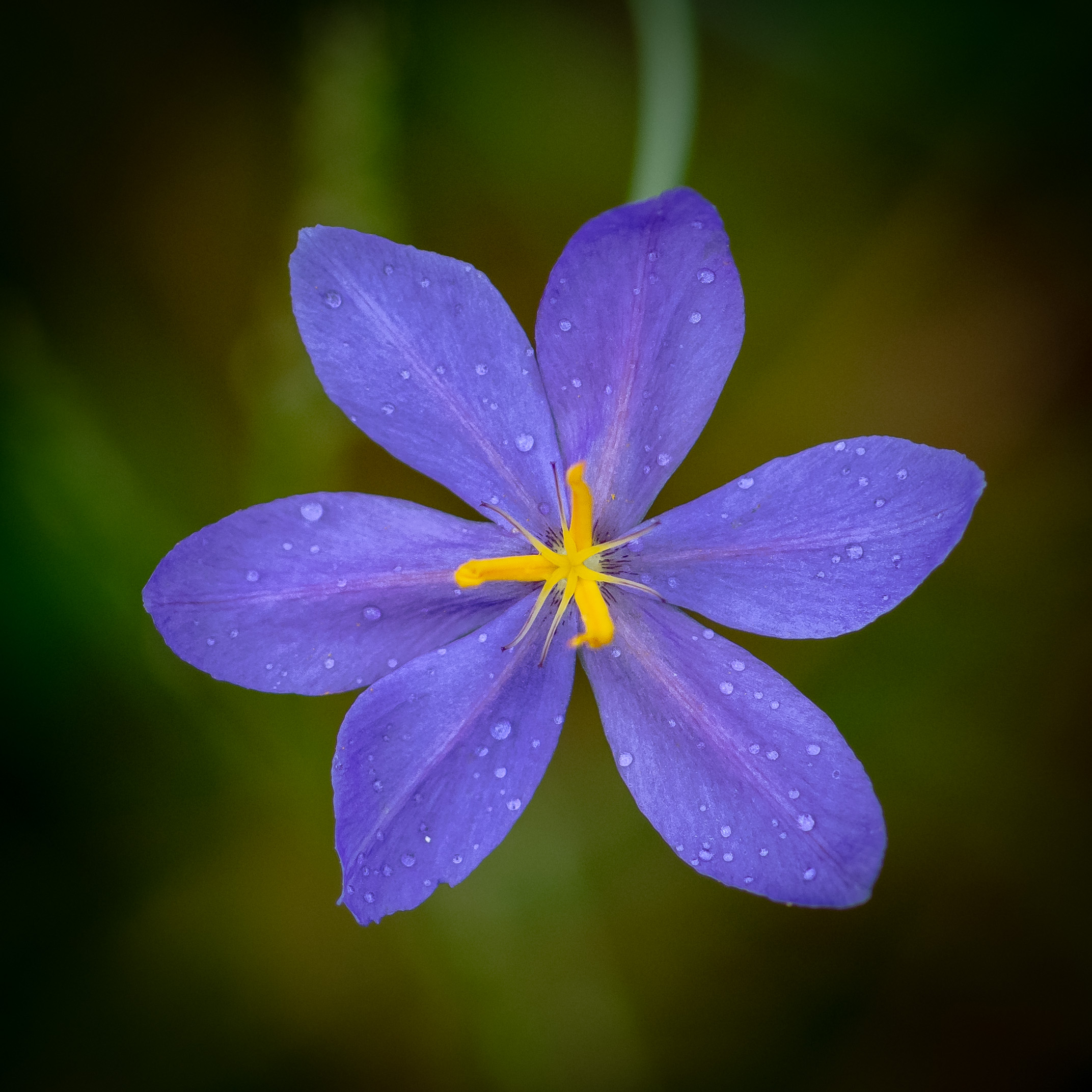
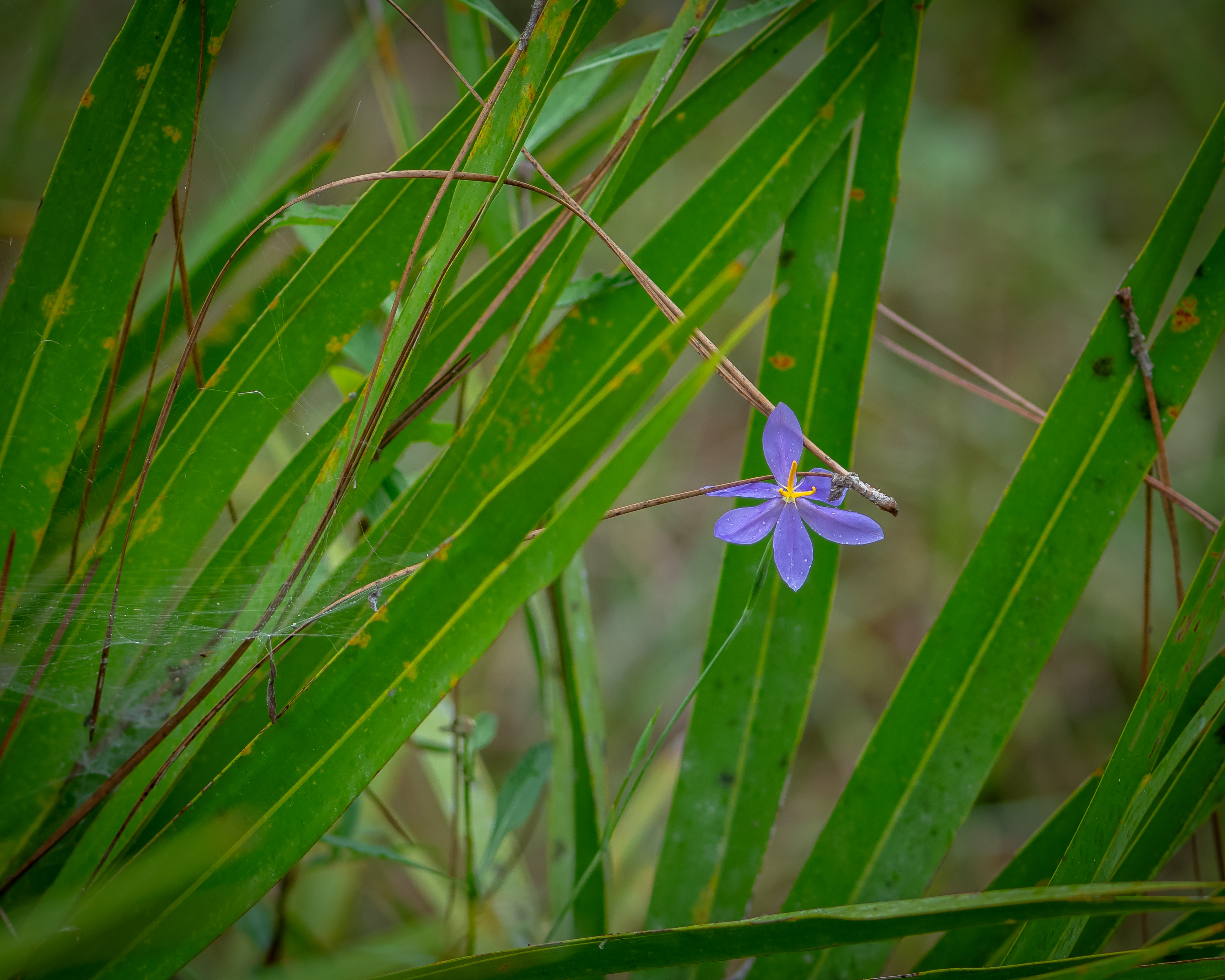
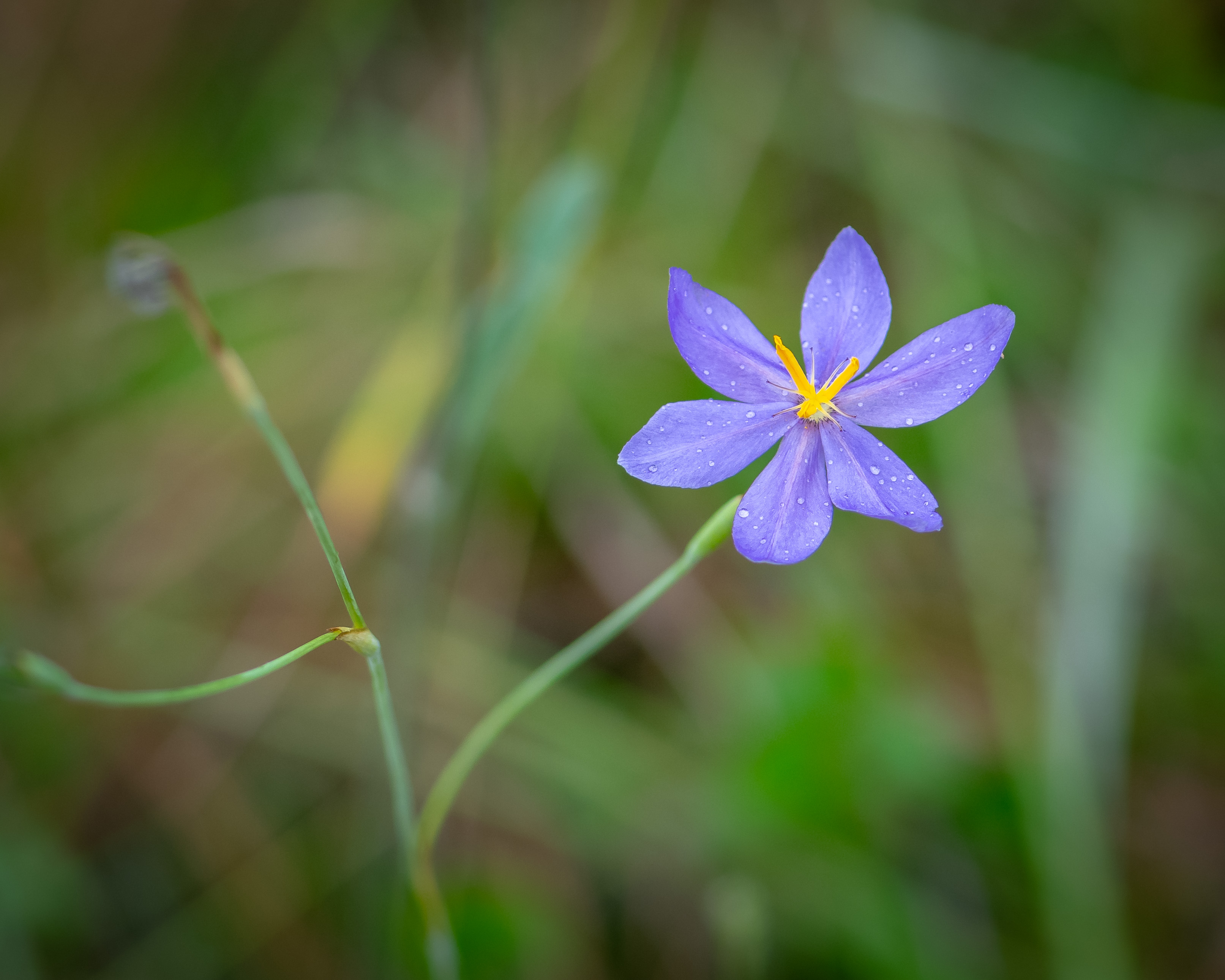
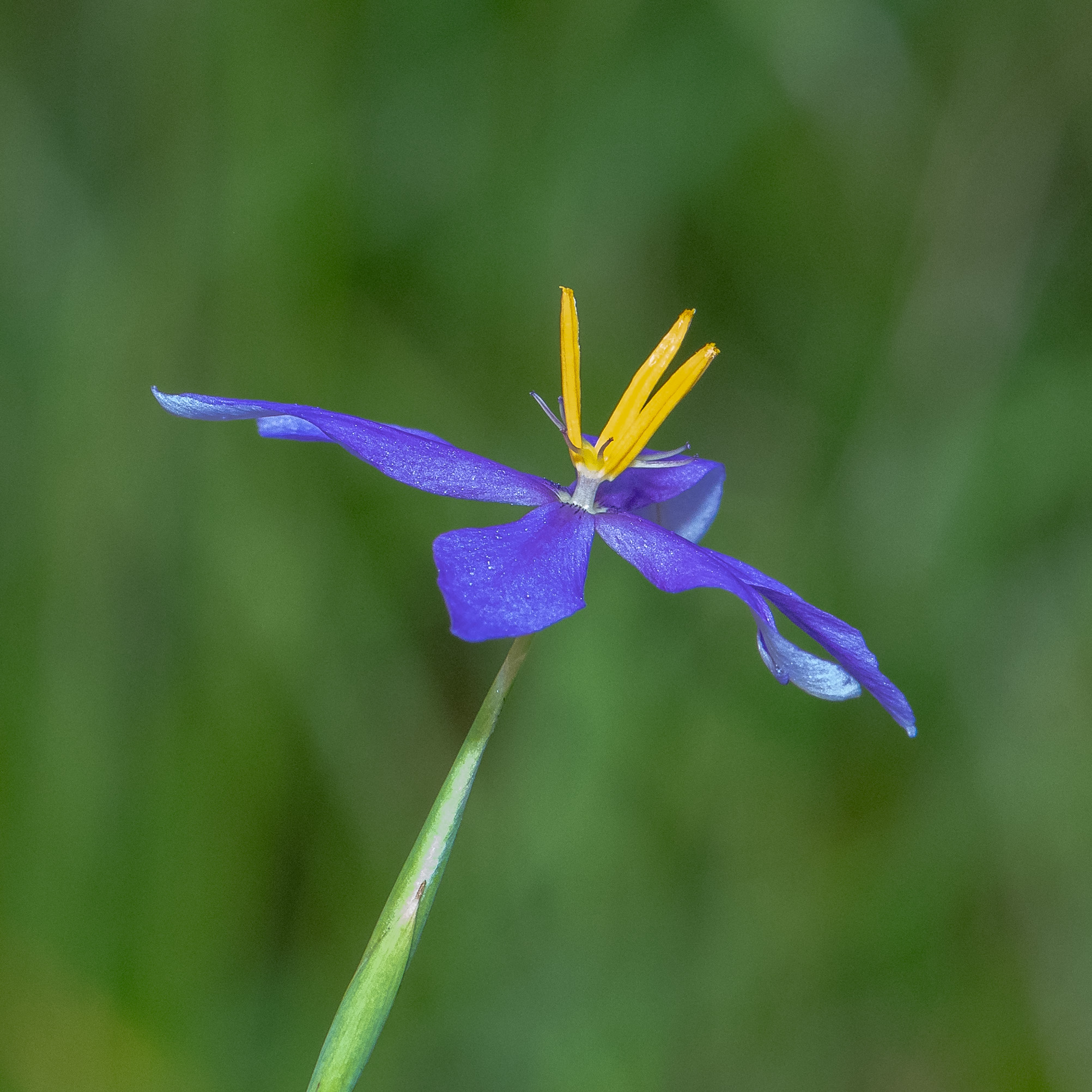
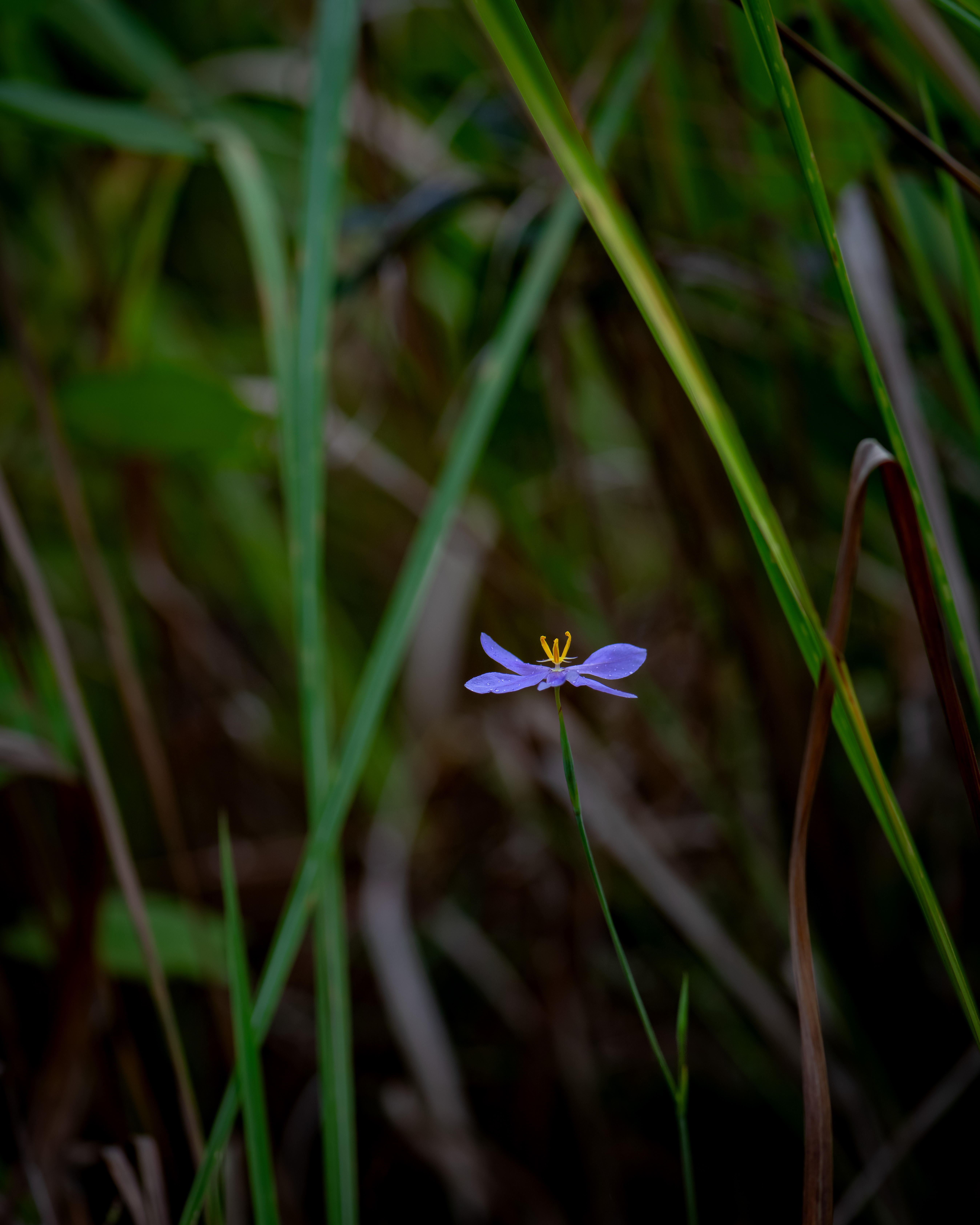
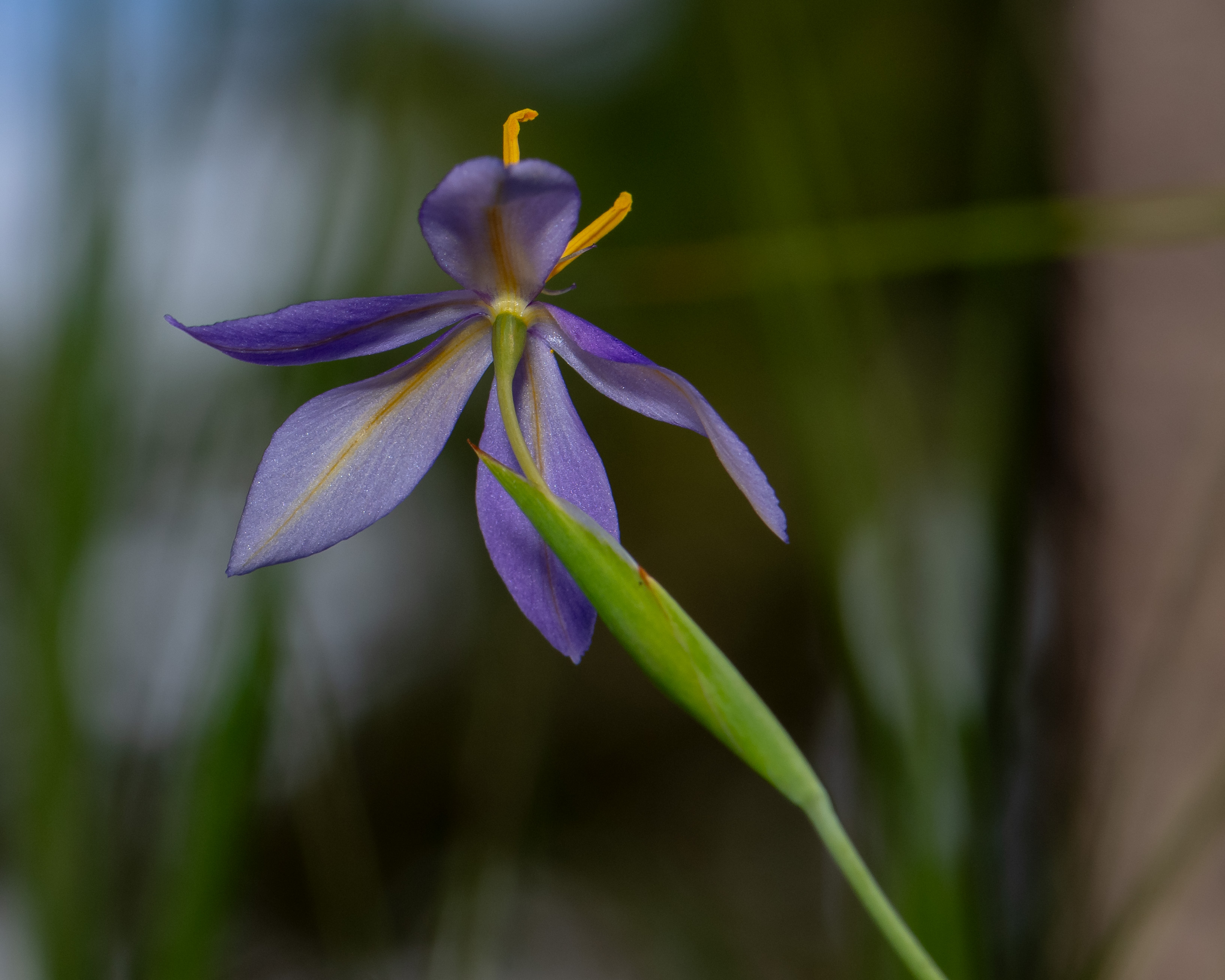
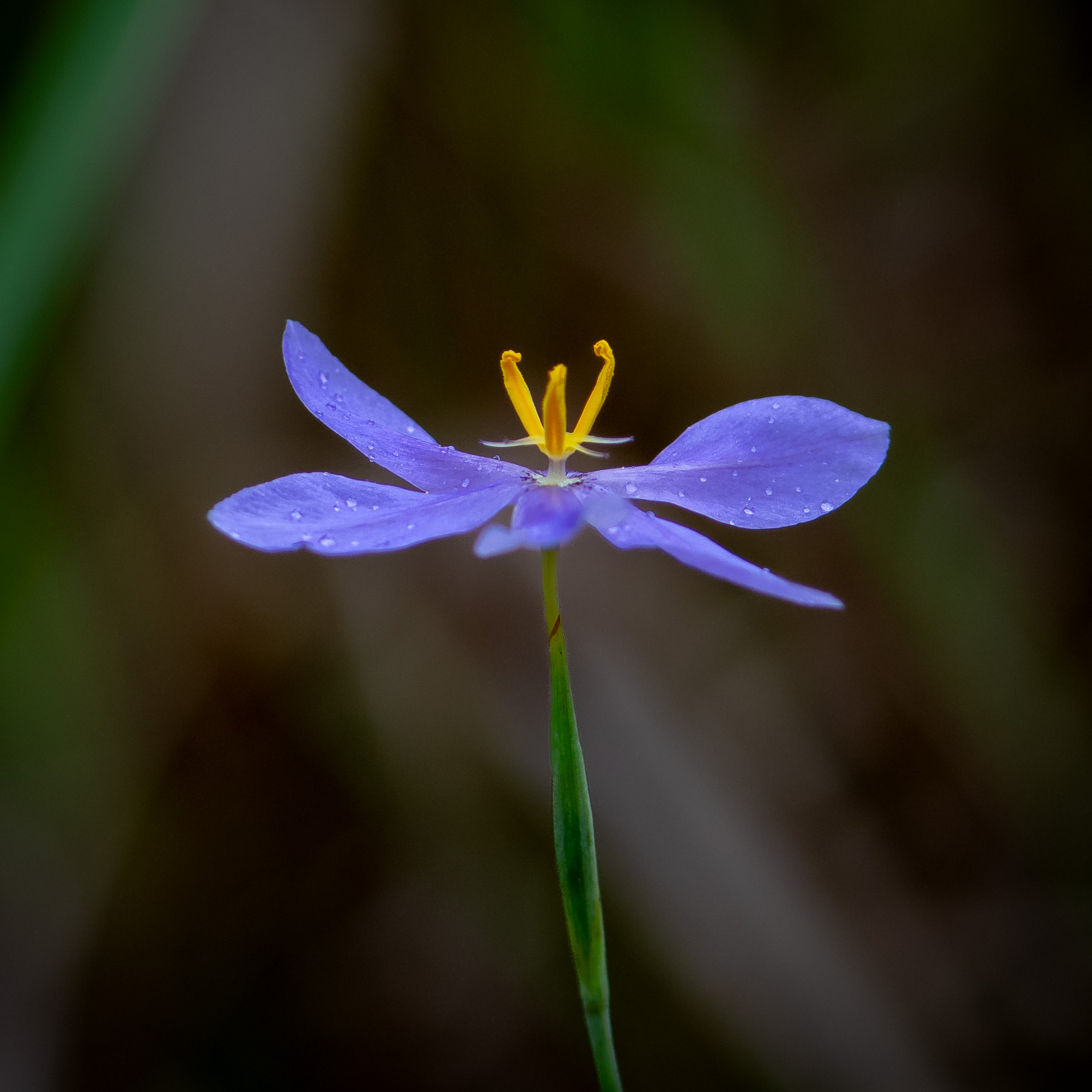
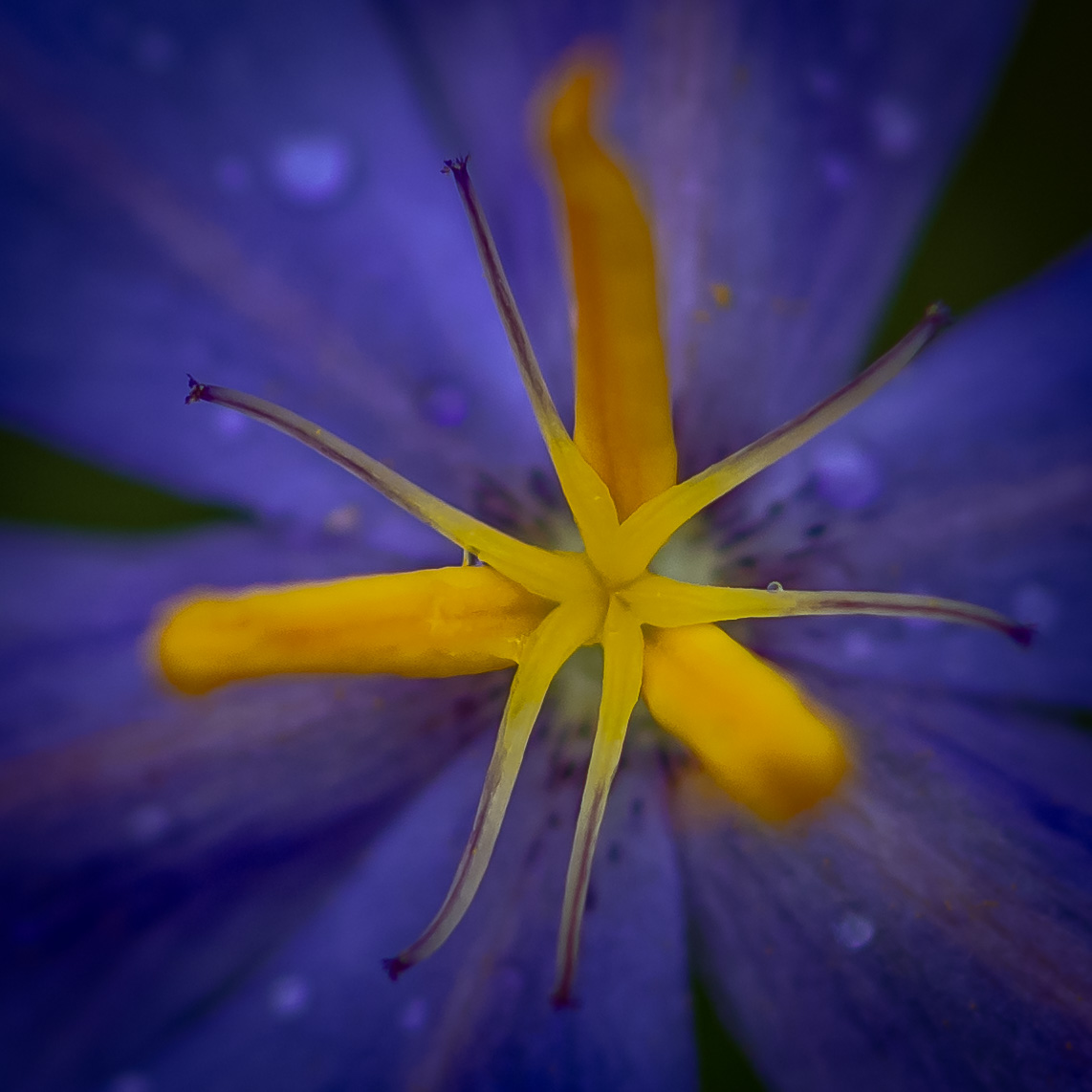
Celestial Lily (Nemastylis floridana). The blue flowers are 1-1.5 inches wide, consist of six petals and are borne on thin grass-like stalks. The USDA calls this the Fallflowering Pleatleaf. I’ll stick with its more heavenly common name. This plant likes open, sunny wetlands found in or near pinelands. It is found nowhere on earth outside of Florida and is listed as an endangered species.

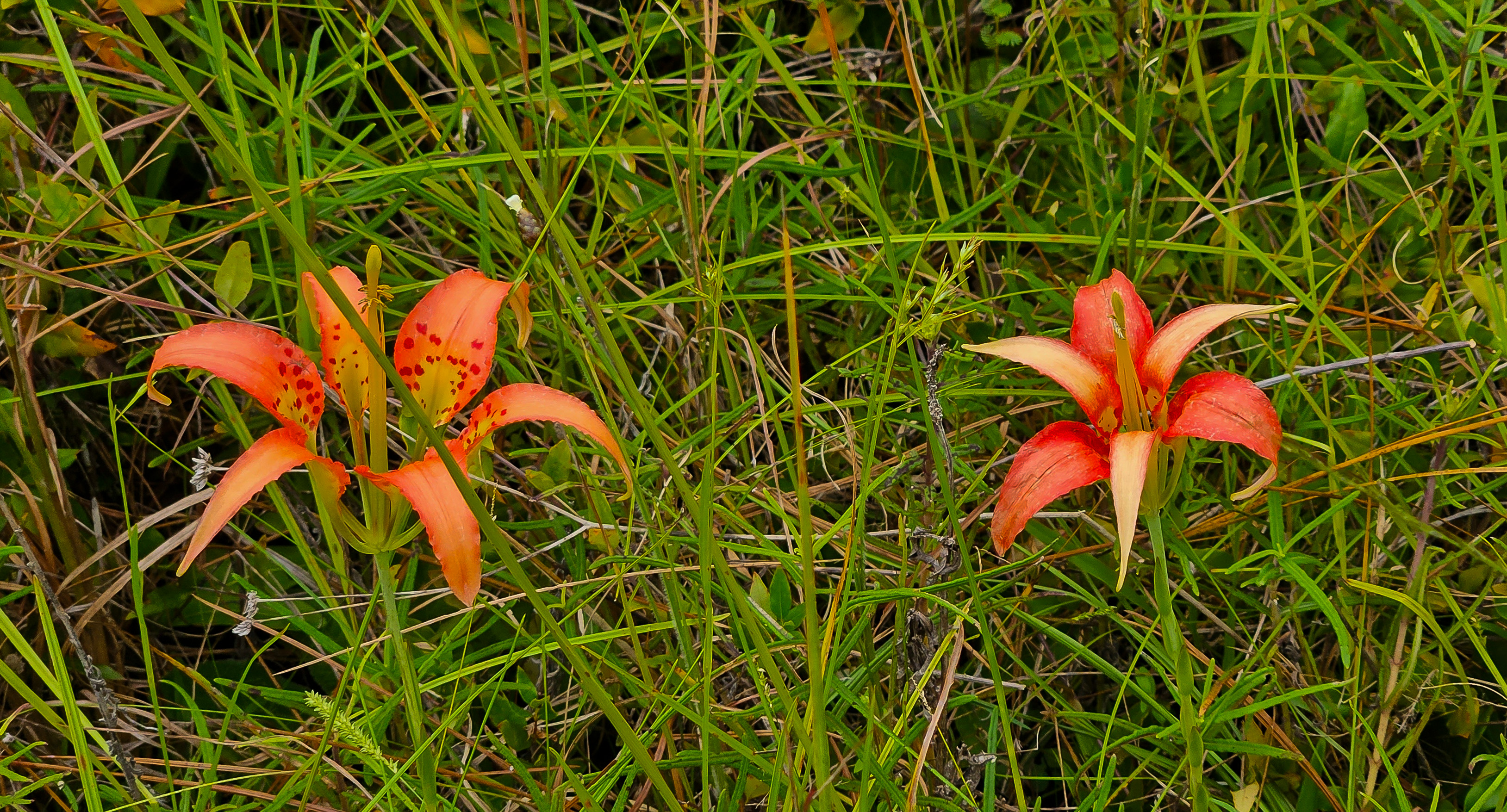
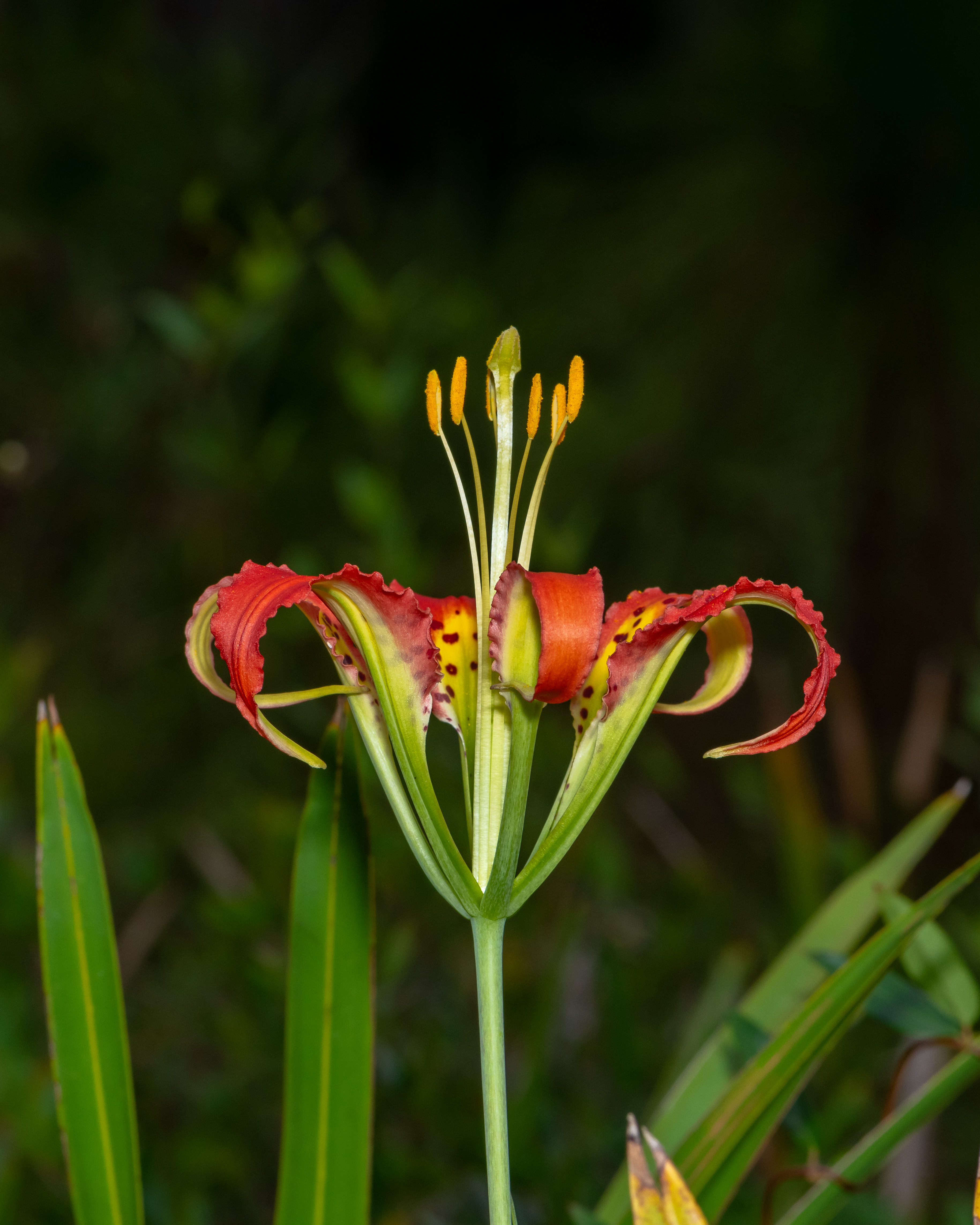
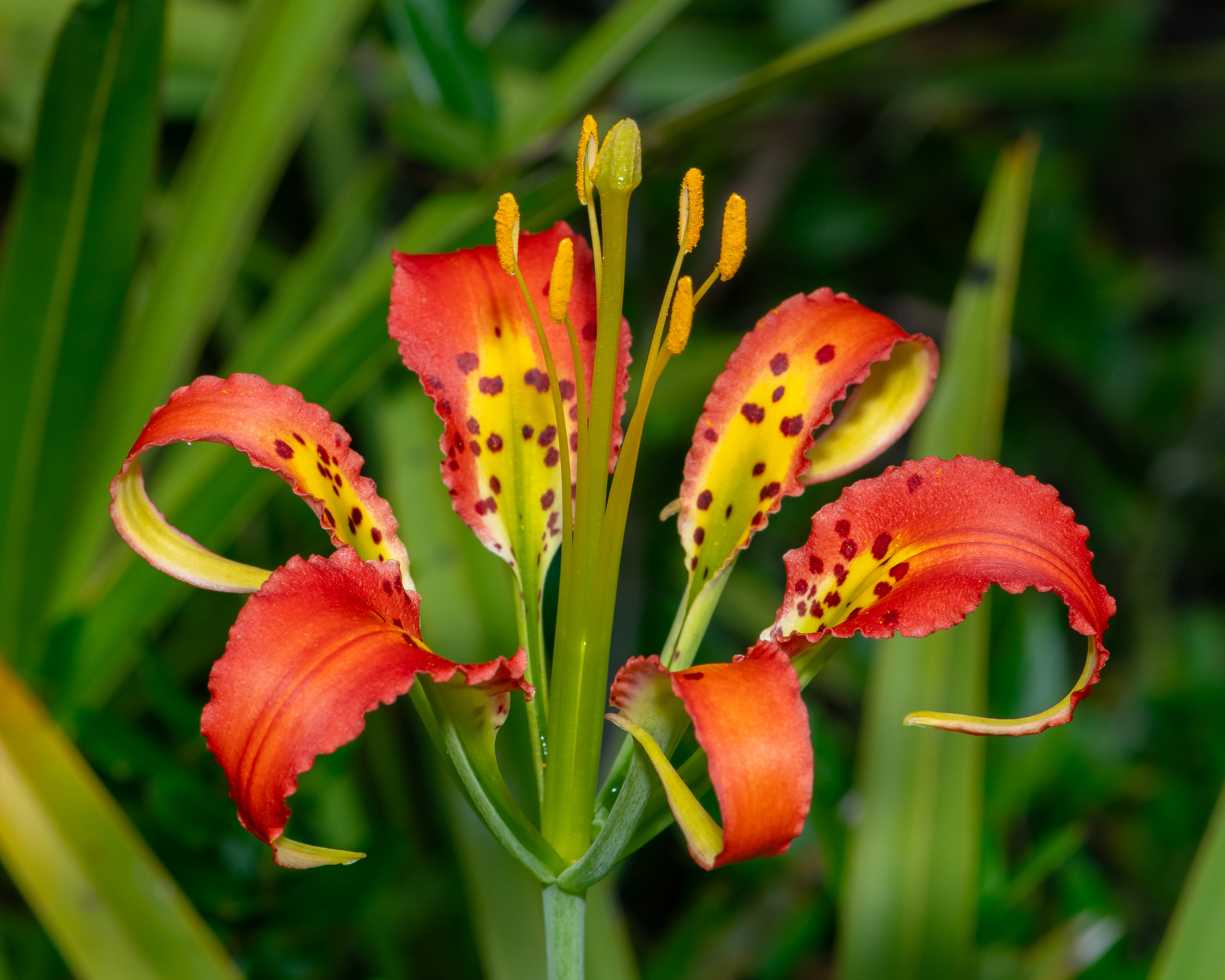
Pine Lily (Lilium catesbaei). Also known as Catesby’s Lily, is named for the British naturalist, Mark Catesby, who explored the flora and fauna of America in the early 1700’s. Found throughout the coastal plain states of the southeast, it produces the largest flowers of any member of the lily family. Growing to a height of 2-3 feet, it loves moist pine flatwoods and nearby prairies. Within Florida, it is a threatened species, due primarily to loss of habitat.
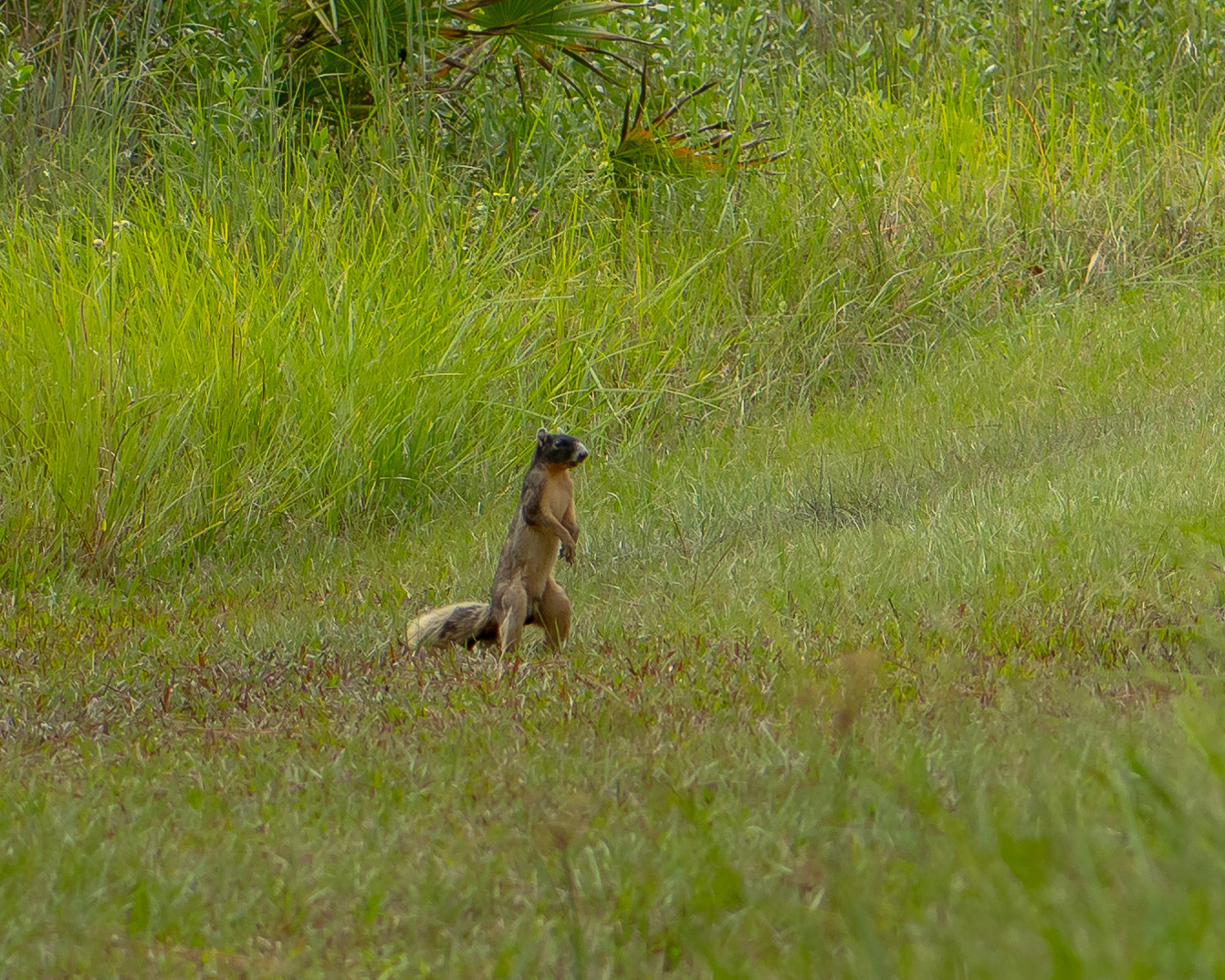
Sherman’s Fox Squirrel. Guardian of the pine woods pathways.
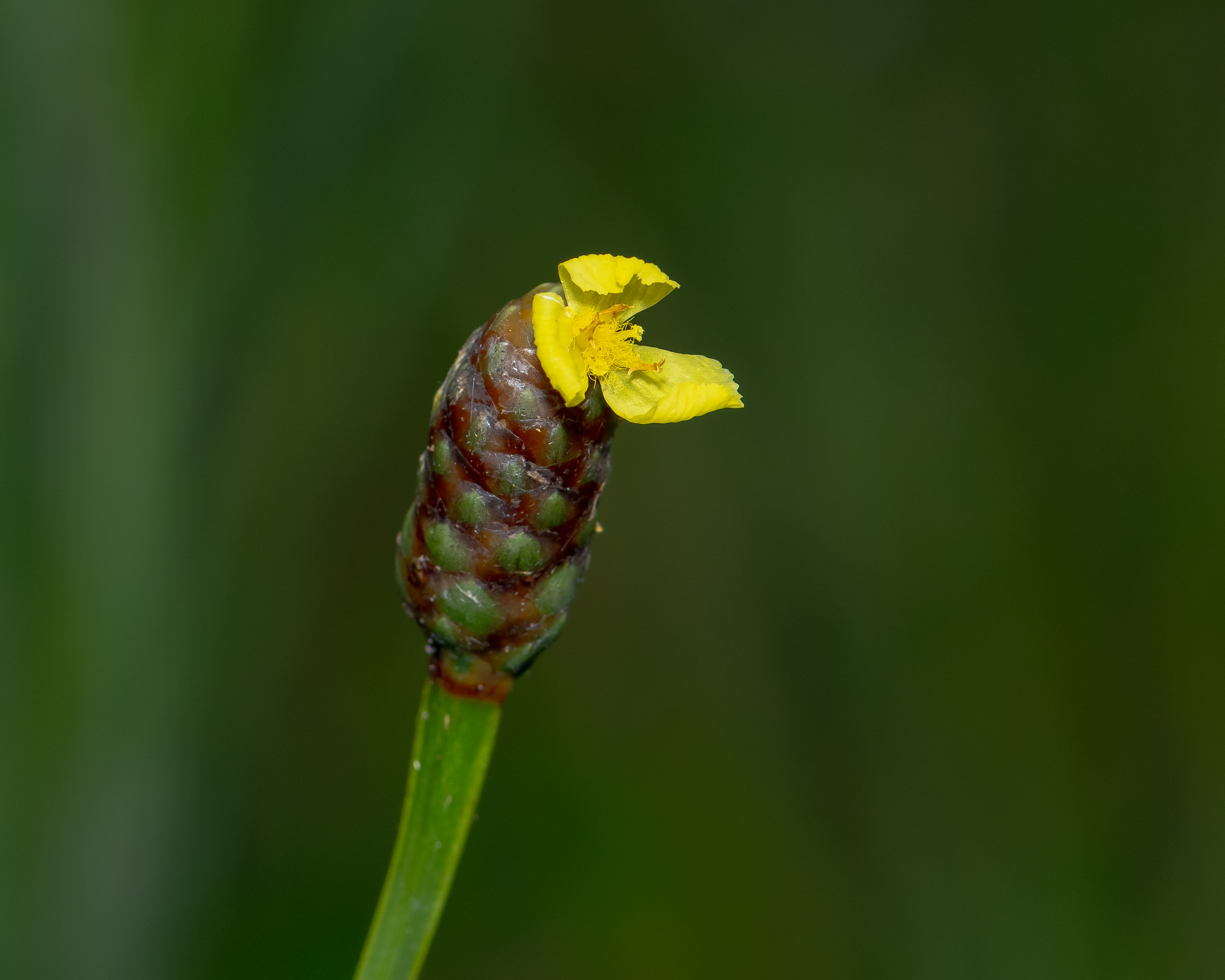
Yellow-eyed Grass (Xyris spp.). There are over two dozen species of Yellow-eyed Grass in Florida. This is one of them. This speciemen was about three feet tall and we encountered a lot of it along the path, although none was in full bloom. The small flowers appear very delicate.
A wand of bright purple lay across a part of the path and we hope to return soon to capture more photos of a few different species of Liatris. In Florida, almost 20 species are named Blazing-star or Gayfeather.

Just before sunset, clouds along the horizon lifted just a bit to spotlight a White-tailed Deer and her fawn. A perfeclty delightful end to a late day in the woods.

Early morning exploration is our “normal” operating mode. The middle of the day has been surprisingly rewarding at times, despite the warnings of Noel Coward. A late day hike which revealed the impossible amalgamation of orange, red and yellow Pine Lily was so satisfying. The discovery of a new plant which offered an incredibly beautiful flower, and only if you were present at the “happy hour” of blooming, well – the Celestial Lily made our Afternoon Delight – heavenly.
Enjoy your search for a natural place and come back for a visit!

(Reminder: Click to enlarge images. Click again to zoom.)
A cool morning!
Okay, perhaps not “cool“, but “not as hot“. It was a few minutes past sunrise and our target area for exploration was already buzzing, literally, with activity. Birds were chattering and insects were beginning to move about as the dew evaporated. Today was one of those unplanned excursions and we hoped to find a few subjects willing to pose for the camera.
Although we heard quite a few birds, not many ventured into camera range and even fewer begged for a portrait. No worries. Slow down, change to a macro lens, focus on the few feet around our – feet. Plenty to appreciate here.
Today we had to finish early as other tasks needed attention after lunch. Fresh fruit fueled our endeavors. (Know why we like bananas so much? Because they have “a peel“. Barump -bump.) Several flower species in the area were in full bloom and the nectar seekers obligingly drank their fill and flitted to the next plant for another sip, transporting pollen along the way.
Speaking of pollinators, Gini gently reminded me, for the third time, to brush my pants to remove items ingeniously placed by various plants in an attempt to increase their population. I don’t understand why she doesn’t want me to wait until we get home to do that so we can have a yard filled with beggar lice, sandspurs and Spanish needles. That way, we wouldn’t have to go very far to enjoy having all those hitchikers jump on us for a ride.
Most of the photographic results of today’s exploration were of subjects on the diminutive side. Hope you can see them okay.
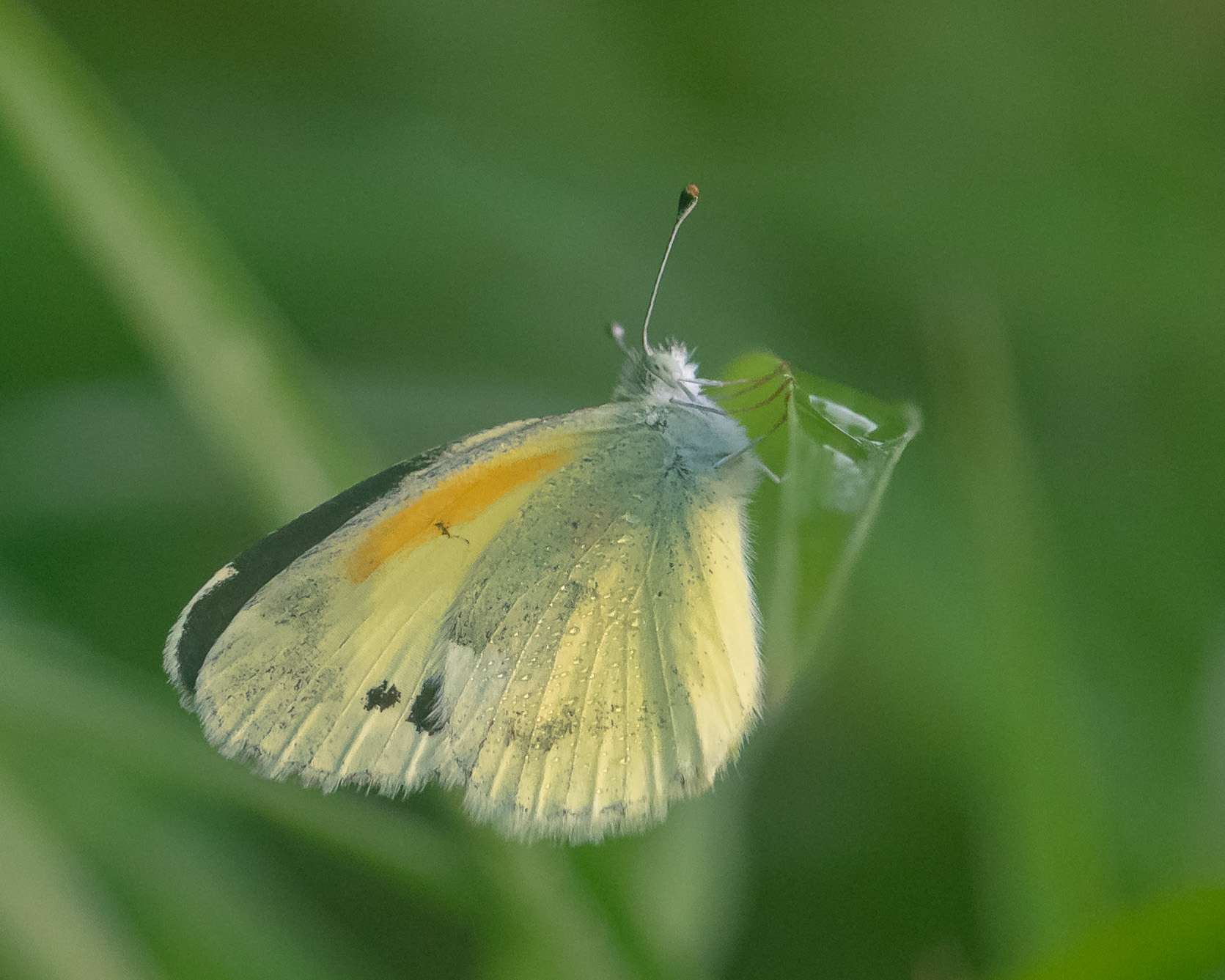
Clutching a blade of wet grass, a Dainty Sulphur (Nathalis iole) patiently waits for the sun to do its job of drying the dew from its wings.
A new bug! This good-sized specimen is a Wedge-shaped Beetle (Macrosiagon octomaculata) feeding on Shrubby False Buttonweed (Spermacoce verticillata).

The brightly colored Milkweed Assassin Bug (Zelus longipes) is known as a “generalist” when it comes to prey. It eats pretty much anything it finds. Any bug which eats Army Worms and Mosquitoes gets my vote as “friendly”.

Often, we become so enamored of the beauty of a butterfly displaying its upper wings that we forget how incredible the other side of those wings can be. A case in point: the Variegated Fritillary (Euptoieta claudia). Gorgeous from above or below.


Growing to a height of four to five feet, Plains Snakecotton (Froelichia floridana) is in the Amaranth family. Leaves are near the plant’s base and the small white flowers are borne on tall stalks which wave sinuosly in the wind, giving the plant one of its common names.
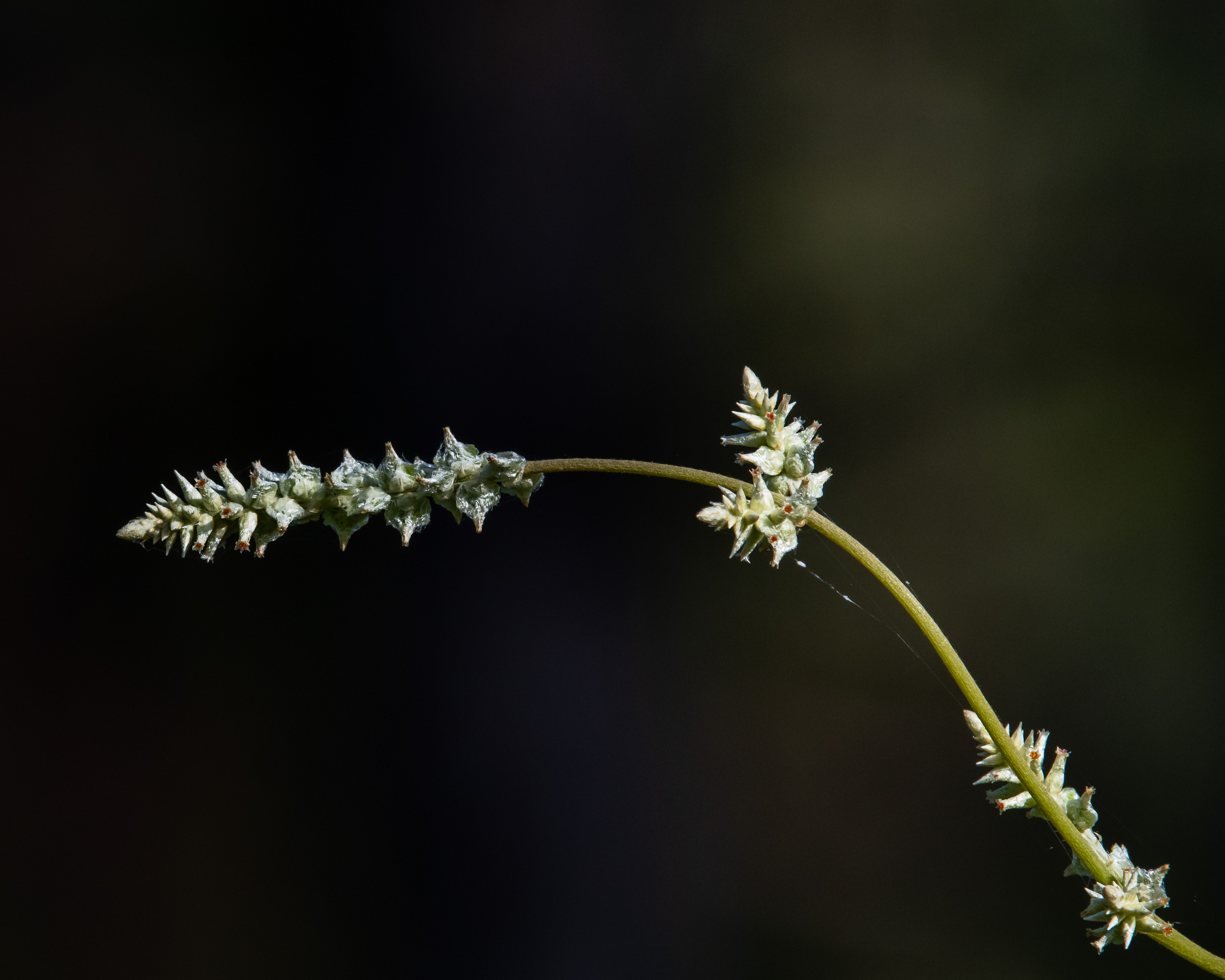
It’s always a bit startling to see Fire On The Mountain (Euphorbia cyathophora) growing in the wild. It’s like an early Christmas as the familiar holiday Poinsettia is in the same family.

How can a butterfly have nothing but dull colors and still be so beautiful? I don’t know either, but we always enjoy finding Horace’s Duskywing (Erynnis horatius) during any trip.

We interrupted a preening session of Common Ground Dove. The plain gray birds favored us with a wave of a wing revealing an incredibly rich brown plumage.

Compared to the small brown Horace’s Duskywing above, a large Spicebush Swallowtail (Papilio troilus) appears almost gaudy. Almost.

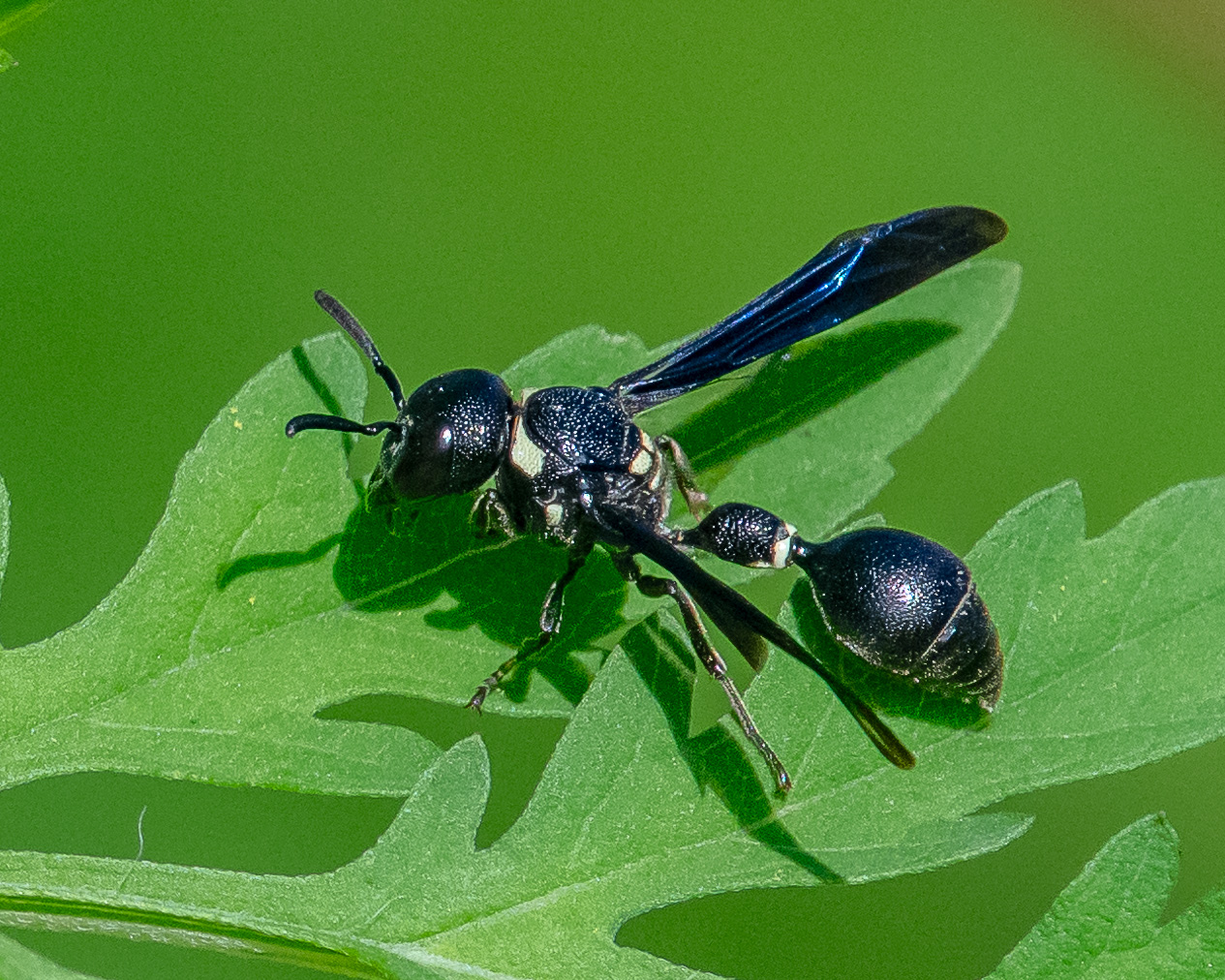
Many wasps receive a negative reaction due to the very real fact they can inflict a painful sting if one is not careful. Most species of wasp are not aggressive, so as long as you respect their space, you should remain pain-free. This handsome Mason Wasp (Zethus spinipes) builds a uniquely-shaped nest which is stuffed with a caterpillar for junior to nibble on once hatched.
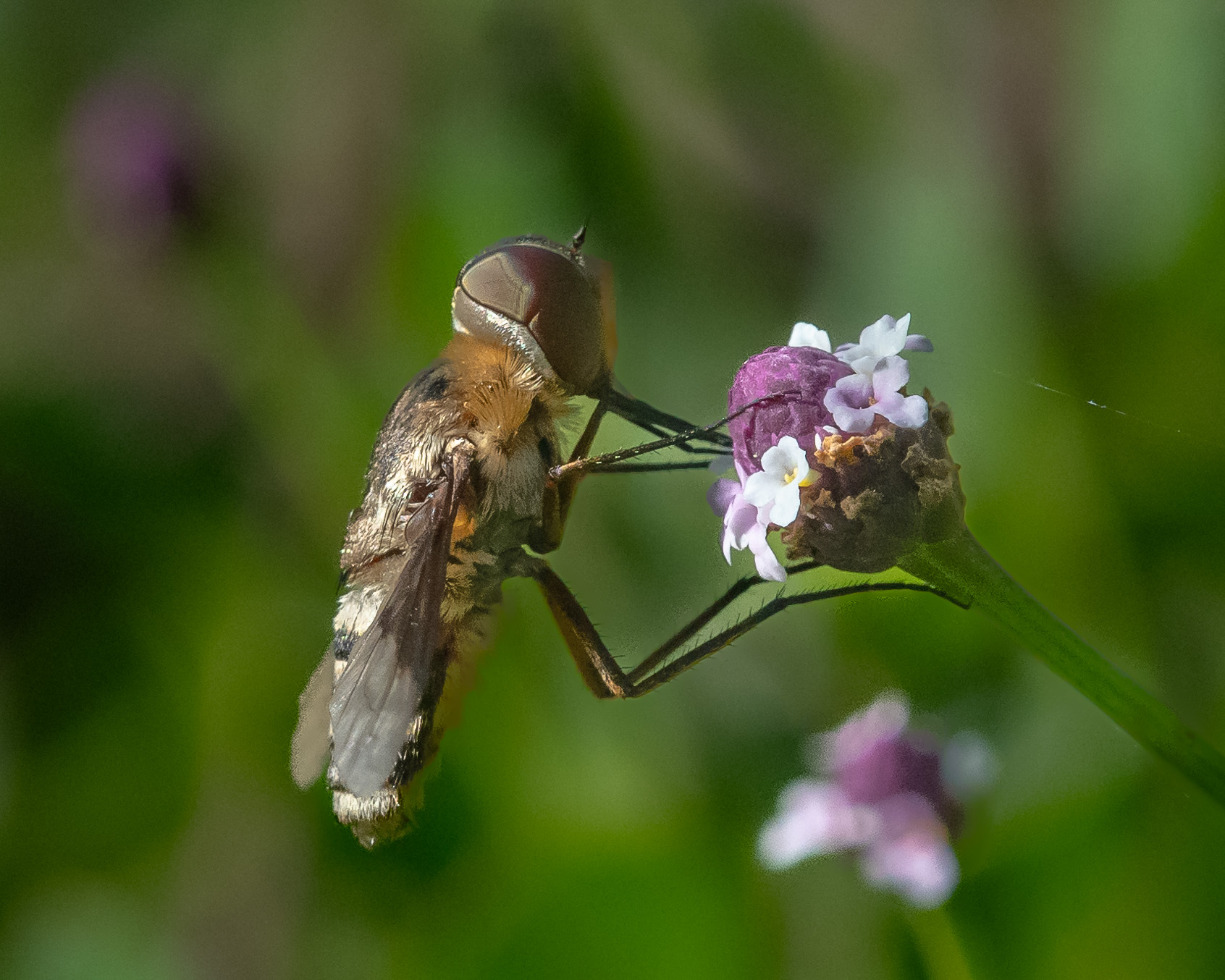
I was unable to determine the exact species, but this little Hoverfly (Syrphidae spp.) was very active. If you know how small the flower of the Frogfruit (Phyla nodiflora) is, then you know how small the fly is.
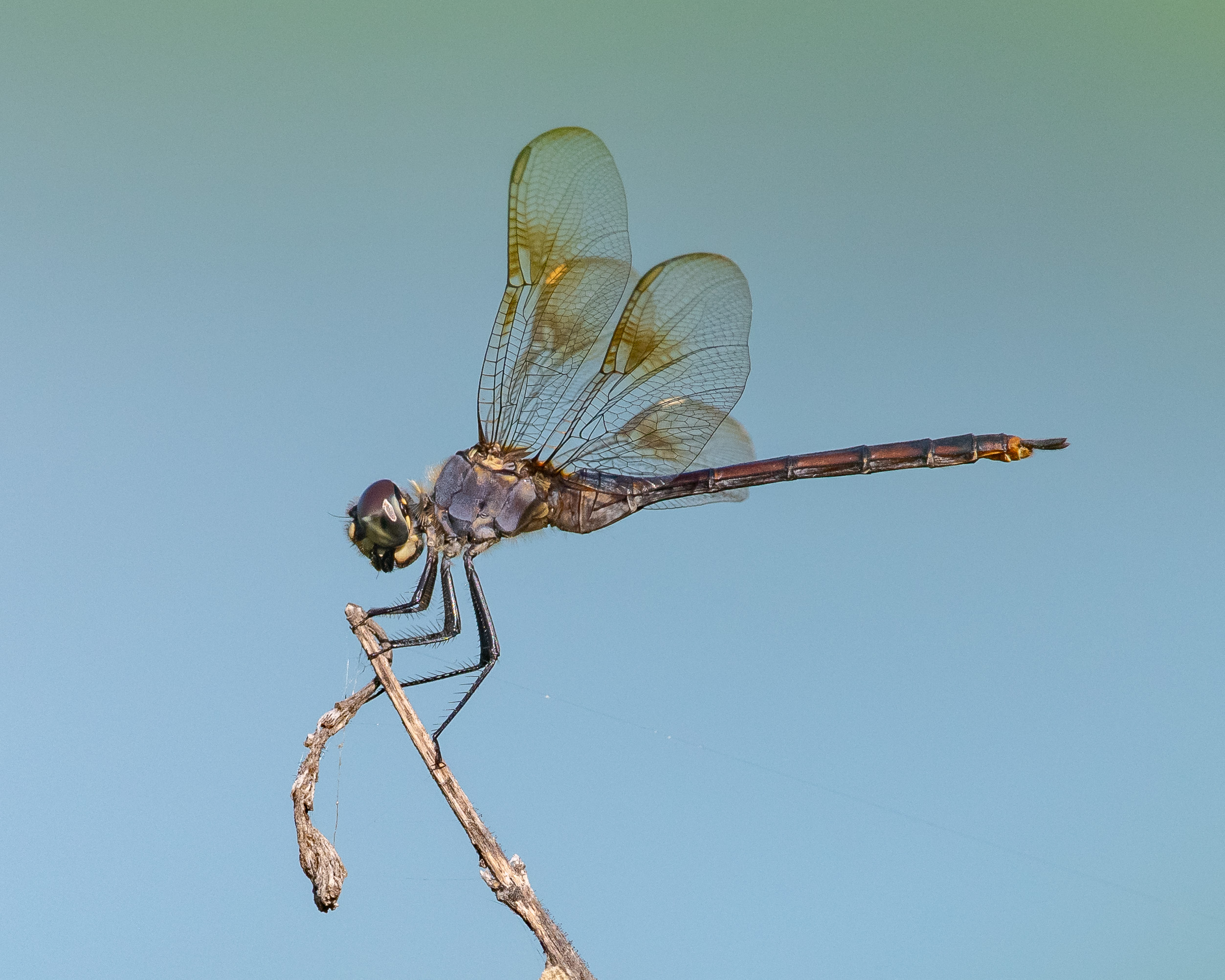
Four-spotted Pennant (Brachymesia gravida) is one of our most abundant dragonfly species. Spots/smudges on the wings and their preference for perching horizontally on bare twigs help with identification.
That eminent entomologist, the Loggerhead Shrike, generously provided a specimen for our viewing enjoyment. She only asks that we not take the Rainbow Scarab Beetle (Phanaeus igneus) from its display since she intends to invite it for dinner.

An immature male Roseate Skimmer (Orthemis ferruginea) still has the coloration of a female but will soon transform into the purple hues of an adult.

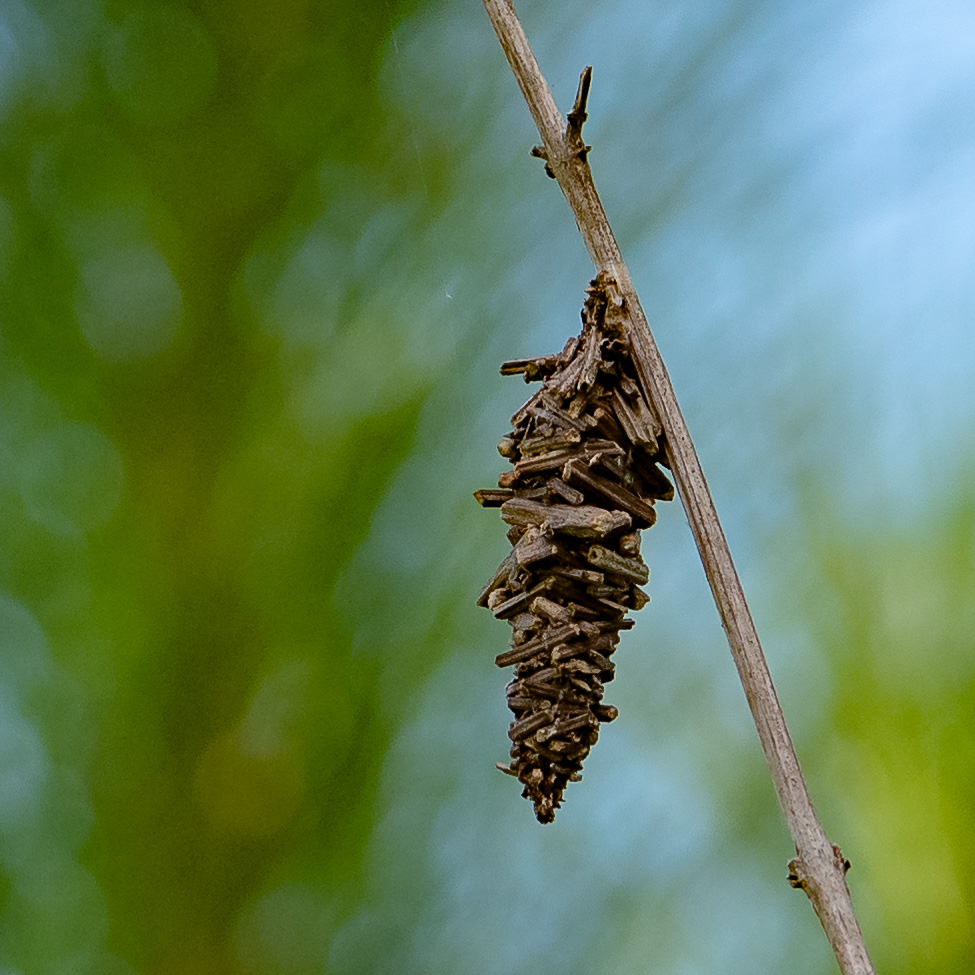
The mobile home expert of the moth world, an Abbot’s Bagworm Moth (Oiketicus abbotii) is seldom seen outside its protective case.
When the sun’s rays highlight a perching female Needham’s Skimmer (Libellula needhami), she seems to have threads of gold woven into her wings.

Tiny damselflies can be so colorful. The Rambur’s Forktail (Ischnura ramburii) takes it even further by having four different color forms. Here are a green and a blue specimen.


We opened with a candid picture of a Green Anole (Anolis carolinensis) and thought we would bid him farewell until our next visit.

Our day was filled with finding small treasures and all produced huge pleasures. In your hunt for a natural subject to enjoy or photograph, don’t forget to look for the little things which make our lives better.
Enjoy your search for a natural place and come back for a visit!
 Our Natural Places