“… To Where It Bent In The Undergrowth …”*

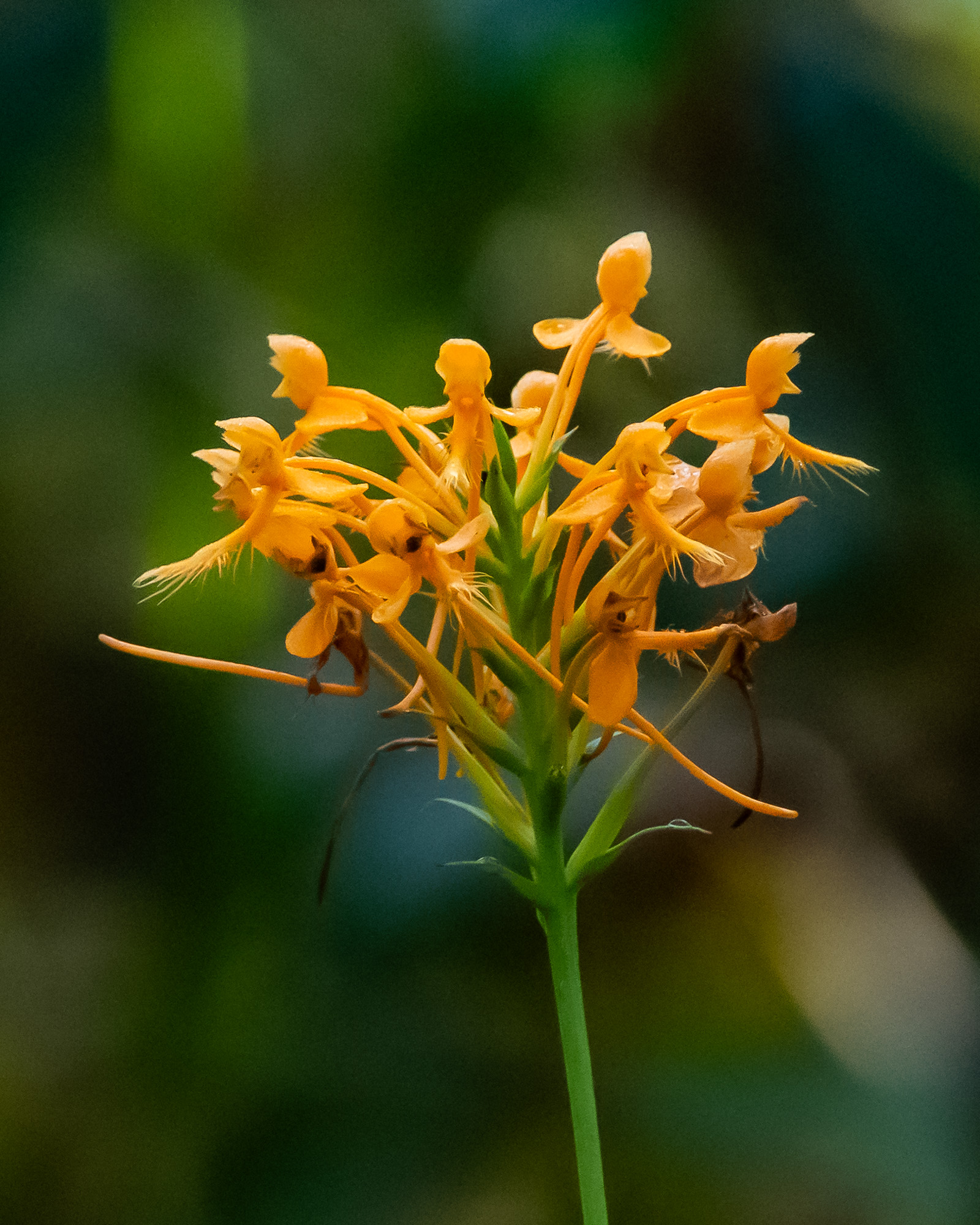
A glimple of bright orange. “Is that a milkweed?” No. No it wasn’t.
It was just after sunrise and we made a different choice today. This particular tract is a wildlife management area within the Withlacoochee River State Forest and consists of nearly 60,000 acres. We have developed a loose routine for exploring this vast area. There are three access points from the main road cleverly named “North”, “Central” and “South” Grade. Each winds through a dozen or so miles and eventually hooks up with one of the other roads to take us back to the highway.
There are three additional access points. One is gated and remains locked until hunting season. A second is either under water or, during dry season, contains potholes large enough to swallow large trucks without leaving a trace. The third has no name and we have used it in the past as an exit. It always looked interesting to explore but since we had usually just spent our morning rambling along another road, we never had sufficient time to look more closely.
Until today.
The turnoff from the paved road was almost hidden and I drove past it and made a u-turn. It was in better-than-expected condition. Similar to the other roads we have explored, this one had several areas to pull off with trails leading deeper into the swamp and forest. Same habitat: sandhills, pine flatwoods, oak hammocks, river swamp and cypress ponds.
The date of our visit was August 15, 2024. Hot and humid, just like Florida is supposed to be in summer. Plenty of seasonal rain results in a lot of standing water throughout the swamp. Plenty of standing water results in plenty of mosquitoes. And they are hungry. Good test environment for the three different repellants we brought with us.
Birds were singing, flying, hunting and mostly not perching within camera range. All morning we enjoyed Northern Cardinals, Carolina Wrens, Tufted Titmice, Carolina Chickadees, Brown-headed Nuthatches, Downy/Pileated/Red-bellied Woodpeckers, Blue Jays, Eastern Towhees, Osprey and Red-shouldered Hawks.
In addition to the skeeters, were myriad other insects. Cicada choruses were almost deafening. The dragonflies were enjoying what Air Force combat pilots refer to as a “target rich environment“. Flowers were in abundance. Nectar-seekers were happily busy.
We didn’t want to tax Gini’s still somewhat weak stamina, especially in the excess humidity, so we headed home after a couple of hours of blissful exploration. The road may not have a name, but now we know exactly how to find it and can’t wait to return.
So, if it wasn’t a milkweed?? A first for us. As Gini was examining the bright orange blooms, her florist background kicked in. “This sure looks like some sort of orchid.” Spot on. Again. Yellow Fringed Orchid (Platanthera ciliaris) is also referred to in some sources as Orange Fringed Orchid. Not to be confused with Crested Yellow Orchid (P. cristata) or the Yellow Fringeless Orchid (P. integra). Not to mention, if you travel in the northern part of Florida, the very similar looking and rare Chapman’s Fringed Orchid (P. chapmanii). Coincidentally, Linda on her fabulous blog, Lagniappe, posted on August 21 about her find of the latter plant in Texas. Go there and see her wonderful write-up and photographs. (https://lindaleinen.com/2024/08/21/a-splendid-splash-of-orange/#comments)
Do it now. We’ll wait here.

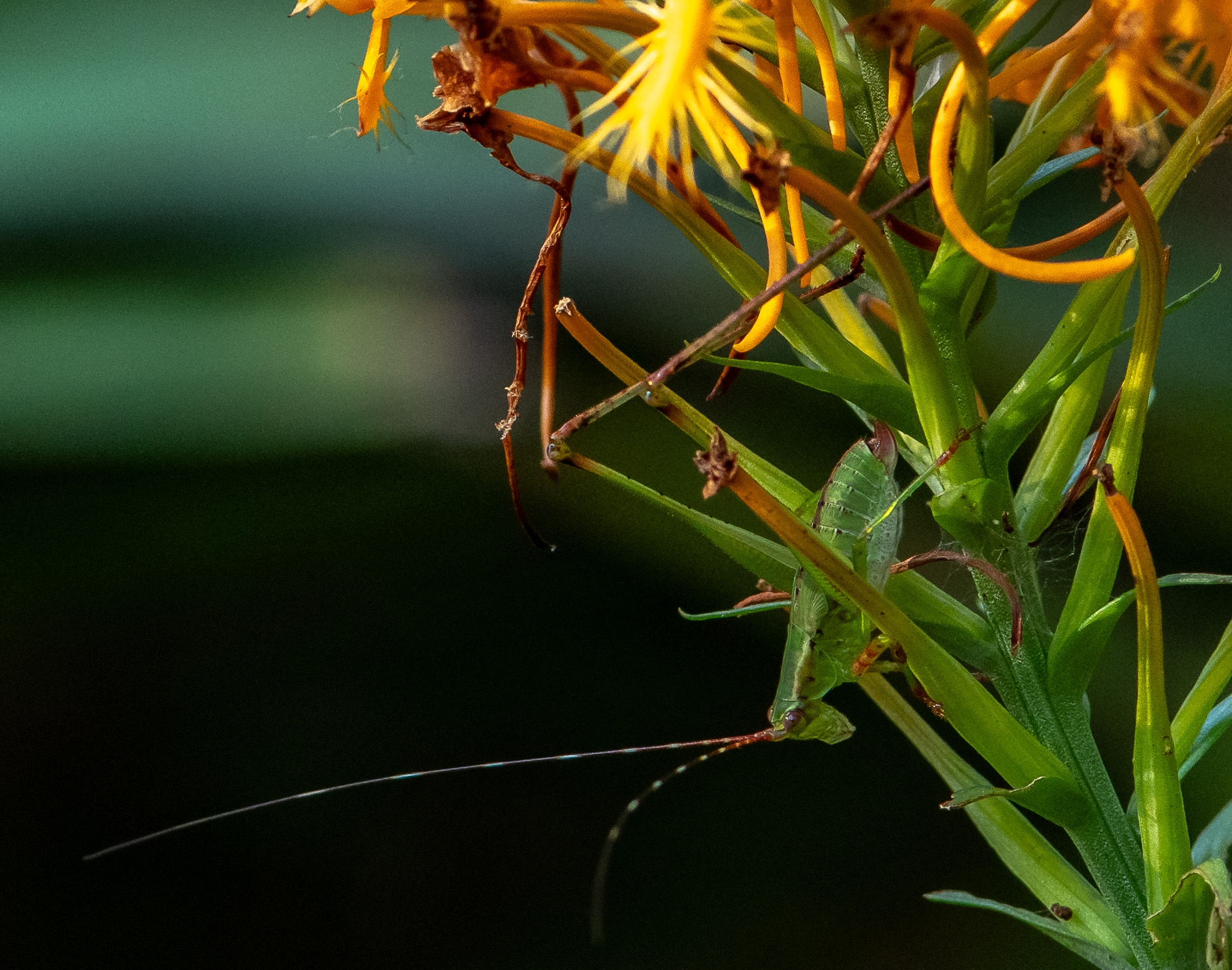
The leaves of Winged Loosestrife (Lythrum alatum) remind me a bit of the herb Rosemary. Also known as Winged Lythrum, the lovely purple blooms attract a great variety of pollinators. Such as a Brown-winged Striped Sweat Bee (Agapostemon splendens), whose name is longer than its owner.


Southern Beeblossom (Oenothera simulans) is one of those plants with small flowers which is all too easy to overlook once the blooming season is in full swing. If we stop to admire it, however, we can find a lot of beauty to like.

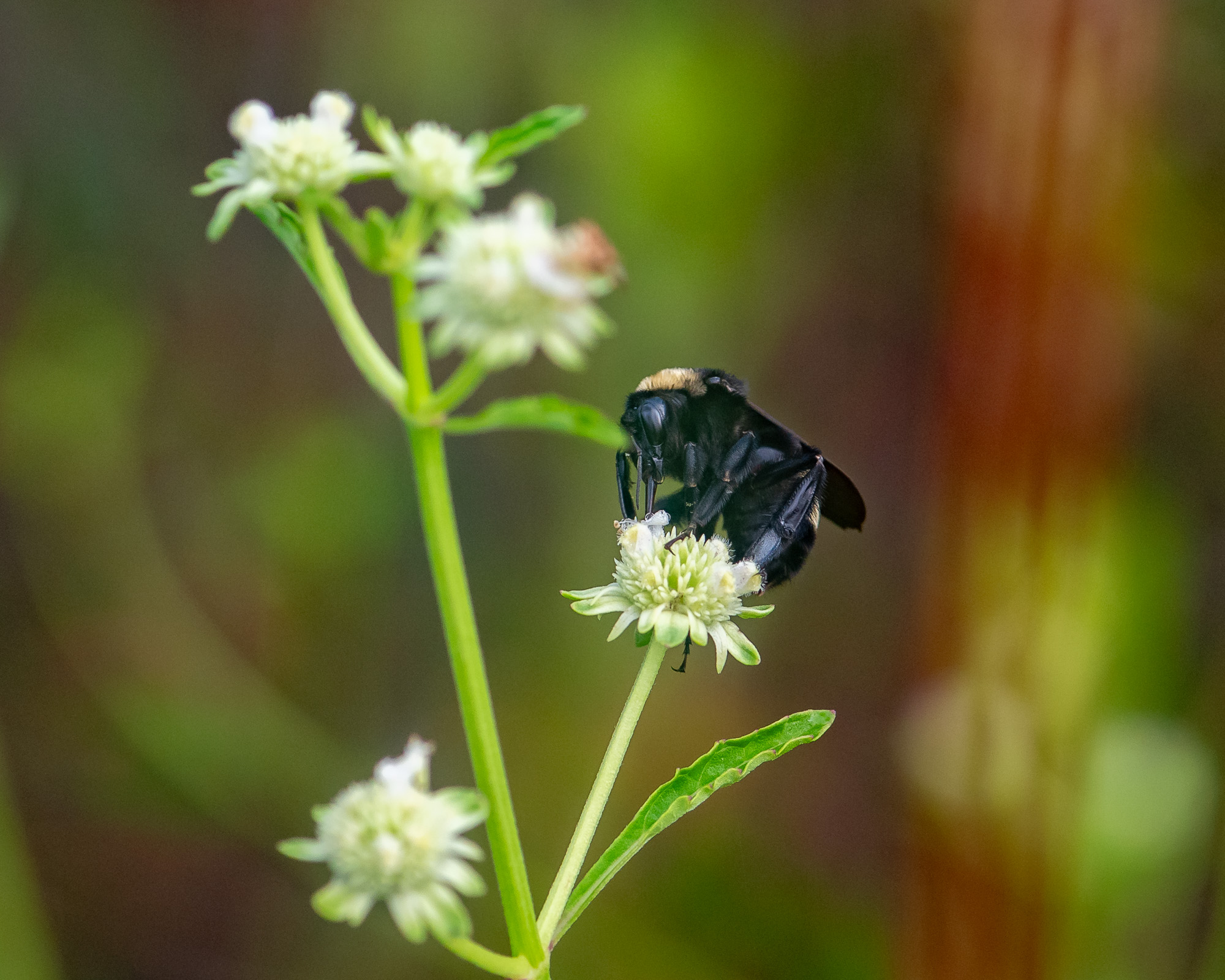
One of the most abundant flowering plants we encountered this morning was the Clustered Bushmint (Hyptis alata). Each flower head contains a number of small blooms which don’t all bloom at the same time. This offers the nectar seekers a chance to visit again and again.

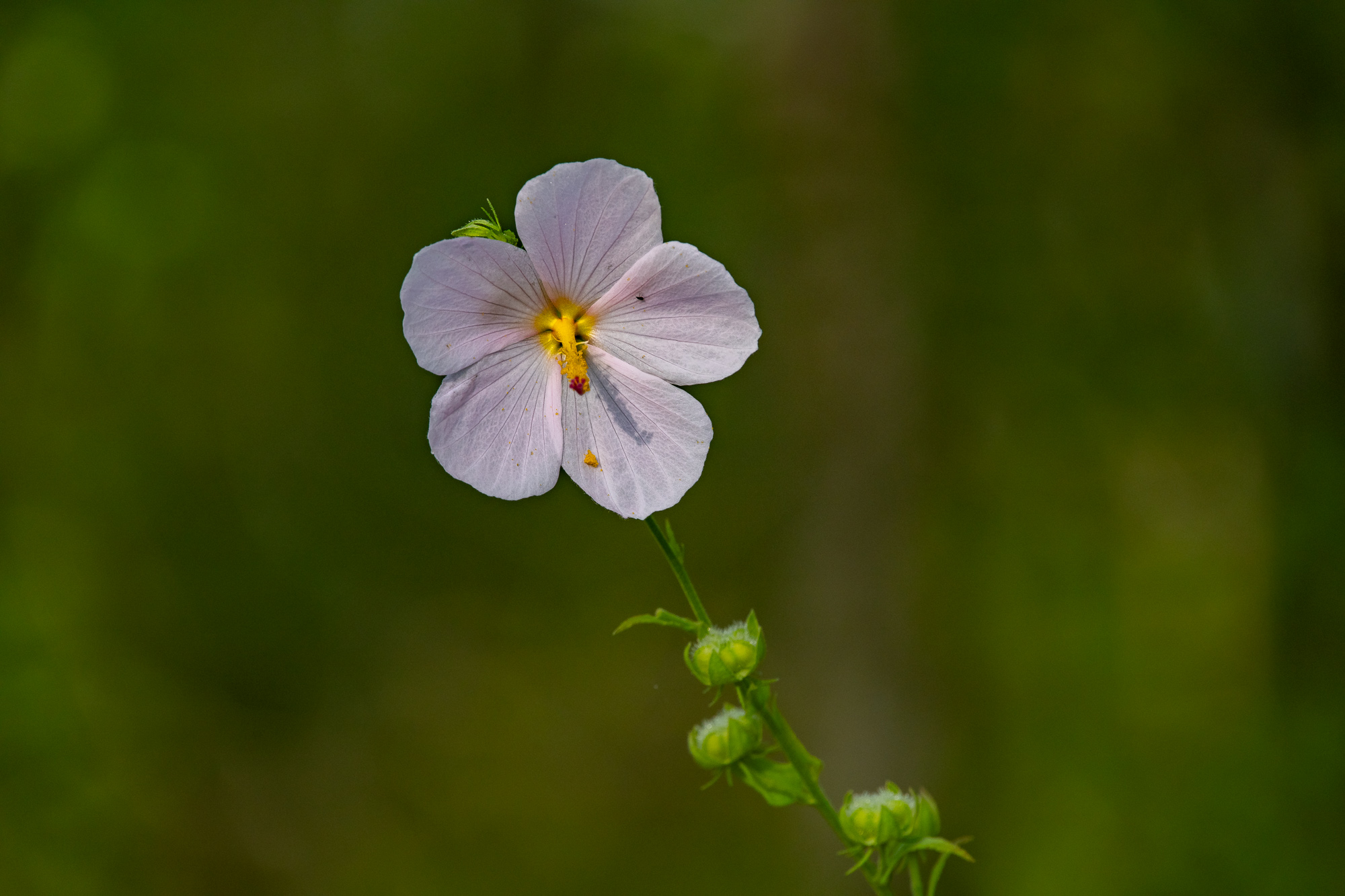
Vincent Franz Kosteletzky, Bohemian botanist and physician (1801-1887), has several plants named in his honor. One such is a member of the hibiscus family and was named for him in 1835. It is the Virginia Saltmarsh Mallow (Kosteletzkya pentacarpos). We found a few dozen plants today and there’s no doubt they are hibiscus. (Hibiscuses? Hibisci?)
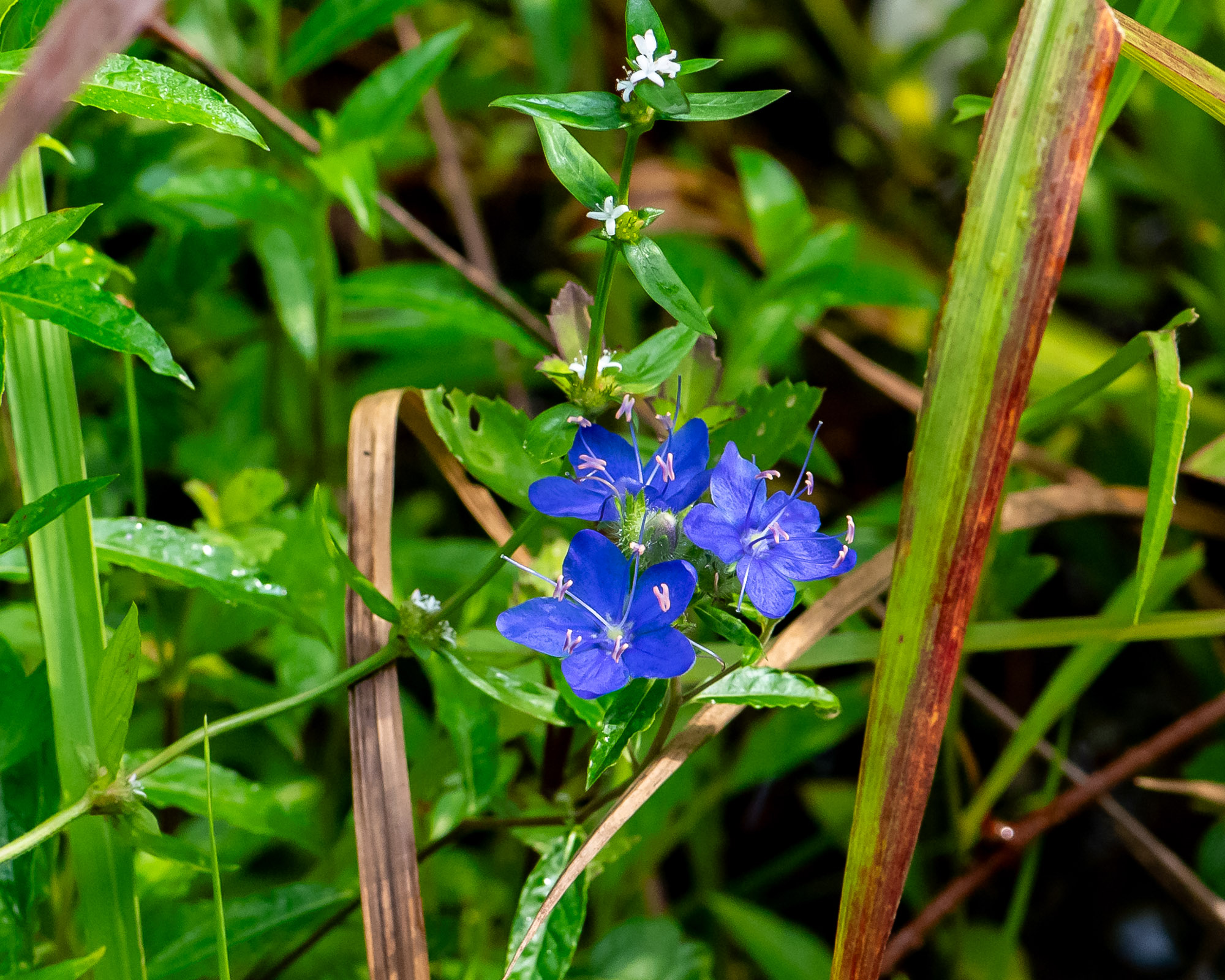
The color almost doesn’t look real. Talk about “blue“! Found in only four southeastern states, the Skyflower (Hydrolea corymbosa) is aptly named. Enjoy the blooms early as they begin to fade in the afternoon.

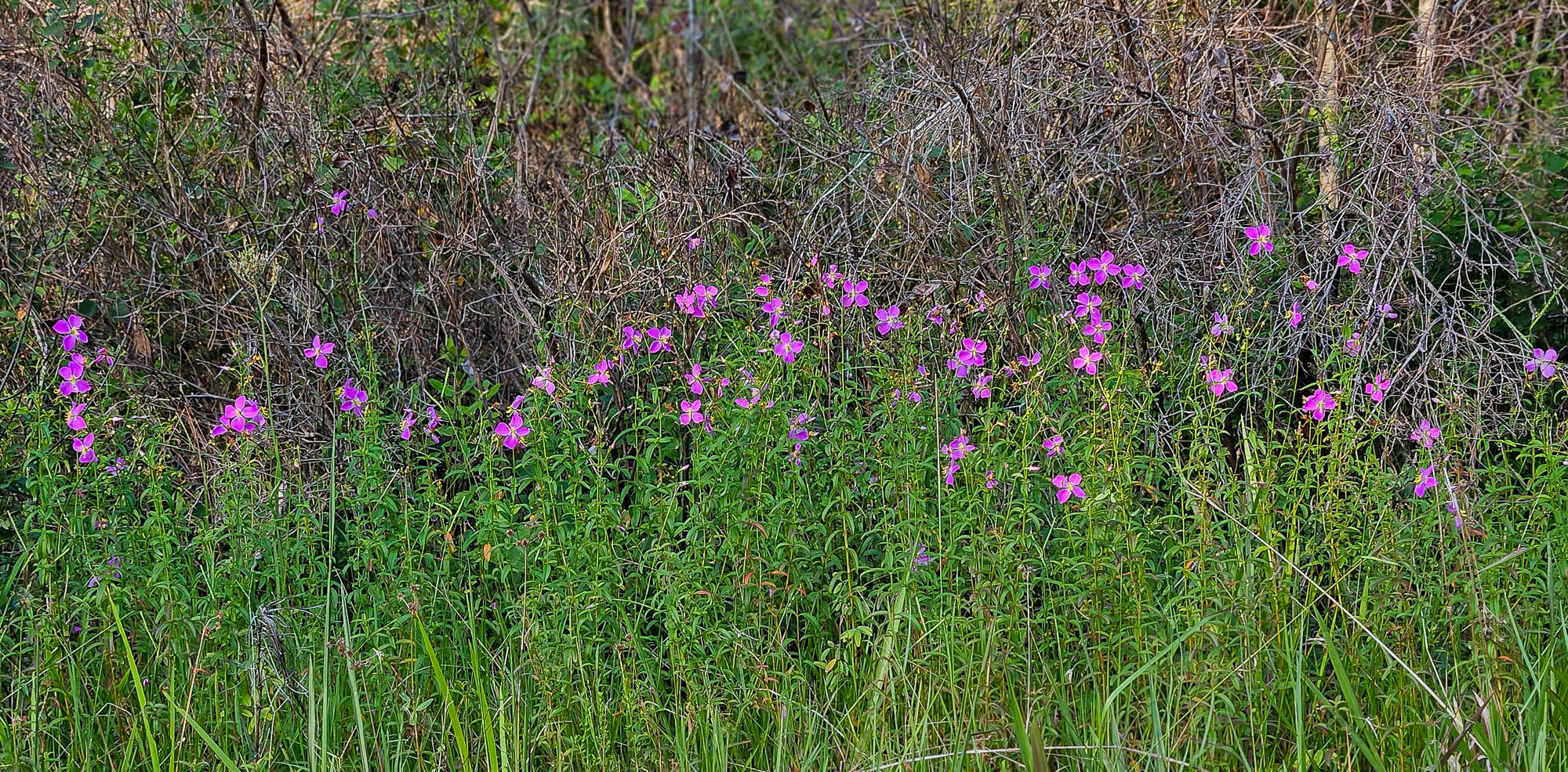
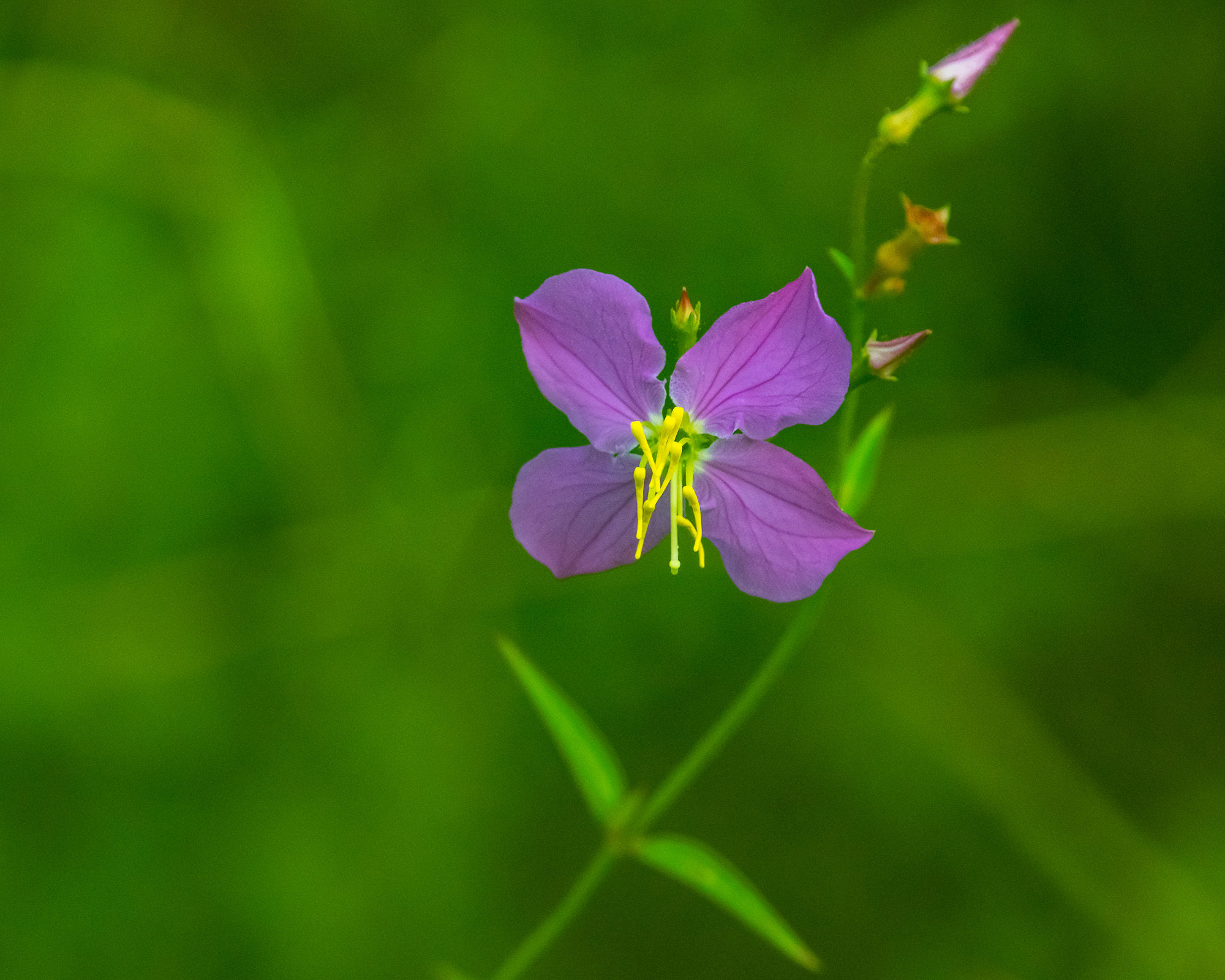
It may be a common flower in much of the country, but when the flowers are this gorgeous, common is a good thing. Call it Pale Meadowbeauty or Maryland Meadowbeauty (Rhexia mariana) or anything else you like. Just savor its loveliness.
Oh. And the persimmons are just about ripe. Common Persimmon (Diospyros virginiana).

We are understandably happy that today we took the road which we have traveled less than some others. It made all the difference.
Enjoy your search for a natural place and come back for a visit!
*The Road Not Taken
Two roads diverged in a yellow wood, And sorry I could not travel both And be one traveler, long I stood And looked down one as far as I could To where it bent in the undergrowth;
Then took the other, as just as fair, And having perhaps the better claim, Because it was grassy and wanted wear; Though as for that the passing there Had worn them really about the same,
And both that morning equally lay In leaves no step had trodden black. Oh, I kept the first for another day! Yet knowing how way leads on to way, I doubted if I should ever come back.
I shall be telling this with a sigh Somewhere ages and ages hence: Two roads diverged in a wood, and I— I took the one less traveled by, And that has made all the difference.
Robert Frost
 Our Natural Places
The blue hue on that skyflower is absolutely amazing!!! Also really like the additional creatures on the flower shots. Inquiry minds need to know, what was the best repellent of the day?!?!?! My go to spray is Repel – and when going to those Mosquito hell holes in Texas I have to up the ante and go with the 10-12 hr Repel oil which gives me a little additional time out in the sucking fields.
LikeLike
Those skyflowers always startle us with that blue. They almost look fake.
Yeah, Gini says we’re gonna get Tee shirts with our motto: “Birds, Blooms and Bugs”.
Currently using a product made by Avon Skin–So-Soft called “Bug Guard Plus”. Pretty effective and the main ingredient, Picaridin, does not react with the surfaces of cameras and lenses. Definitely a plus after having some products melt the paint off my Nikon.
LikeLiked by 1 person
I know all about the affect most bug repellent products have on the camera bodies – Repel is absolutely awful in that space and will strip the ink off water bottles and tablecloths. I have to keep baby wipes in the car to use after spraying myself. Repel has a Tick repellent product that uses Picaridan – didn’t work as well in the Texas wildlife refuges as you know, those spots are full of persistent blood suckers. I will have to try the Avon product, has to smell better than the rest of them.
LikeLike
Milkweed is pretty common up here, but the flowers are purple rather than orange. The flowers and insects you showcased were stunning. Even though I am not an insect fan, I cannot help but be fascinated by the detail in your photography.
LikeLike
When we moved around while in the Air Force, we were always surprised to find flowers we were familiar with in Florida dressed up in different colors. I reckon that’s one thing that makes nature so interesting.
Thank you very much for taking the time to visit and make nice comments.
LikeLike
How exciting to see that orange flower and realize it was something ‘out of the ordinary’! And I parked next to a persimmon tree at a trailhead yesterday and it was loaded with fruit! I always heard it had to frost before you could eat it. Hmmm…that wouldn’t work here! Hope Gini is feeling stronger this weekend. Hugs to you both, Diane
LikeLike
Thank you, Diane. As you well, know, it seems there is always something different to discover in our Florida nature.
Gini is feeling well, but has another procedure later in the week. Sigh. As she is fond of saying: “Getting old is NOT for sissies!”.
LikeLike
A very beautiful orchid. I can see why it jumped out from a distance with its bright orange color. Wonderful opening photo… tunnel like, with some spooky feeling mixed in for good measure. Perfect for B&W!
LikeLike
Thank you, Peter.
We’ve had some neat discoveries in that area, such as that orchid. A few weird occurrences as well. Such as the tail-less alligator chasing us down the trail. And the Pygmy Rattler slithering across my foot. Good times.
LikeLike
Hello Wally and Gini. It’s good to know that tou are both out together again, if only until you both return to full pace.
I wondered where you were sending me to bend down in the undergrowth! What a shame that hunters get priority over birders (or birds). If that was over here I think birders would unlock that gate pretty smartish, not that I am suggesting you and Gini should do so and get arrested or shamed in the local media. Could it be that your birds are shy because very soon the sportsmen will be bending down in the undergrowth and bang-banging at everything in sight?
Yes, that orange orchid is very beautiful but I rather wondered how the Brown-winged Striped Sweat Bee earned that name?
Good words from Robert Frost. Do we have people in 2024 who can write like that?
I am trying to find some enthusiasm for blogging. Wish me luck.
LikeLike
Plenty of undergrowth to bend down in around that place. Especially with our seasonal rains. The hunting season in that spot is for deer. That gate is locked but access by foot, bike or horse is permitted. The vast population of deer beyond that gate are fairly safe, as the annual seasonal tally by the mighty hunters is quite low. It’s more of a “group camp” sort of hunting.
Another case of a beauty receiving its name from a beast.
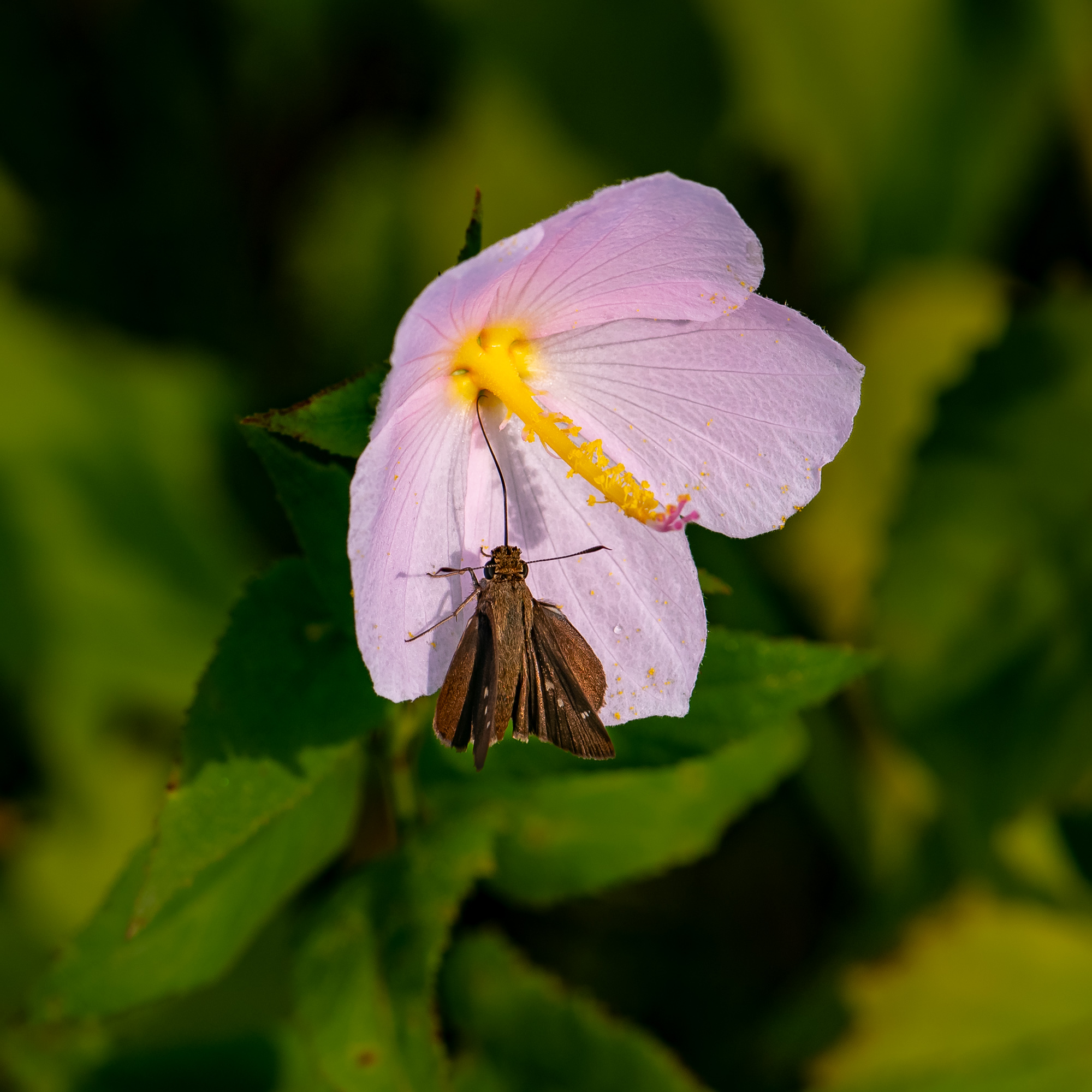
We managed a couple of hours again this morning. Was hoping to see a wandering warbler migrating through the area but no luck. Did come across a colorful moth who loves coffee, according to that naming thing.
Gini, who is wise in all things, says just slap the keyboard until a few words pop onto the screen, call it a “blog post” and we shall supply the enthusiasm.
You’re welcome.
LikeLike
I know the snowy orchid (Platanthera nivea), but P. blephariglottis was new to me. There’s a reason! When I looked up its location in BONAP, it wasn’t there. When I went to the USDA site, it was shown only in Galveston County. At that point, there was nothing for it but to turn to Joe Liggio’s book on Texas orchids, and the mystery was solved. He writes:
“In Texas, this orchid has been collected only from Galveston County…[and was] collected for the first and only time in the early 1900s. Donovan Correll (1950) considered the Galveston County site, which was then the only known record west of the state of Mississippi a ‘probable disjunct station.'”
On the other hand, in 1995 a small population of white fringed orchids was found near Leesville, Louisiana: only 90 miles from where I found the Chapman’s orchid.
Looking at that pretty southern beeblossom, I noticed a similarity with many of our primroses, other than the cross-shaped stigma. The sepals are bent away from the flower in exactly the same way. I also discovered that our Kosteletzkya virginica and your K. pentacarpos are the same flower: a member of the mallow family. I read that the salt-marsh mallow is “distinguished from Hibiscus by the flat ring of fruit segments.” Who knew?
I mostly missed east Texas this year, and I’m lonesome for the meadow beauties! Maybe some still will be blooming when I get there. I might find the clustered bushmint, too. I’ve seen it in the past, but never took the time to identify it. Now I know!
LikeLike
Similar to our experience with common and scientific names of birds when we began the hobby, trying to obtain accurate nomenclature for many living organisms can lead one down a very deep and twisty Leporidae labyrinth.
Speaking of which … recently discovered that out of ten Rhexia species in Florida, there are at least three in our immediate area which are very similar. It may not be too long where I shall revert to my inner child-naturalist: “Oooohhh, purty flower!”.
LikeLiked by 1 person
Taking the road less traveled by is great for explorations such as yours (it might be less desirable if one needs to reach a certain destination by a certain time).
The different shades and shapes of your lovely flowers (especially the beautifully bedewed beeblossom) and insects (the color of the sweat bee is electric) are endlessly fascinating.
Your list of birds makes me giddy–I’m envisioning encounters with 4 life birds (the titmouse, chickadee, nuthatch, and hawk)!
LikeLike
Somehow, those destinations with a time requirement are not nearly as fulfilling as our less traveled roads.
Nature’s diversity is amazing. I guess that’s why we all love it.
Hard to believe, but we are already seeing fall migrants. Yellow Warblers and American Redstarts.
LikeLiked by 1 person
I also prefer the less traveled, slower road. They lend themselves to the types of explorations we like.
Yes, time flies, along with the migrants. Enjoy them!
LikeLike
That’s us – slow explorers and flighty.
Hope to find our first fall warblers tomorrow.
Have a great weekend, Tanja.
LikeLiked by 1 person
Thank you, I wish you the same. Good luck finding your fall warblers!
LikeLike
All are beautiful images, but I particularly loved the Twin-spot Skipper! Thanks for sharing!
LikeLike
Happy to share a butterfly any time!
Thank you, Maria.
LikeLike
Beautiful details. One of these days I’m going to get there.
LikeLike
Thank you, Dina.
You have your own beautiful playground which we appreciate you sharing.
LikeLike
Beautiful. Healing. Magical. Thank you.
LikeLike
Yes to all of the above.
You’re welcome.
LikeLike
The darkness in your opening image creates an air of mystery. And your three access points are reminiscent of the mysterious names of New Zealand’s two main islands: North Island and South Island.
It’s clear that as a photographer you do enjoy seeing the dew do its duty adorning the Oenothera flower. And those iridescent green sweat bees are always a delight. For a while I thought there was also a black~silver bee under the flower, but I guess that was a wraparound of the sweat bee’s abdomen.
I recognized the orange orchid as such right away, thanks to Linda’s recent post about a Texas species, as you discussed.
Apropos your mention of stamina: most people are surprised when they learn that stamina was originally the plural of stamen.
LikeLike
We are often in that area before dawn and going through some of those hammocks in the near-darkness can be truly mysterious.
I dew enjoy my dewty dewing the dew.
Now that we found the orange orchid, we are on the search for the white variety, Platanthera blephariglottis, which also can be found in Texas.
LikeLike
All is beautiful and well described. A very enjoyable post!
LikeLike
Thank you! It really is a beautiful place.
LikeLiked by 1 person