Big Cypress National Preserve

(Click image to enlarge, click again to zoom.)
We had not taken a road trip for quite awhile. March is the month in which we married, 56 years ago. Time to celebrate.
Several locations in southwest Florida have been on our “sure would like to go” list for several years. As we reviewed the map, two new spots and one long-time favorite were declared the winners.
The vehicle was serviced, hotel reservations booked, food sources scouted, bird reports digested, photographer recommendations considered, weather reports ignored (hey, it’s Florida!). We’re off!
First up, Big Cypress National Preserve, a 729,000 acre swampy buffer zone helping protect the vast Everglades watershed immediately to the south. Most of this area is only accessible by boat and much of that only by airboat. A few park service roads and very nice visitors’ centers helped us enjoy a couple of days exploring cypress and sawgrass swamp habitat.
Grab some bug repellant, get your hat, check your camera batteries and let’s see what we can find.
As the morning sky began to lighten, the sun chased away bits of lingering clouds and we began to see open wet sawgrass prairie dotted with single cypress trees and where deeper water collected, cypress domes.


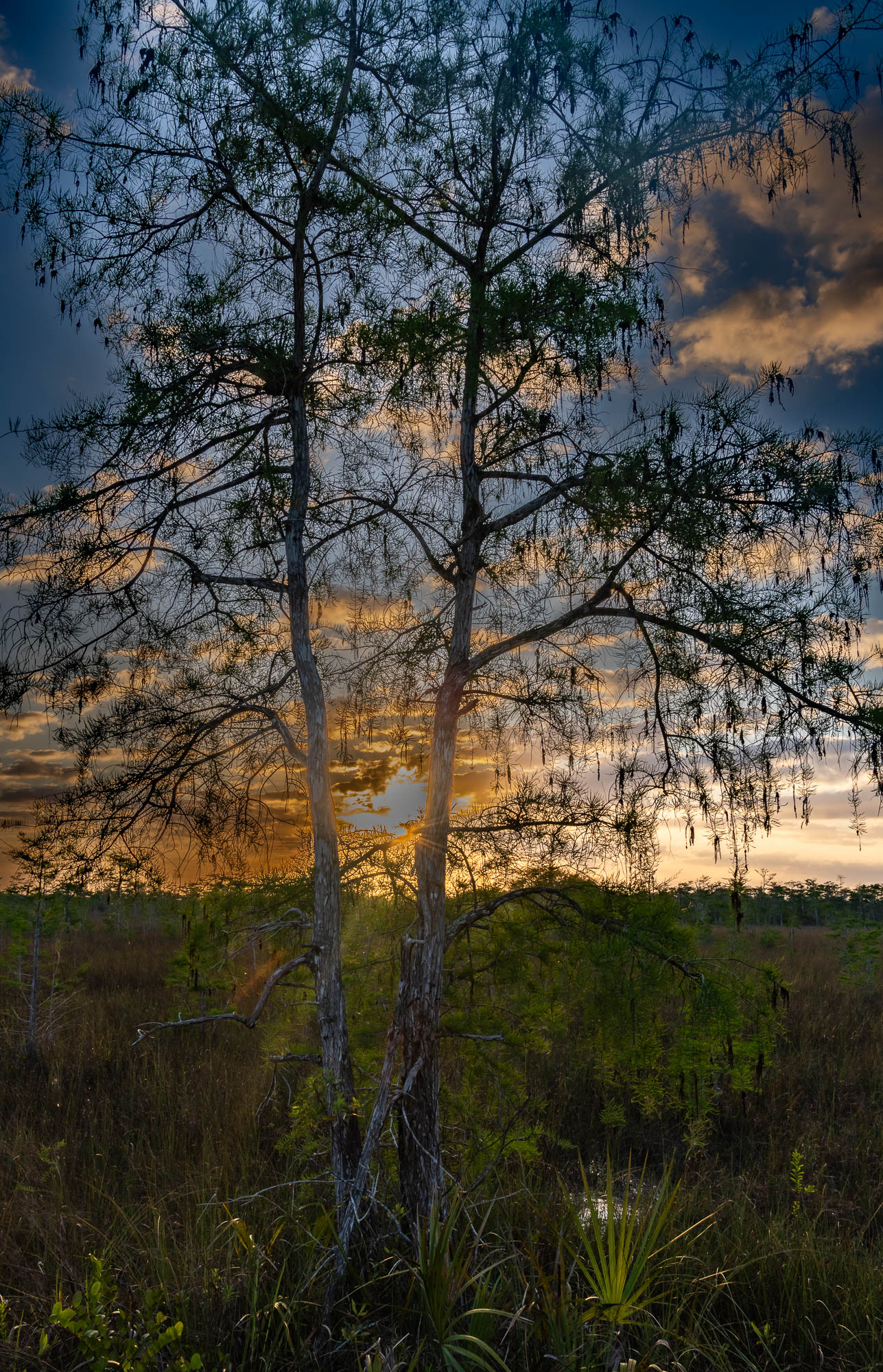
Once the sun was up, we had a better view of our surroundings.

Throughout the preserve are small areas of open water. If you’re a duck, you know where to find these waterfowl oases. These are all Blue-winged Teal.

Sub-tropical conditions for much of the year provide ideal habitat for all sorts of humidity and heat loving plants. Cardinal Airplant (Tillandsia fasciculata) seemed to be blooming at every place we visited in the preserve.

Leafy Bladderwort (Utricularia foliosa) looked as if someone had scattered very small yellow stars throughout the swamp. The fern-like submerged leaves trap all sorts of yummy things to help these small carnivorous plants thrive. Including mosquitoes! (I may have a new favorite plant.)


Even a large white bird such as this Great Egret can almost vanish in the vast swamp of sawgrass and reeds.

We found many familiar faces as we explored new territory. A bright Saltmarsh Morning-glory (Ipomoea sagittata) was a very welcome sight.

Timing was apparently good for a new crop of Halloween Pennant (Celithemis eponina) dragonflies. They were flitting nearby at almost every location.

Rain in early March resulted in several flowing streams within the preserve. Clear water moving quickly over a rock bed carries nutrients to waiting flora and fauna in the sawgrass prairie.

If the cypress and palm trees were happy with that wet enviroment, the Cardinal Airplant (Tillandsia fasciculata) must have been ecstatic. Red blooms filled our day.

Breakfast in the swamp is made better when friends drop by to visit. This little Palm Warbler said in a few weeks he would be feathering his nest near the Great Lakes.

Yes. We saw alligators. Like this one.

Just in case we needed a reminder, a large Palamedes Swallowtail (Papilio palamedes) butterfly emphasized it is Spring.

Underscoring the Spring attitude of the swamp dwellers, a female Northern Flicker surveyed the scene from her high-rise condo where there may soon (or already) be new eggs to incubate.

You look like you could use a break. Rest here awhile and we’ll find a gas station so we can continue to explore. Perhaps we’ll bring you some orange juice. And Key Lime Pie. Don’t go away.
Enjoy your search for a natural place and come back for a visit!
Additional Information
Big Cypress Preserve: https://www.nps.gov/bicy/index.htm
 Our Natural Places
Big Cypress is definitely on my go to list with Loop Road especially. I particularly like February for that. Gators like to sun more in the cooler months and are more visible than in summer when they sink to cooler climes. Plus the birds are in their mating garb.
I didn’t see the mention here but Clyde Butcher’s Ochopee Gallery is kind of a great place to see when in the Loop Road Monroe Station area. Yes you have been ???
Looks like you and yours are only 5 years ahead of us. We married March of 1973 on my husband’s birthday…the 24th!! It was cute they sang Happy Birthday when the cake was cut.
March is a good month for Loop Road too!!
A bit from mine…about Clyde and Big Cypress
Clyde Butcher – Everglades Photographer isTurning 70! | Janthina Images – Photo Journal (wordpress.com)
So many years…Yeah!!
LikeLike
What a wonderful place to celebrate a special event. Happy belated anniversary to both of you! 💕
LikeLike
Thank you, Tanja. We had a terrific time. Can’t wait to return.
Hopefully, before 56 more years pass.
LikeLiked by 1 person
Happy Anniversary to you both! How exciting to see these beautiful photos, I miss my visits to Big Cypress! Such vastness and soooo many dirt roads to venture. Did you get to drive the scenic Loop Road?
LikeLike
Thank you, Donna.
It really is a wonderful expanse to explore. We can’t wait to return.
Yes, we dodged a few potholes on the Loop Drive. Loved every bumpy moment!
LikeLiked by 1 person
The great egret, salt marsh morning glory, and Halloween pennant made me feel right at home. And I always enjoy seeing your photos of the alligators; catching them on a bayou bank is one thing, but capturing them in dusky shadows gives them an extra dollop of vague threat.
My favorite here is the Cardinal Airplant. As it happens, I have a nice example of ball moss (Tillandsia recurvata) currently riding around in the trunk of my car. I found it in a parking lot post-bloom, but with some really nice opened seed pods. Clearly, the blooms of this gorgeous Tillandsia would be easier to photograph than those of the ball moss. I managed it just once, five years ago, and nearly gave up.
I didn’t realize there were so many Tillandsia species, or that they could be so vibrant and attractive. Perhaps we’ll see others here in the future!
LikeLike
It was comforting to see familiar species and at the same time exciting to see them in a somewhat different venue.
I’m still inspecting some of the trip’s images of Tillandsia as I suspect they are not all T. fasciculata. All those red/green/purplish/bluish blooms were incredible.
I’m pretty sure you haven’t seen the last of the Cardinal Airplant for the forseeable future.
LikeLiked by 1 person
Big Cypress is a beautiful place Wally and it looks like you had a wonderful visit!
LikeLike
We’re already planning a return visit and hopefully, on to the Everglades.
Plenty to see.
LikeLike
What a fantastic beginning to your celebratory trip! I’m especially taken with the Cardinal Airplant – it made its own bouquet nestled between those cypress trunks. Great shot of the fast-running water over the stones – are the stones really that intense yellow color, or is the water tinted gold with minerals? Fascinating part of the world, I’m looking forward to more!
LikeLike
Thanks, Sam. It was a terrific adventure.
Gini commented that it looked like hundreds of florists had scampered around the swamp sticking those air plants in all the cypress trees – just for us! We appreciated it.
The stones in that image are pure white. Water is stained with tannin from the bases and roots of cypress trees. We both grew up in Florida swimming in “tea-stained” creeks.
More? As you wish …
LikeLike
The first picture’s a dramatic way to have begun that day and this post about it. The following sunrise photographs maintain the break-of-day theme.
You sure had yourselves a good time, what with two new spots and one venerable favorite.
You’ve again fulfilled your longstanding quota of close portraits of little critters.
Tillandsia fasciculata is a new one on me, after Texas’s ball moss and Spanish moss in the same genus.
Looking forward to the next round.
LikeLike
Thank you, Steve.
We managed to scout some decent spots to enjoy the sunrise by exploring during our first afternoon. Had planned to attempt photographing the Milky Way but the projections of “clear skies” evolved into “cloudy skies”. Next time.
Florida lists 15 species of Tillandsia and seven of those are unique to the southern portion of the peninsula. Our timing was good as we found an incredible number of plants in bloom.
Next round soon.
LikeLike
Beautiful shots! That has been on my list as well. I may have to bump it up to the top based on these pictures.
LikeLike
Thanks, Dina.
Big area but limited access unless you have an airboat! All the park service roads we explored are in pretty poor shape. Lots of deep potholes so it is very slow going.
More pics coming …
LikeLike
What a wonderful place! So many great photos, but I especially love the Great Egret, dragonfly and warbler.
LikeLike
It really is quite a special area.
Thank you for visiting with us and making such nice comments. We appreciate it.
LikeLike
Such a unique and interesting area! Did you take that dragonfly picture? That is a good one! As were many others like the flicker and the butterfly.
LikeLike
That uniqueness is the main reason we wanted to explore that area. I got lucky and one of the dragons posed for a couple of seconds.
There is truly an amazing amount of life to observe throughout this huge area. Not necessarily easy to get to most of it, but worth our while once we did.
Thank y’all for visiting with us and stay tuned for more of that area coming up next.
LikeLike
What a wonderful start to your anniversary celebrations, Wally – I reiterate my congratulations on your 56 years.
You will not be surprised to know that the fabulous Halloween Pennant was the star of the show for me, but the Palamedes Swallowtail was not far behind, and those were closely followed by the ‘gator, the Northern Flicker and the delightful Palm Warbler.
My very best wishes to you and Gini – – – Richard
LikeLike
Thank you very much, Richard. We appreciate your gracious comments.
An example of the abundance of the Halloween Pennant would be lunch time on our first day. We found a lone picnic table in a grassy expanse bordered on three sides by water. While we ate, we counted 18 individual Halloween Pennants around the table. Incredible.
More on the way …….
LikeLike
Love all these images Wally, looks like you had a fantastic trip.
Happy anniversary (it’s our 41st today).
LikeLike
Congratulations, Brian!
We love it when you youngsters report such good news.
We had a really good time.
LikeLike
You got a good idea to celebrate 56!
My favourite in this post is the adorable Palamedes swallowtail.
All the best!
LikeLike
I stay married to Gini because she always comes up with good ideas! Well, that and she is a really great cook.
Butterflies are beginning to show up everywhere we go as Spring is in full swing.
LikeLike
What a wonderful celebration. Thank you (so much) for sharing the wonders, enduring the humidity and being bitten for us.
LikeLike
Thank you, EC. We had a really nice trip.
Happy to share what we find and it’s no problem enduring the tropical weather. As for being bitten, Gini has learned to be gentle, so I don’t mind so much. 🙂
LikeLike
Wait, there’s a Halloween inspired Dragonfly!?!?! Why have I not been told this before. This could easily be a totem creature for me (along with the Roadrunner and Wolf). Love the early morning shots, very dramatic skies. I am guessing it is the same over there, but our Texas Gulf/RGV trip so far has been punctuated with morning latherings in bug spray. Usually we are here in January when the bugs are more well behaved, right now they are out for blood, gallons of it ha. Looks like a great way to celebrate 56.
LikeLike
I can’t believe there has not been a Halloween Dragon in your annual display! I blame the mainstream media for such an appalling lack of significant news.
We really lucked out with our timing on this trip. Long sleeves, full body netting, a dozen types of repellants, over-sized bug swatters – and the little vampires and arm biters were at a minimum. Gini swatted a few ‘skeeters, but they were probably spring-breakers from the Great Dismal Swamp. We were not too unhappy with the no-show of biting bugs.
Each morning we were in place before sunrise and were treated to some really spectacular sky shows.
A really good time.
LikeLike