The Collecting Jar
(Reminder: Click to enlarge, click again to zoom on images.)

During the first week of September, Gini and I spent a morning roaming around the Richloam Wildlife Management Area (WMA). The location is part of the Withlacoochee River State Forest and is within a portion of the vast Green Swamp. It’s about a 30 minute drive north of our house so we visit frequently.
As we enter the area, we pass by the state-run Florida Bass Conservation Center. It is one of two hatcheries used by Florida to stock fish in lakes throughout the peninsula. The hatchery has set aside a couple of ponds primarily for families to fish. These are seldom visited during the week and the weedy banks of the ponds and adjacent wetlands are great places for hunting dragons, other bugs and birds.
The vast WMA is accessed via a few old logging roads which can become a challenge during the wet season. This day presented no problems. Plenty of water throughout the swamp, none on the road. That’s a good thing. Our rainy summer has resulted in an abundance of fall wildflowers. All those blooms attract more than a few pollinators. All those blooms and bugs attracted – us!
Once upon a time, I relished visiting my cousin Gerald. He was studying to become an entomologist and was gracious enough to teach a curious 10-year old about biology, insects in particular and how to collect them for further study. Nets were involved. So were lights and white sheets at night. Subjects he wanted to examine were dispatched by placing them into a jar with acetone-soaked cotton in the bottom and a tight-fitting lid. Good times. He went on to receive his BS at the University of Florida and ultimately became head of the Entomology Department at the University of Miami. Gerald was born with deformities of all his limbs. Observing how he overcame challenges to become a highly regarded scientist has always been very motivating.
This trip was the first this year where summer was visibly yielding to autumn. The morning air was slightly cooler, there were only dozens of mosquitoes instead of thousands, flowers seemed to be everywhere and insects appeared to be in hyper-drive. Glorious.
Although entomologists still use jars for gathering specimens, those of us who don’t need to perform autopsies on bugs now have “digital collecting jars”. We can photograph our subjects from several angles, study their physical form, admire their beauty, “pin” them to our album and refer to them next year and they will not have deteriorated at all. We can do this without harming the insect and share our findings with anyone who might be interested.
In case you might be interested, here are the contents of today’s collecting jar.
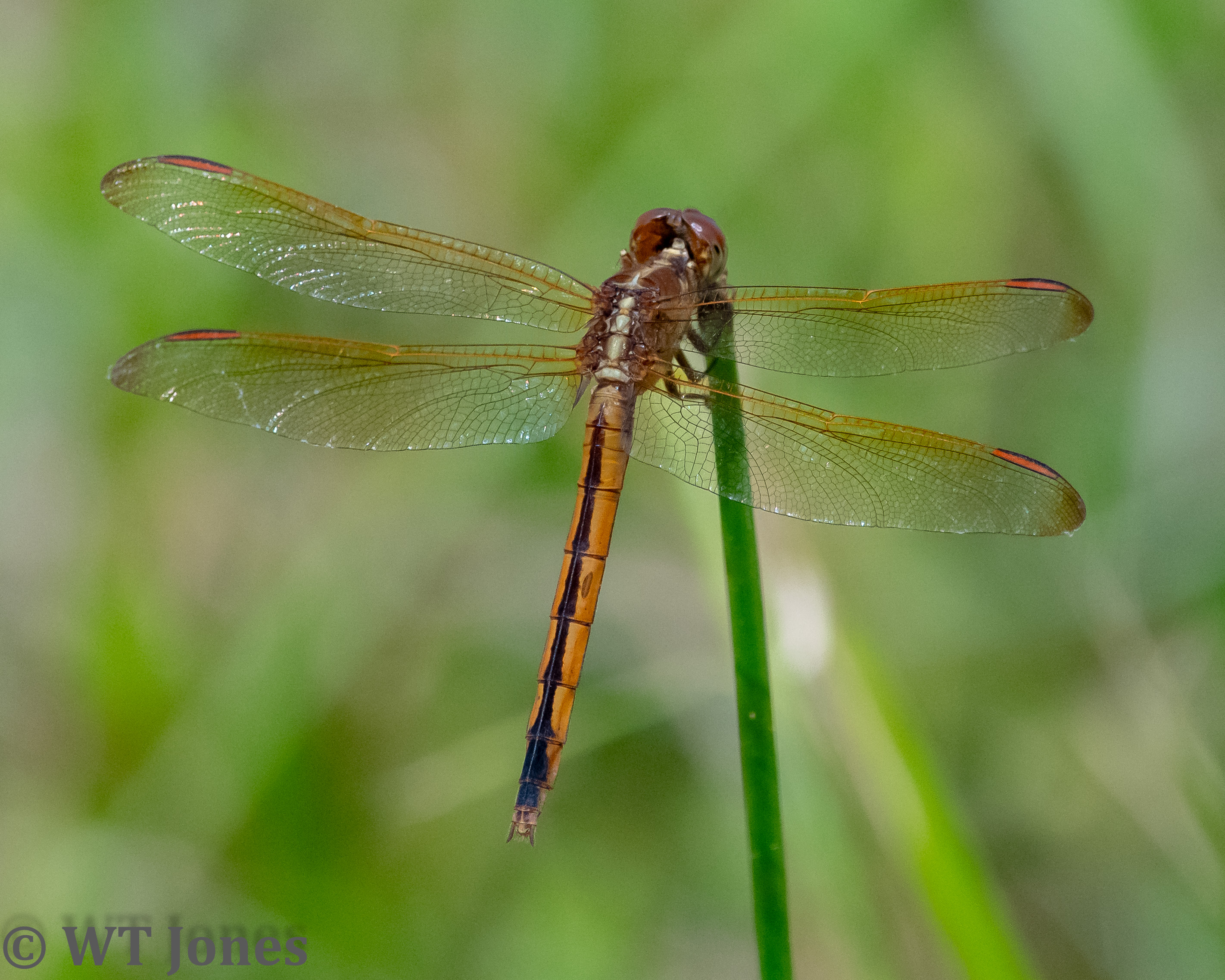
Just because they were abundant does not mean they would hold still for a portrait. Finally, a couple of Needham’s Skimmers (Libellula needhami) took pity on me and perched for a moment.

At the beginning of the trip, it seemed as if there were impossibly blue Skyflowers (Hydrolea corymbosa) everywhere. On one, we found a fragile Crane Fly (Toxorhina magna) had stopped for a rest.


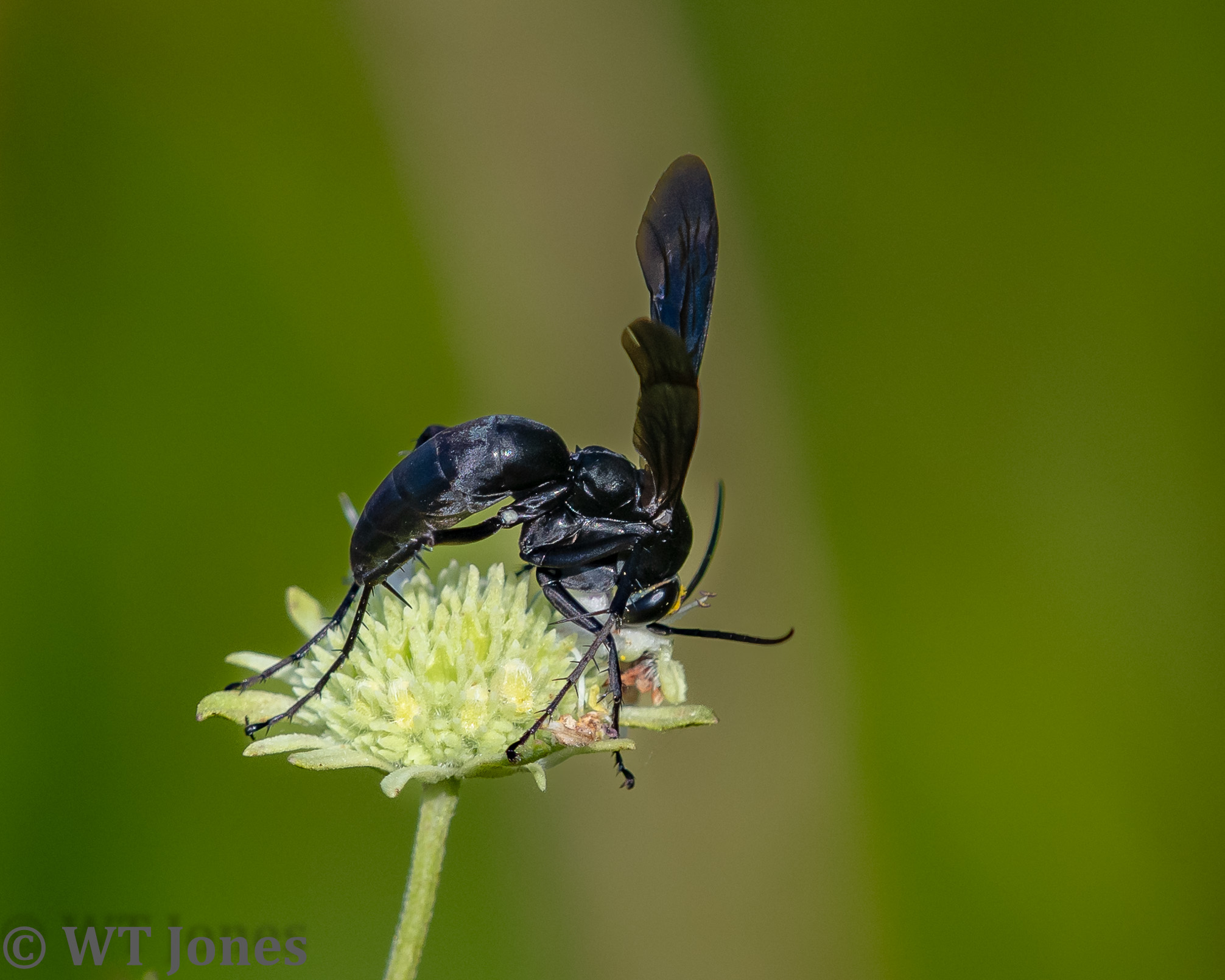
(Updated from original post.) An entomologist has informed me this is a Spider Wasp in the family Pompilidae. We saw several today which were very actively pursuing nectar, mostly among the Clustered Bushmint (Hyptis alata). Or, perhaps they were searching for spiders?
Here and there were small bright red lights shining among the deep green pines. This one is theYaupon Holly (Ilex vomitoria).

Small. Agile. Beautiful. Eastern Amberwing (Perithemis tenera).

Lots of flowers. Lots of admirers. There were plenty of Common Eastern Bumble Bees (Bombus impatiens) busily buzzing from bloom to bloom. The flower here is an attractive invasive species, Peruvian Primrosewillow (Ludwigia peruviana).

Just as busy as the bees, butterflies sipped and flitted, flitted and sipped. This one is a Dorantes Longtail (Urbanus dorantes). (Looks like a leaf-cutter bee was here.)

A specialized assassin, the Mole Cricket Hunter Wasp (Larra bicolor), was imported from South America to try and control, you guessed it, Mole Crickets, which can be an agricultural pest. The linked article is about the importation of this wasp to Florida. Interesting but a bit lengthy. (https://edis.ifas.ufl.edu/publication/IN451)

“Ooohh“, she said. I followed her gaze and agreed with her assessment. Pearl Crescent (Phyciodes tharos).

Speedy little things all over the swamp. Here’s one now. A female Blue Dasher (Pachydiplax longipennis).

A lovely large spider. With a name even bigger. Red-femured Spotted Orbweaver (Neoscona domiciliorum). I can personally vouch for the sticky strength of its web. Ptooey.

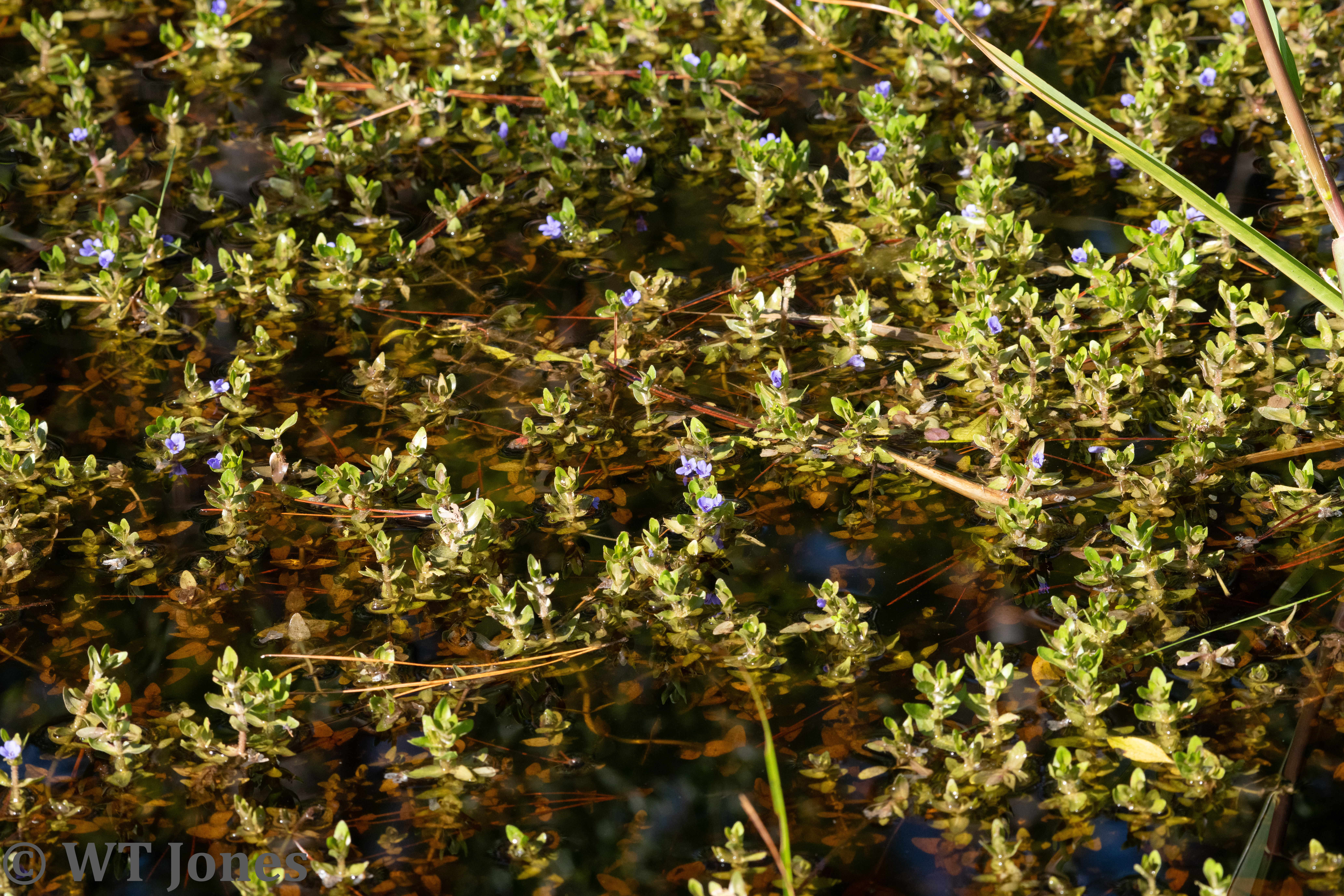
The morning came to a pleasant conclusion with the discovery of a new to us flower species. Standing water seemed to have been sprinkled with small blue stars. Blue Waterhyssop (Bacopa caroliniana) – a beautiful exclamation point on a glorious day!

The days are about to become shorter and cooler. Flowers will be abundant for a bit and we hope to fill our Digital Collecting Jar with dazzling specimens of nectar seekers. We may even share our treasures with someone special. (That would be – YOU!)
Enjoy your search for a natural place and come back for a visit!
 Our Natural Places
Thank you for sharing the contents of your collecting jar which are far more enjoyable alive than dead. I’m so glad that for most of us, entomology and ornithology no longer involve catching and killing beautiful animals.
LikeLike
You’re very welcome, Tanja.
And my “digital collections” smell better than the other kind over time.
Happy November!
LikeLiked by 1 person
I too had a collecting jar when I was in my teens, but I confess, my memories associated with it are not as pleasant as yours. I’m so glad we now collect electronically – nowadays, I’m inspired to do more research about each find. Your collection on this day was wonderful, full of Ooohs and Ahhhs! I’m particularly fond of that Red-femured that you captured – the lighting really makes him radiate!
LikeLike
Funny how we all have different memories of similar events. Humans. Weird creatures.
At times lately, it’s hard to avoid those master web-spinners. Innocently walking along scanning for birds in the treetops and all of a sudden a face full of sticky.
LikeLiked by 1 person
Speaking of guessing, is that a Bidens of some sort that the Pearl Crescent is perched on? I’m always astonished by the images you manage of the dragonflies. Either Florida dragonflies are far more accomodating than ours, or your longer lens allows you to stay back a bit, and keep from spooking them as often as I do. Does early morning help, as it does with butterflies?
My 10th grade biology class involved insect death traps, boards, and pins. I much preferred my lightning bug-filled peanut butter jars, with a bit of grass and holes in the lid. The next morning, those lightning bugs could fly away, an option not available to those that ended up in my class project.
LikeLike
You good “flower eye” is working well. The crescent was sipping at the Bidens alba bar.
The experts say ….. yes, early morning is the best time for photographing dragons for the same reason it is for butterflies. Takes a bit for wings to dry and besides, their breakfast items also have to dry out a bit before becoming active.
Having said that, I usually shoot them when I find them, which is very often in the middle of the day. The majority of the images are with a 500mm lens, which helps me “sneak up” on them.
Your peanut butter collecting jar system is preferred among citizen scientists of all ages.
LikeLiked by 1 person
Here’s a bit of wisdom for you:
Q: What’s the best way to get a good photo of a unique dragonfly?
A: Unique up on it.
LikeLike
One day, we shall all be “pun”ished.
LikeLiked by 1 person
I’m glad your “digital collecting jar” is so large. It lets us follow along and see so much of what you see.
Also glad it’s starting to cool off a bit. Enjoy the changing seasons!
And no acetone – thanks for sharing Wally!
LikeLike
Good Morning, Ed!
Isn’t this “fall” weather great? I almost needed a jacket yesterday. 🙂
As soon as the duck tourist population reaches 10,000 at MINWR we’ll head to your coast.
LikeLike
I have a good friend who worked for the US Fish and Wildlife Services and spent a lot of time traveling to different WMA’s across the country. I always thought that would have been an awesome job. I forget how many WMA’s there are across the country but he knew exactly how many there were.
LikeLike
They make terrific places for exploring nature. Except during hunting season. Fortunately, there are many other venues we have available to satisfy our adventurous itch.
LikeLike
“Digital collecting jars” is a felicitous phrase. We hope your observation that specimens in those jars “will not have deteriorated at all” is correct, though I’ve often wondered about the longevity of all my images on hard drives, which only last for so long, and that a single unusually intense solar storm might wipe out. There’s also the general tendency for particular digital formats to become obsolete: how easily will someone two centuries from now be able to read a jpg file? Digital archeology sounds like a promising field for future generations.
All that aside, your closeups are as always a delight to behold.
LikeLike
Your concerns about the reliability of our digital images are real. When using film, we had a negative as our “backup” system. But how long do they last? (Note to self: Dig out some 60 year old negatives and test for viability.)
I use an off-site backup for all data, but if we have that solar storm, that source might be affected also.
Alas, I fear I am now beyond the age where I’ll worry about it today.
Thank you for the very nice compliment.
LikeLike
From the 1970s through the mid-80s I worked extensively with black and white infrared film. Over the past couple of months I’ve been going back through many of those negatives, cataloguing them in an excel spreadsheet. I’ve also digitized several dozen pictures and have found that the negatives have held up just fine. At the same time, I’ve noticed occasional scratches and other imperfections that resulted from the film getting spooled and unspooled inside the camera, and thereby rubbing against the camera’s internal parts. With modern software I can remove those imperfections, and I also have much more control over the tonality and contrast of the images than I ever did in the days of chemicals.
LikeLike
Thank you, Steve. That is good information.
Now I’m really interested in processing some of those old negatives to see if my experience is similar.
LikeLike
This is the negative scanner I bought a couple of months ago:
I’d previously been using a Canon 9000F flatbed scanner that includes a holder for 35mm. That scanner is at least 13 years old, and there’s no updated software that will let me use it on my 3-year-old iMac. The old Canon scanner works fine, however, on my equally old MacPro.
LikeLiked by 1 person
Don’t know why the link to the Plustek OpticFilm 8300i negative scanner didn’t load, but you can look it up yourself if you’re interested.
LikeLiked by 1 person
Your odonata photos are, of course, wonderful, Wally, but your other insects and the spider are just as fabulous. I was particularly impressed by the two wasp photos and, yes, I did click on them twice to zoom in!
I do take a couple of collecting pots most times I go out with my camera, but only to collect ‘dead’ things – most commonly odo exuviae. In my childhood days I used to collect butterflies and, sadly, kill and mount them. I seem to remember that chloroform was the usual means oof dispatching them – strange that someone would let a kid loose with chloroform!
My very best wishes to you and Gini. All is good here, apart from the suspense of waiting for the results of a couple of medical tests and an x-ray. Take good care – – – Richard
LikeLike
So many life forms, so little time!
Collecting insects is, in my opinion, a great way to introduce children to the natural world. By studying the subjects, a better understanding of their life cycle and the role they play in the environment can lead to us all developing ways to coexist.
I remember using chloroform, too, for science class bug collecting. Different times!
Fingers crossed for good results of tests and x-rays.
Gini and I just came in from a glorious morning afield and we hope you and Lindsay will have a peaceful weekend.
LikeLike
Gorgeous photography! I like the idea of “digital collecting jars.” Always looked kind of gruesome to see bug stabbed with pins on display. We get a smallish tree called a Toyon that looks a lot like your Yaupon Holly. I wonder if they are related?
LikeLike
Thanks very much Peter.
There is quite a variety of holly and holly-like trees. I am an expert in “guessing” which is which.
Hope your weekend is ready to be great.
LikeLike
It really is wonderful that we can take as many photos as we want now and enjoy looking at them when we get home. We load them onto my computer, hook it up to the tv and look at them with a cup of coffee at hand. It’s a fun part of the whole experience. I love the little Pearl Crescent…one of my favs! Enjoy your day! Have FUN!
LikeLike
Sharing is absolutely a huge part of why we do what we do.
Aren’t those little crescents gorgeous!
Enjoying the day.
Having FUN.
LikeLike
Thanks for sharing these little creatures: critters and flowers. The world is a better place with their presence.
LikeLike
You are very welcome.
We agree all our creatures make up a wonderful world.
LikeLiked by 1 person