Can’t See The Flowers For The Bees
“Did you see that?”
“Nope.”
This is a frequent exchange between my brown-eyed beauty and myself. I often must gently remind her that when two of us are present, although we have twice as much chance of seeing something, it doesn’t work that way all the time. “But how could you miss that bird on the fence post?” “Because I was looking at the butterfly on the flower on the opposite side of the path.”
Over time, our powers of observation in nature have evolved. We have learned to look for certain things within a certain environment. At the lake, we expect to find waterfowl. In the hardwood forest, we expect to find woodpeckers. Likewise, we react to the unexpected. A Green Heron untypically perched on a utility wire. An alligator walking across a plowed corn field. (An actual event.)
No matter how expert we may think we are, there is simply no way we can see everything. Gini comes close but she cheats. She was born with the “Mother’s Radar” gene and is able to “sense” things most mortals cannot.
When we pause to observe a field of grass and weeds bordered by a forest, we “look” and may see some wildflowers, an Ibis flying over the field, a hawk perched in a tree, a few dragonflies hovering above the grass. Closer inspection reveals a spider in the flower, a pair of quail skulking through the stalks of grass, mounds of dirt around a hole which is the den of a gopher tortoise, small warblers in the top of the tree where the hawk sits, a robber fly on the stem of a weed waiting for one of those dragonflies to come – just – a – bit – closer.
There is a difference between “looking” and “seeing”. We have not mastered the art of observation. Nor shall we ever. Remembering to slow down, not only with our gait, but also with our gaze is a challenge but we’ll keep trying to improve. Not only do we hope to see the field and the forest, but also the flower and the hawk, as well as the spider and the nuthatch.
Arthur Conan Doyle said: “You know my method. It is founded upon the observation of trifles.”
Herewith, some of our recent trifles.
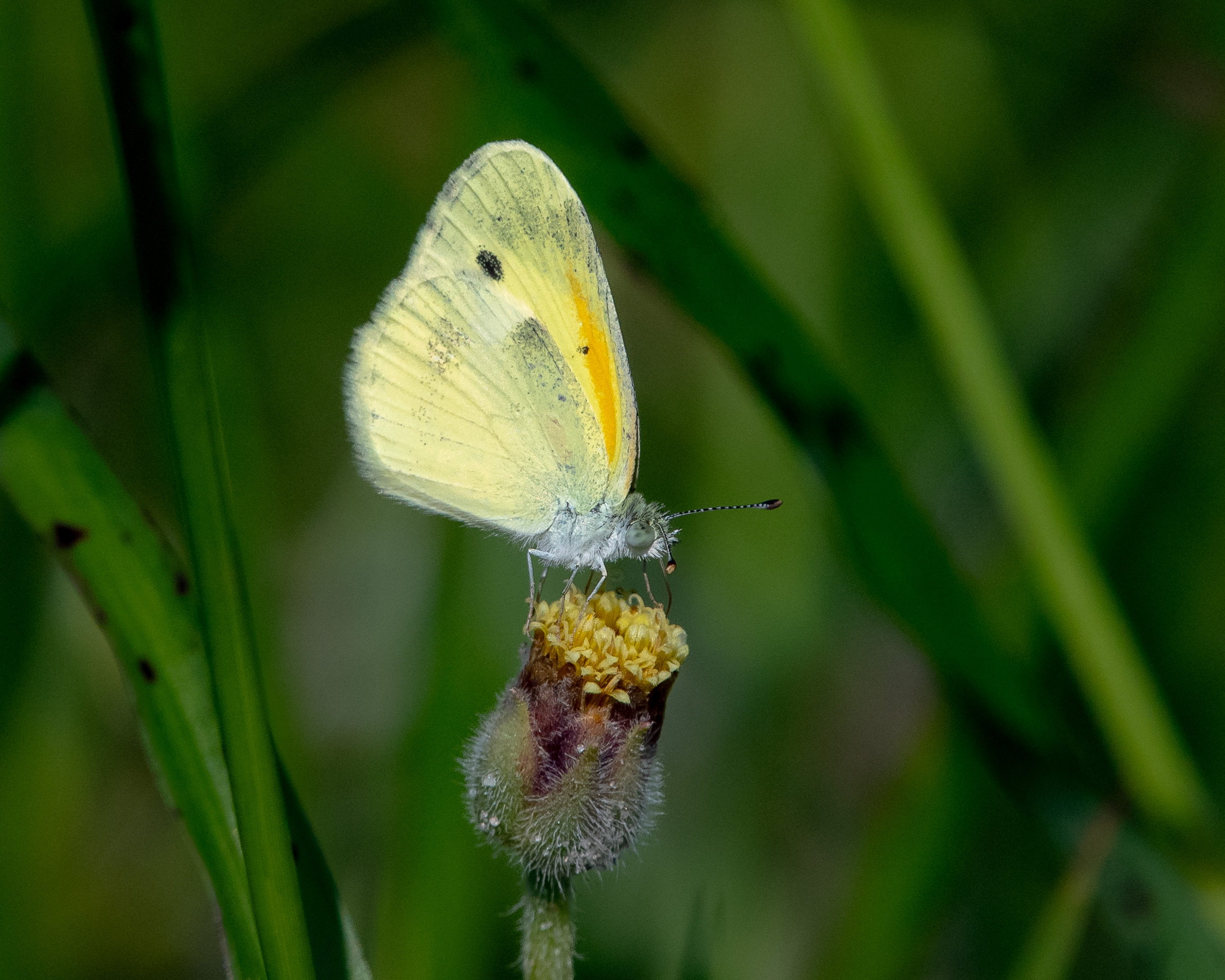
Smallest of the sulphur butterflies in North America, the Dainty Sulphur (Nathalis iole) will become almost gray colored during the winter. It’s bright yellow of summer is a joy to find at any time.
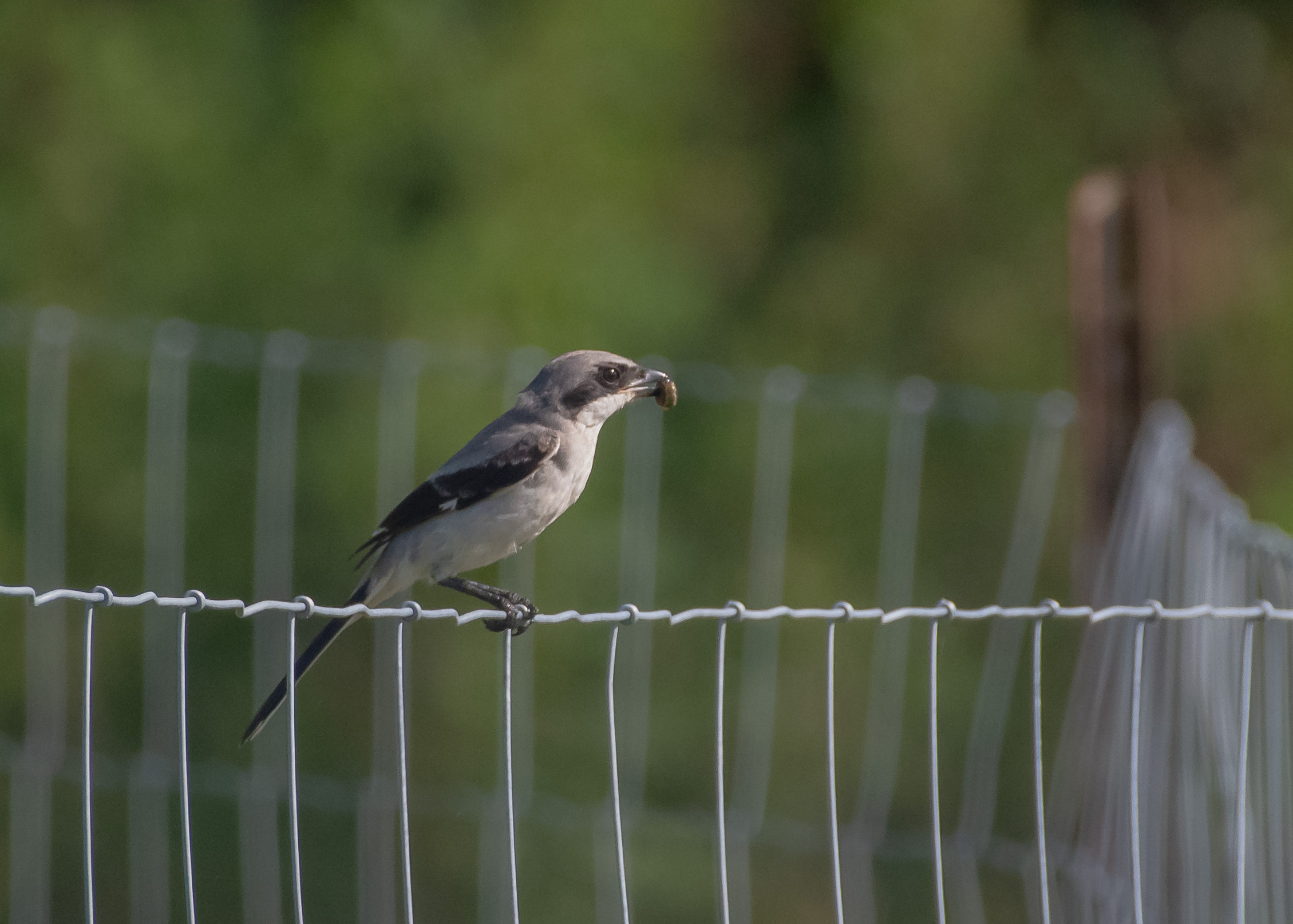
Butcher Bird is the name applied to the Loggerhead Shrike by many due to its habit of impaling its prey upon the barb of a wire or thorn of a branch. This one was too hungry and simply inhaled its grub on the spot.
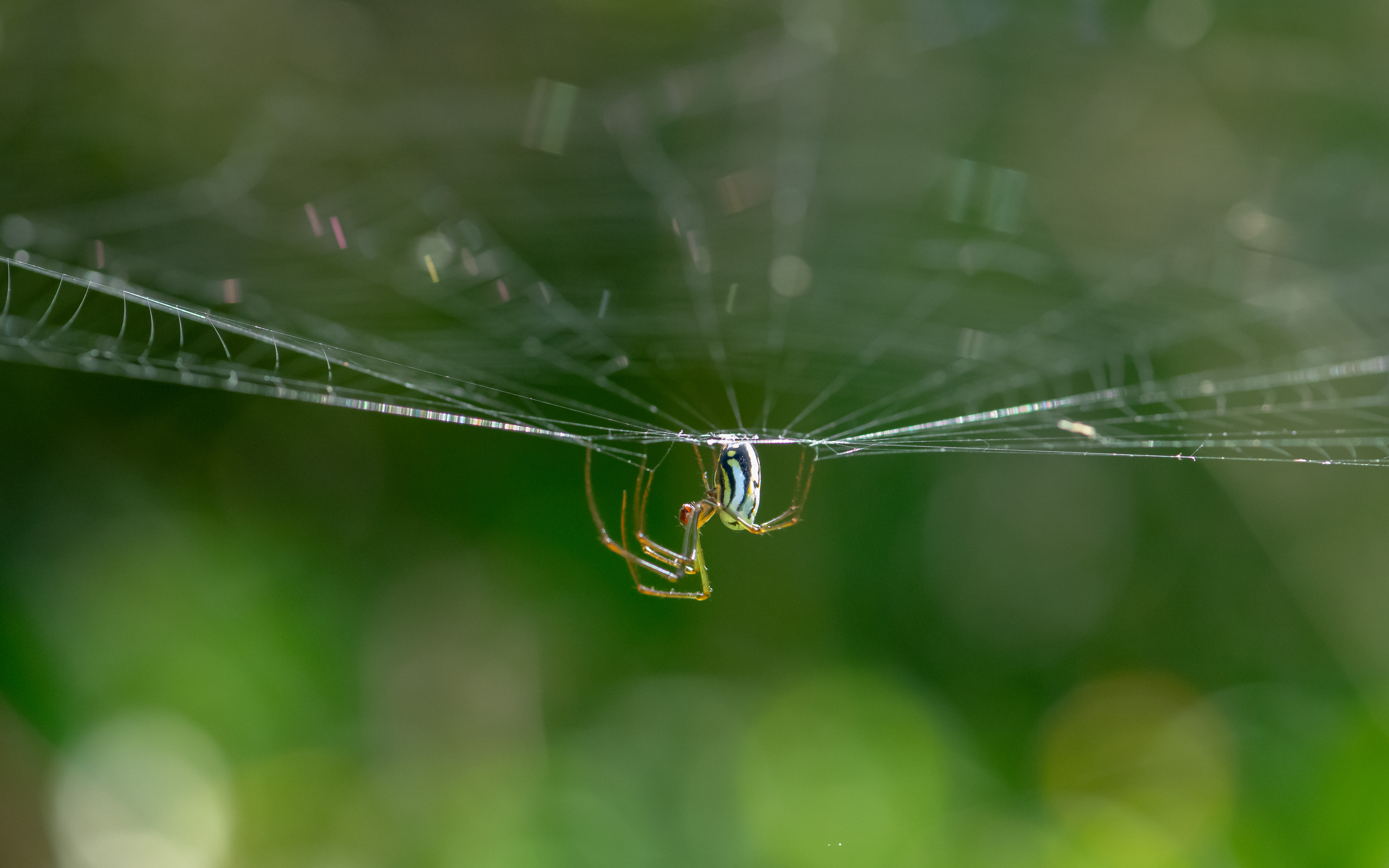
Master web-spinners, the orb weavers are represented world-wide by over 3,000 species with 180 in North America. This representative is an Orchard Orbweaver (Leucauge argyra) whose range is limited to central and south Florida.
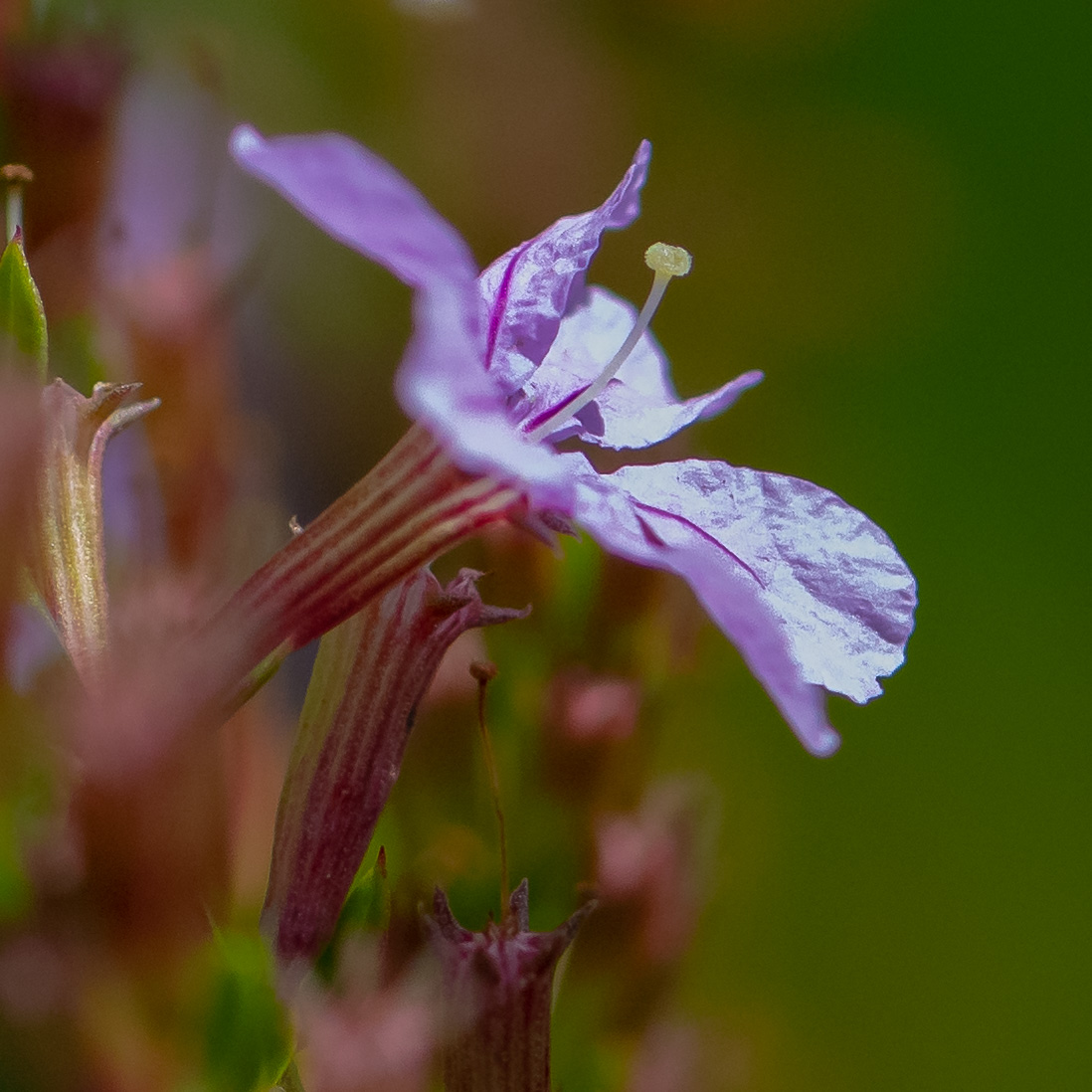
Winged Loosestrife (Lythrum alatum Pursh var. lanceolatum) is one of our favorite blooms to find, not only because it’s Gini’s favorite color, but it attracts an incredibly diverse number of pollinators.
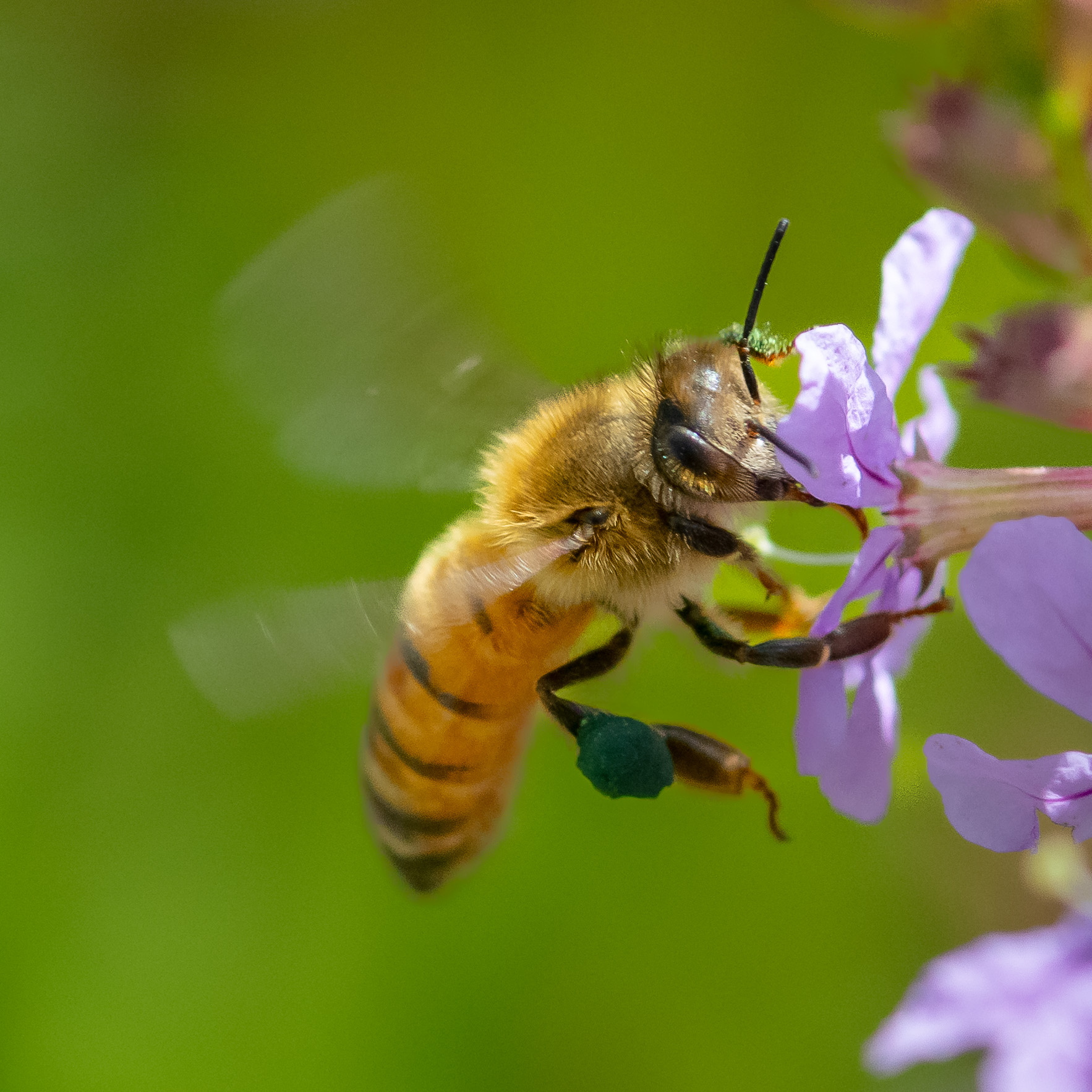
Speaking of Loosestrife pollinators, here’s one now. The common, busy but handsome Western Honey Bee (Apis mellifera). Sweet.
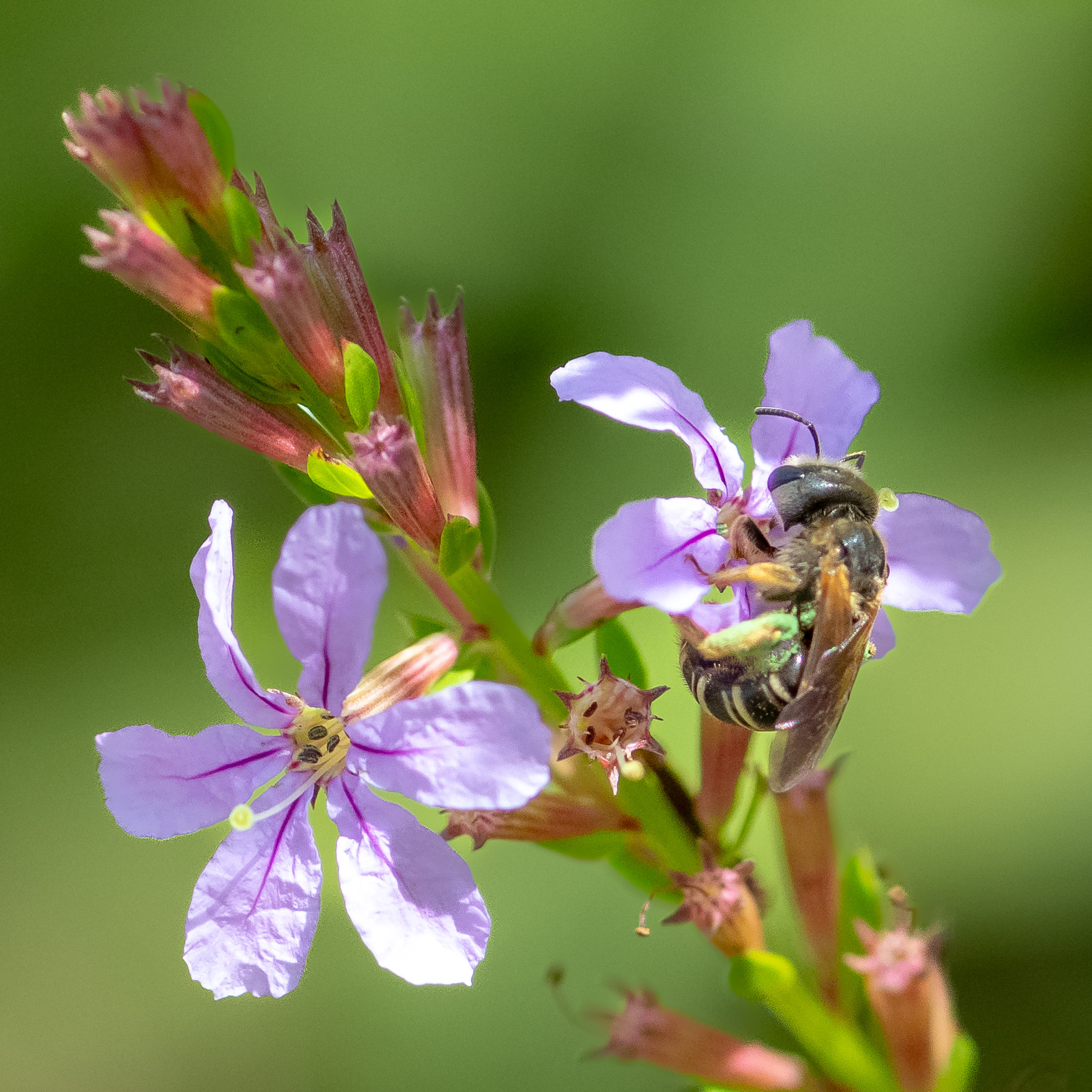
Speaking of Loosstrife pollinators, here’s another one. I had to enlist the help of an entomologist to identify this one. It is “most probably” a Poey’s Furrow Bee (Halictus poeyi), which is in the same family as Sweat Bees (Halictidae).

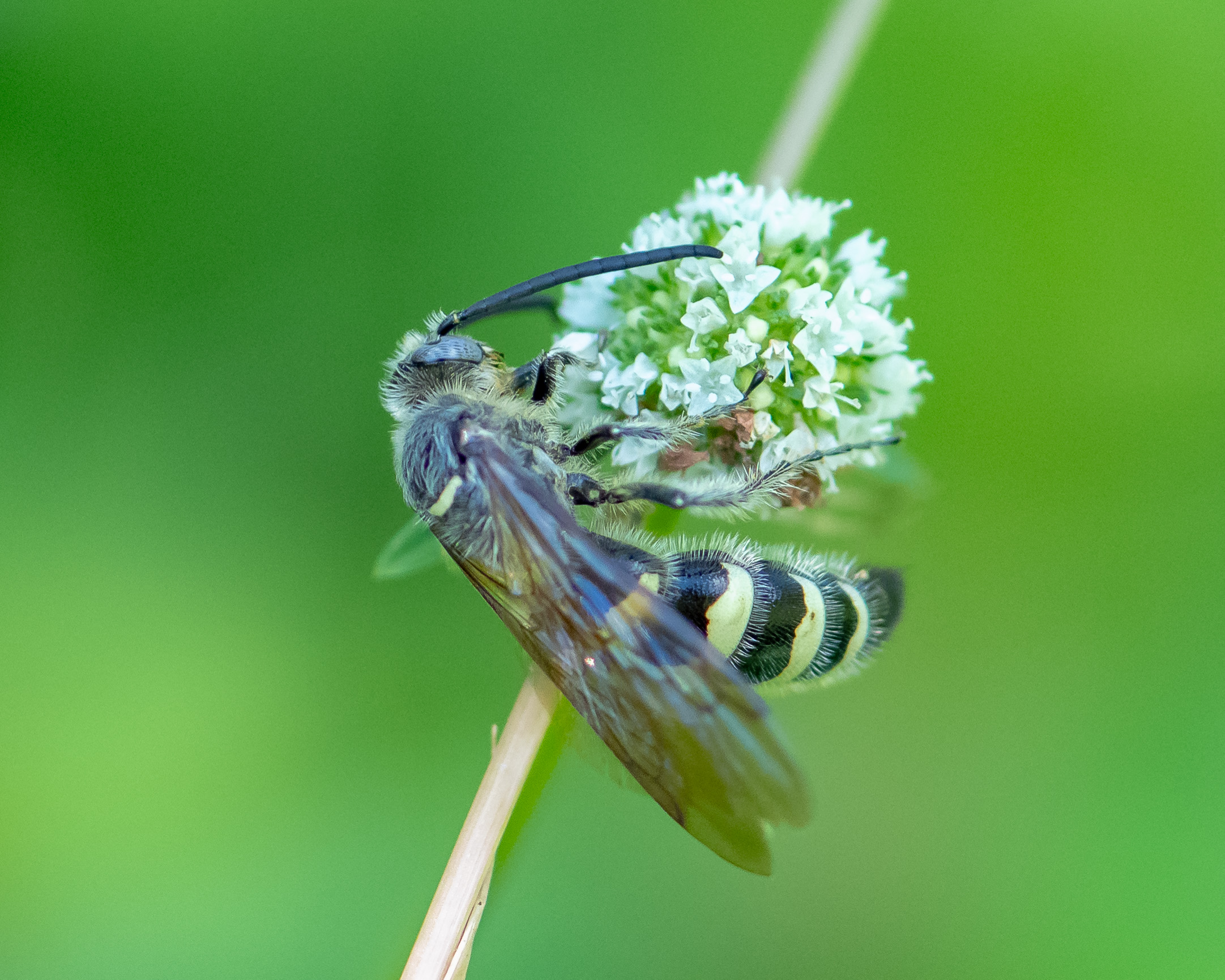
Although I managed to identify this one on my own, I still asked for (and received) confirmation that it is a new insect for us, the wonderfully-named Feather-legged Scoliid Wasp (Dielis plumipes). It’s busy enjoying the nectar of a Shrubby False Buttonweed (Spermacoce verticillata)
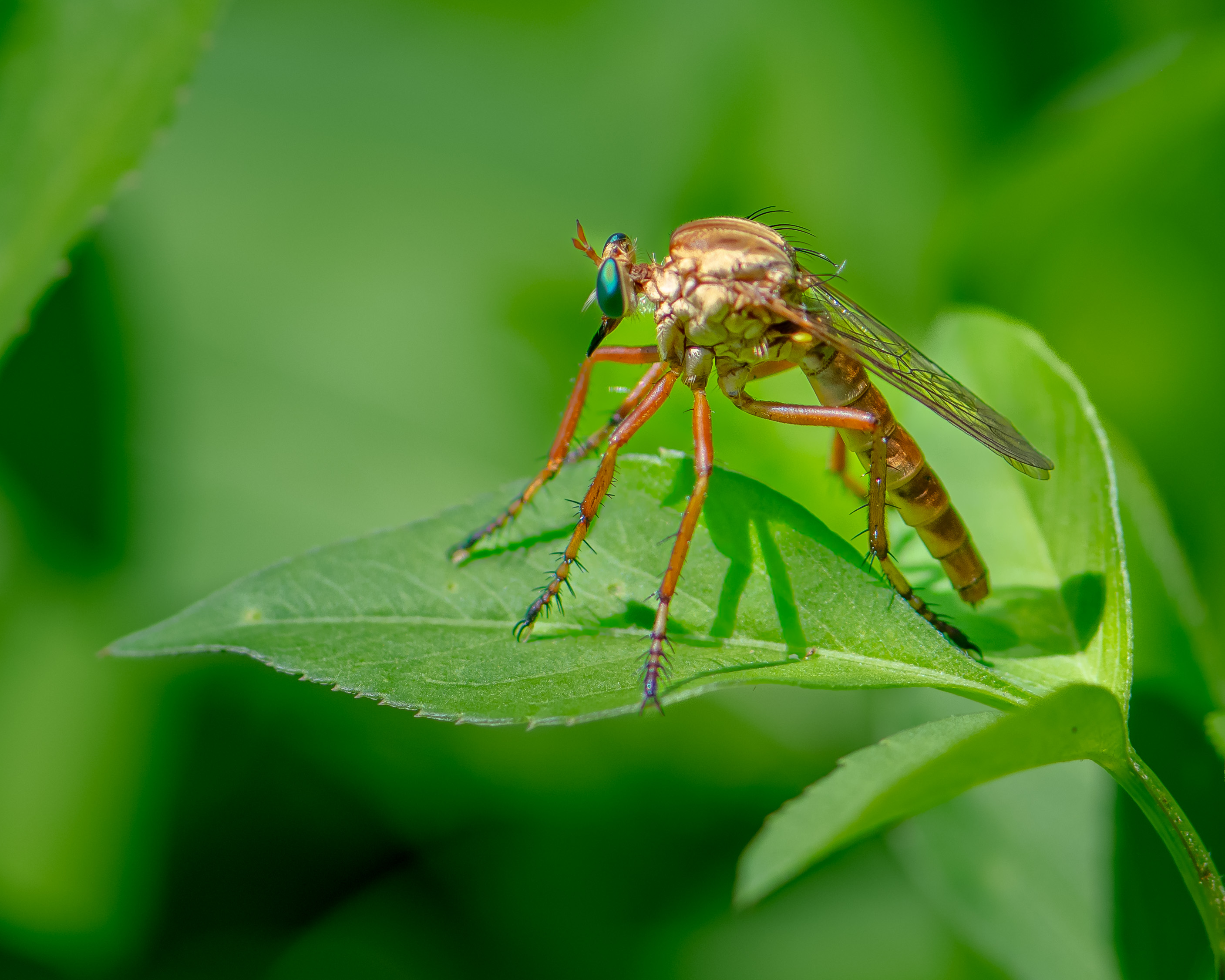
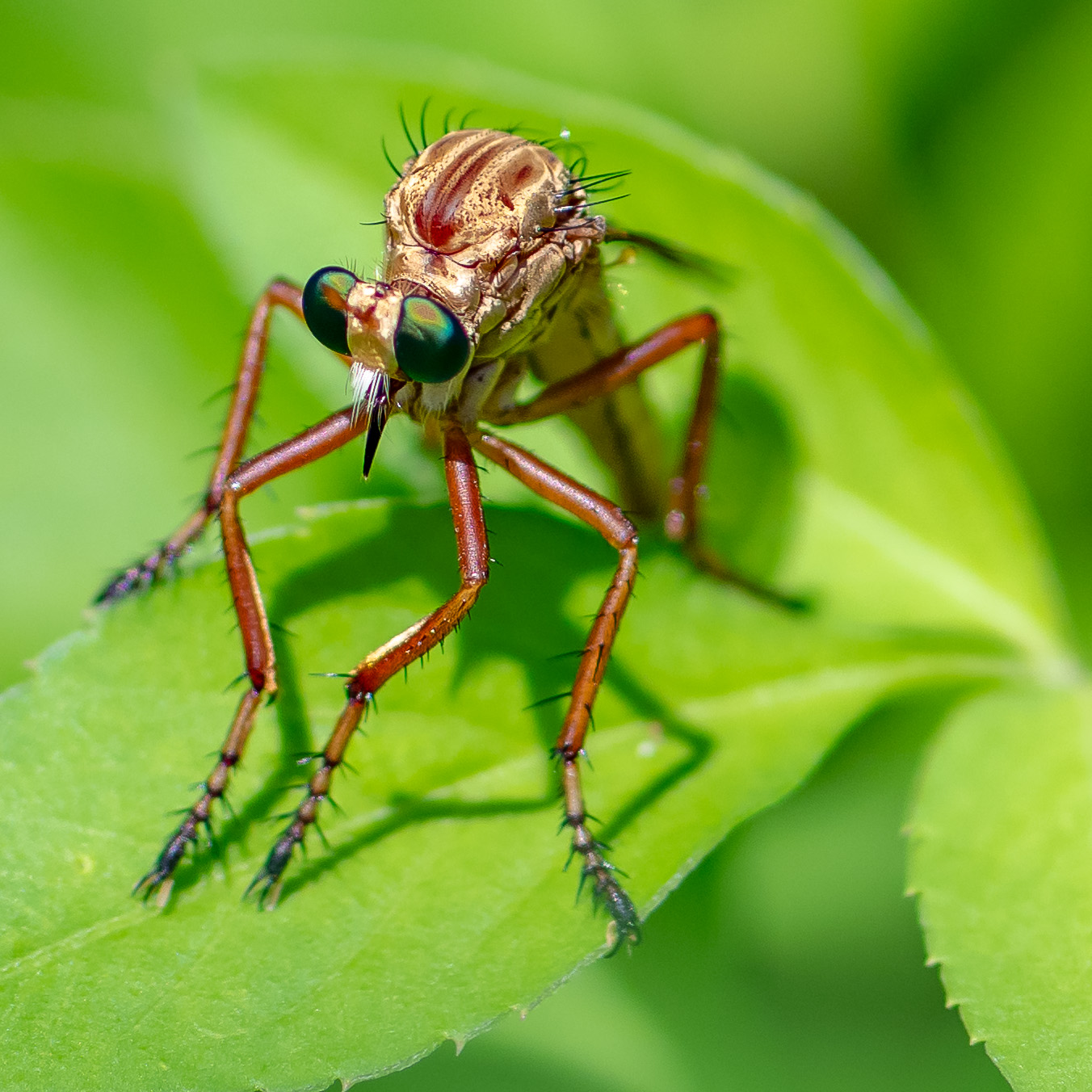
Robber Flies! There are around 7,500 species in the world with over 1,000 in North America. About the best I could do here is identify the genus as Diogmites. Individuals in this genus are fondly referred to as “hanging thieves” for their habit of dangling from a twig as they munch their prey.
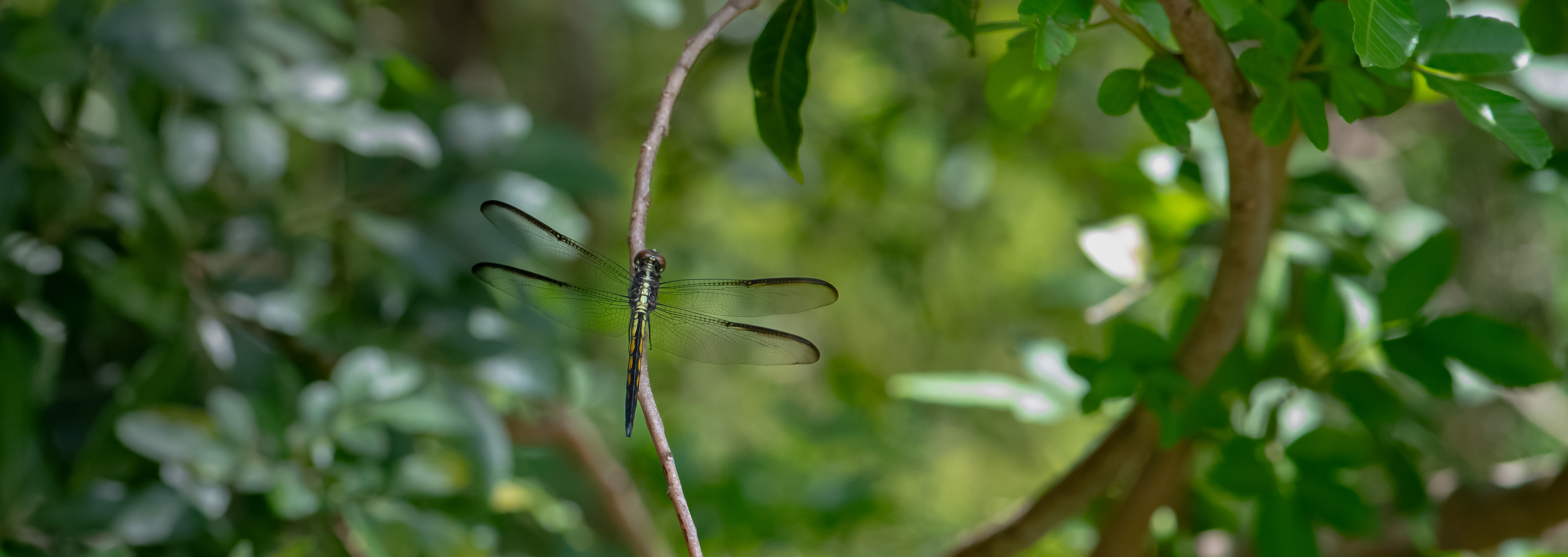
A Great Blue Skimmer (Libellula vibrans). Wait – what? Where is the Blue that’s so Great?? Patience, grasshopper. This is a young male which, as is the case with many young dragons, at the moment looks like his Mama. Soon he will morph into a pale blue body with bright blue eyes and Papa will be proud.

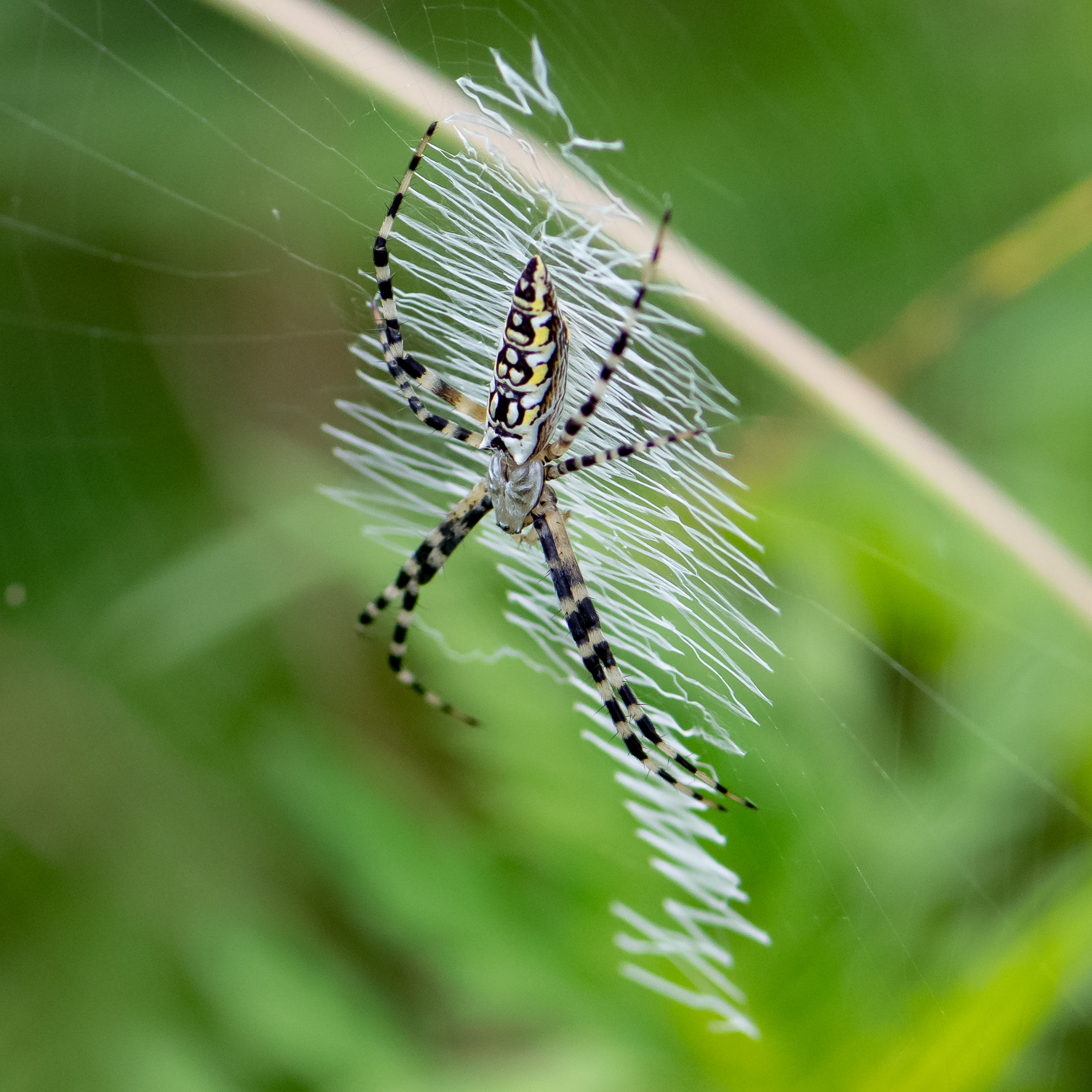
Wandering down the path intent on “seeing” and not just “looking” may occasionally cause one to stumble over a root or receive a face full of sticky silk. The latter occurrence might be due to the work of a really beautiful spider, the Yellow Garden Spider (Argiope aurantius). Large spiders and large webs. Attractive on both counts.

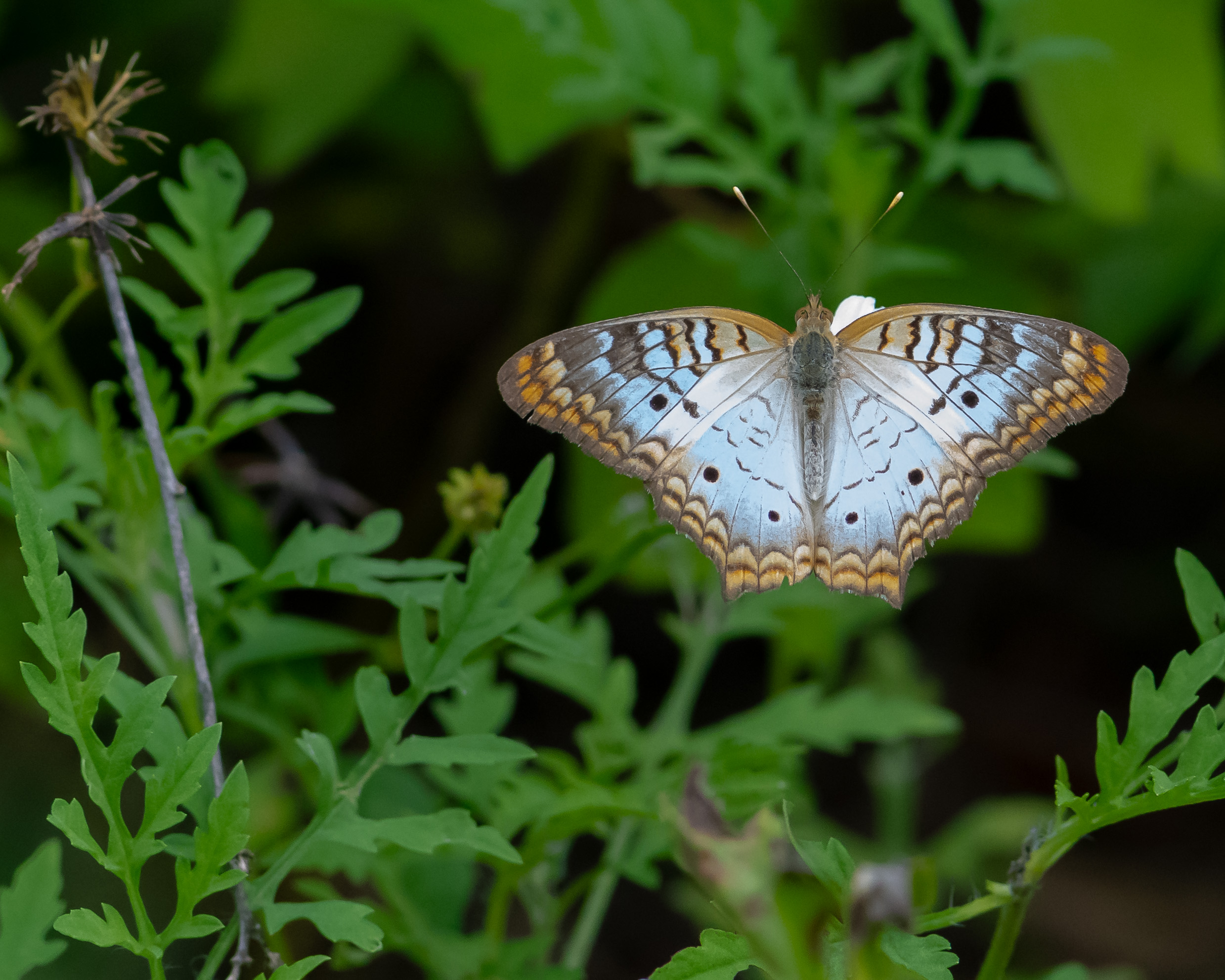
Sometimes we become complacent about “common” subjects. Sometimes we need to remind ourselves that Nature does not create anything which is insignificant. Our human eyes may not call it “pretty”. Our human brain may register it as “oh, just another _____”. We may have seen 40 White Peacock (Anartia jatrophae) butterflies today. The brain finally kicked in with “HEY! THIS IS GORGEOUS! TAKE A PICTURE!”. I just needed a gentle reminder.
We went. We looked. We saw. Forest/trees. Flowers/bees. We will try to improve our obervational skills but we still won’t be able to see it all. This is where you all come in. Get out there and help us!
“It’s not what you look at that matters, it’s what you see.” – Henry David Thoreau
Enjoy your search for a natural place and come back for a visit!
 Our Natural Places
If you could just manage to bottle up some of that “Mother’s Radar” we would definitely be up for buying some! Linda is actually pretty good at picking out interesting details in the field – most of my time is spent scanning the treelines for anything that looks out of place – a lump there, a darkening there, inconsistent color spot etc. I need to keep reminding myself to slow down and try to take more in – if nothing else, to keep from almost stepping on a Gator again. Never know what you are going to see “hanging” about a Shrike – the world’s original wet market. That last shot is absolutely beautiful.
LikeLike
Gini is definitely special when it comes to detecting things. Just ask our kids.
I’m in the same boat as you when it comes to finding stuff. Scan it all. Watch for anything out of place.
Thank you so much for the nice comments.
LikeLike
You and Gini have a gift for seeing. I really identified with you in that moment when, after seeing yet another _____ , your hind-brain carefully noting the uniqueness and special quality of whatever it is, your fore-brain finally, finally!, wakes up and says Wow, look at that!
I read the Seeing chapter linked by Linda L, and it is magical. It reminded me vividly of The Immense Journey, by Loren Eiseley, one of my favorite books of all time.
LikeLike
Thank you very much, Sam.
Developing and nurturing that looking versus seeing phenomenon is a lifetime challenge which never ends.
LikeLiked by 1 person
Beautiful shots of the little critters. The details in that robber fly is insane! Perfect capture.
LikeLike
Thank you, Dina.
When I can’t find birds, bugs show up.
LikeLike
Have you read Annie Dillard’s Pilgrim at Tinker Creek? If you have, and have the book, pull it out and read the second chapter again. It’s titled: “Seeing.” If you haven’t read it, I brought you a present: an online text of the entire book. You can skip down to the chapter on “Seeing” and luxuriate in her language and her insights. I read the entire book a couple of times a year, and there are chapters, like “Seeing,” that I return to much more often. There are plenty of Dillard quotations in my blog, but her chapter is better than any quotation. I’ll bet you’ll notice, and resonate with, her discussion of the difference between walking with, or without, a camera.
Here, the glow of the White Peacock is fabulous. I recently learned that different species of spiders have different stabilimenta. The ‘zigzags’ are the most noticeable, of course. When I heard them called ‘writing spiders,’ I laughed, because some of their word does look like the Palmer Method handwriting exercises we did in grade school.
I saw something remarkable at work today. I looked down at a piece of canvas, and discovered the tiniest crab spider I’ve ever seen. Its forelegs couldn’t have been more than a quarter-inch across, and its abdomen was about one-fourth the size of the head of a pin. I couldn’t figure out what it was doing on a boat, or how it got there. Then, as I was watching, it expelled a thread of silk which the wind caught, and it went flying off to its next destination — unplanned, I’m sure!
LikeLike
ps: love your reworking of the old saying in your title!
LikeLike
Gini says my mind works in mysterious ways. I thank her for acknowledging I haven’t completely lost it – yet.
LikeLiked by 1 person
Thank you very much for the book. I look forward to enjoying it. I kept meaning to delve into her work after seeing your use of her passages from time to time. Now you have saved me a step.
Another project I need to complete is an album of spider webs. If the webs are words I won’t have write any myself to describe them!
Perhaps your crab spider visitor is actually on a planned jouney and she just stopped to greet a fellow voyager.
LikeLiked by 1 person
Very nice assortment of “trifles”. All most likely overlooked by the casual observer.
LikeLike
Thanks, Brad.
We’re trying to become “uncasual” observers.
LikeLiked by 1 person
Beholding nature is fun also because nature is every day different. I truly enjoyed your macros. Have a nice day!
LikeLike
We are so glad you visit with us. That every day difference is what keeps us all returning to the outdoors.
Best wishes as we all begin a new week.
LikeLiked by 1 person
Wonderful reflection, Wally, on looking and seeing and some great photos. I like what you had to say about never being able to see everything. My field of vision is often limited by my lens choice–if I have a macro lens on my camera, I tend to look almost exclusively for close subjects, while I look for more distant subjects when I have a telephoto zoom lens on my camera. There are exceptions, of course, and I have photographed birds with my macro lens and insects with my telephoto lens. Some of my friends are amazed by what I photographed at places that they had visited at the same time and come up empty-handed. They ask me, “How is it that you see so much?” I usually reply with the Zen-like answer of “How is it that you do not?” 🙂
LikeLike
I love your Zen answer, Mike!
Since obtaining a macro lens a couple of years ago, I have experienced exactly the same “re-focusing” as you describe. I really like how the macro actually forces me to slow down and inpect what is right in front of me.
Thank you for visiting.
LikeLike
That quote from Thoreau well and truly hits the nail on the head, Wally, and it is clear, from posts like this one, that you and Gini’s combined powers of observation are well up to scratch (I hope that expression transatlantics OK!).
I’m not in a postion that I can judge what might be common in your neck of the woods but, whatever the case, Dainty Sulphur, Winged Loosestrife, the Robber Fly, Yellow Garden Spider and its web, and White Peacock are all stunningly beautiful and gorgeously depicted here. Having said that, there’s nothing shabby about the other images in this post either.
Thank you for a heart-warming start to my day.
My very best wishes to you and Gini – – – Richard
LikeLike
Good Morning, Sir Richard! We hope you and Lady Lindsay are busy enjoying this New Week.
“Up to scratch” translates perfectly. Gini is by far the more observant as she has those Mother genes, but she is also able to hear a damselfly whisper at a thousand yards.
We’re beyond blessed that all of the subjects you mentioned are, indeed, fairly common here. Locating them and getting them to pose for a moment – as you well know – is another story.
Happy to warm your heart today, or any day.
You both take good care.
LikeLike
If the White Peacock is common then so much the better, what a gorgeous butterfly and lovely shot!
LikeLike
Thank you, Brian.
Their abundance certainly makes our outings more attractive.
LikeLiked by 1 person
‘Our’ butcher birds also impale their prey – but are related to our magpies.
Open eyes, hearts and minds return some incredible dividends don’t they? And make each walk a wonder and a joy.
Thank you and Gini so much for sharing some of yours.
LikeLike
We are still very happy to share the little bits we find on our outings.
It is so gratifying to know it’s appreciated. Who knew there were so many nature lovers?
LikeLike
Wally,
The last butterfly is the best ever! I did think you were going to have the green heron on the wire, though so was disappointed.
Keep up the beautiful work; I enjoy the identification of the plants especially.
Nancy
LikeLike
Thank you so much, Nancy.
We will keep our eyes peeled for that Heron on a wire. (I know I’ve got some in the archives. Finding one may be a challenge.)
LikeLike
We’re in accord: “No matter how expert we may think we are, there is simply no way we can see everything.”
From what I’ve read, arachnologists still don’t really know the purpose of the stabilimentum in the webs of spiders like the Argiope.
What nice closeups of the robber fly, the bees, and the wasp.
That butterfly in the final picture emits quite a cool glow.
LikeLike
Thank you, Steve.
We are all still learning. Which is a good thing.
LikeLike