Wading For Inspiration
Header Image: Reddish Egret
A small mound of sand just under the surface of the water turned out to be a good spot to sit. My knees supported the camera lens and I had a good field of view toward the shore where moments ago I had been prone in the mud. The sun was now rising behind me and as long as I made no sudden moves, birds went about their daily routine of hunting and eating.
Fort DeSoto Park is such a jewel along Florida’s gulf coast. There is a good mix of sand beach, mud flats, tidal lagoons and groves of hardwood trees. The combination is a magnet for birds migrating in spring and fall. Many species remain here all year and several shorebirds nest among the sand dunes.
The park has a campground, two large fishing piers and a very nice boat launch facility. It’s a great place to launch a boat and head out into the Gulf of Mexico or to motor into the shallower waters of Tampa Bay. A ferry takes visitors across the shipping channel to Egmont Key for a day of exploring the dunes and a lighthouse. Several picnic areas and an award-winning beach combine with all of the above to make this spot one of the most heavily visited coastal attractions in our area. Which is why we arrive as early as possible!
I was beginning to get whiplash trying to keep up with Willets, Dowitchers, Godwits, Herons, Egrets, Plovers, Sandpipers, Pelicans, Gulls, Terns and Frigatebirds. Oh, my. An hour flew by as swiftly as the birds. Reluctantly, I waded up the shoreline and made my way along the beach back to the car. Gini didn’t have to ask how the morning was going. My grin said it all.
We sat and enjoyed the view of the blue waters of the Gulf of Mexico. A light snack of just fruit gave us a bit of energy but we wanted to be careful to not have anything filling. Our plan of operation included a lunch stop at The Fish House. Goodbye diet.
First, however, we had to see what might be happening at the gulf fishing pier. Soon, you will know what we found. In the meantime, be consoled, as I was, knowing that all things come to those who wade.
A Reddish Egret greets the first rays of the sun as it rises above the Sea Oat-covered sand dunes.
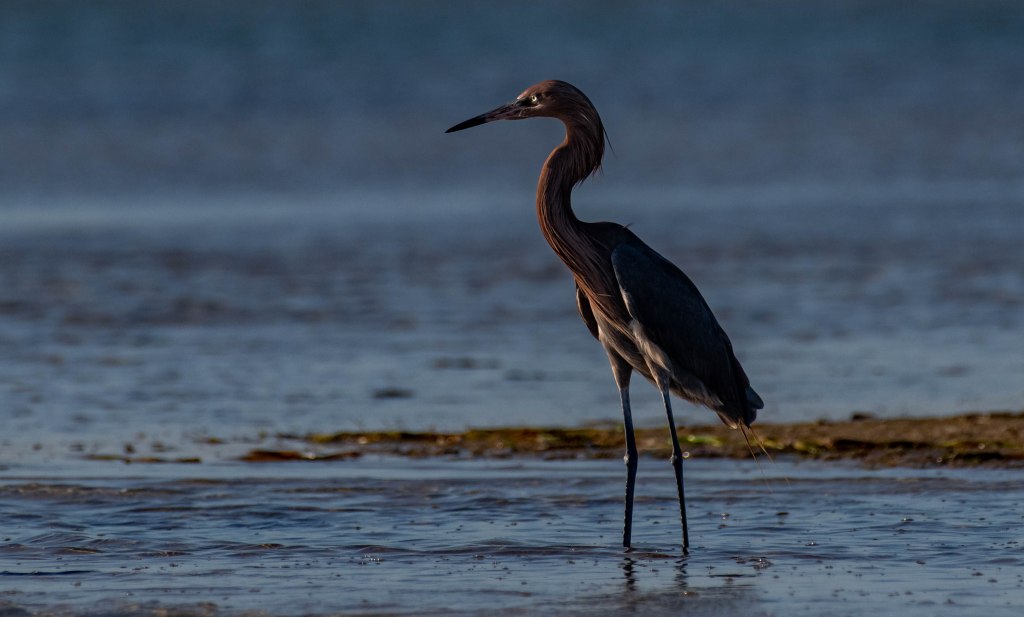
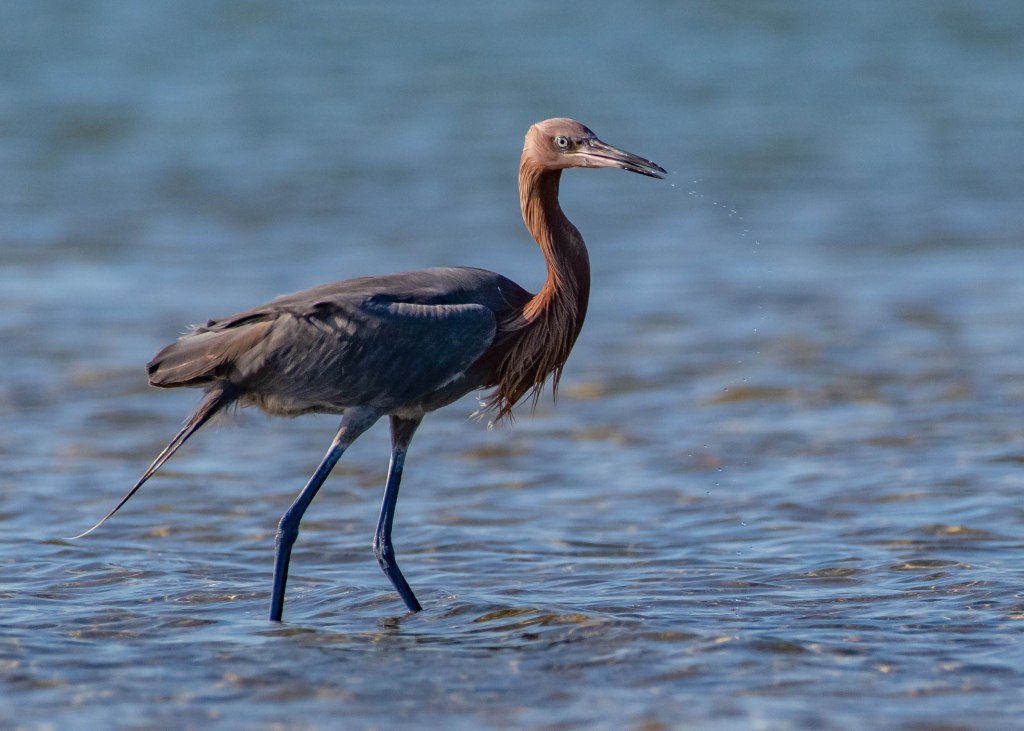
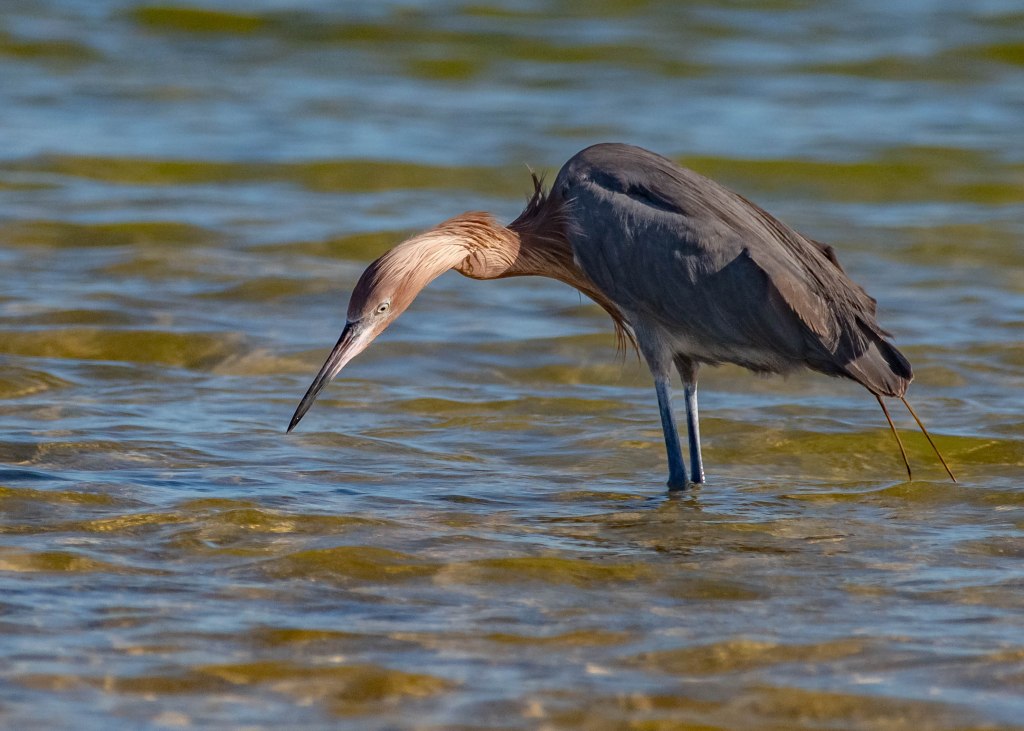
The Reddish Egret can be entertaining to watch as it chases small fish in shallow water, often using a “run-stop-run” technique which resembles some sort of energetic dance. There is a white version of this bird which is not as common as the dark morph.
A Snowy Egret watches with interest as a Red-breasted Merganser plows through the shallows churning up small fish, shrimp and crabs.
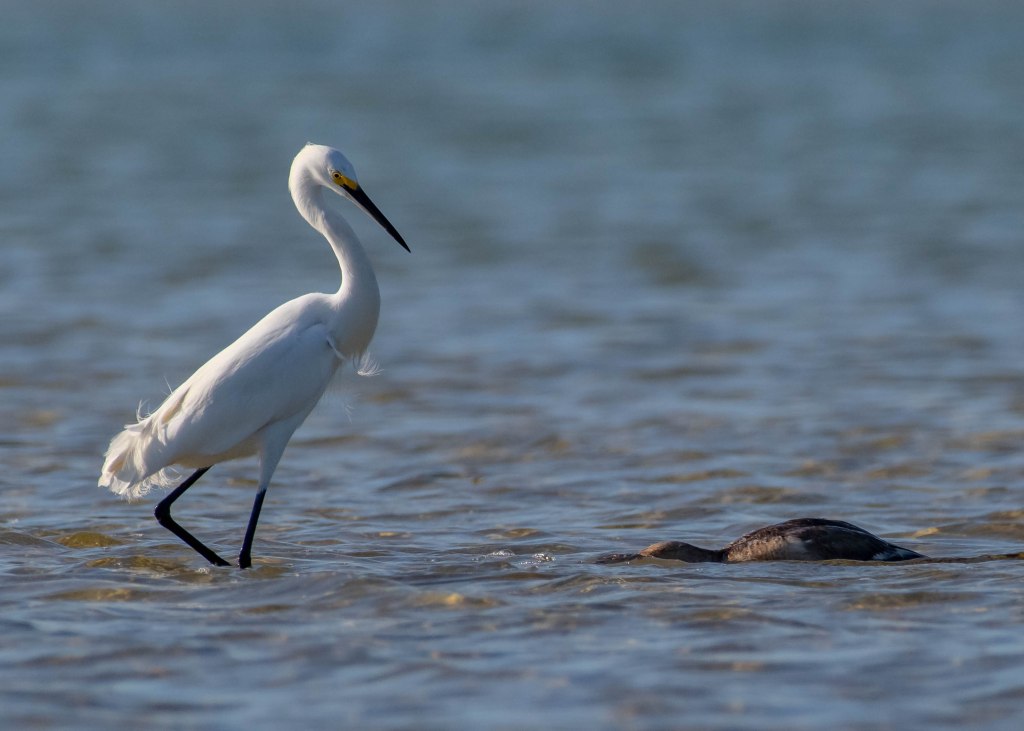
The merganser kept an eye on me but didn’t stop hunting. At last, she gave me a quick view of her glorious self before diving for more breakfast. (The female and immature male look similar.)
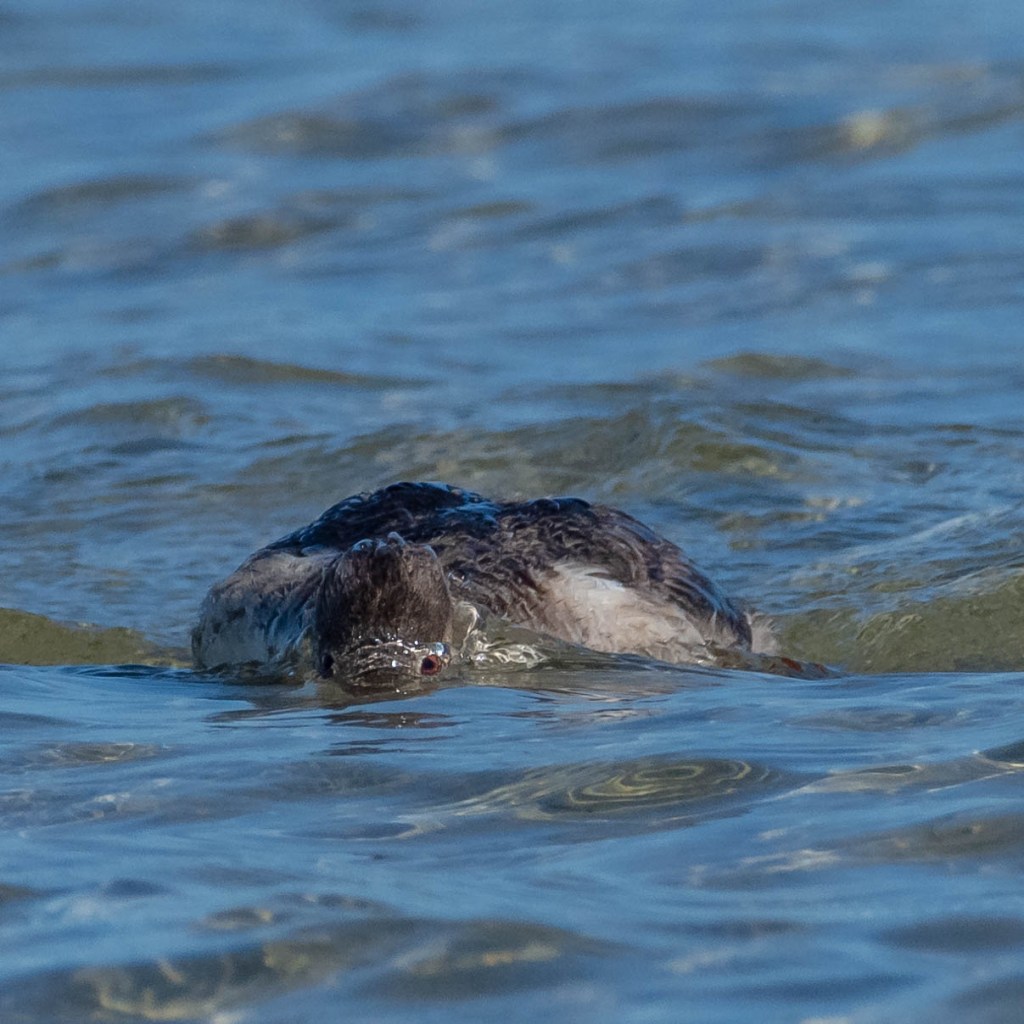

Even when half-asleep, a Great Blue Heron exudes magnificence.
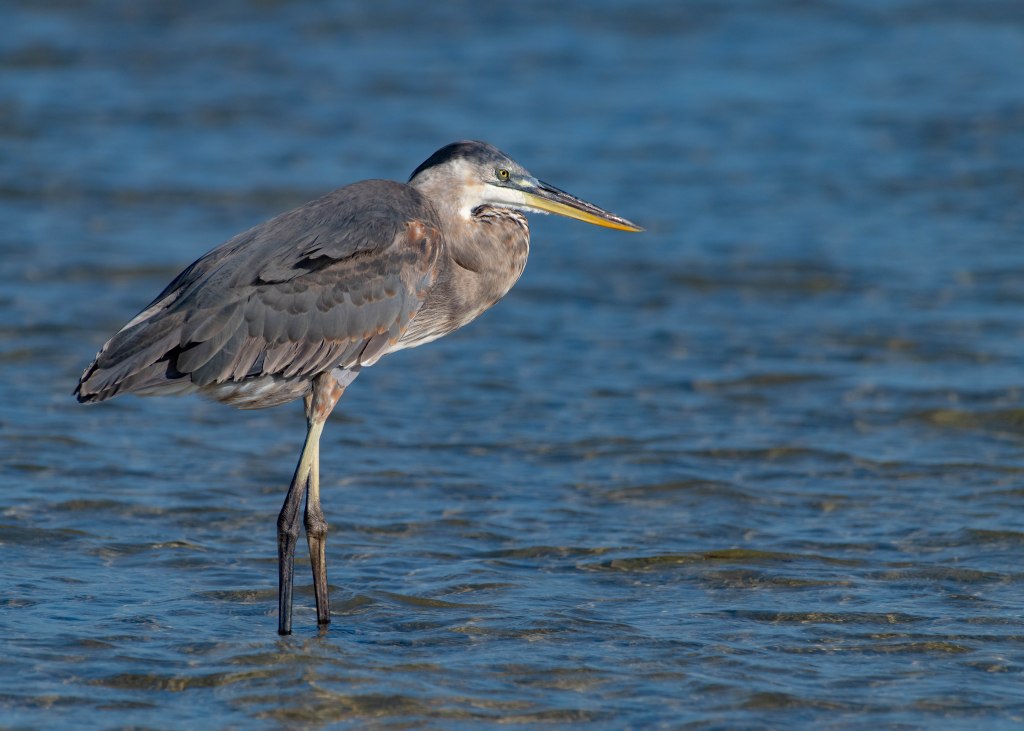
That nice long bill makes the Marbled Godwit a mud specialist. They breed mainly in the northern Great Plains of the United States.
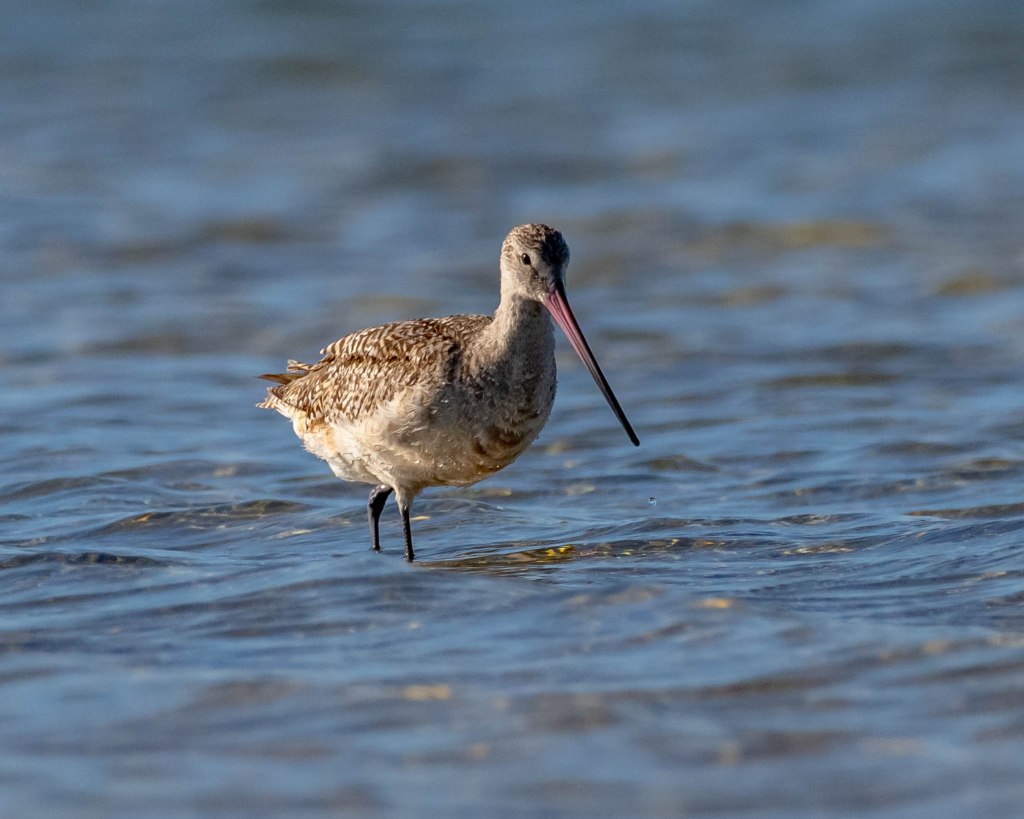
Like the Marbled Godwit above, Willets are among the largest members of the sandpiper family. Plumage is overall gray and nondescript all year around and Willets have shorter bills than the godwit. When a Willet spreads its wings, however, dramatic replaces nondescript!
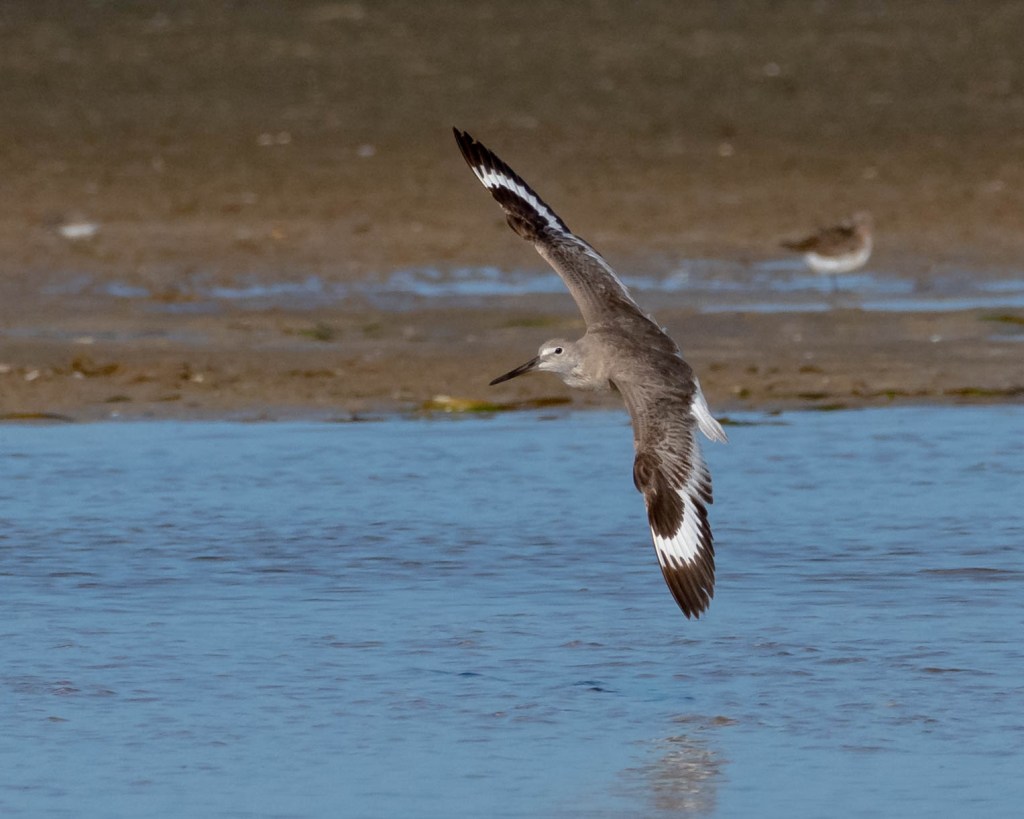
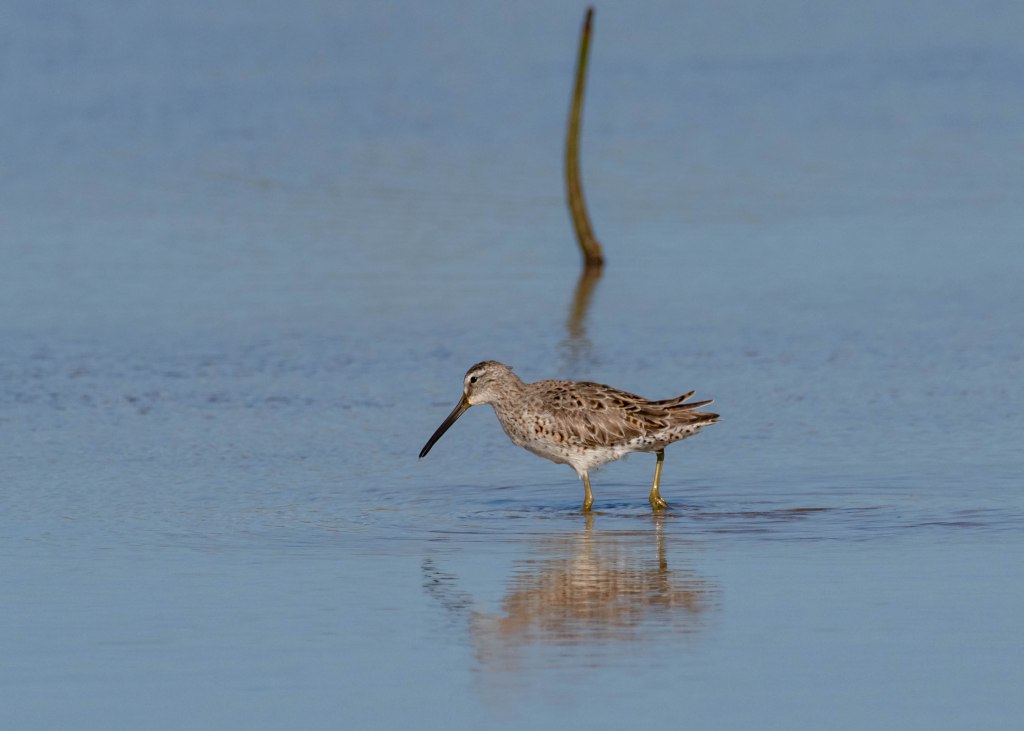
Breeding in Canada and Alaska, Short-billed Dowitchers probe shallow water in a straight up-and-down motion, like a sewing machine. “Short-billed” seems a misnomer, but there is also a “Long-billed” Dowitcher. Despite the name difference, it can be very challenging to tell the two species apart as bill length can be similar. The calls of the two birds are different as is their “normal” habitat.
Playing in the mud was fun. I embraced my inner child and probed the ooze with my fingers while waiting on birds to hop closer. Waiting on waders while wading was also great entertainment. I can’t wait for you to peer at what we found at the pier.
Stay tuned for the exciting conclusion of our coastal adventure: “Pier Pressure”!
Enjoy your search for a natural place and come back for a visit!
 Our Natural Places
Frigatebirds!!!! I hunted up and down the gulf coast this year hoping one would come in close enough for a visit…struck out.
LikeLike
Fort DeSoto Park is a good location for the Frigatebirds. I’ll try to include a few pics next time around. Which I hope will be soon!
LikeLiked by 1 person
That looks like a great location. Loved the way the progressing morning sunshine is visible in your photos – and how it makes the air and water glow. What a special place!
LikeLike
It’s one of those spots we are happy and sad at the same time that it is not closer. Gini says if it was closer I would be charged rent.
We always find interesting things out there and the time goes by all too quickly.
LikeLiked by 1 person
I don’t need to tell you how much I wanted to be there with you both. All that sunshine, waders and a fishy lunch. My only problem might be that once I settled down on that mud, how would I get back up? We used to use sun loungers but I got quite embarrassing having to ask passers by to help us back up. Now we take garden chairs. Can’t wait to see your fish lunch
LikeLike
“Getting back up” has become the greatest challenge to my photography hobby. Garden chairs sound like a good idea. Carrying them a couple of miles through deep beach sand may be yet another challenge.
Pictures of fish lunches are like pictures of rare birds. Both disappear too quickly for even the fastest shutter speeds to capture.
LikeLike
Your seat and wade proved fortuitous, Wally. Some nice shots and excellent studies of a few at work. The park is indeed a birder’s gem of a location. Excellent shot of the banking willett!
LikeLike
Thank you, Steve.
Wading helped me keep cool, cleaned off some mud and put me in the middle of feeding birds. Hard to beat that combination!
LikeLiked by 1 person
Here’s an unexpected and mostly unrelated connection I have to Fort DeSoto Park and the Tampa area generally. For years, I’ve been buying 100% cotton shirts and such from a company in Tarpon Springs, just north of the mudflats you’ve been enjoying. When I looked at a map to take a look at your birding hot spot, I realized it was in the same ‘neighborhood.’
Dare I say that all birds come to those who wade? Maybe not all, but a good number, given the variety of photos here. I especially enjoyed the second photo of the Reddish Egret. I suspect that neat line of water drops might be a sign of recent tidbit consumption. I know now that I’ve seen a Willet. Those wings are unmistakable.
After looking at your photos of the Dowitchers and Godwit, I finally did a comparison with a bird from a flock that landed in a vacant lot in Austwell as I was leaving the Aransas Wildlife Refuge. The first thing I noticed was that ‘my’ birds had long, curved bills, so I got out my PictureThis app, which has expanded from flowers to trees, birds, and such, and took a lot. Lo and behold, the app says I encountered the Long-billed Curlew: Numenius americanus. How ironic is that?
LikeLike
Tarpon Springs is yet another one of our favorite places. It has a rich history of Greek immigrants and sponge diving. We have spent a lot of time pulling fish from nearby waters.
You’re right about the Reddish Egret. I wasn’t quick enough to catch it stabbing the water but I liked the water droplets which, apparently, told the story.
Now, considering your curlew discovery – do we believe in coincidence or is there something “else” involved here?
LikeLiked by 1 person
I believe in coincidence, but I also believe in “Ask, and ye shall receive.” Sometimes I think nature’s paying as much attention to us as we are to her.
LikeLike
Hello Wally, I saw your comment over on Wildlife intrigued blog. Brads blog on the brown pelican and you mentioned you are working on a post about them as well. I love your photos, I am a birder as well and often spend time at Dauphin Island on the Gulf Coast. I know I will enjoy your post and information on Florida birds. I to have a post coming up sometime soon on the brown pelican. This year I saw something very interesting with this species. I am used to the all brown pelicans but in April I photographed brown pelicans that were even more colorful with the pink eyes and yellow crest and white necks. I can’t find information on if this is a different species of brown pelican or just their breeding colors. They are so pretty compared to the all brown pelicans. 🙂
LikeLike
Welcome to Our Natural Places, Sandra!
What very nice comments! Thank you so much.
Dauphin Island is a terrific place! I have relatives in Florida’s panhandle and we often include a visit to the Alabama Gulf shore area when we’re up that way.
Your description is the adult Brown Pelican. Males and females look alike and in breeding season they can be really colorful, like your April birds. The all brown birds are immature Brown Pelicans and can take from 3-5 years to change to adult plumage.
We hope you’ll come back for another visit soon!
LikeLiked by 1 person
Now I have to ask, Wally: have you been to the Flora-Bama? There are some colorful birds there, too!
LikeLike
No I haven’t. I’ll have to ask my sister since her house is a stone’s throw from there.
LikeLiked by 1 person
I was wondering that. I thought maybe I had stumbled apon a new species of Brown Pelicans. 🙂
LikeLike
A wonderful selection of bird images, Wally, leaving no shadow of doubt as to whether the small discomfort of having to endure a mud-bath was worthwhile.
The Willet, in flight, is an absolute beauty!
Thank you also for including a generous measure of humour into this post. It helped soften the disappointment that bubbled to the surface, as I recalled that this year I missed my annual shorebird fix which, rather than wading or lying in mud, usually entails hiding in shoreline rocks, waiting for the birds to come to me.
My very best wishes to you and Gini – – – Richard
LikeLike
Thank you so much, Richard. I know it must be bittersweet to see these images and wistfully think what might have been. Take heart. Your next adventure among the shoreline rocks will be the best ever!
Gini and I hope you and Lindsay have started this new week in good spirits.
LikeLike
Lovely set! Keeping low down gives the shots a great perspective, not sure I would want to take the camera gear complete with heavy lens into the water though.
Teasing us with something good? Can’t wait.
LikeLike
Thank you, Brian.
I did hold my breath a bit in the water with the gear. It was a calm, shallow lagoon so no unexpected wave activity.
Nah, just overall teasing. I’m bad like that.
LikeLiked by 1 person
Waiting on waders while wading certainly paid off, and I suspect peering at the pier did the same. I look forward to learning what you found, but no pier pressure!
LikeLike
Thanks, Tanja.
We love the variety this place always seems to dish up.
LikeLike
Beautiful shots! The mergansers are here late this year. Can’t wait to see what you found on the pier. I always stop there before leaving.
LikeLike
Thank you, Dina.
The Fort always provides something interesting, doesn’t it? I was happy at least one Merganser hung around for me.
LikeLike
Fantastic finds Wally. Being smack in the Midwest we only see the Great Blue Herons regularly.
That is, unless I travel to a large body of water someplace. Looking forward to more from your mound of sand.
LikeLike
Thanks, Brad.
We are truly blessed with water and all the birds which love it!
LikeLiked by 1 person
They are all charming critters. The Reddish Egret in particular.
LikeLike
That egret is a crowd favorite!
Thank you for visiting.
LikeLiked by 1 person
If you spend too much time prone in the mud you might end up like a prune in the mud.
Better a light snack of just fruit than of unjust fruit. May justice prevail.
I searched for the origin of the name godwit, which presumably is not god + wit; the dictionary I consulted says the origin is unknown.
Your statement “I can’t wait for you to peer at what we found at the pier” implies you consider the birds there to be without peer.
LikeLike
Better a prune in the mud than a stick in the mud? I already have enough wrinkles to wrival a prune.
The godwits are in the genus Limosa which translated to muddy. They do love the mud. I recall an article from long ago that attributed “godwit” being assigned to that group of birds as someone thought it resembled their call. I have not heard much more than a “squawk” from them.
We sought to answer the question whether a bird without peer would be as outstanding as a bird without a pier. So we went to the pier to peer. You’ll see.
LikeLiked by 1 person
You’re slightly challenging sitting position, certainly paid off. In the beautiful perspectives you have on these wonderful birds!
LikeLiked by 1 person
Oh my! I apparently did not proofread for spelling and punctuation. So sorry.
LikeLike
No worries. I seldom recognize correct spelling and punctuation anyhow.
It’s the thought that counts. And we are thankful for yours!
LikeLiked by 1 person
😊
LikeLike
It certainly helped keep me cool under pressure!
LikeLiked by 1 person
Lol, I can imagine.
LikeLike